Implications
Breeding records of Merino sheep selected for low and high behavioural reactivity (calm and nervous temperament) at the University of Western Australia consistently showed that calm ewes weaned 10% to 19% more lambs than the nervous ewes. We found that the differences in reproductive outcomes between the calm and nervous ewes were mainly due to a higher ovulation rate (OR) in calm ewes, possibly due to the effects of metabolic hormones. Understanding why the reproductive outcome of these ewes is different will help to breed sheep better suited for the production system, improving their welfare.
Introduction
Since domestication, while natural selection has continued, subjective artificial selection has resulted in the adaptation of farmed livestock to their artificial environment. Two noticeable impacts of domestication are (1) a lower behavioural reactivity to the presence of humans or to a novel situation (being an important criterion for selection of domesticated animals) and (2) an increase in reproductive success (Price, Reference Price2002). It is generally accepted that stress has a tendency to impair reproduction (Dobson et al., Reference Doney, Gunn, Smith and Carr2012), but important individual variation in the response to stress exists (Cockrem, Reference Cockrem2013), possibly linked to coping styles or behavioural syndromes (Koolhaas et al., Reference Koolhaas, de Boer, Coppens and Buwalda2010). The link between low behavioural reactivity and high reproductive success is poorly understood. In this study, we explore the impact of differential selection for behavioural reactivity on reproductive success in sheep.
In 1990, two different selection lines of Merino sheep were established for low and high behavioural reactivity (also called calm and nervous temperament, respectively) at the University of Western Australia (Murphy et al., Reference Murphy, Purvis, Lindsay, Le Neindre, Orgeur and Poindron1994; Blache and Bickell, Reference Blache and Bickell2010). In the early years of the selection, low behavioural reactivity was more strongly correlated with improved maternal behaviour and greater lamb survival than in the high behavioural reactivity ewes (Murphy et al., Reference Murphy, Purvis, Lindsay, Le Neindre, Orgeur and Poindron1994; Murphy, Reference Murphy1999). After 10 to 13 years of selection, the differences in maternal behaviour and lamb survival between the two lines had dissipated (Bickell et al., Reference Bickell, Poindron, Nowak, Ferguson and Blache2010b), but breeding records of the two lines obtained over 4 years showed that 10% to 19% more lambs (to mated ewes) were weaned from the calm ewes than from the nervous ewes (Blache and Bickell, Reference Blache and Bickell2010). The higher reproductive success of the ewes of the calm line compared with those of the nervous line could be explained by diverse impacts of behavioural reactivity on the reproductive biology of each line (Blache and Bickell, Reference Blache and Bickell2010).
Previous investigations have shown that (1) 32 h after the withdrawal of progesterone sponges, calm ewes are more proceptive in seeking males and receptive to approaches by males than nervous ewes (Gelez et al., Reference Gelez, Lindsay, Blache, Martin and Fabe-Nys2003), (2) colostrum produced by calm ewes has more lactose, less fat and is less viscous than that from nervous ewes (Hart et al., Reference Hart, Chadwick, Sèbe, Poindron, Nowak and Blache2006), (3) calm dairy ewes produce more milk than nervous ewes (Murray et al., Reference Murray, Blache and Bencini2009) and (4) milk from calm ewes has more protein than that of nervous ewes (Sart et al., Reference Sart, Bencini, Blache and Martin2004). While the studies listed above could contribute to the differences in lamb production between the two lines, an analysis of 2 years of data from routine ultrasound scanning of the two selection lines during mid pregnancy (60 to 90 days post mating) suggested that selection for behavioural reactivity could influence fertility and prolificacy. In fact, the analysis showed that ewes in the calm line carried more foetuses (1.39, n=472) compared with nervous ewes (1.29, n=302). The calm ewes carried a higher proportion of twins, 35.4% compared with 14.6% for the nervous ewes (P<0.001; Blache and Bickell, Reference Blache and Bickell2010).
The differences in reproductive outcome between the low and high reactivity ewes could be due to differences in ovulation, ovulation rate and/or the maintenance of early pregnancy between the lines. To date, the influence of behavioural reactivity on any of these outcomes has not been investigated. We hypothesise that two factors may be responsible for the difference in the outcome of the early stages of the reproductive cycle between the two temperament selection lines. First, low behavioural reactivity ewes (calm ewes) could have a higher ovulation rate than high behavioural reactivity ewes (nervous ewes); and second, calm ewes could have a lower rate of embryo mortality than nervous ewes. We further hypothesise that the different reproductive outcome is due to a more efficient in energy utilisation in calm ewes than in nervous ewes (Hafez and Lindsay, Reference Hafez and Lindsay1965). We tested these hypotheses by comparing the ovulation rate and the rate of embryo mortality between the calm and nervous lines before and after synchronisation and artificial insemination. After oestrus synchronisation, plasma concentrations of progesterone, insulin and leptin were measured to investigate the potential pathway(s) by which behavioural reactivity could influence these two early steps of the reproductive cycle.
Material and methods
This experiment was approved by the Animal Ethics Committee of the University of Western Australia (approval number 07/100/625). The experiment was conducted at Allandale Farm, which is located ~60 km north-east of Perth, WA (latitude 31°46′ south, longitude 116°29′ east). Merino ewes were selected from the calm (n=100) and nervous (n=100) selection lines. Selection was based on age (2.5 to 4.5 years), BW (±SD) (calm 57.2±0.71 kg; nervous 57.7±0.73 kg) and body condition score (±SD) (calm 2.85±0.03; nervous 2.77±0.03; based on a subjective scale where 1 is lean through to 5, which is fat; Jefferies, Reference Jefferies1961), which did not differ between the lines.
Early in the breeding season (mid-January), the oestrus cycles of the ewes were synchronised for laparoscopic timed artificial insemination using intravaginal sponges containing 40 mg of fluogestone acetate (Chrono-gest® 40; Intervet, Bendigo, Victoria, Australia) for 14 to 15 days. Immediately after sponge withdrawal the ewes were injected with 200 IU of equine chorionic gonadotropin (eCG) (Folligon®; Intervet). After ~50 h of sponge removal the ewes were inseminated by laparoscopic intrauterine insemination by a veterinarian specialised in artificial insemination (AI). The ewes were sedated with 0.3 ml of xylazine hydrochloride (Rompun®, 20 mg/ml; Bayer, Gordon, NSW, Australia) i.m. Lignocaine hydrochloride (0.5 to 1 ml of Lignocaine®, 20 mg/ml; Ilium Veterinary Products, Smithfield, NSW, Australia) was injected s.c. in four sites around the insertion point of the laparoscopic probe 10 to 15 min before the procedure. At the end of the procedure, antiseptic (Terramycin®; Pfizer Australia, West Ryde, NSW, Australia) was sprayed on the insertion point. When released after the AI procedure, the ewes walked on their own without assistance and were fully recovered from sedation before being moved to their home paddock. In order to reduce the effects of individual ram fertility on the results, for each selection line, semen was pooled from the ejaculates of three rams and a minimum of 200 million sperm/dose of fresh semen was used. The day of insemination was designated as day 0. As insemination was carried out over 2 days, all days are quoted in relation to day 0 and may therefore be ±1 day. In total, 18 ewes were not inseminated because of either technical problems during synchronisation (n=14) or due to the presence of lesions on the uterus (n=4). A further 17 ewes (calm: n=9; nervous: n=8) did not respond to the synchronisation treatment and were not inseminated.
On day-17 and 11 the corpora lutea (CL) were counted using real time B-mode ultrasound with a 7.5 MHz linear-array transrectal transducer (Aloka SSD 900; Aloka Co., Ltd, Tokyo, Japan), as described by Viñoles et al. (Reference Viñoles, Gonzalez de Bulnes, Martin, Sales and Sale2010a). The number of embryos was recorded on day 30 using transrectal ultrasound and the number of foetuses on day 74 using transabdominal ultrasound with a 3.5 MHz convex transducer (Viñoles et al., Reference Viñoles, Gonzalez de Bulnes, Martin, Sales and Sale2010a). On days 5 (day of embryo arrival in the uterus), 12 (around maternal recognition of pregnancy) and 17 (follicular phase in non-pregnant ewes) blood samples were collected from the jugular vein to determine the concentrations of progesterone, insulin and leptin. Plasma was obtained by centrifugation of the samples immediately after collection and then stored at −20°C within 2 h. Ewes that had progesterone levels of >3.18 nmol/l on day 17 were considered to be pregnant and ewes with progesterone concentrations <3.18 nmol/l were considered to have returned to heat (Susmel and Piasentier, Reference Susmel and Piasentier1992). Ultrasound data from day 30 confirmed that ewes classified as having returned to heat were not pregnant.
Hormone assays
All hormone concentrations were measured in a single radioimmunoassay for each hormone using techniques validated for sheep samples. Plasma progesterone was assayed in duplicate using Active® Progesterone RIA DSL-3900 kits (Diagnostic Systems Laboratories Inc., Webster, TX, USA). Quality control samples containing endogenous progesterone (low 3.47 nmol/l and high 27.9 nmol/l) were assayed in duplicates at both the beginning and end of the assay. The intra-assay CV were 2.7% and 3.1%, respectively. The analytical detection limit of the assay was 1.27 nmol/l. Plasma insulin was assayed in duplicate by a double-antibody radioimmunoassay (Tindal et al., Reference Tindal, Knaggs, Hart and Blake1978). All samples were processed in a single assay and the limit of detection was 3.59 pmol/l. The assay included six replicates of three control samples, which were used to estimate the intra-assay CV of 6.6% at 16.1 pmol/l, 4.3% at 27.5 pmol/l and 4.9% at 48.9 pmol/l. Plasma leptin was measured in duplicate by a double-antibody radioimmunoassay developed for sheep in our laboratory and described in detail by Blache et al. (Reference Blache, Tellam, Chagas, Blackberry, Vercoe and Martin2000). All samples were processed in a single assay and the limit of detection was 0.10 μg/l. The assay included six replicates of three control samples, which were used to estimate the intra-assay CV of 6.3 % at 0.54 μg/l, 4.8% at 0.97 μg/l and 3.8% at 1.85 μg/l.
Statistical analysis
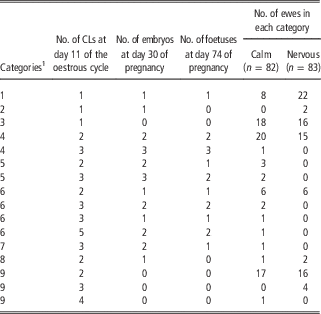
Data were analysed using the SAS Systems programs (SAS 9.2V; SAS Institute Inc., Cary, NC, USA). Categorical data (ovulation rate, prolificacy and pregnancy rates) were analysed using χ 2 procedure in SAS. Ovulation rate (OR; 1 or ⩾2), pregnancy (0 or 1) and prolificacy (1 or ⩾2) were analysed. The fixed effect in the model was temperament (calm or nervous). To analyse embryo losses, ewes were allocated into nine categories according to their reproductive outcome on the basis of possible combination of losses among the number of CLs, number of embryos observed at day 30 and number of foetuses observed at day 74 of pregnancy (Table 1). To further analyse the reproductive wastage before day 30, day 17 progesterone data were used to classify ewes into categories, on the basis of their pregnancy status: (1) ewes that were pregnant (P: high progesterone on day 17 and embryo(s) present on day 30) or late loss (LL: high progesterone on day 17 and no embryos present on day 30) or early loss (EL: low progesterone on day 17 and no embryos present on day 30).
Categorisation of ewes (Ovis aries) according to their reproductive outcome on the basis of possible combination of losses among the number of corpora luteas (CLs), number of embryos observed at day 30 and number of foetuses observed at day 74 of pregnancy, and the number of ewes in each category according to their temperament

1 Categories 1, 2 and 3: mono-ovulatory ewes retaining all (1), losing all between days 30 and 74 (2) and not maintaining pregnancy (3). Categories 4 to 9: multiple-ovulatory ewes retaining all (4), loosing 1 between days 30 and 74 and maintaining pregnancy (5), loosing 1, 2 or 3 before day 30 but maintaining pregnancy (6), loosing 1 before day 30 and another between days 30 and 74 but maintaining pregnancy (7), loosing 1 before day 30 and another between days 30 and 74 and not maintaining pregnancy (8) and not pregnant (9).
Continuous data with repeated measurements (plasma concentrations of progesterone, insulin and leptin) were compared using ANOVA, using the mixed procedure in SAS along with the Kenward–Roger correction for DF. The model included the fixed effects of temperament (calm or nervous) and pregnancy status (P, LL or EL), and their interactions. Ewe within group was considered as the random effect. The covariance was modelled to consider the correlation between successive measurements of the same animal, with the option autoregressive order 1. The level of significance was considered to be P<0.05, and tendency as 0.05<P<0.10.
Results
Ovarian cyclicity and ovulation rate
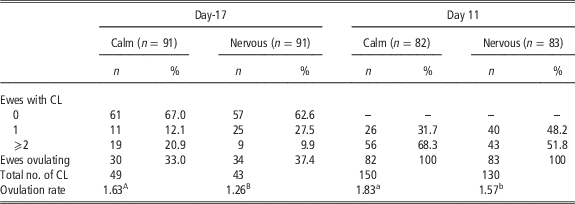
Before oestrus synchronisation (day-17) there was no difference between the selection lines in the proportion of ewes that were ovulating (64/182, 35.2%), but there was a difference in the ovulation rate between the selection lines. Calm ewes had a higher ovulation rate than nervous ewes (P=0.003; Table 2). On day 11 the proportion of ewes that had ovulated in response to the synchronisation treatment was not different between the two lines (165/182, 90.7%). The average ovulation rate was higher in the synchronised cycle than in the previous cycle in both the calm (+12.3%) and nervous (+24.6%) lines, but the increase was significant only in nervous ewes (P=0.01). On day 11 the ovulation rate was again higher in the calm ewes than the nervous ewes (P=0.03; Table 2).
The number and percentage of calm and nervous ewes (Ovis aries) presenting 0, 1 or ⩾2 corpora lutea (CL), number and percentage of ewes ovulating, total number of CL and ovulation rate on day-17 and 11 (day 0=timed artificial insemination)

A,BValues within day with different superscript letters differ significantly at P<0.01 (day-17).
a,bValues within day with different superscript letters differ significantly at P<0.05 (day 11).
Pregnancy and prolificacy
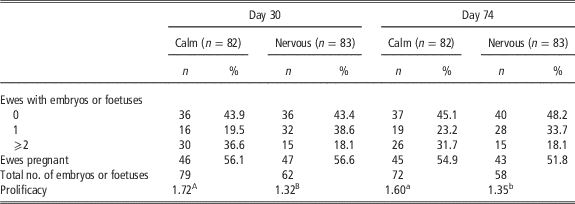
On day 30 there was no difference in the proportion of ewes that were pregnant (calm 46/82, 56.1%; nervous 47/83, 56.6%) as detected by ultrasonography. There was a difference in the average litter size with calm ewes carrying more embryos than nervous ewes (P=0.001; Table 3). On day 74 there was no difference in the proportion of ewes that were pregnant (calm 45/82, 54.9%; nervous 43/83, 51.8%). The average litter size of the calm line on day 74 was still higher, due to more multiple pregnancies, compared with the nervous line (P=0.03; Table 3).
The number and percentage of calm and nervous ewes (Ovis aries) presenting 0, 1 or ⩾2 embryos or foetuses, number and percentage of ewes pregnant, total number of embryos or foetuses and prolificacy on days 30 and 74 (day 0=timed artificial insemination)

A,BValues within day with different superscript letters differ significantly at P<0.01 (day 30).
a,bValues within day with different superscript letters differ significantly at P<0.05 (day 74).
Loss of reproductive potential
Overall, there were fewer embryos present on day 30, and fewer foetuses on day 74, than expected from the number of CLs present on day 11 (Tables 2 and 3). On day 30, about half of the potential embryos had been lost, and although there was no difference in the proportion of overall lost embryos between the selection lines (calm 47.3%; nervous 52.3%), the ewes of the nervous line had proportionally fewer twin pregnancies than would be expected from the CLs present on day 11. Between days 30 and 74 fewer embryos were lost than between days 0 and 30 (calm 4.7%; nervous 3.1%) and single and multiple pregnancies were equally affected. Of the total reproductive wastage, 92.7% occurred between days 0 and 30 and 7.3% between days 30 and 74, but the overall wastage rate in each period was similar in the two selection lines.
Progesterone
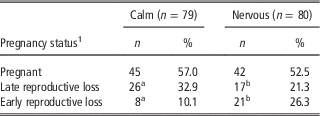
The effect of temperament on plasma concentrations of progesterone was not significant (P=0.79), but day, pregnancy status and the interaction day×pregnancy were significant (P<0.0001) (Table 4). The proportion of ewes with late reproductive loss (pregnant on day 17, with progesterone >3.18 nmol/l, and not pregnant on day 30) was higher in the calm ewes than the nervous ewes (P=0.02) (Table 5).
Mean concentrations of progesterone (nmol/l) for ewes (Ovis aries) on days 5, 12 and 17 after timed artificial insemination (TAI), according to pregnancy status on days 17 and 30 after TAI

RMSE=root mean square error.
1 Pregnant: pregnant on days 17 and 30.
2 Late reproductive loss: pregnant on day 17 and not pregnant on day 30.
3 Early reproductive loss: not pregnant on days 17 and 30. Ewes that had progesterone levels of >3.18 nmol/l on day 17 were considered to be pregnant at that time.
A,B,CValues within column with different superscript letters differ significantly at P<0.01.
X,YValues within a row with different superscript letters differ significantly at P<0.01.
The number of calm and nervous ewes (Ovis aries) classified as pregnant (pregnant on both days 17 and 30), late reproductive loss (pregnant on day 17 and not pregnant on day 30) and early reproductive loss (not pregnant on days 17 and 30) (day 0=timed artificial insemination)

1 Ewes that had progesterone levels of >3.18 nmol/l on day 17 were considered to be pregnant at that time. Pregnancy estimated on day 30 by transrectal-ultrasound scan.
a,bValues within a row with different superscripts differ significantly at P<0.05.
Insulin
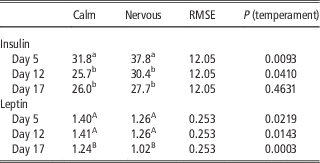
Temperament (P=0.013) and day (P<0.0001) affected the plasma concentrations of insulin but not pregnancy status, which was taken out of the model (Table 6). The interaction temperament×day was not significant (P=0.26). The ewes of the calm line had lower plasma concentrations of insulin (27.8 pmol/l±1.17 SEM) than the ewes of the nervous line (32.0 pmol/l±1.17 SEM) regardless of their pregnancy status.
Mean concentrations of insulin (pmol/l) and leptin (μg/l) for calm and nervous ewes (Ovis aries) on days 5, 12 and 17 after timed artificial insemination

RMSE=root mean square error.
a,bValues within column with different superscript letters differ significantly at P<0.05.
A,BValues within column with different superscript letters differ significantly at P<0.01.
Leptin
Temperament (P=0.002) and day (P<0.0001) had a significant effect on the plasma concentration of leptin, but not pregnancy status, which was taken out of the model (Table 6). The interaction temperament×day was not significant (P=0.25). The ewes of the calm line had higher plasma concentrations of leptin (1.35 μg/l±0.04 SEM) than the ewes of the nervous line (1.18 μg/l±0.04 SEM) regardless of their pregnancy status.
Discussion
The first part of the hypothesis that selection for behavioural reactivity in Merino ewes would affect ovulation rate was supported; the calm ewes had a higher ovulation rate and more multiple pregnancies than the nervous ewes. The second part of the hypothesis that the level of behavioural reactivity would affect conception or embryo loss was not supported, although the timing of reproductive loss seemed to be affected. The mechanism by which behavioural reactivity affects ovulation rate is not understood but our data lead us to suggest that rather than a direct effect of the stress axis on the ovarian function it could be due to a more efficient in energy utilisation in calm ewes than in nervous ewes as hypothesised.
Ovulation can be directly blocked by stress because increased cortisol secretion can reduce LH pulsatility and block or delay the LH surge (Breen et al., Reference Breen, Billings, Wagenmaker, Wessinger and Karsch2005). When under stress, the nervous ewes secrete more cortisol than the calm ewes (Hawken et al., Reference Hawken, Luckins, Tilbrook, Fiol, Martin and Blache2013), but the resting activity of the hypothalamus-pituitary-adrenal axis is similar in ewes selected to be calm or nervous (Rietema et al., Reference Rietema, Blackberry, Maloney, Martin, Hawken and Blache2015). Although we did not measure cortisol, it is unlikely that the lower reproductive performance of the nervous ewes was due to activation of the stress axis, as there was no difference in the number of ewes of each line ovulating, nor any difference in the fertility to timed artificial insemination. Therefore, behavioural reactivity seems not to affect ovulation per se.
The number of gonadotropin-dependent follicles becoming ovulatory follicles depends on the duration of the window of FSH above threshold values, the number of gonadotropin-dependent follicles present at the time of this window or both (Scaramuzzi et al., Reference Scaramuzzi, Baird, Campbell, Driancourt, Dupont, Fortune, Gilchrist, Martin, McNatty, McNeilly, Monget, Monniaux, Viñoles and Webb2011). Reduced negative feedback on the hypothalamus and pituitary due to lower levels of oestrogens and/or inhibins can lead to a longer duration of above threshold FSH levels. The higher leptin concentrations in the calm ewes may have reduced aromatase activity in the follicle, resulting in lower oestrogen production (Kendall et al., Reference Kendall, Guitierrez, Scaramuzzi, Baird, Webb and Campbell2004). In addition, leptin increases the efficiency of the use of FSH by the follicles (Viñoles et al., Reference Viñoles, Paganoni, Glover, Milton, Blache, Blackberry and Martin2010b). While these mechanisms are theoretically sound, caution should be taken with this interpretation as no blood samples were taken during the follicular phase before AI. Ovulation rate after oestrus synchronisation increased in nervous ewe and is influenced by eCG, although it must be noted that ovulation rate before oestrus synchronisation was higher in the calm ewes than in the nervous ones. Co-selection for eCG sensitivity cannot be ruled out during temperament selection, nevertheless, the higher ovulation rate in the nervous ewes was not accompanied with higher prolificacy. The increased in ovulation rate of the nervous ewes in response to eCG may suggest that, in contrast to the ewes of the calm line, ewes of the nervous line were not ovulating at a rate close to their maximum genetic potential when hormonal treatments were not applied.
As expected, we recorded the major part of reproductive loss (>90%) before day 30 (Ashworth, Reference Ashworth1995). However, the timing differed between the two lines; more nervous ewes either failed to conceive or lost more pregnancies before day 17, whereas more calm ewes lost pregnancies after day 17. It is unlikely that the nervous ewes were affected by handling around AI because the proportion of ewes ovulating did not differ between the lines and the ewes were handled gently and only rough handling or the use of dogs can affect maintenance of pregnancy during the first 20 days of gestation (Doney et al., Reference Dobson, Fergani, Roulty and Smith1976). It is possible that the higher plasma concentrations of leptin in calm ewes may have led to better embryo survival (Sosa et al., Reference Sosa, Abecia, Forcada, Viñoles, Tasende, Valares, Palacín, Martin and Meikle2006; Viñoles et al., Reference Viñoles, Glover, Paganoni, Milton and Martin2012), whereas the lower plasma concentrations of leptin in nervous ewes may have affected the expression of steroid receptors in the uterus, thus impairing embryo growth and its ability to produce interferon τ (Sosa et al., Reference Sosa, Abecia, Forcada, Viñoles, Tasende, Valares, Palacín, Martin and Meikle2006). High plasma concentrations of insulin are associated with better resumption of ovarian cyclicity in dairy cattle, but they also interfere with oocyte competence resulting in low blastocyst rate (Adamiak et al., Reference Adamiak, Mackie, Watt, Webb and Sinclair2005). The higher ovulation rate after oestrus synchronisation in the nervous ewes might be associated with the higher plasma concentrations of insulin, and interference with oocyte competence could explain why it did not result in similar prolificacy on day 30, as oocyte competence is a key factor in embryo survival (Krisher, Reference Krisher2004). The differences in the timing of the reproductive losses between the two lines may be explained as follows: the calm ewes possibly lost their embryos late because of the negative relationship between the number of ovulations and subsequent embryo survival (Haresign, Reference Haresign1985), whereas nervous ewes may have had difficulties either at conception (high concentrations of insulin affecting oocyte competence) or during maternal recognition of pregnancy (low concentrations of leptin affecting the quality of the uterine environment).
The ewes of the selection lines have similar productive outcomes when not challenged by the environment or nutrition (Bickell et al., Reference Bickell, Durmic, Blache, Vercoe and Martin2010a; Blache and Bickell, Reference Blache and Bickell2010; Hawken et al., Reference Hawken, Williman, Milton, Kelly, Nowak and Blache2012). When under sub-optimal conditions, the calm ewes perform better than the nervous ewes (Hawken et al., Reference Hawken, Williman, Milton, Kelly, Nowak and Blache2012). These previous data have led us to hypothesise that energy partitioning is different between the lines, as nervous animals would have to spend more energy on reacting to the sub-optimum environment or nutrition. Reproduction responds to variation in nutrition and abundant evidence exists of cross-talk between the reproductive and metabolic axes (Blache et al., Reference Blache, Chagas and Martin2007). Although BW and body condition score were not different between the selection lines, insulin and leptin concentrations were, suggesting that there is an energetic cost to having high behavioural reactivity and this may involve differences in the way energy is partitioned, and metabolic signalling may affect the number of ovulatory follicles or the quality of the oocytes. In fact, in numerous species from laboratory rodents, companion animals to farm animals, domestication and in a similar way selection for tameness or low level of behavioural reactivity is associated with an increase in litter size (Setchell, Reference Setchell1992; Price, Reference Price2002).
Conclusions
Behavioural reactivity affects ovulation rate but not the occurrence of ovulation, so differences in reproductive outcomes between the calm and nervous ewes were mainly due to a higher ovulation rate in calm ewes. Some of the nervous ewes, when the ovulation rate is maintained, have problems in maintaining their pregnancy possibly because of the quality of the oocytes and subsequent embryos, and perhaps the quality of the uterine environment during the first 2 weeks of pregnancy. As plasma concentrations of progesterone post-AI were not affected by temperament, but insulin and leptin concentrations were, we suggest that reproduction in nervous ewes is compromised by factors leading up to ovulation and conception, or in the uterine environment during early pregnancy, that reflect differences in energy utilisation.
Acknowledgements
E. v. L.’s scholarship for visiting UWA was funded by CSIC, Universidad de la República. K. W. H. was supported by Meat and Livestock Australia. The authors thank Steve Gray, the manager of Allandale Farm for his assistance and management of the sheep. The authors also thank the Breeding Centre for performing the artificial insemination. Thanks to Aprille Chadwick, Trina Jorre de St Jorre, Kristy Glover, Clemens Khaiseb and Celine Lenoury for their assistance. The authors declare that there are no conflicts of interest that could be perceived as prejudicing the impartiality of the research reported.