Management Implications
After a disturbance event or removal of invasive plant communities it is important to make efforts to prevent new invasive species from colonizing or reinvading an area. Riparian area tree-planting efforts should be prioritized where inputs of native propagules may not be sufficient to naturally restore native communities. In the northeastern United States, we found that in these areas it is beneficial to plant native tree species immediately after a disturbance event to restore biomass and provide native plant communities a head start over invasives present before the disturbance. In particular, fast-growing early-successional tree species such as willow (Salix spp.), poplar (Populus spp.), red maple (Acer rubrum L.), birch (Betula spp.), and cottonwood (Populus spp.) are likely to increase the success of establishing native plant communities and slowing the growth of highly competitive invasive species. Active habitat restoration of native plant communities may be an essential tool in maintaining ecological integrity, biodiversity, and ecosystem functioning. To reduce the likelihood and/or impact of invasion, it may be most beneficial to assess the traits and resource use of planted and potential invading species. If invasion does occur, it may take a suite of management techniques (e.g., removal of aboveground biomass, herbicide treatment, planting native species, monitoring) to successfully combat invasive plants.
Introduction
Natural and anthropogenic disturbances strongly influence the risk and magnitude of invasive plant colonization. These disturbance events often create open areas with newly available resources (e.g., nutrients, light, and space) that are easily colonized by invasive plants (Richardson et al. Reference Richardson, Holmes, Esler, Galatowitsch, Stromberg, Kirkman, Pyšek and Hobbs2007; Vila and Weiner Reference Vila and Weiner2004). Furthermore, disturbance events are often responsible for transporting and introducing invasive plant propagules to new areas through the use of heavy machinery, contaminated landfill, and flowing water (McDonald et al. Reference McDonald, Motzkin and Foster2008; Richardson et al. Reference Richardson, Holmes, Esler, Galatowitsch, Stromberg, Kirkman, Pyšek and Hobbs2007; Vila and Weiner Reference Vila and Weiner2004). Once invasive plants establish, they are further spread throughout the watershed and into riparian habitats by natural processes such as flooding, moving water, and hurricanes (Hood and Naiman Reference Hood and Naiman2000). Riparian areas are some of the most disturbed ecosystems in the world and are often highly modified for transportation, flow regulation, power generation, and drainage purposes (Allan and Flecker Reference Allan and Flecker1993; Liendo et al. Reference Liendo, Biurrun, Campos, Herrera, Loidi and García-Mijangos2015). Efforts to restore natural vegetation to riparian areas frequently must contend with the invasion of nonnative plants that could compromise the ecosystem service benefits provided by intact riparian vegetation (Hammer Reference Hammer2019; Richardson et al. Reference Richardson, Holmes, Esler, Galatowitsch, Stromberg, Kirkman, Pyšek and Hobbs2007). In this case study, we evaluate the success of restoration planting of native trees and shrubs in disturbed riparian areas and their ability to increase biotic resistance to invasive nonnative plants.
Restoring and maintaining intact and diverse riparian areas on the landscape are critical to mitigate the effects of disturbance and ensure ecosystem functioning (Hale et al. Reference Hale, Reich, Daniel, Lake and Cavagnaro2018; Hood and Naiman Reference Hood and Naiman2000; McDonald et al. Reference McDonald, Motzkin and Foster2008; Wilkerson et al. Reference Wilkerson, Hagan, Siegel and Whitman2006). Assisted revegetation can be an effective strategy to prevent the establishment and spread of invasive plants and can strongly influence the ability of native communities to resist invasion if they are diverse and have sufficient biomass and occupied niche space (Nunez-Mir et al. Reference Nunez-Mir, Liebhold, Guo, Brockerhoff, Jo, Ordonez and Fei2017). This is known as the biotic resistance hypothesis, which states that habitats or native communities with greater species richness and functional diversity have less niche space and resources available (i.e., space, light, and nutrients) to invaders, therefore increasing a community’s resistance to invasion (Funk et al. Reference Funk, Cleland, Suding and Zavaleta2008; Nunez-Mir et al. Reference Nunez-Mir, Liebhold, Guo, Brockerhoff, Jo, Ordonez and Fei2017). Conversely, native plant communities exhibiting low species richness or composed of similar functional groups may have strong competition for resources but may be at high risk of invasion if their traits are not diverse, leaving niche space and resources available to potential invaders (Funk et al. Reference Funk, Cleland, Suding and Zavaleta2008). This is important in riparian areas, where frequent disturbances can compromise native plant communities and reduce biomass before the arrival of invasive species (Richardson et al. Reference Richardson, Holmes, Esler, Galatowitsch, Stromberg, Kirkman, Pyšek and Hobbs2007). In these disturbed areas, native plant propagule pressure may not be adequate for the revegetation of native riparian communities; therefore, planting of native species is often required to successfully restore riparian areas (Richardson et al. Reference Richardson, Holmes, Esler, Galatowitsch, Stromberg, Kirkman, Pyšek and Hobbs2007). Understanding how to increase a native plant community’s competitive ability and the role that biotic resistance has in a riparian forest ecosystem is imperative to effectively reduce the risk of invasion (Funk et al. Reference Funk, Cleland, Suding and Zavaleta2008).
In this case study, we assess whether planting native trees and shrubs within the riparian zone can increase biotic resistance to Japanese knotweed [Fallopia japonica (Houtt.) Ronse Decr.; syn. Polygonum cuspidatum Siebold & Zucc.], and invasive woody plants following a major natural disturbance. Our hypothesis was that riparian sites that were planted following a major disturbance would have lower densities of invasive plants compared with non-planted sites, because more niche space will be occupied, and fewer resources will be available to invading plant species. For this study, we were only interested in terrestrial nonnative and invasive woody plant species. Hereafter, we refer to the terrestrial nonnative and invasive woody plant species as “invasive plant species” or “invasive plants.” In the case study area, knotweed (Fallopia spp.) is abundant and functions similarly to a woody plant species, although it is classified as a herbaceous perennial. Because of this, we treated F. japonica as a woody species in the analyses described here.
Materials and Methods
Study Site and Tropical Storm Irene
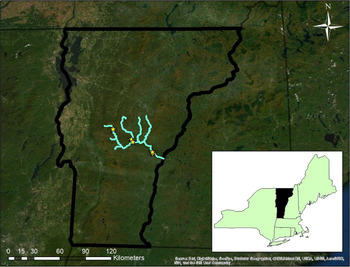
This research took place in the White River watershed in central Vermont in the northeastern United States (Figure 1). Our study sites (n = 5) were located in a landscape that is mostly covered by forest and farmland and contains parts of the Green Mountain National Forest. The nonprofit White River Partnership (WRP) has been working along the White River and its tributaries to restore riparian areas after Tropical Storm Irene delivered 10 to 20 cm of rainfall in August of 2011 and caused substantial damage and severe flooding to the area. Tropical Storm Irene left many areas bare from intense flooding and massive erosion and uprooted many riparian plant communities. The flooding deposited up to 1 m of sand in some areas and buried native vegetation that was not swept away. Subsequent disturbances included the removal of sediment from the river and riparian areas by heavy machinery in some areas (M Russ, WRP Executive Director, personal communication, June 1, 2018).
Study area containing paired (planted and non-planted) riparian study sites (n = 5) along the main branch of the White River and some of its major tributaries, Vermont, USA. Study sites include Peavine Park (43.82723°N, 72.63455°W); Floyd (43.85361°N, 72.64814°W); Bagley (43.95843°N, 72.83904°W), Mill Brook (43.72195°N, 72.42752°W); and Clifford Park (43.70893°N, 72.41766°W).

Study Design
We assessed whether planting native species within the riparian zone can increase biotic resistance to F. japonica and woody invasive plant species by conducting vegetation surveys at previously planted areas (native trees and shrubs) that were restored post–Tropical Storm Irene (2011 to 2012). The WRP generally plants 988 stems ha−1 of early-successional and fast-growing native species in an attempt to successfully compete with fast-growing invasive species (Table 1). Planting mixtures of desirable species used by the WRP at a given site are determined largely by availability from local commercial nurseries. We used non-planted areas directly adjacent to planted sites to serve as reference areas. We selected non-planted areas that had similar slope, aspect, topography, overstory canopy, and disturbance regime compared with the planted areas. Together, these planted and non-planted areas served as our paired riparian study sites (n = 5). We conducted the vegetation surveys described in the materials and methods section on both planted and adjacent non-planted sites to quantify the differences between paired planted and non-planted sites in May and June 2017 (Figure 2).
Tree and shrub species (by proportion) planted by the White River Partnership (WRP) after Tropical Storm Irene (2011–2012) in the planted area of the riparian study sites (n = 5) in the White River watershed, Vermont, USA.

Plot layout used on paired (planted and non-planted) riparian study sites in the White River watershed, Vermont, USA. Plot width was fixed at 10 m, but plot length varied with the distance between the stream bank and the extent of the restored site (plot A). A 2-m-wide transect (subplot B) was established through the center of plot A. Light circles indicate planted vegetation with slightly larger planted trees at end of riparian buffer. Dark circles indicate naturally recruited vegetation throughout entire riparian buffer. Soil characteristics data were collected at soil sample locations 2 m from the stream bank and 2 m from the extent of the restored site.

Plot Layout and Design
We established 10-m-wide strip transects (plot A) spaced 15 m apart along the adjacent stream or river that extended perpendicularly from the shoreline through the riparian zone to the back of the restoration site. Transect segments were of variable lengths because the shape and total size of the sites varied (Figure 2). We spaced the transect segments with the intent of sampling 40% (i.e., 10 m of every 25-m-width segment) of the total area in a manner that allowed us to capture variability throughout the site. We established a 2-m-wide nested subtransect (subplot B) through the center of plot A to achieve a 20% sample area of the main plot. Subplot B extended perpendicular to the adjacent stream or river through the riparian zone to the back edge of plot A (Figure 2). We considered the total area of the strip transects (plot A) at each site to be a single plot at each site for the purposes of the statistical analyses.
Vegetation Surveys
Within plot A, we collected tree species and diameter at breast height (DBH in centimeters) for all trees >10 cm DBH. Height (in meters) was also measured on one dominant and one codominant tree using a Haglöf Vertex IV and Transponder III (Haglöf Sweden AB, Långsele, Sweden). We made visual estimates (in percent cover) within plot A to characterize vegetation structure using the following categories: overstory canopy (>5 m in height); understory (0.5 to 5 m in height); and herbaceous and non-herbaceous ground cover (<0.5 m in height) (Lazorchak et al. Reference Lazorchak, Klemm and Peck1998). We further characterized ground cover into 11 categories by estimating percent cover of the following: (1) hay-scented fern [Dennstaedtia punctilobula (Michx.) T. Moore]; (2) various other ferns; (3) horsetail (Equisetidae); (4) leaf litter; (5) moss; (6) club moss (Lycopodium spp.); (7) various herbaceous plants; (8) bare ground; (9) grasses (Poaceae), sedges (Cyperaceae), and rushes (Juncaceae); (10) invasive species; (11) and F. japonica (live and dead). At all plot locations we documented GPS coordinates, bank facing direction, any signs of disturbance or modifications, and dominant land use/land cover. We documented species and stem density (counted at 15.24 cm above the ground) of all woody vegetation within subplot B (the nested 2-m transect), and binned stem height into the following height classes: 1 (0 to 1 m), 2 (1.1 to 2 m), 3 (2.1 to 5 m), or 4 (≥5 m). We classified all native stems as a non-planted stem or planted stem based on what we knew about planting spacing, species, and size. We also estimated invasive species percent cover and distance to the river.
Soil Composition and Function
To analyze differences in soil composition and functioning between planted and non-planted sites, we measured the depth of leaf litter and duff (i.e., decomposed organic soil layer above the mineral A horizon) layers (to the nearest 0.1 cm). We dug shallow soil profiles on the forest floor with a small trowel 2 m from the front edge and 2 m from the back edge of subplot B, where we measured litter and duff depth and characterized soil (Figure 2). We also measured infiltration rates of water into soil (centimeters per minute) at these two locations in subplot B to assess overland flow potential by using a 15.24-cm-diameter cylinder (single-ring infiltrometer made from plastic PVC) to perform an infiltration test (USDA 2014).
Statistical Analysis
We used the statistical program JMP Pro 13 (SAS, Cary, NC, USA) to perform nonparametric block-centered Wilcoxon signed-rank tests to examine the differences between paired planted and non-planted riparian study sites for abundance of native and invasive vegetation (per square meter), regeneration (per square meter), soil characteristics, species richness (Shannon-Wiener diversity index), and species evenness. (Shannon/Pielou evenness index). We defined the “block” as the site (Bagley, Peavine Park, Mill Brook, Clifford Park, and Floyd).
Results and Discussion
Plant Community and Soil Composition
All paired study sites had fewer invasive species stems present in the planted area (x̄ = 1.3) when compared with its non-planted counterpart (x̄ = 4.1, P = 0.01; Table 2). The invasive plant species composition in the paired riparian study sites (planted and non-planted) was composed mostly of F. japonica (92% and 95% of all stems, respectively) and the remainder was Morrow’s honeysuckle (Lonicera morrowii A. Gray). There were no significant differences in the density of native stems between planted and non-planted riparian sites (Table 2). Total stem density was slightly higher in non-planted sites when compared with planted sites, although not statistically significant at α = 0.05 level (P = 0.14, x̄ = 16.3 and 11.4, respectively). The diversity of native species was slightly greater in the planted sites compared with the non-planted sites, but the difference was not significant (P = 0.29, x̄ = 16.6 and 14.4, respectively; Table 3). Similarly, the diversity of native and invasive species combined was also greater (P = 0.34) in the planted sites when compared with their non-planted counterparts (x̄ = 18.2 and 17.2, respectively; Table 3). Furthermore, comparisons of Shannon-Wiener diversity index and Shannon/Pielou evenness index showed no significant differences (Table 3). Other measured response variables, such as native tree regeneration, soil properties and soil function, showed no significant differences or trends in the paired riparian study sites (Table 2).
Mean, standard error (SE), and block-centered Wilcoxon signed-rank test P-values for the response variables in the riparian paired non-planted (NP) and planted (P) study sites (n = 5) in the White River watershed, Vermont, USA.

a Bold P-value indicates significance at α = 0.05 level.
Species richness indices and block-centered Wilcoxon signed-rank test P-values for the riparian paired non-planted (NP) and planted (P) study sites (n = 5) in the White River watershed, Vermont, USA.

Overall, invasive plants comprised 23% of all stems, with the highest proportion observed at Bagley (63%), followed by Peavine Park (23%), Mill Brook (18%), Clifford Park (10%), and Floyd (1%). Mill Brook had the largest difference in abundance of invasive plants between non-planted and planted riparian sites, followed by Bagley and Peavine Park (Figure 3). Planted sites had an average of 61% fewer invasive stems compared with non-planted sites.
Total (native and invasive) stems per square meter in the paired planted (P) and non-planted (NP) riparian study sites in the White River watershed, Vermont, USA (n = 5).

This study reveals a clear trend when comparing the mean stem density of invasive plants between planted and non-planted sites (P = 0.01). This difference may be explained by the reduction of resources and space available to the invaders (i.e., niche availability) as native communities begin to establish. Conversely, non-planted sites may have greater niche space available to invading species, with the exception of the Floyd site, which receives more native propagule pressure in the non-planted area (discussed later) (Figure 4). These findings are consistent with the biotic resistance hypothesis and other community ecology theories that state that native plant communities with sufficient biomass and higher species richness can successfully lower the probability of invasion when compared with communities with low species richness or less occupied niche space (Funk et al. Reference Funk, Cleland, Suding and Zavaleta2008; Nunez-Mir et al. Reference Nunez-Mir, Liebhold, Guo, Brockerhoff, Jo, Ordonez and Fei2017). Diverse native plant communities can increase resistance to invasion by decreasing the availability of critical resources (e.g., nitrogen, light, and soil moisture) (Maron and Marler Reference Maron and Marler2007). The results from our case study point to biomass and occupied space of planted trees rather than diversity as the driver of biotic resistance at planted sites.
Total stems per square meter (by functional group) colonizing paired (planted and non-planted) riparian study sites in the White River watershed, Vermont, USA (n = 5) after Tropical Storm Irene.

The riparian forest study sites were mostly in the stand initiation stage following a natural disturbance, and low biomass may have been the limiting factor for these young native communities to increase biotic resistance to invasion. If planted species and native communities are allowed more time to establish before receiving high propagule pressure from F. japonica, statistical analysis may reveal more significant results. In these newly developing stands, some well-dispersed large legacy trees survived the tropical storm in the paired study sites. These residual trees with mature canopies, in conjunction with a diverse array of planted fast-growing trees and shrubs, may have provided enough biomass, cover, and competition to not only increase biotic resistance to invasion but also to reduce the vigor of invasive F. japonica after its establishment. Furthermore, as these young trees and shrubs develop mature canopies over time, their competitive ability will increase and further slow the growth of invaders, particularly shade-intolerant species.
In these disturbed riparian areas, newly available resources and niche space combined with an abundance of moving water greatly facilitated the establishment and spread of invasive species throughout the White River watershed. Fallopia japonica was by far the most abundant invasive plant species found in our study sites. Fallopia japonica was quickly able to spread and colonize many riparian areas after Tropical Storm Irene, as it primarily reproduces by vegetative propagation, and its propagules are consistently dispersed to new areas through moving water, especially after high-flow and rain events. Fallopia japonica also has a very aggressive rhizome structure and a fast-growing dense canopy that allowed this species to quickly outcompete native vegetation after Tropical Storm Irene and establish large monospecific stands throughout central Vermont.
The Mill Brook site had the greatest difference in density of invasive stems between planted and non-planted sites (Figure 3). This site was located at the confluence of Mill Brook and the White River. The reason for this large difference is not clear but may be influenced by the frequent ice scouring of the banks and intense flooding this section of the main branch of the White River often experiences. Planted trees at the Mill Brook site likely failed to establish because of the large sections of moving ice that scour the banks during the annual thawing of the river. The ground in the section planted with native trees was completely dominated by native ostrich fern [Matteuccia struthiopteris (L.) Todaro]. The adjacent non-planted section was almost devoid of native species and was completely taken over by invasive F. japonica. In addition, the planted section was ˜1-m lower in elevation and therefore may experience more frequent inundation and disturbance from ice scouring and flooding. Both the nonnative, invasive F. japonica and native M. struthiopteris are perennials that are well adapted to flooding and can quickly spread through rhizomes. But the M. struthiopteris may be better suited to deal with more frequent scouring of the banks on the lower floodplain of the planted area.
There were no significant differences in total stem density of native vegetation between planted and non-planted sites (Table 2). Native stem density was similar across all paired planted and non-planted sites, except at the Floyd site (Figure 3). At the Floyd site, the non-planted area had much higher stem density of native species when compared with the planted area. This is most likely because the non-planted area was directly adjacent to a mature forest, receiving much greater inputs of native species propagules than the planted area, which was adjacent to a mowed field. This is the only paired site that had distinct differences in vegetation in the adjacent habitat.
These young riparian study sites, mostly in the stand initiation stage following the stand-replacing disturbance, again best explain why soil composition and soil-functioning response variables showed no significant differences in mean values (Table 2). These study sites currently have poorly developed sandy soils and most likely had their uppermost soil layers washed away by Tropical Storm Irene. In addition, most of these riparian sites had large amounts of sand left deposited after the flood waters receded. In some cases, soils were further disturbed by heavy machinery needed to remove the sand and/or restore the stream banks (M Russ, WRP Executive Director, personal communication, June 1, 2018), which can also introduce outside seed sources (McDonald and Urban Reference McDonald and Urban2006; McDonald et al. Reference McDonald, Motzkin and Foster2008). Like the young plant communities in these sites, the soils at the case study sites may not have had enough time to develop, and long-term effects are not yet realized. This was most apparent at the Floyd and Mill Brook sites, both of which have soils composed of mostly sand and experience ongoing high natural disturbance frequency from ice scouring of the banks and frequent flooding. This further prevents the riparian soils from accumulating litter and duff, organic soil layers, and upper soil horizons that play a critical role in regulating the transfer of nutrients and sediment into waterways (Likens et al. Reference Likens, Bormann, Johnson, Fisher and Pierce1970). Having organic material present in riparian soils can be an important factor in reducing overland flow by providing stable soil aggregates and suitable habitat for soil biota, both of which increase porosity and improve soil structure, and therefore increasing infiltration rates and ultimately allowing water to infiltrate downward into the soil (Sun et al. Reference Sun, Yang, Guan, Yang, Wu, Yuan, Jin, Wang and Zhang2018; USDA 2014; USDA-NRCS 2014). Conversely, soils with less organic material typically have slower infiltration rates (Sun et al. Reference Sun, Yang, Guan, Yang, Wu, Yuan, Jin, Wang and Zhang2018; USDA-NRCS 2014). This increases the potential for more overland flow that facilitates the loss of topsoil from the terrestrial habitat and can allow sediment and excess nutrients to enter the stream.
Natural Regeneration
Although there was no difference observed in natural regeneration between planted and non-planted areas (P = 1.00), small shrubs and low-lying woody plants such as Rubus spp., Ribes spp., Spirea spp., Virginia creeper [Parthenocissus quinquefolia (L.) Planch.], and highbush cranberry (Viburnum opulus L. var. americanum Aiton) colonized the paired study sites most frequently after Tropical Storm Irene, followed by trees and tall shrubs (Figure 4). With the exception of the Floyd site, all planted areas had greater tree species richness when compared with their non-planted counterparts (Table 3). Boxelder (Acer negundo L.), eastern cottonwood (Populus deltoides W. Bartram ex Marshall), A. rubrum, and Salix spp. were the most common and widespread tree species observed across all sites (Table 4).
Native tree species observed colonizing (stems per hectare) after Tropical Storm Irene (2011) in riparian paired non-planted (NP) and planted (P) study sites in the White River watershed, Vermont, USA (n = 5). Stems per hectare values include seedlings, saplings, and established mature trees of all size classes.

The similarity of native tree regeneration and total density of native vegetation between planted and non-planted sites is best explained by these stands being in an early-successional development stage and most vegetation and upper soil layers (and stored seedbank) being denuded by the effects of Tropical Storm Irene. In these sites, the highly competitive invasive plants that colonized most likely have not had enough time to fully establish, outcompete, and displace native species. Furthermore, F. japonica can have lasting impacts on soil chemistry and soil properties that may hinder native regeneration (Abgrall et al. Reference Abgrall, Forey, Mignot and Chauvat2018; Cygan Reference Cygan2018; Murrell et al. Reference Murrell, Gerber, Krebs, Parepa, Schaffner and Bossdorf2011). Therefore, these stands have yet to experience all of the potential impacts caused from invasive plant colonization to regeneration, stem density, and species composition.
Native, low-lying woody plants quickly established naturally at most paired riparian study sites (Figure 4). This is common in early-successional northeastern U.S. riparian forests, although it was different at the Floyd site. Here, trees had the highest density of regeneration and species richness of all growth forms (Table 4). At the Floyd site, the difference is again likely explained by the forest adjacent to the non-planted area, which provides consistent inputs of seeds and other plant propagules. This also resulted in high values when quantifying the density of regenerating tree species of seedlings with stems <5 m (Table 4). Although large amounts of small seedlings were present, many will not survive past the seedling stage. This was often the case with large amounts of yellow birch (Betula alleghaniensis Britton) and A. negundo (Table 4).
Our results illustrate that planting can make a difference in reducing the abundance of invasive plant species following a major disturbance, but soil properties may be slower to respond, as they are often dependent on vegetation type, canopy characteristics, and stand development stages. Monitoring is critical to evaluate the success of riparian restoration efforts and how well ecosystem functioning responds. This is particularly important to ensure soil development and functioning, as riparian soils are responsible for nutrient regulation and many other critical ecosystem services that riparian areas provide.
Acknowledgments
Funding was provided by the New Hampshire Agricultural Experiment Station. This is Scientific Contribution Number 2892. This work was supported by the USDA National Institute of Food and Agriculture McIntire-Stennis project no. 1010675. Thomas Lee and Wilfred Wollheim provided valuable input on study design as master’s thesis committee members and reviewed an early draft of the article. Many thanks are due to the field technician for this project, Nathan Rees, for his hard work assisting with data collection. The authors would also like to especially thank Mary Russ, Executive Director of the White River Partnership, for logistical assistance and valuable insight. No conflicts of interest have been declared.