


Introduction
Clinical supervision is the primary method used to develop and maintain competence in cognitive-behavioural therapy (CBT). Policy-makers also recognize its vital role in fostering reflective practice and ensuring a high quality of practice (Department of Health, 2004). This is buttressed by the emphasis accorded to supervision by the mental health professional bodies, as all of them require career-long supervision, covering both pre-accreditation/qualification development as a clinician, and the subsequent maintenance of professional standards (e.g. Nursing and Midwifery Council, 2006). Recently, some of these bodies have also implemented supervisor accreditation schemes (e.g. BABCP, 2006) and although the Health Professions Council (HPC) appears to give supervision a somewhat lesser status (see the Standards for Proficiency; HPC, 2007), supervisees and supervisors rate it highly (Lucock et al. Reference Lucock, Hall and Noble2006). Not least, there is research evidence that supervision benefits patients, through such mechanisms as improving adherence to treatment guidelines (Bambling et al. Reference Bambling, King, Raue, Schweitzer and Lambert2006), and by facilitating experiential learning (Milne & James, Reference Milne and James2000).
In part, supervision is so widely endorsed because it can fulfil diverse and valued functions. In summary, the over-arching purpose of supervision is to foster safe and effective clinical practice, in order to secure and enhance patient welfare. This purpose is delivered through at least 10 supervisory functions (Milne, Reference Milne2009), such as the well-established ‘normative, formative and restorative’ functions (Proctor, Reference Proctor, Marken and Payne1988). To achieve these functions requires supervisors utilizing experiential methods in order to facilitate activities like reflection on one's practice. They also require that supervisees collaborate actively, as in the classic CBT example of providing their therapy tapes for supervision. As many as 20 ways of collaboration by the supervisee have been identified, within a 1-year audit (Milne & Gracie, Reference Milne and Gracie2001).
So far, so good, but this ‘official’ representation of supervision conceals numerous problems in making supervision a satisfying and effective activity. These include: insufficient high-quality research – profound questions are raised by sceptics about whether there is a sound knowledge-base; poor leadership; weak or non-existent peer support within the supervisor's workplace; inadequate training in supervision; a lack of expert or local consensus on supervisory procedures (e.g. audit standards are vague or absent; authoritative guidelines few and far between); considerable variability in what is judged to be competent supervision; and a paucity of instruments with which to monitor and enhance supervision (see Milne, Reference Milne2009, for details on all these points).
A brief review of interpersonal dynamics in supervision
Of particular relevance in the present paper are the subtle and negative (i.e. manipulative/ulterior) interpersonal interactions that often arise between supervisor and supervisee, interfering with supervision methods, e.g. facilitating reflection. A case in point is collusion, selected in this study because it occurred during a project on supervision that involved routinely taping sessions for discussion with a consultant. Collusion is a form of ‘resistance’ (Binder & Strupp, Reference Binder, Strupp and Watkins1997) that can be defined as a joint process (conscious or unconscious) whereby both supervisor and supervisee engage in complementary safety behaviours that serve to conveniently avoid and escape from difficult topics and challenging supervision methods. Instead, they indulge in reassuring or other comforting and non-threatening behaviours that privilege the needs of the supervisee/or over those of supervision (Hawkins & Shohet, Reference Hawkins and Shohet2000). In the original transactional analysis account (TA; Berne, Reference Berne1964), these interactions were referred to as ‘games’, defined as an ‘ongoing series of complementary, ulterior transactions that are superficially plausible but have a concealed motivation to maximize pay-offs and minimize penalties for the initiator’ (from Berne, Reference Berne1964, quoted on p. 227 of McIntosh et al. Reference McIntosh, Dircks, Fitzpatrick and Shuman2006).
Within interpersonal dynamics, games can be thought of as one of the critical processes (or ‘dynamics’) that influence adversely the way that methods are applied in supervision, and hence undermine their effectiveness in achieving the 10 supervision functions (Milne, Reference Milne2009). These processes have long been recognized in psychoanalysis, justifying in part the requirement that the analyst receives a personal training analysis. Indeed, as far back as 1902, a peer-supervision group of qualified analysts (a ‘study circle’), facilitated by Freud, generated ‘disturbing factors which proved a great hindrance to harmonious cooperation’. Freud took the view that this was due to the ‘un-resolved psychic conflicts’ of his colleagues, and this led to the requirement for a training analysis (Kovacs, Reference Kovacs1936; both quotes p. 347).
How frequent or problematic are such dynamics? A survey of the BABCP membership by Townend et al. (Reference Townend, Iannetta and Freeston2002) stated that ‘problems can arise with collusion over poor practice’ (p. 497), although in fact their 170 respondents reported few difficulties over the one aspect that they addressed explicitly (i.e. dual relationships). By contrast, Hagler & Casey's (Reference Hagler and Casey1990) survey of 68 speech pathology students indicated that transactional games were common (their study was qualitative, so they did not report any frequency data). More recently, McIntosh et al. (Reference McIntosh, Dircks, Fitzpatrick and Shuman2006) surveyed 204 genetic counsellors (supervisees and their supervisors) to ask about the kinds of games that they had encountered, and their coping strategies for responding to these. A list of 37 games resulted, with some being identified by more than one respondent, indicating that they were very diverse, fairly common, and generally problematic (again, the qualitative approach used precludes specific frequencies being attached to these games). An example that maps onto the present case study is ‘Poor me’, which involves the supervisees in presenting themselves as needing help and attention [‘treat me, don't beat me’, in Kadushin's (Reference Kadushin1968) categorization]. According to McIntosh et al.'s (Reference McIntosh, Dircks, Fitzpatrick and Shuman2006) summary, this usually has the effect of decreasing the supervisors' criticism and negative feedback, whilst increasing their support, empathy and encouragement. Meanwhile the supervisees' workload and responsibility are expected to decrease. To counteract this game, the respondents suggested supervision tactics, like providing balanced feedback, confrontation over game-playing, and monitoring/reducing the amount of support provided.
Within CBT, the importance of supervision dynamics was acknowledged in a review by Perris (Reference Perris1994), who summarized approvingly Kadushin's (Reference Kadushin1968) amusing TA treatment of the phenomenon, and concluded that the supervisor needs to be able to detect and manage such dysfunctional, maladaptive ‘security manoeuvres’. Desperate efforts by supervisees to preserve their self-image should, he thought, be tackled by supervisors supporting adaptive development, for instance by providing a trustworthy, facilitating approach (the ‘safe base’), and by using CBT reflexively (e.g. to challenge the supervisees' dysfunctional assumptions and ploys, and to foster collaborative empiricism; Perris, Reference Perris1993, Reference Perris1994).
More recently, Liese & Beck (Reference Liese, Beck and Watkins1997) devoted a section of their review to such ‘interpersonal processes’, also adopting this TA perspective to introduce some problematic supervisory styles (e.g. ‘Attila the supervisor’, who insists on that there is only one approach to pursue – his). Like Perris (Reference Perris1993, Reference Perris1994), they recommend that supervisors draw on CBT principles and practices for solutions, such as careful conceptualization of the supervisory relationship and modelling adaptive functioning (e.g. by seeking regular feedback). Lomax et al. (Reference Lomax, Andrews, Burruss, Moorey, Gabbard, Beck and Holmes2005) provide a deeply thoughtful account of the difficulties that may be encountered in trying to establish the supervisory relationship, including omissions and distortions, such as lying by supervisees. Alongside vigilance, they recommend that the supervisor studies full, unedited tapes (at least initially), and interviews the patient. In relation to helping supervisees to behave more adaptively, they encourage the use of educational role-play and self-reflection (e.g. as to whether personal therapy is merited).
A recent development of reflective practices in CBT is the ‘self-practice, self-reflection’ (SP-SR) approach. This entails CBT practitioners practising CBT techniques on themselves (e.g. completing thought records), leading to reflecting on this experience (e.g. evaluating its worth; Bennett-Levy et al. Reference Bennett-Levy, Turner, Beaty, Smith, Patterson and Farmer2001). A related development is evidence-based clinical supervision (EBCS; Milne & Westerman, Reference Milne and Westerman2001; Milne, Reference Milne2009). The EBCS approach builds on the conventional CBT approach to supervision by adding a greater emphasis on the experiencing of the supervisees, which entails recounting and processing the affectively laden aspects of supervision; and experimenting, namely formulating and testing out ideas and skills within supervision. This emphasis reduces the attention given to case conceptualization and makes interpersonal difficulties a greater feature of supervision, whether in casework or elsewhere. For a detailed account of EBCS and its overlap with CBT, see Milne (Reference Milne2008, Reference Milne2009). This incorporates the work on relationship ruptures by Safran et al. (Reference Safran, Muran, Stevens, Rothman, Falender and Shafranske2008).
In summary, interpersonal ‘dynamics’ such as collusion are a recognized source of difficulty in CBT supervision, to date treated by drawing reflexively on CBT principles and practices. Next, we wish to use a case study to illustrate how CBT supervisors can add self-reflection to their repertoire of skills for managing dynamics effectively.
A case study
Objectives
The purpose of this case study is to illustrate a novel, CBT-focused way of coping with supervision dynamics through the application of the self-reflection model (Bennett-Levy & Thwaites, Reference Bennett-Levy, Thwaites, Gilbert and Leahy2007). The model was implemented within a consultancy session, at the end of a research study on clinical supervision. The consultancy had three aims: to offer the supervisor some external feedback on the dynamics within the study's supervision sessions; drawing on this self-reflection model, to try and help the supervisor to formulate the supervisory dynamics; and to develop the supervisor's competence in the use of an evidence-based approach to addressing such dynamics.
Method
Participants
The study involved a supervisor (the second author, C. L.), her consultant (the first author, D. M.) and an assistant psychologist, who collated feedback information (the third author, N. C.). The supervisor was a 45-year-old female registered mental nurse with a Masters in psychosocial interventions (PSI) that included a research thesis on supervision. In addition to her NHS work as a clinical nurse specialist, she taught and supervised at a local PSI course and had over 10 years supervisory experience. The consultant (the first author) was a 56-year-old male consultant clinical psychologist with a career specialization in staff development lasting some 25 years, including clinical supervision. The supervisee was a 34-year-old mental health professional, who received supervision from the second author as a routine aspect of studying part-time on this PSI programme.
Design
This is a descriptive case-study account of one consultancy session, using self-reflection as the intervention framework to examine the supervisor's collusion experiences. Her reflections, including a CBT formulation of the collusion, represent the data.
Procedure
Immediately preceding the present case study was an N = 1 analysis, aimed at evaluating EBCS (Milne & Westerman, Reference Milne and Gracie2001). It was within this N = 1 analysis that collusion was identified, during the routine consultancy sessions between the supervisor and consultant. Consultancy involved a review of the preceding supervision session, based on the consultant listening to a full tape-recording of supervision, and the EBCS approach was introduced as necessary as a way of developing supervision skills. As far as possible, the consultant also used the EBCS approach within consultancy, as in modelling the expression of affect and role-playing new ways of supervising. In order to conclude the N = 1 analysis, a final consultancy session was arranged to give the supervisor the opportunity to reflect on her experiences of collusion. This began with the playback of relevant audio tape-recorded episodes of collusion in relation to one supervisee, as selected by the consultant and his assistant (the third author).
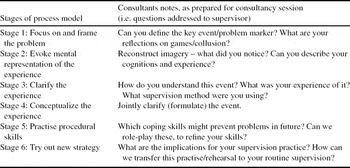
In order to review these dynamics, the six-stage process model for reflecting on therapeutic relationship difficulties was followed (Bennett-Levy & Thwaites, Reference Bennett-Levy, Thwaites, Gilbert and Leahy2007). According to this process, the consultant asked a series of questions to help structure the session, and to encourage the supervisor to reflect, as set out in Table 1.
Six stage process for addressing supervisory relationship difficulties (Bennett-Levy & Thwaites, Reference Bennett-Levy, Thwaites, Gilbert and Leahy2007), linked to the consultant's interview

The tone was accepting, exploratory and affirmative, in a collegial recognition of the difficulties of grappling with collusion. For example, the consultant asked the supervisor if she could draw on some of her memories of the supervision sessions so as to give an example of an episode marked by collusion or other dynamics. This was defined as something that is not part of the agenda and is perhaps awkward or uncomfortable. Indicating duly focused attention, the supervisor referred to times when the supervisee was not forthcoming, for example only offering general objectives for the session. She felt that in such situations she terminated the collaborative agenda-setting effort prematurely, partly in response to the supervisee's negative reactions, which included looking confused and restating objectives using different wording, but without making them more specific or enabling for the supervisor to grasp what was needed. This stage in the consultancy process helped to reconstruct her experience, which is intended to facilitate the supervisor's personal reflection, leading to joint problem conceptualization. Specifically, an improved understanding of how the supervisee resisted the introduction of the more structured EBCS approach was developed, in the shape of a self-formulation.
In terms of the SP-SR model, this represented the conversion of the supervisor's considerable declarative knowledge about clinical formulation into a new procedural understanding. Based on this novel and insightful conceptualization of the collusion, consultancy could then concentrate on experimenting with and practising alternative ways of responding to instances when the supervisee was unforthcoming. An example is by placing pressure on the supervisee to enable supervision, by drawing attention to the clinical consequences of collusion. This experimenting involved educational role-play between the supervisor and the consultant, as per the experiential emphasis within EBCS, targeting both behavioural proficiency and schema re-appraisal. Once the supervisor was comfortable with the new response, planning how to implement it took place, as in anticipating transfer problems and ways to address these. The session concluded with an evaluation of its utility, by the supervisor.
Results
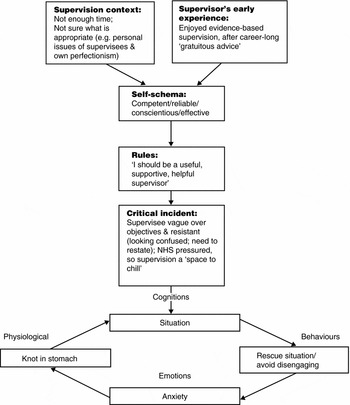
Figure 1 summarizes the outcome of step 4 (conceptualize) of the self-reflection process, our main ‘result’. The Figure is intended to illustrate how, using the basic CBT formulation diagram, the consultant and supervisor were able to make sense of the collusion episode. This Figure indicates that part of the problem (context) was that the supervisor had time constraints on the supervision, and yet continued to apply her perfectionistic expectations. Moreover, in relation to ‘early experience’, the supervisor had been accustomed to regarding supervision as a source of ‘gratuitous advice’, by contrast with her more recent adoption of EBCS, which represented an enjoyable alternative. These background factors appeared to interact adversely with her self-schema, as the view of herself as competent conflicted with the dynamics within the episode. The supervisor's rules (i.e. I should be useful, supportive and helpful) also contributed to her discomfort, allowing the critical dynamic incident to provoke an anxious reaction. This was reduced by trying to ‘rescue’ the situation, by placating the supervisee in the form of acquiescing to the tendency to describe interminable case details, and so entering a collusive process.
A CBT formulation of collusion in a case study of clinical supervision.

Summary and Discussion
Learning is an important objective of supervision, but for learning to be optimal cognitive theory suggests that the supervisee must, with the appropriate support of their supervisor (Vygotsky, Reference Vygotsky1978), experiment with relatively confusing material and tolerate experiences of incompetence (Zorga, Reference Zorga2002). The present case study describes an episode where the supervisee avoided such discomfort and the supervisor offered excessive support, through what appeared to be a process of collusion or game-playing (Kadushin, Reference Kadushin1968): each member of the supervisory dyad consciously or unconsciously behaved in ways that kept learning suboptimally comfortable. This is consistent with the account in Scaife (Reference Scaife2001), who noted that this may be because both supervisor and supervisee have an anxiety (e.g. about being observed), and so agree to prioritize case discussion. It is also consistent with the above review, in that the supervisor was not using CBT supervision approaches reflexively, in order to identify and redress the collusion. For example, this was achieved by challenging dysfunctional schemas and stressing collaborative empiricism. The case study outlined how an explicit CBT method, self-reflection (Bennett-Levy & Thwaites, Reference Bennett-Levy, Thwaites, Gilbert and Leahy2007), could be deployed to heighten the supervisor's awareness of collusion. This was achieved by formulating the process in CBT terms, which was congruent with the programme of training within which the supervision was provided. The formulation provided the basis for rehearsing more adaptive coping skills.
In conclusion, the use of self-practice appears to show promise as a way to encourage effective supervision. Next steps include simple evaluations to determine whether this assumed effectiveness is achieved reliably, and (if so) the development of a manual and more rigorous analysis (e.g. N = 1).
Acknowledgements
The authors thank Richard Thwaites for helpful feedback on an earlier draft of this manuscript.
Declaration of Interest
None.
Learning objectives
By studying this paper, readers will be able to:
• Define collusion and provide an example from clinical supervision.
• Place collusion in the context of a range of related interpersonal, supervisory transactions or ‘games’.
• Cite survey research regarding the frequency of such games in supervision.
• Summarize the ‘self-reflection, self-practise’ procedure.
• Sketch a CBT formulation of supervisory collusion.



Comments
No Comments have been published for this article.