At the close of 1823, the twelve monthly issues of the Harmonicon's first year were bound together in a large volume, to which was added a prefatory address lauding the success of the new periodical. Amongst the proud ruminations of the editor, William Ayrton (1777–1858),Footnote 1 there can be detected a distinct pride in the multifaceted varieties of music covered by the London journal which, he observes, were beneficial for the much-neglected general education of the amateur:
While there are periodical works in profusion, which communicate the thoughts of the ingenious, and record the results of industrious research, in every other department of the arts, sciences, and belles lettres, the stores of music are either unblocked at an extravagant and almost prohibitory price, or frozen up by the contracted means, or still more contracted views, of their accidental possessors; so as to remain, in effect, ‘a fountain sealed’, to thousands of amateurs, who in vain look for that which taste and reason require, but which circumstances deny.Footnote 2
Ayrton's Introduction then comments upon the wide and general scope of literary and musical coverage that his journal was proud to encompass.Footnote 3 What is emphasized is not an exclusive specialized approach but, instead, the undiscriminating variety of ‘all’ types of music: not only did the Harmonicon intend to cover the music of ‘really eminent’ composers, but also that of the ‘passing day’.Footnote 4 Both the affordability of the journal's sheet music and the aesthetic worth of its astute written criticism are praised.Footnote 5 Specifically, the cultivation of taste through the educational lenses of the journal was to be gained not just through the study of great masters, or by an immersion within any one particular style, but through knowledge of the peculiarities of different schools of music.Footnote 6
To the modern reader, the use of miscellany as a method of improving taste might seem puzzling in light of the enduring presence of a ‘canon’ in most musical educational systems.Footnote 7 Yet composers from the so-called ‘canon’ as we now define it are certainly not the only names published in the sheet music component of the Harmonicon (see Table 2, below, page 276), which was arguably the major selling point of the journal.Footnote 8 It is thus fair to consider whether a conscious application of the principles of miscellany and collegiality, as discussed by William Weber,Footnote 9 may prove helpful for a modern reading of the journal's impetus and aesthetic rationale, and whether this may enrich our appreciation of the role of this journal within early nineteenth-century British culture. Concerning its efforts to cover a vast range of musical topics while still having an aesthetic claim to be an arbiter of public taste, I argue that the Harmonicon attempted to create a ‘miscellaneous collegiality’ through the diverse potpourri of its contents. This article also presents a survey of the frequency with which all of the composers of the Harmonicon's sheet music appear, year by year. It is hoped that this information might be a useful reference tool for further research into miscellany and the interplay between ‘canonical’ and ‘other’ composers in the popular culture of early nineteenth-century Britain.Footnote 10
The Aesthetics of Miscellany and Collegiality
Miscellany
The term ‘miscellany’ had deeply rooted and largely pleasing connotations in the eighteenth and early nineteenth centuries. The Oxford English Dictionary dates the use of the term to 1601, noting that in the eighteenth century the term ‘miscellany gentleman’ was used to refer to the type of cultivated gentleman who took a broad interest in many things, often including the collection of miscellaneous articles or trinkets. It was further used as a generic term to classify books and publications that contained a wide array of information on any subject.Footnote 11 With regard to music, Weber asserts that the principles of miscellany and collegiality as defined in the eighteenth century ‘governed concert programming’ for well over a century.Footnote 12 Miscellany therefore functioned as what Lydia Goehr would call a ‘regulative’ principle in musical practice prior to the emergence of the concept of a musical canon as we know it.Footnote 13 As a regulative code, miscellany thus had a tangible influence upon the publishing of sheet music in Britain, although its impact on concert programming is better documented.Footnote 14
While Weber and others have applied the term extensively to concert programming, the time is ripe for its application to music publishing, since miscellanies as a broader print phenomenon were a staple of late eighteenth- and early nineteenth-century British reading culture. The fact that Britain's most famous author, Charles Dickens, first gained mass popularity through the periodical serializations of the Pickwick Papers in the 1830s attests to the fact that the Harmonicon was marketed to a reading public already accustomed not only to the purchasing of cheap periodical literature, but also to the miscellany gentleman epitomised by Dickens's Pickwick himself. Mr Pickwick, in the name of miscellaneous self-improvement, rambles about the British countryside and metropolis in an effort to ‘extend his researches into the quaint and curious phenomena of life’, thereby perceiving the world around him through the broadest and most varied lens possible.Footnote 15 In short, it was because of this broad and, significantly, not necessarily musical public that this journal was able to market itself.
Against this backdrop, the impact of miscellany upon the contents of nineteenth-century music publishing warrants scholarly attention. Quite apart from the presence of miscellany in concert programming, its principles were certainly at work in periodical journalism at large. For example, the Gentleman's Magazine has been described as the leading ‘miscellany journal’, encompassing ‘a collection of diverse, usually light elements in both prose and verse: odes, songs, fables, dialogues, enigmas, letters, translations, essays on scattered themes, and news’; it was the type of publication that ‘appealed to a broad range of readers, including women’.Footnote 16 In many respects, the orientation of the Harmonicon stems from this publishing genre. According to Langley, ‘[b]etween 1800 and 1845 some 30 periodicals devoted to music were launched in Britain, nearly all of them attributing their appearance to a current “general”, “wide”, “perfect” or “increasing” cultivation of the subject’.Footnote 17 There is also evidence that the Harmonicon's business model was surprisingly lucrative: the available information concerning the success (or lack thereof) of other journalistic ventures testifies to the fact that, in its enduring legacy and wide readership, the Harmonicon was extraordinarily successful for a journal of music.Footnote 18
Although in a position of prestige, the Harmonicon did have a serious competitor, which departed markedly from the tradition of the periodical miscellany: the Quarterly Musical Magazine and Review (hereafter QMMR).Footnote 19 Edited by Richard MacKenzie Bacon and published in substantial quarterly volumes from Norwich, this rival periodical held a similarly influential status in British music criticism from its inception in 1818 until its end in 1828.Footnote 20 Yet although the QMMR was respected for having more sophisticated criticism, it did not publish sheet music, nor did it cover such a wide array of topics. There were therefore considerable differences between the journals in ‘format as well as intention’,Footnote 21 and the marketability of miscellany is perhaps at the heart of these discrepancies. Bacon's overall tone was more exclusionary than open, and the plan of the journal was in bulk ‘essay format’,Footnote 22 far more concerned with theoretical and academic matters in its aim to afford a ‘medium for philosophical and technical communications’.Footnote 23 Furthermore, Norwich's geographical isolation from London prevented the QMMR from being able to report as swiftly on the concert seasons of the capital as the Harmonicon, with the result that its tone was more distanced from public life.
Bacon was, moreover, not afraid to discriminate explicitly against periodicals that held a broader appeal.Footnote 24 While the QMMR engaged in deeper aesthetic polemics through reader correspondence, the Harmonicon, by contrast, mainly offered more colloquial writings, by its editor and his associates.Footnote 25 Vogan relates the differing orientations of the journals to the proximity of their editors to London's concert life, noting that ‘[w]hile Richard Bacon maintained a position of interested onlooker to the musical scene, William Ayrton was very much part of that scene’ and therefore, for an impression of the actual musical life of the period, ‘the Harmonicon is the more useful journal’.Footnote 26 Unlike the QMMR, the Harmonicon was clearly not designed to be a ‘platform for the social, literary, or philosophical views of its editor’.Footnote 27 Just how much this editorial screen impacted upon the success of the journal would require further study, but what can be said is that the Harmonicon's relative neutrality is a constructive window from which to view the operation of miscellany and collegiality in public musical criticism.
Collegiality
Collegiality, or the inclusive and open ‘relationship between colleagues’,Footnote 28 was a concept associated with ‘pleasant’, ‘rational’ and ‘elegant’ culture (or ‘amusement’) amongst educated circles in the eighteenth century, giving the attendance of polite public music events a communal and even ethical dimension. As Wollenberg observes with regard to early public concerts at the Holywell Rooms in eighteenth-century Oxford, the early collegial audience constituted a ‘regular gathering of friends and acquaintances; the mixture of local musicians and visiting performers; the intimate surroundings with seating for only a few hundred’.Footnote 29 This form of collegial concert-going had, by the early nineteenth century, permeated the rising middle-class culture of cosmopolitan public spaces such as coffee houses and concert venues, which provided a place for distinctively ‘civilising’ and didactic activities.
It was also in coffee houses that multifarious periodicals such as the Harmonicon were available to be read.Footnote 30 These were relaxed, appropriate public spaces in which popular publications on a broad range of topics were available.Footnote 31 A miscellaneous knowledge of the arts was seen as more important than a narrow focus on a specialized national style or national school – an approach that was much aligned with the outlook of Ayrton's Harmonicon and its reaction to public attempts to found national schools of music.Footnote 32 Thus, the collegial miscellany gentleman, as much as he still existed in the early nineteenth century, would have been the ideal amateur reader for Ayrton's Harmonicon.
The Harmonicon in Nineteenth-Century British Culture
In its day the Harmonicon was arguably the dominant musical periodical, boasting loyal readers from London to Manchester, from Paris to Leipzig, to colonial Kingston, Jamaica, to New York and Boston. The recurring column entitled ‘Foreign Musical Report’ not only exemplifies Ayrton's awareness of international musical events but also demonstrates the appeal of the journal to foreign readers. It was read more widely and in more parts of the globe than the later Allgemeine musikalische Zeitiung of Leipzig or the Harmonicon's contemporary French rival, the Revue Musicale of Paris,Footnote 33 which disparaged the Harmonicon for pandering to the needs and wants of the unmusical and far too variegated British public.Footnote 34 Filled with incisive essays, reviews, gossip, and trivia on all aspects of music and musical life in London and abroad, and categorized as a ‘typical musical miscellany’, the Harmonicon appealed to a wide readership.Footnote 35
The scope of the journal is perhaps daunting for a modern reader, yet in its day the Harmonicon's aim was ambitious but not out of the ordinary. The early nineteenth-century concert-goer, at least in London, would have found it normal to attend some or perhaps nearly all of the number of concerts reviewed in the journal. This lifestyle was to be discouraged by the middle of the century, for the primary reason that the aesthetics of listening had by then undergone a drastic transformation, as the abundant literature on nineteenth-century aesthetics has shown.Footnote 36 As Carl Dahlhaus has argued, for example, the aesthetics of monumentality that emerged towards the middle of the nineteenth century required that listeners not stray fleetingly from one concert of entertaining music to another but treat serious music with due respect.Footnote 37
But perhaps Dahlhaus, with his Germanocentric outlook, oversimplified the case. Certainly the roots of the nineteenth-century shift to specialized, non-miscellaneous and serious listening are far more complex than such a simplistic rationalisation. This shift in aesthetics was fast occurring during the Harmonicon years, and the journal displays the tensions at the heart of it: an orientation to a collegial reader, yet the presence of an emerging canon; the hailing of miscellany, yet the nostalgic lauding of the ‘Great Masters.’ The discussion below on the ‘Diary of a Dilettante’ displays these ambiguities of the marketability of miscellany, and at the same time, the ludicrous, almost clownish nature of the miscellaneous gentleman by the 1830s. Ayrton himself was palpably aware that some composers were certainly viewed as ‘better’ than others. But regardless of acts of serious listening on the part of the editor, it is clear that the Harmonicon's readership was, for marketing purposes, wider and more varied than any superficial aesthetic categorization could permit.Footnote 38
The Harmonicon's primary intention, according to Langley, was economic, as the publishers aimed to ‘create an attractive product that would pull in as many music admirers as possible, from students and accomplished amateurs to the opera-going nobility’.Footnote 39 The journal's design features reflecting this aim included its ‘monthly interval of publication, large quarto size and equal division into literary and musical parts, its topical breadth and fair-minded tone – stimulating but not too provocative – and, for its day, advanced production and low price’.Footnote 40 Names that arise in relation to the journal's publication and readership are those of middle-class musical ‘dabblers’: those who were educated in music (usually male), but who were interested in the journal more as part of a wider liberal education than because music was necessarily their profession or exclusive interest.Footnote 41 William Clowes, the journal's printer, was involved in the project from the point of view of someone who had specialized in publishing lower-class fiction in the form of the Penny Cyclopedia, and who had been associated with the famous Society for the Diffusion of Useful Knowledge.Footnote 42 The SDUK would have approved of the Harmonicon, in its attempt to market an awareness of elementary musical discourse to those not educated (or even interested) in formal aesthetic debates. Although on a personal level Ayrton might have cringed at such a ‘lowering of standards’, he understood through his business ventures with Clowes that writing for a mass market would gain greater readership for the journal.
This large readership was stimulated and guaranteed by the presence of the Harmonicon's sheet music: fairly easy to play and sing, yet representative of all of the current styles and popular composers. Langley argues that by giving exactly equal space to both sheet music and written criticism, the Harmonicon became, more than any other, ‘the peculiarly English musical journal.’Footnote 43 In its varied and practical orientation, it not only embodied miscellany in a successful way but also achieved a level of cosmopolitanism that other British journals did not.Footnote 44 Regrettably for this notion of a ‘peculiarly English musical journal’, the design of the Harmonicon was not emulated by any later successful musical journals.Footnote 45 It is therefore worth examining what was so important about the success of a journal within its own time if its design was later made redundant. Even infamous enemies of British music, such as the Belgian music critic François-Joseph Fétis (1784–1871), conceded that the publishing power of the Harmonicon was one avenue through which Britain gained much-needed and much-coveted respect from serious musical critics in Europe and beyond.Footnote 46
Although focusing primarily on concert programming rather than musical journals, Weber's work is particularly helpful here, illustrating the ways in which concepts such as miscellany and collegiality influenced public musical culture and, similarly, the choices of musical critics and editors, who considered themselves to be arbiters of good taste. For example, those critics who at the time argued that ‘variety is the soul of a concert’Footnote 47 reflected the view, stemming from the eighteenth century, that a truly cultured gentleman or lady in London at the turn of the nineteenth century ‘found it convenient to visit parts of several entertainments in one day’, rather than attending only one concert and giving it their undivided and sustained attention.Footnote 48 These gentlemen and ladies were considered to be part of a ‘collegial’ culture because, rather than prioritising one type of entertainment over another, they sought both musical and social enjoyment through variety itself.Footnote 49 None were specialized professionals; all were amateurs, praising some aspects of one composer and some aspects of another. In this way they did not discriminate one level of taste from another, or alienate their colleagues in doing so, thus creating a sense of ‘collegiality’.Footnote 50
The Harmonicon, similarly, did not discriminate in scope between what would later be constructed as highbrow versus lowbrow music (although Ayrton was known to have very strong opinions about this), but sought to give the reader the broadest exposure possible to all musical styles, even including articles on and examples of non-Western music.Footnote 51 In other words, the journal's choice of repertoire attempted to promulgate a collegial appreciation of music in Britain via constant exposure to broad varieties of styles. This sundry exposure was sought even if (or especially if) a work was not to the listener's taste. As the Harmonicon's review of a Philharmonic Society concert in 1826 noted, a ‘harp concerto is not exactly the thing that we wish to hear in a concert-room, but variety must be sought in all shapes’.Footnote 52
The overarching vision, then, was economically driven but also ideologically didactic. The amateur could only be taught musical appreciation by wide exposure to all sorts of music, through which would emerge a more nuanced understanding of taste. The Harmonicon's resolution to hold ‘the amateur in the highest esteem’Footnote 53 can thus also be linked to the journal's constant offerings of varied, entertaining articles.Footnote 54 Any section that delves deeply into a particular topic is usually followed by a humorous or pithy article, which alleviates sustained or difficult concentration (much as in a modern daily newspaper). It was, in short, a journal of interest to any amateur even remotely interested in any of the topics covered, as long as he or she remained an amateur and did not assume specialized analytical or critical discourse.Footnote 55
This economic caution about constructing hierarchies of taste, felt by many music reviewers, concert managers and editors in Britain at this time, was also related to the fear of excluding any type of reader from buying and reading their works in a competitive market. A contemporary of Ayrton was to remark that ‘never was the press more actively employed, or ampler scope allowed for the diffusion of every species of information, than at the present period’.Footnote 56 Brewer has described this phenomenon as a reflection of the gradual cultural change from ‘intensive’ to ‘extensive’ reading.Footnote 57 This has many parallels with collegial and miscellaneous shifts in musical taste, both in concert programming and in periodical criticism.Footnote 58 The later nineteenth-century distinction between what we have now been taught are the ‘serious, symphonic’ or ‘vocal/comic’ music genres did of course persist during the mid-1830s, but not to such a degree that these genres needed to be separated from each other within a concert.Footnote 59
For journals that struggled financially, as the Harmonicon (despite its success) admittedly did, being unappealing to any potential buyer was too great a risk, and thus from the start its visual and material marketability comprised a remarkably ‘handsome production’ that walked a fine line between accessibility to the amateur and respectability for the professional.Footnote 60 In order for the journal to survive at all, the economic viability of the enterprise needed to be taken very seriously. Indeed, the statistics of other surviving music periodicals were so bleak that any mode of dissemination that would appeal to the widest distribution possible was not going to be taken lightly.Footnote 61 The humility and self-deprecation of the editorials written by Ayrton hint that in order to gain sales he had to resist the authoritarianism of taste hierarchies that would dominate later nineteenth-century criticism. The prevalence, therefore, of both old and new styles of music in the journal situates the Harmonicon within a wider disintegration of the appeal of miscellany in the printing marketplace by the time of the journal's downfall. I do not necessarily claim that it failed because of this, but simply that this context of the disintegration of miscellany could be a reason why no periodical in a similarly miscellaneous format survived after this time.
Small wonder, then, that in largely ignoring themes of miscellanea, much of twentieth-century musicology failed to appreciate the complex face of the sheer diversity of musical consumption in eighteenth- and nineteenth-century Britain. As Brewer has noted with regard to the scholars who have disregarded works of English composers such as Arne, Dibdin and Storace – all of whom appear in the Harmonicon – ‘Twentieth-century critics, preoccupied with artistic originality and with the issue of the artist's control over his work, have not always given these potpourris a friendly reception. Their composition seems too commercial, too concerned to popularize music and make it accessible to a large audience’.Footnote 62 They have thus been ignored because of the miscellaneous qualities of the music and the collegial context for which it was composed. Yet it was precisely due to the open-market inclusiveness of London's musical world that the pages of the Harmonicon are presented in such a varied, entertaining fashion, and that its refusal to claim an overt or very explicit preference for one genre or style over another was itself the editor's agenda.Footnote 63
Ayrton as Miscellaneous and Collegial Editor: The ‘Diary of a Dilettante’
William Ayrton was born in London on 24 February 1777, one of the 14 children of the composer Edmund Ayrton (1734–1808). Among the younger Ayrton's diverse musical activities, he was a founding member of the London Philharmonic Society (1813), and in 1817 he became manager of the Italian opera at the King's Theatre, Haymarket, which opened up the possibility for him to travel abroad, notably to Paris, to engage opera singers.Footnote 64 Ayrton was responsible for introducing to England works by Paer and Cimarosa, and it was under his management that Mozart's Don Giovanni and Rossini's La gazza ladra were premiered in London. He became a fellow of the Royal Society in 1837, and among his many editorial pursuits he was most well known and respected for the Harmonicon; his anonymity as editor was probably thus a mere formality.Footnote 65
As an editor who strove for impartiality, Ayrton embraced diversity in the music he wrote about and printed, and often intentionally put personal preferences for certain genres aside to ensure that his journal consisted only of ‘impartial and instructive criticisms’.Footnote 66 Studies of Ayrton note that despite the inclusiveness of the Harmonicon he was a conservative classicist at heart, who actually loathed the idea of making quality business ventures such as the Harmonicon cheap, and that in reality he disliked the thought of pandering to the level of the musical amateur merely to gain sales.Footnote 67 However, such was Ayrton's familiarity with the demands of the marketplace that he could not openly complain about any lowering of standards due to the presence of amateurish music in the journal.Footnote 68 Ayrton knew all too well that within the social contracts of British periodical journalism, over-strong opinions would not sell – nor would a specialist Beethoven journal. It was not actually the lack of a British school of music that worried Ayrton, but instead what he saw as a dearth of good taste and a lack of musical knowledge in Britain. His aim was thus to improve British awareness of music through an international or cosmopolitan exposure to existing styles. Through a miscellaneous approach to the music market, Ayrton hoped, the British public would begin to discover a more nuanced appreciation of music for themselves.
In terms of rising middle-class sociability, moreover, gaining personal musical knowledge through living out a miscellaneous musical life was also an important aspect of being a self-educated and respectable gentleman, both for those who only had a cursory interest in music as well as for serious professional musicians.Footnote 69 Brewer describes how British composer John Marsh made a point of enjoying the variety of what London's concerts had to offer:
Marsh was part of a national music scene. On his annual spring visits to London he regularly attended the concerts staged by Wilhelm Cramer, Muzio Clementi and Johann Peter Salomon at Hanover Square; he also frequented performances at the Philharmonic Society and the Concert of Ancient Music. He attended operas at the Pantheon in Oxford Street, at Drury Lane and at the Lyceum or English opera house. From 1801 he was a member of the Royal Society of Musicians, and he made a special point of attending benefit concerts for musical societies and individual performers.Footnote 70
In posing as the anonymous author of the ‘Diary of a Dilettante’ series,Footnote 71 Ayrton similarly embodied the musical miscellany gentleman; King has even described him as a nineteenth-century version of a ‘Renaissance man’.Footnote 72 Indeed, despite his experience and knowledge Ayrton only ever referred to himself as a musical amateur – as many British critics were wont to do.Footnote 73 This is most likely why he achieved the humble tone of a self-professed ‘dilettante’ so successfully; he had the miscellaneous resources to do so, above and beyond personal preferences. Ayrton's eclectic editorial and musical expertise has been summarized by Langley, who notes that he was ‘an inveterate book and music collector, antiquarian note taker, newspaper clipper, scrapbook maker and letter writer’.Footnote 74 Ayrton's personal musical library was itself vast and truly miscellaneous.Footnote 75 Moreover, his employment at the King's Theatre for many years, his connections with London's premiere newspapers, and his association with the London Philharmonic Society clearly qualified him for the range of musical knowledge expressed in a humble and amateurish manner in the ‘Diary of a Dilettante’ series of the later Harmonicon years.Footnote 76
This series of musical ‘chit-chat’ and its entertaining observations from a so-called ‘idle man’ brought the later issues of the Harmonicon to a more accessible and often humorous level. Unfortunate personal management of the Harmonicon's finances, resulting in severe loss of profits for the journal, required the launching of a ‘New Series’ in 1828, subtly reformatted. Langley relates the alterations in the ‘New Series’ to the gradual lowering of the more scholarly standard of the journal to appeal to an even broader market: ‘The length of many miscellaneous articles became shorter and their topics more directly relevant to a popular audience, for example descriptions of musical instruments or the history of London concert life’.Footnote 77 Moreover, the series of biographical memoirs of famous composers, found on the first page of each issue, began to include ‘more native musicians and contemporary performers, and a larger portion of the music in Part II was written by contemporary composers specifically for domestic use’.Footnote 78 The memoirs also became more concise, often divided into brief sections, including short biographies of several composers at once rather than a long article on one person.
The ‘Diary of a Dilettante’ accordingly begins with the publishing of a letter from Ayrton (anonymously) to himself:
SIR - I HAVE for some years past amused myself by making notes – (not crotchets and quavers) – of all I hear or read concerning music, an art to which I devote a full fourth of my time, being what is called an idle man; that is, one who has no professional occupation whatever, and who therefore finds it expedient, in order to keep off ennui, to have one fixed pursuit, at least.Footnote 79
Crucially, this notion of the collegial ‘idle man’ or ‘full-time amateur’ assumes no negative connotations here as it does later in the nineteenth century. Note in particular that an idle man here does not indicate an uneducated one, whereas later times, including our own, would inevitably bring those associations to it.Footnote 80 As an example of the varieties of miscellaneous topics printed in this ‘Diary’, here are several extracts from the month of January 1828:
5th. I am much diverted by some remarks on musical albums, in the Harmonicon for this month. An album full of jet-black notes, covered all over with the filthy ink used by music-printers, is a striking example of antiphrasis. It reminds one of a saying well known in quarters of the town not remarkable for ultra-polish, ‘Black is the colour of the white of my eye.’
7th. A letter on opera matters appears in the Courier of this evening, signed ‘An old Subscriber,’ – which signature, being interpreted, signifies, a new manager – wherein it is said, that ‘engagements of the first consequence have been accepted from characters of known private worth and respectability.’ Bochsa, the notorious Bochsa, made the engagements, whose matchless private worth and unparalleled respectability are now known full well to every body; even to those who never saw the Moniteur, who never heard of his bankruptcy, and who are quite ignorant of his expulsion from the Royal Academy of Music, &c. &c. &c.
8th. Moscheles gave a concert in the Assembly Rooms this evening, but the company scarcely filled one-fourth of the seats. He played many things, and amongst these, ‘Anticipations of Scotland,’ a new composition … But, seriously, I did expect than an artist of such very rare talents, a man so justly celebrated all over Europe, would have met with a kindlier welcome. The plague of fashion has, I fear, spread even to the intellectual city, the modern Athens.
10th. In the Post of this day, is a rigmarole letter of near a column, the object of which does not appear till the reader gets nearly to the end, when he perceives that it is for the purpose of inserting a puff in favour of a Signor Negro, Negri, or Niger, I forget which, a gentleman who, having taken his flight from Milan rather suddenly, is about to open an academy for music, in all its branches here in London.Footnote 81
Presented here in the space of one page are ostensibly random descriptions of topics as diverse as the problems of the quality of black ink used for printing the Harmonicon, to the scathing comments about the French musician Boscha, whom Ayrton detested.Footnote 82 These extracts supplied a quotidian quality to what was the more formal monthly format of the journal. Note that in concept and style, ‘daily’ and ‘monthly’ periodicals were quite distinct modes of journalism at the time, and that by having a ‘daily’ style within a monthly periodical, the tone of the Harmonicon was altered.Footnote 83 A more serious tone did still pervade the regular concert review series, especially in any Philharmonic Society review.Footnote 84 In conforming to the ideal of a collegial gentleman, Ayrton the classicist thus successfully masked the more canonical leanings of his own musical preferences. As Langley puts it, the tone Ayrton adopted throughout the pages of the magazine ‘functioned like a screen’, hiding from the public the editor's ‘real personality’ and degree of involvement with the project.Footnote 85
Miscellaneous Editorials; Miscellaneous Sheet Music
The typical format of the Harmonicon featured regular ‘Departments’: each issue contained ‘Biographical Memoirs’ of dead and living composers (starting with more famous names such as Handel, Mozart, Haydn, Beethoven and Rossini in the first year, and moving to more obscure names in subsequent volumes).Footnote 86 It also included ‘Miscellaneous Essays, Correspondences, Notices, &c’, which incorporated musical ‘Chit-Chat’ from around the globe and commentary on interesting trivia and anecdotes.Footnote 87 Other regular features included a ‘Review of New Music’ (a summative description of new publications of printed music), ‘London Concerts’ (concert reviews of all of London's varied musical entertainments), ‘The Drama’ (reviews of music in operatic and theatrical productions), and the ‘Foreign Musical Report’ (detailing concert events, music criticism, and musical gossip from Europe and beyond).Footnote 88 Each issue also included a ‘Part the Second’, containing ‘A Collection of Vocal and Instrumental Music, By British and Foreign Authors’.
A Miscellany of Written Criticism
The written portion of the journal covers an extraordinary range of musical topics, as is evident from a cursory perusal of the indices. Over the Harmonicon's decade, it produced numerous series of articles and reviews, interspersed with letters and essays on topics ranging from discourses on the ‘vibrations of a tuning fork’ to the state of tribal music in Central Africa, the ‘utility of music for sailors’, the ‘mode of communication of musical sounds to deaf persons’ and the latest gossip about popular opera singers.Footnote 89 This was part of the journal's initiative to report on all aspects of musical life, which ‘could be made popular only through the agency of such a publication as the present’.Footnote 90
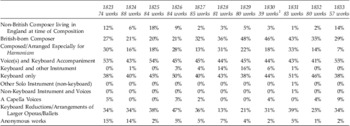
One attempt to increase variety and access to playable ‘amusements’ was the effort in 1830 to publish the printed sheet music supplements scattered amongst the literary component of the journal rather than bound separately. Naturally this had practical limitations: for those who wanted to place the music on a piano stand, the pages of ‘Chit-Chat’ and ‘Miscellaneous Essays’ would have been in the way. Also, as is evident in Table 1, this was such an impractical design that only half the quantity of sheet music was presented in the 1830 issues as compared to the other years of the journal. Nevertheless, it is indicative of an effort to increase sales, since the inclusion of compositions amidst literary discourse emphasized the journal's close correlation of commentary and music. George Hogarth, for instance, described the 1830 design as a ‘great improvement’.Footnote 91 However, many found the design completely impractical for actually playing the inserted music, and the old format was restored by the following year.Footnote 92
Percentages of genres of national and international music printed in the Harmonicon

1See my discussion above, to the effect that in 1830 the sheet music was published within the body of the written criticism, and the practical limitations of this design led to there being less published music during this year.
What the proprietors of the Harmonicon would have thought about the concept of miscellany as a regulative aesthetic principle on a conscious level is difficult to know. What can be said is that on some level miscellany, and what lay behind it – the drive to appeal to the public through variety rather than homogeneity – is a factor that is both explicitly and implicitly alluded to throughout the years of the journal. For example, in the journal's first issue, the Concerts of Ancient Music – one of the very few specialized concert genres in existence in London at the time – were scathingly critiqued for their lack of variety and their connotations of aristocratic snobbery:
It is much to be lamented that the direction of these concerts should be left entirely to noblemen, who, without considering the general disappointment it occasions to a great body of the subscribers, are satisfied with a repetition, from year to year, of the very same pieces of music, both vocal and instrumental. There is less excuse to be made for such supineness and indifference, when we know that they are in possession of a very scarce and valuable musical library, from which a constant variety of the finest compositions of the best masters might be selected. We mean no disrespect to the noble directors; on the contrary, we applaud them for the patronage they have so long bestowed upon this excellent institution; but the superintendance [sic] of such concerts should be intrusted [sic] to a professional man, who should have authority to recommend, at least, the pieces to be performed, thus varying the performances of each season.Footnote 93
This sentiment was similarly expressed in one of the Harmonicon's 1831 reviews of the Philharmonic concerts, in an article proposing that, regardless of whether one genre was superior to the other, the solution to the problem of too much Italian vocal music was not to replace it entirely with German symphonies, but to have an equal variety amongst the different styles.Footnote 94
Miscellany was thus in fact operative in concert programming even for an elite organization such as the London Philharmonic Society, which ruled out much music performed at other venues, such as the Hanover Square and Argyll Room concerts.Footnote 95 For although the Philharmonic Society initially set out to perform only orchestral music, it ended up giving way to formats of miscellany in programming its concerts well into the nineteenth century, inserting the odd Rossini or Mozart aria to break up the weighty tones of a Beethoven symphony.Footnote 96 In an 1831 review of a Philharmonic Society concert, the Harmonicon stated that in order to be able to appreciate works by the ‘three great masters’ (Haydn, Mozart, Beethoven), one should compare them with less significant works:
It is necessary for the sake of variety, and to prevent the too frequent recurrence of works of high art, which are, unhappily, very limited in number, to introduce now and then a symphony not standing in the same rank with those of the three great masters; and this will account for the occasional performance of Spohr's in E [flat], which is a production of labour not of genius …Footnote 97
Thus we can understand why Ayrton advocates listening to Spohr even though he finds the symphony in question ‘an unintelligible mass’, and accuses the composer of having a ‘dry, unfruitful manner’ of putting the work together.Footnote 98
A Miscellany of Sheet Music
Since the Harmonicon was directed towards the amateur, the overall tone and format of the journal aimed to be very practical – ‘at times aggressively so’, as can be seen not only in the reviews of music but in the large space given to sheet music.Footnote 99 Indeed, the practicality of incorporating sheet music, which was likely pulled out from the binding and separated from the literary part of the journal upon purchase, has made finding entirely intact volumes of the journal today very difficult.Footnote 100 Regrettably, this lack of availability has exacerbated the problem of the Harmonicon's sheet music being too often denigrated as less interesting than the journal's written criticism.Footnote 101 However, the sheer diversity of these scores is significant because it reflects the Harmonicon's willingness to embrace miscellany as a guiding force in publishing works for the public's enjoyment, and also shows the close relationship of the journal to a wide variety of active composers. As Table 2 shows, numerous works were composed or arranged for, and/or dedicated to, the journal.
Frequency of Publication of Composers’ Works in the Harmonicon
• This graph covers all of the composers of the sheet music published in the Harmonicon, 1823–1833.
• Composers are listed alphabetically.
• Each numeral indicates the number of times the given composer's work(s) was or were published in the relevant year.
• A numeral in bold indicates that the work was composed or arranged expressly for the Harmonicon (if rearranged, this was often done by someone other than the composer, most obviously if the composer was dead before the Harmonicon was ever published). Therefore, if only the text of a song has been translated for the Harmonicon, but none of the music changed, the numeral will not be in bold.
• If only a portion of the works by a given composer were composed or arranged for the Harmonicon, for example 2 out of 5, then they will be listed as follows: 5(2).
• Blank boxes indicate that no works were published by a given composer during that year.

In Table 1 (above), I have formulated a numerical demonstration of the international varieties of sheet music published in the Harmonicon. The numbers of foreign as opposed to local compositions appear to resist undue tension, as Ayrton often intermixes their order so that works by British and foreign composers occur interchangeably. There seems to be an almost intentional refusal to make distinctions between the local and the international, or amateur and professional compositions; rather, the journal often rated ‘amateur composers favourably in comparison to certain professionals’.Footnote 102Table 1 also shows the percentages of different categories of sheet music in the Harmonicon for each of its printed volumes.Footnote 103 In each case, the percentage was calculated in relation to the number of works published during the respective years. The number of British composers in relation to foreign composers is interesting, for during 1829 and 1830 they made up almost half of the entire output of the Harmonicon's sheet music.
Works by non-British composers living in England at the time of composition are placed in a separate category from the British composers since, although composed in Britain, these works by and large retained Continental musical styles.Footnote 104 The publication of foreign music in Britain had, indeed, been an ‘established practice long before the middle of the eighteenth century’,Footnote 105 and was prevalent in the Harmonicon in order to mix and counterbalance foreign music with local talent to ensure variety. That said, the sheer extent of the measures Ayrton took to include works of British composers was comparatively unusual for its day. A tendency of other British publishers to overlook or ‘disparage their own composers’Footnote 106 is noted by a ‘Constant Reader’: ‘I cannot help feeling pleased whenever I take up your valuable work to perceive that you have escaped the fashionable influenza – a malady which prevails to a considerable extent, in this country – that of admiring only foreign music’.Footnote 107 The high level of the inclusion of British compositions for the sake of miscellaneous variety is likely a testament to Ayrton's initiative to cater to the wide variety of music that would be attractive for the amateur to collect and play, and, judging by the high number of compositions dedicated to the journal, a forum for his musical friends and colleagues to publish their music.
Rather than a dramatic or even gradual change in taste over the years, the one steady factor in all of the numbers in Table 1 is the fact that the journal's music was consistently miscellaneous. Works composed or arranged expressly for the Harmonicon waned, perhaps because composers were aware of the financial troubles of the journal. Yet through its struggles the journal never changes from miscellany to anything more homogenous: the vast majority of music is always suitable for the amateur. It is almost always written for the keyboard or for the voice and keyboard, and fairly easy to play and sing, with piano writing that usually fits nicely under the hand, particularly in arrangements of operatic or symphonic repertoire.
In terms of genre there is a preference for the type of piano music produced by or associated with the London Pianoforte School: composers such John Baptist Cramer (1771–1858) and Johann Nepomuk Hummel (1778–1837) were, for the Harmonicon, synonymous with good taste because of their ability to encompass stylistic variety within their compositions themselves. As King posits, ‘their music … tempers modern mannerisms with some admirable features of the Classical, or “ancient” style’.Footnote 108 The accessibility of such works conformed to Ayrton's aesthetic ideals: works that emphasized clear, fine melodies but which were also applicable to a modern style were suitable for the amateur.Footnote 109 Such preferences for amateur-appropriate music also enabled Ayrton to avoid much of the modern virtuosic pieces that he so disliked.Footnote 110 However, semi-virtuosic works are occasionally present, demonstrating just how much Ayrton wanted the sheet music portion of the Harmonicon to function as an ‘objective’ exposé of all the music he could access, both locally and internationally.
A Miscellany of Composers
Regarding the range and diversity of the composers represented in the Harmonicon, consider the information summarized in Table 2, which lists every composer published in all 11 years of the journal's existence (anonymous works are not counted as they are in Table 1.)
Each year displayed in Table 2 has roughly the same number of works published (around 80), with the exception of the re-formatted 1830 volume (note that 1833 would have had a similar number of works to the other years, but the journal only published issues until September of that year). Moreover, during all 11 years Ayrton reliably continued to introduce works by a large number of new composers. It would appear that, in being ‘miscellaneous’, the journal was consistently indiscriminate in its choice of works for publication, particularly when it came to the lesser-known composers. By and large, most of the composers presented only had a work published once or twice. The composers most widely featured are usually either ‘canonical’ composers or names that nineteenth-century music specialists would recognize, which suggests that Ayrton had an awareness of an emerging canon despite his inclination to cover it up through miscellany. There is also a nod here in the direction of two different emerging aesthetic categories: the opera, and works for the concert stage. The appearance of these two categories side by side within the journal's sheet music must have been an intentional and possibly contentious act, given the acknowledgement of the aesthetic discrepancies between these two styles in the journal's written criticism.
The ‘canonical’ or at least fairly well-known names who appear frequently in the graph are as follows: Attwood (only in the early years), Auber, Beethoven (extremely popular, 35 in total), Boieldieu, Czerny, Diabelli, Handel, Haydn (quite popular, 16 in total), Hummel (very popular, 20 in total), Mehul, Meyerbeer (although all 14 works were published in the same year), Moscheles, Mozart (very popular, 26 in total), Purcell, Ries (only in the early years), Rossini (very popular, 30 works in total), Spohr (11 in total), Weber (the most popular, 47 in total), and Weigl (11 in total). It is interesting to see just how early in the nineteenth-century this was, since J.S. Bach is nowhere listed, although C.P.E. Bach appears once.Footnote 111 The ‘canonical’ composers that one might expect to be popular are, indeed, Beethoven, Mozart, Rossini and Weber, and Weber's higher number of publications than Beethoven probably attests to the fact that he visited and died in London in 1826 (an event well-marked by the Harmonicon),Footnote 112 as well as to the fact that he was an opera composer, and his works were easily reducible to playable reductions. Rossini is second to Beethoven in popularity, and the prevalence of Mozart, although no longer living, is no surprise given both the popularity of Mozart in London and Ayrton's personal adulation of this composer.Footnote 113
It is the lesser-known composers, many of them living in England, who composed, arranged, or dedicated their works for the Harmonicon (represented by bold numerals in Table 2), and it is in this category also that most of the female composers appear. Many of the works ‘arranged for’ the Harmonicon are possibly re-worked by Ayrton himself, especially when the composer was no longer living at the time of publication.Footnote 114 However, the number of works expressly ‘written for’ or ‘dedicated to’ the Harmonicon by living composers suggests not only the many friends and connections that Ayrton had in London, but also the national and international prestige of the journal, as certain dedications or ‘presentations’ are from subscribers living abroad. The fact that both Tables 1 and 2 reflect the decline in the number of works composed or arranged for the Harmonicon in the later years of the journal is a probable indication of the journal's failing popularity towards its end. At the same time, it can be said that many composers, including names such as Ferdinand Ries (son of Beethoven's teacher Franz Ries), saw the Harmonicon as a good avenue for publication of works – hence Ries’ stipulation on all of his works listed here that they were specifically ‘composed for’ the journal.
However, many well-known composers of the day such as Clementi and Mendelssohn are barely represented, which is especially surprising given Mendelssohn's presence in London in 1829. It is even more surprising that there are only two works by Paganini, given the overwhelming attention lavished upon his sensational tours in the literary part of the journal in 1829. Then there is the high percentage of works by dead composers, revealing Ayrton's awareness of history and a certain consciousness about making deliberate decisions concerning precisely what a miscellany of published works should cover. He appears to want to include a tangible sense of the classics – for example, in presenting a work each by Lully, Pergolesi, Purcell and Morley, which both correlates with the aim of the journal (to introduce the music of different schools, including those of the past) and goes against the aim of the ‘New Series’ (to embrace articles and music that are light in tone).
While all of this information does evidence a ‘miscellany’ of works, there are nonetheless also elements of canon-formation. Yet despite the fact that Ayrton would himself have been entirely happy to have shown a preference for Mozart, Beethoven and Rossini, the argument for the journal as an example of miscellany becomes even stronger considering that no one composer was featured in all of the 11 years. Even though Beethoven, Hummel, Mozart, Rossini and Weber come close, Ayrton omitted works by all of these men periodically. There is thus no sense that any one composer ‘absolutely must’ be included all of the time, despite the obvious popularity of a few pivotal names.
The Disintegration of Miscellany after the Harmonicon
Six months before the final issue of the Harmonicon in September 1833, the Westminster Review published a paean for the journal:
At the head of the list of periodical works, for the extent of information and comprehensiveness of aim, necessarily stands the Harmonicon. He is the chef d’état-major of the musical forces. Nothing is too much for him, or too little. He can tell all operas, that were performed at all seasons, at every court from Petersburgh to the Tagus. He knows the Professor in Denmark, who plays the best fantasia in 5/4; and commemorates the first public concert ever performed in Australasia. Of all musical speculations he is the great repository, from the gnarled mysteries of the scale, to the pin of a clavichord. Finally, he has the reputation of being the only English power that could rule the microcosm of the Opera.Footnote 115
Throughout its entire print run, the Harmonicon had cherished its ‘great repository’ of sundry topics and diverse music, and had remained staunchly unreconciled to the swiftly homogenizing concert culture of early romanticism (although its immediate failure was for more pecuniary than aesthetic reasons).Footnote 116 This transformation resulted in the rapid commodification of what later became the nineteenth-century specialized types in London's concert life: the very separate realms of the solo virtuoso concert, the benefit concert, the intimate seriousness of the string quartet, or the more introspective, sustained listening required for a performance of the romantic symphony. All of these genres required increasingly specialized audiences, which began to threaten the popularity of miscellaneous concerts by constructing new and unprecedentedly draconian aesthetic hierarchies of taste. The Harmonicon's presentation of an eclectic interest in so many facets of London's musical life would not have offered sufficient depth for the serious, specialized devotees of the genres of opera, symphonic music and chamber music respectively, as did later nineteenth-century concert structures. Despite the fact that many long-standing principles of miscellany, such as relatively equal exposure to vocal and instrumental music, remained in place well into the nineteenth century, emerging specialist concert forms, such as the string quartet, exacerbated taste hierarchies and changed the concept of collegiality at concerts.Footnote 117
Weber identifies the disintegration of miscellany, followed by ‘Classical music achieving hegemony’, as occurring decisively from the Revolutions of 1848, after which emerged a ‘new social order’.Footnote 118 Although concert programmes tended to remain slightly more miscellaneous in London than in Vienna or Paris, ‘classical music (in London) was viewed in just as strict terms ideologically’.Footnote 119 By the second half of the century, the term ‘miscellany’ itself was becoming taboo in the public press; instead, the word ‘serious’ became dominant.Footnote 120 ‘Miscellany’ began to adopt connotations of the unserious or the ephemeral that it still carries today – connotations that are at odds with the didactic, measured and educated efforts of Ayrton's editorial decisions.
In conclusion, the Harmonicon was an enormously successful journal with implicit, encrypted didactic and sub-canonical leanings, all of which were presented under the guise of avoiding specialization. The subscribers to the Harmonicon gained from the journal not only a ‘who's who’ of British and foreign musicians, but also a guide to understanding music through inclusive variety. Unfortunately for the journal, this collegial-cosmopolitan outlook began to wane as a marketable ploy towards the middle of the 1830s, due to the homogenization of concert and print genres of music. Consequently, no similarly structured musical journals would ever succeed the Harmonicon in influence. Although London's musical life was to retain remnants of miscellany throughout the rest of the nineteenth century, the widening gap between the types of audiences attending different varieties of concerts, and an increasing hierarchical construction of musical taste, caused the simpler outlines of a journal like the Harmonicon to lose its direct appeal.
Thus, what might appear on the surface to be a disjuncture between the undiscriminating variety of music covered in the journal and Ayrton's personal adoration of Mozart and Beethoven is in fact the very thoughtful process of an editor under the constraints of what I would like to call the ‘polite miscellaneous marketing’ of early nineteenth-century British culture. It would not have been collegial or financially lucrative to turn the Harmonicon into a Beethoven journal. However, by the time the periodical ended, miscellany was a dying principle, and publishers (musical and non-musical) gradually began to desire specialization. Perhaps the social context of the Harmonicon can help us to reassess the implicit politics of music writing and publishing throughout the rest of the nineteenth century and beyond. One wonders, for example, what Ayrton would have thought of the extreme disjuncture between our overspecialized music writing versus our even more radically miscellaneous music consumption today. Tensions regarding how to write about and experience canonical versus miscellaneous repertoires are arguably still just as prevalent.