Introduction
Approximately 50,000 patients per year present at emergency departments (EDs) because of carbon monoxide (CO) intoxication.Reference Hampson and Weaver1 Diagnosis may be difficult as CO is a colorless, odorless, tasteless, non-irritant gas and patients often present at EDs with non-specific toxicological symptoms.
Carbon monoxide shows approximately 200-times more affinity to hemoglobin compared to oxygen, and its half-life can reach four to five hours.Reference Bleecker2 Therefore, it primarily affects the tissues with high-oxygen consumption, such as the brain and heart, causing symptoms to develop.
Typical symptoms of CO intoxication include headache, nausea, dizziness, and fatigue, and at advanced levels, loss of consciousness, syncope chest pain, seizure, and respiratory distress.Reference Bleecker2,Reference O’Donoghue and O’Donoghue3
Together with these symptoms, the diagnosis is made from a high carboxyhemoglobin (COHb) level in arterial blood gas. The level of COHb, which can be normally seen in blood gases up to three percent, can rise to 10% in smokers, and values above this are considered toxic.Reference Bleecker2
Oxygen therapy is applied to such patients. It is aimed to reduce the half-life of CO by applying normobaric high-flow oxygen or hyperbaric oxygen (HBO2). The half-life is approximately 40–60 minutes on average with normobaric high-flow oxygen and approximately 15–30 minutes in HBO2.Reference Bleecker2
The hypothesis of this study was that compared to high-flow oxygen treatment, CO half-life and the regression period of complaints could be reduced more quickly by administering oxygen through the Continuous Positive Airway Pressure (CPAP) modality with the help of non-invasive mechanical ventilation in patients diagnosed with CO intoxication in the ED and applied normobaric high-flow oxygen therapy.
Methods
Study Methods
This prospective study was conducted on patients diagnosed with CO intoxication in the Southern Region Public Hospitals Association Health Sciences University İzmir Bozyaka Training and Research Hospital Emergency Medicine Clinic (Izmir, Turkey). Patients who were stable and received the diagnosis of arterial blood gas and CO intoxication (COHb > 10% in blood gas) following the completion of the necessary examinations and tests by an attending physician in EDs were informed about the study. A voluntary consent form was received from patients who agreed to participate in the study. Patient information was recorded on the data record form.
Approval for the study was granted by Izmir Bozyaka Training and Research Hospital’s Ethics Committee for Clinical Trials. Ethics Committee protocol number is 24.3.15/7.
Patients were excluded if vital functions were unstable; if the Glasgow Coma Score was <15; there was a history of somnolence, syncope or seizure, chest pain, or shortness of breath; if they were pregnant; or aged <18 years.
The patients were divided into Group 1 and Group 2 in terms of the treatment method applied. They were divided into groups according to admission to the ED (eg, first patient to Group 1, second patient to Group 2, third patient to Group 1, and fourth patient to Group 2). It was planned to include 40 patients in each group, and patients were assigned to the groups according to order of arrival at the ED.
Patients in Group 1 received FiO2 1.0 15 l/minute oxygen at room temperature for at least 30 minutes with a non-rebreather mask. Patients in Group 2 received FiO2 1.0 oxygen at 12 cmH2O pressure with non-invasive mechanical ventilation for at least 30 minutes with an oronasal mask in CPAP modality.
The COHb levels of the patients in both groups were measured using non-invasive pulse CO-oximeter at the beginning of the treatment (zero minutes) and after 30 minutes of treatment; data were recorded on the data record form.
The patients were questioned about the complaints of headache, nausea, dizziness, and weakness and were asked to grade the relevant symptoms on a Likert scale (zero = absent; 10 = very severe).
The COHb levels of the patients in both groups of the current study were measured using a MASIMO Radical-7 (Masimo; Irvine, California USA) portable pulse CO-oximeter device from the right-hand second finger of the patients. A Philips Resipronics A 40 (Philips; Seoul, South Korea) device was used for non-invasive mechanical ventilation.
Statistical Analysis
Statistical analyses of the variables were performed using SPSS 22.0 (IBM Corporation; Armonk, New York USA) and PAST 3 software (PAleontological Statistics [PAST]; online software). Conformity of the data to normal distribution was assessed with the Shapiro-Wilk test and to multivariate normal distribution with the Mardia (Dornik and Hansen omnibus) test. The Mann-Whitney U test was used with the Monte Carlo results in the comparisons of two independent groups according to the quantitative data. The Wilcoxon Signed Ranks test was used to compare two repeated measures of dependent quantitative variables. The Pearson Chi-Square (Exact) test was applied to compare categorical variables. Quantitative variables were shown as mean (standard deviation [SD]) and median range (Maximum/Minimum) and median interquartile range (IQR) values, and the categorical variables were shown as number (n) and percentage (%). Variables were examined at a 95% confidence level and a value of P <.05 was accepted as statistically significant.
Results
Of the patients who agreed to participate in the study, 40 were included in Group 1 and 40 were included in Group 2. In Group 2, three patients were excluded from the study because they were uncomfortable with the oronasal mask during the treatment, so final evaluation was made of 37 patients.
Of the total 77 patients included in the study, 48 (62.3%) were female. The gender distribution in the groups is shown in Table 1.
Gender Distribution of the Groups

Mann Whitney U Test (Monte Carlo) - Pearson Chi-Square Test (Exact)
The mean age of patients was 42.95 (SD = 19.43) years (range: 18–93 years). The median age in Group 1 and Group 2 were 43 years and 35 years, respectively (Table 2).
Age Distribution of the Groups

Mann Whitney U Test (Monte Carlo) - Pearson Chi-Square Test (Exact)
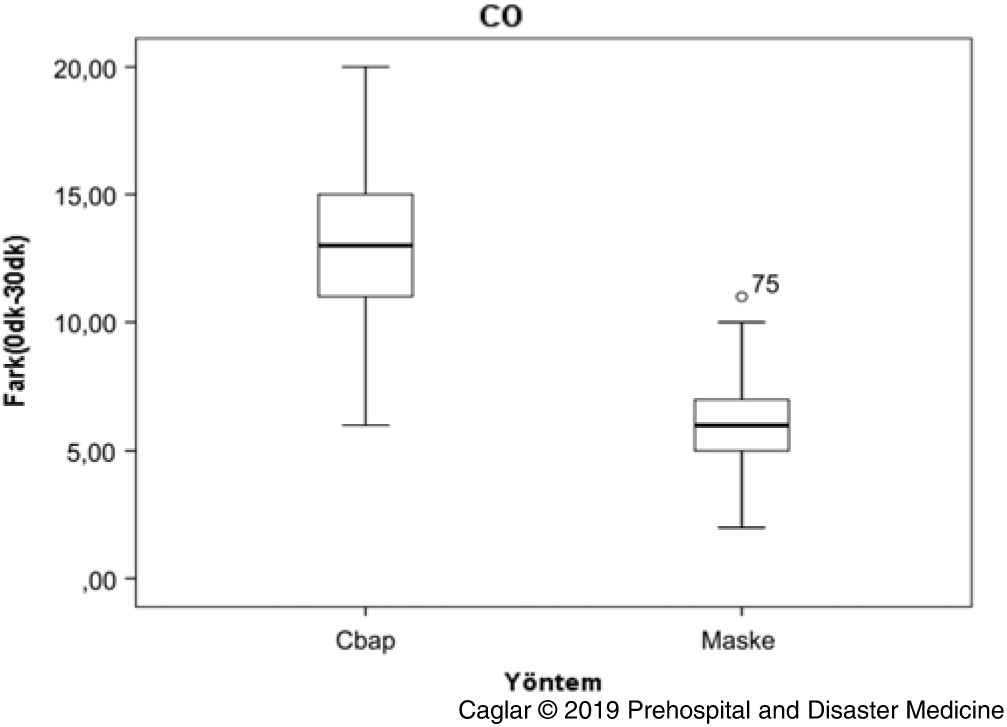
The median values of COHb levels at zero and 30 minutes of patients in Group 1 and Group 2 were 19% and 14% in Group 1 and 22% and nine percent in Group 2, respectively; a median difference of six percent was detected in Group 1 and of 13% in Group 2 in the first 30 minutes (Table 3; Figure 1).
Change of COHb Levels in the Groups

Abbreviation: COHb, carboxyhemoglobin.
Mann Whitney U Test (Monte Carlo) - Wilcoxon Signed Ranks Test (Monte Carlo) / Max.: Maximum - Min: Minimum IQR: Interquartile Range
Change of COHb Levels in the Groups.

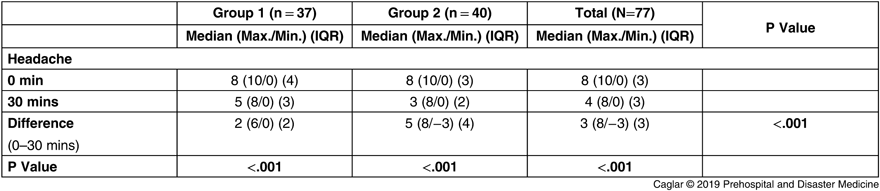
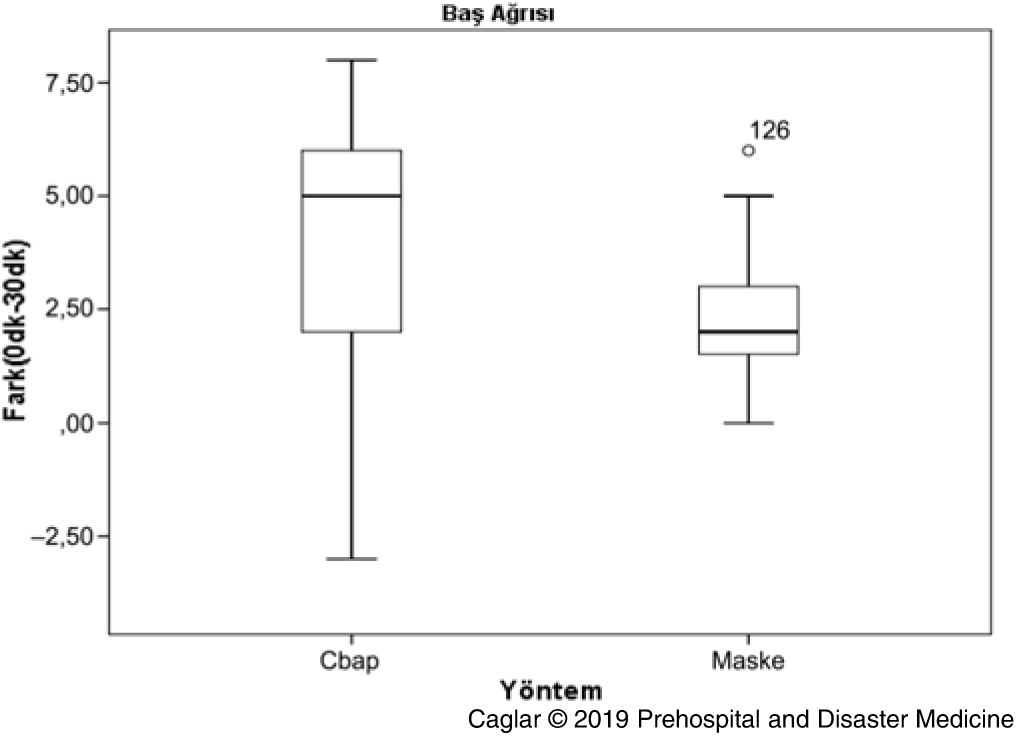
When the headache symptoms of the patients were examined, the median values of Group 1 and Group 2 at zero minutes were both eight units, and at 30 minutes were five and three units, respectively. A decrease was determined of five units in the median of Group 2 in the first 30 minutes and a decrease of two units in the median of Group 1 (P <.001; Table 4; Figure 2).
Distribution of Headache Symptom in the Groups

Mann Whitney U Test (Monte Carlo) - Wilcoxon Signed Ranks Test (Monte Carlo) / Max.: Maximum - Min: Minimum IQR: Interquartile Range
Change of Headache Symptom in the Groups.

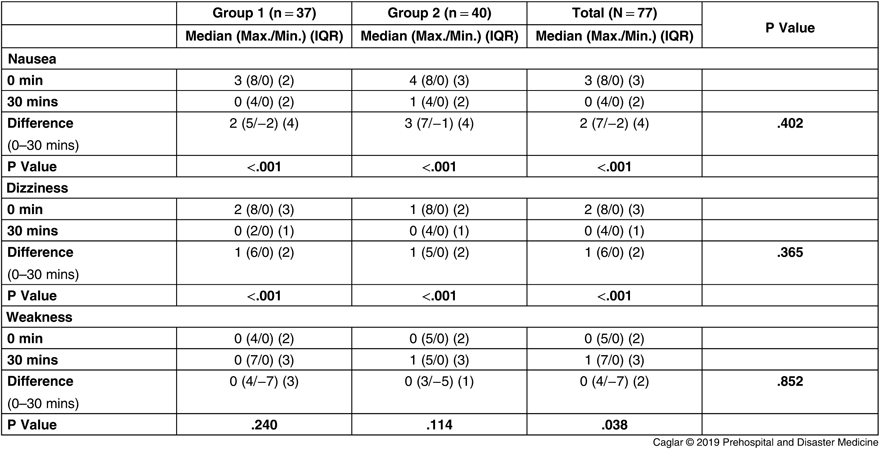
Although there was a statistically significant decrease in nausea and dizziness in both groups in the first 30 minutes, no statistically significant difference was found between the groups (P = .402; Table 5).
Changes in Complaints of Nausea, Dizziness, and Weakness in the Groups

Mann Whitney U Test (Monte Carlo) - Wilcoxon Signed Ranks Test (Monte Carlo) / Max.: Maximum - Min: Minimum IQR: Interquartile Range
No statistically significant difference was determined between the groups in the first 30 minutes in terms of weakness.
Discussion
Carbon monoxide intoxication is frequently encountered in EDs, and it requires a good anamnesis and a high-level of suspicion from the history.Reference Iqbal, Law, Clower, Yip and Elixhauser4 Normobaric or HBO2 therapies are applied as current treatment approaches. In both treatments, it is aimed to remove the CO more rapidly from the tissues by increasing the partial oxygen pressure in the blood.Reference Bleecker2,Reference Prockop and Chichkova5,Reference Roderique, Josef, Feldman and Spiess6 In the present study, unlike the standard therapy, oxygen was administered to patients by creating high pressure with the help of a non-invasive mechanical ventilator. It was determined that the COHb level in the group applied with CPAP regressed in the first 30 minutes twice as quickly as that of the standard group (six versus 13). However, the rate of regression of headache, one of the major complaints of the patients, in Group 1 was twice as fast as that of Group 2. There was no significant difference between the two groups in terms of other symptoms. Although there is no similar study in literature, the half-life of COHb is reported to be 40–60 minutes with Fio2 1.0 oxygen and 15–30 minutes with HBO2 under normal pressure. In the present study, it was determined that the use of CPAP was almost the same as that of HBO2 in terms of the half-life of COHb.
However, in the present study, it was seen that three patients could not tolerate the CPAP use. The administration of oxygen at high pressure with a closed mask can cause a claustrophobic effect with complaints such as the feeling of drowning and nausea in some patients. This limits the use of the CPAP modality.
Limitations
A limitation of the present study is that there was no evaluation of late neurological disorders, which are one of the important effects of CO intoxication. There is a need for further studies to investigate late neurological disorders with similar treatment modalities.
Conclusion
The use of CPAP was determined to more rapidly reduce COHb level as opposed to high-flow oxygen therapy. It is also thought that it may enable earlier discharge by reducing the duration of the emergency follow-up since it provides a faster improvement in the symptoms of the patients.
Conflicts of interest
none