


Literature on censorship emphasizes its role in reducing and silencing opponents through press and internet controls (Dimitrov Reference Dimitrov2014; King, Pan, and Roberts Reference King, Pan and Roberts2015; Lorentzen Reference Lorentzen2014), aligning with a broader literature on the role of repression in eliminating dissent (Davenport Reference Davenport2007; Svolik Reference Svolik2012). However, most dictators seek not only to suppress opposition but also to ensure the support of their backing coalition (Bueno de Mesquita et al. Reference de Mesquita, Bruce, Siverson and Morrow2005). Autocrats adopt a variety of policies to ensure such support, from economic concessions to propaganda (Wintrobe Reference Wintrobe2000). Though censorship is typically understood as a punitive strategy to stifle opponents, this article develops and tests the theory that censorship—in particular the censorship of popular culture—also serves as a policy reward to authoritarian supporters.
Existing literature proposes two central theories to explain censorship, both focused on limiting access to opposition information. State critique theory suggests that autocrats ban materials critical of the state as a means to limit dissatisfaction, though this also constrains the regime’s ability to monitor dissent (Chwe Reference Chwe2013; Dimitrov Reference Dimitrov2014, Reference Dimitrov2015; Greitens Reference Greitens2013; Hassid Reference Hassid2012; Lorentzen Reference Lorentzen2014; Policzer Reference Policzer2009). Collective action potential theory claims autocrats target materials that facilitate or inspire mobilization. By allowing criticism but suppressing dissent, the regime can gain performance information while controlling citizen behavior (King, Pan, and Roberts Reference King, Pan and Roberts2015).
While this work focuses on press and internet censorship, dictators often prohibit materials even outside the explicitly political realm, from books to visual art: Saudi Arabia banned movie theaters for 35 years, and Argentina’s last dictatorship banned hundreds of songs, including Rod Stewart’s “Do You Think I’m Sexy?” In 2017, more than 550 violations of artistic freedom were documented across 78 countries (Freemuse 2018). Yet despite being widespread—and despite the fact that, normatively, the ability to produce or consume art is considered a human right (Brett Reference Brett1998)—we know little about why dictators censor entertainment (Ballesteros Reference Ballesteros1981; Morais Reference Morais2017). Such pop culture controls are particularly puzzling because existing research suggests that, if anything, access to entertainment mollifies opposition (Kern and Hainmueller Reference Kern and Hainmueller2009; Wedeen Reference Wedeen1999).
This article provides evidence that pop culture censorship serves not only to limit political content, as existing theories suggest, but also to reward dictators’ supporters. Most authoritarian regimes serve “winning coalitions” that they rely on to maintain power (Bueno de Mesquita et al. Reference de Mesquita, Bruce, Siverson and Morrow2005). Dictators adopt a variety of policies to sustain such backing, from quasi-democratic institutions to the distribution of private or public goods (Albertus Reference Albertus2015; Blaydes Reference Blaydes2010; Bueno de Mesquita et al. Reference de Mesquita, Bruce, Siverson and Morrow2005; Carter and Carter Reference Carter and Carter2016; Gallagher and Hanson Reference Gallagher and Hanson2014; Gandhi and Lust-Okar Reference Gandhi and Lust-Okar2009; Magaloni Reference Magaloni2008; Morrow et al. Reference Morrow, de Mesquita, Siverson and Smith2008; Svolik Reference Svolik2012; Truex Reference Truex2017). Closest to censorship, propaganda allows the state to enforce order and spread its ideology (Carter and Carter Reference Carter and Carter2016; Geddes and Zaller Reference Geddes and Zaller1989; Guriev and Treisman Reference Guriev and Treisman2015; Rozenas and Stukal Reference Rozenas and Stukal2017; Treisman Reference Treisman2018).
In contrast to methods of cooptation, censorship is typically understood as a strategy of denial to limit opposition access to information. However, literature on authoritarian censorship often overlooks that many individuals support such government controls. This has been widely documented in democratic contexts, where pro-censorship positions are linked to the belief that entertainment may incite delinquency in others (the “third-person effect”) (Davison Reference Davison1983; Rojas, Shah, and Faber Reference Rojas, Shah and Faber1996). Evidence similarly shows that citizens in authoritarian countries often support limits on certain materials, due to the third-person effect (Gunther and Hwa Reference Gunther and Hwa1996) or due to religious or ideological convictions and socialization (Boas Reference Boas2004; Pietiläinen and Strovsky Reference Pietiläinen and Strovsky2013; Wang and Mark Reference Wang and Mark2015). Saudi Arabia’s internet censorship, for example, “has been strongly influenced by the pressures of a conservative society … and considerable societal support for censorship” (Boas Reference Boas2004, 440). This suggests that some citizens view bans as a social good.
I argue that regimes use popular culture censorship not only to eliminate political expression but also to appeal to supporters. This research suggests that some citizens actively want entertainment bans. Where regime supporters favor censorship, governments can use bans on certain types of materials as a form of policy reward. Censorship supporters may lack the influence to enact such prohibitions in democracies due to both a wider selectorate and norms and laws that are related to freedom of expression. As backing coalitions in autocratic systems, however, they offer strong incentives to ban content. This way, authoritarian rule offers a benefit to supporters—censorship of materials deemed offensive—that democracies typically cannot.
Relative to political theories of censorship, censorship as a policy reward generates significantly different expectations for the types of materials that should be banned. Applying state critique theory to popular culture suggests governments should be concerned with negative depictions of like regimes; the collective action potential theory implies portrayals of revolution or opposition ideology should provoke censorship to politically isolate opponents. By contrast, if authoritarian regimes censor content to appeal to their backing coalitions, we should see censorship of materials considered offensive by regime supporters. While these theories are not mutually exclusive, understanding censorship as a reward provides insight into why authoritarian regimes expend resources controlling materials outside the directly political sphere.
To provide evidence for this theory, I draw on original data from all 8,000 films that were reviewed for distribution during Chile’s dictatorship, collected from the archives of Chile’s Council for Cinematic Classification (CCC). Text analysis of film content shows that censorship targeted sexual content, material considered morally taboo, and some especially violent materials, demonstrating that existing political theories of censorship are inadequate to explain entertainment restrictions. Qualitative evidence links this to the pursuit of censorship by regime supporters, particularly conservative groups. Providing additional evidence for bans as a policy reward, the censors most directly linked to Opus Dei were most likely to vote to ban films. The results also provide some evidence in favor of the collective action potential theory: although findings are inconsistent, depictions of communism were also banned.
I additionally address several alternative explanations for my empirical results. Hand-coded metrics and censors’ own comments reduce concerns that immoral material masked political themes. If the regime appointed more conservative censors, it may alternatively be that censor preferences, rather than regime priorities, drive findings. However, democratization had a significant effect on censorship even when all councilors were appointed under the dictatorship and no formal rules had changed. Comparing reviewed films with all those produced using a web-scraped database shows no evidence of distributor self-censorship. Placing Chile in comparative perspective suggests results are unlikely to be the result of the dictator’s idiosyncratic preferences.
This article makes three primary contributions to research on censorship, human rights, and authoritarian stability. First, it extends literature on authoritarian censorship to identify why dictators place controls on content outside the overtly political. By using unique data on movies reviewed during Chile’s dictatorship, this research quantifies the materials most concerning to the regime. Second, though just one in a broader set of strategies, identifying the role of such social policing can improve our understanding of how dictators govern. From restrictions on homosexuality and birth control to propaganda idealizing motherhood, autocrats frequently seek to influence the social sphere. This research provides insight into the political logic behind these behaviors.
Finally, my research highlights the role of regime supporters in influencing authoritarian rule, even seemingly punitive behaviors. Public and private goods provision, quasi-democratic institutions, and propaganda have all been found to increase support for dictatorships (Albertus Reference Albertus2015; Bueno de Mesquita et al. Reference de Mesquita, Bruce, Siverson and Morrow2005). Such strategies of cooptation, however, are typically treated as distinct from punitive policies like state-led violence and censorship. This research shows even repressive behaviors can be used to reward supporters, offering benefits unique to authoritarian rule (Stanley Reference Stanley1996).
Film Censorship as a Reward in Chile
General Augusto Pinochet took power in 1973 in a coup that toppled a democratically elected socialist government that was led by Salvador Allende. Despite widespread use of repression and censorship, Pinochet’s regime enjoyed broad support from the middle and upper classes. These sectors viewed the military government as uniquely capable of fighting the communist threat to Chile, though the danger of leftist subversion was greatly exaggerated through propaganda and CIA intervention (Kornbluh Reference Kornbluh2005). Even years after the coup, the CIA noted Pinochet was “genuinely popular” (CIA 1977). He did not lose power until he called a plebiscite on his own rule, allegedly believing he would win (he received 45% of the vote) (Spooner Reference Spooner1999). The dictatorship relied on this support to prevent restiveness, delay reform, ensure military loyalty, and effectively govern (CIA 1984; Huneeus Reference Huneeus2006). Supporters were predominantly conservative Catholics and Evangelicals (Boas Reference Boas2016).
Along with anti-communism, Pinochet pinned his legitimacy to a “moral mandate” to rule (CIA 1978), claiming to “obtain power from God” (Schuffeneger Reference Schuffeneger1988). The regime promised to use this authority to “cleanse” the country of Marxism and immorality, tightly linked in its rhetoric. Allende threatened the state not only through communism; he “tried to drag the whole country [into] moral corruption” (Junta de Gobierno Reference de Gobierno and Chile1974, 89). Pinochet’s supporters adopted this rhetoric. A former judge recounted how a friend searching Allende’s home became “physically sick” because of the “mountains of [pornography]—the worst kind,” demonstrating Allende was a man “without any moral calibre” (Anderson Reference Anderson1998). Upper-class women agitated for the military coup because they “felt their fundamental values of family and motherhood threatened” (de los Angeles Crummett Reference de los Angeles Crummett1977, 110).
While censorship is typically understood as a punitive measure that is directed at stifling opposition, this article argues that dictators, including Pinochet, use entertainment restrictions to appeal to their backing coalitions. Research has shown that many individuals support prohibitions on certain materials as a form of social good (Boas Reference Boas2004; Davison Reference Davison1983; Pietiläinen and Strovsky Reference Pietiläinen and Strovsky2013; Wang and Mark Reference Wang and Mark2015). This suggests that dictators can use pop culture bans to highlight the benefit of autocracy to supporters: relative to democracy, they have greater capacity to use widespread censorship to manage perceived social threats. The theory of censorship as a reward implies that the Chilean regime should target not only political material but also content judged immoral by the standards of conservative Catholics of the time. By contrast, the state critique theory implies that Pinochet should target content that is critical of right-wing authoritarian regimes, and the collective action potential theory suggests that the state should limit materials that are related to communism or revolution.
Censorship as a reward aligns with a broader literature on governments providing benefits to their base to lock in support rather than target goods towards swing or opposition populations (Calvo and Murillo Reference Calvo and Murillo2004; Cox and McCubbins Reference Cox and McCubbins1986; Magaloni, Cayeros, and Estévez Reference Magaloni, Cayeros and Estévez2017). In the case of censorship, this follows for two reasons. First, unlike more targeted benefits that can be distributed strategically (Magaloni Reference Magaloni2008), censorship is a national policy: entertainment restrictions affect all citizens. In the case of Chile, the preferences of moderates and the leftist populations were more secular, conflicting with the preferences of conservative groups. Second, authoritarian supporters likely viewed censorship more positively as a whole. Entertainment bans are one in a broader set of censorship decisions, some of which more directly target opponents. Pinochet, for example, implemented press censorship, closed newspapers, and burned books.
Supporters and Censorship
In this section, I provide evidence that the regime’s backing coalition did, in fact, agitate for pop culture censorship—and that the regime responded to these calls. Evidence suggests that Pinochet’s upper-class and conservative supporters viewed pop culture censorship as an important goal of their broader social agenda, rallying against materials viewed as deleterious to society. In 1981 a woman’s group leader wrote, “Divorce, abortion, and pornography … are all attacks against the family … . If love and respect are lost, then the family also loses its unity and those who benefit are the Marxists” (La Nación, July 26, 1981, quoted in Power Reference Power, Bacchetta and Power2002, 280). The CCC’s current head stated that the root of moral censorship was simply that Chile was such a “conservative country.”Footnote 1 While CCC decisions were not actively publicized, they served to eliminate offensive materials from view, and their operations were well known—built into the last paragraph of Pinochet’s 1980 constitution.
Powerful conservative organizations played a particularly important role in film censorship, as the mainstream Catholic Church opposed Pinochet. Chilean bishops decried human rights violations: Pinochet’s Interior Minister called the Church “one of the greatest obstacles facing the government” (Santa-Cruz Reference Santa-Cruz2010, 73). Instead, the regime drew support from conservative Catholic organizations, most significantly the sect Opus Dei and lay group Tradition, Family, and Property (TFP). The support of these groups offered three central benefits to the regime. First, they attracted support from the dictatorship’s own base, making their buy-in particularly important to maintain cohesion (Gill Reference Gill1998). Opus Dei, for example, ran private schools for the elites’ children (Blofield Reference Blofield2001). Second, these groups offered moral legitimation that the dictatorship could not receive from the Church. Chile’s ambassador to the Holy See belonged to Opus Dei and arranged for Pope John Paul II to give communion to Pinochet (Morley and McGillion Reference Morley and McGillion2015). The TFP decried the “revolutionary clergy” of the mainstream church (La Iglesia del Silencio en Chile 1976). Pinochet could thus achieve moral legitimation while discrediting opponents in the church as Marxists.
Third, these groups had considerable influence within the government. Jaime Guzmán, the regime’s central ideologue, was a TFP member. He later wrote Pinochet’s Declaration of Principles, which promised to “cleanse our democratic system of the vices that had facilitated its destruction” (Ugarte Reference Ugarte1974). Ruderer (Reference Ruderer2012) describes its close ties to Pinochet’s military and economic group: “[The TFP] must have had the support of the military government.” While Opus Dei denies involvement with the dictatorship, at minimum “many members and collaborators of Opus Dei participated in different public roles” (Monckeberg Reference Monckeberg2016, 658). A founder of an Opus Dei university, for example, contributed to Pinochet’s 1980 Constitution (Monckeberg Reference Monckeberg2016).Footnote 2
Opus Dei and TFP actively pursued pop culture censorship. While they were unlikely to defect from the regime, given their influence the dictatorship still had incentives to pursue policies to reward their support. In 1963, TFP’s newsletter stated, “Those who … manage to stop immoral or agnostic cinema or television would be doing much more for the Counter-Revolution than if they unseated a leftist cabinet” (TFP 1963, 8). During the dictatorship, TFP encouraged censorship internationally, praising boycotts of entertainment depicting sex and violence (TFP 1981a), and the group encouraged “combatting immorality” through “the fight against pornography” and the “retraction of feminism and homosexuality” (TFP 1981b, 12).
The role of these organizations in film censorship became explicit after democratization. When a ban on Martin Scorsese’s The Last Temptation of Christ was lifted, Opus Dei-linked group El Porvenir de Chile took the case to the Supreme Court as representatives of Jesus Christ (Inter-American Courts of Human Rights 2001). Many of the lawyers were TFP members (La Redacción Reference Redacción1997). In another incident, using their considerable lobbying power, they forced a local television channel to cancel a talk show that dealt with “immoral” themes like sexuality and reproductive health by causing advertisers to leave the show (González Reference González1996).
Cultural censorship was consistently blamed on their influence. Social policing was credited to “the conservative press and its allies, particularly a small but highly influential entrepreneurial elite and the Roman Catholic Church” (LaFranchi Reference LaFranchi1996). Chilean legislators themselves blame film censorship on the influence of conservative organizations. In the parliamentary debate that ended film censorship in 2001, one senator offered the following reflection:
We live in a democratic political system, but the debatable and questionable part is if we live in a democratic society… . The influence of recalcitrant and very conservative [groups] remains, such as El Porvenir de Chile, Opus Dei, and other groups … that impose their criteria and vision of things for our country, convinced that they have the truth and absolute wisdom and that all the rest of us are children that need to be protected (Chilean Legislature Reference Legislature2001, 65).
Later in the same discussion, senators discussed the TFP: “Many films will end up being debated in the courts … . On the one hand, there will be lawyers for freedom of expression … and on the other hand there will be [TFP], which is also very well organized, which defends good morals and is well informed about everything happening in this area … who will defend their positions in the courts with great zeal” (164). These statements demonstrate the role of these organizations in upholding film censorship.In line with this article’s theory, this qualitative evidence suggests that film bans served in part as a policy reward to the supporters who backed it. While not inconsistent with the state critique or collective action potential theories of censorship, this suggests that bans should follow the preferences of the backing coalition: rather than target political content alone, the regime should also remove sexual, morally taboo, or highly violent material.
Data and Empirical Strategy
To identify censored content, this article draws from original data on film censorship collected from Chile’s Council for Cinematic Classification (CCC). One challenge of empirically identifying banned content is that we often do not know the full scope of materials permitted. The CCC, however, practiced prior review, meaning that the council rated every movie submitted for domestic distribution since 1938.Footnote 3 This provides a unique opportunity to identify the effects of different content on censorship.
Signaling its importance to the regime, Pinochet reformed the CCC in 1974 and enshrined its functions in the 1980 constitution. Movies could receive a rating of “for all audiences”; for 14, 18, or 21 and over; or banned entirely.Footnote 4 Five councilors were supposed to watch every film, and a median of five did.Footnote 5 As part of the reforms implemented in 1974, Pinochet increased the number of councilors on the CCC from five to 19, drawing them from groups and organizations that predominantly supported the dictatorship: the Ministry of Education (MoE), the armed forces, university rectors, the judiciary, a parents’ group, and journalism schools. Censors were assigned to films based on availability, as most maintained other jobs. Decisions were enforced through theater and video store inspections (Junta de Gobierno Reference de Gobierno and Chile1975).Footnote 6 The Rules of Cinematic Classification defined four broad types of movies to censor: those that “foment or propagate ideas contrary to the fundamental values of the Fatherland or the nation, like Marxism”; that “offend states with which Chile maintains international relations”; that “run contrary to public order, morality, or good customs”; and that “induce antisocial or delinquent behavior.”
Even after democratization, little was known about the CCC’s operations: “The council’s deliberations are secret … . It is impossible to know how [councilors] voted” (Brett Reference Brett1998, 133). However, upon request the head of the CCC granted me access to their archives, which continue to be housed within the Ministry of Eduction. This openness is in part political. Film censorship ended in 2001, and in general transparency around dictatorship-era records increased after Pinochet’s death in 2006. The functional limitations on accessing censorship records also decreased. When I first visited the CCC in November 2017, staff had recently completed the process of moving censorship documents into binders, organized by year, which made them more accessible to researchers. The CCC staff gave me unrestricted access to the file room, where I spent the month photographing every document related to censorship during the dictatorship.Footnote 7
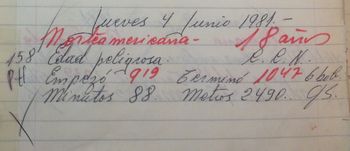
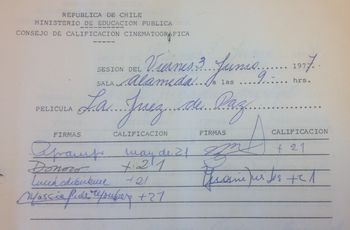
Because the archive is paper-based, to minimize missing data I collected, transcribed, and merged three unique sources. The first, produced by the CCC itself after democratization, catalogues 10,698 movies reviewed between 1938 and 1994. This document lists title, date reviewed, and rating. The second are notebooks recording reviews, a practice that began in 1977 (Figure 1). Unlike the list, which was produced after the dictatorship fell, these notebooks are handwritten and were maintained concurrent to rating decisions. They list the date of review, the country of origin of the film, and the rating. There are missing entries where pages fell out, and some notebooks from 1987 and 1988 have disappeared from the archive. Regressions include fixed effects for year to account for archival practices. The third source, expedientes, are half-page documents filled out by the censors themselves directly after watching a film or advertisement, covering 1970 to 1989 (Figure 2). Each lists the date of review, the Chilean title, censors’ signatures, and how each councilor voted.
Example CCC Notebook Entry

Example CCC Expediente

These three sources—the CCC’s own list of decisions, review notebooks from the dictatorship, and the censorship-decision documents themselves—were then hand-transcribed to collect title, date of review, and rating. For expedientes, each censor signature was assigned a unique code to create censor-fixed effects. Sources were then merged based on the date of review and the title the film was distributed under in Chile, for a dataset of 7,989 films reviewed between 1974 and 1989. To link films to their content, I then matched movies to their original titles by using censorship documents (where such titles were available), alternative title information from the Internet Movie Database (IMDb), or through translation. In total, 91.4% of movies could be matched to IMDb pages.
A concern is that films may be missing from the data in a way that creates bias, particularly if reviews for certain types of films were systematically removed from the archives. Triangulating across sources—and in particular drawing on the paper-based archives maintained during the dictatorship itself rather than just the list of movies produced by the CCC after democratization—reduces these concerns. Reassuringly, results are stable using data from any one source. That archiving occurred in advance of my arrival and was implemented by bureaucrats with little political stake in hiding regime behavior makes bias further unlikely. More broadly, politically sensitive archives in Chile were generally destroyed during the transition: the Ministry of Defense, for example, suffered a “terrorist bombing.” The very fact that film censorship had fairly wide support (and, unlike disappearances, would not result in prosecution) provides greater confidence that the archives were not systematically damaged. Finally, qualitative accounts of movies known to be banned during the dictatorship generally align with CCC records, including for films that were likely censored for political reasons (Olave and Parra Reference Olave and de la Parra2001).Footnote 8 This offers reassurance that political films were not systematically excluded from CCC records.
This data provides a unique window into the process of censorship in authoritarian regimes. One of the challenges of identifying censored content is that we rarely have information about both what was banned and what was permitted (King, Pan, and Roberts Reference King, Pan and Roberts2015). These archives—matched with publicly available information about the content of films—provide a novel opportunity to systematically and quantitatively evaluate the drivers of pop culture censorship.
Dependent Variable
My dependent variable is a binary indicator for whether a film was banned. Table 1 shows a random sample of films banned during the dictatorship and the short description from their IMDb page, highlighting the prominent role of moral censorship. A total of 7.56% of films (604) reviewed were censored during the dictatorship. Figure 3 shows patterns of review and censorship, demonstrating a sharp increase in prohibitions after CCC reorganization in 1974.Footnote 9 Democracies do ban some films, as shown in Online Appendix F.1, which compares censorship before and after Chile’s coup. Still, rates more than double after CCC reorganization, highlighting that Pinochet significantly expanded censorship during his rule.
Selection of Banned Movies

Movies Reviewed and Banned by Year

Text Corpora
To identify content determinant of censorship, I draw on user-submitted keywords and plot summaries from IMDb pages.Footnote 10 For the banned film Bluebeard (1972), keywords include aristocrat, lesbianism, guillotine, serial killer, corpse, uxoricide, and freezer. Its plot summary reads as follows:
Baron von Sepper is an Austrian aristocrat noted for his blue-toned beard, and his appetite for beautiful wives. His latest spouse, an American beauty named Anne, discovers a vault in his castle that’s filled with the frozen bodies of several beautiful women. When confronted with this slight oddity, Bluebeard explains to Anne that he found an easier alternative to divorce when he grew bored with his previous wives. In order to avoid being Bluebeard’s next frozen bride, Anne must find a way to outwit her murderous hubby.
Punctuation and stop words are removed from plot summaries and remaining terms “stemmed”Footnote 11 to produce unigrams. Results in the main paper draw on keywords, as they are more indicative of true meaning: the unigram “bust” may refer to the verb, a statue, or breasts, whereas keywords by definition require no context. They also signal the appearance of features often excluded from plot summaries, as for Bluebeard.
Controls
To account for certain classes of films being persistently less likely to be banned, genre controls are included. Year-reviewed fixed effects address shocks that were influencing CCC decisions or archival practices. All models control for the total number of keywords or unigrams associated with a movie, as text is user-submitted and this may influence the likelihood of particular terms being included.Footnote 12 I include a binary indicator for whether a movie was a VHS, in case whether it was intended for public or private distribution influenced decisions. In models including only films included among the expedientes, I control for censor-fixed effects to take into account whether some censors may be persistently more or less likely to ban movies.Footnote 13
Text Analysis Methods
In order to strengthen confidence in findings, I report two methods of text analysis to identify film content most correlated with censorship. The supervised Indian Buffet Process (sIBP) automatically identifies groups of important terms based on inputting keywords directly; while there is still subjectivity in model selection and parameter choices, this more flexibly estimates content important to censorship. The other method, which I refer to as tracking themes, is based on hand-coding all plot keywords. While dependent on predetermined researcher decisions about categories, this allows the identification of the relationship between various topics—including political issues—directly. Together, they offer greater confidence in overall text analysis results. Both datasets include all films reviewed during the dictatorship that (1) could be linked to an IMDb page, (2) contained at least one keyword, and (3) were not missing information on rating or year of review, for datasets with 6,361 observations.
sIBP
The sIBP is a natural language processing method that identifies “features”—here groups of IMDb keywords—related to an outcome, here censorship (Fong and Grimmer Reference Fong and Grimmer2016). It specifically seeks to identify the effects of multidimensional text on a low-dimensional outcome, meaning that rather than simplify text down to specific words, it groups clusters of terms that co-occur and estimates their effect. The sIBP outputs a predetermined number of features and their relationship to an outcome of interest, here censorship.Footnote 14 Features can be interpreted substantively; for example, a feature containing the keywords “princess,” “frog,” and “cartoon” reflects children’s content.
The program was implemented using the R library texteffect (Fong Reference Fong2019).Footnote 15 The sIBP estimates the average marginal component specific effect for a given feature  $$ k $$ (
 $$ \mathrm{AMC}{E}_k $$) (Hainmueller, Hopkins, and Yamamoto Reference Hainmueller, Hopkins and Yamamoto2014), to identify the influence of a single feature, given that it might vary with others. This is helpful in identifying the effect of film content on censorship, as content may be correlated: nudity may be more likely in romantic films, even if romance is unrelated to bans. The sIBP uses as its input a document-term matrix, indexed by film with keywords as column names.Footnote 16 The model is built on a training set of 50% of observations; effect sizes and confidence intervals are identified using withheld data to avoid overfitting (Egami et al. Reference Egami, Fong, Grimmer, Roberts and Stewart2018). Only keywords appearing at least 25 times are used, to ensure overlap between the training and test sets and for estimation purposes, for a total of 2,419 terms.
Results are sensitive to the starting values of two parameters:  $$ \upalpha $$, which determines how common features are, and
 $$ \upsigma $$, which determines the degree to which features must explain variation in the text. I search across several values of each (Fong and Grimmer Reference Fong and Grimmer2016). Parameter values are then chosen based on a coherence and exclusivity metric and by qualitatively selecting those that produce the most substantively interpretable results (Egami et al. Reference Egami, Fong, Grimmer, Roberts and Stewart2018). Under certain conditions, effects can be considered causal. While the keyword data may meet these conditions, given the degree of flattening from film (a visual, complex medium) to keywords, I interpret results descriptively (Fong and Grimmer Reference Fong and Grimmer2019). Other information, including censor comments left on expedientes, provide greater confidence in text analysis findings. More information about estimation can be found in Online Appendix A.
The sIBP has the benefit of being automated and using keywords as a direct input, meaning human classification decisions have less of an effect on findings. While there is subjectivity in selecting results in order to find the most substantively meaningful models, this means the sIBP can be used to inform and validate decisions about classification. By identifying the marginal effect of a given feature, it can additionally provide greater confidence that correlated content is not driving findings. However, the sIBP cannot track all features of interest, particularly important for content that appears rarely. For example, films about revolution are less common than those with sexual content. If revolution does not appear in sIBP results, it may be due to either the fact that it does not influence censorship or that it appears only rarely in the data.
Tracking Themes
The second method of text analysis relies on manually coding all 38,000 keywords and 28,000 unigrams associated with reviewed films to create a scaled film content measure. I code all terms into four categories: politics, sexual content, gore, and moral taboos. With the exception of gore, each category is additionally broken down into component pieces (Online Appendix A.2) both for clarity of coding and to identify the most significant content influencing censorship. For example, many films contain sex scenes, but these may occur under the covers, or the movie may cut them away. Tracking nudity as a subcategory of sexual content offers a more direct metric of explicit material. Because moral taboos reflect “immoral” behavior as judged from the perspective of conservative Catholics of the time, subcategories are the most granular, ranging from cannibalism to homosexuality.
Categories were determined based on several factors. The most important were the rules of classification provided to the censors themselves, which targeted “ideas contrary to the fundamental values of the Fatherland, like Marxism,” “run contrary to … morality,” and “induce … delinquent behavior.”Footnote 17 This offered broad justification for tracking political, sexual, highly violent, and otherwise immoral content. Second, qualitative evidence, including conversations with CCC bureaucrats, highlighted that immoral content, and to a lesser extent political content, influenced censorship. Descriptions of films that were known to be banned during the dictatorship offered further guidance. For example, it became clear that zombies and cannibalism appeared frequently in descriptions of censored content, so cannibalism appears as a subcategory of moral taboos. The category politics I define as references to revolution, communism, and authoritarianism, all tracked as subcategories. This both aligns with CCC guidelines and offers a more direct test of state critique and collective action potential theories of censorship. The sIBP results additionally validated and shaped tracked themes, offering justification for coding sex and gore.
Each keyword and unigram that appeared on the IMDb page of any movie reviewed by the CCC during the dictatorship was then coded for whether they fall into one of these categories, following the coding scheme in Online Appendix A.2. For each film, the number of keywords associated with each theme and subcategory were summed to create a measure of film content. For example, a movie with the keywords “flesh-eating” and “cannibal” scored a two for the moral taboo subcategory of cannibalism. These content measures were then used in logistic regression where film censorship was the dependent variable, with block-bootstrapped standard errors clustered at the day of review to account for the fact that censors may have watched several films on a given day.Footnote 18 Relative to classifying films into categories directly, this measure allows greater flexibility to track what content influences censorship. Keywords often report content that may not be central to the plot but may be integral to censorship: in Bluebeard, “lesbianism” is a keyword, but it does not appear in online plot summaries. Searching for it directly leads to one review: “Lesson ends with her learning the total ways of lesbianism and Burton drops a pointed chandelier on them” (Variety 1971). Keywords are also typically more straightforward to classify than overall films. Still, to validate the tracking themes metric, I used a sample of hand-coded films to demonstrate that having just one keyword related to an immoral or political theme performs well as a classifier (Online Appendix D.1).
Results
This article argues that pop culture censorship serves not only to limit opposition but also to maintain popular support. Central to this theory is that immoral content is, in fact, censored. The sIBP and tracking-themes methods of text analysis provide evidence that sexual, morally taboo, and certain highly violent content was frequently censored.Footnote 19 While each method of text analysis has its drawbacks, together the results provide confidence that existing political theories of censorship are inadequate to explain the logic of pop culture bans.
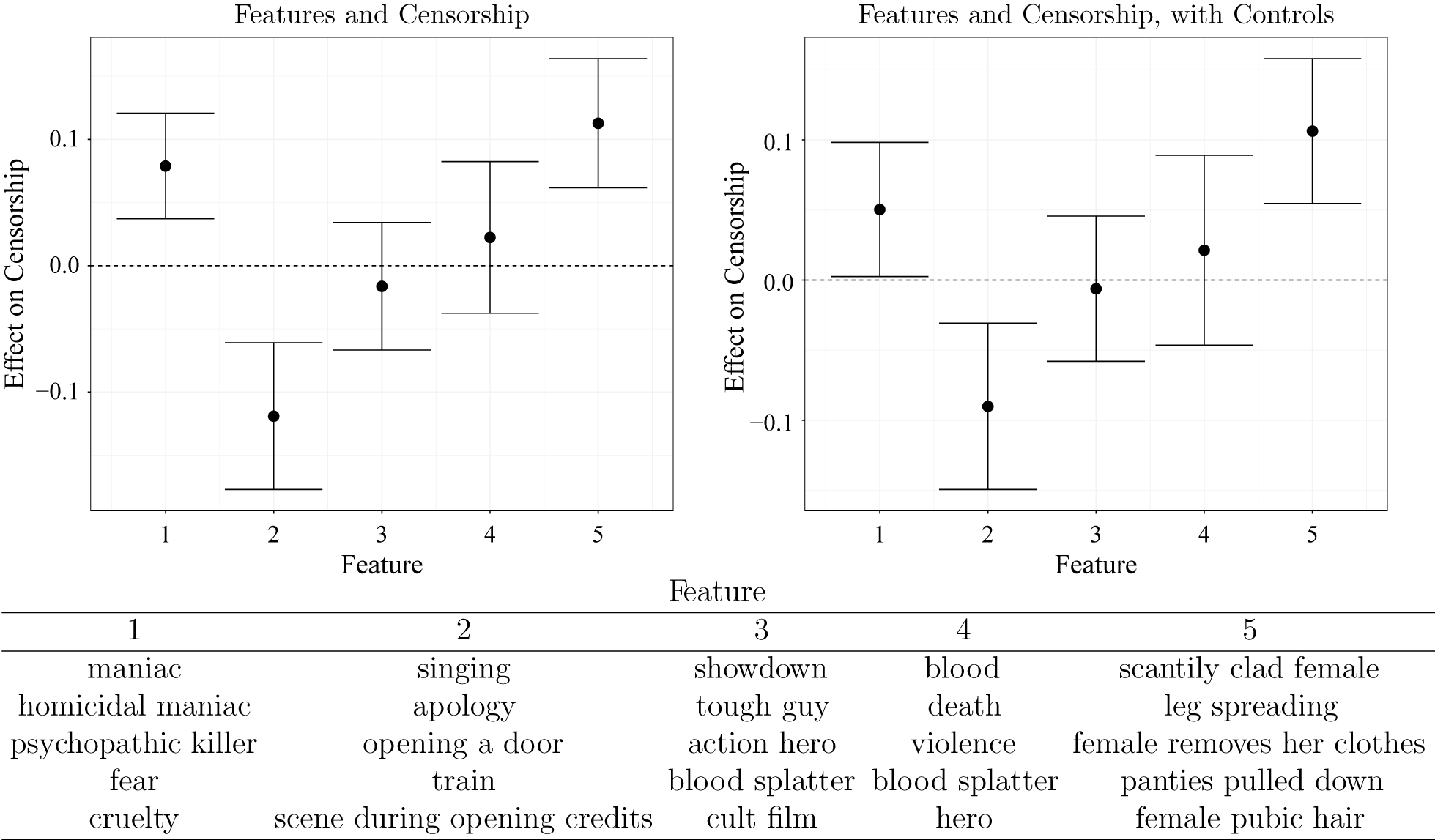
Figure 4 shows sIBP results, interpretable as the relationship between identified keyword groupings and censorship. Controls are added into models fit on the test set, after identifying features. These features can be interpreted as types of film content: Feature 2, for example, relates to dramas. Sexual content (Feature 5) is associated with about an 11% increase in the likelihood of censorship, while gore (Feature 1) is associated with a 6% increase in the probability of being banned. The results on violence are less robust and generally more ambiguous, given that Features 3 and 4 reflect action movies with varying degrees of violence.Footnote 20 In Online Appendix C.2, I demonstrate that results are robust to including censor-fixed effects, which reduces concerns that results are only due to the influence of particularly conservative censors. It also shows results are substantively similar using only data from expedientes. I additionally show results hold when including only films rated as suitable for individuals 18 or older, a harder test of the drivers of censorship. The finding that immoral content remains associated with prohibition suggests that the results reflect more than differences between movies directed at adults or all audiences.
sIBP Features and Censorship

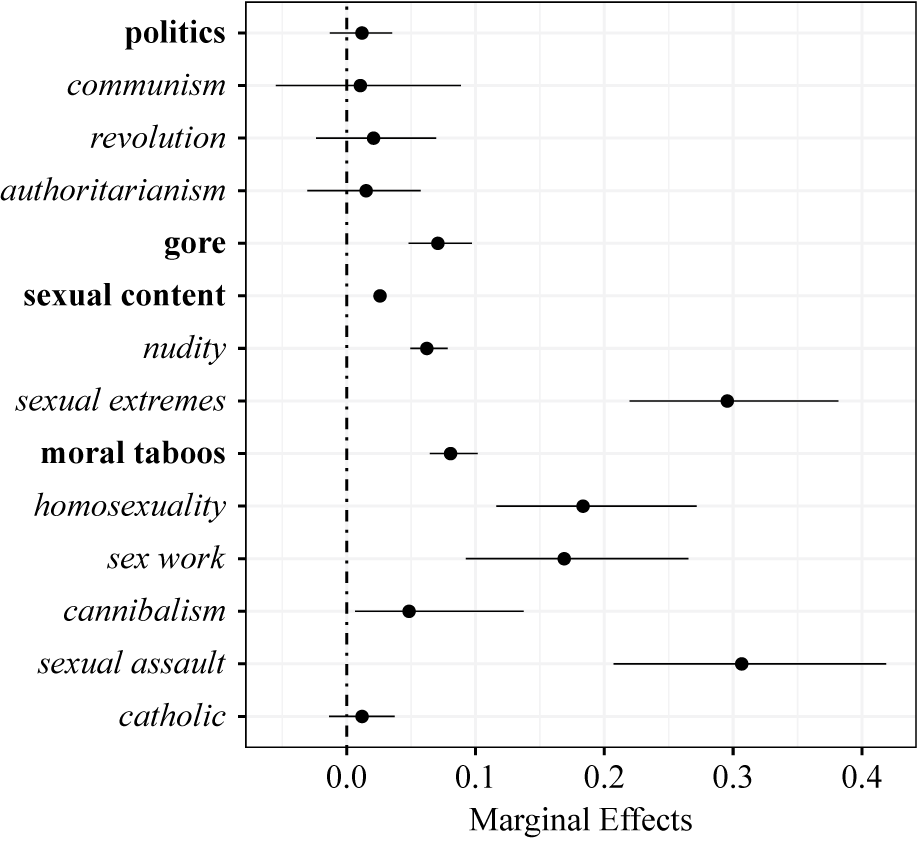
The results for the tracking-themes methods broadly confirm the results of the sIBP models while allowing estimation of the relationship between censorship and specific content of interest. Including content measures in logistic regressions shows immoral themes—including sexual content, moral taboos, and gore—are all correlated with censorship. Politics has an insignificant and small effect, though this varies over time, as I show later. Figure 5 visualizes the marginal effects of themes and their component parts on censorship by using first differences, taking the average predicted effect of changing the number of thematic keywords from zero to five while holding all other covariates at their true values.Footnote 21 Increasing moral taboo keywords from zero to five, for example, raises the probability of censorship by about 10%.Footnote 22
Censorship and Film Content

Online Appendix D.2 offers several robustness checks for these results. Findings are robust to including censor-fixed effects and clustering standard errors at the censor group, as sets of councilors may have been persistently more likely to watch certain movies together based on availability.Footnote 23 This helps to demonstrate that findings are not due only to the preferences of certain particularly conservative censors. Findings also hold when omitting controls, showing the bivariate correlation between themes and censorship and demonstrating the consistency of results across specifications. Results are similar when restricting analysis to films rated as for 18 and 21 and over, providing evidence that findings do not only reflect differences between movies geared towards older and younger audiences. Even among films directed at adults, immoral content has a significant relationship with censorship. Effects also hold when using plot-summary unigrams as an alternate measure of film content. This helps confirm that, though keywords are more likely to pick up political or immoral content, they do not produce significantly different results than are produced by using plot summaries directly. Results also hold when normalizing the tracking-themes content measure by the total number of keywords. Since text is user-submitted, this demonstrates that results are not due only to variation in the amount of information that we have about any given film.
Both sIBP and tracking themes show the descriptive relationship between content and censorship. Given that Chilean censors were not required to explain their votes, however, there may be concerns that films were censored for reasons other than those identified through text analysis. To check this, I hand-coded all of the films for whether they contained political content and also recorded its direction (whether positive, negative, or neutral). For example, the film Night of the Pencils, about the disappearances of student activists during Argentina’s dictatorship, I coded as positive about revolution but negative about authoritarianism. Results are similar when using this metric (Online Appendix F.2), suggesting that the political keywords successfully capture political content and changes in censorship over time.
More directly, in 22 cases censors’ provided hand-written notes explaining their decisions on expedientes; five cite technical problems, while 17 exclusively pinpoint immoral content:
• The Bionic Man. “Scenes with lesbianism and grotesque humor.”
• Epitaph. “Movie with unnecessarily violent and morbid scenes.”
• Lunch Meat. “Repulsive anthropophagy [cannibalism].”
This provides greater confidence in overall results: immoral content clearly played a major role in censorship, even from the perspective of councilors themselves.
Film Censors and Opus Dei
An expectation of this article’s theory is that councilors linked to conservative organizations should be more stringent in their rating decisions. To test this, I exploit that the MoE had deep ties to Opus Dei relative to other organizations that provided councilors: “the nation’s educational system was taken in hand by [Opus Dei]” (Hutchinson Reference Hutchinson2006, 214). Indeed, three ministers of education and at least one superintendent of education were followers. The council included censors from the MoE; members of the Center for Parents and Guardians, who were designated by the MoE; and university rectors, who were appointed by the MoE. I thus test whether education-linked censors were more likely to place restrictions on immoral content. To do so I build a dataset of censor votes, though a limitation of this analysis is that it includes only censors whose signatures are legible and whose names can be linked to an organization. A total of 20 of 67 councilors who reviewed at least five films could be linked to their institutions. However, bias is unlikely, and Kolmogorov–Smirnov tests show no difference in the distribution of ratings for censors whose institutions could and could not be identified.
To identify whether education-appointed censors place stricter limits on films, I first regress censors’ votes on an indicator for whether they were education-appointed, controlling for final rating, film content measures, and fixed effects for year. The dependent variable is either an indicator for a “ban” vote or a binned vote measure ranging from zero (“for all audiences”) to four (“banned”). Second, I normalize votes by subtracting films’ final ratings from censor’s individual votes (e.g., a censor that votes to ban a film ultimately rated as 21 and over scores one). Third, censor votes are regressed on the education-appointment indicator and title-fixed effects, exploiting within-movie voting heterogeneity. All models are ordinary least squares. Given the small number of clusters (20), the results here have robust confidence intervals, but I demonstrate in Online Appendix D.3 that results hold using confidence intervals obtained through block bootstrap at the censor level.Footnote 24 Across these metrics education-appointed councilors are more likely to vote to ban or restrict films (Figure 6). Though effect sizes are small, they are substantively significant given overall censorship rates. Along with the qualitative evidence, this provides additional evidence that the regime used censorship to reward its support base, particularly conservative Catholic groups.
Education-appointed Censors and Voting

Censor Preferences
Patterns may alternatively be a function not of regime strategy but of the decision to select conservative censors. While in part this should be true—the regime drew from conservative organizations—the theory presented here relies on institutional environment playing a role. While censor-fixed effects reduce concerns that preferences drive results, I show that censorship drops after democratization, while CCC structure and members changed very little. A democratically elected president took power in March 1990, but the new constitution eased restrictions on political materials only. A coalition of moderate and leftist parties had majority control, though the binomial system of voting established in Pinochet’s constitution guaranteed artificially high representation for conservative politicians. Until 2001, the CCC had the same structure and could ban films.
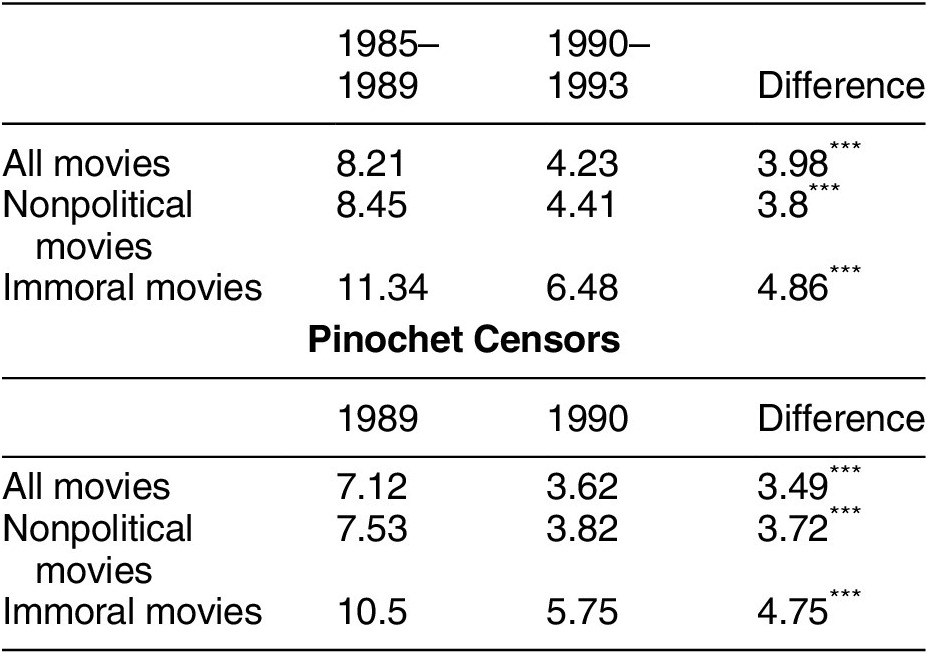
Still, Table 2 shows a nearly 50% drop in censorship after democratization. Results hold when excluding political films, including only immoral movies, or using logistic regression (Online Appendix E.2). This change could be explained by the democratic government appointing new, liberal censors. The MoE releases show that the democratic government did not appoint any new censors in 1990 and Pinochet changed just two councilors in 1989. Thus between 1989 and 1990 the CCC included only Pinochet-appointed censors. Censorship drops by nearly half just in these years (Table 2). While results could reflect either the autocratic government encouraging prohibitions or the democratic government discouraging them, they provide evidence of a role for regime type in censorship.
Percentage of Censorship Before and After Democratization

Note: Difference in means by using t-tests. Although no formal rules changed outside political content, censorship falls by nearly half after democratization. This holds when comparing 1989 and 1990, when all censors were Pinochet-appointed. ***p < 0.01.
Distributor Self-censorship
The weak relationship between politics and censorship—and the comparatively stronger correlation between bans and immorality—may be driven by distributors withholding movies they anticipate will be banned (Brett Reference Brett1998). To test for this I compare films reviewed with all movies produced between 1960 and 1995, scraping information from the Movie Database (TMDb), an IMDb alternative that permits web-scraping.Footnote 25 I then coded an additional 11,000 keywords linked to the full set of films produced during this period. Reviewed films are compared with unreviewed movies released two years prior, the median delay in reaching Chile. Figure 7 shows no visible difference in review, comparing movies with at least one political keyword with all films (left) and with films with no content related to one of the four tracked themes (right)—in case immoral content is also subject to self-censorship.
Percentage of all Movies Reviewed, Political Versus Nonpolitical

Online Appendix E.1 reports several tests, all finding no evidence of self-censorship. First, I show there is no correlation between the number of political keywords associated with a film and its probability of review. This is also true of immoral content.Footnote 26 Second, I use a difference-in-differences framework to identify whether the probability of review changed with the CCC’s creation in 1974 or 1979, when the MoE came under civilian control. Results confirm a stable rate of review. Since restrictions on political material were relaxed with democratization in 1990, I additionally test for changes in review after democratization using the list of films reviewed by the CCC through 1994, confirming null results. Immoral films also do not experience self-censorship.Footnote 27 However, given the prevalence of censorship, why did distributors not self-censor? International distributors did not have complete knowledge of banned films, and because Chile was a small market, they may not have bothered to learn preferences. Additionally, to submit films distributors just paid a processing fee, a small cost relative to the larger potential benefits of distribution.
Chile in Comparative Perspective
Pinochet was religious, so censorship of immoral films may reflect his preferences rather than a strategy to build support. The similarity of these bans in other right-wing dictatorships offers some evidence countering this; for example, Argentina’s dictatorship regularly banned nonpolitical songs, like Donna Summer’s “Jungle Fever.” Comparing material censored during Francisco Franco’s regime in Spain in particular provides greater confidence that results are not due to Pinochet’s preferences alone. Like Pinochet, Franco relied on Catholicism and anti-communism to maintain support, and Opus Dei had a powerful role in his government. However, unlike Pinochet, privately Franco was not himself a devout Catholic (Aróstegui and Viñas Reference Aróstegui and Viñas2012). Still, censorship targeted immoral content. To avoid showing female adultery, Spanish censors dubbed the film Mogambo so that husband and wife became brother and sister (Zatlin Reference Zatlin2005). Since Spanish censors typically dubbed or edited offending scenes, censor comments on three films entirely banned in Chile—collected from Spain’s Archives of Administration—demonstrate their preoccupation with morality:
• Karatista Asesino. “Delete the frames with nudity—all.”
• The Wilby Conspiracy. “Substitute the word ‘foreskin’ with ‘beard.’ In general, change the expression that the lead repeats various times, ‘how is there a God.’”
• The Savage Three. “[Cut] the strangest aspects of the sex scene and the frames of female nudity after hanging up the telephone. Cut the clearest blows to the testicles.”
Censorship of immoral content could alternatively reflect powerful groups capturing the CCC rather than strategic regime behavior. Turning to morality policy provides evidence that Pinochet’s government used the fight against social immorality to appeal to conservative sectors. Pinochet rolled back family planning laws implemented under Allende to appease conservatives and “win … the sympathy of the Catholic Church” (Jiles Moreno Reference Moreno and Ximena1992, 187). Responding to Catholic groups, Pinochet banned all forms of abortion. He maintained a prohibition on divorce, claiming separation disrupted the nuclear family (Power Reference Power, Bacchetta and Power2002). These policies again find parallels in Spain, where Franco implemented “Social Danger Laws” against homosexuality, drugs, prostitution, and pornography.
Political Censorship
While this article focuses on how entertainment censorship may serve as a policy reward, this theory is not mutually exclusive to political censorship. A total of 7.5% of the films with at least one political keyword were prohibited, and Online Appendix F.1 demonstrates that the jump in political censorship in 1974 is similar in magnitude to the change for immoral content: highly conservative Chile already banned some sexual and violent content before dictatorship. Additionally, Figure 8 breaks “tracking-themes” results into two periods, demonstrating that communism-related terms are significantly correlated with censorship prior to 1979, but not after. This aligns with qualitative evidence; for example, the CCC permitted Night of the Pencils (1986), about disappearances during Argentina’s dictatorship, but it banned Nicholas and Alexandra (1971), about the fall of Tzar Nicholas II. Counter to state critique theory, even negative depictions of right-wing authoritarian regimes are not significantly correlated with censorship.
Censorship and Film Content, Pre- and Post-1978

Given that banning any individual film is low cost, why did political censorship fall after 1979? This period corresponds to a broader change in repression: security services were reorganized in 1977, after which repression fell and some rights of association were restored. That year the regime appointed a civilian as Minister of Education for the first time since the coup, which could explain the drop in political censorship, particularly because evidence suggests that military censors voted to control political—but not other types—of content more aggressively (Online Appendix D.3). Additionally, it may have been more difficult for councilors to agree on when political content deserved censorship. Banned political films with positive depictions of revolution or communism were 16.7% more likely than were films with immoral content to have at least one councilor vote against censorship ( $$ p=.051 $$), a difference that increases after 1979 (26.9%,
 $$ p=.06 $$). Wilhelm (Reference Wilhelm1991) offers a political explanation for why some revolutionary films were shown during Argentina’s dictatorship: “The Argentine military government hoped that the film’s [revolutionary] action, which was directed against the ‘Yankee devil,’ would discharge or redirect some of the strong antigovernment feeling which had built up in the Argentines against their own government” (25). This logic is similar to safety-valve theories of censorship, which argue that permitting criticism serves to diffuse tension (Hassid Reference Hassid2012). While it is difficult to prove this political explanation, at minimum the results suggest that administrative changes within the regime may explain them.
Conclusion
Literature on authoritarian censorship highlights the role of press and internet controls in restricting opposition. In this article, however, I provide evidence that censorship of popular culture serves not only to limit the spread of political content but also to maintain support. Text analysis of nearly 8,000 films reviewed during Pinochet’s dictatorship content judged immoral motivated censorship, demonstrating that existing political theories of authoritarian censorship cannot explain the breadth of government controls. Qualitative evidence suggests restricting such sexual, morally taboo, or particularly gory materials rewarded the dictator’s support base, including conservatives and influential Catholic groups. Censors’ votes provide further evidence those councilors linked to Opus Dei were more likely to vote to ban films. Results also provide evidence for the collective action potential theory, particularly in the regime’s early years.
Where should we expect this theory to hold? This article focuses on the role of authoritarian supporters in motivating censorship, making the need to appeal to supporters a central scope condition. While most autocrats rely on backing coalitions, some use widespread repression to prevent restiveness, making them less likely to focus on such social controls and rewards. Second, regime supporters should have a coherent ideology that motivates censorship. For example, during the single-party rule of Mexico’s PRI—a government that specifically promoted unity among the population—film censorship was rare. Under these conditions, censorship to appease supporters appears across a variety of dictatorships. Ferdinand Marcos established the Philippines’ film review board, lauded in one newspaper as “necessary if the community’s welfare is to be safeguarded” (in de Vega Reference de Vega1975). The Soviet Union censored “religious sequences,” as well as erotica—common and popular in left-wing regimes as a means to protect “cultural security” (Johnson Reference Johnson and Zhang2012; Sapiets Reference Sapiets1982; Wang and Mark Reference Wang and Mark2015). Iranian censors cut even remotely sexual content, once superimposing a vase over a low-cut top (Fisher Reference Fisher2012). South Africa banned films to promote “the dominant (i.e., white) ideology,” prohibiting not just interracial relationships but immoral content like The Rocky Horror Picture Show (Tomaselli Reference Tomaselli2008, 1).
This research thus expands literature on censorship to entertainment. Work on authoritarian censorship often overlooks that some citizens actively support prohibitions on certain content (Boas Reference Boas2004; Gunther and Hwa Reference Gunther and Hwa1996). Censorship as a reward argues that dictators can provide pop culture restrictions to those supporters who view it as a social good. In democratic states with wider selectorates, these individuals may lack the influence to ban offensive content. Moreover, democracies must typically contend with laws and norms related to freedom of expression that curtail their ability to censor content, particularly compared with autocrats. In dictatorships, however, censorship supporters may make up the winning coalitions, and autocrats have the ability to implement social controls (Bueno de Mesquita et al. Reference de Mesquita, Bruce, Siverson and Morrow2005).
This article additionally demonstrates how policing the moral and social sphere serves as a tool of authoritarian control alongside other methods like private goods provision and violence. While it is one in a broader set of morality policies, understanding the purpose of entertainment censorship offers new insight into how dictators govern. Many autocracies adopt social controls on their population. Text analysis of all films submitted for distribution in Chile quantifies the types of materials that motivate such prohibitions, improving our understanding of the logic behind morality policing.
Moreover, while censorship is typically understood as a means to isolate and deter opposition, this research shows that even seemingly punitive policies may be used to reward a regime’s backing coalition. Research on authoritarian rule typically treats cooptation and repression separately because they are believed to be directed at different audiences (Wintrobe Reference Wintrobe2000). Understanding censorship as a reward suggests that conservative autocrats’ backing coalition may want restrictions on social freedoms. This article thus helps demonstrate that even punitive policies are influenced by dictators’ need to maintain popular support.
Supplementary Materials
To view supplementary material for this article, please visit http://dx.doi.org/10.1017/S000305542000026X.
Replication materials can be found on Dataverse at: https://doi.org/10.7910/DVN/QQ2FV9.







Comments
No Comments have been published for this article.