

Introduction
In the last several decades significant effects of genetic selection have been observed in broiler chickens in terms of the breeding and performance parameters attained viz. feed conversion rates, weight gain rates of birds, the proportion of meat, particularly breast muscles. Leading companies in the production of nucleus and parent flocks intensively compete on the market, offering increasingly better economic payback from birds. However, this intensification has led to several evident cardiovascular diseases, as well as anomalies of the skeletal and muscular systems in fattened broiler chickens and turkeys (Hafez and Hauck, Reference HAFEZ and HAUCK2005). Following mainly economic indexes, disregarding natural anatomical, physiological and behavioural predispositions of birds, has led to several degenerations, particularly within pectoral muscles, such as deep pectoral myopathy (DPM), and pale, soft, exudative symptoms (PSE).
In recent years a marked intensification has been observed in the incidence of m. pectoralis myopathy symptoms in specialised, highly producing, well-muscled chickens. Myopathy (Greek mys ‘muscle’, páthos ‘anguish’) refers originally to muscle diseases or degeneration, not caused by changes in the nerves supplying them and differing in their pathogenesis and development. DPM is a muscle disease found in gallinaceous poultry, turkeys and chickens, in which the tender, located under the superficial breast muscle, turns green and becomes necrotic, caused by inadequate blood supply causing muscle ischemia (Grunder, Reference GRUNDER1983; Siller, Reference SILLER1985). DPM is also called the Green Muscle Disease (GMD), and previously the Oregon disease (Siller, Reference SILLER1985) and, in turkeys, is termed ‘degenerative myopathy of the supracoracoideus’ (DMS) (Grunder, Reference GRUNDER1983). The disease is not infectious (Harper and Helfer, Reference HARPER and HELFER1972; Crespo and Shivarprasad, Reference CRESPO and SHIVARPRASAD2003). According to the currently binding anatomical terminology this degeneration affects the minor pectoral muscle (musculus pectoralis minor), and, due to its location in relation to the bone, is also known as the m. supracoracoideus.
Pectoral muscle - anatomy and physiology
The pectoral major muscle and the pectoral minor muscle are elements of the system facilitating wing movement. Stretching of muscles is caused by the action of gravity or - as in the case of the discussed pectoral muscles - by contraction of antagonistic muscles. Pectoral muscles are responsible for the upward and downward wing movement. The pectoral minor muscle is attached to the upper section of the humeral bone with a tendon passing between three bones, i.e. the humeral, coracoid and the scapula, forming the pectoral girdle. During muscle contraction, the tendon decreases in length causing an elevation of the humeral bone and thus upward wing movement (Bilgili and Hess, Reference BILGILI and HESS2002). The minor pectoral muscle is confined in a closed space. On two sides it is limited by the sternum bones and additionally it is surrounded by the non-elastic fascia, separating it from the pectoral major muscle (Siller, Reference SILLER1985). The fascia surrounding the muscle is a membrane composed of dense connective tissue and it is an auxiliary organ of the muscle (Sobociński, Reference SOBOCIŃSKI1987). Pectoral muscles participate actively in movement and thus they belong to the skeletal transversely striated muscle tissue. The muscle tissue is composed of multinucleated cells (polykaryocytes), due to their spindle shape called muscle fibres. The cytoplasm of muscle fibres contains high concentrations of contractile proteins, forming filaments.
The major and minor pectoral muscles vary in terms of the proportions of red (slow-twitch) and white (fast-twitch) cells. Musculus pectoralis minor is predominantly composed of white muscle cells, i.e. fast-twitching ones, at the same time exhibiting low tolerance to fatigue (Pastuszczak et al., Reference PASTUSZCZAK, URADZIŃSKI and ROTKIEWICZ2002). Blood is supplied to pectoral muscles by the subclavian vein (v. subclavia) and thoracic arteries (a. thoracica externa ventralis, a. thoracica dorsalis). However, due to the greater share of white muscle cells in the minor pectoral muscle it contains lower amounts of myoglobin and has less extensive vascularisation. Thus the efficiency of the circulatory system is lower in this muscle than in the greater superficial pectoral muscle (Wight et al., Reference WIGHT, SILLER, MARTINDALE and FILSHIE1979; Pastuszczak et al., Reference PASTUSZCZAK, URADZIŃSKI and ROTKIEWICZ2002).
DPM symptoms
macroscopic changes
Deep pectoral myopathy is observed as a change in the appearance of the pectoral muscle, and these symptoms are similar in turkeys and chickens. This disease is detected only at the dissection of the carcass into cuts. Symptoms affect mainly the minor pectoral muscle less frequently and, to a lesser extent, the major superficial muscle. Changes are observed both in colour and texture of the tissue. Most typically, the muscle is described as pink colouring with tissue hyperaemia or, at the stage of advanced lesions, the occurrence of green and grey-green colouration. This is accompanied by visible broken blood vessels, while, at a more advanced stage of the disease, it includes muscle retraction. Necrosis may cover one or both tenders of the pectoral muscle and lesions over an area from 1/3 to 3/5 the tender.
Myopathy develops mainly in the central part of the muscle and frequently only the central region is affected by the disease (Wight et al., Reference WIGHT, SILLER and MARTINDALE1981a; Bilgili and Hess, Reference BILGILI and HESS2002; Kijowski and Kupińska, Reference KIJOWSKI and KUPIŃSKA2012). DPM symptoms afflicted the muscles bilaterally (67%). In 64% cases of pectoralis minor muscles affected by the analysed anomaly, changes were found on the inner side of the superficial muscle. Disturbed symmetry and muscle shrinkage were observed in almost all (96%) pectoral muscles examined (Kijowski and Konstańczak, Reference KIJOWSKI and KONSTAŃCZAK2009).
Depending on the advance in DPM symptoms in chickens, it is possible to distinguish different stages of the disease. Bianchi et al. (Reference BIANCHI, PETRACCI, FRANCHINI and CAVANI2006) identified two stages: early and late. The stage of DPM depends on the time which has passed from the moment a factor inducing disease has arisen to the slaughter of a given bird. A three-stage characteristic of the discussed anomaly was proposed by Bilgili and Hess (Reference BILGILI and HESS2008). Pastuszczak and Uradziński (Reference PASTUSZCZAK and URADZIŃSKI2002) when investigating lesions macroscopically analysed 4090 turkey carcasses. On the basis of this analysis in adult 54-week turkeys they distinguished four degrees of intensity of pathomorphological changes.
Our proposal comprises four stages of changes in macroscopic characteristics in muscles of chickens (Kijowski and Kupińska, Reference KIJOWSKI and KUPIŃSKA2012; Reference KIJOWSKI and KUPIŃSKA2013). The first stage of DPM is characterised by the occurrence of blood extravasations and clotted blood in blood vessels. The second stage of myopathy is characterised by the pale-pink colour of the minor muscle as well as necrotic changes in the tissue, which then becomes fibrous. The third stage is distinguished by greening of the muscle tissue, first of all in the central section of the minor muscle. In turn, in the fourth stage the minor muscle becomes grey-white-green and is necrotised. Specific characteristics, particularly concerning muscle colour, were used to develop a chart to identify all the four stages of DPM symptoms for potential use at poultry abattoirs (Kupińska, Reference KUPIŃSKA2013).
microscopic histopathological changes
Microscopic histopathological analyses of tissues affected by the DPM revealed several significant changes occurring at the cellular level (Wight et al., Reference WIGHT, SILLER and MARTINDALE1981b; Pastuszczak et al., Reference PASTUSZCZAK, URADZIŃSKI and ROTKIEWICZ2002; Dinev and Kanakov, Reference DINEV and KANAKOV2011). As revealed by microscopic examinations, myopathy of the pectoral muscle in chickens leads to the damage of its structure at the cellular level, i.e. the muscle fibre. Sarcolemmal nuclei are faintly stained or absent, muscle fibres are transversely rounded and show discoid degeneration, the blond vessels are packed with lysed erythrocytes. Histopathologically changes of muscle cause disintegration of Z lines, breakdown of actin filaments, destruction of nuclei and other organelles (Wight et al., Reference WIGHT, SILLER and MARTINDALE1981a).
Dinev and Kanakov (Reference DINEV and KANAKOV2011) conducted routine histological analyses on ten DPM muscle samples from chickens of the Ross 308 and Cobb 500 lines. In the early stages of DPM they found acute inflammation, oedema, hyperaemia and haemorrhages. In the later stage, symptoms included degenerative necrotic changes, Zenkers degeneration, increased acidophilia, heterophil leukocytes, macrophages between the necrotic meat tissue, discoid muscle bundles and separation of individual sarcomeres. In the most advanced lesions, normal muscle fibres are replaced by fibrous and/or adipose tissue.
Pastuszczak et al. (Reference PASTUSZCZAK, URADZIŃSKI and ROTKIEWICZ2002) conducted detailed histopathological analyses on pectoral muscles of 54-week pedigree turkeys. This experiment showed that pathological changes connected with DPM affect both minor and major pectoral muscles. The most frequently detected lesions included oedema, hyperaemia, atrophy of cross striation, follicular, segmental and granular decomposition, eosinophilic necrosis with macrophage infiltrations, connective tissue proliferation, eosinophilic cell and phagocyte infiltrations, and muscle fibre atrophy (Pastuszczak et al., Reference PASTUSZCZAK, URADZIŃSKI and ROTKIEWICZ2002; Pastuszczak and Uradziński, Reference PASTUSZCZAK and URADZIŃSKI2006). Overall, histopathological analyses showed changes both in the m. pectoralis minor and major muscles. In case of macroscopic observations necrotic changes were confirmed by microscopic analyses. However, Bilgili and Hess (Reference BILGILI and HESS2002) were of an opinion that the green muscle disease affects only m. pectoralis minor.
Incidence of DPM
The first cases of an anomaly in pectoral muscles were observed in turkeys in the years 1967-1968 in Canada, the United States and Great Britain. In 1968 Dickinson et al. (Reference DICKINSON, STEVENS and HELFER1968) described the disorder as ‘degenerative myopathy’ when found in turkeys. The disease was investigated and discussed in more detail in turkeys by Harper et al. (Reference HARPER, BERNIER and THOMPSON-COWLEY1981; Reference HARPER, BERNIER and THOMPSON-COWLEY1983) from Oregon State University. The first reports on DPM symptoms concerned adult meat-type birds, first turkeys and later mature and adult meat-type chickens (Hollands et al., Reference HOLLANDS, GRUNDER, WILLIAMS, GAVORA and CHAMBERS1981; Grunder, Reference GRUNDER1983). In young broiler chickens the occurrence of DPM was found for the first time by Richardson et al. (Reference RICHARDSON, BURTGENER, WINTERFIELD and DHILLON1980), however, that case was considered as untypical. At that time, the common belief (based on the available genetic material) was that it would not be a problem in commercial production of young broiler chickens. However, other studies, including those reported by Bilgili and Hess (Reference BILGILI and HESS2002), further investigations on 7-8 week old chickens conducted by Georgopoulou et al. (Reference GEORGOPOULOU, BOUGIOUKLIS, IORDANIDIS and LEKKAS2005), heavier roaster chickens aged 7-9 weeks (Bianchi et al., Reference BIANCHI, PETRACCI, FRANCHINI and CAVANI2006), a report by Kijowski et al. (Reference KIJOWSKI, KUPIŃSKA, KACZMAREK, STANGIERSKI and POPIÓŁ2009) concerning 6-7-week chickens, another study by Kijowski and Konstańczak (Reference KIJOWSKI and KONSTAŃCZAK2009) on 5-6-week chickens, work reported by Dinev and Kanakov (Reference DINEV and KANAKOV2011) on seven-week chickens, and other work by Kijowski and Kupińska (Reference KIJOWSKI and KUPIŃSKA2012) revealed an increasing incidence of DPM cases in commercial broiler chicken flocks.
Intensity of DPM cases
In Poland, DPM was identified in the western and northern parts of the country in the early 1990's. Myopathy was observed mainly in heavy-type turkeys and semi-heavy layer hens aged 378 days, as well as older birds at the completion of the egg laying cycle (Pastuszczak and Uradziński, Reference PASTUSZCZAK and URADZIŃSKI2002). Reports prepared at poultry processing plants in the United States and in South America show that cases of the so-called green muscle disease were becoming increasingly more frequent (Bilgili and Hess, Reference BILGILI and HESS2002).
In literature concerning the DPM as green muscle disease, there is a variety of data concerning the frequency of myopathy. A high discrepancy in these figures is most frequently the result of different age groups, genetic lines and rearing conditions in birds. For poultry production, the most important data are those obtained under commercial scale production conditions. In Poland, the incidence of DPM cases recorded in populations of several thousand birds of commercial slaughter chickens was recorded between 0.02% and 1.9% (Kijowski et al., Reference KIJOWSKI, KUPIŃSKA, KACZMAREK, STANGIERSKI and POPIÓŁ2009). Lien et al. (Reference LIEN, BILGILI, HESS and JOINER2011) reported that the incidence of spontaneous DPM cases ranged from 3 to 17% and seemed greater in broiler chickens with a higher growth dynamics and occurred more often in roosters than in hens. Badger (Reference BADGER2011) identified 4.4% DPM cases in chickens at slaughter and when cut up for customers.
Risk factors for the incidence of DPM
The frequency of the DPM in broiler chickens depends on many factors. They include rearing conditions, age, weight, sex and genetic line.
rearing conditions
Welfare of these animals is a major factor affecting the incidence of DPM. Necrotic changes in pectoral muscles are initiated in the course of the rearing period in animals. They are formed at the time of sudden mobility of birds, which may be caused by stress factors during rearing. In accordance with EU recommendations in litter management systems for poultry, the stocking rate should not exceed 25 kg per m2 body weight (chickens, turkeys, ducks). In the case of semi-intensive rearing, due to access to the grass range, this stocking rate is increased to 27 kg/m2.
However, in practice stocking rates are frequently exceeded (Grabowski and Kijowski, Reference GRABOWSKI and KIJOWSKI2009). What is more, chickens living at such stocking densities do not have suitable conditions for natural physical activity, such as walking, flying or perching. Moreover, in the case of excessive over-stocking in the flock, fights for access to drinkers and feeders are increasingly more common (D'Silva, Reference D'SILVA2006). This is evident from the incidence of disease found in different management systems. Under the Label Rouge certified poultry production system, where slow-growing chicken strains are used in a free-range system for a period of at least 81 days, no DPM cases were found. Moreover, a longer production cycle of chickens has a beneficial effect on quality attributes of meat evaluated by experienced consumers. An alternative Polish solution is connected with the production of crosses of native hen breeds with meat-purpose cocks, e.g. a Greenleg partridge with a cockerel from the fast-growing meat purpose strain such as Ross 308 or Hubbard (Połtowicz, Reference POŁTOWICZ2012). Crossbreds are characterised by consistently greater body weight and better muscling. Studies confirmed that such crossbreds may provide birds for alternative breeding systems, whereby chickens are not prone to develop DPM symptoms. However, such production systems are more expensive, which may limit demand for such products, as is the case with organic poultry farming.
Stresses experienced during transport of birds to the abattoir are irrelevant for DPM incidence, since the time from bird loading to their slaughter is too short to result in the development of early degeneration symptoms. A study on the effect of the feeding method on the frequency of DPM excluded any relationship between incidents of myopathy and the diet of birds (Grunder et al., Reference GRUNDER, HOLLANDS and GAVORA1979).
age
Cases of pectoral muscle myopathy are recorded much more frequently in older birds. Studies confirming the effect of age on the frequency rates of the disease confirmed greater susceptibility to DPM in older birds (Siller, Reference SILLER1985; Grunder, Reference GRUNDER1983). Siller (Reference SILLER1985) conducted analyses on two groups of 250 chickens, with both groups of animals being kept under identical conditions. With a certain exception, in one group the development of the disease was provoked by electric nervous excitation of muscles or enforced wing movement (wing flapping). The presence of DPM symptoms was verified at weeks 8, 12, 16, 20, 26 and 35 of life in birds divided into groups of 24 animals each. This experiment showed that the first spontaneous (i.e. not caused by electric excitation or enforced physical activity of birds) case of DPM was detected at week 26. In the group of birds in which the disease was induced, symptoms of necrosis were detected already at week eight of age (20%), while at week 26 green muscles were found in 90-100% birds.
body weight
Greater weight of birds contributed to a more frequent occurrence of the disease. As already mentioned, disease symptoms are observed in heavy hens and chickens produced for large pectoral muscles. Bilgili and Hess (Reference BILGILI and HESS2002) observed that in broiler chickens weighing less than 3.6 kg, the anomaly was found in 2.5% birds, while among birds with body weight exceeding 3.6 kg the frequency of myopathy increased up to 8%. However, Lien et al. (Reference LIEN, BILGILI, HESS and JOINER2012) from the same research group in successive studies, did not find any effect of 0.4 kg difference in body weight (an average of 12% BW) on DPM prevalence.
The effect of carcass weight on the probability of the green muscle disease was also confirmed within the populations of heavy hens. An experiment conducted on broiler chickens at an advanced age of 365 days showed that the weight of birds with symptoms of the green muscle disease was, on average, greater by 154 g from the average weight of the control animals (Hollands et al., Reference HOLLANDS, GRUNDER, WILLIAMS, GAVORA and CHAMBERS1981). It needs to be stressed that not only weight, but also growth rate, influences the risk of DPM. In birds with rapid weight gain, DPM was detected in 17% animals, while in slower growing birds this index was as low as 2.8% (Bilgili and Hess, Reference BILGILI and HESS2002).
Within the last 40 years the weight of both the whole carcass and pectoral muscles from 42-day old chickens have increased almost two-fold, while rearing time has simultaneously decreased by almost a half. To a certain extent these changes are a consequence of improved feeding and management systems; however, genetic selection is the most important factor in this respect (Savory, Reference SAVORY2002). Trends that are advantageous from the point of view of slaughtering, animal producers and the poultry industry have turned out to be a factor increasing the risk of DPM.
sex
DPM degeneration is detected more frequently in 49-68 week old commercial meat-type chickens coming from the male strain; for these birds the index of disease frequency fell within the range of 0-43%, while for females it was 0-22%. In the female strain this index was much lower and comparable for both sexes, which, for males, amounted to 0-18%, while for females to 0-17%, respectively (Hollands et al., Reference HOLLANDS, GRUNDER, WILLIAMS, GAVORA and CHAMBERS1981). This may be related to the variation in body weight in birds of the same age, depending on their sex. Generally males in the same period reach a greater body weight and larger pectoral muscles than females, and this difference increases with age. However, Lien et al. (Reference LIEN, BILGILI, HESS and JOINER2012) when investigating encouraged wing flapping in 49-day chickens, found no effect of sex on DPM prevalence, accounting for 56% of the analysed population.
genetic background
All the recorded cases of identified DPM symptoms were found in chickens from genetic lines selected for a high share and yield of breast meat, such as Ross 308 and 508, Cobb 500 or Flex Hubbard (Bianchi et al., Reference BIANCHI, PETRACCI, FRANCHINI and CAVANI2006; Kijowski et al., Reference KIJOWSKI, KUPIŃSKA, KACZMAREK, STANGIERSKI and POPIÓŁ2009; Kijowski and Konstańczak, Reference KIJOWSKI and KONSTAŃCZAK2009; Dinev and Kanakov, Reference DINEV and KANAKOV2011; Kijowski and Kupińska, Reference KIJOWSKI and KUPIŃSKA2012). Studies by Bilgili and Hess (Reference BILGILI and HESS2002) and Lien et al. (Reference LIEN, BILGILI, HESS and JOINER2011) in the USA, as well as those cited above and conducted in Europe, point to the problem of the increasing intensity of DPM incidence in commercial flocks of young broiler chickens.
In the poultry industry there is a major trend in genetic selection. Since the demand for heavy hens is growing, it is focussed on increasing dressing percentage and slaughter yield, as the industry is more interested in chickens with the highest share of muscles in the carcass. Analyses conducted on a group of animals from Ross 508 and Cobb 500 showed differences between them in terms of the frequency of DPM. The intensity of DPM incidence in the genetic line Cobb 500 was two-times greater than in Ross 308 (Kijowski et al., Reference KIJOWSKI, KUPIŃSKA, KACZMAREK, STANGIERSKI and POPIÓŁ2009). It is confirmed that genetic origin has an effect on the probability of the occurrence of the discussed anomaly, however it has not been explained why myopathy affects only some birds reared under identical conditions. This may still be related with genetic factors (Pastuszczak and Uradziński, Reference PASTUSZCZAK and URADZIŃSKI2002). Myopathies are, to a considerable degree, hereditary diseases, with data indicating a heritability coefficient of 0.4 (Prost, Reference PROST1981).
Mechanisms of transfer of genes responsible for the development of the DPM have not been fully clarified to date. Harper et al. (Reference HARPER, BERNIER and THOMPSON-COWLEY1983), when investigating the mechanisms of inheritance for DPM, stated that this anomaly is a trait specified by the cumulative effect of more than one pair of genes, namely a polygenic trait. Modern genetic selection has attempted to eliminate this defect (Lubritz, Reference LUBRITZ2007), and recent developments in whole-genome selection using dense DNA-markers may provide powerful tools to reduce DPM in the future (Petracci and Cavani, Reference PETRACCI and CAVANI2012).
Etiology of the disease - the ‘compartment’ syndrome
The cause of the development of DPM in m. pectoralis minor has been explained to a considerable degree. It is known that necrosis occurs in case of oxygen and nutrient deprivation in muscles during normal physical activity of birds (Siller, Reference SILLER1985; Pastuszczak and Uradziński, Reference PASTUSZCZAK and URADZIŃSKI2002; Bilgili and Hess, Reference BILGILI and HESS2008). It needs to be stressed that an important role is played in the development of the anomaly by the specific location of m. pectoralis minor in a closed space with limited capacity for relaxation.
During the physical activity of birds, a properly functioning pectoralis minor muscle relaxes, thus increasing its volume by 20% (Siller, Reference SILLER1985) or even 25% (Bilgili and Hess, Reference BILGILI and HESS2008). However, due to the limited physical activity of birds during their rearing, the fascia surrounding m. pectoralis minor does not acquire elasticity. Most probably the capacity of fascia to expand does not develop in proportion to the rapid increase in weight of the tender breast muscle (Siller, Reference SILLER1985). During work, muscles change their volume, while the tender does not have sufficient space to relax. This results in a considerable increase in pressure inside the muscle, which exceeds the blood pressure of the birds, a consequence of which is that the inflow of fluids to the muscle is stopped. In the case of further physical activity of the pectoral muscle, oxygen deficit develops and tissue hypoxia occurs. The contracted muscle prevents inflow of oxygenated blood and becomes hypoxified (Bilgili and Hess Reference BILGILI and HESS2002; Reference BILGILI and HESS2008). The state described above, in which relaxation is impossible, is referred to as the ‘compartment syndrome’ (Siller, Reference SILLER1985). During physical activity of the birds, the pressure inside a muscle is a significant factor influencing the formation of necrosis.
In broiler chickens, the pressure inside muscles was measured directly after an enforced activity of pectoral muscles, and was found to be 600 mm Hg, while in case of lighter layer hens it was 100-160 mm Hg (Martindale et al., Reference MARTINDALE, SILLER and WIGHT1979). What is more, in lighter birds this pressure quickly returns to the normal state. In broiler chickens, pressure can be maintained long enough to lead to irreversible necrotic changes (Siller, Reference SILLER1985). Harper et al. (Reference HARPER, BERNIER and THOMPSON-COWLEY1983) applied enforced physical activity, which induced necrotic changes in the pectoral minor muscle in almost 80% of birds subjected to the experiment. In turn, the effect of disturbed blood supply on the formation of necrosis was confirmed by an experiment, in which the subclavian vein, participating in blood circulation, was completely blocked (Orr and Riddell, Reference ORR and RIDDELL1977; Siller and Wight, Reference SILLER and WIGHT1978). This caused necrotic changes in the pectoralis minor muscle.
The production of the green colour in muscles has not been comprehensively clarified to date. It probably results from anaerobic changes of the muscle pigment, i.e. myoglobin to oxymyoglobin and its derivatives. The change of muscle colour from pinkish-red to green and greyish-green is most probably a consequence of the transition of haemoglobin into choleomyoglobin, when iron of the haem pigment (being in the ionic state Fe3+ under the influence of hydroperoxide) is transformed or when haem is in contact with hydrogen sulphide and oxygen it forms the pigment of sulphomyoglobin (Grabowski and Kijowski, Reference GRABOWSKI and KIJOWSKI2009; Pisula and Pospiech, Reference PISULA and POSPIECH2011).
Detection of DPM
in vivo
In commercial production, an effective elimination of live chickens suffering from this degeneration is impossible. One method applied in the detection of myopathy in live birds is to measure the activity of an enzyme, plasma creatine kinase (CK). An elevated activity of this enzyme may be caused by damage to (mainly skeletal) muscle, as damage of the cell structure causes the release of creatine kinase from muscle fibres. The value by which the enzyme activity increases is, to a degree, proportional to the degree of muscle damage (Stockham and Scott, Reference STOCKHAM and SCOTT2002).
Blood analyses of CK activity make it possible to detect changes in pectoral muscles relatively effectively. The highest enzyme concentration in birds affected by myopathy occurs two or three days after physical activity and considerably exceeds the level of the enzyme in healthy birds. When using CK as a criterion for the elimination of diseased birds, 82% birds would be correctly diagnosed as suffering from myopathy and 5% birds would be rejected incorrectly (Grunder, Reference GRUNDER1983; Hollands et al., Reference HOLLANDS, GRUNDER, WILLIAMS and GAVORA1980). Due to its time and cost intensity, this method is not applicable in commercial bird rearing systems, although it may be the basis for selection of birds resistant to DPM (Grunder, Reference GRUNDER1983). However, research reported by Lien et al. (Reference LIEN, BILGILI, HESS and JOINER2011) indicated that basal CK does not appear to be related to DPM susceptibility and that a reduced CK response to early encouraged wing flapping may indicate susceptibility.
post mortem
DPM is most frequently detected during dissection. In case of whole carcasses, detection of the disease can be difficult. Some sources report the application of a light-weight probe (Jones, Reference JONES1977), which, when introduced to carcasses in case of necrotic changes in pectoral muscles, presents an inaccurate image of the areas around the sternum. This method makes it possible to detect disease without dissection, i.e. it does not reduce carcass value. The application of such a probe during carcass dissection in a poultry abattoir is not very effective in view of the speed of operations on the processing line (Pastuszczak and Uradziński, Reference PASTUSZCZAK and URADZIŃSKI2002; Grunder, Reference GRUNDER1983).
Stimulation and induction of DPM symptoms
The progress of pathological lesions depends on the time which has passed from the factor causing them. Wight et al. (Reference WIGHT, SILLER and MARTINDALE1981b), when investigating a group of 110 broiler chickens forced to perform physical activity, stated that pathological changes were observed as early as after 15 minutes from the moment of intensive muscle work. Considerable oedema and blood vessel blocking were observed. After nine hours, exudate was observed between the pectoralis major and pectoralis minor muscles. After 24 hours the stressed and swollen muscle was becoming increasingly softer and resembled dough in consistency. Only after nine days, necrotic changes included green colouring and the affected tissue was distinctly different from normal tissue. Symptoms characteristic to ischemic necrosis were observed. After three weeks, changes in muscle in the macroscopic examinations resembled the condition from day nine; however, oedema was markedly reduced. After six weeks, the whole muscle was visibly smaller and in the central part it was dried and markedly shrivelled. Other studies reported by Lien et al. (Reference LIEN, BILGILI and HESS2008; Reference LIEN, BILGILI, JOINER and HESS2010) on 47 d broilers encouraged to wing flap showed the following results. At one day post-exercise m. pectoralis minor was light red, at five days post-exercise, pigment breakdown was evident with yellow and green discoloration, and at eight to eleven days, pigment breakdown was complete.
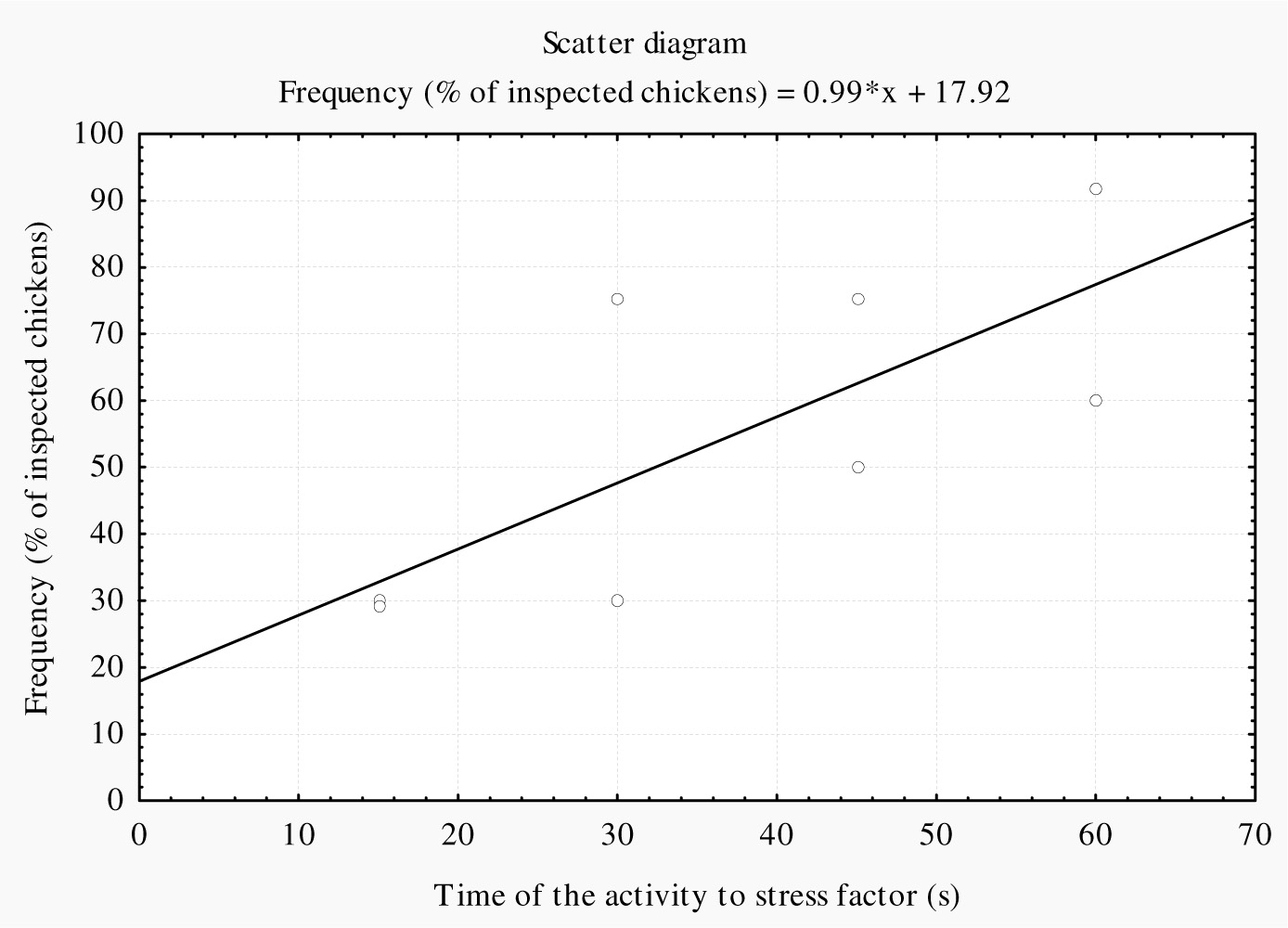
In our study on the stimulation of DPM incidence in Polish farms, chickens of the genetic lines Ross 308 and Hubbard Flex were subjected to forced and control wing flapping (FCWF) according to the method developed within this study in co-operation with Prof. S. Bilgili from Auburn University, USA (Kijowski and Kupińska, Reference KIJOWSKI and KUPIŃSKA2012). Early symptoms of myopathy stages I and II were observed in chickens subjected to FCWF at days one and three before slaughter. It was found that induced wing flapping in birds at five, seven and 14 days before slaughter caused the appearance of stages III and IV of the disease. No DPM changes were observed in the group of birds subjected to FCWF at 21 days before slaughter. It is probably that the birds were too young, and thus their pectoral muscles were too small for symptoms of myopathy to develop. Moreover, the effect of FCWF time on the intensity of myopathy incidence was analysed, and showed a statistically significant positive linear dependence (r = 0.73) between FCWF duration and the frequency of the anomaly. This was confirmed by an analysis of linear regression and the plotted graph of scatter (Figure 1).
Frequency of myopathy (DPM) in the minor pectoral muscle of tested chickens influenced by time of the forced and control wing flapping ( FCWF).
R=0,73; R2=0,54; the standard error of estimate: 17,79; significance level p<0,038; confidence interval: 0,95

The linear regression coefficient was 0.99. This means that if the duration of intensive wing flapping increases by just one second, it may be expected that the frequency of DPM in broiler chickens will increase by 0.99%. It was observed that the increasing duration of the stress factors causes greater fatigue of pectoral muscles in birds and, in the final period of FCWF, it results in lower wing movement activity. In case of the experiment with FCWF, in which 42-day Ross 308 chickens were slaughtered, the frequency of induced myopathy was 43% of the analysed population. In turn, in the experiment on 45-day chickens of the Hubbard Flex lines, symptoms of myopathy were found in 64% examined population.
Lien et al. (Reference LIEN, BILGILI, HESS and JOINER2012) reported that DPM was induced by encouraged wing flapping (EWF) in 49-day old broilers in 56% birds subjected to the experiment. The incidence of DPM and discoloration increased with the time of EWF and were unaffected by sex or body weight.
Prevention of DPM
Myopathy of the deep pectoral muscle is a degeneration caused by human interference, which does not take into consideration the laws of biology and anatomy governing the nature of birds. Prevention of DPM consists in the limitation of sudden, unnecessary and excessive mobility of the flock by reducing stress factors, and may be achieved by appropriate farm management.
Bilgili and Hess (Reference BILGILI and HESS2008) developed a short manual for farmers to help them reduce unnecessary wing flapping in birds. Their task was to eliminate stress situations, reduce sudden and excessive wing flapping and to control flightiness. The authors supplied specific guidelines indicating how to achieve this. In Poland, a questionnaire survey was conducted among managers of 12 broiler chicken farms. The most important risk factors for the incidence of DPM ranked in terms of their importance include (Kupińska, Reference KUPIŃSKA2013): disturbed flock hierarchy, handling by catching by wings, inappropriate handling by staff, violent actions, scaring, flock thinning and selection, excessive amounts of light, noise and new sounds in the vicinity of the henhouse, the applied method of bird weighing, excessive stocking rates, particularly at drinkers and feeders, excessive intervals in water and feed administration (over 3-4 h), veterinary practices, and prophylactic vaccinations.
An important element in restriction of the pectoral muscle anomaly is to keep detailed documentation for each case of myopathy in abattoirs, because DPM is a concealed disease. Proper documentation may be an element in the prevention system. If necrotic changes concern a greater number of fillets coming from one batch from one supplier, then, on the basis of advancement of changes, it may be determined when the inducing factor occurred.
Economic losses for abattoirs and processing plants
Average consumers not only rarely encounter DPM, but also have no knowledge of the background of changes occurring in tissues. Symptoms characteristic of the necrosis, i.e. changes in colour and texture of pectoral muscles, may be seen by consumers as signs of spoilage and the basis for complaint. What is more, consumers who purchased a carcass affected by myopathy will probably no longer trust the producer and will refrain from buying their products in the future. Poultry fillets are the most valuable elements of the carcass., and loss of these is very costly for the producer.
Annual economic losses due to DPM, incurred by poultry processing plants in Poland, were calculated, with the following assumptions: annual production of broiler chickens at 1,550,000 tons in 2011 (KRD-IG, 2012); mean minimum frequency of DPM incidence at 0.2% (Kijowski et al., Reference KIJOWSKI, KUPIŃSKA, KACZMAREK, STANGIERSKI and POPIÓŁ2009); mean body weight of live chickens at 2.4 kg; mean weight of pectoralis minor muscles with DPM lesions at 85 g; value of 1kg fillets (tenders) (m. pectoralis minor) at €3.5 (Euro). Using these values, disposal of pectoralis minor muscles due to DPM in Poland causes annual losses of € 411,718. Assuming DPM intensity at 1% losses will amount to € 2,058,590. The US researchers report losses of their poultry industry based on losses of tenders (0.7% DPM incidence rate) at $16 million annually (Lien et al., Reference LIEN, BILGILI, HESS and JOINER2011). For an abattoir slaughtering one million chickens weekly at 3.15-3.6 kg, these losses were calculated at $350,000.
According to a study by Pastuszczak-Frąk and Uradziński (Reference PASTUSZCZAK-FRĄK and URADZIŃSKI2009a), superficial pectoral muscles (m. pectoralis major) corresponding to m. pectoralis minor with DPM symptoms in post-production turkey hens had lower water holding capacity, disturbed muscle pH after slaughter as well as changes in colour and texture. The organoleptic quality of pectoralis major muscle from turkey hens with DPM degeneration is lower and these muscles should not be used to produce scalded and smoked breast fillets due to the inferior quality of such products (Pastuszczak-Frąk and Uradziński, Reference PASTUSZCZAK-FRĄK and URADZIŃSKI2009b).
Consequently, studies conducted on m. pectoralis major corresponding to m. pectoralis minor with DPM symptoms in broiler chickens showed slightly different results (Kupińska, Reference KUPIŃSKA2013). In pectoralis major muscles with lesions typical for DPM, a statistically greater thermal drip loss was recorded in comparison to pectoral muscles with no myopathic changes. Moreover, it was found that the later the stage of deep pectoral myopathy, the significantly greater thermal drip loss from m. pectoralis major. Muscles were subjected to thermal processing in a foil bag, and mean values of sensory quality attributes, i.e. taste, surface colour and overall desirability, were lower in muscles corresponding to tenders with symptoms of only the last stage (IV) of DPM in comparison to the control. For these samples, the sensory panel detected an extrinsic taste (haem) and adverse changes in colour on the surface (hyperaemia). When samples were grilled, the mean scores for all analysed sensory quality attributes of the meat were lower in case of pectoralis major muscles corresponding to m. pectoralis minor with symptoms of individual stages in comparison to control samples.
For overall consumer desirability, meat with DPM differs from unaffected breast meat when cooked. Subsequently, after more intensive processing procedures, i.e. curing and smoking, differences in quality of pectoralis major muscles accompanying minor muscles with DPM symptoms are eliminated and do not influence quality attributes evaluated by consumers (Kupińska, Reference KUPIŃSKA2013). Losses caused by deteriorated quality of large, superficial pectoral muscles are more difficult to calculate and the observed limitations to their technological and processing utilisation increase these costs significantly.
Conclusions
Myopathy of the deep pectoral muscle is caused by a complex of factors primarily of genetic, and physio-anatomical background of chickens as well as management systems on commercial farms. DPM is thus a price we have to pay for successful selection towards a desirable increase in muscling in broiler chickens. In order to reduce the incidence of DPM, it is essential to improve welfare standards and minimise unnecessary wing motion activity in birds. A factor which help prevent the occurrence of DPM, is slowing down the growth rate of broiler chickens in alternative rearing systems, particularly with respect to weight gain of pectoral muscles. The DPM paradigm, apart from the economic issues, is a problem of sanitary and veterinary nature as well as procedures adopted in abattoirs. In addition, the consumer's view of affected meat and its culinary value cannot be ignored.