

Catatonia is a syndrome that was first described in literature by Karl Kahlbaum in 1874. It presents commonly in psychiatric patients in both acute and long-term settings. But despite its common occurrence, catatonia remains a poorly understood, studied and recognised syndrome presenting with a variety of psychiatric and medical illnesses which can be treatable once a diagnosis is established (Reference Fink and Taylor1). The most common signs of catatonia are mutism, posturing, negativism, staring, rigidity and echo phenomena. However, it is a rare phenomena in which osmotic demyelination syndrome (ODS) presents as catatonia syndrome.
We describe a middle-aged woman with no past psychiatric disorder who on following rapid correction of hyponatraemia developed catatonia and other neurological symptoms diagnosed as ODS and followed by a severe neurological deficit.
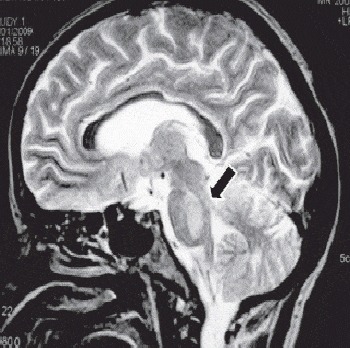
Forty-eight-year-old women presented to emergency room with complaints of abrupt onset vomiting, headache, decreased oral intake, generalised weakness for 7 days, as well as fluctuating sensorium and episodes of visual hallucination for 2 days. She was diagnosed to be hypertensive 2 weeks prior to this visit and put on antihypertensive (metoprolol) and at that time her investigations were normal including serum electrolytes. Her general physical and neurological examinations revealed no abnormality. The patient was subsequently admitted for further management. This time her investigations showed low sodium and potassium (104/3.2 mEq/l). The treatment for this was initiated and her sodium increased within 24 h to 122 mEq/l. She started showing improvement in alertness and oral intake and her vomiting stopped. Computed tomography of the chest showed signs of tuberculosis (TB) for which she was put on antitubercular treatment (isoniazid, 300 mg; rifampacine, 600 mg; ethambutol, 300 mg and pyrizaniamide, 750 mg on alternate-day regimen). The magnetic resonance imaging (MRI) of the brain revealed no abnormality with any evidence of TB meningitis or encephalitis. Sodium reached to normal levels on the 10th day of admission (136 mEq/l). On the 11th day of admission she became totally unresponsive to stimuli. The examination revealed the patient showing mutism, immobility, rigidity, negativism, maintaining inappropriate postures of the upper limbs spontaneously, incontinence, staring and drooling of saliva. Past history did not reveal any psychiatric illness in patient or her family. A diagnosis of organic catatonia was made and she was started on lorezepam (1 mg) in two divided doses orally. The Bush Francis catatonic rating scale revealed the score of 25 (Reference Bush, Fink, Petrides, Dowling and Francis2). Her haemogram, liver function test, thyroid function test and serum phosphorous were normal. The possible causes for these symptoms were thought to be due to intracranial bleed, space occupying lesion and intracranial infection. Considering a possibility of central pontine myelinolysis due to rapid correction of hyponatraemia a repeat MRI was done on 16th day (4 days of stupor) which showed bilateral basal ganglia, thalamus and central pons T2W and FLAIR hyperintensity. This confirmed the diagnosis of ODS. Subsequently, the patient was started on trihexyphenydyl (6 mg) in divided doses to decrease the rigidity. But the patient started developing other symptoms like crying for 10–12 h without any reason and resting tremors in bilateral hands. On 25th day (15 days of stupor) admission she showed some improvement in her rigidity, eye movement and swallowing. But she continued to be mute, immobile, negativistic and incontinent. After a period of 12 weeks of admission, the patient was discharged on request by family members. During that time, she had shown some improvement but her overall condition showed minimal response and she was dependant on others for activities of daily living.
Discussion
ODS usually presents with tetraparaesis and pseudobulbar palsy (Reference Illowsky and Laureno3), although unusual clinical presentations include extrapyramidal syndromes, ataxia and neurobehavioural syndromes.
Although psychiatric manifestations of ODS have been recognised, they usually manifest as an agitated delirium or a pseudobulbar state with pathological laughing and crying. When present, neuropsychiatric symptoms are usually overshadowed by florid signs of brainstem and pyramidal tract dysfunction (Reference Price and Mesulam4). Behavioural changes such as inappropriate effect, emotional lability, personality changes, paranoia, poor judgement, emotional incontinence and disinhibition have been reported. However, catatonia seems to be a relatively rare manifestation in ODS as reflected by only three case-report publications (Reference Mattoo, Biswas, Sahoo and Grover5,Reference Koussa and Nasnas6). Our patient had transient long-tract signs associated with catatonic state. The catatonic state was attributed to ODS induced by serum osmotic changes and not due to psychiatric disorder because of the evidence of hyponatraemia and neurological symptoms developing immediately after correction of hyponatraemia.
MRI brain showing central pontine myelinolysis (arrow mark).

The catatonia was unlikely to be due to metoprolol because metoprolol was started 3 weeks prior to the onset of catatonic symptoms. Also it was unlikely to be due to TB or antitubercular medication because symptoms have appeared after starting antitubercular medication rather than spontaneous progression of tubercular disease and antitubercular drugs do not produce catatonia.
Furthermore, the onset of typical catatonic signs like generalised stiffness and slowing of body, reduced eye blinking, posturing and negativism occurred when there were no effective or psychotic symptoms during that time.
The extensive extrapontine myelinolysis present in our patient may explain the behavioural symptoms we encountered. At the onset of neurological deterioration MRI may be normal but subsequent imaging studies usually disclose the lesions. Akinetic mutism and catatonia may be the dominant clinical features in ODS as seen in our case. Thus, our case highlights the need for detailed evaluation for organic causes in all patients presenting with catatonic syndrome and other neurological manifestations, especially in the context of possible rapid serum osmotic changes.
Acknowledgements
This study has not taken any grants from any company or any agency.