Introduction
Persistent pulmonary hypertension of the newborn is a serious respiratory condition characterised by pulmonary vascular maladaptation, impaired angiogenesis, and hypoplastic pulmonary vasculature in neonates.Reference Mathew and Lakshminrusimha1 Persistent pulmonary hypertension of the newborn due to pulmonary vascular maladaptation is often observed in meconium aspiration syndrome, respiratory distress syndrome, sepsis, and pneumonia.Reference Mandell, Kinsella and Abman2 Impaired pulmonary angiogenesis is frequently associated with idiopathic persistent pulmonary hypertension of the newborn accompanied by pulmonary vascular remodelling.Reference Sankaran and Lakshminrusimha3 The prevalence of persistent pulmonary hypertension of the newborn is estimated to be between 0.12% and 0.46%, with a mortality rate of 20%.Reference Nakwan, Jain and Kumar4 Inhaled nitric oxide is considered the standard treatment for persistent pulmonary hypertension of the newborn; however, 40% of neonates do not respond to inhaled nitric oxide.Reference Lai, Chu, Lakshminrusimha and Lin5 Other pulmonary vasodilators, such as magnesium sulphate, sildenafil, milrinone, prostacyclin, and its analogues, have not fully resolved persistent pulmonary hypertension of the newborn. Many hospitals, particularly in developing countries, lack the necessary inhaled nitric oxide equipment. Therefore, exploring effective treatment methods for neonates with persistent pulmonary hypertension of the newborn is of critical clinical importance.
Magnesium sulphate is a calcium antagonist widely used in the treatment of eclampsia, arrhythmia, and asthma.Reference Guerrera, Volpe and Mao6 Additionally, magnesium sulphate exhibits antioxidant and anti-inflammatory effects, regulates mitochondrial dysfunction, and modulates inflammatory factors and apoptosis.Reference Liu and Dudley7 The effect of magnesium sulphate in reducing persistent pulmonary hypertension of the newborn may be linked to its calcium antagonist properties.Reference Akhtar, Ullah and Hamid8 Additionally, magnesium sulphate mitigates the progression of pulmonary hypertension.Reference Chang, Shih, Huang, Tsai, Chen and Huang9 Given the absence of nitric oxide facilities in many hospitals, magnesium sulphate represents an affordable alternative for the first-line treatment of moderate persistent pulmonary hypertension of the newborn. On the other hand, the effects of magnesium sulphate on persistent pulmonary hypertension of the newborn have not been fully elucidated. This article aims to systematically review and conduct a meta-analysis on the effects of magnesium sulphate on persistent pulmonary hypertension of the newborn.
Methods
This systematic review was conformed to the Preferred Reporting Items for Systematic Reviews and Meta-Analyses. This study was registered with PROSPERO (CRD42024578092).
Data sources and searches
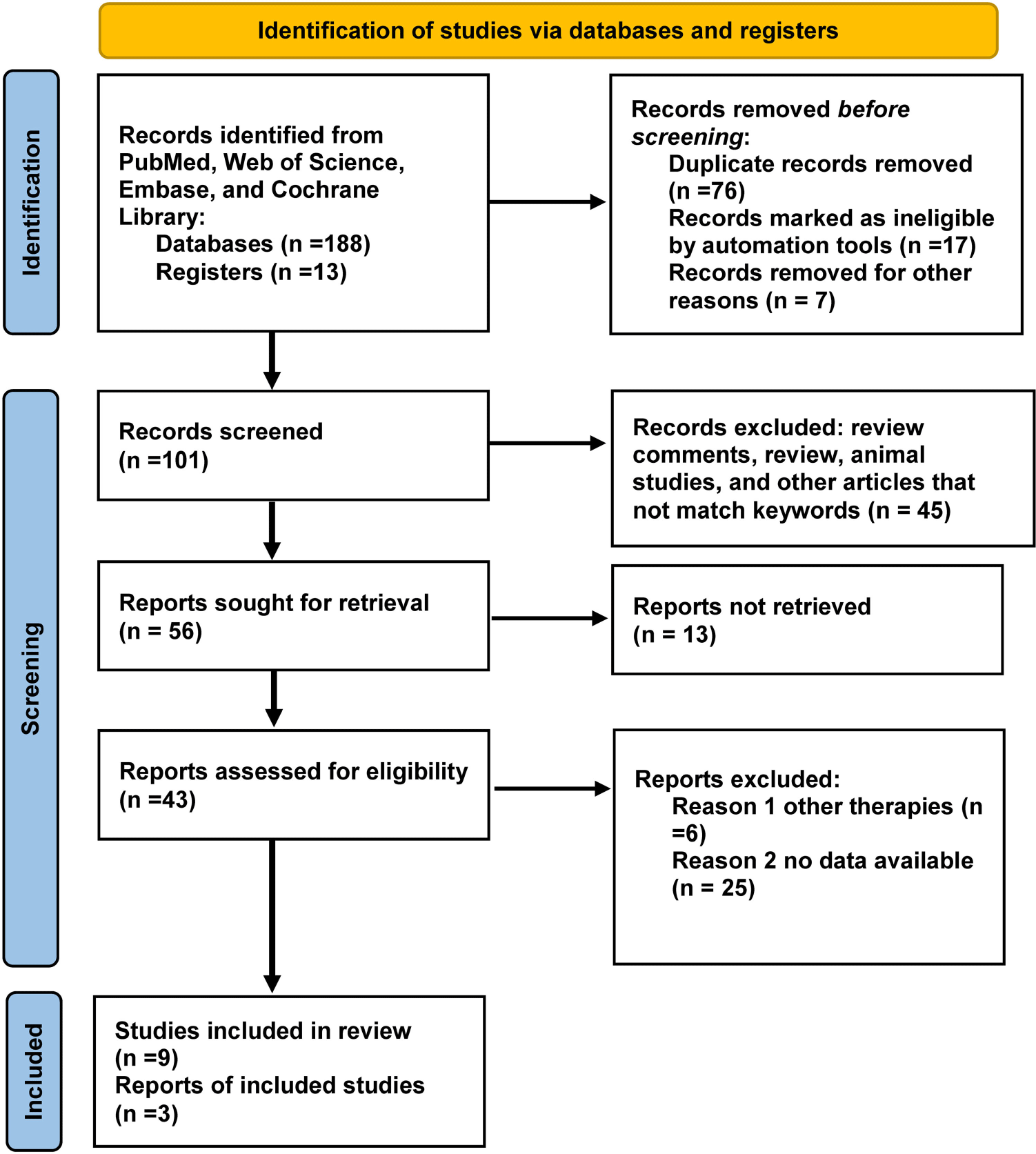
We performed an extensive search of relevant studies in PubMed, Web of Science, Embase, and Cochrane Library from their inception to July 1, 2024. Our search strategy focused on two key areas using Medical Subject Headings terms, titles, or abstracts: (i) “infant” OR “neonate” OR “premature infant” OR “preterm infant” OR variations of these terms; (ii) “Persistent Pulmonary Hypertension” OR “Persistent Fetal Circulation Syndrome” OR “Persistent Fetal Circulation” OR “Persistent Pulmonary Hypertension of Newborn” OR “PPHN” OR variations of these terms (iii) “Magnesium sulfate” OR “Magnesium”. The complete search strategy is an essential component of the research process and is typically outlined in the Preferred Reporting Items for Systematic Reviews and Meta-Analyses diagram (Figure 1).
The flow diagram of the PRISMA process illustrating the literature search and study selection.

Inclusion and exclusion criteria
The inclusion criteria were as follows: 1) The study clearly diagnoses persistent pulmonary hypertension; 2) the subjects of the study are newborns; 3) treatment with magnesium sulphate is administered, with no restrictions on the treatment method; 4) observing the changes in pulmonary artery pressure, oxygenation index, oxygen partial pressure, carbon dioxide partial pressure, etc., before and after magnesium sulphate treatment; and 5) Included studies can be randomised controlled trials or retrospective studies. The following exclusion criteria were as follows: (1) studies comprising only an abstract for which data were not available, duplicated publications, conference reports, or systematic reviews; (2) studies that lacked usable data or failed to meet the inclusion criteria; and (3) animal studies.
The primary outcomes were pulmonary artery pressure and oxygenation index. The secondary outcomes were also evaluated, including mean blood pressure, alveolar-arterial oxygen difference, arterial partial pressure of oxygen (PaO2), arterial partial pressure of carbon dioxide (PaCO2), and arterial oxygen saturation, if sufficient experimental data were available.
Data extraction and quality assessment
Two researchers (Z Tang and ZW Wang) independently reviewed the studies based on inclusion and exclusion criteria and extracted essential information from the studies. Differences in opinions were resolved by the third researcher (X Wang). Extracted general information included the first author, publication date, sample size, interventions, and outcomes as defined above. The quality of the included studies was evaluated using the Newcastle-Ottawa Scale, Reference Cook and Reed10 which encompasses three domains: selection of the study population, comparability, and assessment of exposure and outcomes. Newcastle-Ottawa Scale scores range from 0 to 9, with scores of 7 or higher indicating high quality.
Data synthesis and analysis
Statistical analysis was conducted using Cochrane Review Manager 5.3. Continuous variables were evaluated using mean difference and standard deviation. The random-effects model analysed the data when Higgins I-squared (I 2 ) was greater than 50%, while a fixed-effect model was used if I 2 was less than 50%. A P-value < 0.05 was considered statistically significant. The publication bias was assessed using a funnel plot and Egger’s regression equation.
Results
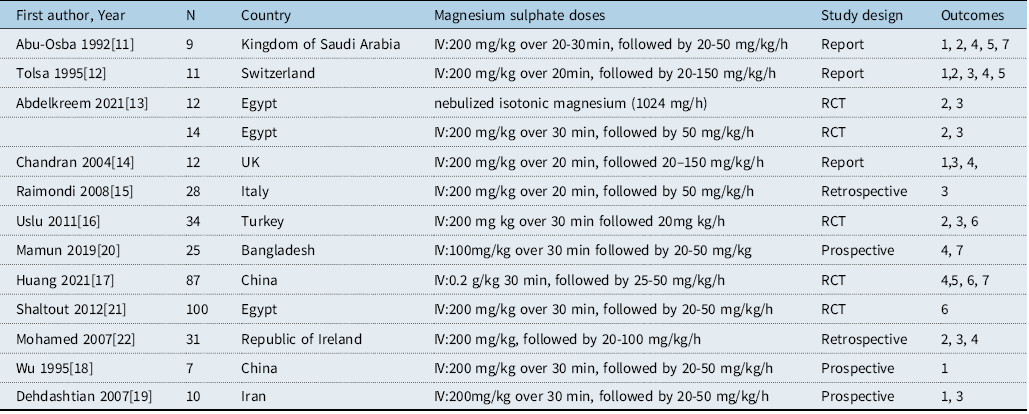
Initially, 201 studies were identified. Out of these, 100 studies were eliminated due to duplicates and the review of titles and abstracts. Following this, 45 additional studies were dismissed as they were either case reports or review articles. Ultimately, after evaluating the full texts, this study included 4 randomised controlled trials and 8 observational studies Reference Abu-Osba, Galal, Manasra and Rejjal11–Reference Mohamed, Matthews, Corcoran and Clarke22 (see Figure 1). The characteristics of the included studies are summarised in Table 1.
Characteristics of the studies included in the meta-analysis Instruction

Foot notes: Outcomes: 1 (A-a) dO2, 2 MBP, 3 OI, 4 PaCO2, 5 PaO2, 6 PAP, 7 SO2, IV: Intravenous injection; RCT: randomized controlled trial.
Effect of magnesium sulphate on pulmonary artery pressure
Three studies reported the effect of magnesium sulphate on pulmonary artery pressure with 221 neonates included in the study. The random effect model was used based on the heterogeneity test results, with I 2 = 86%. Pulmonary artery pressure significantly decreased after magnesium sulphate treatment (MD −24.96, 95%CI −28.19 to −21.73, P < 0.0001) compared to pretreatment (Figure 2a).
The effect of magnesium sulfate on (a) pulmonary artery pressure; (b) oxygenation index (OI); (c) mean blood pressure (MBP); (d) arterial partial pressure of oxygen (PaO2); (e) arterial oxygen saturation (SO2).; (f) arterial partial pressure of carbon dioxide (PaCO2); (g) alveolar-arterial oxygen difference (A-a) dO2).

Effect of magnesium sulphate on oxygenation index
Seven studies reported the effect of magnesium sulphate on oxygenation index (oxygenation index = (fraction of inspired oxygen × mean artery pressure × 100)/ PaO2),Reference Vadi23 152 neonates included). The random effect model was used based on the heterogeneity test results I 2 = 89%. Magnesium sulphate treatment significantly decreased oxygenation index (MD −18.85, 95%CI −22.82 to −14.89, P < 0.00001) compared to pretreatment (Figure 2b).
Effect of magnesium sulphate on mean blood pressure
Three studies reported the effect of magnesium sulphate on mean blood pressure (88 neonates included). Mean blood pressure was detected after magnesium sulphate treatment 2 hours. The fixed effect model was used based on the heterogeneity test results I 2 = 0%. After magnesium sulphate treatment for 2 hours, mean blood pressure was significantly decreased (MD −3.11, 95%CI −3.91 to −2.32, P < 0.0001) compared to pretreatment (Figure 2c).
Effect of magnesium sulphate on PaO2
Six studies reported the effect of magnesium sulphate on PaO2 (175 neonates included). The random effect model was used based on the heterogeneity test results I2 = 96%. After magnesium sulphate treatment, PaO2 was significantly increased (MD 38.26, 95%CI 22.81 to 53.71, P < 0.00001) compared to pretreatment (Figure 2d).
Effect of magnesium sulphate on arterial oxygen saturation
Three studies reported the effect of magnesium sulphate on arterial oxygen saturation (121 neonates included). The random effect model was used based on the heterogeneity test results I2 = 95%. Magnesium sulphate treatment significantly increased arterial oxygen saturation (MD 22.60, 95%CI 10.59 to 34.60, P < 0.0001) compared to pretreatment (Figure 2e).
Effect of magnesium sulphate on PaCO 2
Three studies reported the effect of magnesium sulphate on PaCO2 (107 neonates included). The random effect model was used based on the heterogeneity test results I2 = 95%. There was no difference in PaCO2 levels before and after the administration of magnesium sulphate (MD −6.86, 95%CI −17.43 to 3.71, P = 0.20) (Figure 2f).
Effect of magnesium sulphate on alveolar-arterial oxygen difference
Six studies reported the effect of magnesium sulphate on alveolar-arterial oxygen difference (39 neonates included). The random effect model was used based on the heterogeneity test results I 2 = 50%. Alveolar-arterial partial pressure significantly decreased after magnesium sulphate treatment (MD −52.88, 95%CI −83.38 to −22.38, P < 0.0001) (Figure 2g).
Quality of included studies
The included studies comprised nine studies and three reports. The methodological quality of the 12 observational studies was assessed as moderate, with a Newcastle-Ottawa Scale score of 7. Due to the inherent nature of observational studies, randomisation could not be achieved, raising concerns about selection bias. Nevertheless, the neonates included met the established inclusion criteria, which helped minimise this risk. Given the interventional nature of the index procedure and the single-arm study design, it was not possible to ascertain the potential for performance bias. Similarly, a precise evaluation of detection bias was limited. The risk of reporting bias was minimal, as comprehensive documentation of outcomes was maintained. A detailed explanation of the Newcastle-Ottawa Scale is provided in (Supplemental table 1).
Publication bias
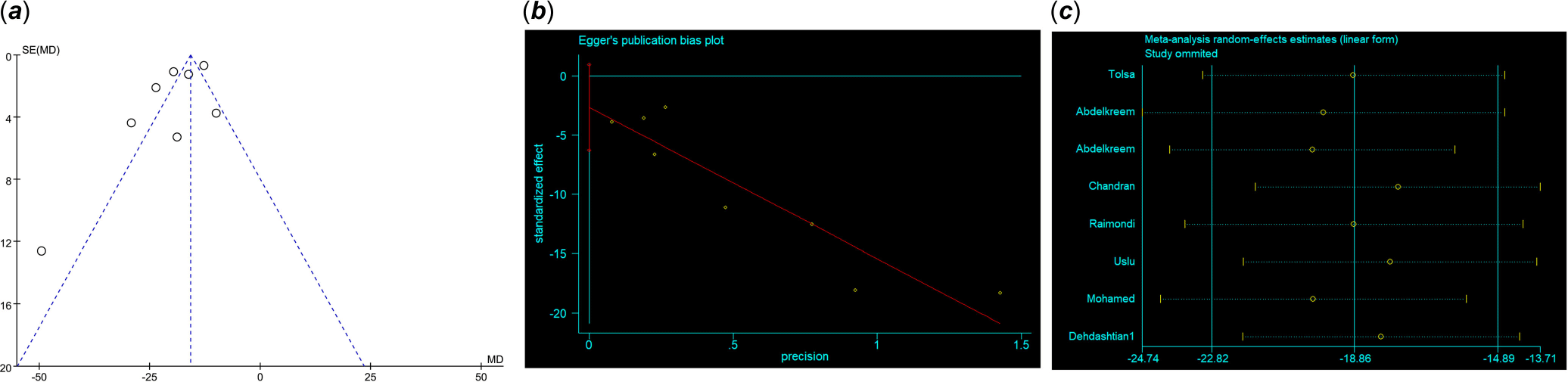
The vertical axis of the plot used standard error to estimate the sample size of the study, with larger population studies positioned at the top and smaller ones at the bottom. The horizontal axis represented the power and effect size of the included studies. The funnel plot of oxygenation index was not symmetrical on visual assessment (Figure 3a). The publication bias was also evaluated by Egger’s regression model. The results showed that there was no significant publication bias (p = 0.124 > 0.05, Figure 3b). The sensitivity analysis of the seven articles showed that no single article caused strong heterogeneity in the results of the study (Figure 3c).
(a) Funnel plot of the oxygenation index (OI); (b) Egger’s regression model of OI; (c) sensitivity analysis of OI.

Discussion
PPHN is a serious and potentially life-threatening condition that affects newborns. Magnesium sulphate exerts muscle relaxant and potent vasodilation and is extensively used in hypertension induced by pregnancy with no adverse effects on the fetus and newborn.Reference Euser and Cipolla24 The present meta-analysis showed that magnesium sulphate treatment significantly decreased pulmonary artery pressure, mean blood pressure, oxygenation index, PaCO2, and alveolar-arterial oxygen difference, but increases PaO2 and arterial oxygen saturation.
Magnesium sulphate has gained attention for its role in managing PPHN due to its various mechanisms, primarily vasodilation.Reference Dehdashtian and Tebatebae25 As a strong vasodilator, it relaxes the smooth muscles of the pulmonary arteries, reducing pulmonary vascular resistance. This relaxation improves blood flow and oxygen exchange in the lungs. Magnesium sulphate achieves this by inhibiting calcium influx into cells, which is necessary for muscle contraction, thereby promoting smooth muscle relaxation.Reference Tang, He and Li26 The effects of magnesium sulphate on reducing pulmonary artery pressure were related to its vasorelaxing effect. However, mean blood pressure was also affected in some contexts. mean blood pressure was monitored during the process of magnesium sulphate treatment. Mean blood pressure significantly decreased after magnesium sulphate treatment 2hours and gradually increased in the following several hours. Magnesium sulphate is not a selective pulmonary vasodilator and may cause hypotension, a condition characterized by abnormally low blood pressure.
Magnesium sulphate markedly increased PaO2 and arterial oxygen saturation levels, while having no effect on PaCO2. PaO2 is a measure of the amount of oxygen dissolved in the arterial blood. A decrease of PaO2 can indicate inadequate oxygenation, which results from various causes including hypoventilation, impaired alveolar-capillary membrane function, or right-to-left shunting.Reference Sarkar, Niranjan and Banyal27 Magnesium sulphate, through its vasodilatory effects, can potentially improve pulmonary blood flow and gas exchange, leading to an increase in PaO2. Improvements in PaO2 would generally correspond to increases in arterial oxygen saturation.
In addition, magnesium sulphate significantly decreased the oxygenation index in neonates with PPHN. The oxygenation index is a composite score that combines the fraction of inspired oxygen, mean airway pressure, and PaO2, providing a comprehensive assessment of respiratory function and oxygenation status. A higher oxygenation index indicates worse oxygenation and is typically seen in severe respiratory conditions such as acute respiratory distress syndrome.Reference Dechert, Park and Bartlett28 The clinical significance of oxygenation index lies in its utility as a marker for the severity of respiratory failure and as a guide for treatment response. Magnesium sulphate’s vasodilatory properties could theoretically lead to a decrease in pulmonary vascular resistance, potentially improving oxygenation and thus lowering the oxygenation index. Additionally, magnesium’s role in reducing inflammation and oxidative stress may indirectly benefit respiratory function by mitigating lung injury.Reference Liu and Dudley29 While the oxygenation index serves as a critical tool for assessing respiratory function and guiding treatment in severe respiratory conditions, the effect of magnesium sulphate on oxygenation index remains an area requiring further research.
Alveolar-arterial oxygen difference alveolar-arterial oxygen difference is an area of interest in respiratory medicine, particularly in the context of acute respiratory distress syndrome. The alveolar-arterial oxygen difference is a measure used to assess the efficiency of gas exchange in the lungs. A high alveolar-arterial oxygen difference indicates poor oxygen transfer from the alveoli to the blood, which can occur in conditions like acute respiratory distress syndrome, pulmonary oedema, or respiratory failure.Reference Harris and Massie30 Magnesium sulphate is known to have vasodilatory properties, which could theoretically improve pulmonary blood flow and gas exchange. By relaxing pulmonary vascular smooth muscle, magnesium sulphate may reduce pulmonary vascular resistance, potentially improving oxygenation and decreasing the alveolar-arterial oxygen difference.
The standard care for persistent pulmonary hypertension of newborns in high-income countries relies heavily on technologies and interventions that are largely inaccessible in resource-limited settings. Inhaled nitric oxide therapy requires specialised delivery systems, continuous monitoring equipment, trained respiratory therapists, and reliable electrical power supply, infrastructure components frequently unavailable in many healthcare facilities across sub-Saharan Africa, South Asia, and rural areas of middle-income countries.Reference Juliana and Abbad31,Reference Slusher, Olusanya and Vreman32 A systematic assessment of neonatal care capacity across low-income countries revealed significant gaps in healthcare infrastructure, with limited facilities possessing the basic equipment necessary for advanced neonatal care, while fewer had trained personnel capable of managing complex therapies safely.Reference Knippenberg, Lawn and Darmstadt33,Reference Penzias, Bohne and Ngwala34 Similarly, echocardiographic equipment essential for persistent pulmonary hypertension of the newborn diagnosis and monitoring is available in a limited number of district-level hospitals in resource-limited settings.Reference Ansa, Odigwe, Agbulu, Odudu-Umoh, Uhegbu and Ekripko35,Reference Kwan, Bukhman and Miller36
The economic burden of inhaled nitric oxide therapy varies significantly across healthcare systems. In the United States, treatment costs are estimated at $150 per hour, with typical treatment durations of 72–96 hours,Reference Pierce, Peters, Cohen, Goldman and Petros37–Reference Dzierba, Abel, Buckley, IJPTJoHP and Therapy39 resulting in total costs of approximately $10,800–14,400 per patient. European markets charge €150 (approximately £90) per hour up to a maximum of 96 hours, after which no additional charges apply.Reference Subhedar, Jauhari and Natarajan38 This pricing structure yields maximum costs of €14,400 (approximately £8,640) per patient. However, a United Kingdom study by Subhedar et al.Reference Hoyle, Spierson, Cordon, Brady and Subhedar40 reported more modest costs, with a mean inhaled nitric oxide therapy cost of approximately £820 per treated infant (equivalent to £8.50 per hour), though alternative pricing models suggested calculated costs ranging from £950 to £1,350 per patient.
In contrast, sildenafil demonstrates variable cost-effectiveness across economic settings. The sildenafil strategy proved cost effective for upper but not lower middle-income countries, with an incremental cost-effectiveness ratio of $2,339 per quality-adjusted life year. Studies have concluded that enteral sildenafil represents a cost-effective intervention for severe PPHN in upper middle-income countries where extracorporeal membrane oxygenation and inhaled nitric oxide are unavailable.Reference Evers, Critser, Cash, Magness, Hoelle and RJAjop41
In resource-constrained environments, magnesium sulphate presents the most cost-effective therapeutic intervention,Reference Chandran, Haqueb, Wickramasinghec and Wint42 with treatment costs under $10 per complete course. This accessibility is further enhanced by its compatibility with standard healthcare infrastructure, requiring only conventional intravenous routes and basic infusion systems, while parenteral administration remains both simple to implement and monitor throughout the therapeutic period. Despite this remarkably low cost, magnesium sulphate has demonstrated significant clinical efficacy.Reference Tolsa, Cotting and Sekarski43
Current guidelines recommend inhaled nitric oxide as first-line therapy for term and near-term infants with PPHN and oxygenation index > 25, with sildenafil serving as reasonable adjunctive therapy for inhaled nitric oxide-refractory cases, particularly when oxygenation index remains elevated.Reference Abman, Hansmann and Archer44 The evidence base for magnesium sulphate compared to sildenafil or nitric oxide therapy in PPHN treatment remains limited. The most significant direct comparative study by Uslu et al. (2011)Reference Uslu, Kumtepe, Bulbul, Comert, Bolat and Nuhoglu16 randomized 65 newborns with PPHN, demonstrating comparable efficacy between magnesium sulphate and sildenafil, though sildenafil showed faster clinical response. Multicenter studies comparing intravenous magnesium sulphate versus inhaled nitric oxide found both treatments effective, with nitric oxide providing faster oxygenation improvement.Reference Raimondi, Migliaro and Capasso15,Reference Boo, Rohana, Yong, Bilkis and Yong-Junina45 However, magnesium sulphate may be considered as a first-line alternative when inhaled nitric oxide is unavailable or as a bridge to more definitive therapies.Reference Chandran, Haqueb, Wickramasinghec and Wint42,Reference Ho and Rasa46 Therefore, present evidence suggests that magnesium sulphate should be considered as an alternative or adjunctive therapy, particularly in resource-limited settings. Furthermore, high-quality randomised controlled trials are needed to establish definitive treatment protocols and optimize clinical outcomes in diverse healthcare settings.
Limitation
Due to the limited amount of randomised study data, observational studies were also included in this article; however, there was a lack of large multicentre randomised studies. More randomised double-blind studies should be included in future analyses. As it was a single-arm study, there was a lack of comparison with other studies, such as inhaled nitric oxide and sildenafil. Although magnesium sulphate had therapeutic effects and lower side effects in pulmonary hypertension, long-term randomised studies are still needed to follow-up on potential long-term side effects that may arise from randomised controlled trials.
Conclusion
Magnesium sulphate exerts significant effects by decreasing pulmonary artery pressure, augmenting PaO2 and arterial oxygen saturation levels, and reducing oxygenation index, alveolar-arterial oxygen difference, and PaCO2, thereby markedly enhancing oxygenation. Additionally, it demonstrates a moderate hypotensive effect on mean arterial pressure after two hours of administration, necessitating caution to prevent hypotension during its use.
Supplementary material
For supplementary material accompanying this paper visit https://doi.org/10.1017/S1047951125100887
Acknowledgements
We expressed our gratitude to Shanshan Wu from the Department of Clinical Epidemiology and Evidence-Based Medicine at Beijing Friendship Hospital for her guidance on the article.
Author contributions
XB Wang oversaw the research design and data analysis. Z Tang and ZW Wang independently reviewed the studies based on inclusion and exclusion criteria and extracted essential information from the studies. All authors reviewed and approved the final manuscript.
Financial support
No funding was received for conducting this study.
Competing interests
None.