1. Introduction
Diapirs often occur both at continental margins and in foreland basins. They are the result of upward flow of underground low-density and high-plasticity materials (such as rock salt, gypsum, mudstone and magma) under conditions of differential pressure or tectonic stress. There are diverse types of diapirs in different tectonic settings, such as magma diapirs, salt diapirs and mud diapirs. Salt diapirs and mud diapirs are common in active or passive continental margin basins and foreland basins of orogenic belts, such as the mud diapirs in the Andaman Sea Basin, the high-temperature overpressure mud–fluid diapirs in the Yinggehai Basin, salt diapirs in the Gulf of Mexico and the salt diapir in the foreland basin of the Tethyan tectonic domain (Van Rensbergen et al. Reference Van Rensbergen, Morley, Ang, Hoan and Lan1999, Reference Van Rensbergen, Hillis, Maltman, Morley, Rensbergen, Hillis, Maltman and Morley2003; Ismail-Zadeh, Talbot & Volozh, Reference Ismail–Zadeh, Talbot and Volozh2001; Smit, Brun & Sokoutis, Reference Smit, Brun and Sokoutis2003; Tang et al. Reference Tang, Jia, Jin, Pi, Chen and Xie2003; Yu et al. Reference Yu, Li, Wang, Wang and Lu2005; Albertz, Beaumont & Ings, Reference Albertz, Beaumont, Ings and Wood2010; Adam, Ge & Sanchez, Reference Adam, Ge and Sanchez2012). Diapirs usually comprise three parts: diapiric core, upper covering (above the core) and lower formation (below the core). Overlying strata of diapirs often undergo complex deformation due to the upward flow of the diapiric core (Qi, Xia & Yang, Reference Qi, Xia and Yang2005), whereas lower formations of diapirs normally show weak deformation.
Structural features and formation conditions of diapirs have long been investigated (Jackson & Talbot, Reference Jackson and Talbot1986, Reference Jackson and Talbot1991; Fei & Wang, Reference Fei and Wang1982; Cartwright, Reference Cartwright1994; Wang & Xie, Reference Wang and Xie1998; Xie et al. Reference Xie, Li, Dong, Zhang and Yang1999; Zhang, Reference Zhang2000; Tang et al. Reference Tang, Jia, Jin, Pi, Chen and Xie2003; Hudec & Jackson, Reference Hudec and Jackson2007; Adam, Ge & Sanchez, Reference Adam, Ge and Sanchez2012). Fei & Wang (Reference Fei and Wang1982) related the formation of salt and mud diapirs in the Dongying Depression of Bohai Bay Basin to sediment density, deposition rate and horizontal tectonic stress, and suggested that horizontal tectonic stress may be the key triggering factor. Based on their systematic analyses of salt diapirs in both passive continental margins and orogenic belts, Hudec & Jackson (Reference Hudec and Jackson2007) and Albertz, Beaumont & Ings (Reference Albertz, Beaumont, Ings and Wood2010) proposed that buoyancy force, structural stress, basal dip and differential loading are the main factors controlling the formation of salt diapirs. Recent investigations of analogue and numerical modelling have shed new light on the formation process and the mechanism of salt diapirs (Brun & Fort, Reference Brun and Fort2011; Adam, Ge & Sanchez, Reference Adam, Ge and Sanchez2012; Rowan et al. Reference Rowan, Peel, Vendeville and Gaullier2012; Samuel, Reference Samuel2012; Warsitzka, Kley & Kukowski, Reference Warsitzka, Kley and Kukowski2013; Nikolinakou, Hudec & Flemings, Reference Nikolinakou, Hudec and Flemings2014; Wachenl et al. 2014). Results of analogue modelling (Warsitzka, Kley & Kukowski, Reference Warsitzka, Kley and Kukowski2013) suggest that the formation of a salt diapir may be controlled by various factors, such as consumption of its deep-buried ductile layer or source layer, the sealing capacity of the caprock, denudation, basal dip and the acting mode of structural stress. By comparing the results of evolutionary and static numerical models of salt diapirs, Nikolinakou, Hudec & Flemings (Reference Nikolinakou, Hudec and Flemings2014) suggested that under the same condition of porosity the average effective stress is greater in the evolutionary model than in the static model and that in the evolutionary model the intensity as well as anisotropy of stress in the peripheral rock of a salt diapir can be properly predicted.
However, previous studies mainly focused on salt diapirs (Vendeville & Jackson, Reference Vendeville and Jackson1992; Morley & Guerin, Reference Morley and Guerin1996; Graue, Reference Graue2000; Kopf, Reference Kopf2002). Although mud diapirs or mud volcanoes are also common in continental margin basins and orogenic foreland basins (Fig. 1) and nearly 900 mud volcanoes have been discovered thus far (He et al. Reference He, Zhu, Weng and Cui2010), they have not been sufficiently studied, due largely to their low vertical extent and the difficulty of identifying them in seismic profiles. Detailed seismic data have revealed that there are various types of mud diapirs in petroliferous basins, such as the Andaman Sea Basin, the Yinggehai Basin, the Dongying Depression, the Pearl River Mouth Basin and Taiwan (Fei & Wang, Reference Fei and Wang1982; Xie et al. Reference Xie, Li, Dong, Zhang and Yang1999; Zhang, Reference Zhang2000; Nielsen, Chamot-Rooke & Rangin, Reference Nielsen, Chamot-Rooke and Rangin2004; He et al. Reference He, Xia, Zhang, Yan and Liu2006, Reference He, Zhu, Weng and Cui2010; Wang et al. Reference Wang, Pang, Wang, He and Lian2006; Zhu, Xie & Qiu, Reference Zhu, Xie and Qiu2010; Chen et al. Reference Chen, Hsu, Wang, Chung, Chen, Tsai, Liu, Lin and Lee2014). Owing to the low contrast between mud diapirs and the surrounding strata, mud diapirs are much more difficult to identify than salt diapirs in seismic profiles, especially when the mud diapirs have low ductility. However, exploration practices suggest that mud diapirs may have played an important role in the accumulation of hydrocarbon. Hence, thorough investigations of mud diapirs are necessary and significant for oil and gas exploration.
(a) Shale-related diapirs in the Niger Delta (after Albertz, Beaumont & Ings, Reference Albertz, Beaumont, Ings and Wood2010). (b) Mud diapirs in Yinggehai Basin (after He et al. Reference He, Xia, Zhang, Yan and Liu2006). (c) Mud diapirs and mud volcanoes in the offshore area of SW Taiwan (after Chen et al. Reference Chen, Hsu, Wang, Chung, Chen, Tsai, Liu, Lin and Lee2014).

Andaman Sea Basin, located in the northern part of the Indian Ocean, is a Mesozoic–Cenozoic petroliferous basin (Khan & Chakraborty, Reference Khan and Chakraborty2005). Previous studies have demonstrated the existence of mud diapirs or mud volcanoes in this area, and different regions of the Andaman Sea Basin apparently have different types of mud diapirs (Nielsen, Chamot-Rooke & Rangin, Reference Nielsen, Chamot-Rooke and Rangin2004; Zhu, Xie & Qiu, Reference Zhu, Xie and Qiu2010). However, the features of mud diapirs in this basin are far from being fully understood owing to insufficient exploration data, and their formation conditions have not been systematically investigated. In this paper, we discuss further the structural features and formation conditions of mud diapirs in the Andaman Sea Basin based on some new seismic data together with previous seismic and drilling data.
2. Geological setting
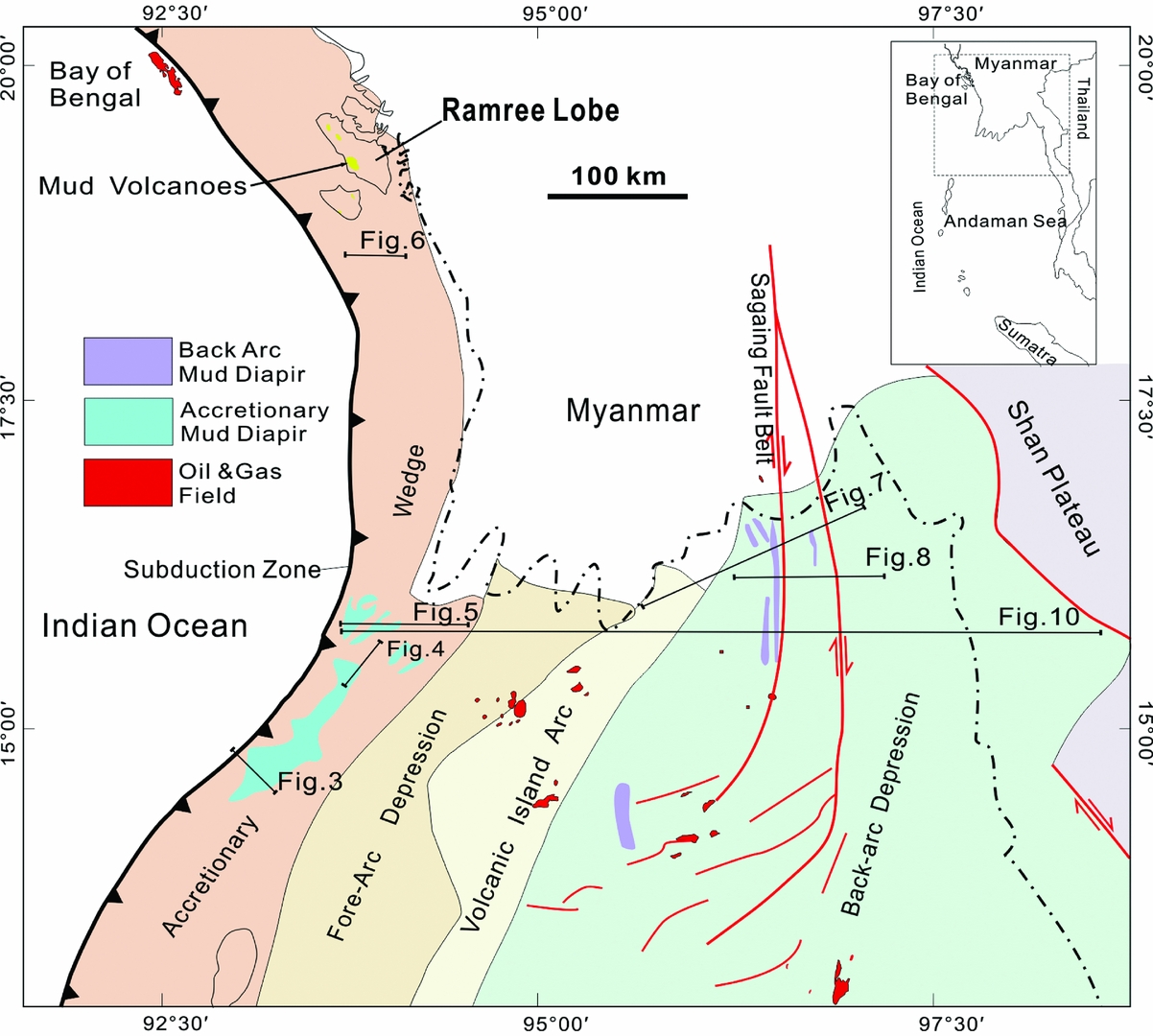
The Andaman Sea Basin is located at the intersection of the India Plate, the Eurasian Plate and the Southeast Asian plates (Curray, Reference Curray2005; Khan & Chakraborty, Reference Khan and Chakraborty2005; Raju et al. Reference Raju, Ray, Mudholkar, Murty, Gahalaut, Samudrala, Paropkari, Ramachandran and Surya Prakash2012; Rangin et al. Reference Rangin, Maurin and Masson2013; Sautter et al. Reference Sautter, Pubellier, Jousselin, Dattilo, Kerdraon, Choong and Menier2017). It is bounded to the east by Than Plateau, to the west by the Bay of Bengal, to the north by Myanmar and to the south by Sumatra (Fig. 2). NNE-oriented oblique subduction of the India Plate as well as the dextral strike-slip movement of Sagaing fault may have controlled the deformation of the basin. It is known that this basin has undergone three stages of tectonic deformation (Khan & Chakraborty, Reference Khan and Chakraborty2005; Morley, Reference Morley2012; Reference Morley2013; Xu et al. Reference Xu, Zheng, Zhu, Yang, Li and Yang2012: (1) oblique extensional deformation stage during the Early Miocene – Late Miocene; (2) rifting stage during the Miocene–Pliocene stage; and (3) post-rift deposition stage. According to its present tectonic framework, it can be divided into five belts: the accretionary wedge, fore-arc depression, volcanic island arc, back-arc depression and Shan Plateau (Fig. 2; He et al. Reference He, Mei, Zhu, Yang, Hu, Xiao and Zou2011; Zhu et al. Reference Zhu and Li2012). Mud diapirs have been observed mainly in the belts of the accretionary wedge and the back-arc depression (Nielsen, Chamot-Rooke & Rangin, Reference Nielsen, Chamot-Rooke and Rangin2004; Zhu, Xie & Qiu, Reference Zhu, Xie and Qiu2010).
Geological sketch of the Andaman Sea Basin (compiled from Nielsen, Chamot-Rooke & Rangin, Reference Nielsen, Chamot-Rooke and Rangin2004; Khan & Chakraborty, Reference Khan and Chakraborty2005; Zhu, Xie & Qiu Reference Zhu, Xie and Qiu2010), showing distributions of mud diapirs and locations of seismic profiles discussed in this study.

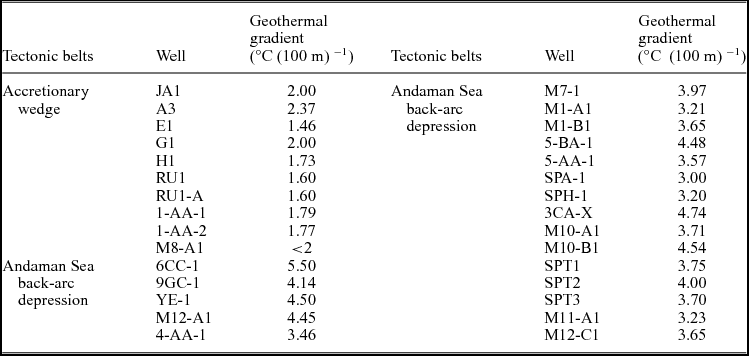
The accretionary wedge of the Andaman Sea Basin has a westward concaved boundary. Multibeam bathymetric data revealed that its different segments apparently have different structural styles and shortening amounts, which may account for the development of some right strike-slip faults (Nielsen, Chamot-Rooke & Rangin, Reference Nielsen, Chamot-Rooke and Rangin2004). There are normal faults, reverse faults and strike-slip faults in the accretionary wedge. Drilling data revealed that the southern segment of the accretionary wedge is of thin Miocene to Holocene strata, the lower part and the upper part of which consist of marine shale with intercalations of thin sand layers and littoral–neritic sand interbedded with shale, respectively. The middle segment of the accretionary wedge consists of ~7 km thick Eocene – upper Miocene sediments (Robinson et al. Reference Robinson, Bird, Oo, Hoey, Aye, Higgitt, Lu, Swe, Tun and Win2007; Zhu, Xie & Qiu, Reference Zhu, Xie and Qiu2010; Cai et al. Reference Cai, Zhu, Jiang, Yang and Li2012). In contrast, the northern segment of the accretionary wedge consists of nearly 3,600 m thick Miocene sediments (Uddin & Lundberg, Reference Uddin and Lundberg2004). Generally, the accretionary wedge has relatively thin strata and low geothermal gradients (Table 1).
Geothermal gradient statistics of accretionary wedge and back-arc depression

The Andaman Sea back-arc depression experienced rifting during the Mesozoic–Cenozoic period. Seismic and drilling data revealed that it has ~8 km thick Middle Miocene – Holocene strata with a deposition rate of ~616 m Ma−1 (Raju et al. Reference Raju, Ramprasad, Rao, Ramalingeswara Rao and Varghese2004; Morley, Reference Morley2013; Morley & Alvey, Reference Morley and Alvey2015). The strata have strong heterogeneity (comprising mudstone, shale interbedded with siltstone, sandstone interbedded with pelitic bands, clastic limestone and glauconite) and a geothermal gradient of ~4.54°C (100 m) −1 (Table 1), higher than that of ~3.0°C (100 m)−1 in other basins. Although the Palaeogene strata are commonly cut by normal faults, no obvious faults can be observed in the Neogene strata.
3. Features of mud diapirs
3.a. Mud diapirs in the accretionary wedge
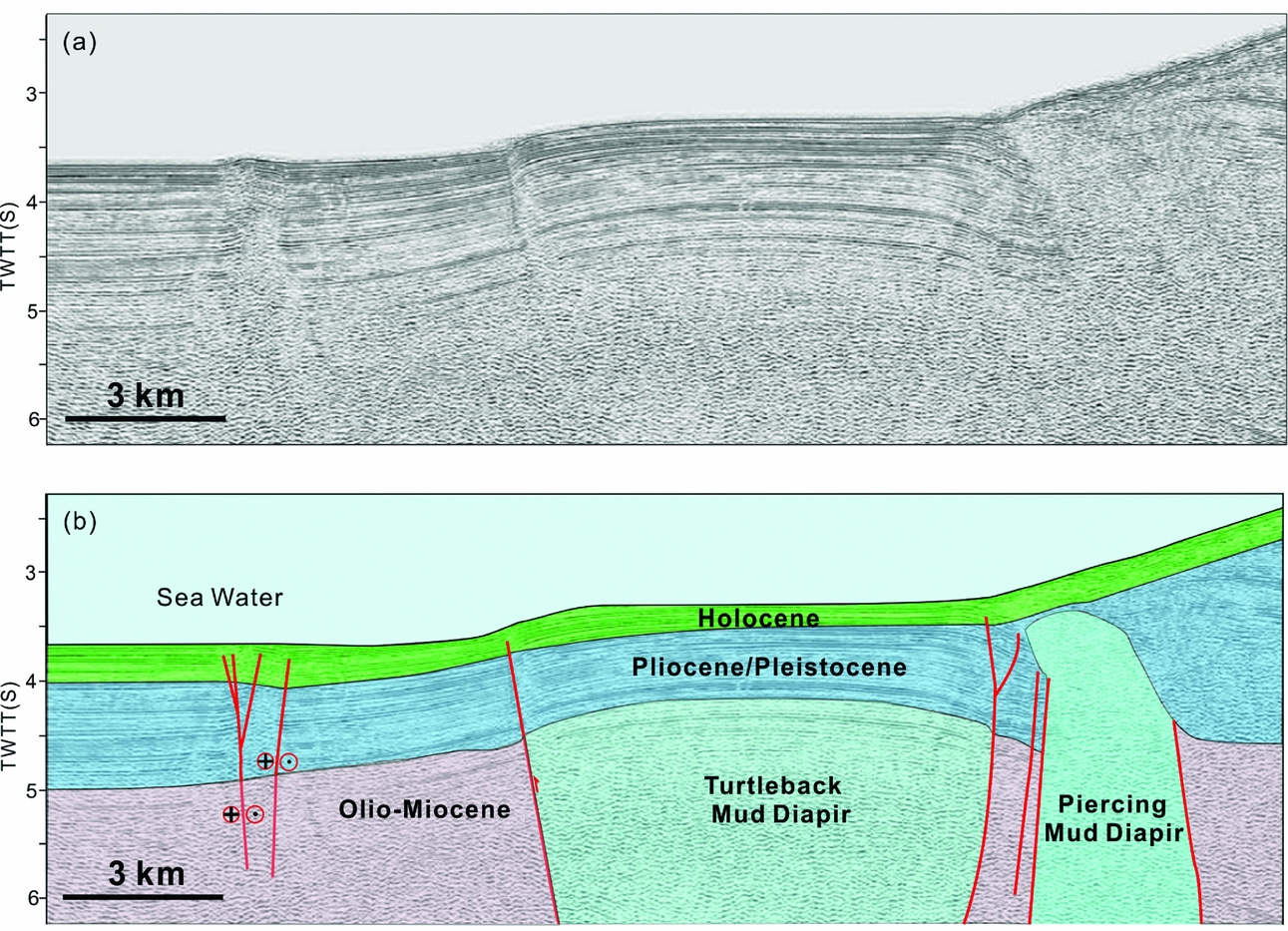
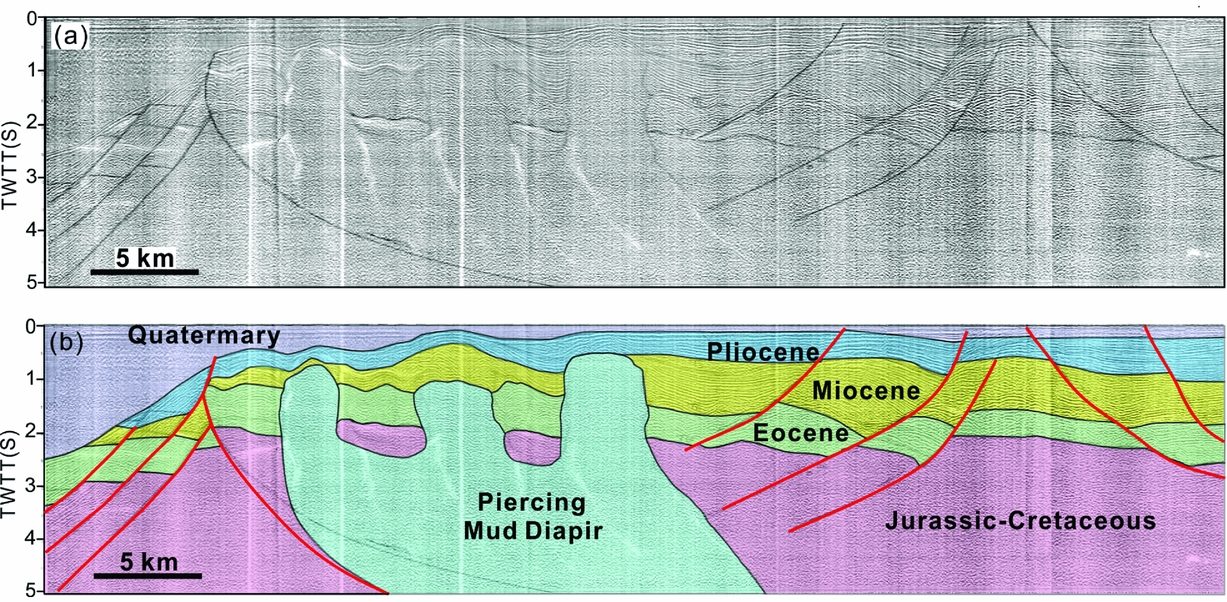
There are four types of mud diapirs in the accretionary wedge. Turtleback mud diapirs mainly occur in the southern segment of the accretionary wedge, are often bounded by reverse faults and are up to 6 km wide (Fig. 3). Their lower parts often show chaotic and discontinuous seismic reflections, while their upper parts show relatively continuous and sub-parallel seismic reflections. The diapirs in the area close to the trench generally have larger widths than those in the other places.
Turtleback mud diapir in the seismic profile across the southern segment of the accretionary wedge of the Andaman Sea Basin (modified from Nielsen, Chamot-Rooke & Rangin, Reference Nielsen, Chamot-Rooke and Rangin2004). (a) Original seismic profile and (b) interpreted seismic profile with the location shown in Figure 2 (same in Figs 4–8).

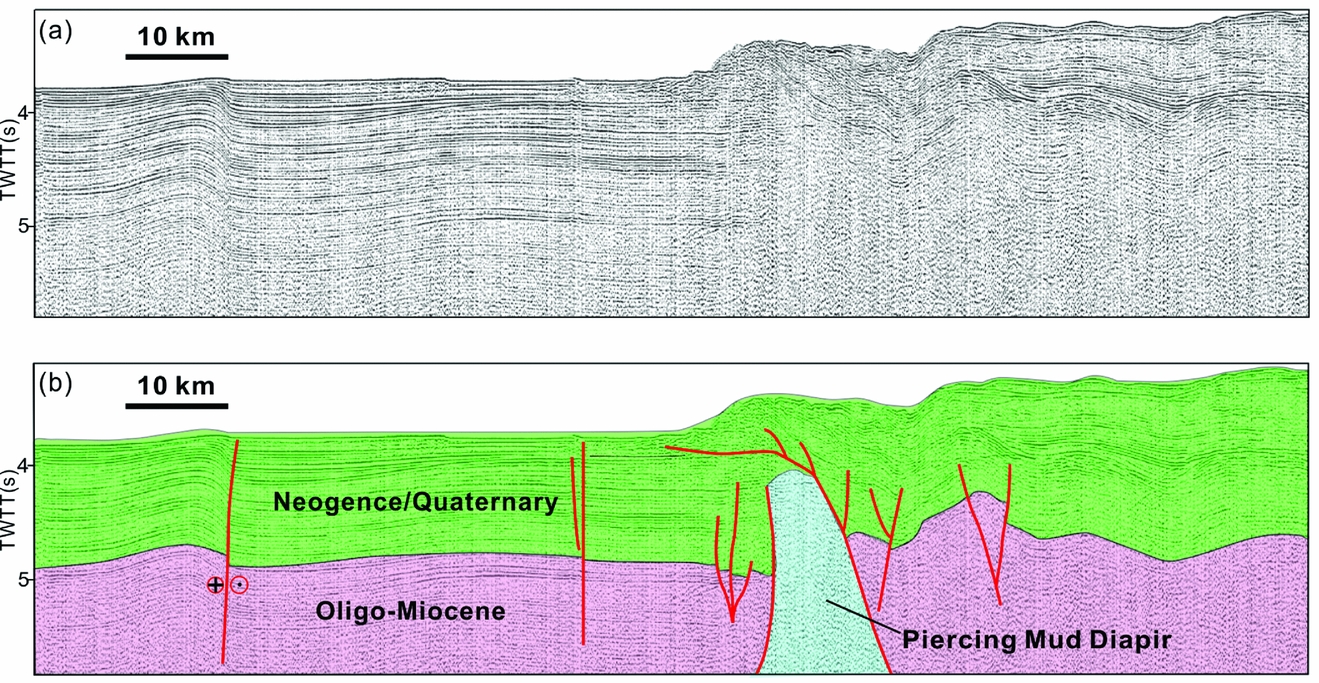
Piercing diapirs mainly occur in the central segment of the accretionary wedge, especially in the area close to the tectonic zone of the Gulf of Martaban. They can be up to ~5 km wide and commonly penetrate their overlying Miocene strata (Figs 4, 5). The strata of their upper parts are often out of alignment and distorted, while the strata of their lower parts are always of chaotic and discontinuous seismic reflections. These piercing diapirs can be formed under both transpressional and extensional circumstances (Figs 4, 5).
Piercing mud diapir in the seismic profile across the middle segment of the accretionary wedge of the Andaman Sea Basin (modified from Nielsen, Chamot-Rooke & Rangin, Reference Nielsen, Chamot-Rooke and Rangin2004).

Piercing mud diapirs in the seismic profile across the middle segment of the accretionary wedge of the Andaman Sea Basin (after He et al., Reference He, Mei, Zhu, Yang, Hu, Xiao and Zou2011).

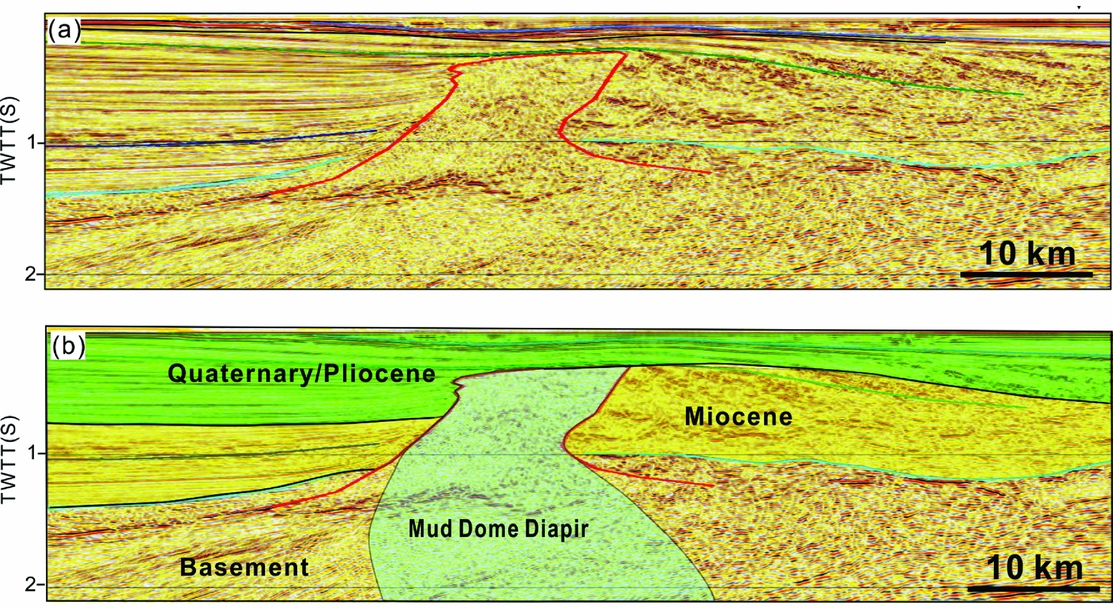
The mud domes and mud volcanoes were found mainly in the northern segment of the accretionary wedge, which can be up to ~8 km wide (Fig. 6), wider than that of the turtleback mud diapirs in the southern segment. The strata on both sides of the mud dome diapirs are often distorted and show chaotic seismic reflections. Mud volcanoes were found mainly in the Ramree Lobe (Nielsen, Chamot-Rooke & Rangin, Reference Nielsen, Chamot-Rooke and Rangin2004).
Mud dome diapir in the seismic profile across the northern segment of the accretionary wedge of the Andaman Sea Basin.

3.b. Mud diapirs in the back-arc depression
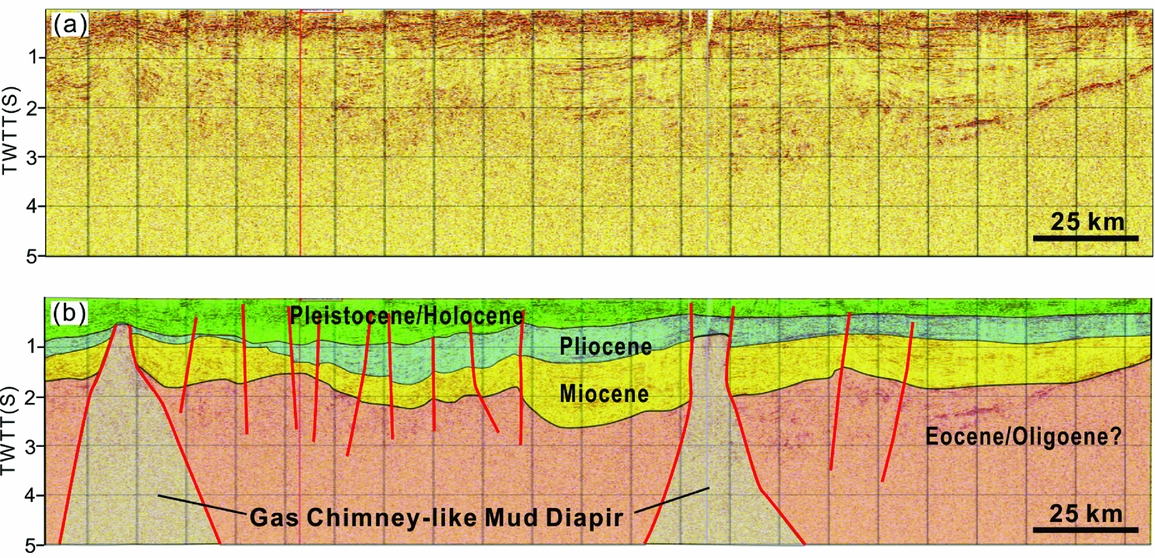
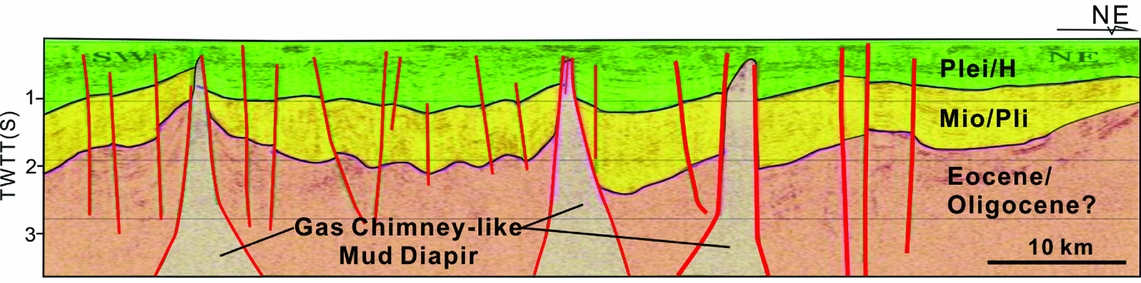
Mud diapirs in the back-arc depression are mainly gas chimney-like, and are concentrated in the Gulf of Martaban (Zhu, Xie & Qiu, Reference Zhu, Xie and Qiu2010), east of the Sagaing fault zone (Fig. 2). They have nearly N–S trends, widths up to ~6 km and lengths up to ~125 km (Fig. 2). Seismic profiles across the northern segment of the back-arc depression reveal that the mud diapirs are commonly of chaotic seismic reflections and have greater vertical piercing distances into the overlying Eocene to Holocene strata (Figs 7, 8). The mud diapirs in the eastern central zone and the northern segment of the back-arc depression have similar features. Their surrounding beds are often intersected by normal faults and have relatively large dip angles.
Gas chimney-like mud diapirs in seismic profile across the back-arc depression of the Andaman Sea Basin.

Gas chimney-like mud diapirs in seismic profile across the back-arc depression of the Andaman Sea Basin. Plei/H – Pleistocene/Holocene; Mio/Pli – Miocene/Pliocene.

4. Discussion
4.a. Formation conditions of mud diapirs in the accretionary wedge
Since very thick sediments may often result in the undercompaction of strata (Van Rensbergen et al. Reference Van Rensbergen, Morley, Ang, Hoan and Lan1999), the nearly 3600 m thick Miocene sediments in the Bengal Fan (Uddin & Lundberg, Reference Uddin and Lundberg2004) may result in the undercompaction of strata and hence prompt the formation of mud diapirs in the accretionary wedge. Rapid filling (up to ~250 m Ma−1) of mud deposits is another important fact, as found in previous studies (Brown, Reference Brown1990; Gopala Rao et al. Reference Gopala Rao, Bhattacharya, Ramana, Subrahmanyam, Ramprasad, Krishna, Chaubey, Murty, Srinivas and Desa1994; Milkov, Reference Milkov2000; Alam et al. Reference Alam, Alam, Curray, Chowdhury and Gani2003; Talukder et al. Reference Talukder, Bialas, Klaeschen, Buerk, Brueckmann, Reston and Breitzke2007). Therefore, apparent differences in the deposition rate of different parts of the accretionary wedge during the Miocene–Holocene period (Nielsen, Chamot-Rooke & Rangin, Reference Nielsen, Chamot-Rooke and Rangin2004) may also affect the formation of mud diapirs in the accretionary wedge. The fact that the accretionary wedge changed from transpressive deformation in the south to pure strike-slip deformation in the middle and then to sedimentary wedge growth in the north (Nielsen, Chamot-Rooke & Rangin, Reference Nielsen, Chamot-Rooke and Rangin2004; Hudec & Jackson, Reference Hudec and Jackson2007), and the types of mud diapirs in the accretionary wedge changed from turtleback mud diapir in the south to piercing mud diapir in the middle and then to mud dome and volcano in the north, implies a possible relationship between the patterns of deformation and types of mud diapirs. In addition, the seaward tilting of upper parts of some piercing mud diapirs (Figs 3–5) implies that gravitational spreading and sliding may also affect the formation of mud diapirs in the accretionary wedge, as proposed by Adam, Ge & Sanchez (Reference Adam, Ge and Sanchez2012).
It is therefore indicated that thickness of sediments, deposit filling rate, strain pattern of structure and gravitational spreading and sliding are the important factors controlling the formation of mud diapirs in the accretionary wedge. In contrast, mud diapirs in the accretionary wedge of the Andaman Sea Basin clearly differ from those in offshore SW Taiwan, where the mud diapirs formed under conditions of extremely high pressure caused by rapid deposition, strong compressional stress and a large amount of fluid (Chen et al. Reference Chen, Hsu, Wang, Chung, Chen, Tsai, Liu, Lin and Lee2014).
4.b. Formation conditions of mud diapirs in the back-arc depression
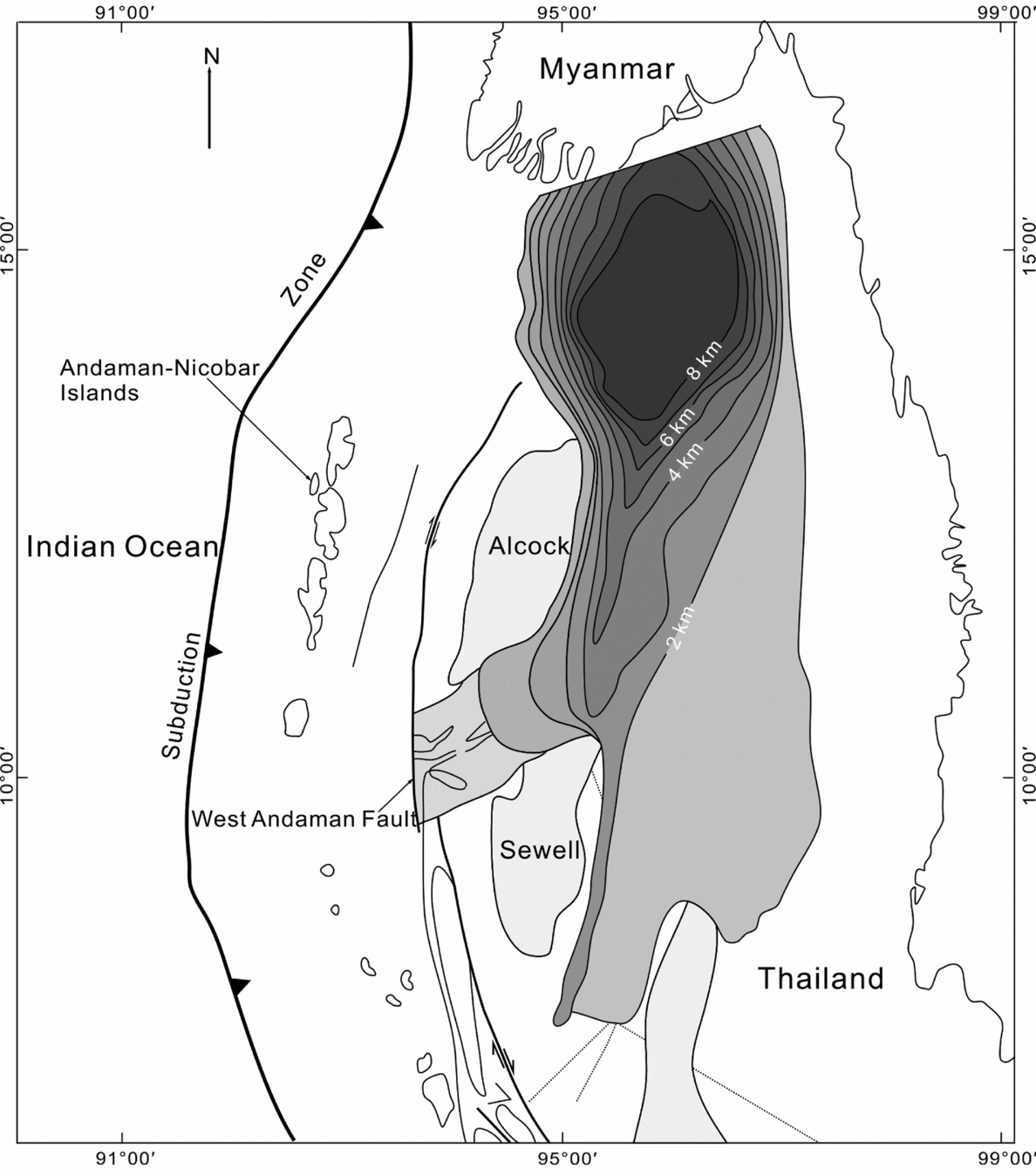
Similar to the mud diapirs in the accretionary wedge, the formation of gas chimney-like mud diapirs in the back-arc depression of Andaman Sea Basin was also prompted by the large sediment thickness and high sedimentation rate of this region, which are related to the high sediment flux from the Irrawaddy, Sittoung and Salween rivers (Figs 9, 10). The strong heterogeneity and the lack of obvious faults in the Neogene strata, which can hinder the release of fluids from strata (Hao et al. Reference Hao, Li, Gong and Yang2001), may favour the formation of the gas chimney-like mud diapirs. The high geothermal gradient, which may favour water vaporization and hydrocarbon generation and hence the flow of mud sediments (Vendeville & Jackson, Reference Vendeville and Jackson1992; Hao et al. Reference Hao, Li, Gong and Yang2001; He et al. Reference He, Xia, Zhang, Yan and Liu2006), may be an important factor prompting the formation of the gas chimney-like mud diapirs in this depression. In addition, the movement of the Sagaing strike-slip fault belt since the Pliocene (Morley & Alvey, Reference Morley and Alvey2015) may favour the flowing and piercing of mud sediments (Van Rensbergen et al. Reference Van Rensbergen, Hillis, Maltman, Morley, Rensbergen, Hillis, Maltman and Morley2003) and hence the formation of gas chimney-like mud diapirs in the depression.
Isopach map of Middle Miocene to Recent sediments in the back-arc depression of the Andaman Sea Basin (after Morley & Alvey, Reference Morley and Alvey2015).

Gas chimney-like mud diapirs in the back-arc depression of the Andaman Sea Basin shown in the summary cross-section (see Fig. 2 for location). Plei/H – Pleistocene/Holocene; Pli – Pliocene; Mio – Miocene; Oli – Oligocene; C/E – Cretaceous/Eocene.

Therefore, we believe that high sediment thickness, rapid sedimentation rates, strong heterogeneity in strata, high geothermal gradient and the movement of the Sagaing strike-slip fault belt may be the main factors controlling the formation of the gas chimney-like mud diapir in the back-arc depression, similar to the conditions of Yinggehai Basin and Pearl River Mouth Basin (He et al. Reference He, Xia, Zhang, Yan and Liu2006, Reference He, Zhu, Weng and Cui2010; Wang et al. Reference Wang, Pang, Wang, He and Lian2006).
5. Conclusions
Seismic profiles together with drilling data have clearly indicated that the mud diapirs in the accretionary wedge and the back-arc depression of Andaman Sea Basin generally have a NE–SW trend and a S–N trend, respectively. There are five types of mud diapirs, namely turtleback mud diapir, piercing mud diapir, mud dome, mud volcano and gas chimney-like mud diapir, in Andaman Sea Basin. Turtleback mud diapirs, piercing mud diapirs, mud domes and mud volcanoes mainly occur in the accretionary wedge, while the gas chimney-like mud diapirs only occur in the back-arc depression. In the accretionary wedge, the turtleback diapirs, the piercing diapirs and both the mud domes and mud volcanoes were found mainly in the southern segment, the middle and the northern segment, respectively.
Six factors, namely the sediment thickness, sedimentation rates, geothermal gradient, strain patterns, gravitational spreading and gravitational sliding, may have affected the formation of mud diapirs in the Andaman Sea Basin. Large sediment thickness, rapid sedimentation rate, high tectonic stress level, the existence of gravitational spreading and gravitational sliding may have favoured the formation of the mud diapirs in the accretionary wedge. Additional factors such as movement of strike-slip fault and high geothermal gradient may have played important roles in the formation of mud diapirs in the back-arc depression.
Acknowledgements
We thank Drs Lianfu Mei, Sihuang Xu, M. K. Pandit and Diane Chung for their helpful suggestions on a previous version of this paper. This paper benefited significantly from thorough and constructive reviews and comments by two anonymous reviewers and Editor Prof. Olivier Lacombe. The China National Oil Development Corporation (CNODC) and CNPC-Logging are thanked for their seismic and well data.