Introduction
Finger millet (Eleusine coracana subsp. coracana Gaertn.) is emerging as one of the potential grain crops for food and nutritional security, climate resilient farming and agricultural diversification. The allotetraploid, finger millet (2n = 4x = 36; genome AABB) belongs to the family Poaceae and subfamily Chloridoideae. Finger millet cultivation is spread in many parts of the eastern and southern Africa and in South Asia. Millions of poor farmers and consumers depend on finger millet as a subsistence food and feed grain. Finger millet grains are packed with high nutrition, dietary fibre content (15–20%) (Chethan and Malleshi, Reference Chethan and Malleshi2007), essential amino acids (44.7%) (Mbithi-Mwikya et al., Reference Mbithi-Mwikya, Ooghe, Van Camp, Nagundi and Huyghebaert2000) and balanced mineral compositions, such as calcium (344 mg/100 g) (Upadhyaya et al., Reference Upadhyaya, Ramesh, Sharma, Singh, Varshney, Sarma, Ravishankar, Narasimhudu, Reddy, Sahrawat, Dhanalakshmi, Mgonja, Parzies, Gowda and Singh2011), zinc (1.3 mg/100 g), iron (4.4 mg/100 g) and phosphorus (180.4 mg/100 g) (Singh and Raghuvanshi, Reference Singh and Raghuvanshi2012). Finger millet as a crop can withstand extreme climatic conditions, thus considered as one of the most potential future agricultural crops for the difficult ecosystems.
Blast disease, caused by the fungus Magnaporthe grisea, seriously affects production, consumption and trade of finger millet (Lenne et al., Reference Lenne, Takan, Wanyera, Manyasa, Mgonja, Okwadi, Brown and Sreenivasaprasad2007; Babu et al., Reference Babu, Thakur, Upadhyaya, Reddy, Sharma, Girish and Sarma2013). The average yield loss due to blast disease is around 28–36% (Rao, Reference Rao1990; Prajapati et al., Reference Prajapati, Sabalpara and Pawar2013). The traditional management of blast disease includes fungicides, which is expensive to the poor farmers and environmentally unsafe. Alternatively, development of durable-resistant variety is a more practical approach to manage blast disease in finger millet (Nagaraja et al., Reference Nagaraja, Kumar, Raguchander, Hota, Patro, Gowda, Savita and Gowda2012). Global collections of finger millet germplasm were evaluated to develop core (Gowda et al., Reference Gowda, Suvarna, Somu, Bharathi and Mathur2007) and minicore collections (Upadhyaya et al., Reference Upadhyaya, Sarma, Ravishankar, Albrecht, Narasimhudu, Singh, Varshney, Reddy, Singh, Dwivedi, Wanyera, Oduori, Mgonja, Kisandu, Parzies and Gowda2010; Upadhyaya et al., Reference Upadhyaya, Ramesh, Sharma, Singh, Varshney, Sarma, Ravishankar, Narasimhudu, Reddy, Sahrawat, Dhanalakshmi, Mgonja, Parzies, Gowda and Singh2011). Accessions of finger millet were also evaluated under field conditions to identify blast disease resistant and susceptible genotypes against various isolates of M. grisea (Nakayama et al., Reference Nakayama, Nagamine and Hayashi2005; Takan et al., Reference Takan, Chipili, Muthumeenakshi, Talbot, Manyasa, Bandyopadhyay, Sere, Nutsugah, Talhinhas, Hossain, Brown and Sreenivasaprasad2012; Babu et al., Reference Babu, Thakur, Reddy, Upadhyaya, Girish and Sarma2012; Babu et al., Reference Babu, Thakur, Upadhyaya, Reddy, Sharma, Girish and Sarma2013). Since, it is a self-pollinated crop a limited genetic diversity is expected within a gene pool of popular cultivars and landraces. Thus, it is important to assess the genetic variation in selected trait-specific genotypes before exploiting them in a resistance breeding program. Molecular markers, such as, random amplified polymorphic DNA (RAPD), restriction fragment length polymorphism (RFLP), simple sequence repeats (SSRs) and expressed sequence tags-SSRs (EST-SSRs) were employed in finger millet to assess genetic variation and construction of linkage maps (Salimath et al., Reference Salimath, de Oliveira, Godwin and Bennetzen1995; Fakrudin et al., Reference Fakrudin, Shashidhar, Kulkarni and Hittalmani2004; Babu et al., Reference Babu, Senthil, Gomez, Biji, Rajendraprasad, Satheesh Kumar and Babu2007; Dida et al., Reference Dida, Wanyera, Harrison Dunn, Bennetzen and Devos2008; Panwar et al., Reference Panwar, Nath, Yadav and Kumar2010; Arya et al., Reference Arya, Verma, Gupta and Seetharam2013). Recently, Babu et al. (Reference Babu, Dinesh, Agrawal, Sood, Chandrashekara, Bhatt and Kumar2014) reported comparative genomic association of blast disease resistant phenotype and EST-SSR markers in finger millet. In the present study, we examined the genetic polymorphism in blast disease resistant and susceptible finger millets through two polymerase chain reaction (PCR)-based markers, Sequence related amplified polymorphism (SRAP) and genomic SSRs. We report identification of diverse resistant and susceptible genotypes, which will help us to set up a resistance breeding program for mapping and mining of superior alleles and understand host–pathogen interaction mechanisms.
Materials and methods
Plant materials, genomic DNA extractions and PCR amplification
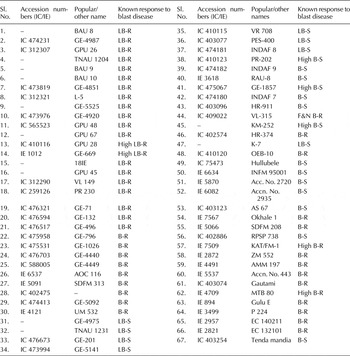
In total, 67 finger millet genotypes, including 45 blast disease resistant and 22 susceptible, were selected for genetic polymorphism analysis (Table 1 and Supplementary Table S1). The resistant and susceptible information of the genotypes was either derived from the genebank information submitted by the breeders or published literature of various forms (Rajanna et al., Reference Rajanna, Rangaswamy, Basavaraju, Karegowda and Ramaswamy2000; Mantur et al., Reference Mantur, Vishwanath and Anilkumar2001; Nagaraja et al., Reference Nagaraja, Jagadish, Ashok and Krishne Gowda2007; Babu et al., Reference Babu, Thakur, Upadhyaya, Reddy, Sharma, Girish and Sarma2013; Babu et al., Reference Babu, Dinesh, Agrawal, Sood, Chandrashekara, Bhatt and Kumar2014). Genomic DNA extracted from the fresh leaves of all finger millet accessions using the Cetyl trimethyl ammonium bromide method (Doyle and Doyle, Reference Doyle and Doyle1990) were used for PCR amplifications. Out of 154 combinations of SRAP (Li and Quiros, Reference Li and Quiros2001) and 33 SSR primer pairs (Dida et al., Reference Dida, Srinivasachary Ramakrishnan, Bennetzen, Gale and Devos2007) screened, 12 combinations from both marker types, which produced satisfactory and polymorphic bands in two each highly resistant (GPU 28 and IE 1012) and susceptible (PR-202 and GE-1857) finger millet genotypes were chosen to profile the 67 finger millet genotypes (Supplementary Table S2). The PCR was performed in each 25 µl of reaction volume consisting of 100 ng of genomic DNA, 1.0 unit of Taq DNA polymerase (Fermentas Inc, USA), 1.0× PCR buffer with (NH4)SO4, 2.0 mM MgCl2, 0.2 mM dNTP mix and 0.8 µM each forward and reverse primers. The PCR program used for SRAP primer amplification included denaturation at 94°C for 10 min, 5 cycles of 94°C for 45 s, 35°C for 1 min and 72°C for 2 min, followed by 35 cycles at 94°C for 45 s, 50°C for 1 min and 72°C for 1 min. The final extension of PCR products was carried out at the 72°C for 5 min. For the SSR amplification, PCR program included a touchdown program: denaturation at 95°C for 5 min, 10 cycles at 95°C for 45 s, touchdown primer annealing started at the 65°C for 1 min with a gradual decrease in temperature of 1°C per cycle for the remaining 9 cycles, and 72°C for 1 min. The PCR products were further amplified for 35 cycles at 94°C for 45 s, 55°C for 1 min, 72°C for 1 min and a final extension of strands at 72°C for 5 min. The SRAP and SSR primer amplification products were resolved on ethidium bromide-stained 1.8% agarose gel and 3.0% MetaPhor™ Agarose (Lonza Inc, USA) gel, respectively, and the gel images were recorded using gel documentation and analysis system, G: BOX (Syngene, USA).
List of 67 finger millet genotypes and blast resistant or susceptibility traits

See Supplementary Table S1 for details of the finger millet accessions used in the study.
– , Accession no. not available; IC, indigenous collection existing at National Bureau of Plant Genetic Resources, India; IE, accession number of the global collection of finger millet germplasm from the International Crop research Institute for the Semi-Arid Tropics, India; EC, exotic collection existing in the NBPGR gene bank, India; LB-R, leaf blast resistant; LB-S, leaf blast susceptible; B-R, blast resistant; B-S, blast susceptible; F&N B-R, finger and neck blast resistant.
Molecular marker scoring and data analysis
Both the SRAP and SSR produced bands were considered as dominant markers and only the clear and reproducible bands from two repeated SRAP and SSR amplifications were scored as discrete variables for the presence (1) and absence (0) across the 67 finger millet genotypes. The ‘1’ and ‘0’ binary data matrices were separately scored for SRAP and SSR analysis. Further, a locus was considered polymorphic if its frequency was ≤to 0.99. The mean number of alleles was estimated using the formula A = (1/K) ∑n i; where K is the number of locus and n i is the number of alleles detected per locus. The polymorphic information content (PIC) of each loci was determined according to Roldan-Ruiz et al. (Reference Roldan-Ruiz, Dendauw, Van Bockstaele, Depicker and De Loose2000), and the resolving power (Rp) of each primer was calculated according to Prevost and Wilkinson (Reference Prevost and Wilkinson1999). Clustering analysis, pairwise genetic similarity coefficient based on Jaccard's similarity index and principal coordinate analysis (PCoA) were carried out separately on the SRAP and SSR-derived binary data using the Numerical Taxonomy and Multivariate Analysis System (NTSYSpc) Version 2.02e (Rohlf, Reference Rohlf1998). Correlation of similarity matrices and goodness of fit of the dendrograms was measured by the Mantel test (Mantel, Reference Mantel1967) using 1000 permutations. The dendrograms were made using the unweighted pair-group method with an arithmetic average (UPGMA) procedure (Sneath and Sokal, Reference Sneath and Sokal1973). The binary data were also analysed for PCoA using the same software. Bootstrap analysis with 500 permutations was carried out using the program WINBOOT (Yap and Nelson, Reference Yap and Nelson1996) to estimate the confidence of clustering in the branches of the dendrograms.
The software POPGENE v1.32 (Yeh and Boyle, Reference Yeh and Boyle1999) was used to estimate the population level analysis, such as, the observed number of alleles (N a), effective number of alleles (N e), Nei's gene diversity (h) and Shannon's information index (I) within and among the 45 resistant and 22 susceptible genotypes of finger millet. The Hardy–Weinberg equilibrium was assumed, and 1000 simulated samples were used for the POPGENE analysis. Analysis of molecular variance (AMOVA) was carried out for both the SRAP and SSR data using the software Genetic Analysis in Excel (GenAlEx v6.41) to estimate the variance component within and between the resistant and susceptible finger millet genotypes (Peakall and Smouse, Reference Peakall and Smouse2006) with 999 permutations.
Results
Genetic diversity
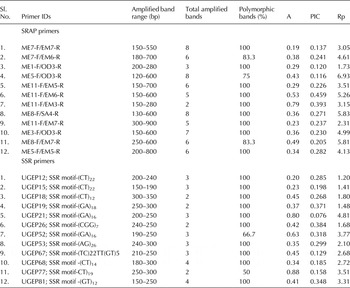
In the present study, out of the 154 SRAP primer combinations screened, 12 primer combinations produced clear and distinguishable bands across the 67 finger millet genotypes. These 67 finger millet genotypes were either varieties, cultivars, breeding materials or collections with previous records of blast disease tolerance from various sources such as, breeders assessment and varietal release notifications. Total 70 bands were scored ranging in size from 120 to 900 bp (Table 2). The 12 SRAP primer combinations produced a minimum of two bands for the ME11-F/EM3-R primer combination and a maximum of eight bands for the primer combinations ME7-F/EM7-R, ME5-F/OD3-R and ME8-F/SA4-R. An average of five bands per primer combination was recorded. The range of polymorphism obtained from SRAP primer amplification was 75–100% with an average of 95.1%. Out of the 12 SRAP primer combinations, 10 produced 100% polymorphic bands (Table 2). The overall range of band size in different alleles amplified by the 12 SSR primers was 150–300 bp. The 12 SSR primers produced total 34 alleles across the 67 genotypes with an average of 2.83 alleles per loci and a range of 2–4 alleles per loci (Table 2). Three private alleles i.e. alleles that did not occur in any other genotypes, were observed in genotype IE 4709 with the UGEP 15, UGEP 52 and UGEP 68 primers. Two alleles amplified each by the SSR primers UGEP 18 and UGEP 26, were considered rare alleles as they were found in <5% of the finger millet genotypes. These alleles are useful to develop genotype-specific markers. Out of the total 34 alleles amplified by the 12 SSR primers, 32 were found to be polymorphic (94.1%). The polymorphism percentage of the SSR primers across the 67 genotypes ranged from 50 to 100% with an average of 93.1%.
Details of the SRAP and SSR primers used in the study and their polymorphism statistics

See Supplementary Table S2 for primer sequences.
F, forward primer; R, reverse primer; SRAP, sequence related amplified polymorphism; SSR, simple sequence repeat; UGEP, SSR primers from Dida et al. (Reference Dida, Srinivasachary Ramakrishnan, Bennetzen, Gale and Devos2007); A, average number of alleles per primer; PIC, polymorphic information content; Rp, resolving power.
The efficiency of the SRAP and SSR primers and the frequency of allelic diversity among the genotypes were measured through PIC and Rp values (Table 2). The PIC values of the SRAP and SSR markers used in the present study ranged from 0.12 to 0.46 (average 0.24) and 0.08 to 0.38 (average 0.25), respectively. Discriminating power of the SRAP and SSR primers, estimated through the Rp values, ranged from 1.73 to 6.93 and 1.20 to 4.81, respectively. The mean number of bands or allele frequency (A) observed over a range of loci, provides a reasonable indication of the presence of allelic diversity within the population. In the present study, the observed values of allele frequencies were found from 0.19 to 0.79 and 0.20 to 0.88 for the SRAP and SSR primers, respectively. The above analysis of allele frequency and variability explains a range of genetic variations in resistant and susceptible finger millet genotypes using even a limited number of codominant markers.
Cluster and PCoA
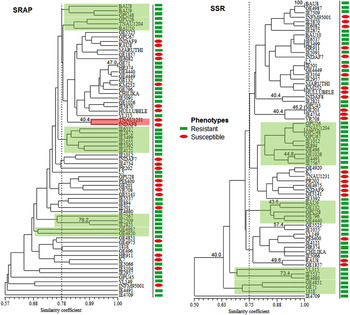
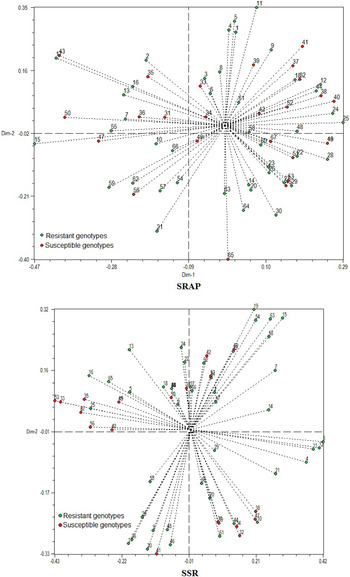
The range of Jaccard's similarity coefficient values from the SRAP amplification data exhibited variations ranging from 0.57 (between INFM 95001 and PR-202) to 1.00 (between GE-4440 and GE-4449). In case of SSR primers, the similarity coefficient values ranged from 0.35 (between IE 4709 and INDAF 7) to 0.96 (between K-7 and GE-4920, IE 7509 and BAU 8, IE 7509 and GE-4987, and IE 4491 and GE-1026) accounting for an average 61% variation. The UPGMA dendrograms formed from the SRAP and SSR primers showed different topologies and clusters of the finger millet genotypes (Fig. 1). The genotypes were separated at 0.57 and 0.50 similarity coefficient values, respectively, for the SRAP and SSR markers. Although the resistant and susceptible genotypes formed a mixed cluster, few resistant genotypes grouped together in small subclusters. The highly resistant finger millet genotype IE 4709, which is an E. coracana sub species africana from Burundi, diverged from the other genotypes at the farthest similarity coefficient. Mantel correlation (r) value between the SRAP and SSR-derived binary matrices was found 0.10 (P = 0.91). Goodness of fit of the dendrograms and the similarity matrices observed using the Mantels test for both the SRAP and SSR primers showed high correlations. The values observed was r = 0.83 (P = 1.0) and r = 0.73 (P = 1.0) for the SRAP and SSR data, respectively, which is a good fit. The PCoA agrees with that of the UPGMA dendrograms; i.e. an overall mixed grouping pattern was observed between the resistant and susceptible genotypes (Fig. 2). The aggregates from the first three coordinates correspond to 29.7 and 43.8% of the total cumulative variance observed with the SRAP and SSR primers, respectively. This suggests the PCoA analysis could be used to estimate the genetic relationships among finger millet genotypes. From the PCoA plot, it is speculated that diverse finger millet genotypes, which were placed in different groups can be hybridized for a combination of genotypes.
The similarity coefficient-based UPGMA clustering dendrograms of the 67 finger millet genotypes using SRAP and SSR primers. The green bar and red ovals represent resistance and susceptibility to fungal blast disease associated with specific genotypes. The bootstrap values of ≥40.0 were depicted on the branch nodes. See colour figure online.

Principal coordinate (PCoA) diagrams showing genetic polymorphism among the 67 finger millet genotypes derived from SRAP and SSR data. The resistant genotypes and susceptible genotypes were filled with green and red circles, respectively. See colour figure online.

Population variation analysis
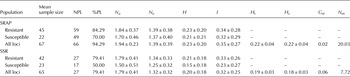
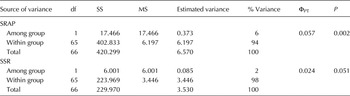
For population genetic analysis, the 67 finger millet genotypes were assorted by resistant and susceptible groups, according to breeders’ assessment and published information (Rajanna et al., Reference Rajanna, Rangaswamy, Basavaraju, Karegowda and Ramaswamy2000; Mantur et al., Reference Mantur, Vishwanath and Anilkumar2001; Nagaraja et al., Reference Nagaraja, Jagadish, Ashok and Krishne Gowda2007; Babu et al., Reference Babu, Thakur, Upadhyaya, Reddy, Sharma, Girish and Sarma2013; Babu et al., Reference Babu, Dinesh, Agrawal, Sood, Chandrashekara, Bhatt and Kumar2014). Assuming Hardy–Wienberg equilibrium, single and multiple population-level statistics were derived by scoring the SRAP and SSR bands as dominant diploid markers (Table 3). Using SRAP markers, the resistant and susceptible groups separately displayed 84.3 and 70% polymorphic loci, respectively, with the total polymorphic loci being 94.3%. The SSR genotyping revealed 79.4% and 50.0% polymorphic loci, respectively, for the resistant and susceptible groups with a total polymorphic loci of 79.4%. The mean estimates of observed alleles (N a) and effective alleles (N e) between the resistant and susceptible genotypes varied moderately, for both the SRAP and SSR data (Table 3). According to the SRAP genotyping, the mean heterozygosity or the gene diversity (h) varied slightly, 0.23 ± 0.20 and 0.21 ± 0.21, respectively, between the resistant and susceptible genotypes, which is similar to the average gene diversity of 0.23 ± 0.20 in the total population. Using the data obtained from SSR genotyping, the gene diversity (h) between the resistant and susceptible genotypes ranged from 0.21 ± 0.18 and 0.15 ± 0.18, respectively with a total gene diversity of 0.20 ± 0.18. AMOVA was performed between and within the resistant and susceptible groups using both SRAP and SSR genotyping data (Table 4). Comparison between the resistant and susceptible groups revealed 6 and 2% of genetic variations, respectively, for the SRAP and SSR primers. Nevertheless, a high genetic variation of 94 and 98%, respectively, in the SRAP and SSR genotyping data, was observed within the groups. The pairwise estimates of variance (ΦPT) were observed low, 0.057 (P = 0.002) using SRAP and 0.024 (P = 0.051) using SSR data, which shows about the confidence of the data points close to the mean value.
Summaries of genetic variations between the resistant and susceptible finger millet genotypes using POPGENE v1.32 and 1000 simulated samples

SRAP, sequence-related amplified polymorphism; SSR, simple sequence repeat; N a, observed number of alleles; N e, effective number of alleles; h, Nei's (Reference Nei1973) gene diversity; I, Shannon's information index; NPL, number of polymorphic loci; %PL, per cent polymorphic loci; H t, gene diversity over all groups; H s, gene diversity within populations; G st, coefficient of genetic differentiation; N m, average estimate of gene flow from G st.
Analysis of molecular variance (AMOVA) in 67 finger millet genotypes considering two groups, resistant and susceptible

SRAP, sequence-related amplified polymorphism; SSR, simple sequence repeat; df, degrees of freedom; SS, sum of squares; MS, mean of squares; ΦPT, pair wise population structure; P, random probability value.
Discussion
The results from the present study showed how two different molecular markers, SRAP and SSR, were used to explore the genetic diversity pattern among the 67 finger millet genotypes that differ in response to fungal blast disease. Previous estimates of genetic diversity (Babu et al., Reference Babu, Senthil, Gomez, Biji, Rajendraprasad, Satheesh Kumar and Babu2007) and population genetic structure in finger millet (Arya et al., Reference Arya, Verma, Gupta and Seetharam2013) were related to geographical accessions irrespective of any specific phenotypic trait. Our study reports genetic variation within finger millet genotypes that were classified as resistant or susceptible to fungal blast disease and are of various pedigree and origins. In a contemporary study by Babu et al. (Reference Babu, Dinesh, Agrawal, Sood, Chandrashekara, Bhatt and Kumar2014), EST-SSR markers were developed using comparative genomic information from disease resistant genes of rice. They further carried out an association analysis of the blast disease resistant and susceptible phenotypes in several global finger millet accessions, in which approximately 30% of the genotypes used in the present study also coincided. In the present study, we employed simple PCR-based genomic SSR and SRAP markers to assess primary level information on the genetic variations of the resistant and susceptible finger millet genotypes. Most of the finger millet genotypes used in the study were from the Indian National Agricultural Research system collections. Thus, the results from the present study may serve as a supplementary data to the existing molecular genetic diversity of finger millet genotypes differing in response to fungal blast disease.
The average band polymorphism among the 67 finger millet genotypes used in the present study were found high for both SRAP (>95%) and SSR primers (>93%) with an average of 5 and 2.83 bands per primer, respectively. However, the PIC values and other marker discrimination indices, such as Rp and allelic richness were found to be in moderate ranges. Our results of overall PIC values are in conformity to the PIC values reported in finger millet from other diversity analyses (Panwar et al., Reference Panwar, Nath, Yadav and Kumar2010; Babu et al., Reference Babu, Dinesh, Agrawal, Sood, Chandrashekara, Bhatt and Kumar2014; Nirgude et al., Reference Nirgude, Babu, Shambhavi, Singh, Upadhyaya and Kumar2014). Considering finger millet a self-pollinated crop, the genetic diversity estimates based on gene diversity (h), Shannon's index (I) and genetic differentiation coefficient (G st) were found to vary reasonably between the resistant and susceptible genotypes. Gene diversity did not differ much when estimated in overall and within populations, but the gene flow measures (N m) were found to be high between the resistant and susceptible groups. This might be explained because many of the present-day cultivars or genotypes have a lineage from ancestral E. coracana sub sp. africana genome (Dida and Devos, Reference Dida, Devos and Kole2006).
Based on pairwise Jaccard's similarity coefficient values, the pairs of finger millet genotypes with the highest and lowest similarity coefficients were identified using data generated from SRAP primers. Accessions INFM 95001 and PR-202 were identified as highly diverse genotypes (similarity index 0.4%), which are both susceptible to the blast disease. This is expected because of the origin of these genotypes; the former is developed from an African genetic donor, whereas the latter is from an Indian accession. The Indian germplasm GE-4440 and GE-4449, both reported as resistant to the blast disease, were found to have maximum genetic similarity index (98%). Both these genotypes were originated from the Orissa state of India, which possibly is reflected in their genomic similarity. Compared with the SRAP genotyping data, the pairwise genetic similarity index generated by SSR markers could distinguish better between the resistant and susceptible genotypes. The highest genetic diversity (similarity index 0.4%) was noted between the resistant IE 4709 genotype from Burundi and susceptible genotype INDAF 7 from India. The IE 4709 genotype is an E. coracana sub species africana, a wild relative, also known for its higher grain nutrient content, while INDAF 7 has a higher yield potential and cold tolerance (Upadhyaya et al., Reference Upadhyaya, Ramesh, Sharma, Singh, Varshney, Sarma, Ravishankar, Narasimhudu, Reddy, Sahrawat, Dhanalakshmi, Mgonja, Parzies, Gowda and Singh2011). Hence, these diverse genotypes may serve as effective parents in breeding programs for desirable agronomic traits like disease resistance, grain nutrient and yield. Clustering based on UPGMA and analysis of principle coordinates suggested different topologies and placed the finger millet genotypes in mixed and broad clusters. At the subcluster level, few resistant and susceptible genotypes clustered together. The results from UPGMA analysis also identified IE 4709, the highly blast disease resistant genotype from Burundi, as the most diverse from the other finger millet genotypes. The divergence of the IE 4709 genotype from all other finger millet genotypes was observed at ~50% similarity coefficient value. Similar divergence of the IE 4709 genotype from other cultivated finger millets was also reported through RAPD markers (Malambane et al., Reference Malambane, Jaisil, Sanitchon, Suriharn and Jothityangkoon2013). Although no clear distinction of resistance and susceptible genotypes was observed in PCoA analysis, the first three coordinates produced >25% contribution to the total genetic variation, which is a good measure of selecting diverse genotypes for hybridization experiments (Mohammadi and Prasanna, Reference Mohammadi and Prasanna2003). Thus, PCoA analysis can be employed to select diverse resistant and susceptible finger millet genotypes for development of mapping populations. The population genetic parameters and AMOVA analysis showed 2–6% genetic variation between the resistant and susceptible groups compared with 96–98% genetic variation observed within the groups. Similar differences in variation between resistant and susceptible genotypes of soybean to rhizoctonia root rot disease were reported (Tomar et al., Reference Tomar, Saini, Goyal, Tripathi, Shrivastava, Verma and Tiwari2011) or between and within rust-resistant genotypes of orchard grass (Zeng et al., Reference Zeng, Zhang, Huang, Jiang, Luo and Yin2014).
In conclusion, we report a molecular characterization of genetic diversity among and within finger millet genotypes differing in resistance and susceptibility response to fungal blast disease. Although genotypes that differ in their resistance to blast did not cluster into any particular group, a few consistent genetically diverse resistant and susceptible genotypes were identified. Especially, the resistant IE 4709 and susceptible INDAF 7 were identified as the most genetically diverse genotypes among the accessions used in the study. Interestingly, few unique SSR alleles were also identified specific for the resistant IE 4709 genotype. These genotypes can be potentially employed in developing mapping populations for tagging resistance genes, generating efficient markers and strategic marker-assisted breeding for fungal blast disease resistance. Given the genomic resources and techniques in finger millet are scanty, the present study is an important stepping-stone for finger millet genetics and resistance breeding program.
Supplementary material
To view supplementary material for this article, please visit http://dx.doi.org/10.1017/S1479262116000010
Acknowledgements
Authors thank National Bureau of Plant Genetic Resources, New Delhi, the All India Co-ordinated Small Millets Improvement Project, Bengaluru and the International Crops Research Institute for the Semi-Arid Tropics, Hyderabad for providing finger millet accessions. The research support provided by the Head, Division of Genomic Resources and Director, NBPGR is also acknowledged. Authors are grateful to Dr Savithri Nambeesan, Assistant Research Scientist, University of Georgia, Athens, USA for language correction of the article.