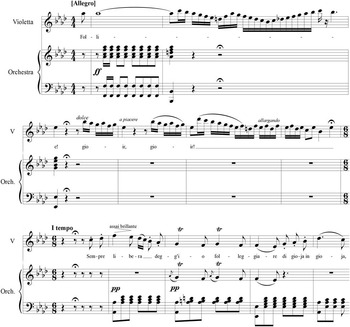
This article concerns a lapse of voice: a sliver of silence in the final scene of Act I of La traviata. It is marked in the score as the pause at the conclusion of Violetta’s recitative, ‘Follie!... follie!...’, and functions musically as the launch into the final ‘cabaletta brillante’, ‘Sempre libera’ (see Ex. 1).Footnote 1 My inclination to attend to this silence may seem contrary in the context of such abundant musicality. However, Violetta’s momentary suspense of lyricism carries some associations both in and around the opera that invite attention. It is that delicate thread of a history of vocal rupture which I will pursue here.
Conclusion of Violetta’s recitative ‘Follie!… follie!…’ from final scene of Act I of La traviata.

My curiosity about this passage arose partly by chance, in the context of teaching an undergraduate survey on the history of opera. That Verdi’s La traviata proved so popular among students is no surprise. In the era in which I first taught this opera, its appeal was further enhanced by one particular Violetta, Angela Gheorghiu, cast in Richard Eyre’s Royal Opera House production, conducted by Georg Solti and recorded live for Decca in December 1994. The production is well known as the soprano’s break-out performance, and while the qualities of the singing and production were reason alone to assign it to the students, some other, rather more banal, motivations influenced my selection. Gheorghiu’s appearance, exaggerated by the costume, lighting and makeup, make her the virtual identikit of Dumas fils’s portrait of Marguerite Gautier, thus neatly embodying the history of the heroine and her movement from life to novel, to play and to opera libretto.Footnote 2 In addition, Gheorghiu’s youthful Violetta was also ‘relatable’ to my Verdian first-timers – a member of the students’ historical peer-group, eminently suited to deepening their sympathy to the opera, its characters and their dreadful story.Footnote 3 It was in the course of class preparations and discussion of the Act I finale that Gheorghiu’s rendering of the hiatus came to establish itself as part of the operatic text, a place in which the students and I habitually came to linger. Not simply in between or by-product of the more readily decipherable features of dramatic form and melodic detail, it accrued meaning as something noteworthy and strangely affective.
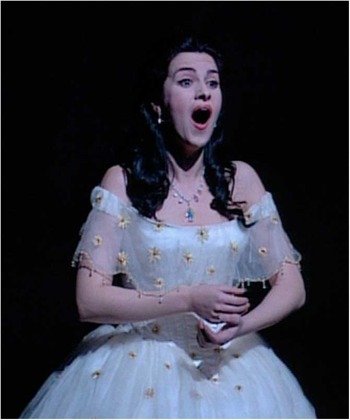
Gheorghiu’s silence is anything but inaudible. In the final moments of her recitative, with her pitch sharpening by minute degrees, the soprano turns face-on to the audience, her exposed neck and open body stance contributing to the impression of vocal vulnerability. The suspense carries through to her final note, where she lingers, singing through to the limits of her breath. Then, in that first second of non-melody, she takes in air so noisily as to be virtually notatable. It is articulated not only as breath, but also as a bodily gesture, with her arms and head rising as she replenishes her air supply (see Fig. 1). Inhalation leads to an exhalation of laughter as the orchestra reignites for the finale, to a swish of her dress, and to further voluble intakes of air in the restless wait for the final vocal launch.
(colour online) Angela Gheorghiu as Violetta Valéry.

Is there anything to be gained by lingering on Gheorghiu’s vocal gesture here? Most obviously, it punctuates the structural turn in music and plot: Violetta’s suppression of love’s ‘folly’, in ‘Ah, fors’è lui’, in favour of decadence, in ‘Sempre libera’. But it has a more basic effect. It exposes a seam in the voice, that unsettling threshold in opera in which the singing voice gives way to another more ordinary kind of vocality. It resides on the same spectrum as moments in opera at which characters speak – something like the category which Mladan Dolar identifies as a ‘non-voice’ in his discussion of the linguistics of the voice.Footnote 4 As such, it marks an uneasy transformation in the singer, their voice making their presence fleetingly more familiar and ordinary, the superhuman made human again.
The vocal shift amounts to nothing in the score – it is a blank, unnotated mark in the staves beneath the pause. But in the performance tradition of this scene, it proves a highly prescriptive moment, exacting varied response and action from the singers who have occupied the role. Most sopranos take care to suppress their vocal apparatus here, resisting and concealing what the melodic line requires of the lungs. Some do so by quite literally hiding it from the audience, by turning away from them – often with a full swish of the dress on the final note.Footnote 5 The early recording history testifies to a long tradition of singers transitioning directly from the sung note to a descending peal of laughter, without pause.Footnote 6 More elaborate responses include filling champagne glasses during the cadenza, ready for a gulp at the breakpoint.Footnote 7 Gheorghiu’s move – to let the breath show and sound – is rare. Moreover, a look at other recordings of her in this role suggest that this breathiness is written into the way she inhabits Violetta, a vocal hallmark every bit as personal as, for example, the unnotated embellishments that Joan Sutherland added to the concluding melisma in one of her 1960s Bell Telephone performances.Footnote 8
These absences in the operatic score are thus, paradoxically, places where a singer’s presence may be felt to be more acutely idiosyncratic and which render any given performance so singular. Is there anything in these moments of ephemeral vocal agency that feeds back into the wider expressive range of the scene or opera? As a brief experiment, let me follow the line of Gheorghiu’s breath back into the opera’s history and sources. Her inhalation is at the tail end of the word ‘gioir’, a word of rich associations, especially in this opera. One venerable ontology links joy to musical expression.Footnote 9 Violetta’s joy here seems to follow that logic: it gives way to ‘Sempre libera’, which is indexed as ‘music’ within the opera through its coding as a waltz. Its hypermusicality mirrors corresponding scenes of dance in Dumas fils’s novel and play which, as Emilio Sala has shown, reflect contemporary fashions for waltz and polka in Parisian popular theatre during the 1840s and 1850s.Footnote 10 Indeed, ‘Sempre libera’ was swiftly recast and published as a polka by Pierre-Claude Perny in Album per il carnevale 1854.Footnote 11 Joy’s other close associate, death, also looms large: ‘Gioia!’ marks Violetta’s ascent from speech to song, life to death, in the closing moments of the opera. Moreover, in all texts of the story – opera, play and novel – symptoms of joy are closely related to those of consumption, and Violetta’s social pleasures consistently render her weak and breathless.Footnote 12 Gheorghiu’s breathy habitation of her line embodies the sheer physicality of Violetta’s suffocating illness, echoing Dumas fils’s portrait of Marguerite as wracked with coughing ‘as though her chest was being torn to pieces from the inside’.Footnote 13 Gheorghiu’s unscripted interpolation thus contributes to the opera’s fuller etymology of joy.
Gheorghiu’s performance also exaggerates a more widespread feature of her character’s melodic style – that of vocal discomfort and disruption implicit in her melodies. These include the ‘broken consumptive melody’ brought about by her coughing earlier in Act I,Footnote 14 and the painful trip-ups that come later in her Act III aria ‘Addio del passato’. A similar fragility inflects Violetta’s earlier melody in this scene: the deliberate spaces between the notes of the opening phrase of the ‘Ah, fors’è lui’ make more hesitant an otherwise assuredly lyrical line. Sketches for La traviata intimate the ways in which this halting quality seemed to circulate in and around the ideas for this melody. Fabrizio Della Seta’s facsimile and commentary of the sketches brings to light at least two different versions of the melody.Footnote 15 In one version Verdi notably offers an alternative to the final solution of quoting Alfredo’s ‘Di quell’amor’ melody. But both versions offer a continuity in the way the opening of the melody is notated: in both cases supplying rests throughout repetitions of the opening falling motif. Though hardly as dramatic as the larger scale melodic re-workings, those rests are interesting in their own terms. As Della Seta notes, Verdi did not always supply specific or consistent notational detail in his drafts, opting to get down what was most salient to the ‘idea’. The consistency of these signs thus draw attention to those spaces between notes as being in some sense integral to the concept of the melody or, more specifically, to the feel of that phrase in the singing voice.Footnote 16
Gheorghiu’s noisy silence may also prompt connection to La traviata’s operatic siblings (Rigoletto, Il trovatore and Stiffelio), encouraged by other incidental and unintentional interactions between these works.Footnote 17 As Roger Parker has shown, an uncomfortable, unsingable melodic turn in ‘D’amor sull’ali rosee’ in Il trovatore similarly invites – requires – unprescribed action from the singer.Footnote 18 And there is that most famous of vocal lapses at the end of Rigoletto, when Gilda’s death, mid-word and mid-phrase, is marked with a pause and the instruction in the autograph score ‘la voce muore’ (a silence that, like Violetta’s lapse, has brought forth non-vocal sounds from generations of Gildas).
The silence of the score thus gathers into it a modest history – of the visceral nature of a character’s love and affliction, and her literary and historical models; of a sympathy with other situations of vocal interruption across Verdi’s operas, and beyond. What also animates the text’s silence is of course a history of the countless singers who are called on to inhabit this space with unscripted sounds and vocal gestures. To attend to them requires a special kind of devotion – one that the operatic voice seems particularly to command. But that kind of devotion strikes me as emblematic of the broader enterprise of historical research, and particularly music history. Historian and medievalist Paul Zumthor, sensitive to the multiple vocalities of medieval texts, has drawn parallels between the work of history and the act of listening, suggesting that the historian’s work is to attend to ‘the discourse of some invisible other that speaks to us from some deathbed (or some couch), of which the exact location is unknown. We strive to hear the echo of a voice which, somewhere probes, knocks against the world’s silences, begins again, is stifled.’Footnote 19 In her gloss of Zumthor, Gabrielle Spiegel, in her 2009 presidential address to the American Historical Association, likewise urged historians to attend to silence, ‘to solicit those fragmented inner narratives to emerge from their silences. In the last analysis, what is the past but a once material existence now silenced, extant only as a sign and as a sign drawing to itself chains of conflicting interpretations that hover over its absent presence and compete for possession of the relics, seeking to invest traces of significance upon the bodies of the dead.’Footnote 20 Violetta is the incarnation of such a history; and with the endeavour to listen to her – the many hers – comes a reminder, too, of the musicality of history. Learning to listen to opera, to the silences as well as the vivid presence of its text, might thus act as training for engaging many other kinds of historical record. Of how to attend to other kinds of sonic history, through the medium of tricky, partial, quiet, often entirely absent sources, and to find in the silence voices unfamiliar, strange and indecipherable.