The negative implications of exposure to hostile marital conflict for children across a wide spectrum of response processes, including emotions, behaviors, and cognitions, are well documented (see Cummings & Davies, Reference Cummings and Davies2010; Rhoades, Reference Rhoades2008). The sensitization hypothesis proposes that rather than habituating to stress, children's reactivity along these dimensions intensifies with increased exposure to destructive forms of conflict. Even though this notion has long had currency (e.g., Cummings, Zahn-Waxler, & Radke-Yarrow, Reference Cummings, Zahn-Waxler and Radke-Yarrow1981; Grych, Reference Grych1998) and the findings of many cross-sectional and experimental (Davies, Myers, Cummings, & Heindel, Reference Davies, Myers, Cummings and Heindel1999) studies support the proposition, significant gaps remain in the literature regarding the cogency of this hypothesis. The principal notion that increases in hostile conflict exposure lead to changes in various dimensions of children's responding over time has rarely been examined empirically in prospective longitudinal tests (Davies, Sturge-Apple, Winter, Cummings, & Farrell, Reference Davies, Sturge-Apple, Winter, Cummings and Farrell2006). Given the status of the sensitization hypothesis as a foundational assumption of process-oriented explanations for relations between marital conflict and child adjustment (Cummings & Davies, Reference Cummings and Davies2002), elaboration of the dimensions of responding in which sensitization is engaged is warranted. Empirical examination of change in marital hostility and children's responses to conflict in the context of a prospective longitudinal design is a significant step toward furthering our understanding of these important developmental issues and disentangling normative developmental changes in reactivity to conflict from changes associated with increased exposure.
Two leading conceptual models have been proposed to explain children's responses to conflict, the cognitive–contextual framework and emotional security theory. Each of these complementary theories can be interpreted to assume a sensitization hypothesis, and the limited longitudinal tests of these theories can be seen to support sensitization notions, but direct tests of propositions of the sensitization hypothesis are lacking. According to the cognitive–contextual framework (Grych & Fincham, Reference Grych and Fincham1990), when children are exposed to interparental conflict, they make appraisals about the degree to which the interaction poses a threat to their own and their family's well-being and about the extent to which they are to blame. These appraisals are informed by the nature of interparental conflict as well as the context in which it occurs, and they shape children's evaluation and response. Emotional security theory (Davies & Cummings, Reference Davies and Cummings1994; Davies, Harold, Goeke-Morey, & Cummings, Reference Davies, Harold, Goeke-Marcie and Cummings2002) posits that exposure to chronic, destructive marital conflict undermines children's feelings of security regarding the stability of the family. The emotional security response system regulates, organizes, and motivates children's response to marital discord through three component processes: emotional reactions (e.g., negative emotional reactivity), cognitive representations (e.g., confidence in parents' ability to resolve conflict), and behavioral action tendencies (e.g., regulation of exposure to conflict through intervention or avoidance). Although each of these component processes is proposed to serve as an indicator of emotional security, emotional reactivity is thought to serve as the primary guide for responding (Davies et al., Reference Davies, Harold, Goeke-Marcie and Cummings2002). Extensive evidence supports the link between conflict and each of the dimensions of responding posited by these theories (see Buehler, Lange, & Franck, Reference Buehler, Lange and Franck2007; Cummings & Davies, Reference Cummings and Davies2002; Grych & Fincham, Reference Grych, Fincham, Grych and Fincham2001).
Each of these emotional, behavioral, and cognitive response processes reflects a general higher order notion of negative impact for children. Heightened responding in any of these interrelated but distinct dimensions may be cause for concern, because each generally reflects an activation of emotional insecurity (Davies & Cummings, Reference Davies and Cummings1994), including a judgment on the part of children that the conflictual interaction poses a significant threat to themselves or their family (Grych & Fincham, Reference Grych and Fincham1990). Both theories support the notion that repeated exposure to hostile conflict places children at risk for heightened responding in any of these dimensions, although it remains an open question which systems are primarily engaged by repeated exposure or sensitive to changes in exposure history.
Questions also remain about changes in responding as a function of age and developmental stage. Developmental theory suggests that children become better able to cope with stressors and regulate their emotions across childhood (Cummings & Davies, Reference Cummings and Davies2010). In addition, older children, particularly adolescents, have greater capabilities to regulate their exposure to conflict by leaving when conflict begins or by spending time away from highly conflictual homes, and their agentic efforts to influence the course of parents' conflict are likely to be more effective than younger children's. Cross-sectional research supports the relation between conflict exposure and children's emotional, behavioral, and cognitive responses across childhood. It is unclear whether these relations hold longitudinally during this period and whether one age group is more vulnerable than another to these processes over time. In their meta-analysis of 68 studies, mostly based on cross-sectional designs, Buehler and colleagues (Reference Buehler, Lange and Franck2007) concluded that age was not a significant moderator of the effect of marital conflict; however, they identified variability in effect sizes, indicating a need for further research.
Results from cross-sectional studies suggest that age differences in children's responses to conflict merit consideration. For example, Cummings, Ballard, and El-Sheikh (Reference Cummings, Ballard and El-Sheikh1991) examined differences in the responses of 9- to 11-year-olds, 13- to 15-year-olds, and 17- to 19-year-olds to analog presentations of conflict. These researchers showed that older children reported less emotional distress, including anger and fear, than younger children in response to hostile disputes, perhaps indicating less threat appraisals. Furthermore, older children reported greater inclination to become involved in their parents' conflict (see also Davies et al., Reference Davies, Myers, Cummings and Heindel1999) and lower expectations about future relationship quality; older children have been shown to blame themselves less for parents' anger (Covell & Abramovitch, Reference Covell and Abramovitch1987). Using an audiotape analog methodology, Grych (Reference Grych1998) found that 7- to 9-year-olds reported greater appraisals of threat and self-blame and lower coping efficacy than 10- to 12-year-olds. Limited longitudinal work suggests that threat attributions decline with age, whereas self-blame remains stable (Richmond & Stocker, Reference Richmond and Stocker2007).
These findings may appear to suggest that children become less vulnerable to marital conflict with age; however, such a conclusion is premature. While the manifestation of distress may vary developmentally, the emotional security implications of conflict may not lessen with age. Cummings, Schermerhorn, Davies, Goeke-Morey, and Cummings (Reference Cummings, Schermerhorn, Davies, Goeke-Morey and Cummings2006) found that marital conflict was an even stronger predictor of children's emotional security for older children. More sophisticated social cognitions may make older children more sensitive to the nuances of conflict expression and potential negative implications of parents' marital problems (Davies & Windle, Reference Davies and Windle2001). Furthermore, the stronger impact of marital conflict on emotional security or subsequent adjustment as children get older may be due in part to a confounding of age and exposure history (Cummings et al., Reference Cummings, Schermerhorn, Davies, Goeke-Morey and Cummings2006). It is likely the case for many children that conflict exposure has intensified over time, which may account for more extreme responses.
Consistent with contemporary theory suggesting that children become sensitized to interparental disputes, repeated exposure to hostile interparental conflict has been shown to lead to greater reactivity in children. The finding has been replicated with children from preschool (El-Sheikh, Cummings, & Reiter, Reference El-Sheikh, Cummings and Reiter1996) through late adolescence (David & Murphy, Reference David and Murphy2004) across various dimensions of responding, including emotional reactivity, behavior, and cognitive appraisals. Most studies of children's sensitization have relied on cross-sectional designs. Understanding how interparental conflict impacts reactivity to conflict over time requires prospective assessments of change in children's responses to interparental conflict. In one of the few studies to evaluate stability and change in children's responses to interparental conflict, Davies and colleagues (Reference Davies, Sturge-Apple, Winter, Cummings and Farrell2006) evaluated reactivity to conflict in early elementary-aged children at two points in time. The resulting model tests indicated that interparental hostility predicted child overt reactivity concurrently and 1 year later and that interparental withdrawal during conflict predicted concurrent levels and increases in emotional reactivity and negative representations, further supporting the notion of sensitization. Some of the many contributions of the study were the demonstration that conflict exposure led to sensitization across multiple dimensions of responding and that specific aspects of conflict, namely, hostility and withdrawal, differentially predicted increases in dimensions of reactivity currently and 1 year later.
The current study extends Davies et al.'s (Reference Davies, Sturge-Apple, Winter, Cummings and Farrell2006) work in several regards. Although their two-wave structural equation modeling analysis advanced the understanding of rank order change beyond what is possible with cross-sectional designs, it does not inform the question of how individual children change over time. In the current study, hierarchical linear modeling (HLM) analyses are conducted with three waves of data to examine intraindividual change in reactivity over time, as well as the within-person (i.e., conflict exposure) and between-person (i.e., gender) factors that contribute to change. Furthermore, Davies et al. examined marital conflict at a single point in time, but research has shown that couples' conflict changes in significantly variable ways over time (Umberson, Williams, Powers, Chen, & Campbell, Reference Umberson, Williams, Powers, Chen and Campbell2005). In order to fully appreciate the interplay between the dynamic processes involved, the current project will examine intraindividual change in conflict exposure as a predictor of intraindividual change in children's responses to conflict. Finally, whereas the participants in the Davies et al. study were 6 and 7 years old, in the current study children range in age from 8 to 19 years.
To our knowledge, there is limited research following the logic of the present study for testing sensitization, that is, the extent to which change in conflict properties relates to change in children's responding over time. One notable exception is a study in which Richmond and Stocker (Reference Richmond and Stocker2007) used this conceptualization to examine the association between change in conflict exposure and change in children's appraisals of threat and self-blame. They found that increases in conflict exposure predicted increases in appraisals of threat, but not self-blame, from childhood through adolescence. The current study extends their work to include responses to conflict indicative of emotional security (i.e., emotional, behavioral, and cognitive responses) in addition to appraisals of self-blame and threat. Furthermore, the current analyses will consider whether older or younger children are more susceptible to these sensitization processes.
It is unresolved whether child gender plays a role in the effect of marital conflict. Major empirical studies and meta-analyses generally do not find gender to be a significant moderator of the direct effect of marital conflict (Buehler, Anthony, Krishnakumar, & Stone, Reference Buehler, Anthony, Krishnakumar and Stone1997; McDonald & Grych, Reference McDonald and Grych2006), and differences that do exist in the literature are often inconsistent or even contradictory (Davies & Lindsay, Reference Davies, Lindsay, Grych and Fincham2001), suggesting that both boys and girls are vulnerable to insecurity and negative appraisals in response to interparental conflict.
An important consideration, however, as Davies and Lindsay (Reference Davies, Lindsay, Grych and Fincham2001) indicate in their review, is that the effect of gender likely depends on children's developmental level and consequently may change over time. Cross-sectional research supports the theory that boys are likely to be particularly vulnerable to conflict in early childhood (Laumakis, Margolin, & John, Reference Laumakis, Margolin, John, Holden, Geffner and Jouriles1998) and that girls are more susceptible to negative effects of conflict, particularly depressive symptoms, beginning in early adolescence (Davies & Lindsay, Reference Davies and Lindsay2004). Limited longitudinal work suggests greater increases in reactivity with age, particularly threat appraisals, for girls than for boys (Richmond & Stocker, Reference Richmond and Stocker2007). Gender intensification theory has been identified as one possible explanation for the proposed shift in effects, suggesting that with the onset of adolescence, children subscribe more to traditional gender roles (see Ruble & Martin, Reference Ruble, Martin, Damon and Eisenberg1998). As a result, boys are hypothesized to develop greater independence and concern for self-protection whereas girls are hypothesized to become increasingly interdependent with greater concern for connectedness and close relationships and thus more reactive to interparental conflict. Furthermore, gender role theories suggest that children's manifestation of vulnerability may vary across gender, in keeping with conventional gender roles and expectations for proper behavior. For example, Davies and Lindsay (Reference Davies and Lindsay2004) reported that girls' higher levels of communion moderated the impact of conflict on internalizing problems, further supporting the possibility that girls' increased concern for interpersonal relationships in adolescence may partly account for girls' increased vulnerability to emotional or internalizing problems as a result of interparental conflict. In keeping with the notion that girls are more concerned for the implications of conflict (Laursen, Reference Laursen1993), David and Murphy (Reference David and Murphy2004) found that late adolescent girls from high conflict homes were more pessimistic than boys about the implications of parents' conflict. Although these examples support socialization as an explanation for gender differences in responses to conflict at different points in development, in the absence of longitudinal research spanning childhood and adolescence, conclusions about change remain speculative.
The Current Study
The current study aims to address some of the critical questions that remain regarding the pattern of relations that may exist when changes in marital conflict and children's responses to conflict (i.e., cognitive, emotional, and behavioral processes) are considered across time. First, in this 3-year prospective, longitudinal study we examine change in responses to conflict in children spanning the range from middle childhood through late adolescence. Based on previous empirical work, it is hypothesized that threat, emotional reactivity, and confidence regarding resolution will decline with age (Davies et al., Reference Davies, Sturge-Apple, Winter, Cummings and Farrell2006; Richmond & Stocker, Reference Richmond and Stocker2007), self-blame will remain stable (Richmond & Stocker, Reference Richmond and Stocker2007), and involvement will increase with age (Cummings et al., Reference Cummings, Ballard and El-Sheikh1991). However, given the lack of previous longitudinal work, and conflicting theoretical assumptions, these hypotheses are speculative. Second, moving beyond a static measure of marital functioning, we explore the extent to which change in marital conflict predicts change in children's reactivity and whether older or younger children are more vulnerable. Examining change in conflict responses as a function of change in conflict in the current study may help disentangle normative developmental changes in reactivity to conflict from changes associated with increased exposure. In keeping with the sensitization hypothesis, we expect that as conflict becomes more frequent and intensely hostile, children will grow increasingly negative in their emotional reactions and appraisals, and feel a greater inclination toward intervention in the conflict. Considering the primacy in emotional security theory of emotional responding and the implication for appraisal of threat, we expect these to be particularly vulnerable to sensitization. Third, we consider whether any of these patterns of change differ as a function of child gender. If gender intensification theory holds as an explanation for responses to conflict across adolescence, we expect increases in interparental hostility will contribute to girls', but not boys', greater emotional reactivity and more negative cognitive representations about the implications of conflict for future interparental relationship quality during the transition to and through adolescence.
Methods
Participants
The sample included 297 families in a Midwestern town with two cohabiting parents and at least one child. At the start of the 3-year study, children (48% girls) ranged in age from 8 to 16 years (M = 11.1 years, SD = 2.3 year). Age distribution at Wave 1 was as follows: 8 (21%), 9 (18%), 10 (14.5%), 11 (13.5%), 12 (10.5%), 13 (8%), 14 (6%), 15 (5%), and 16 (3.5%) years. Ninety-six percent of couples were married (M = 13 years, SD = 6 years), and all had lived together for a minimum of 2 years. Forty-two percent of the sample (26% wives, 28% husbands) reported that their marriages were disharmonious, as indicated by a score of less than 100 on at least one of the spouses' Marital Adjustment Test (Locke & Wallace, Reference Locke and Wallace1959; e.g., Crane, Allgood, Larson, & Griffin, Reference Crane, Allgood, Larson and Griffin1990). Moreover, 22% of couples (15% of wives, 13% of husbands) reported that their marriages were extremely disharmonious, as indicated by scores of less than 85 on at least one of the spouses' Marital Adjustment Test questionnaires.
Children were primarily European American (85%), with 9% African American, 2% Hispanic American, and 3% multiracial or other. Median family income fell between $45,000 and $65,000 (44%), but ranged from less than $10,000 (2%) to more than $80,000 (13%). Mothers' mean age was 38 years (SD = 6 years); fathers' mean age was 40 years (SD = 7 years). Nearly all mothers and fathers completed high school or the equivalent (98% and 95%); 35% of mothers and 41% of fathers obtained a college degree (i.e., BA/BS level or above). Families were recruited through a variety of means, including letters sent through the schools, direct mailings to homes, and notices posted in the community. If the family included more than one child in the age range, the parents selected one target child.
Two hundred thirty-four families completed all three waves of data collection. An additional 19 and 13 completed Wave 2 and Wave 3, respectively. All families were included in the multilevel models due to HLM's capacity to accommodate missing data. Only one difference emerged between demographic characteristics of those completing all waves and those missing one or two waves: fathers completing all three waves were slightly more educated than those missing data at one or both subsequent waves, t (294) = –3.91, p < .001. Those completing all waves did not differ from those missing at a later point in terms of any study variables (i.e., conflict exposure or response to conflict), with one exception: Children missing at a later point (M = 7.54, SD = 1.93) were less confident in their parents' ability to resolve conflict than those present at all waves (M = 8.25, SD = 1.70), t (268) = –2.57, p = .011.
Procedures
This report is drawn from a larger study of family, marital, and psychosocial functioning. Only procedures or measures used in the current report are described here. Participants completed assessments each year for 3 consecutive years. Data collection entailed one (~3 hr) or two (~2 hr each) private laboratory sessions each year, depending on the participants' condition with regard to an aspect of the broader project not central to the current analysis.
During the sessions, parents engaged in a conflict resolution task that was videotaped and shown to the child. In addition, children completed an analog procedure in which they responded to a series of video stimuli depicting actors engaging in a variety of conflict expressions. Finally, participants completed questionnaires. Families received monetary compensation for their involvement in the study. The project was approved by the university's committee for the protection of human subjects, and each participant provided informed consent or assent prior to beginning participation each year.
Children's responses to analog presentations of conflict
Children participated in an analog procedure that involved responding to the presentation of a variety of conflict expressions in a controlled laboratory context (for a complete description of the methodology and interview, see Goeke-Morey, Cummings, Harold, & Shelton, Reference Goeke-Morey, Cummings, Harold and Shelton2003). Analog procedures elicit scripts that lead to reaction patterns approximating those that occur in real life, while allowing the researcher to enhance internal validity by maintaining a high degree of control over the stimuli presented.
To serve as a stem for analog presentations, the examiner described one of two common interparental conflict topics (i.e., a messy house or making an expensive purchase) in vivid detail so children could visualize the situation as if it were occurring at home between their own parents. Thematic content was consistent across the two scenarios. Children were then shown a video clip and instructed to imagine the man and woman were their parents. Each video clip was a short segments (5–10 s) depicting one of a number of hostile, destructive conflict tactics (i.e., physical aggression-person, physical aggression-object, threat to leave, personal insult, verbal anger, stonewalling, physical distress, pursuit, defensiveness, withdrawal from the interaction, or hostile unresolved ending). Before each clip, the experimenter reminded children of the scene and explained that this time the parents did something different. Clips of more constructive expressions were interspersed, but responses to those expressions were not included in the current analyses. Comparable videos were created with White, Black, and Latino actors; children were presented with the tape that most closely corresponded to their family's race. Children saw the same video each year of data collection.
Following the presentation of each conflict expression, the experimenter asked the children a series of questions designed to tap components of emotional security. To assess the children's emotional reactivity, the experimenter asked how the children would feel if the interaction were occurring between their parents. Children chose from a set of five descriptors (i.e., happy, mad, sad, scared, or ok) and rated the intensity of the emotion of a scale from 1 (not at all) to 10 (a whole lot). Children could endorse multiple emotions, but for these analyses, only the maximum value for mad, sad, or scared responses for each clip was included in the analysis.
Next, to assess involvement, children were asked what they would do if they were in the room with their parents during the conflict interaction. Open-ended responses were coded along 5-point scales of intervention and avoidance. Codes of 0 reflected no involvement/avoidance (e.g., nothing, play, or continue previous activity), 2 reflected active intervention (e.g., suggesting a solution or taking care of the problem) or active avoidance (e.g., going away or leaving room), and 4 reflected extreme intervention (e.g., punishing parents, calling police, or pleading with parents to stay) and extreme avoidance (e.g., running and hiding or going to secret place). All responses were coded twice, and the scores of the two coders were averaged for each clip. The correlation between coders' responses for intervention ranged from .96 to .98 (p < .001), and for avoidance it ranged from .97 to .99 (p < .001).
Finally, to assess cognitive representations of parents' conflict, the examiner asked the children how much they thought the parents would resolve the problem. Children responded using a 10-point scale from 1 (not at all) to 10 (a whole lot).
Children's responses to each question were averaged across the 11 hostile conflict expressions in order to create composite scores for intensity of negative emotionality, intervention, and cognitive representations, respectively.
Children's responses to parents' conflict resolution interaction
In order to assess children's responses to their own parents' actual marital conflict, children watched a video of their parents engaged in a conflict resolution task in the lab. This protocol complements the highly controlled analog procedure by providing a stimulus with greater ecological validity. Across these two methodologies, we are able to enhance both internal and external validity and obtain a more sophisticated test of the phenomenon of interest. The goal of the parent video was to present an ecologically valid stimulus, but at the same time we were sensitive to ethical concerns of exposing children to hostile interparental conflict in the lab. Thus, we asked parents to discuss for 7.5 min a topic that was a problem for them but that they were generally able to handle reasonably well when it arose. Parents were aware that the videos would be shown to their child and were asked to choose an appropriate topic. After the interaction was complete and consent was obtained from each parent, the video was shown to the child. Only one parent refused consent in Wave 1; two parents refused in each of the later two waves. In addition, a minority of children (27 in Wave 1, 16 in Wave 2, and 25 in Wave 3) are missing this data due to one or more family member being absent from part or all of the lab session or, in rare cases, due to experimenter error. Before the video began, children were asked how they felt knowing their parents would be discussing the topic chose, and how much they thought their parents would work out the problem. The tape was stopped every 1.5 min so children could answer the same emotional reactivity and cognitive representation questions described above about the previous segment. Interview questions and response formats were the same as those used for the analog presentations.
Questionnaires
Children's exposure to hostile conflict
A combination of parent and child report was used to measure children's exposure to hostile interparental conflict. Mothers and fathers each completed the nine-item O'Leary Porter Scale (OPS; Porter & O'Leary, Reference Porter and O'Leary1980). This instrument assesses children's exposure to overt interparental hostility on a scale from 0 (never) to 4 (very often). Alphas for mothers' ranged from 0.83 to 0.84 and for fathers' from 0.80 to 0.82 across the three waves of data collection. Correlations between mother and father report ranged from .59 to .64 (M = .59) across the 3 years of the study. In addition, children completed the conflict properties scale of the Children's Perceptions of Interparental Conflict (CPIC) scale (Grych, Seid, & Fincham, Reference Grych, Seid and Fincham1993), which assesses the frequency, intensity, and lack of resolution of parents' conflict. Alphas ranged from 0.89 to 0.91 across waves. Correlations between parent OPS and CPIC conflict property ranged from .39 to .56 (M = .46) across the 3 years of the study. A composite score was created by combining standardized measures of the OPS (mother and father average) and the CPIC conflict properties subscale.
Children's appraisals of conflict
Children reported their feelings of threat and self-blame in response to parents' conflict using the CPIC (Grych et al., Reference Grych, Seid and Fincham1993). Alphas for threat ranged from 0.81 to 0.85 across the 3 years of the study; alphas for self-blame ranged from 0.74 to 0.82.
Analysis plan
In order to examine the study questions, we conducted HLM using HLM 6.06 (Raudenbush, Bryk, & Congdon, Reference Raudenbush, Bryk and Congdon2004). HLM was an appropriate framework for our study because it allowed us to examine predictors of change over time, while accommodating missing data and diversity in ages of the participants across the data points (Singer & Willet, Reference Singer and Willet2002). Each model comprises two levels: a within-person model (Level 1), which estimates an intercept and slope for each participant, and a between-person model (Level 2), which allows for examination of interindividual differences in the Level 1 estimates. The coefficient (γ) can be interpreted in a similar way as an unstandardized beta in ordinary least squares regression.
In the primary analyses, we conducted a series of HLMs examining change in children's reactions to conflict with increasing age. To test whether changes in exposure to conflict were associated with changes in children's responses, we added conflict exposure (i.e., combined parent report OPS and child report CPIC conflict properties) at Level 1 as a time-varying covariate. At this level conflict exposure was person mean centered (i.e., each youth's average exposure across waves was subtracted from the youth's exposure score at each wave) and represents a child's deviation from his or her mean over time. The youth's average conflict exposure was entered as a predictor of the intercept in Level 2. This method of centering ensured that changes in exposure were not confounded with levels of exposure. Using this technique, a significant time-varying covariate at Level 1 indicates that changes in exposure to marital conflict were related to changes in reactivity to conflict (controlling for developmental change in reactivity and mean levels of exposure to marital conflict).
In order to examine whether older or younger children were more vulnerable to sensitization, we included the Age × Conflict Exposure interaction term in these models. To aid in the interpretation of significant Age × Conflict Exposure interactions, follow-up tests were conducted with age centered at 8 years and at 16 years. In order to determine whether any of these associations varied for boys and girls, gender was included as a predictor in each Level 2 equation. To demonstrate the HLMs used for these analyses, we provide the following illustration examining change in appraisal of threat:
Level 1 model:
 $$\eqalign{\hbox{threat} & = {\rm \beta}_{0} + {\rm \beta}_{1} \lpar \hbox{age} \, centered \, at \, 12 \, years\rpar \cr & \quad + {\rm \beta}_{2} \hbox{\lpar conflict exposure} \, group \, \, mean \, centered\rpar \cr & \quad + {\rm \beta}_{3} \lpar \hbox{Age} \times \hbox{Conflict Exposure}\rpar + r\comma \; }$$
where β0 is the intercept, or the threat score for each child centered around the study midpoint (i.e., for 12-year-olds); β1 is the slope, or the extent to which threat changes over time (i.e., with increasing age) for each individual child; β2 is the linear association between the change in conflict (the time-varying covariate) and the change in threat for each individual over time; β3 reflects the extent to which β2 varies as a function of children's age; and r is the residual component. These Level 1 parameters are simultaneously modeled in Level 2 to provide estimates for the entire sample of children and allow for inclusion of person-level covariates (i.e., gender).
Level 2 model:
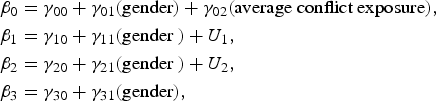 $$\eqalign{{\rm \beta}_{0} & = {\rm \gamma}_{00} + {\rm \gamma}_{01} \lpar \hbox{gender}\rpar + {\rm \gamma}_{02} \lpar \hbox{average conflict exposure} \rpar \comma \cr {\rm \beta}_{1} & = {\rm \gamma}_{10} + {\rm \gamma}_{11} \lpar \hbox{gender }\rpar + U_{1} \comma \cr {\rm \beta}_{2} & = {\rm \gamma}_{20} + {\rm \gamma}_{21} \lpar \hbox{gender }\rpar + U_{2}\comma \cr {\rm \beta}_{3} & = {\rm \gamma}_{30} + {\rm \gamma}_{31} \lpar \hbox{gender}\rpar \comma}$$
where γ00, γ10, γ20, and γ30 are sample-level intercepts; γ01 reflects gender differences in average level of threat; γ02 represents between-person conflict exposure differences in the average level of threat; γ11 examines whether gender moderates the change in threat over time; γ21 examines whether the association between change in conflict and change in threat is moderated by gender; γ31 examines whether the Age × Conflict Exposure interaction is moderated by gender; U 1 and U 2 indicate random person effects; estimation of variance components revealed a lack of significant variation in the slopes of the interaction terms, so the random effects for β3 were constrained in all models.
Results
Preliminary analyses
Intraclass correlation coefficients (ICCs) were calculated for each of the dimensions of children's responses to conflict based on results of random intercept models. ICCs ranged from 0.28 to 0.65 (M = 49.5), suggesting that 29% to 65% (M = 49.5%) of the total variation in children's responses to conflict is attributable to differences among children, and 71% to 35% (M = 50.5%) is attributable to differences within children (Singer & Willett, 2003). Next, a series of random coefficient regression models predicting response processes revealed significant variability in each of the intercepts and slopes. Together, these analyses support the investigation of within- and between-child predictors of average responses and changes in responses with age.
In addition, we explored the change in youths' exposure to parents' conflict (i.e., our proposed time-varying covariate) over time. The intercept only model suggested that 82% of the variance in conflict exposure was between person. The random-regression coefficients model revealed a lack of change in youths' exposure to conflict across time on average (γ = –0.02, SE = 0.01, t = –1.22, df = 296, p = .224); however, significant variation was present in the slopes (χ2 = 3945.17, p < .001). Examination of the pattern of change suggested that while some children were exposed to decreasing levels of conflict over time (56.6%), others' exposure increased (42.7%).
Changes in youths' responses to conflict over time
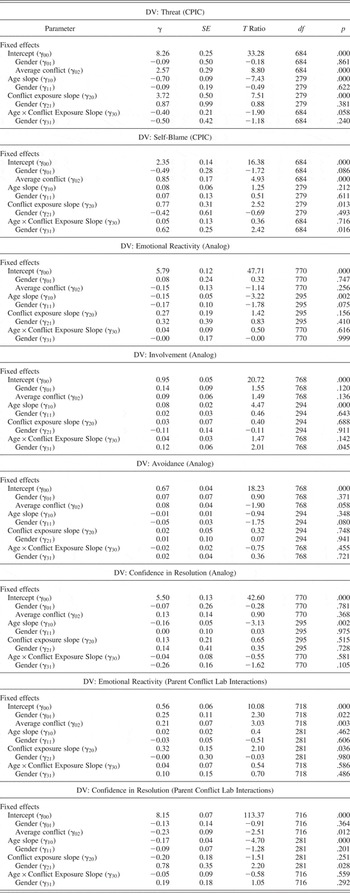
For the principal analysis, we conducted a series of intercepts and slopes as outcomes models examining changes in youths' responses to conflict over 3 years as children developed from middle childhood through adolescence. Change in youths' exposure to frequent, hostile, and unresolved interparental conflict was entered at Level 1 as a time-varying covariate, and gender was entered at Level 2 as a time-invariant covariate. The results are presented in Table 1.
Results of a series of hierarchical linear model analyses examining change in responses to conflict

Note: CPIC, Children's Perceptions of Interparental Conflict.
Differences in average levels of responding
Age was centered at 12 years (the midpoint of the study age range), so intercept tests apply to children at this median age. As shown in Table 1 (γ02), children with greater exposure to conflict reported greater appraisals of threat and self-blame, as well as greater emotional reactivity and less confidence in resolution during parents' conflict in the lab. Only one gender difference (γ01) was found in average levels of youths' response to conflict. That is, girls were more emotionally reactive than boys (parent video; γ = 0.69, SE = 0.10, t = 7.18, df = 718, p < .001 and γ = 0.43, SE = 0.06, t = 7.75, df = 718, p < .001, respectively).
Changes in responses to conflict with increasing age
As shown in Table 1 (γ10), youths' appraisals of threat in the face of parents' conflict decreased as they grew older. Youth became less emotionally reactive and more involved in parents' conflict over time (analog). As they grew older, youth reported less confidence that their parents would be able to reach a resolution (during both analog and the parent video). Appraisals of self-blame, avoidance, and emotional reactivity (parent video) were stable over time. Boys and girls did not appear to change in different ways over time in terms of their responses to conflict (γ11).
Relations between changes in conflict exposure and changes in responding
Supporting the notion of sensitization, as shown in Table 1 (γ20), increases in a youths' exposure to intense and unresolved interparental conflict over time were related to increases in youths' appraisal of threat and self-blame. In addition, as conflict exposure increased, youths' emotional reactivity became increasingly negative when witnessing their parents' conflict in the lab. Follow-up tests to a significant gender effect (γ21) suggest that increasing conflict exposure over time was related to boys' decreasing confidence in parents' ability to resolve their conflict in the lab (γ = –0.59, SE = 0.03, t = –2.61, df = 281, p = .010); no effect was found for girls (γ = 0.19, SE = 0.27, t = 0.69, df = 281, p = .493).
Age × Conflict Exposure interactions (γ30) were not significant for any of these models, suggesting that neither older nor younger children were more susceptible to change in their responses as a function of change in exposure. However, a gender effect for the Age × Conflict Exposure interaction (γ31) was significant in the models predicting youths' involvement in conflict and appraisals of self-blame. Follow-up tests to a significant Age × Conflict Exposure interaction for girls (γ = 0.10, SE = 0.05, t = 2.10, df = 768, p = .035) found that increases in exposure to conflict were related to decreases in involvement in parents' conflict for younger girls (age centered at 8 years; γ = –0.45, SE = 0.22, t = –2.04, df = 294, p = .042) but to increases in involvement for older teens (age centered at 16; γ = 0.47, SE = 0.24, t = 1.97, df = 294, p = .049). The Age × Conflict Exposure interaction for boys was not significant (γ = –0.02, SE = 0.03, t = –0.48, df = 768, p = .632). Follow-up tests to the significant gender effect for the Age × Conflict Exposure interaction in the prediction of self-blame were not statistically significant.
Discussion
The goal of the present study was to investigate changes in youths' responses to marital conflict across middle childhood and adolescence and to test the cogency of the sensitization hypothesis by examining directly whether change in marital conflict predicted change in responding. Studying intraindividual change is a hallmark of developmental theory and research, and it is a critical principle of the developmental psychopathology orientation. However, to date, speculation about children and adolescents' change over time in responding to conflict has relied largely on cross-sectional designs or longitudinal analyses that predict from static measures of marital conflict. Although the major theories in the field hypothesize that worsening marital conflict will heighten reactivity, the present study is among the first to directly test this central proposition of sensitization in a prospective, longitudinal design.
Extending cross-sectional study of age differences in youths' responses to conflict, HLM analyses showed that as youth aged from middle childhood through adolescence, they became less threatened by conflict, less emotionally distressed, less confident in their parents' ability to reach resolution, and more involved behaviorally in parents' conflict. In keeping with social cognitive theory, youth may become better judges of the nuances of conflict expressions and the implications of hostile, unresolved conflict for future relationship quality. At the same time, these findings support the general notion that children become better able to regulate their emotions and cope with the stress of marital conflict with increasing emotional and cognitive maturity. Youths' increased involvement may reflect greater capacity to affect change in their parents' conflict expression, further reducing threat and emotional distress.
Consistent with past work, history of conflict exposure was related to higher average levels of threat, self-blame, emotional reactivity, and skepticism about resolution. Moreover, supporting notions posited by the sensitization hypothesis, when the frequency and intensity of hostile conflict increased, children's appraisals of threat and blame increased over time. In addition, children's emotional responses to parents' actual conflict episodes became more negative, and boys became increasingly pessimistic about their parents' ability to resolve future conflict as parents' conflict intensified over time. To our knowledge, this is among the first tests of the sensitization hypothesis to show empirically that as parental disputes intensify, so too do the children's reactions across a variety of responses processes, even as they age. Both younger and older children were susceptible to this intensification in responses to conflict.
These findings add an important qualifier to any notion that conflict may pose less risk to children as they develop. It seems that children may become generally less responsive to conflict over time as long as conflict does not intensify. However, if parents' conflict becomes more frequent, intense, and unresolved, both younger and older children become more reactive to conflict as they develop. These results confirm the robustness of the notion of sensitization by showing empirically that exposure to increasingly hostile conflict is related to alterations, even reversals in some cases, in the pattern of normative change in emotional, behavioral, and cognitive responses to conflict.
It is notable that links with increases in conflict exposure were found for heightened emotional reactivity and skepticism about resolution in the parent video methodology but not the analog methodology. Analog techniques have been shown to elicit the scripts of responding that develop based on experiences with their own parents. However, these stimuli are not as engaging as witnessing actual parent conflict interactions and may not have been salient enough to engage the sensitization processes.
Important questions remain with regard to individual differences in response and sensitization processes. Recent work has begun to integrate physiological and psychological responses to family stress (El Sheikh, Hinnant, & Erath, 2010). For example, in an innovative study, Davies, Sturge-Apple, Cicchetti, and Cummings (Reference Davies, Sturge-Apple, Cicchetti and Cummings2008) found that children's heightened psychological distress responding was associated with elevated cortisol reactivity. Considering the interaction between biology and environment may prove valuable toward identifying children most at risk for heightened reactions to conflict.
Effects for boys and girls were largely consistent and provided further support for the conclusion that both boys and girls are vulnerable in terms of heightened responses to conflict. Girls reported greater emotional reactivity than boys, on average, in response to their parents' conflict expressions. However, change in responses to conflict over time did not vary for boys and girls. Nuances emerge in boys' and girls' behavioral involvement and confidence in resolution. Results suggested the normative developmental pattern for behavior, controlling for exposure, was for children to become more involved in conflict as they grew older. However, Age × Conflict Exposure interaction analyses suggest that as conflict increased, older girls continued to became more involved, whereas boys (regardless of age) remain stable in their level of involvement and younger girls become less involved. Finally, with increased conflict exposure, boys, but not girls, expressed decreased confidence in parents' ability to resolve their conflict (parent videos). In summary, while nuances emerged in some dimensions of responding, minimal support was found for major gender differences in conflict responses or patterns of change from childhood through adolescence for boys and girls.
The current analyses provide support for a central test of sensitization, that is, increasing exposure to hostile interparental conflict intensifies emotional, cognitive, and in some cases behavioral responses. Further exploration of additional aspects of sensitization warrant consideration in future research. For example, conflict exposure is hypothesized to change the threshold at which children's emotional security system is triggered (Hammon, Henry, & Daley, Reference Hammen, Henry and Daley2000), resulting in heightened reactivity at lower levels of stress. The design of the current study (i.e., three waves of assessment per individual) precludes a test of curvilinear trajectories, but such examination is important for determining whether change is incremental, or rather exponential, with implications for better understanding sensitization. Increasing evidence supports the notion that components of emotional security (Davies & Cummings, Reference Davies and Cummings1994) and cognitive appraisal (Grych & Fincham, Reference Grych and Fincham1990) are mediators of the link between marital conflict and children's adjustment. A mediational test of change in conflict exposure leading to change in reactivity, and consequently change in adjustment, would contribute further to our understanding of sensitization.
Additional limitations should be acknowledged. We considered the relation between change in marital conflict and change in children's responses; however, contemporary theory assumes a transactional relationship between family systems. Research shows that children's emotions and behaviors during parents' conflict influence the course of the particular episode (Schermerhorn, Chow, & Cummings, Reference Schermerhorn, Chow and Cummings2010) as well as future marital disputes (Schermerhorn, Cummings, DeCarlo, & Davies, Reference Schermerhorn, Cummings, DeCarlo and Davies2007).
Children in the study ranged in age from 8 to 19 years, allowing us to look at change across a wide span from middle childhood through adolescence. It is important to note that individual children were assessed 3 consecutive years during that span, which may have limited power or impacted heterogeneity in intercept and slope parameters. Furthermore, whenever multiple comparisons are made, such as in this report, one must be concerned with experiment-wise alpha. Effects for most of the primary analyses were robust, as can be seen by an examination of the exact p values. However, some of the effects related to interactions with age or gender were closer to .05 and should be considered as tentative until replicated.
Responses of multiple reporters were used for the conflict exposure measure (i.e., mother, father, and child report), but children's responses to conflict were based solely on children's self-report. We might have greater confidence in results if we had corroborating reports or observational data for these constructs. However, we relied on child report of these constructs because children become more adept at masking distress in adolescence (Davies & Sturge-Apple, Reference Davies and Sturge-Apple2007), making self-report a valuable tool for identifying children's internal processes. Although children provided self-report for each, concerns about shared method variance are lessened to a degree by the use of three methods to assess children's responses to conflict (i.e., questionnaires, experimental analog presentations, and parents' naturalistic observations). Furthermore, whereas emotional reactivity and cognitive representations were evaluated in response to both the analog and the parents' actual conflict episodes, children's involvement was only assessed with regard to the analog presentations. Understanding of this behavioral component of emotional security and its implication for adjustment would be strengthened if it had been evaluated in the naturalistic observation as well.
Although it is possible the results were influenced by testing effects, we were unable to identify a systematic pattern in the data suggesting it as a source of variability. This is perhaps not surprising considering the 1-year span between data collection. Moreover, testing effects are unlikely with everyday interactions such as those used in this study. Furthermore, the sample was predominantly White and middle class, potentially limiting generalizability.
Nonetheless, the current study furthers process-oriented understanding of the effects of marital conflict on children over time by supporting the propositions of the sensitization hypothesis. It is the first to examine intraindividual change of children's emotional, behavioral, and cognitive responses to change in marital conflict over time. Study findings suggest that children may become less vulnerable to conflict as they develop through middle childhood and adolescence. However, consistent with the notion of sensitization, children's responses to conflict over time indicated greater appraisals of threat and self-blame and greater insecurity as parents' conflict intensified regardless of age. Findings are important for advancing prevention and intervention programs designed to reduce the negative effects of marital conflict on children and providing valuable information to those who work with children and families about youths' vulnerabilities to conflict from middle childhood through adolescence.