Although, traditionally, much sentence-processing research has targeted first language (L1) use, the recent psycholinguistic literature reveals an increasing interest in the area of second-language (L2) sentence processing (e.g., Clahsen & Felser, Reference Clahsen and Felser2006a; Felser, Roberts, Marinis, & Gross, Reference Felser, Roberts, Marinis and Gross2003; Hahne, Reference Hahne2001; Hahne & Friederici, Reference Hahne and Friederici2001; Hopp, Reference Hopp2006; Jiang, Reference Jiang2004; Juffs, Reference Juffs1998a, Reference Juffs1998b; Papadopoulou & Clahsen, Reference Papadopoulou and Clahsen2003; Sanders & Neville, Reference Sanders and Neville2003; Su, Reference Su2001; Weber-Fox & Neville, Reference Weber-Fox and Neville1996; Williams, Möbius, & Kim, Reference Williams, Möbius and Kim2001). This L2-focused research has varied along several dimensions, but many studies (e.g., Hahne; Hopp) have compared the strategies used by native speakers (NSs) with those used by nonnative speakers (NNSs). This comparative methodological approach seems sensible, in that the examination of L1 strategies provides a baseline, or control condition, with which L2 processing can be compared. Much of this comparative research has identified several distinct features of L2 sentence processing, one of which is that NNSs seem to rely less on syntactic information than NSs when interpreting sentences (Clahsen & Felser; Felser et al.; Hahne; Hahne & Friederici; Weber-Fox & Neville).
In an attempt to examine the effects of syntactic information in L2 sentence processing, Hahne and Friederici (Reference Hahne and Friederici2001) measured event-related potential (ERP) effects in groups of NSs and NNSs of German as they listened to four different types of sentences: (a) syntactically incorrect sentences, (b) semantically incorrect sentences, (c) sentences with a combined syntactic and semantic anomaly, and (d) correct sentences. The NNSs were L1 Japanese advanced learners of German who were studying at a German university. The four types of sentences used are illustrated in (1)–(4).
(1) Syntactically incorrect
Das Eis wurde im gegessen.
“The ice cream was in the eaten.”
(2) Semantically incorrect
Der Vulkan wurde gegessen.
“The volcano was eaten.”
(3) Semantically and syntactically incorrect
Das Türschloss wurde im gegessen.
“The door lock was in the eaten.”
(4) Correct
Das Brot wurde gegessen.
“The bread was eaten.”
When Hahne and Friederici compared the four different sentence types across the two participant groups, they found that NNSs processed the syntactically incorrect sentences such as (3) and the combined incorrect sentences such as (4) differently than NS controls. In particular, two ERP effects that are typical responses to syntactic violations in NSs were absent in the NNS group. These missing effects were the early left anterior negativity (ELAN) and the later P600. (The ELAN effect has been interpreted as a reflection of first-pass syntactic parsing processes, whereas the P600 effect has been interpreted as an indication of reanalysis and repair processes.) Hahne and Friederici therefore concluded that NNSs did not use the same early first-pass syntactic parsing processes that NSs used; nor did they employ the same reanalysis and repair processes in sentences with a syntactic anomaly. A possible conclusion from this comparative research is that NNSs are somewhat less sensitive to syntactic information than NSs. Similarly, some NNSs also appear to be less sensitive than NSs to specific morphological features of language. Jiang (Reference Jiang2004) reported that Chinese speakers of L2 English were less sensitive than NSs to plural morpheme and subject-verb number agreement violations in sentential contexts.
Along these lines, Clahsen and Felser (Reference Clahsen and Felser2006a) formulated the shallow structure hypothesis, according to which the “syntactic representations adult L2 learners compute for comprehension are shallower and less detailed than those of native speakers” (p. 32). The shallow structure hypothesis also predicts that adult L2 learners base their sentence representations mainly on lexical-semantic information. It is important to note that, in a further refinement of their hypothesis, Clahsen and Felser (Reference Clahsen and Felser2006b) distinguished between the processing of local and nonlocal syntactic dependencies. L2 users process sentences that contain nonlocal dependencies in a shallower fashion than L1 users, but they process local dependencies in a similar fashion to NSs.
In contrast, similarities in morphological processing between NSs and NNSs have also been reported. In this regard, Beck (Reference Beck1997) found that in nonclausal contexts (i.e., at the word level), NNSs are just as sensitive to regular past tense verb morphology as NSs. Beck presented NSs and NNSs (from mixed L1 backgrounds) with pairs of regular verb stems (e.g., call and boil) matched for stem frequency but mismatched for their respective past tense verb frequency. Participants were required to produce the appropriate past tense verb form from each stem and their responses were timed. Both NSs and NNSs produced high-frequency regular past tense verbs like called equally as fast as low-frequency regular past tense verbs like boiled. This result indicated that NSs and NNSs use similar verb production processes: Neither NSs nor NNSs were guided by the frequency of the past tense verb in their production to a significant degree; rather, both groups used rule-based processing to retrieve and produce regular past tense verb forms. Although this finding was at the single-word level, it is conceivable that similar strategies may be used in sentential contexts; Beck speculated on this point and suggested areas for further research.
Similarities between NSs and NNSs in semantic processing have also been reported (Clahsen & Felser, Reference Clahsen and Felser2006a; Hahne & Friederici, Reference Hahne and Friederici2001). Thus, although Hahne and Friederici found differences between NSs and NNSs in their responses to sentences that contain syntactic anomalies, they also found that their NS and NNS groups provided similar responses to semantically incorrect sentences, such as the sentence in (2). This result indicates that when interpreting a sentence, the sensitivity of NSs and NNSs to semantic information is approximately equal. This similarity between NSs and NNSs in the use of semantic information in sentence processing has been reported in a number of other studies as well (Felser et al., Reference Felser, Roberts, Marinis and Gross2003; Hahne, Reference Hahne2001; Sanders & Neville, Reference Sanders and Neville2003; Weber-Fox & Neville, Reference Weber-Fox and Neville1996).
Similarities between NSs and NNSs have also been reported to be a function of proficiency. As one would expect, with increasing L2 proficiency, NNSs appear to adopt more nativelike sentence-processing strategies. In an online reading study, Hopp (Reference Hopp2006) found that near-native English and Dutch speakers of German read and processed sentences that involved case and word-order ambiguities and ungrammaticalities in ways similar to NSs; both groups were roughly equally sensitive to syntactic information. However, in the same study, Hopp also found that advanced NNSs (i.e., NNSs who were less proficient than near-natives) were less sensitive to syntactic information, which is consistent with previous findings.
The available evidence thus suggests that semantic processing in NSs and advanced NNSs is similar and that syntactic processing is different, whereas conclusions about morphological processing are, as yet, uncertain. However, only a limited set of grammatical features has been investigated so far in L2 sentence-processing studies, a point also noted by Clahsen and Felser (Reference Clahsen and Felser2006b), who called for an expansion in the range of grammatical phenomena under investigation. Furthermore, up until now, most of the grammatical structures studied have been associated with long-distance syntactic dependencies (Clahsen & Felser). For example, one of the most frequently investigated structures in L2 sentence-processing studies has been the relative clause (e.g., Felser et al., Reference Felser, Roberts, Marinis and Gross2003; Izumi, Reference Izumi2003; Juffs, Reference Juffs1998a; Papadopoulou & Clahsen, Reference Papadopoulou and Clahsen2003), which reflects the popularity of this structure in L1 sentence-processing studies. Other long-distance dependencies that have been investigated in L2 sentence processing include: wh-questions, such as Which river did the man push the bike into late last night? (Williams et al., Reference Williams, Möbius and Kim2001), and subject-verb agreement anomalies, as in The key to the cabinets were rusty from many years of disuse (Jiang, Reference Jiang2004). Local temporary syntactic ambiguities, such as Before Mary ate the pizza arrived from the local restaurant (Juffs, Reference Juffs1998b), and syntactically simple sentences, such as Das Brot wurde gegessen “The bread was eaten” (Hahne & Friederici, Reference Hahne and Friederici2001), have also been studied. In pointing out the imbalance in the selection of structures, Clahsen and Felser called for the investigation of online sentence processing in more locally complex grammatical structures than those previously studied to clarify more fully the nature of NNS sentence processing.
In an attempt to address these concerns raised by Clahsen and Felser (Reference Clahsen and Felser2006b) about the bias in the selection of structures, we chose to investigate an English structure unexplored until now from a sentence-processing perspective—namely, the modal perfect (MP), which is illustrated in (5).
(5) They could have painted the back of their house.
Modal perfect sentences provide an opportunity to investigate NNS sentence processing within a locally complex grammatical context, as advocated by Clahsen and Felser, and to explore preferences and strategies in sentence processing by NNSs in comparison to NSs. The choice to examine MP sentences also makes this study of direct relevance to some of the practical concerns of SLA. The MP is known to present acquisition difficulties for English language learners (Bloom, Reference Bloom1981, Reference Bloom1984; Bowen & McCreary, Reference Bowen and McCreary1977; Chou, Reference Chou2000; DeCarrico, Reference DeCarrico1986; Frazier, Reference Frazier2003; Swan & Smith, Reference Swan and Smith2001; Thomas, Reference Thomas1994), and a comparison of NSs’ and NNSs’ processing strategies may therefore help to explain this difficulty. DeCarrico (Reference DeCarrico1986) referred to the difficulty that MP clauses pose for advanced English-as-a-second-language (ESL) learners, when she stated that:
In the view of many ESL teachers, these cases [MP clauses] present the most difficulty for students, including those who are able to gain full mastery of the semantics, functions, and forms of modals used in present tense, such as I would help you but I am busy. (p. 665)
In focusing on a structure known to be challenging for NNSs to acquire, one goal was to explore the nature of SLA by understanding how NNSs process sentences in their L2 (e.g., Juffs, Reference Juffs1998a). In contrast, previous research in L2 sentence processing has not always targeted language features that present particular acquisition difficulties for NNSs. For example, many L2 sentence-processing studies have investigated the processing of relative clauses (e.g., Felser et al., Reference Felser, Roberts, Marinis and Gross2003; Izumi, Reference Izumi2003; Juffs, Reference Juffs1998a; Papadopoulou & Clahsen, Reference Papadopoulou and Clahsen2003), which are generally accepted to be difficult to process for both NSs and NNSs. However, it is not at all clear that relative clauses are especially difficult for advanced adult NNSs compared to other English structures. Instead, structural features that involve tense, aspect, conditionality, modality, and voice have been more frequently mentioned in the literature as posing difficulties for language learners (Bowen & McCreary, Reference Bowen and McCreary1977; Dabrowska & Street, Reference Dabrowska and Street2006; DeCarrico, Reference DeCarrico1986; Hinkel, Reference Hinkel1992, Reference Hinkel2004; Hyland, Reference Hyland1996, Reference Hyland2000; Montrul & Slabakova, Reference Montrul and Slabakova2003; Skelton, Reference Skelton1988; Swan & Smith, Reference Swan and Smith2001). It is unfortunate, however, that little is known about the online processing difficulty that these particular language features might present for NNSs. Thus, there is often a disconnect between L2 sentence-processing research and the practical language acquisition difficulties faced by learners, and only a small number of researchers have explicitly linked L2 sentence-processing research to the acquisition difficulties faced by NNSs. Jiang, with his (2004) study of plural morphemes, subject-verb number agreement, and verb subcategorization, is one of the few researchers to explicitly justify sentence-processing research on the basis of the particular grammatical difficulties faced by L2 learners.
In sum, this study has two purposes: (a) to compare the sentence-processing strategies adopted by NNSs versus NSs and (b) to explore a possible reason for the acquisition difficulty that NNSs experience with the MP—namely, a processing difficulty. A potential ambiguity in MP offers a new linguistic context in which to study L2 sentence processing. The strategy used here for examining MP sentence processing relies on the same logic as previous studies of the processing of temporary structural ambiguities (e.g., Holmes, Stowe, & Cupples, Reference Holmes, Stowe and Cupples1989; Lipka, Reference Lipka2002). In essence, there is a temporary ambiguity that immediately follows the modal verb plus have string in a MP sentence. To illustrate, consider the sentence fragment in (6), which could be continued in various ways, two of which are provided in (7) and (8). We refer to sentences like (7) as lexical-have (LH) sentences. In LH sentences, have acts as a lexical verb, whereas in MP sentences, have acts as an auxiliary verb. The main difference between MP and LH sentences is the word immediately after have: In MP sentences, a past participle verb form follows have, whereas in LH sentences, a noun follows have.
(6) He could have…
(7) He could have work at the shoe factory.
(8) He could have worked at the shoe factory.
It is assumed here that the immediacy principle operates (Just, Carpenter, & Woolley, Reference Just, Carpenter and Woolley1982) and that NSs and NNSs parse sentences in a serial manner, initially committing to one, and only one, interpretation of the sentence at each word. If NSs and NNSs have a mental representation of MP, they will preferentially expect to see a past participle verb form after the modal verb plus have string. Evidence for this MP preference comes from Boyland’s (Reference Boyland1996) study: She found that during sentence processing, NSs attach have to the modal verb in phrases like (6), which means that have is grammaticalized and functions as a grammatical morpheme that marks counterfactuality. We argue that this attachment strategy means that readers expect to see a past participle verb form immediately upon—or just after—reading the word have and thus construct a MP phrase such as (8). In contrast, the presence of the noun in LH sentences such as (7) will lead readers to think, incorrectly, that the sentence is ungrammatical at that point; that is, they might infer that the verb has been used without its (appropriate) past participle inflection. Thus, this ambiguity in LH structures should result in a temporary increase in processing difficulty around the noun. As a consequence, compared with LH sentences like (7), MP sentences like (8) should be the preferred continuation of sequences like (6). Errors and slower reading times (RTs) at the noun, or just after the noun, in LH sentences like (7), could then be taken as evidence that there is a garden-path effect resulting from language users’ preference for processing the modal verb and have incorrectly as the beginning of a MP verb phrase.
A preference for MP over LH sentences would also be consistent with the syntactic principle of late closure. The principle of late closure requires that incoming lexical items be attached to the clause or phrase being processed whenever possible (Frazier & Fodor, Reference Frazier and Fodor1978). In the case of the sentence fragment in (6) and of the two possible continuations illustrated in (7) and (8), the past participle worked would thus be preferentially attached to the verb phrase, over the noun work, therefore extending the verb phrase from two words (for LH) to three words (for MP). This processing strategy would extend closure of the verb phrase and as a result be compatible with late closure. In contrast, if the noun work followed could have as an object noun phrase, the verb phrase would be closed early and thus be incompatible with late closure.
The possible role of word-category frequency in the processing of MP sentences has not yet been considered here. Rather, it has been argued that a syntactic preference for MP may occur as a result of an attachment strategy that reflects either a preference for late closure or the grammaticalization of have (along the lines suggested by Boyland, Reference Boyland1996), or both. It is possible, however, that a word’s syntactic category frequency might also influence the processing of the sentences at some stage. Most NS serial parsing models, such as the garden-path model (Frazier & Fodor, Reference Frazier and Fodor1978), maintain that syntactic information has temporal priority in sentence processing and that lexical frequency and semantic information (e.g., information about the pragmatic plausibility of a sentence) come into play only after an initial syntactic parse (e.g., Ferreira & Clifton, Reference Ferreira and Clifton1986; Ferreira & Henderson, Reference Ferreira and Henderson1990; Frazier & Rayner, Reference Frazier and Rayner1982; Rayner, Carlson, & Frazier, Reference Rayner, Carlson and Frazier1983). According to this view, processing is modular, in that syntactic and nonsyntactic information are dealt with by separate systems, and although the output of these systems interacts at some stage, they function independently of each other in real time. Following Frazier and her colleagues (e.g., Frazier & Fodor), some researchers have referred to this process as information encapsulation, whereby the module that uses syntactic information to complete a first parse is not influenced by any nonsyntactic information. Nonsyntactic information is dealt with by other modules that work independently of the syntactic module. In contrast, several researchers have claimed that lexical information can influence initial parsing and lead to (or reduce) garden-path effects in NSs (Crocker & Brants, Reference Crocker and Brants2000; Crocker & Corley, Reference Crocker, Corley, Merlo and Stevenson2002; Holmes et al., Reference Holmes, Stowe and Cupples1989; Macdonald, Pearlmutter, & Seidenberg, Reference MacDonald, Pearlmutter and Seidenberg1994; Mitchell & Holmes, Reference Mitchell and Holmes1985; Trueswell, Reference Trueswell1996; Trueswell, Tanenhaus, & Kello, Reference Trueswell, Tanenhaus and Kello1993). Along similar lines, NNS processing has also been argued to be interactive (or nonmodular). Thus, it has been proposed that NNSs simultaneously use a combination of information types—syntactic, lexical, and semantic (Felser et al., Reference Felser, Roberts, Marinis and Gross2003; Hahne, Reference Hahne2001; Hahne & Friederici, Reference Hahne and Friederici2001; Weber-Fox & Neville, Reference Weber-Fox and Neville1996)—in interpreting sentences. In sum, however, on the basis of the current evidence from a small subset of syntactic structures, it still remains unclear as to what extent NS and NNS processing differ in terms of modularity. The temporary ambiguity in MP sentences presents an opportunity to investigate this issue.
On the interactive (or nonmodular) view, differences between the frequency of the noun work in sentence (7) and the past participle worked in sentence (8) might influence the processing advantage for MP over LH structures. According to the Brown corpus of American English (Francis & Kučera, Reference Francis and Kučera1982), a corpus of written English compiled in the 1960s, the noun form of work occurs considerably more often (with 579 occurrences per million written words) than the past participle worked (53 occurrences). If online parsing decisions are influenced by a word’s frequency, then we might expect to see faster or more accurate processing of LH sentences like (7) than of MP sentences like (8). Finding such an effect would provide some evidence against the primacy of syntactic information in initial sentence parsing but evidence for the early use of word-category frequency information.
The experimental hypotheses were based on the assumption that MP sentences would generally be preferred over LH sentences for reasons of a syntactic preference for late closure and the grammaticalization of have and its attachment in MP (Boyland, Reference Boyland1996). Based on these assumptions, it was hypothesized that MP sentences would be easier to read and comprehend than LH sentences for NSs. This prediction is consistent with the view that syntax is of primary importance in NS sentence processing. In contrast, it was hypothesized that NNSs would show a weaker preference or no preference for MP over LH sentences, based on the argument that they rely less on specific syntactic information in understanding sentences. On the question of the effect of category frequency information in sentence processing, it was hypothesized that a preference for MP over LH sentences would be correlated with the frequency difference between the noun and the past participle verb form of a word. Furthermore, consistent with the claims of Clahsen and Felser (Reference Clahsen and Felser2006a) and others, this frequency effect, which would be expected to diminish garden-path effects in LH sentences, should be significantly stronger in NNSs than in NSs.
METHOD
Participants
Participants were either postgraduate or undergraduate linguistics students at an Australian university who took part in the experiment for course credit. There were 37 NSs of English (8 males and 29 females) and 37 advanced NNSs of English (10 males and 27 females). All NNSs stated that English was not their dominant language. The average age of NNSs was 30.2 years (SD = 7.30) compared to 22.0 years for the NSs (SD = 6.26). Although the age difference between the groups was significant, t(72) = 5.144, p < .001, it was not considered problematic because both groups consisted of young, healthy adults.
To ensure that the group of advanced NNS participants would have had adequate exposure to MP sentences either in their English language learning or their daily life, they had to satisfy at least one of the following criteria: (a) an International English Language Testing System (IELTS) score of 6.0 or higher, (b) an equivalent score on another English language test (e.g., TOEFL, Test of English for International Communication, Cambridge), or (c) the English language entry criteria of an Australian university (e.g., through the completion of a course of academic English). Additionally, nearly all NNSs had studied English at school in their home country. A range of other factors confirmed that the NNS participants were indeed advanced speakers of English: Thirteen had been English-as-a-foreign-language (EFL) teachers in their home countries, whereas four others had completed an undergraduate degree with a major in either English, English literature, or English education but had not taught EFL classes. Another seven had completed part of their education in Australia, either at school or university.
In identifying participants as NSs or NNSs, the primary criteria were age of acquisition of English and language dominance as judged by the participant. Thus, for all NSs, English had been learned early and was the dominant language, whereas in the NNS group, all participants had learned English relatively late and identified their other language as dominant. One NNS spoke Singaporean English and Chinese, but for the purposes of this study, Singaporean speakers were treated as NNSs of English, based on evidence about the syntactic variability in counterfactual conditionals in Singaporean English (Ziegeler, Reference Ziegeler1994, Reference Ziegeler1995). The breakdown of NNSs’ L1s was as follows: 13 Korean, 9 Chinese, 1 Singaporean English-Chinese, 8 Japanese, 2 Bengali, 1 Arabic, 1 Norwegian, 1 Portuguese, and 1 German.
Materials
In this experiment, 24 LH test sentences, as illustrated in (9), and 24 analogous MP test sentences, as shown in (10), were used, which resulted in a total of 48 test sentences. The full set of test sentences can be found in Appendix A.
(9) They could have paint at the back of their house.
(10) They could have painted the back of their house.
The nouns in the LH sentences were a mixture of uncountable mass nouns and uncountable abstract nouns, all of which could occur without a determiner (e.g., an article). It is important to note that all but one noun had a corresponding, graphically identical, verb stem; the exception was the irregular verb-noun pair bleed-blood.
To ensure that any differences in processing difficulty around the disambiguating verb or noun could not be attributed to uncontrolled variation between test sentences of the two types, the MP and LH sentence pairs were constructed to be as similar as possible to each other. The main difference was an alternation in the syntactic category of the word between a past participle and a noun. Within three pairs, the subject also alternated between an impersonal and a personal pronoun. In the case of the 21 regular verbs used, this manipulation meant the presence or absence of an –ed ending. In addition to the regular verbs, three irregular verbs (bled, fed, and drunk) were used. Sentences of each type were matched for length in number of words (MP = 7.46, SD = 0.89; LH = 7.88, SD = 0.90), F(1, 47) = 2.12, p = .152. Four modal verbs were distributed relatively equally across the full item set: might (n = 14), could (n = 12), must (n = 10), and should (n = 10). This matching ensured that any differences in sentence processing could only be attributed to the difference between the past participle and the noun. Relatively short sentences and short, frequently occurring, and easily recognizable words were used so that NNSs would have little difficulty understanding them. In the case of uncountable mass nouns such as paint, the absence of a determiner in the noun phrase was critical in setting up the possibility of a temporary ungrammaticality (associated with the missing –ed inflection). Therefore, determiners were absent from all LH sentences at the object noun.
The 48 test sentences were split into two lists, A and B, of 24 test sentences. Each list contained 12 MP and 12 LH sentences. The two lists were balanced in terms of test sentences, so that either the MP or the LH form of each verb-noun pair, but not both, was included in a list. In addition to the 24 test sentences, both lists contained the same 52 filler and practice items, which resulted in a total of 76 sentences per list. The filler items in each list were 16 practice sentences, 24 ungrammatical distractor sentences, and 12 grammatical distractor sentences. Each participant saw list A or list B but not both. Of the NS group, 18 participants received list A and 19 received list B, whereas for the NNS group, 19 participants received list A and 18 received list B. The stimulus sentences in each list were pseudorandomly scrambled for each individual participant to ensure even distribution of the different item types.
It was hypothesized that participants’ preference (or lack of a preference in the case of NNSs) would be determined by their responses to syntactic features at the critical nouns and verbs in LH and MP sentences, respectively. It is also possible, however, that participants might find the LH sentences more difficult to process because they consider them less plausible than the corresponding MP sentences. In an attempt to rule out this possibility, the plausibility of LH and MP test sentences was compared. To ensure that participants in this plausibility-judgment task based their decisions primarily on semantic information, the test sentences were converted into questions that were cut off at the noun or the past participle, which resulted in sequences such as Could he have work…? and Could he have worked…? This transformation disrupted the modal verb plus have sequence, thus reducing the possibility of a garden-path effect at the noun in LH sentences while preserving the essential proposition contained within each declarative sentence. The 48 question beginnings were split into two balanced lists, following the same logic as for the main experiment, and were presented to 20 NS participants who were asked to rate, on a scale from 1 (implausible) to 5 (plausible), the likelihood that each sequence could begin a question. Median plausibility ratings on MP and LH question beginnings were then compared using a Wilcoxon signed ranks test after omitting data from two potentially problematic test sentences that contained drink and drunk. Although there was a small difference in plausibility that favored MP over LH sentences (medians of 4.40 and 4.05, respectively), it was nonsignificant, Z = –1.858, .05 < p < .10. It is therefore assumed that any significant differences between MP and LH sentences evident in the main experiment would not primarily reflect differences in semantic plausibility.
Procedure
In the main experiment, stimuli were presented using DMDX software (Forster & Forster, Reference Forster and Forster2003). Participants were seated in front of a computer screen and asked to judge the grammaticality of sentences presented word-by-word on the screen. The sentences were presented using a self-paced cumulative display technique.Footnote 1
Participants read each sentence one word at a time as the sentence built up on the computer screen. Participants had to monitor the sentence, deciding as each word appeared whether the sentence could continue grammatically. Because words were displayed cumulatively on the screen, participants could also go back and reread the sentence if they wanted. RTs and response accuracy (errors) were recorded at each press of the mouse button.
Before the session began, participants read an instruction sheet and were briefed on how to complete the task. Participants also completed six practice sentences in the presence of the investigator before doing the experiment proper. They were instructed to respond as quickly and as accurately as possible but received no feedback regarding speed or accuracy during the experiment. Sentence-final words were followed by a period. NSs took approximately 10 min to complete the entire experiment, and NNSs took between 15 and 20 min. To avoid distracting participants, the investigator was not present in the room as they completed the experimental trials.
Design
The design of the experiment was a 2 (participant group) × 2 (stimulus list) × 2 (sentence type) × 5 (word) mixed factorial. Participant group (NS vs. NNS) and stimulus list (list A vs. list B) were between-subjects variables, whereas sentence type (MP vs. LH) and word were within-subjects variables. There were four within-sentence words in both sentence types; the fifth word was the sentence-final word. In MP sentences, the four within-sentence words were (a) modal verb, (b) have, (c) past participle, and (d) the word immediately after the past participle; however, in LH sentences, the four words were (a) modal verb, (b) have, (c) noun, and (d) the word immediately after the noun. The critical words for evaluating the hypotheses were the past participle or the noun as well as the word immediately following the past participle or the noun for both MP and LH sentences. The dependent variables were RT in milliseconds (ms) and percentage of errors at each of the measurement positions in the test sentences.
Data from the four sentence-internal words were analyzed separately from data for the sentence-final word, because the main aim of the experiment was to obtain measures of online processing difficulty (i.e., as participants read the sentences rather than after they had finished reading). Thus, for most statistical analyses, the design was a 2 × 2 × 2 × 4 mixed factorial. Furthermore, separate ANOVAs were conducted on the data from each group of participants (NSs vs. NNSs) on the assumption that the NNS group would exhibit considerably more variability in performance than the NS group. To ensure that any effects were generalizable to the majority of sentences in the experiment and not simply an effect localized to one or two atypical items (e.g., as a function of semantic factors associated with particular verbs or nouns in specific sentence contexts), item analyses were performed in addition to subject analyses. In item analyses, sentence type was considered a between-items factor. Subject analysis F-values and item analysis F-values are represented as F 1 and F 2, respectively.
RESULTS
RTs and Errors
Reading times (in ms) and errors were measured and examined at the four critical sentence-internal words in both MP and LH sentences for both NSs and NNSs. Final-word RTs were also measured and subjected to separate statistical analysis. Outlier RTs, which were more than two standard deviations above or below an individual participant’s mean, were trimmed at that cutoff value, and RTs faster than 200 ms were discarded before analysis on the assumption that participants could not respond that quickly if they were doing the task as directed. RTs for correct responses only were analyzed.
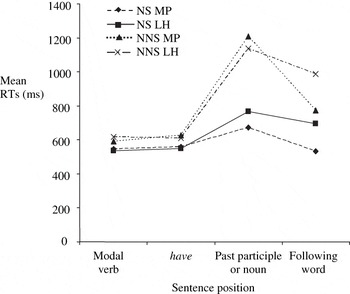
Figure 1 shows the mean RTs for NSs and NNSs for MP and LH sentences at the four sentence-internal words. Figure 1 reveals that, as expected, there was minimal or no difference in processing difficulty between sentence types (MP vs. LH) at either the modal verb position or have. Additionally, there appears to be no marked difference between participant groups at these early within-sentence locations, although they were not directly compared statistically.
Mean RTs for the NSs and the NNSs on MP and LH sentences at the four sentence-internal words.

Statistical analysis of RT data for NSs for the four sentence-internal words revealed a significant difference overall between MP and LH sentences, F 1(1, 35) = 23.37, p < .001, such that mean RTs per word were shorter for MP than for LH (577 ms vs. 638 ms, respectively). Overall, when sentence-internal words are considered, there was also a strong main effect for word, F 1(3, 105) = 52.598, p < .001; F 2(3, 132) = 56.482, p < .001. More relevant than these two main effects, however, was a significant interaction between sentence type and word, F 1(3, 105) = 20.8, p < .001; F 2(3, 132) = 14.83, p < .001. This interaction reflects the fact that RTs for words in MP and LH sentences varied only minimally at the modal verb (544 ms vs. 537 ms, respectively) and at the word have (558 ms vs. 549 ms, respectively), whereas there was a marked difference of 103 ms at the past participle or the noun (673 ms vs. 776 ms, respectively), which favored MP sentences (see Figure 1), and an even larger difference at the word following the participle or the noun (532 ms vs. 688 ms, respectively). An analysis of final-word RTs for NSs also confirmed this difference between MP and LH sentences (1157 ms vs. 1269 ms, respectively), with MP being processed faster than LH sentences, F 1(1, 35) = 7.59, p < .009; F 2(3, 132) = 5.32, p < .026.
One test item was possibly anomalous: the LH sentence that contained drink (He might have drink in the fridge). This sentence was considered potentially anomalous because it could be argued that a determiner should occur before drink (e.g., somedrink, adrink). The absence of a determiner in the sentence might therefore have misled participants and contributed to response delays and errors for LH sentences overall. To evaluate this possibility, the LH sentence that contained drink and its corresponding MP sentence that contained drunk were excluded and the RT data were reanalyzed. The effects were changed minimally from the previous analyses: Mean RTs at the noun changed by less than 1 ms, whereas mean RTs at the word immediately following the noun changed by just under 14 ms. It is important to note that there was still a significant difference overall between MP and LH sentences, F 1(1, 35) = 18.98, p < .001, such that MP sentences were read faster than LH sentences. In sentence-internal positions, there was also a strong main effect for word, F 1(3, 105) = 55.51, p < .001; F 2(3, 126) = 61.33, p < .001, and there was still a significant interaction between sentence type and word, F 1(3, 105) = 19.69, p < .001; F 2(3, 126) = 13.73, p < .001, such that the difference in RTs for words in MP versus LH sentences also varied according to sentence-internal position.
In many respects, the NNSs showed a similar pattern of responses to the NSs. Figure 1 also shows the mean RTs for NNSs at the four sentence-internal words for MP and LH sentences. Statistical analysis revealed a marginally significant difference overall between MP and LH sentences, F 1(1, 35) = 4.02, p = .053, such that mean RTs per word in sentence-internal positions were shorter for MP than for LH sentences (800 ms vs. 849 ms, respectively). This pattern was consistent with that observed for NSs but considerably weaker. More similar to the NSs, there was a strong main effect for word, F 1(3, 105) = 76.22, p < .001; F 2(3, 132) = 195.403, p < .001, which also reflected readers’ tendency to respond more slowly at the later sentence positions. Finally, and most importantly for present purposes, similar to the NSs, there was a significant interaction between sentence type and word, F 1(3, 105) = 6.84, p < .001; F 2(3, 132) = 10.43, p < .001. This interaction reflected a pattern that resembled the data from the NSs in some, but not all, respects. Thus, as for the NSs, RTs at the modal verb and have were similar across sentence types (590 ms vs. 617 ms at the modal verb and 627 ms vs. 608 ms at have, respectively). Unlike the NSs, however, NNSs did not show a marked difference between MP and LH sentences at the past participle or at the noun (1208 ms vs. 1183 ms, respectively). However, they showed a marked preference for MP structures at the word immediately following the past participle or the noun; at this word, the RT advantage in favor of MP sentences was 213 ms (773 ms vs. 986 ms for MP and LH sentences, respectively). In a separate ANOVA, this difference between MP and LH sentences at the word immediately following the past participle or the noun was found to be highly significant, F 1(1, 35) = 14.90, p < .001; F 2(1, 132) = 17.06, p < .001. An analysis of final-word RTs for NNSs also confirmed this difference between MP and LH sentences (2261 ms vs. 2616 ms, respectively) with MP sentences again being processed faster than LH sentences, F 1(1, 35) = 12.10, p < .001; F 2(3, 132) = 4.74, p < .035. For NNS, there was also a weak interaction among list, sentence type, and word, F 1(3, 105) = 3.13, p < .029; F 2(3, 132) = 3.85, p < .020.
The LH and MP sentences that contained drink and drunk were excluded, as for the NS data, and the NNS RT data were reanalyzed. As observed for the NS data, the effects barely changed from the previous analyses; in fact, the mean RT at the word following the noun changed by approximately 1 ms. The statistical analysis revealed that there was a small significant difference overall between MP and LH sentences, F 1(1, 35) = 4.40, p < .043, as well as a strong main effect for word, F 1(3, 105) = 81.84, p < .001; F 2(3, 126) = 181.55, p < .001, and a significant interaction between sentence type and word, F 1(3, 105) = 7.25, p < .001; F 2(3, 126) = 10.02, p < .001. There was also a relatively weak interaction among list, sentence type, and word, F 1(3, 105) = 3.50, p < .018; F 2(3, 126) = 4.05, p < .019. In other words, this analysis revealed a pattern essentially comparable to the one observed when all sentences were included.
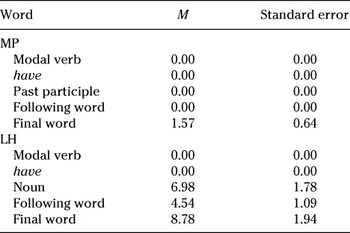
Both NSs and NNSs made errors in the grammaticality-judgment task, most of which were associated with LH sentences. NSs made no errors at sentence-internal positions (i.e., on the modal verb, have, or the past participle) in MP sentences but made a small number of errors at the final-word position (1.6%). In LH sentences, NSs did not make errors at the modal verb or have either, but almost 7% of responses at the noun were incorrect; that is, participants judged the sentences to be ungrammatical at this point. Errors also persisted at the next word. Table 1 shows mean error rates (as a percentage of all responses) for NSs as a function of sentence type and word.
Mean percentage of errors on MP and LH sentences by word for the NSs (N = 37)

An analysis of final-word errors provides additional information about participants’ ability to judge the grammaticality of sentences. Some participants may, for example, have progressed through the entire sentence rather quickly, waiting until the final word was presented to make a considered judgment about grammaticality (even though they were instructed to process sentences as they went). It is also possible that some participants may have been slower than others to detect the grammaticality or ungrammaticality of sentences. Errors for these participants may therefore be more frequent at the final-word position than at other sentence positions. NSs made just over five times as many final-word errors on LH sentences as they did on MP sentences, a difference that was statistically significant, F 1(1, 35) = 13.02, p < .001; F 2(1, 46) = 9.82, p < .003.
As might be expected, there was considerable variation in errors and error location among the test sentences; for instance, the sentence that contained drink, which might have been anomalous, accounted for a total of 16 errors by the NSs—the highest number of errors for any sentence in the test set. Therefore, the data for this sentence were also excluded and the LH data were reanalyzed. Mean error rates were lower at the three critical sentence positions when drink was excluded, but, importantly, the same trend remained. Additionally, it is worth noting that NSs’ responses to ungrammatical distractors were as accurate overall as their responses to grammatical test items at sentence-final words (with mean error rates of 4.52% vs. 4.39%, respectively). This finding indicates that participants were not simply responding yes to all sentences without taking due care to process them.
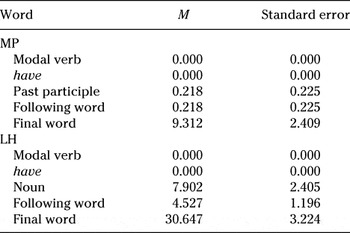
Table 2 shows the mean percentage of errors made by NNSs on MP versus LH sentences at each of the four critical within-sentence words and the final word. It is clear that NNSs made many more errors on the LH sentences than on the MP sentences, in line with the findings for the NSs. NNSs made just over three times as many final-word errors on LH sentences as on MP sentences, a difference that was highly significant, F 1(1, 35) = 40.75, p < .001; F 2(1, 46) = 26.36, p < .001. Excluding final-word errors, mean percent errors for NNSs were 0.11% and 3.11% on MP and LH sentences, respectively, a difference that was also highly significant, F 1(1, 35) = 14.10, p < .001. Similar to the NSs, this difference suggests that LH sentences also caused processing difficulty for NNSs. Also consistent with the NS data, NNSs made no errors at the modal verb or have in either MP or LH sentences. Additionally, NNSs made very few errors on MP sentences at the past participle and at the following word; in fact, the observed mean error rate of 0.22% at these positions was the result of a single error by a single participant on a single sentence. Therefore, all subsequent analysis of sentence-internal errors was performed on LH sentences only. This method of analysis was consistent with the NS data analysis and made comparison between NSs and NNSs error data more straightforward.
Mean percentage of errors on MP and LH sentences by word for the NNSs (N = 37)

There was considerable variation in errors and error location among the test sentences for NNSs, much like the NSs. The sentence that contained drink was one such sentence. Therefore, the data for this sentence were excluded and the LH data were reanalyzed. Mean error rates were lower at the three critical sentence positions when drink was excluded, but, importantly, the same trend remained. Additionally, it is important to note that NNSs’ accurate performance on (especially MP) test items was not achieved at the expense of poor performance on ungrammatical distractors. Thus, responses to ungrammatical distractors were accurate 84.45% of the time, compared to 90.69% for MP sentences.
Word-Category Frequency Effects
It is possible that participants might have based their online syntactic decisions partly on information about the category frequencies of individual words; that is, processing times for sentences that contained words in their preferred (or more frequent) syntactic roles might be faster than for sentences that contained words in less preferred roles. If this logic is applied to the present experiment, evidence of an association between RTs (or error rates, or both), on the one hand, and the relative frequency of occurrence of the verbs and nouns used, on the other hand, might be expected to emerge. In contrast, if participants’ RTs and error rates were not associated with noun or past participle frequency measures, this finding would provide evidence for the primacy of syntax in initial sentence processing and a syntactically motivated preference for MP sentences.
To investigate whether word-category frequency might have influenced participants’ online parsing decisions, data on the frequency of the target past participles and nouns used in the test sentences were extracted from the Brown corpus of American English (Francis & Kučera, Reference Francis and Kučera1982; see Appendix B). These frequency data were then examined in relation to the RT and error data for both the NSs and the NNSs. It was predicted that if a word were highly likely to occur in its nominal form (as opposed to its past participle verb form), then LH sentences might be easier to understand than MP sentences. In contrast, if a word were highly likely to occur in its past participle verb form (as opposed to its nominal form), then MP sentences should be easier to understand than LH sentences. Therefore, the crucial variable here that might determine how easy it is to understand a MP or a LH sentence is the relative frequency of the nominal or past participle verb form of a given word. Thus, a ratio (of nominal to past participle verb form use) was computed and correlational analyses were conducted using the ratio as one measure and both the item-error and the RT data as the other measure(s). Relative frequency ratios are shown in Appendix B.
For the item-error data, total errors (which included errors at the noun, the word immediately following the noun, and final word) and sentence-internal errors only (which included errors at the noun and the word immediately following the noun) were considered. Due to the small number of errors made on MP sentences, only data from LH sentences were used in the error analyses. Spearman (rs) rank order correlations (two tailed) were applied to the RT data for each group of participants separately. The error data contained a large number of tied results, however, which can produce a higher-than-expected Spearman correlation coefficient. Therefore, the error data for each participant group were analyzed using Kendall’s tau-b (τb) rank order correlation (two tailed), which allows for tied results. Analyses were performed on RT and error data excluding those for drink versus drunk.
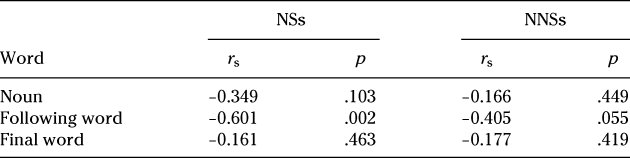
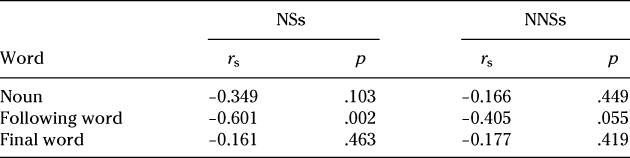
For the NSs and the NNSs, as the frequency of the nominal reading of the critical word increased relative to the past participle reading, participants experienced less difficulty (exhibited in faster RTs) when they reached the word immediately following the noun in LH sentences. In contrast, in LH sentences that contained a noun whose frequency was low compared to its past participle verb form, participants read the word immediately following the noun more slowly than in sentences that contained a noun whose frequency was high compared to its past participle verb form. This trend was evidenced in a significant negative correlation between RTs and the ratio of noun to past participle (relative frequency) at the word immediately following the noun (r s = –0.601, N = 23, p < .002) for NSs and a marginally significant negative correlation between the same variables for NNSs (r s = –0.405, N = 23, p = .055). No significant correlations were observed at the other sentence words for either group. Table 3 provides a summary of correlation data at the noun, the word immediately following the noun, and the final word.
Spearman correlations (r s) of RTs with the relative frequency of nouns to past participles by group
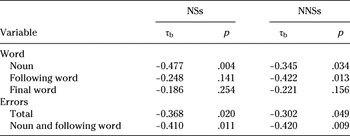
The pattern of correlations that involves error rates was similar for both the NSs and the NNSs (see Table 4). As the frequency of the critical word’s nominal form decreased in relation to its verb reading, both groups of participants appeared to experience more difficulty in assessing the grammaticality of the LH sentences. Hence, when participants read LH sentences that contained a noun with a low frequency relative to its past participle counterpart, they were more likely to incorrectly judge the sentence as ungrammatical at that point. This difficulty occurred for both groups when they reached the noun in LH sentences and lingered until the word immediately following the noun for NNSs. This trend was evidenced in a significant negative correlation between errors on the LH sentences and the ratio of the relative frequency of nouns to past participles at the noun for NSs (τb = –0.477, N = 23, p < .004) and for NNSs (τb = –0.345, N = 23, p < .034). For both participant groups, there was also a significant negative correlation between the category frequency ratio and total internal errors—combined errors at the noun and the word immediately following the noun (for NSs, τb = –0.410, N = 23, p < .011; for NNSs, τb = –0.420, N = 23, p < .009)—and a correlation between the category frequency ratio and total errors (for NSs, τb = –0.368, N = 23, p < .020; for NNSs, τb = –0.302, N = 23, p < .049).
Kendall tau-b correlations (τ b) of errors with the relative frequency of nouns to past participles by group

DISCUSSION
In this experiment, NSs and NNSs performed similarly in many respects. To evaluate the evidence in relation to the original hypothesis that NSs would show a stronger preference for MP over LH sentences than NNSs, the RT data and the error data for both NSs and NNSs are considered in turn. The findings are then discussed in light of existing knowledge about sentence processing in NSs and NNSs.
The RT data provide strong evidence that MP sentences were easier to process than LH sentences for both NSs and NNSs, thus confirming the hypothesis about NSs’ preference for MP sentences but disconfirming the hypothesis about NNSs’ nonpreference for MP sentences. As predicted, NSs experienced reading difficulty with LH sentences, reading the noun and the word immediately following the noun more slowly than the corresponding words in MP sentences (i.e., the past participle and the word immediately following it). This pattern of results suggests that MP sentences were preferred over LH sentences by NSs. However, these results are not consistent with the hypothesis that NNSs would have a markedly reduced preference or even no preference for MP sentences. In fact, NNSs also showed a clear preference for MP sentences in their RT data, although this effect was delayed compared to the NSs, only appearing on the words following the noun and the past participle. Therefore, according to the RT data, overall, both NSs and NNSs showed a preference for MP sentences.
The correlations between relative word-category frequency and RTs provide additional evidence for NSs’ and NNSs’ preference for MP sentences. Although NSs experienced some processing difficulty and slowed down at the noun in LH sentences, they were uninfluenced by word-category frequency information at this point. This assertion is supported by the lack of a significant correlation between word-category frequency and RTs at the noun. If NSs were using word-category frequency information, processing should have been easier and, as a result, RTs should have reduced as the noun form of the word became more frequent. Yet this was not the case. In fact, even when NSs encountered a high-frequency noun such as work as in the LH sentence He could have work at the shoe factory, they still experienced difficulty processing the word and were thus statistically more likely to slow down at the noun form work than at the verb form worked in the matched MP sentence (717 ms for work vs. 604 ms for worked). This pattern emerged despite the fact that work occurs more than 10 times as frequently as worked according to the Brown corpus (Francis & Kučera, Reference Francis and Kučera1982). We therefore conclude that the NSs must have been mainly guided by syntactic information when they interpreted the test sentences. Although the NNSs did not slow down significantly at the nouns in LH sentences, they were just as uninfluenced by word-category frequency information at this position as the NSs, which points to a further similarity between the two groups in terms of the dominance of syntactic information in sentence processing.
An even stronger similarity between NSs and NNSs emerged at the word immediately following the noun in LH sentences. At this point, relative word-category frequency appears to have influenced processing ease for both participant groups. Thus, as the nouns in LH sentences became relatively more frequent, both NSs and NNSs processed those sentences more quickly at the word immediately following the noun, whereas as the nouns became less frequent, both groups took longer to read the sentences at the word immediately following the noun. The only difference was the strength of the correlations between frequency and RTs, with a clear and significant influence of frequency for the NSs but only a marginally significant influence for the NNSs. This small difference in the strength of the correlation between NSs and NNSs could be explained in two ways. First, random variability due to individual differences among the NNS participants might have led to a weaker correlation than otherwise would have been expected. It is inherently difficult to define NNS status given the variations in personal backgrounds of speakers, and language processing researchers have acknowledged the impact that this variability can have on the interpretability of the findings of L2 processing research (e.g., Osterhout, McLaughlin, Pitkänen, Frenck-Mestre, & Molinaro, Reference Osterhout, McLaughlin, Pitkänen, Frenck-Mestre, Molinaro, Gullberg and Indefrey2006). Therefore, it seems reasonable to describe the NNS group as somewhat less homogeneous than the NS group in terms of language background and language proficiency. To address this problem, further research that uses larger or more linguistically homogenous groups of NNSs may clarify the nature of NNS sentence processing. The second possible explanation for the weaker correlation between word-category frequency and RTs for the NNS group, compared to the NSs, is also a methodological issue. It is possible that the frequency values, based on the data from Francis and Kučera (Reference Francis and Kučera1982), do not accurately represent current usage, specifically for NNSs. This methodological concern for language processing research in L2 contexts has also been raised by Beck (Reference Beck1997).
Similarities between the NSs and the NNSs were also clearly evident in the analyses of error data, according to which MP sentences were easier to process than LH sentences for both groups of participants. Both groups made errors only on LH sentences: They seem to have expected to see a past participle verb form, and upon seeing a noun instead, they temporarily thought that the sentence was ungrammatical. Thus, both groups must have had a strong processing preference for MP sentences. Furthermore, actual error rates at sentence-internal positions were similar in the two groups. Further evidence for NSs’ and NNSs’ clear preference for MP sentences can be found in the final-word error data. Both groups made a significant number of errors not only at sentence-internal positions but also at the final word in LH compared to MP sentences. Thus, both groups had such a high preference for the MP that they failed to recover from a misanalysis of a significant number of LH sentences even by the time they reached the final word.
The correlational analyses of error data and frequency indicate that although the NSs and the NNSs both had a preference for MP sentences, their grammaticality judgments were also guided to some extent by word-category frequency. The significant negative correlations between word-category frequency and errors indicate that as noun forms became more frequent, both groups made fewer errors on the LH sentences. The similarity between the two groups becomes particularly apparent when total internal errors (the combination of errors at the noun and the word immediately following the noun) are considered; the Kendall tau-b correlation coefficients were strikingly similar. However, although both groups were influenced by category-frequency information, it is important to note that both groups made a significant number of errors on the LH sentences at the noun and at the word immediately following the noun, which indicates that syntactic information continued to be of primary importance in processing.
Rather compelling additional evidence for a MP preference and for the dominant influence of syntactic information for both speaker groups comes from a close inspection of the noun and past participle category-frequency information. In general, the vast majority of nouns in the test sentences were much more frequent than their matched verbs; in fact, only 3 of the 24 noun–past participle pairs contained verbs more frequent than their matching nouns (i.e., paint, dye, and hail). Additionally, in 12 of the 24 pairs, the noun form was more than 20 times as frequent as the verb form. Given such large differences in category frequency within each pair, if word-category frequency were going to affect RTs and error rates, it would have been expected not only to favor the processing of LH sentences but also to be highly significant and obvious; that is, RTs and errors on LH sentences should have been significantly shorter than on MP sentences. However, LH sentences were not favored over MP sentences in either position—at the noun or at the word immediately following the noun—by either participant group. On the contrary, both NSs and NNSs had a clear preference for MP sentences, although this preference was moderated by category-frequency information.
Taken together, the results of the RTs and error analyses suggest that when NSs and NNSs process MP sentences, they are principally guided by syntactic information, which reflects the importance of attachment preferences based on the parsing principle of late closure, or on the grammaticalization of have, or on both. The data also show that integration of word-category frequency information takes place at some point as sentences are processed. This tentative conclusion about the integration of category-frequency information is broadly consistent with the findings of Crocker and Brants (Reference Crocker and Brants2000), Trueswell (Reference Trueswell1996), and Trueswell et al. (Reference Trueswell, Tanenhaus and Kello1993) in relation to L1 sentence processing. Trueswell found that L1 users are influenced by the relative frequency of the inflectional forms of a verb when resolving syntactic ambiguities. Trueswell examined ambiguous reduced relative versus main clause sentences in which the ambiguity resided at the verb (e.g., The experienced soldiers warnedabout the dangers conducted the midnight raid). Verbs with a higher past participle frequency biased the analysis of ambiguous sentences toward the reduced relative clause version. In contrast, for verbs whose simple past form had a higher frequency, main clause interpretations were favored. Here, the relative frequency of the form of a word (noun vs. past participle) was also found to influence the processing of MP and LH sentences, but in the case of the MP sentences, syntactic information appeared to mask the influence of frequency information. We tentatively propose that in sentences that contain locally dependent ambiguities (e.g., MP sentences), syntactic information takes precedence over frequency information for both L1 and advanced L2 users.
Working from a L1 perspective, Crocker and Brants (Reference Crocker and Brants2000) developed a probabilistic model of L1 sentence processing in which lexical category information plays a crucial role. According to their model, words are assigned to a lexical category (part of speech) in the initial stage of sentence interpretation, with the category to which a word is assigned being the most frequently occurring one. Only later during processing do phrase structure subcategorization preferences come into play. Although the present findings show that participants were influenced by lexical-category information, participants were also found to maintain a strong preference for MP sentences even in the face of an overwhelming frequency bias for the noun over the past participle verb form. This bias meant that both the NSs and the NNSs tended initially to select the least frequently occurring lexical category: the past participle verb form. Thus, it appears that, at least in this study, principles such as a preference for late closure and grammaticalization of have are of primary importance in processing and that word-category frequency information is of secondary importance. The present findings therefore are not entirely consistent with Crocker and Brants’s processing model; rather, the findings suggest that language users—both NSs and NNSs—are mainly guided by abstract syntactic processes in the initial stages of sentence processing, at least in certain sentence contexts.
Despite this observation, the findings are also consistent with Clahsen and Felser’s (Reference Clahsen and Felser2006a; Reference Clahsen and Felser2006b) shallow structure hypothesis. According to this hypothesis, L2 users engage in shallow sentence processing of long-distance syntactic dependencies, constructing less detailed representations of syntactic structure and basing their representations mainly on lexical-semantic information. Local syntactic dependencies, however, are processed by L2 users in a similar fashion to NSs. The NNSs processed MP and LH sentences, both of which involve local dependencies, in a similar fashion to the NSs, thus in line with the predictions of Clahsen and Felser’s shallow structure hypothesis. Therefore, we infer that NNSs must have formed relatively detailed syntactic representations of the MP (and LH) test sentences. Moreover, the findings are also consistent overall with the findings of Beck (Reference Beck1997) on the similarity of L2 and L1 morphological processing in nonsentential contexts: We found that L2 users can be just as sensitive to verb inflectional morphology at the sentence level as L1 users, albeit with a processing delay when RTs are considered.
Notwithstanding the similarities between the two groups, one possible difference also emerged in the RT data. Whereas the NSs slowed down at the noun in LH, thus showing an immediate preference for MP sentences, the NNSs did not slow down until they reached the next word in the sentence. This delay did not appear to result from a less immediate preference for MP sentences in NNSs than in NSs, however, because both groups made more errors at the noun in LH sentences than at the past participle in MP sentences. A possible explanation for this delayed RT effect in NNSs relates to the timing of reanalysis processes. Thus, if we assume that reanalysis is reflected in RTs, it may be that both L1 and L2 users engage in similar processes of reanalysis of initially misparsed sentences but that reanalysis takes place a little later for L2 users compared to L1 users (Hahne, Reference Hahne2001).
CONCLUSION
For the most part, this research has produced evidence for marked similarities between NSs and NNSs in their sentence-processing strategies. Overall, it was found that both NSs and NNSs were guided primarily by syntactic information. Both groups of speakers were also influenced by word-category frequency information at some point during processing.
It was also suggested that a comparison between NSs and NNSs might shed light on the apparent acquisition difficulty for MP faced by NNSs. It was actually observed that NNSs’ apparent difficulty in acquiring and using MP does not appear to be associated with any nonnativelike processing strategy; both NSs and NNSs showed a strong preference for MP over LH sentences in the grammaticality-judgment task. Additionally, syntactic complexity was not found to be a factor, in spite of what some researchers have suggested (e.g., Chou, Reference Chou2000). According to late closure, MP should be preferred over LH sentences, because it is syntactically simpler, and that is exactly what was found. We have obviously only investigated sentence comprehension, but a study of MP sentence production might well uncover factors that contribute to a difficulty in MP acquisition that have not been identified here. Further research might, for instance, usefully explore factors such as discourse context, L1 transfer, or semantics as possible factors in NNSs’ difficulty with the MP.
The question of MP processing notwithstanding, it is important to note more generally that, up until now, only a limited range of structures has been investigated from a L2 sentence-processing perspective. It has been demonstrated here how the investigation of sentence processing in a previously unexplored linguistic context (MP) can shed light on the nature of L2 sentence processing. We hope that investigation of other linguistic structures in future research could help to not only further clarify the nature of NNS sentence processing but also explore the specific language acquisition difficulties faced by L2 learners.
APPENDIX A
TEST SENTENCES
1. They could have painted the back of their house.
2. They could have paint at the back of their house.
3. She must have coloured her beautiful long hair.
4. She must have colour in her beautiful long hair.
5. They should have carpeted the large bedroom.
6. They should have carpet in the main bedroom.
7. They might have fished after their evening meal.
8. They might have fish for their evening meal.
9. The farmer should have milked the cows in the morning.
10. The farmer should have milk in the morning.
11. They could have wallpapered the living room.
12. They could have wallpaper in the living room.
13. The farmer should have fed all the animals.
14. The farmer should have feed for all the animals.
15. He could have worked at the shoe factory.
16. He could have work at the shoe factory.
17. He might have cashed the large cheque.
18. He might have cash in his wallet.
19. She might have buttered the warm toast.
20. She might have butter on the warm toast.
21. She should have ironed her son’s shirt.
22. She should have iron in her son’s diet.
23. He must have smoked in the car.
24. He must have smoke in his eyes.
25. They must have watered their vegetable garden.
26. They must have water for their vegetable garden.
27. They could have fired the girl for her rudeness.
28. They could have fire in the bush behind the school.
29. He must have bled all over his clothes.
30. He must have blood all over his clothes.
31. It could have snowed in the mountains today.
32. They could have snow in the mountains today.
33. It might have rained on the coast.
34. We might have rain on the coast.
35. It could have hailed in the morning.
36. We could have hail in the morning.
37. They might have changed their telephone number.
38. They might have change for the telephone.
39. They must have loved each other.
40. They must have love for each other.
41. She might have dusted the whole house.
42. She might have dust in the house.
43. He should have oil in the shed.
44. He should have oiled his old bike.
45. He might have drunk all the beer.
46. He might have drink in the fridge.
47. She must have dyed the curtain material.
48. She must have dye on the curtain material.
APPENDIX B
RAW (OCCURRENCES PER MILLION WORDS) AND CALCULATED RELATIVE CATEGORY FREQUENCY OF PAST PARTICIPLES AND NOUNS USED IN THE EXPERIMENT

Note
It is important to note that noun frequencies are for mass nouns only and do not include other noun variants. Additionally, all raw frequency values were increased by one to avoid problems inherent in computing a ratio that involves a zero denominator.