





Introduction
Malnutrition (Synonym: ‘Undernutrition’ (Cederholm et al., Reference Cederholm, Barazzoni, Austin, Ballmer, Biolo, Bischoff, Compher, Correia, Higashiguchi, Holst, Jensen, Malone, Muscaritoli, Nyulasi, Pirlich, Rothenberg, Schindler, Schneider, de van der Schueren, Sieber, Valentini, Yu, van Gossum and Singer2017)) is prevalent among community-dwelling older adults (OAs), particularly those receiving home care services (Volkert et al., Reference Volkert, Beck, Cederholm, Cruz-Jentoft, Hooper, Kiesswetter, Maggio, Raynaud-Simon, Sieber, Sobotka, Asselt, Wirth and Bischoff2022). Globally, prevalence ranges from 1.3% to 47.8% among OAs (WHO, 2017), while 8.5% are reported to be at high risk of malnutrition in Europe (Leij-Halfwerk et al., Reference Leij-Halfwerk, Verwijs, van Houdt, Borkent, Guaitoli, Pelgrim, Heymans, Power, Visser, Corish and de van der Schueren2019). However, variation in assessment and screening tools contributes to differences in reported prevalence (Visser, Reference Visser2025). In Denmark, at least 30% of OAs using healthcare services are malnourished (Skogli et al., Reference Skogli, Vinter, Sjule and Stokke2024), and up to 60% are at risk (Sundhedsstyrelsen, 2022). With ongoing population ageing, the number of affected individuals is expected to increase, placing growing pressure on healthcare systems and society (WHO, 2022). In Denmark, disease-related malnutrition was estimated to cost DKK 14.5 billion in 2024 (Skogli et al., Reference Skogli, Vinter, Sjule and Stokke2024), approximately 10% of which was attributable to community-dwelling OAs (BDO-Danmark, 2025).
OAs are at increased risk due to chronic diseases, polypharmacy, age-related changes, as well as socioeconomic factors such as living alone and lower economic status (Dent et al., Reference Dent, Wright, Woo and Hoogendijk2023). Consequences of malnutrition include functional decline, increased healthcare utilization, reduced quality of life, premature institutionalization, and increased mortality (Visser, Reference Visser2025).
Early identification of malnutrition risk is important to enable timely assessment and intervention before malnutrition develops or progresses (de van der Schueren and Jager-Wittenaar, Reference de van der Schueren and Jager-Wittenaar2022). Although nutritional screening is recommended as a first step in malnutrition management (Volkert et al., Reference Volkert, Beck, Cederholm, Cruz-Jentoft, Hooper, Kiesswetter, Maggio, Raynaud-Simon, Sieber, Sobotka, Asselt, Wirth and Bischoff2022), a substantial gap remains between evidence-based recommendations and routine practice (Håkonsen et al., Reference Håkonsen, Pedersen, Bygholm, Thisted and Bjerrum2019, Dent et al., Reference Dent, Wright, Woo and Hoogendijk2023; Skogli et al., Reference Skogli, Vinter, Sjule and Stokke2024). Addressing this gap requires structured, context-sensitive approaches tailored to the target population, and care setting (Power et al., Reference Power, de van der Schueren, Leij-Halfwerk, Bauer, Clarke, Visser, Volkert, Bardon, Gibney and Corish2019), as well as stakeholder engagement to improve relevance, acceptability, and sustainability (Launholt et al., Reference Launholt, Larsen, Aadal and Kristensen2025).
An initial assessment informed by the ADAPT framework (Moore et al., Reference Moore, Campbell, Copeland, Craig, Movsisyan, Hoddinott, Littlecott, Ocathain, Pfadenhauer, Rehfuess, Segrott, Hawe, Kee, Couturiaux, Hallingberg and Evans2021) did not identify an existing intervention tailored to early detection of malnutrition risk among community-dwelling OAs in municipal homecare settings. Existing interventions have primarily focused on treatment effectiveness and nutritional outcomes (Poscia et al., Reference Poscia, Milovanovic, La Milia, Duplaga, Grysztar, Landi, Moscato, Magnavita, Collamati and Ricciardi2018; Moloney and Jarrett, Reference Moloney and Jarrett2021), with less attention to implementation, municipal homecare contexts, and stakeholder engagement (Ten Cate et al., Reference ten Cate, Mellema, Ettema, Schuurmans and Schoonhoven2021; Launholt et al., Reference Launholt, Larsen, Aadal and Kristensen2025).
This article aims to describe the development process of a complex intervention for early detection of malnutrition risk among community-dwelling OAs (≥65 years) in a Danish homecare setting.
Methods
Design
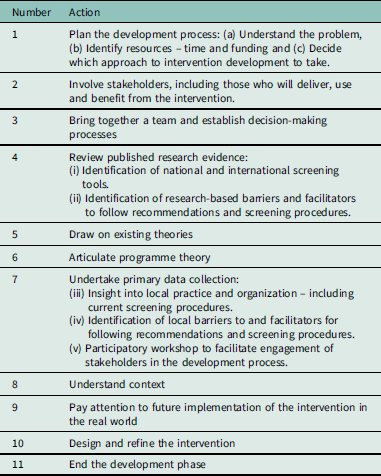
The development process was overall framed by the Medical Research Council (MRC) framework (Skivington et al., Reference Skivington, Matthews, Simpson, Craig, Baird, Blazeby, Boyd, Craig, French, Mcintosh, Petticrew, Rycroft-Malone, White and Moore2021) and guided by the INDEX framework (O’Cathain et al., Reference O’Cathain, Croot, Duncan, Rousseau, Sworn, Turner, Yardley and Hoddinott2019a). The INDEX framework provides eleven iterative actions for the development of complex interventions (Table 1). To improve readability of the present article, the eleven actions have structured the Results Section. Furthermore, the quality of reporting was enhanced by using the guidance for reporting intervention development studies in health research (Duncan et al., Reference Duncan, O’Cathain, Rousseau, Croot, Sworn, Turner, Yardley and Hoddinott2020). In addition, the reporting of the qualitative components of the study was reviewed against relevant items from the Consolidated Criteria for Reporting Qualitative Research checklist (Tong et al., Reference Tong, Sainsbury and Craig2007).
The eleven actions (O’Cathain et al., Reference O’Cathain, Croot, Duncan, Rousseau, Sworn, Turner, Yardley and Hoddinott2019a) applied in the development process of the malnutrition screening intervention. The five data collection steps (i–v) are mentioned under action 4 and 7

Table 1. Long description
A table with eleven rows and two columns. The first column is labeled ‘Number’ and the second column is labeled ‘Action’. Row 1: Number 1, Action Plan the development process: (a) Understand the problem, (b) Identify resources – time and funding and (c) Decide which approach to intervention development to take. Row 2: Number 2, Action Involve stakeholders, including those who will deliver, use and benefit from the intervention. Row 3: Number 3, Action Bring together a team and establish decision-making processes. Row 4: Number 4, Action Review published research evidence: (i) Identification of national and international screening tools. (ii) Identification of research-based barriers and facilitators to follow recommendations and screening procedures. Row 5: Number 5, Action Draw on existing theories. Row 6: Number 6, Action Articulate programme theory. Row 7: Number 7, Action Undertake primary data collection: (iii) Insight into local practice and organization – including current screening procedures. (iv) Identification of local barriers and facilitators for following recommendations and screening procedures. (v) Participatory workshop to facilitate engagement of stakeholders in the development process. Row 8: Number 8, Action Understand context. Row 9: Number 9, Action Pay attention to future implementation of the intervention in the real world. Row 10: Number 10, Action Design and refine the intervention. Row 11: Number 11, Action End the development phase.
Setting and target population
Community-dwelling OAs (≥65 years) receiving home care services in a Danish municipal homecare district constituted the primary target group of the intervention.
In Denmark, OAs may receive publicly funded homecare services, including personal care and practical support with activities such as meal preparation and eating to maintain independence at home. Services are primarily delivered by social and healthcare assistants and helpers.
Stakeholders participating in the development process
Primary data collection (Action 7) in the homecare setting informed a stakeholder analysis which identified stakeholder groups and assessed their interest and stake in the topic of the intervention.
Following the stakeholder analysis, representatives from the identified stakeholder groups were purposively invited to participate based on their role, experience, and relevance to nutritional care in the homecare setting.
Stakeholders were grouped as follows: 1) OAs and Informal Caregivers (family members, friends, or neighbours providing unpaid support), 2) Homecare Staff, 3) Dietitians, 4) Leaders, 5) Nurses, 6) Allocation Team, and 7) Ældresagen (an NGO representing OAs’ interests). In Danish homecare settings, the Allocation Team authorizes services for OAs.
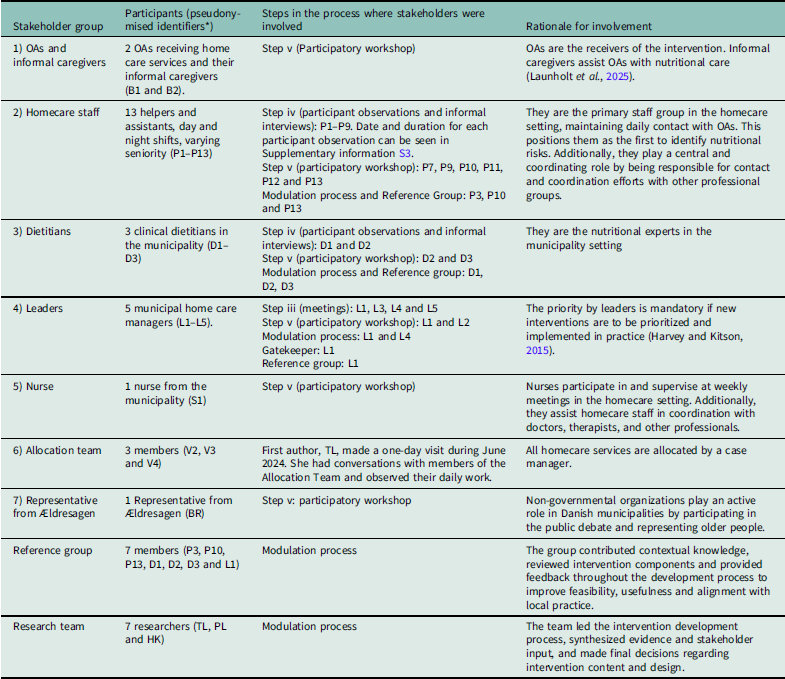
Table 2 details all participants, their roles, involvement, and rationale for involvement.
Stakeholders’ involvement in the development process

Table 2. Long description
The table has six columns: Stakeholder group, Participants (pseudonymised identifiers), Steps in the process where stakeholders were involved, Rationale for involvement, and a note indicating that asterisks denote pseudonymised identifiers. It contains seven rows for different stakeholder groups and their involvement details. Row 1: Stakeholder group, OAs and informal caregivers; Participants, 2 OAs receiving home care services and their informal caregivers (B1 and B2); Steps, Step 5 (Participatory workshop); Rationale, OAs are the receivers of the intervention. Informal caregivers assist OAs with nutritional care (Launholt et al., 2025). Row 2: Stakeholder group, Homecare staff; Participants, 13 helpers and assistants, day and night shifts, varying seniority (P1–P13); Steps, Step 4 (participant observations and informal interviews): P1–P9. Date and duration for each participant observation can be seen in Supplementary information S3. Step 5 (participatory workshop): P7, P9, P10, P11, P12 and P13 Modulation process and Reference Group: P3, P10 and P13; Rationale, They are the primary staff group in the homecare setting, maintaining daily contact with OAs. This positions them as the first to identify nutritional risks. Additionally, they play a central and coordinating role by being responsible for contact and coordination efforts with other professional groups. Row 3: Stakeholder group, Dietitians; Participants, 3 clinical dietitians in the municipality (D1–D3); Steps, Step 4 (participant observations and informal interviews): D1 and D2 Step 5 (participatory workshop): D2 and D3 Modulation process and Reference group: D1, D2, D3; Rationale, They are the nutritional experts in the municipality setting. Row 4: Stakeholder group, Leaders; Participants, 5 municipal home care managers (L1–L5); Steps, Step 3 (meetings): L1, L3, L4 and L5 Step 5 (participatory workshop): L1 and L2 Modulation process: L1 and L4 Gatekeeper: L1 Reference group: L1; Rationale, The priority by leaders is mandatory if new interventions are to be prioritized and implemented in practice (Harvey and Kitson, 2015). Row 5: Stakeholder group, Nurse; Participants, 1 nurse from the municipality (S1); Steps, Step 5 (participatory workshop); Rationale, Nurses participate in and supervise at weekly meetings in the homecare setting. Additionally, they assist homecare staff in coordination with doctors, therapists, and other professionals. Row 6: Stakeholder group, Allocation team; Participants, 3 members (V2, V3 and V4); Steps, First author, TL, made a one-day visit during June 2024. She had conversations with members of the Allocation Team and observed their daily work.; Rationale, All homecare services are allocated by a case manager. Row 7: Stakeholder group, Representative from Ældresagen; Participants, 1 Representative from Ældresagen (BR); Steps, Step 5: participatory workshop; Rationale, Non-governmental organizations play an active role in Danish municipalities by participating in the public debate and representing older people. Row 8: Stakeholder group, Reference group; Participants, 7 members (P3, P10, P13, D1, D2, D3 and L1); Steps, Modulation process; Rationale, The group contributed contextual knowledge, reviewed intervention components and provided feedback throughout the development process to improve feasibility, usefulness and alignment with local practice. Row 9: Stakeholder group, Research team; Participants, 7 researchers (TL, PL and HK); Steps, Modulation process; Rationale, The team led the intervention development process, synthesized evidence and stakeholder input, and made final decisions regarding intervention content and design.
* Participants were pseudonymised using alphanumeric codes (e.g. B1, B2) to protect confidentiality.
Beside these seven groups, two supporting groups were established to facilitate intervention development: a Research Team and a Reference Group (Table 2). The Reference Group contributed contextual knowledge, reviewed intervention components and provided feedback throughout the development process to improve feasibility and alignment with local practice, while the Research Team synthesized evidence and stakeholder input and made final decisions regarding intervention content and design.
Ethical considerations
The study was assessed by the Regional Committees on Health Research Ethics for Southern Denmark (case no. 20242000-137) and was found not to require notification to the committee system under §14(1) of the Danish Committee Act. The study was conducted in accordance with the Declaration of Helsinki. Participation was voluntary, and all participants listed in Table 2 provided written informed consent, while OAs visited in their homes as part of the participant observations provided verbal informed consent before the observations. No patient-record or electronic care-record data were accessed for the intervention development; therefore, permission under §46(2) and §47(1) of the Danish Health Act was not required.
Data collection and analysis
Figure 1 illustrates how five steps (i–v), each using different data collection methods and a Modulation Process, formed the scientific foundation for the INDEX actions and the intervention development (see Table 1).
Overview of the five steps (i–v) informing intervention development, including associated data collection methods and stakeholder involvement.

To ensure that the intervention was tailored to the specific context and informed by the perspectives of OAs, informal caregivers and staff, barriers, and facilitators to evidence-based nutritional care were explored through steps ii and iv (Sackett et al., Reference Sackett, Rosenberg, Gray, Haynes and Richardson1996; Skivington et al., Reference Skivington, Matthews, Simpson, Craig, Baird, Blazeby, Boyd, Craig, French, Mcintosh, Petticrew, Rycroft-Malone, White and Moore2021). Step ii contributed with research-based evidence, while iv gave evidence from the specific local setting.
Via the final Modulation Process the Research Team and Reference Group (see Action 3 for description) collaboratively refined the intervention. Further details of this process can be found in S5.
In addition, a one-day field visit to the municipal Allocation Team was conducted during the Modulation Process period to gain insight into allocation procedures and inform the final refinement of the intervention.
Data collection methods and analysis for the five steps are described below. All qualitative data were collected and analysed in Danish. Translation into English was performed only when quotations were selected for reporting in the manuscript to minimize loss of meaning during analysis. Combined results appear in the Results section as INDEX actions. Additional details and main results from each data collecting step and the modulation process are available in Supporting Information, S1-S5.
(i) Identification of national and international screening tools
Data collection:
Systematic searches in PubMed (MEDLINE), Embase, CINAHL Complete, Scopus, and Cochrane Library, supplemented by grey literature searches were conducted to identify useful screening tools and other relevant literature concerning screening tools.
Additional dialogues with other researchers in the field, e.g. at the European Society of Clinical Nutrition and Metabolism (ESPEN) conference 2024, yielded useful insight into new research in the field.
Analysis:
Tools and relevant literature were mapped and evaluated regarding relevance for the population and setting, including a focus on early signs of malnutrition risk. The map can be seen in S1. In Action 4, selected results are presented.
(ii) Identification of research-based barriers and facilitators to follow recommendations and screening procedures
Data collection:
A scoping review was conducted to identify research-based barriers and facilitators for implementing nutrition interventions in OAs. The review followed Joanna Briggs Institute methodology and PRISMA-ScR guidance (Munn et al., Reference Munn, Aromataris, Tufanaru, Stern, Porritt, Farrow, Lockwood, Stephenson, Moola, Lizarondo, McArthur, Peters, Pearson and Jordan2019). Further methodological details, including databases searched, search concepts and included studies, are available in the published article (Launholt et al., Reference Launholt, Larsen, Aadal and Kristensen2025) and S2.
Analysis:
To allow open exploration, the Inductive Qualitative Content Analysis approach was used to systematically guide and organize the results from the included articles (Graneheim and Lundman, Reference Graneheim and Lundman2004, Kyngäs et al., Reference Kyngäs, Mikkonen and Kääriäinen2020). Further details can be found in the published article (Launholt et al., Reference Launholt, Larsen, Aadal and Kristensen2025), and in S2. Findings were used in the participatory workshop, step v.
(iii) Insight into local practice and organization and (iv) identification of local barriers to and facilitators for following recommendations and screening procedures
Data collection:
Participant observations were conducted with nine homecare staff members and two dietitians (Table 2) over eight days (approximately 34 hours) between November 2023 and January 2024 to gain insight into local practice and identify barriers and facilitators for following nutritional recommendations and screening procedures (Spradley, Reference Spradley1980). Observations took place in OAs’ homes and other homecare work settings and were documented through field notes and supplemented by informal interviews, to provide a comprehensive understanding of daily routines and decision-making processes (Emerson et al., Reference Emerson, Fretz and Shaw2011).
Additionally, meetings were held with leaders and dietitians in the homecare setting to gain insight into the local organizational context.
Analysis:
Guided by the i-PARIHS framework (Harvey and Kitson, Reference Harvey and Kitson2015), data from participant observations, field notes, and informal interviews were analysed via deductive qualitative content analysis (Elo and Kyngäs, Reference Elo and Kyngäs2008), using NVivo 14 for data management (Lumivero, 2023). The framework informed a predefined coding structure focused on innovation, recipients, and context.
Analysis was led by the first author (TL) and discussed with the last author (HK) throughout the analytical process to strengthen consistency and credibility (O’Connor and Joffe, Reference O’Connor and Joffe2020).
Detailed description and main results are shown in S3.
Findings from step iv combined with those from step ii contributed to developing seven focus areas for the participatory workshop, step v.
TL took notes during the meetings with leaders and dietitians and made written summaries afterwards. No further analysis was conducted.
(v) Participatory workshop to facilitate engagement of stakeholders in the development process
Data collection:
A participatory workshop using the World Café method (Löhr et al., Reference Löhr, Weinhardt and Sieber2020; Recchia et al., Reference Recchia, Dodaro, De Marco and Zizza2022; Schiele et al., Reference Schiele, Krummaker, Hoffmann and Kowalski2022) was held on 27 February 2024 to discuss the seven focus areas identified through a synthesis of findings from the scoping review (step ii) and participant observations (step iv). The workshop was designed by the Research Team to further explore these focus areas and identify stakeholder-informed suggestions for intervention content and implementation strategies. 16 participants representing all stakeholder groups listed in Table 2 participated in the workshop. Participants rotated through three discussion rounds, contributing perspectives, identifying challenges, and suggesting improvements. All participants had a stake in nutritional practice within the homecare setting, thus ensuring relevant and informed dialogues (Schiele et al., Reference Schiele, Krummaker, Hoffmann and Kowalski2022). Rationale for stakeholder selection are detailed in Table 2.
Analysis:
Workshop discussions were audio-recorded, transcribed, and analysed using inductive qualitative content analysis (Graneheim and Lundman, Reference Graneheim and Lundman2004; Kyngäs et al., Reference Kyngäs, Mikkonen and Kääriäinen2020). Categories were developed iteratively from meaning units, codes, and abstractions to allow insights to emerge from the data. Analysis was led by the first author (TL) using NVivo 14 (Lumivero, 2023) and discussed with the co-authors throughout the analytical process.
Findings were used to build an intervention fitting context and stakeholders’ preferences. Selected results are presented in Action 8. Moreover, further details and results from the workshop can be found in S4.
Results
The intervention was developed from January 2023 to August 2024. The eleven actions for intervention development were considered during the process, and the results of this iterative development process are reported below (O’Cathain et al., Reference O’Cathain, Croot, Duncan, Rousseau, Sworn, Turner, Yardley and Hoddinott2019a).
ACTION 1: plan the process
(a) Understand the problem
Screening for malnutrition risk was not routinely conducted in the local homecare setting (identified via step iv). Together with the evidence-practice gap identified in the literature, this highlighted the need for a context-sensitive screening intervention and implementation strategy. An implementation strategy was therefore developed as part of the intervention development (Pearson et al., Reference Pearson, Naylor, Ashe, Fernandez, Yoong and Wolfenden2020), informed by contextual factors and other key uncertainties identified through steps ii–v (summarized in Action 8).
(b) Identify resources – time and funding
Resources and staff capacity for the development process and future feasibility testing were secured through collaboration between the research institution and the local homecare setting.
(c) Decide which approach to intervention development to take
Based on the identified problem and context, an evidence-, theory-, and implementation-informed approach was selected to guide intervention development (O’Cathain et al., Reference O’Cathain, Croot, Sworn, Duncan, Rousseau, Turner, Yardley and Hoddinott2019b).
ACTION 2: involve stakeholders
Seven stakeholder groups were involved in the development process (Table 2). Their contributions provided insights into barriers and facilitators for nutritional care, contextual conditions, and stakeholder preferences. These insights informed the development of both the screening procedure and the implementation strategy.
ACTION 3: bringing together a team and establishing decision-making processes
Through the Modulation Process, the Research Team, and Reference Group (Table 2) collaboratively refined the intervention through an iterative feedback process. Final decisions integrated research evidence (steps i and ii), practice-based insights (steps iv and v), and stakeholder preferences, in accordance with evidence-based practice principles (Sackett et al., Reference Sackett, Rosenberg, Gray, Haynes and Richardson1996; Rycroft-Malone et al., Reference Rycroft-Malone, Seers, Titchen, Harvey, Kitson and McCormack2004), Further details are provided in S3 and S5.
ACTION 4: reviewing published research evidence
Selected results from steps i and ii are presented below and specified in S1 and S2.
(i) Identification of national and international screening tools
Initial literature searches, supplemented by the reviews of Power et al. (Reference Power, Mullally, Gibney, Clarke, Visser, Volkert, Bardon, De Van Der Schueren and Corish2018; Reference Power, de van der Schueren, Leij-Halfwerk, Bauer, Clarke, Visser, Volkert, Bardon, Gibney and Corish2019), identified ten screening tools suitable for use among community-dwelling OAs (Power et al., Reference Power, Mullally, Gibney, Clarke, Visser, Volkert, Bardon, De Van Der Schueren and Corish2018; Reference Power, de van der Schueren, Leij-Halfwerk, Bauer, Clarke, Visser, Volkert, Bardon, Gibney and Corish2019). The tools were mapped using the Power et al. (Reference Power, de van der Schueren, Leij-Halfwerk, Bauer, Clarke, Visser, Volkert, Bardon, Gibney and Corish2019) scoring framework, which evaluates validation, parameters, and practicality. Validation refers to the evidence supporting a tool’s accuracy and reliability, parameters to the content included in the tool, and practicality to its feasibility in clinical practice. Parameters and scores for each tool are detailed in S1.
Furthermore, the tools were evaluated for applicability in Danish homecare settings based on insights into local practice and organizational conditions obtained through steps iii and iv. Attention was given to whether tool parameters supported early identification of malnutrition risk and whether their use was feasible within existing homecare workflows. In Danish homecare settings, OAs receive regular homecare visits and maintain ongoing contact with staff, making monthly weight measurements feasible and meaningful. Additionally, most OAs in this setting are expected to be at the early stages of the malnutrition risk continuum (de van der Schueren and Jager-Wittenaar, Reference de van der Schueren and Jager-Wittenaar2022). Therefore, screening should focus on early risk indicators rather than established manifestations of malnutrition. While established malnutrition is often reflected by consequences such as weight loss, early risk identification should consider contributing factors, including nutrition impact symptoms (NIS) such as reduced appetite, early satiety, and dry mouth (Lindqvist et al., Reference Lindqvist, Slinde, Majeed, Bottai and Wahlin2020; de van der Schueren and Jager-Wittenaar, Reference de van der Schueren and Jager-Wittenaar2022; Jespersen et al., Reference Jespersen, Beck, Munk, Jensen and Knudsen2023).
The evaluation showed that most tools lacked contextual fit with Danish homecare settings, with the Eating Validation Scheme (EVS) as the only exception (Beck et al., Reference Beck, Beermann, Kjær and Rasmussen2013; Socialstyrelsen, 2013). EVS is the only identified tool incorporating unintended weight loss >1 kg/month and therefore has the best fit with existing homecare workflows. Furthermore, EVS was developed and validated in Danish community settings. However, despite this contextual fit, EVS places limited emphasis on NIS and physical or social functioning and received a relatively low parameter score in the evaluation by Power et al. (Reference Power, de van der Schueren, Leij-Halfwerk, Bauer, Clarke, Visser, Volkert, Bardon, Gibney and Corish2019).
In addition, physical activity and physical functioning were identified as relevant indicators of increased malnutrition risk among OAs (Neumann et al., Reference Neumann, Miller, Daniels and Crotty2005; Brownie, Reference Brownie2006; Bardon et al., Reference Bardon, Corish, Lane, Bizzaro, Loayza Villarroel, Clarke, Power, Gibney and Dominguez Castro2021).
Based on these findings, it was decided to retain EVS as a validated second-step assessment while developing an add-on screening procedure (Activity D) focused on (a) unintended weight loss ≥ 1 kg/month, (b) nutrition-related risk factors, including NIS, and (c) physical activity/function, thereby strengthening early identification of malnutrition risk while maintaining the contextual fit of EVS.
In addition, research-based evidence supporting active involvement of OAs and their relatives in nutritional self-care procedure (Launholt et al., Reference Launholt, Larsen, Aadal and Kristensen2025) informed the inclusion of a structured start-up conversation (Activity C) as part of the screening procedure.
Figure 2 presents the resulting screening procedure developed from these findings. Further details are presented in Action 10 and S6–S7.
Flowchart describing the risk screening procedure (Activity C and D). Abbreviations: EVS = Eating Validation Scheme.

Figure 2. Long description
The flowchart outlines the risk screening procedure for malnutrition. It starts with Activity C, which involves a start-up conversation with older adults and their informal caregivers. This leads to Activity D, where screening is conducted once a month. Activity D includes three main components: a) Weight, b) Nutrition-related risk factors, and c) Physical activity. Each component has specific questions to determine if there is unintended weight loss, one or more risk factors, or a decline in usual physical activity or functional ability. Based on the answers, further actions are taken according to the Eating Validation Scheme (EVS) recommendations.
(ii) Identification of barriers to and facilitators for following recommendations and screening procedures
Ten categories with barriers and facilitators were identified. The scoping review is published open access (Launholt et al., Reference Launholt, Larsen, Aadal and Kristensen2025) and a figure from the article in which the categories are presented via the i-PARIHS framework is included in S2. The results informed focus areas used in the participatory workshop (step v), helping design of an intervention tailored the specific context and stakeholder preferences.
ACTION 5: drawing on existing theories
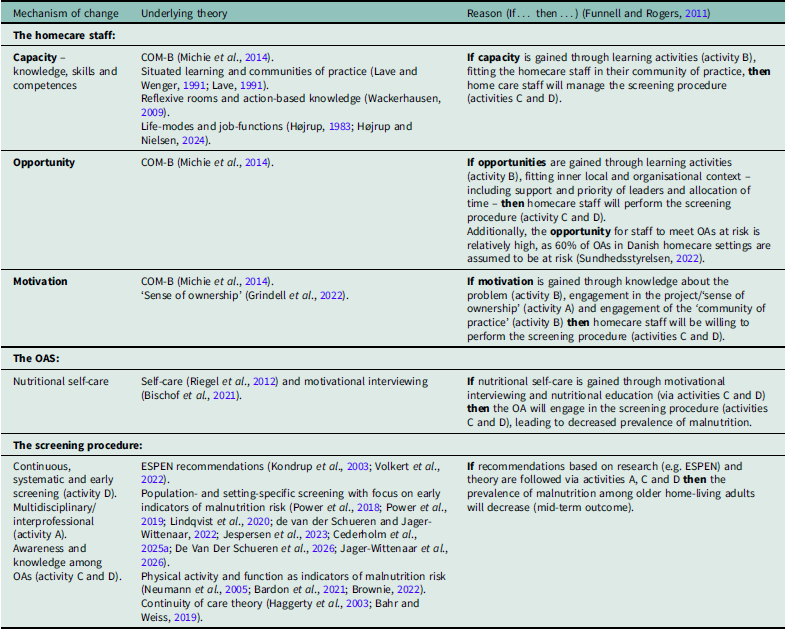
Different theories and research-based evidence supported the mechanisms and chosen activities in the programme theory (Skivington et al., Reference Skivington, Matthews, Simpson, Craig, Baird, Blazeby, Boyd, Craig, French, Mcintosh, Petticrew, Rycroft-Malone, White and Moore2021). As demonstrated in Table 3, the ‘if–then’ approach by Rogers and Funnell supported the coherence between activities, mechanisms, and outcomes (Funnell and Rogers, Reference Funnell and Rogers2011). The coherence between activities, mechanisms, and output are visualized via a logic model in Figure 3. As shown in Table 3, the COM-B model for behaviour of change (Michie et al., Reference Michie, Atkins and West2014) supported the mechanisms and activities selected for the group of homecare staff, and the theory of self-care (Riegel et al., Reference Riegel, Jaarsma and Strömberg2012) and motivational interviewing (Bischof et al., Reference Bischof, Bischof and Rumpf2021) supported the selection for OAs. Nutritional self-care refers to OAs’ ability to maintain nutritional health, monitor potential signs of malnutrition risk, and respond appropriately to emerging concerns. Additionally, continuity of care theory (Haggerty et al., Reference Haggerty, Reid, Freeman, Starfield, Adair and McKendry2003; Bahr and Weiss, Reference Bahr and Weiss2019) and selected research-based evidence supported content of the screening procedure.
Logic model.

Theoretical and research-based evidence underpinning links between intervention activities and mechanisms of change

Table 3. Long description
The table has three main sections: The homecare staff, The OAS, and The screening procedure. Each section is divided into columns for Mechanism of change, Underlying theory, and Reason (if... then...). The homecare staff section includes rows for Capacity, Opportunity, and Motivation, with corresponding theories and reasons. The OAS section focuses on Nutritional self-care, and the screening procedure section details various aspects of the screening process. Each row provides specific theories and reasons supporting the activities and mechanisms.
COM-B = Capability (C), Opportunity (O), Motivation (M) and Behaviour (B) framework, OA = Older Adult.
ACTION 6: articulating programme theory
An initial programme theory was developed to describe how the intervention was expected to achieve its intended outcomes. Figure 3 presents a visualization of the programme theory in the shape of a logic model. The programme theory integrated evidence, theory, stakeholder input, and contextual findings (Actions 2–5 and 7). It hypothesized that Activities A and B would strengthen homecare staff’s capability, opportunity, and motivation to deliver the screening procedure, while Activities C and D would support OAs’ nutritional self-care and engagement in the screening process. Collectively, these activities were expected to support continuous, systematic, and early identification of malnutrition risk.
ACTION 7: undertake primary data collection
Primary data were collected in steps iii–v, as shown in Table 1. The main results are synthesized under Action 8 (and detailed in S3 and S4) along with findings from the scoping review (step ii).
Consequently, to avoid repetition, only selected findings from the participant observations (step iv) of importance for the development process are highlighted below:
-
• Malnutrition risk screening is not systematic in current practice, and nutritional care is only a minor part of daily homecare practice.
-
• The diversity of OAs and their individual personalities and needs require flexibility in the delivery of home care services. As P1 noted: ‘As a homecare worker, you have to wear many hats… act as a friend, psychologist and caregiver.’
ACTION 8: understand context
Contextual understanding was achieved through stakeholder engagement, research-based evidence, and primary data collection. Findings from actual data collection steps (ii, iv, and v) are synthesized below to give a comprehensive overview of identified key uncertainties and contextual factors and how the intervention and the included implementation strategy will either incorporate, adapt to, or modify to cope with them in line with MRC framework (Skivington et al., Reference Skivington, Matthews, Simpson, Craig, Baird, Blazeby, Boyd, Craig, French, Mcintosh, Petticrew, Rycroft-Malone, White and Moore2021). For consistency, the results are presented via the i-PARIHS framework (Harvey and Kitson, Reference Harvey and Kitson2015).
Inner organizational context
Interprofessional collaboration: Collaboration between dietitians and homecare staff is limited, with unclear roles and insufficient understanding about each other’s competences and daily practices (identified via step ii, iv and v). Stakeholders requested face-to-face meetings and learning sessions to improve communication and clarify responsibilities (identified via step v).
To address this, the intervention will incorporate regular interprofessional meetings (Activity A) and learning sessions (Activity B), as part of the implementation strategy.
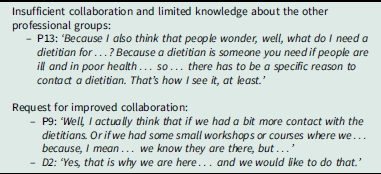
Citations in Table 4 reflect mentioned findings.
Citations reflecting request for improved interprofessional collaboration (from participatory workshop, step v)

Table 4. Long description
A textbox containing two sections. The first section titled ‘Insufficient collaboration and limited knowledge about the other professional groups’ includes a quote from P13: ‘Because I also think that people wonder, well, what do I need a dietitian for ...? Because a dietitian is someone you need if people are ill and in poor health ... so ... there has to be a specific reason to contact a dietitian. That’s how I see it, at least.’ The second section titled ‘Request for improved collaboration’ includes quotes from P9: ‘Well, I actually think that if we had a bit more contact with the dietitians. Or if we had some small workshops or courses where we ... because, I mean ... we know they are there, but ...’ and D2: ‘Yes, that is why we are here ... and we would like to do that.’
Digital infrastructure: NEXUS, the electronic patient record system, is central to inter- and intra-professional communication and documentation (Steps iii and iv).
The screening procedure (Activity D) will therefore be adapted to NEXUS to embed it in daily workflows. Preferably, NEXUS will be modified to enable electronic incorporation of the screening procedure into the system.
Inner local context
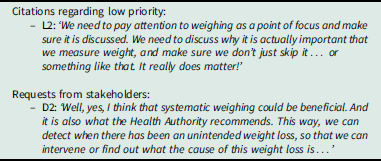
Systematic screening: Malnutrition risk screening is not routinely practiced, and nutritional care is deprioritised (identified via Step ii, iv, and v). Stakeholders emphasize the need for the routine weighing of OAs and clearer procedures following weight changes (identified via Step v).
Regular weight measurements as part of the screening procedure and a guide for further actions if screening is positive (Activity D) will therefore be incorporated into the intervention. Priority will be improved via support from leaders to develop and implement the intervention. Selected citations are shown in Table 5.
Citations reflecting low priority and request for systematic weighing as routine practice (from participatory workshop, step v)

Table 5. Long description
The textbox contains two sections. The first section is labeled ‘Citations regarding low priority’ and includes a citation marked as L 2. The citation reads, ‘We need to pay attention to weighing as a point of focus and make sure it is discussed. We need to discuss why it is actually important that we measure weight, and make sure we don’t just skip it ... or something like that. It really does matter!’ The second section is labeled ‘Requests from stakeholders’ and includes a citation marked as D 2. The citation reads, ‘Well, yes, I think that systematic weighing could be beneficial. And it is also what the Health Authority recommends. This way, we can detect when there has been an unintended weight loss, so that we can intervene or find out what the cause of this weight loss is ...’.
Time constraints: Current practice is shaped by strict schedules and time constraints (identified via Step ii and iv).
The intervention will adapt to this by including activities that are feasible within existing time allocations.
Selected citates in Table 6.
Citates reflecting time constraints (from the participatory workshop, step v)

Table 6. Long description
A textbox containing a quote: ‘But we are the ones who need to have the time. That just occurred to me today at lunchtime. I was out at someone’s house where I had to heat his food, and I had to make five slices of bread, well topped, in ten minutes. There’s a real rush, I can tell you ... ‘
Recipients – homecare staff
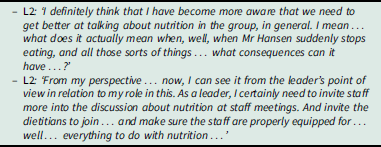
Limited awareness and competences: Homecare staff often lack knowledge about and an awareness of malnutrition and risk. Moreover, nutritional care is often managed by staff with limited nutritional education (identified via Step ii, iv and v). furthermore, stakeholders highlight the need for targeted education and training, particularly from dietitians (identified via Step iv and v).
The intervention will therefore incorporate tailored learning activities for homecare staff in their community of practice (Activity B) and enhance interprofessional collaboration (Activity A).
Selected citations from the participatory workshop (step v) are presented in Table 7 to demonstrate the need and request for improved awareness and competencies among homecare staff.
Citates demonstrating need and request for improved awareness and competencies among homecare staff (from participatory workshop, step v)

Table 7. Long description
The image contains a text box with two bullet points labeled L2. The first bullet point discusses the need for better communication about nutrition within the group, mentioning specific incidents and consequences. The second bullet point highlights the perspective of a leader, emphasizing the importance of inviting staff to discuss nutrition and ensuring they are well-equipped for related meetings. Highlighted sections and annotation symbols are used to emphasize key parts of the text.
Recipients – OAs
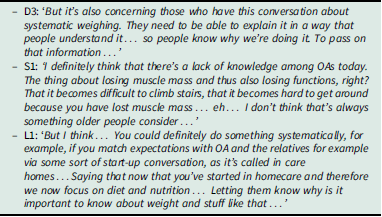
Limited awareness and misunderstandings: OAs show limited awareness of malnutrition and risk but express wishes for independence in nutritional self-care (identified via Scoping Review, step ii). Additional, emotional sensitivity and misunderstandings about body weight and dietary needs barriers for nutritional self-care (identified via Step ii and v). Stakeholders participating in the workshop (step v) request structured start-up conversations with OAs and informal caregivers to improve their awareness and engagement.
Consequently, start-up conversations (Activity C) will be incorporated to support awareness and improve nutritional self-care among OAs.
Selected citates are shown in Table 8.
Citates demonstrating limited awareness and misunderstandings among OAs (from participatory workshop, step v)

Table 8. Long description
The image contains text excerpts from a workshop. Three excerpts are highlighted with different labels: D 3, S 1, and L 1. D 3 discusses the need to explain systematic weighing to the public. S 1 mentions the lack of knowledge about muscle mass loss and its impact on older adults. L 1 suggests systematic education on diet, nutrition, and weight management for older adults.
ACTION 9: attend to future implementation
Analysis using the i-PARIHS framework highlighted several factors likely to influence future implementation, including contextual challenges, recipient needs, and organizational conditions (Action 8). These findings informed the implementation strategy and adaptation of intervention activities. Continuous engagement of stakeholders through the Reference Group further supported alignment with local practice and future implementation.
ACTION 10: design and refine
The developed intervention consists of two components: a screening procedure targeting OAs (≥65 years) and an implementation strategy targeting homecare staff and the local and organizational level of the homecare setting. An overview of all intervention activities, including evidence base, is presented in Table 9 and further detailed in S7.
Overview of activities in the developed intervention

Table 9. Long description
The table has four columns: Part, Activity, Content and short description. It is divided into two main sections: Implementation strategy and Screening procedure. The Implementation strategy section includes two activities (A and B) with detailed descriptions of interprofessional workgroups, learning activities, and mentorship. The Screening procedure section includes two activities (C and D) with detailed descriptions of start-up conversations, measurements, and follow-up screenings. Each activity is supported by various references.
The screening procedure consists of two activities: a start-up conversation (Activity C) followed by continuous screening once a month (Activity D).
Activity D comprises three screening elements:
-
(a) unintended weight loss ≥ 1 kg/month measured by staff or self-reported,
-
(b) identification of nutrition-related risk factors via a 13-item questionnaire,
-
and
-
(c) identification of a noticeable decline in usual physical activity or functional ability through dialogue between the OA and homecare staff.
The 13-item questionnaire in element (b) comprises the nutrition-related risk factors listed in S6 (b). The item on unintended weight loss corresponds to screening element (a), while the open-ended ‘Other concerns’ item supports dialogue and is not included in the 13-item questionnaire.
As demonstrated in Figure 2, the screening procedure is developed as an add-on to the validated EVS and aims to support the early detection of risk of malnutrition rather than the diagnosis of malnutrition.
A positive screening finding is defined as: (a) unintended weight loss of ≥1 kg within the past month; (b) identification of one or more of the 13 nutrition-related risk factors; or (c) a noticeable decline in physical activity or functional ability identified through dialogue between the OA and homecare staff. Element (c) is not score-based; the activity form is intended to support dialogue about changes relative to the OA’s usual level of activity and functioning, while also encouraging OAs to maintain or increase physical activity. A positive finding in any of the three screening elements will trigger completion of EVS as a second-step nutritional assessment and guide subsequent actions. Alongside completion of EVS, all identified concerns shall be explored and addressed directly or referred to an appropriate healthcare professional, as relevant, including concerns not fully captured by EVS. The combined screening procedure had not been validated at the time of development.
Full screening materials are provided in S6. Together, Activities C and D are intended to support OAs’ nutritional self-care and active engagement in the screening process, while enabling homecare staff to deliver continuous and systematic monitoring of malnutrition risk and appropriate follow-up.
The procedure is intended for use among new homecare recipients aged ≥65 years, excluding individuals receiving terminal care and those already identified as malnourished or at risk of malnutrition.
The implementation strategy consists of two activities: an interprofessional workgroup (Activity A, same members as the Reference Group, S5) and learning activities tailored to the homecare staff (Activity B). Activity B is structured for two levels of homecare staff: a mentor/Key Group level and a basic level. TL will initially mentor the Key Group, who will later train their peers using situated learning methods. To support sustainability in a high-turnover homecare environment, the learning activities (Activity B) include e-learning modules, team-based sessions, and peer feedback.
ACTION 11: end of the development phase
The development process ended in August 2024. Subsequently, the intervention underwent feasibility testing and process evaluation, the findings of which have been reported elsewhere (Launholt et al., Reference Launholt, Larsen, Hawkins and Kristensen2026).
Discussion
This study applied an evidence-, theory-, and implementation-informed approach incorporating stakeholder engagement to develop a malnutrition risk screening intervention for OAs receiving homecare services. The development process resulted in an intervention comprising of two components: a screening procedure targeting OAs (≥65 years) and an implementation strategy targeting homecare staff and the homecare setting. The programme theory posits that the intervention will strengthen staff capability, opportunity and motivation, and enhance nutritional self-care among OAs, collectively supporting the continuous and early identification of malnutrition risk.
This theory consists with previous evidence. The implementation strategy aligns with evidence supporting practice-based learning, mentorship, and communities of practice among frontline healthcare staff (Palesy, Reference Palesy2016; Noar et al., Reference Noar, Jeffery, Subbiah Ponniah and Jaffer2023; McGough and Thompson, Reference McGough and Thompson2024), while the screening procedure reflects findings highlighting nutritional self-care, autonomy, and tailored support among OAs (Tomstad et al., Reference Tomstad, Söderhamn, Espnes and Söderhamn2012; Ten Cate et al., Reference ten Cate, Mellema, Ettema, Schuurmans and Schoonhoven2021).
Given the complexity of real-world healthcare settings and the persistent gaps between research and practices, the development of complex interventions are increasingly advocated for Skivington et al. (Reference Skivington, Matthews, Simpson, Craig, Baird, Blazeby, Boyd, Craig, French, Mcintosh, Petticrew, Rycroft-Malone, White and Moore2021). Despite debates on whether interventions can adequately reflect real-world complexity (Fletcher et al., Reference Fletcher, Jamal, Moore, Evans, Murphy and Bonell2016; Knottnerus and Tugwell, Reference Knottnerus and Tugwell2017; Greenhalgh and Papoutsi, Reference Greenhalgh and Papoutsi2018; Mills et al., Reference Mills, Lawton and Sheard2019), the intervention developed in this study qualifies as complex according to the MRC framework due to its multifaceted nature and contextual interactions.
In the study, the MRC framework and additional frameworks and guiding principles were considered useful for structuring the intervention development and supporting systematic consideration of contextual factors, stakeholder perspectives, implementation challenges, and key uncertainties throughout the development process (Harvey and Kitson, Reference Harvey and Kitson2015; O’Cathain et al., Reference O’Cathain, Croot, Duncan, Rousseau, Sworn, Turner, Yardley and Hoddinott2019a; Skivington et al., Reference Skivington, Matthews, Simpson, Craig, Baird, Blazeby, Boyd, Craig, French, Mcintosh, Petticrew, Rycroft-Malone, White and Moore2021). However, the intervention’s feasibility, acceptability, implementation, and potential effects were beyond the scope of this development study and were subsequently evaluated in a separate feasibility study and process evaluation. The findings from that study have been reported elsewhere (Launholt et al., Reference Launholt, Larsen, Hawkins and Kristensen2026).
The INDEX framework supported the structuring of the Results section (O’Cathain et al., Reference O’Cathain, Croot, Duncan, Rousseau, Sworn, Turner, Yardley and Hoddinott2019a). However, examples of its application in published intervention development studies remain limited (Langergaard et al., Reference Langergaard, Evans, Andreasen, Petersen and Overgaard2024; Schmidt et al., Reference Schmidt, Kristensen, Melgaard, Pedersen, Mark, Appel, Langergaard and Overgaard2025). Transparent reporting may contribute to assessing methodological rigour and understanding how intervention components were developed, while also informing future use of intervention development frameworks.
Strengths and limitations
This study has several strengths. First, the intervention was developed using an evidence-, theory-, and implementation-informed approach, supporting the systematic development of an intervention that addressed identified gaps in the literature, drew on research-based recommendations and established theory, and considered implementation challenges and contextual factors throughout the development process. Second, to address contextual complexity and implementation challenges, the development process involved several stakeholder groups, who contributed with insights across multiple levels, including outer context, local context, organizational context, and individual staff and OA levels.
However, some limitations should be acknowledged.
First, transferability and generalizability beyond Danish municipal homecare settings may be limited. Although the screening procedure draws on broadly recognized risk factors for malnutrition among older adults, both the screening procedure and implementation strategy were developed in response to contextual factors and existing workflows within Danish homecare services.
Second, stakeholder engagement aimed to achieve a mid-level position on Bammer’s continuum (Bammer, Reference Bammer2021), ensuring that lived experiences and practical concerns informed intervention development and fostering a sense of ownership among participants (Grindell et al., Reference Grindell, Coates, Croot and OCathain2022). However, this level of engagement was only partially achieved, and stakeholder participation varied. Several homecare staff members appeared unfamiliar with active involvement in intervention development and collaborative decision-making processes. Furthermore, practical constraints, including limited time, resources, and competing service priorities, reduced opportunities for broader participation and shared decision-making. Consequently, stakeholder influence on intervention development was less extensive than originally intended.
Third, direct involvement of OAs was limited. OAs were represented through the participation of two women in the workshop (Step v). Although both actively contributed to discussions, it appeared challenging for them to fully engage with the purpose of the intervention development process and their role within it. This reduced the extent to which intervention development was informed by direct OA perspectives. Nevertheless, a representative from Ældresagen actively contributed views on OA needs and interests, providing an additional perspective on the target group during the development process.
Fourth, information on invitations, non-participation and reasons for declining participation was not systematically recorded across stakeholder groups. Participants were purposively selected based on their role, experience, and relevance to nutritional care, and participation was voluntary. While this approach supported the involvement of knowledgeable and relevant stakeholders, those who chose to participate may have had a greater interest in nutritional care and intervention development than non-participants. Consequently, perspectives from less engaged stakeholders may have been underrepresented during the development process.
Finally, the screening procedure was developed to support early identification of malnutrition risk rather than diagnosis of malnutrition. Consequently, some OAs with established malnutrition, but without unintended weight loss, nutrition-related risk factors, or noticeable changes in physical activity or function, may not be identified through the screening procedure.
Implications for practice and future research
Future research should build on findings from the completed feasibility study and process evaluation (Launholt et al., Reference Launholt, Larsen, Hawkins and Kristensen2026) to determine whether further refinement is needed before scaling up (Skivington et al., Reference Skivington, Matthews, Simpson, Craig, Baird, Blazeby, Boyd, Craig, French, Mcintosh, Petticrew, Rycroft-Malone, White and Moore2021). In addition, the screening performance of the screening procedure, including its sensitivity for identifying OAs at risk of malnutrition, should be evaluated.
Consistent with previous recommendations (Pearson et al., Reference Pearson, Naylor, Ashe, Fernandez, Yoong and Wolfenden2020), the usefulness of the implementation strategy was examined as part of the feasibility study. Furthermore, the feasibility study assessed the acceptability of the intervention among OAs and staff (Sekhon et al., Reference Sekhon, Cartwright and Francis2017; Sekhon et al., Reference Sekhon, Cartwright and Francis2022) and explored unintended consequences (Bonell et al., Reference Bonell, Jamal, Melendez-Torres and Cummins2015) such as increased workload for staff or unintended psychological impacts among OAs.
Future research should also explore approaches to support more meaningful involvement of OAs and informal caregivers in intervention development activities.
In clinical practice, implementation of the intervention will require time for screening, follow-up activities and staff training. However, if successfully integrated into routine care, the intervention has the potential to support nutritional self-care among OAs and facilitate early identification of malnutrition risk and timely nutritional support. Over time, improved nutritional self-care may reduce the need for staff involvement in some aspects of the screening process. These assumptions, however, require evaluation in future long-term effectiveness studies.
Although transferability beyond Danish municipal homecare settings remains uncertain, both the screening procedure and implementation strategy were designed to be adaptable. Consistent with the ADAPT framework (Moore et al., Reference Moore, Campbell, Copeland, Craig, Movsisyan, Hoddinott, Littlecott, Ocathain, Pfadenhauer, Rehfuess, Segrott, Hawe, Kee, Couturiaux, Hallingberg and Evans2021), future transfer to other settings should be preceded by systematic assessment of contextual similarities, differences, and adaptation needs.
Conclusion
The systematic development process represents a series of deliberate decisions and has culminated in a screening intervention for malnutrition risk. The intervention consists of a screening procedure for community-dwelling OAs and an implementation strategy for homecare staff and the homecare organization. The development process described in this article was completed in August 2024. Further refinement of the intervention may be guided by findings from the completed feasibility study and process evaluation (Launholt et al., Reference Launholt, Larsen, Hawkins and Kristensen2026).
Supplementary material
The supplementary material for this article can be found at https://doi.org/10.1017/S1463423626101996.
Acknowledgements
The authors thank their research institution for their financial support.
Author contributions
Tine Louise Launholt (TL): Conceptualization; Methodology; Data Curation; Investigation; Formal Analysis; Writing – Original Draft; Writing – Review & Editing. Palle Larsen (PL): Conceptualization; Methodology; Formal Analysis; Writing – Review & Editing. Hanne Kaae Kristensen (HK): Conceptualization; Methodology; Formal Analysis; Supervision; Writing – Review & Editing.
Funding statement
This research was internal funded by the authors research institution.
Competing interests
The authors declare no conflicts of interest.
Ethical standards
The Regional Committees on Health Research Ethics for Southern Denmark (case no. 20242000-137) determined that the study did not require notification to the committee system under §14(1) of the Danish Committee Act.
Informed consent statement
Informed consent was obtained from all participants involved in the study
Artificial intelligence (AI) statement
Generative artificial intelligence (Microsoft Copilot) was used during manuscript preparation for language editing, text refinement, and assistance with revising manuscript sections and responses to reviewers. All outputs were critically reviewed, edited, and verified by the authors. No AI tools were used for data collection, data analysis, interpretation of findings, or generation of study results. The authors take full responsibility for the content of the manuscript.
Collective statement
All authors contributed substantially to the conception and design of the study.
Tine Louise Launholt collected the primary data, and all authors participated in the analysis and interpretation of the data. All authors contributed to drafting and critically revising the manuscript, approved the final version, and agreed to be accountable for all aspects of the work.
All authors consent to the submission of this manuscript to Primary Health Care Research & Development.





 Open access

