Introduction
Depression is one of the most prevalent classes of mental illness and women are twice as likely to be affected as men (Lewinsohn et al. Reference MacNamara, Ferri and Hajcak1998; Kessler et al. Reference Kessler, Chiu, Demler and Walters2005). Childhood and adolescence are a critical period for the emergence of depression symptoms and syndromes, and epidemiological studies indicate that the lifetime prevalence of depression in adolescence is approximately 11–14% (Kessler & Walters, Reference Kessler and Walters1998; Merikangas et al. Reference Michalowski, Melzig, Weike, Stockburger, Schupp and Hamm2010). However, despite the elevated prevalence of depression the core mechanisms of dysfunction remain relatively unknown, particularly processes that confer risk for the disorder.
Several theoretical models suggest that depression is characterized by emotional dysfunction. For example, the emotion context insensitivity (ECI) model (Rottenberg et al. Reference Ruscio, Weathers, King and King2005) posits that depression is associated with decreased positive and negative emotional reactivity. To date, the majority of supporting evidence for the ECI model comes from adults who currently have depression (Bylsma et al. Reference Bylsma, Morris and Rottenberg2008). It is less clear whether emotional dysfunction may also connote risk for depression and whether this can be measured in children and adolescents prior to the dramatic increase in first-onset depression (Hankin et al. Reference Hankin, Abramson, Moffitt, Silva, McGee and Angell1998).
The late positive potential (LPP) is an electrocortical event-related potential (ERP) component that can be used to measure neural reactivity to emotional stimuli. The LPP is a sustained positive deflection of the ERP that begins as early as 200 ms after stimulus onset and is maximal around centroparietal electrodes (Cuthbert et al. Reference Cuthbert, Schupp, Bradley, Birbaumer and Lang2000; Hajcak et al. Reference Hajcak, Dunning, Foti, Weinberg and Gross2014). Research has demonstrated that the LPP is enhanced for both positive and negative relative to neutral stimuli (Weinberg et al. Reference Weinberg and Hajcak2013) and persists throughout (and beyond) stimulus presentation (Hajcak & Olvet, Reference Hajcak and Olvet2008). The LPP is thought to reflect the motivational salience of stimuli and is potentiated when they are made more salient – by making them targets (Weinberg et al. Reference Wright, Krueger, Hobbs, Markon, Eaton and Slade2012) or making their content more emotional (MacNamara et al. Reference MacNamara and Hajcak2009). The LPP has been identified in children as young as 5 years old (Hajcak & Dennis, Reference Hajcak and Dennis2009; Kujawa et al. Reference Kujawa, Klein and Hajcak2012b ), making it a useful tool for examining neurophysiological reactivity to emotional stimuli across development (Nelson & McCleery, Reference Pauli, Dengler, Wiedemann, Montoya, Flor, Birbaumer and Buchkremer2008).
Depression has been associated with a reduced LPP to negative relative to neutral stimuli (Kayser et al. Reference Kayser, Bruder, Tenke, Stewart and Quitkin2000; Foti et al. Reference Foti, Olvet, Klein and Hajcak2010). There is also initial evidence to suggest that a reduced LPP may index risk for depression. Specifically, Kujawa et al. (Reference Kujawa, Hajcak, Torpey, Kim and Klein2012a ) found that 6-year-old children with no lifetime depression but a maternal history of depression (a known indicator of depression risk; Goodman et al. Reference Goodman, Rouse, Connell, Broth, Hall and Heyward2011) exhibited a reduced LPP to positive and negative compared with neutral faces. The LPP has also been linked to several anxiety disorders. For example, generalized anxiety disorder (GAD) has been associated with a diminished LPP to negative stimuli (Weinberg & Hajcak, Reference Weinberg and Hajcak2011a ), while elevated trait anxiety (MacNamara & Hajcak, Reference Marshall and Tanner2010; MacNamara et al. Reference MacNamara, Foti and Hajcak2011), panic disorder (PD; Pauli et al. Reference Petersen, Crockett, Richards and Boxer1997), social phobia (Moser et al. Reference Muthén and Muthén2008) and specific phobia (Miltner et al. Reference Mitchell, Richell, Leonard and Blair2005; Michalowski et al. Reference Miltner, Trippe, Krieschel, Gutberlet, Hecht and Weiss2009) have all been associated with an increased LPP to negative stimuli. In summary, the growing literature on the LPP in emotional disorders has reported two general findings: reduced LPP in depression and GAD and increased LPP in PD and phobic disorders.
Factor analytic studies on the latent structure of psychopathology have organized these conditions into two empirical classes: distress disorders [major depressive disorder (MDD), dysthymia, GAD and post-traumatic stress disorder (PTSD)] and fear disorders (PD, agoraphobia, social phobia and specific phobia) (Krueger, Reference Krueger1999; Vollebergh et al. Reference Watson2001; Slade & Watson, Reference Sullivan, Neale and Kendler2006; Eaton et al. Reference Eaton, Krueger, Markon, Keyes, Skodol, Wall, Hasin and Grant2013; Keyes et al. Reference Keyes, Eaton, Krueger, Skodol, Wall, Grant, Siever and Hasin2013). Behavioral genetic research has suggested that distinct genetic factors underlie these dimensions (Kendler et al. Reference Kendler, Prescott, Myers and Neale2003). Furthermore, these dimensions appear to influence risk for psychopathology in offspring, presumably through transmission of genetic risk factors (Kendler et al. Reference Kendler, Walters, Neale, Kessler, Heath and Eaves1995; Sullivan et al. Reference Thom, Knight, Dishman, Sabatinelli, Johnson and Clementz2000). Although it has been hypothesized that these patterns of co-morbidity could reveal fundamental biological mechanisms shared across disorders (Watson, Reference Watson, O'Hara, Naragon-Gainey, Koffel, Chmielewski, Kotov, Stasik and Ruggero2005), little progress has been made in this regard. The growing LPP literature suggests that it may be a useful index of emotional processing deficits among distress and fear disorders. However, no study has yet to examine the LPP in relation to distress and fear dimensions.
The present study examined whether parental history of distress and fear disorders was associated with the LPP to emotional stimuli in a large sample of adolescent girls. Depression (Kayser et al. Reference Kayser, Bruder, Tenke, Stewart and Quitkin2000; Foti et al. Reference Foti, Olvet, Klein and Hajcak2010) and GAD (Weinberg & Hajcak, Reference Weinberg and Hajcak2011a ) have been associated with a diminished LPP to negative stimuli, and risk for depression has been associated with a decreased LPP to positive and negative stimuli (Kujawa et al. Reference Kujawa, Hajcak, Torpey, Kim and Klein2012a ). Therefore, we hypothesized that risk for distress disorders would also be associated with an attenuated LPP to positive and negative stimuli. In addition, since several fear disorders have been associated with an increased LPP to negative stimuli (Pauli et al. Reference Petersen, Crockett, Richards and Boxer1997; Miltner et al. Reference Mitchell, Richell, Leonard and Blair2005; Moser et al. Reference Muthén and Muthén2008; Michalowski et al. Reference Miltner, Trippe, Krieschel, Gutberlet, Hecht and Weiss2009), we hypothesized that fear risk would be associated with an enhanced LPP to unpleasant stimuli specifically.
The present study also examined the association between distress and fear risk and the LPP to emotional stimuli independent of the adolescents’ current depression and anxiety symptoms. Adult depression and anxiety have been related to an abnormal LPP (e.g. Michalowski et al. Reference Miltner, Trippe, Krieschel, Gutberlet, Hecht and Weiss2009; Foti et al. Reference Foti, Olvet, Klein and Hajcak2010). However, children with no lifetime depression but a maternal history of depression also exhibited a reduced LPP (Kujawa et al. Reference Kujawa, Hajcak, Torpey, Kim and Klein2012a ). Thus, abnormalities in the LPP may actually reflect a state-independent risk factor and not a temporary state-dependent disease marker. We hypothesized that distress and fear risk would be associated with the LPP even after controlling for the adolescents’ current depression and anxiety symptoms. Finally, adolescence is associated with important pubertal changes that can influence neurobiological systems of emotional information processing (e.g. Van Leijenhorst et al. Reference Vollebergh, Iedema, Bijl, de Graaf, Smit and Ormel2010; Ferri et al. Reference Ferri, Bress, Eaton and Proudfit2014; Schmitz et al. Reference Silk, Davis, McMakin, Dahl and Forbes2014); therefore, the present study also examined participants’ current pubertal status. We hypothesized that puberty would not confound the proposed findings for distress and fear risk and the LPP.
Method
Participants
The sample consisted of 550 adolescent girls between the ages of 13.5 and 15.5 years (mean = 14.39, s.d. = 0.63 years) and their parents who participated in a longitudinal study of adolescent development and mental health. For the present study, data were taken from the initial assessment. Participant racial/ethnic background was 80.5% non-Hispanic Caucasian and 57.8% of parents had a bachelor's degree or greater. Participants were recruited from the community using a commercial mailing list of homes with a daughter aged 13–15 years, word of mouth, local referral sources (e.g. school districts), online classifieds and postings in the community. Families were financially compensated for their participation. Inclusion criteria were fluency in English, able to read and understand questionnaires, and a biological parent willing to participate in the study. Exclusion criteria were a lifetime history of MDD or dysthymia or intellectual disabilities. Lifetime history of MDD or dysthymia was determined using the Kiddie Schedule for Affective Disorders and Schizophrenia for School-Age Children, Present and Lifetime Version (Kaufman et al. Reference Kaufman, Birmaher, Brent, Rao, Flynn, Moreci, Williamson and Ryan1997), which was administered by trained diagnostic interviewers closely supervised by clinical psychologists (R.K. and D.K.).
Parental history of psychopathology
Parental history of psychopathology was assessed using the Structured Clinical Interview for the DSM-IV (SCID; First et al. Reference First, Spitzer, Gibbon and Williams1996). The SCID was administered to the biological parent accompanying the participant to the laboratory session (93.0% mothers). SCID interviews were administered by extensively trained research staff closely supervised by clinical psychologists (R.K. and D.K.). The present study focused on lifetime history of distress disorders, including depressive disorders (MDD or dysthymia), GAD and PTSD, and fear disorders, including PD, social phobia and specific phobia. MDD and dysthymia were combined because we could not relax a hierarchical exclusion rule between them, which would have affected the factor structure. Inter-rater reliability estimates of 25 SCID recordings were found to be excellent [κ range: 0.69 (specific phobia) to 1.00 (PD)].
Adolescent symptoms
Adolescent depression and anxiety symptoms were assessed using the expanded Inventory of Depression and Anxiety Symptoms (IDAS-II; Watson et al. Reference Weinberg, Ferri, Hajcak, Robinson, Watkins and Harmon-Jones2012). The IDAS-II is a 99-item factor-analytically derived self-report inventory of empirically distinct dimensions of depression and anxiety symptoms. Symptoms are rated for the past 2 weeks on a Likert-type scale ranging from 1 (not at all) to 5 (extremely). The present study focused on the IDAS-II subscales dysphoria, lassitude, insomnia, suicidality, appetite loss, appetite gain, well-being, panic, social anxiety, claustrophobia, traumatic intrusions and traumatic avoidance.
Puberty
To assess current pubertal status participants completed the Pubertal Development Scale (PDS; Petersen et al. Reference Pine, Cohen, Gurley, Brook and Ma1988). The PDS is a self-report instrument that measures five indices of pubertal growth: growth in height, body hair, skin changes and breast development on a four-point Likert-type scale ranging from 1 (not yet started) to 4 (seems complete), and menarche (yes versus no). Participants also completed the Tanner scale (Marshall & Tanner, Reference Merikangas, He, Burstein, Swanson, Avenevoli, Cui, Benjet, Georgiades and Swendsen1969), which asked about pubic hair and breast development on a five-point Likert-type scale ranging from 1 (stage 1; prepubertal) to 5 (stage 5; adult type/mature). The Tanner scale ratings were summed and z-scored, the PDS was z-scored, and the resulting two z-scores were summed together to create a composite index of current pubertal status.
Procedure
The LPP was examined using a modified version of the emotional interrupt task (Mitchell et al. Reference Mogg and Bradley2006; Weinberg & Hajcak, Reference Weinberg, Hilgard, Bartholow and Hajcak2011b ), which required participants to respond to a target (left- or right-pointing arrow) that was presented in between the presentation of the same emotional picture. The emotional interrupt task provides advantages over a passive picture-viewing task, including confirmation that participants were paying attention by only examining trials in which their response to the target was correct. Each trial consisted of a fixation point (800 ms), followed by a neutral, pleasant or unpleasant picture (1000 ms), followed by either a left- (<) or right- (>) pointing arrow (i.e. the target; 150 ms), followed by the same picture that had preceded the target (400 ms). The intertrial interval (ITI) consisted of a blank screen and ranged from 1500 to 2000 ms. The task included 120 trials (40 neutral, 40 pleasant, 40 unpleasant) presented in a random order. Age-appropriate pictures were selected from the International Affective Picture System (IAPS; Lang et al. Reference Lang, Bradley and Cuthbert2008), with 20 neutral pictures displaying objects or scenes with people, 20 pleasant pictures displaying affiliative scenes or baby animals, and 20 unpleasant pictures displaying sad or threat scenesFootnote 1 Footnote †. Each picture was presented twice during the task. Participants were instructed to respond as quickly as possible to the target (left or right arrow) by clicking the corresponding left or right mouse button.
Electroencephalography (EEG) recoding and data processing
Continuous EEG was collected using an elastic cap and the ActiveTwo BioSemi system (BioSemi; the Netherlands). A total of 34 electrodes were used based on the international 10/20 system as well as two electrodes placed on the left and right mastoids. Electro-oculogram activity generated from eye movements and eye blinks was recorded using four facial electrodes: horizontal eye movements were measured via two electrodes located approximately 1 cm outside the outer canthus of the left and right eyes. Vertical eye movements and blinks were measured via two electrodes placed approximately 1 cm above and below the right eye. The EEG signal was pre-amplified at the electrode to improve the signal:noise ratio by the BioSemi ActiveTwo system. The data were digitized at a 24-bit resolution with a sampling rate of 512 Hz using a low-pass fifth-order sinc filter with a half-power cut-off of 102.4 Hz. Each active electrode was measured online with respect to a common mode sense active electrode producing a monopolar (non-differential) channel. Offline all data were re-referenced to the average of the left and right mastoids and band-pass filtered with low and high cut-offs of 0.1 and 30 Hz, respectively. Eye blink and ocular corrections were conducted using established standards (Gratton et al. Reference Gratton, Coles and Donchin1983).
A semiautomatic procedure was employed to detect and reject artifacts. The criteria applied were a voltage step of more than 50.0 μV between sample points, a voltage difference of 300.0 μV within a trial, and a maximum voltage difference of less than 0.50 μV within 100-ms intervals. These intervals were rejected from individual channels in each trial. Visual inspection of the data was then conducted to detect and reject remaining artifacts.
Only ERP data associated with correct responses were included in averages to ensure that participants were paying attention. Trials were excluded if reaction time to the target was less than 150 ms, greater than 1500 ms, or no response was provided (mean = 0.65 trials, s.d. = 2.04) or the response was incorrect (mean = 7.49 trials, s.d. = 8.94).
The EEG was segmented for each trial beginning 200 ms before the pre-target picture and continuing for 1200 ms (i.e. the entire duration of the pre-target picture presentation). The baseline was the 200 ms prior to picture onset. The LPP was scored as the average activity between 300 and 1000 ms after picture onset and was pooled at occipital (Oz, O1, O2) and parietal (Pz, P3, P4) sites. Separate averages were conducted for neutral, pleasant and unpleasant pictures, producing six different averages (occipital: neutral, pleasant, unpleasant; parietal: neutral, pleasant, unpleasant).
Data analysis
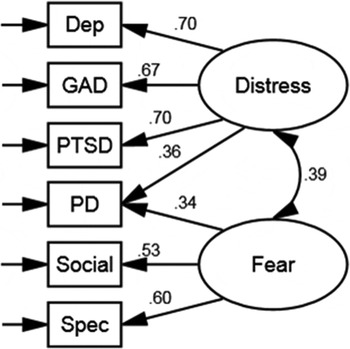
Latent distress and fear dimensions of parental psychopathology (see Fig. 1) were modeled using CFA (Brown, Reference Brown2006) in Mplus, version 6 (Muthén & Muthén, Reference Nelson and McCleery2011). The model was specified based on previous investigations of the latent factor structure of internalizing disorders (e.g. Krueger & Markon, Reference Krueger and Markon2006; Keyes et al. Reference Keyes, Eaton, Krueger, Skodol, Wall, Grant, Siever and Hasin2013) and an exploratory factor analysis in the present data (not reported). Consistent with prior structural studies (Watson et al. Reference Weinberg, Ferri, Hajcak, Robinson, Watkins and Harmon-Jones2012; Wright et al. Reference Wright, Krueger, Hobbs, Markon, Eaton and Slade2013; Kotov et al. Reference Kotov, Perlman, Gámez and Watson2014), PD was allowed to load on both dimensions. This model had superior fit compared with a model in which PD was allowed to only load on the fear factor [cross-load: comparative fit index (CFI) = 0.98, Tucker–Lewis index (TLI) = 0.96, root mean square error of approximation (RMSEA) = 0.02 versus no cross-load: CFI = 0.95, TLI = 0.91, RMSEA = 0.03; Mplus difftest: χ2(1, n = 529) = 3.63, p < 0.06]. Factor scores for distress and fear dimensions were extracted and used in subsequent analyses.
Confirmatory factor analysis results for parental psychopathology. Short arrows indicate disorder-specific residual variances. Long arrows connecting factors to disorders are standardized loadings. Dep, Major depressive disorder or dysthymia; GAD, generalized anxiety disorder; PTSD, post-traumatic stress disorder; PD, panic disorder; Social, social phobia; Spec, specific phobia.

In all, 21 participants were excluded from analyses due to not completing the EEG recording (i.e. equipment malfunction; n = 5), having excessive EEG artifacts (n = 13), making > 50% incorrect responses during the emotional interrupt task (n = 2), or having a parent that did not complete the SCID interview (n = 1), leaving a final sample of 529 participants. Age was also included as a covariate in all analyses to account for the shift in the LPP from occipital regions in children to centroparietal regions in adults (Gao et al. Reference Gao, Liu, Ding and Guo2010; Kujawa et al. Reference Kujawa, Klein and Hajcak2012b ). In an attempt to replicate Kujawa et al. (Reference Kujawa, Hajcak, Torpey, Kim and Klein2012a ), we first examined the effect of parental depression on the LPP and conducted a mixed-measure analysis of variance (ANOVA) with valence and location as within-subjects factors, depression risk (present versus absent) as a between-subjects factor and age as a mean-centered continuous covariate. Parental sex (mother versus father) was also included as a dichotomous covariate to account for potential differences in maternal versus paternal risk on the LPP. For distress and fear risk and the LPP, we conducted a mixed-measure analysis of covariance (ANCOVA) with valence and location as within-subjects factors, parental sex as a dichotomous covariate, and age, distress risk and fear risk as mean-centered continuous covariates. Finally, to examine the association between distress and fear risk and the LPP independent of current depression and anxiety symptoms and pubertal status, we conducted a mixed-measure ANCOVA with valence and location as within-subjects factors and age, IDAS-II symptomsFootnote 2 , parental sex, pubertal status, distress risk and fear risk as covariates. All ANCOVA analyses were conducted in IBM SPSS Statistics, version 22.0 (USA).
Ethical Standards
All procedures contributing to this work comply with the ethical standards of the relevant national and institutional committees on human experimentation and with the Helsinki Declaration of 1975, as revised in 2008.
Results
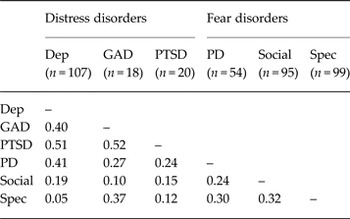
Table 1 displays the number of cases and tetrachoric correlations between parental lifetime depression and anxiety disorders. As expected, distress disorders (depression, GAD, PTSD) correlated more strongly with each other and fear disorders (PD, specific phobia, social phobia) with each other than across clusters. The only exception was PD, as it correlated equally with disorders from each cluster. In parents with at least one lifetime diagnosis, 60.9% had one diagnosis, 28.3% had two diagnoses, 7.4% had three diagnoses, and 3.5% had four or more diagnoses.
Tetrachoric correlations between parental lifetime diagnoses

Dep, Major depressive disorder or dysthymia; GAD, generalized anxiety disorder; PTSD, post-traumatic stress disorder; PD, panic disorder; Social, social phobia; Spec, specific phobia.
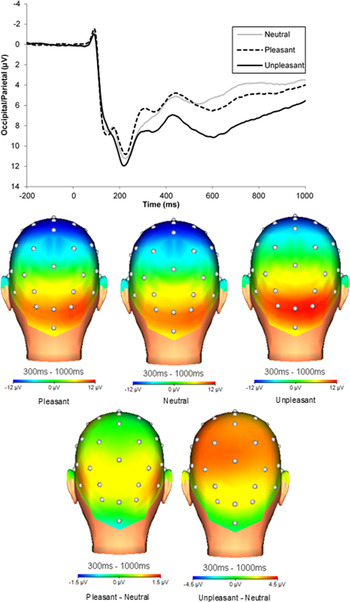
Fig. 2 presents the LPP waveform and scalp topographies for neutral, pleasant and unpleasant pictures. The LPP began at approximately 300 ms and was evident as a sustained relative positivity to pleasant and unpleasant compared with neutral pictures. As expected, the LPP was modulated by picture valence (F 2,1056 = 109.47, p < 0.001, ηp2 = 0.17), such that the LPP was larger for unpleasant (mean = 7.68 μV, s.d. = 6.42) compared with both neutral (mean = 5.01 μV, s.d. = 5.54, F 1,528 = 173.83, p < 0.001, ηp2 = 0.25) and pleasant pictures (mean = 5.43 μV, s.d. = 6.25, F 1,528 = 143.56, p < 0.001, ηp2 = 0.21), and larger for pleasant compared with neutral pictures (F 1,528 = 6.54, p < 0.05, ηp2 = 0.01).
Waveforms and head maps displaying the late positive potential for neutral, pleasant and unpleasant stimuli. Waveforms were pooled across occipital (Oz, O1, O2) and parietal (Pz, P3, P4) regions.

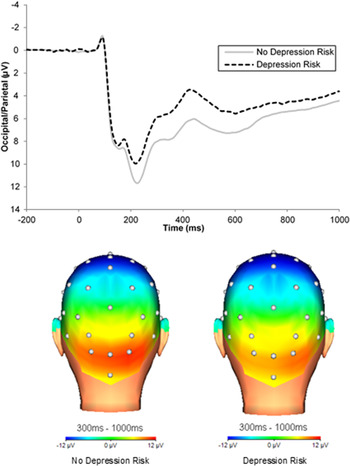
In the analysis of depression risk on the LPP, results indicated a main effect of depression risk (F 1,525 = 6.39, p < 0.05, ηp2 = 0.01), such that participants who had a parental history of depression (mean = 4.87, s.d. = 5.51) demonstrated an attenuated LPP to neutral, pleasant and unpleasant pictures relative to those with no parental history (mean = 6.33, s.d. = 5.45) (see Fig. 3). These results are largely consistent with Kujawa et al. (Reference Kujawa, Hajcak, Torpey, Kim and Klein2012a ), and suggest that a parental history of depression is associated with decreased neural reactivity to motivationally salient stimuli.
Waveforms and head maps displaying the late positive potential across all stimuli (neutral, pleasant and unpleasant) for participants with no risk (left head map) and parental risk for depression (right head map). Waveforms were pooled across occipital (Oz, O1, O2) and parietal (Pz, P3, P4) regions.

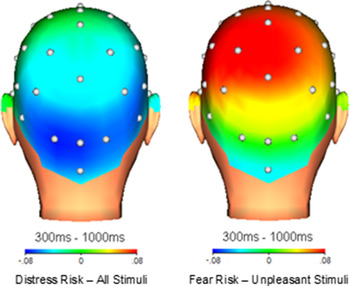
In the analysis of distress and fear risk on the LPP, results indicated a main effect of distress risk (F 1,524 = 7.01, p < 0.01, ηp2 = 0.01), such that greater distress risk was associated with an attenuated LPP to neutral, pleasant and unpleasant pictures. There was also a valence x fear risk interaction (F 2,1048 = 3.34, p < 0.05, ηp2 = 0.01). To follow-up the interaction, LPP data were collapsed across occipital and parietal regions and separate ANCOVAs were conducted for each level of valence (neutral, pleasant, unpleasant). Fear risk was associated with an enhanced LPP to unpleasant pictures (F 1,524 = 5.95, p < 0.05, ηp2 = 0.02), but there was no association between fear risk and the LPP to neutral or pleasant pictures (p's > 0.12) (see Fig. 4)Footnote 3 . Finally, after controlling for participants’ current depression and anxiety symptoms and pubertal status, there was still a main effect of distress risk (F 1,488 = 5.30, p < 0.05, ηp2 = 0.01) and a valence x fear risk interaction (F 2,976 = 3.06, p < 0.05, ηp2 = 0.01). There were no main effects or interactions for IDAS-II symptoms or puberty (p's > 0.10). These results suggest that current depression and anxiety symptoms and pubertal status did not confound the association between distress and fear risk and the LPP to emotional stimuliFootnote 4 .
Head maps displaying correlation coefficients (Pearson's r) between distress risk and the late positive potential (LPP) to all stimuli (left) and fear risk and the LPP to unpleasant stimuli (right).

Discussion
In the current sample of 550 adolescent girls, parental history (i.e. risk) of depression was associated with an attenuated LPP to neutral, pleasant and unpleasant stimuli. Broader parental distress and fear disorders were also associated with the LPP. Specifically, distress risk was associated with an attenuated LPP to all stimuli. In contrast, fear risk was associated with an enhanced LPP to unpleasant stimuli specifically. Importantly, these results were not explained by participants’ current depression and anxiety symptoms or pubertal status. Overall, this study is one of the first to demonstrate that familial risk for distress and fear disorders may have unique profiles in terms of neural measures of emotional information processing.
The distress risk findings are consistent with previous research on depression and the LPP. Depression has previously been associated with a reduced LPP to negative stimuli (Kayser et al. Reference Kayser, Bruder, Tenke, Stewart and Quitkin2000; Foti et al. Reference Foti, Olvet, Klein and Hajcak2010), and a maternal history of depression in 6-year-old children was associated with a reduced LPP to both positive and negative stimuli (Kujawa et al. Reference Kujawa, Hajcak, Torpey, Kim and Klein2012a ). We found similar results in that parental risk for distress disorders was associated with an attenuated LPP to positive and negative stimuli. One important difference is that we also found distress risk was associated with an attenuated LPP to neutral stimuli, indicating a more broad and pervasive blunting of the LPP. There were important methodological differences between studies that may have contributed to these discrepancies, such as Kujawa et al. (Reference Kujawa, Hajcak, Torpey, Kim and Klein2012a ) used emotional faces and the present study used emotional scenes. Interestingly, emotional scenes have been shown to elicit a larger LPP relative to faces (Thom et al. Reference Van Leijenhorst, Zanolie, Van Meel, Westernberg, Rombouts and Crone2014), potentially due to the scenes’ increased complexity and/or motivational salience, thus making them more sensitive to individual difference factors (e.g. familial risk). Furthermore, the present study included an older sample (ages 13.5–15.5 years) relative to Kujawa et al. (Reference Kujawa, Hajcak, Torpey, Kim and Klein2012a ) (age 6 years), and it is possible that adolescents found particular aspects of neutral pictures (e.g. presence of people) to be motivationally salient and this in turn affected the LPP (Ferri et al. Reference Ferri, Weinberg and Hajcak2012).
The current study suggests that adolescent risk for distress disorders may be characterized by broad-based emotional/motivational withdrawal from salient stimuli. This hypothesis is consistent with several etiological theories of distress disorders. For example, the ECI model posits that depression is characterized by diminished positive and negative emotional reactivity (Rottenberg et al. Reference Ruscio, Weathers, King and King2005), and emotional numbing has been considered by some to be a cardinal feature of PTSD (Feeny et al. Reference Feeny, Zoellner, Fitzgibbons and Foa2000; Ruscio et al. Reference Sanislow, Pine, Quinn, Kozak, Garvey, Heinssen, Wang and Cuthbert2002). Alternatively, distress disorders may be characterized by an avoidance of elaborative emotional processing (Weinberg & Hajcak, Reference Weinberg and Hajcak2011a ). This is consistent with the cognitive avoidance theory of GAD (Borkovec & Inz, Reference Borkovec and Inz1990; for a recent review, see Behar et al. Reference Behar, DiMarco, Hekler, Mohlman and Staples2009), which suggests that worry is an adaptive function to dampen emotional reactivity amongst those for whom it is particularly aversive. In the present study, participants at risk for distress disorders may have engaged in self-referential processing typical of these conditions (e.g. rumination, worry) that subsequently utilized and/or depleted attentional resources, making them less available to process environmental stimuli. These participants may have also attended to less arousing picture content, which has been shown to reduce the LPP (Dunning & Hajcak, Reference Dunning and Hajcak2009; Hajcak et al. Reference Hajcak, Dunning and Foti2009, Reference Hajcak, MacNamara, Foti, Ferri and Keil2013).
The present study is also consistent with research examining the LPP in fear disorders and provides novel evidence that an enhanced LPP to negative stimuli may index risk for these conditions. Individual fear disorders, including PD (Pauli et al. Reference Petersen, Crockett, Richards and Boxer1997), social phobia (Moser et al. Reference Muthén and Muthén2008) and specific phobia (Miltner et al. Reference Mitchell, Richell, Leonard and Blair2005; Michalowski et al. Reference Miltner, Trippe, Krieschel, Gutberlet, Hecht and Weiss2009) have previously been associated with an increased LPP to negative stimuli. Moreover, 5- to 7-year-old children characterized by behavioral inhibition, a temperamental style that has been linked to the later development of anxiety disorders (Kagan, Reference Kagan, Beauchaine and Hinshaw2008), have been shown to evidence an enhanced LPP to negative stimuli (Kessel et al. Reference Kessel, Huselid, DeCicco and Dennis2013). These findings are in accord with several theoretical models and empirical findings suggesting that anxiety disorders (particularly fear disorders) are associated with an increased attentional bias toward threat (Mogg & Bradley, Reference Moser, Huppert, Duval and Simons1998; Bar-Haim et al. Reference Bar-Haim, Lamy, Pergamin, Bakermans-Kranenburg and van IJzendoorn2007). It is important to note that the LPP to unpleasant stimuli was greater than to neutral and pleasant stimuli, and it is possible that the association between fear risk and the LPP to negative stimuli may have been due to increased arousal and not the negative content. Future studies should attempt to match emotional stimuli on arousal to limit this potential confound. Overall, results suggest that an enhanced LPP to negative stimuli may be a vulnerability marker for fear disorders that is distinct from risk for distress disorders (characterized by an attenuated LPP to positive and negative stimuli).
There were no associations between current depression and anxiety symptoms and the LPP to emotional stimuli. In the present study, participants had no history of depressive disorders (current or lifetime), and it is possible that the sample did not contain a sufficient range of psychopathology to elicit an association between current symptoms and the LPP. Furthermore, current symptoms were measured using a self-report inventory that covered the last 2 weeks. Extant research on psychopathology and the LPP has primarily focused on DSM diagnoses, which may be more robustly associated with the LPP. Finally, the majority of research examining psychopathology and the LPP has focused on adults. There are additional challenges associated with assessing symptomatology in adolescents (e.g. ability to identify and report internal feeling states and corollary symptoms), and this may influence the association between psychopathology and the LPP.
This study only provides a cross-sectional perspective of the association between the LPP and risk for distress and fear disorders. There may be developmental factors that play an important role and necessitate future investigation. It is possible that liability for distress disorders in adolescence might be associated with reduced emotional reactivity, but disorder onset could alter patterns of reactivity. For example, childhood anxiety disorders have been associated with a heightened sensitivity to negative stimuli (Ladouceur et al. Reference Ladouceur, Dahl, Birmaher, Axelson and Ryan2006; Carthy et al. Reference Carthy, Horesh, Apter and Gross2010), but also prospectively predict the onset of adolescent and adult depressive disorders (Pine et al. Reference Rottenberg, Gross and Gotlib1998; Bittner et al. Reference Bittner, Egger, Erkanli, Costello, Foley and Angold2007), which are characterized by decreased emotional reactivity. Some researchers have suggested that certain developmental processes (e.g. psychosocial maturation, puberty) may interact with these liabilities and lead to the onset of disorders that are characterized by different patterns of emotional reactivity (Silk et al. Reference Slade and Watson2012). Future research is needed to better understand how risk for distress and fear disorders in childhood and adolescence interact with developmental and environmental changes and manifest into psychopathology.
The present study had several limitations that warrant consideration. First, the sample was limited to adolescent girls and findings may not generalize to all populations. Second, the LPP task used standardized emotional stimuli, and it is unclear if the same results would emerge for idiographic, disorder-relevant stimuli. Third, only half of parental risk was assessed in the probands and this was primarily in mothers. Finally, distress and fear risk only accounted for a small percentage of variance in the LPP. It is important to note though that the present study examined adolescent girls who were relatively healthy (e.g. no lifetime depression), and larger effects might be seen in a patient sample.
In conclusion, the present study found that parental history of distress and fear disorders was associated with unique profiles of electrocortical measures of emotional information processing. Specifically, risk for distress disorders was associated with an attenuated LPP to all stimuli, whereas risk for fear disorders was associated with an enhanced LPP to unpleasant stimuli only. These results bridge the gap between the Research Domain Criteria project, which seeks to identify transdiagnostic and neural mechanisms of psychopathology (Cuthbert & Insel, Reference Cuthbert and Insel2010; Sanislow et al. Reference Schmitz, Grillon, Avenevoli, Cui and Merikangas2010), and dimensional models of psychopathology (Watson, Reference Watson, O'Hara, Naragon-Gainey, Koffel, Chmielewski, Kotov, Stasik and Ruggero2005; Krueger & Markon, Reference Krueger and Markon2006; Kotov, in press). Future studies should examine whether this association extends to other populations (e.g. boys) and whether childhood or adolescent LPP prospectively predicts first onset of distress and fear disorders.
Supplementary material
For supplementary material accompanying this paper visit http://dx.doi.org/10.1017/S0033291715000471
Acknowledgements
This study was supported by National Institute of Mental Health grant R01 MH093479 awarded to R.K. We would like to thank Emily Hale-Rude and Nicholas Eaton for their assistance on this project.
Declaration of Interest
None.