


Introduction
Preterm birth (PTB), defined as delivery at less than 37 completed weeks of gestation, is a common pregnancy complication that is on the rise globally, with significant impact on offspring health and socioeconomic burden. The general prevention of spontaneous onset of preterm labour has eluded medical practitioners. Presently, interventions used in mainstream obstetric practice include progesterone prophylaxis and insertion of a cervical cerclage(Reference Romero, Yeo and Miranda1), which are only indicated in women with a history of previous PTB and a short cervix, who are known to be at high risk of PTB(2). Since the vast majority of women who experience a PTB do not have these risk factors, many spontaneous PTB cases are not being prevented by these measures. Thus, novel prophylactic agents against spontaneous PTB which are safe and easy to administer to a wider obstetric population are needed. An example of such a strategy would be the ingestion of supplements or nutraceuticals, of which myo-inositol is emerging as a potential candidate. A meta-analysis of several small clinical trials of myo-inositol supplementation in pregnancy, which were primarily aimed at the prevention of gestational diabetes (GDM), has suggested possible efficacy in reducing the incidence of PTB as a secondary outcome(Reference Zhang, Lv and Li3,Reference Santamaria, Alibrandi and Di Benedetto4) . These results highlight a possible role for myo-inositol in influencing the timing of spontaneous labour onset and the occurrence of PTB. However, the mechanisms by which myo-inositol might do so have not been studied to date. This paper presents hypotheses of the potential role of myo-inositol in human parturition and explains the possible underlying molecular mechanisms by which myo-inositol might modulate the uteroplacental environment to inhibit preterm onset of labour and reduce PTB risk.
Epidemiology of preterm birth
Worldwide, PTB complicates between 5% and 18% of livebirths, with variations across countries, ethnicities and socioeconomic status; generally higher incidences are observed in developing nations and among Black women(Reference Blencowe, Cousens and Oestergaard5,Reference Schaaf, Liem and Mol6) . The incidence of PTB has been rising globally over the past few decades owing to a variety of factors, including increasing assisted reproduction resulting in multiple gestation, rising maternal age, cardiometabolic factors (obesity, diabetes, chronic hypertension, metabolic disease), unhealthy lifestyle, environmental factors (stress, pollution) and malnutrition or micronutrient deficiency. PTB is the leading cause of neonatal and infant deaths worldwide, and is associated with learning disability, visual and hearing impairment and chronic diseases (e.g. hypertension, cardiometabolic disorders) that can persist into adulthood, alongside a reduced life expectancy(Reference Larroque, Ancel and Marret7,Reference Crump, Sundquist and Sundquist8) . Therefore, the untimely and premature onset of labour resulting in PTB is a major public health burden(Reference Blencowe, Cousens and Oestergaard5), with costly short- and long-term health, societal and economic consequences. There is, thus, an urgent need to find effective preventive interventions that can reduce the risk of PTB and allow otherwise uncomplicated pregnancies to continue to term.
PTB can result from spontaneous onset of labour, which accounts for two-thirds of cases(Reference Goldenberg, Culhane and Iams9), with the remainder arising iatrogenically from labour induction or caesarean delivery for medically indicated conditions such as pre-eclampsia, foetal growth restriction and other maternal or foetal disorders. Preterm prelabour rupture of membranes (PPROM), defined as the spontaneous rupture of membranes occurring prior to 37 weeks’ gestation and before labour onset, has been reported to occur in approximately 3% of all pregnancies and is associated with one-third of all PTB(Reference Sae-Lin and Wanitpongpan10,Reference Dars, Malik and Samreen11) . PPROM is thought to result in disruption of the barrier surrounding the foetus that can result in ascending pathogens causing intra-uterine infection, increased inflammation and the triggering of preterm labour(Reference Romero, Quintero and Oyarzun12).
Although a history of previous PPROM and spontaneous PTB are significant risk factors predicting a recurrence of preterm birth in subsequent pregnancies, two-thirds of PTB cases have no such history(Reference Noor, Nazar and Bashir13). Hence, alongside the need to find biomarkers that can predict PTB, there is a need for intervention strategies that are suitable and safe for more widespread PTB prophylaxis in women with no history of PTB. Of late, neither a large randomised controlled trial (RCT) of progesterone prophylaxis against spontaneous PTB in women at risk of PTB (OPPTIMUM)(Reference Norman, Marlow and Messow14) nor another RCT of omega-3 fatty acid supplementation for PTB prophylaxis in the general obstetric population(Reference Makrides, Best and Yelland15) showed any overall beneficial effect in reducing the incidence of PTB compared with the respective control groups. Nonetheless, based on recent clinical trials, myo-inositol is emerging as a potential intervention that holds promise in reducing the incidence of PPROM and PTB(Reference Zhang, Lv and Li3,Reference Godfrey, Barton and El-Heis16) .
Myo-inositol supplementation and reduced risk of PTB
Inositol, a carbocyclic sugar alcohol present in all living cells, is naturally found in plants and is enriched in a wide variety of foods, including cereals, legumes, nuts, seeds and fruits(Reference Dinicola, Minini and Unfer17). In humans, inositol can be synthesised endogenously from glucose. The human kidney produces up to 4 g of inositol daily, while a western diet can provide about 1 g per day(Reference Dinicola, Minini and Unfer17). Myo-inositol, the most abundant of nine stereoisomers of inositol, is involved in a wide array of physiologically important roles. Inositol can be incorporated into a wide range of inositol derivatives with important structural and bioactive functions. Lipid-containing inositol derivatives such as phosphatidyl-inositol are an integral part of lipid cell membranes, where they regulate membrane fluidity, permeability, electro-potential and transmembrane transport. Many inositol derivatives such as inositol phosphates act as intercellular and intracellular signalling molecules and play important roles as second messengers in many hormonal signalling pathways including those of insulin and pituitary-derived trophic hormones(Reference Croze and Soulage18,Reference Larner19) . Some inositol derivatives such as inositol-phospho-glycans (IPGs) even act as endocrine factors, having effects at distant tissues(Reference Watkins, Yong and Sharma20). In the context of pregnancy, myo-inositol is postulated to be a critical player in maintaining normal pregnancy physiology since underlying inositol dysregulation has been implicated in several pregnancy pathologies such as GDM and pre-eclampsia(Reference Watkins, Yong and Sharma20).
Several small open-label clinical trials of inositol supplementation for GDM prevention in metabolically at risk pregnant women have observed trends of a reduction in PTB as a secondary outcome, pointing to the possible role of myo-inositol in reducing the incidence of PTB(Reference D‘Anna, Di Benedetto and Scilipoti21–Reference Farren, Daly and McKeating24). When pooled, a meta-analysis of five randomised controlled trials (total n = 927 women) showed that myo-inositol supplementation starting from the end of the first trimester resulted in a significant reduction in the risk of PTB (risk reduction (RR) 0·36, 95% CI 0·17–0·73; p = 0·005)(Reference Zhang, Lv and Li3). Another meta-analysis comprising a secondary analysis of just three of these randomised controlled trials in Italian women at risk of GDM (n = 595) showed halving in the incidence of PTB (10/291 (3·4%) versus 23/304 (7·6%); p = 0·03) following myo-inositol supplementation (4 g/d)(Reference Santamaria, Alibrandi and Di Benedetto4). However, there are no reported details of their aetiologies, nor any common factors between these PTB cases.
The latest published multicentre international double-blind RCT (NiPPeR; n = 585), which was not included in previous meta-analyses, compared a nutritional supplement containing myo-inositol, probiotics and multiple micronutrients with a standard micronutrient supplement starting preconception and continued throughout pregnancy, with gestational glycaemia as the primary outcome(Reference Godfrey, Barton and El-Heis16). Although there was no difference in gestational glycaemia between the two arms, the study found that intervention reduced the risk of the main secondary outcome of PTB (adjusted RR (aRR) 0·43, 95% CI 0·22–0·82), particularly late preterm ones (34+0 to 36+6 weeks’ gestation) and PTB associated with PPROM (aRR 0·21, 95% CI 0·06–0·69). Intervention also reduced the incidence of PPROM itself (aRR 0·39, 95% CI 0·16–0·97)(Reference Godfrey, Barton and El-Heis16). This provides the first clue as to the possible mechanisms by which inositol may reduce PTB, although it is unclear if this effect could also be attributed to the other components of the intervention(Reference Samuel, Sakwinska and Makinen25), including vitamins D(Reference Kucukaydin, Kurdoglu and Kurdoglu26), B6(Reference Salam, Zuberi and Bhutta27) and B12(Reference Rogne, Tielemans and Chong28) and zinc(Reference Chaffee and King29).
A meta-analysis of six randomised controlled trials reported that vitamin D supplementation alone could reduce the odds of PTB (relative risk reduction 0·57, 95% CI 0·36–0·91)(Reference Zhou, Tao and Huang30). This is consistent with a later trial that identified and supplemented 800 pregnant women with moderate-to-severe vitamin D deficiency (<20 ng/mL) and showed a 40% reduction in the occurrence of PTB(Reference Rostami, Tehrani and Simbar31). It has been postulated that such effects could be mediated through vitamin D’s role as a steroid hormone with progesterone-like activity(Reference Monastra, De Grazia and De Luca32). Recent gene expression and network analyses studies performed on peripheral blood of women with vitamin D insufficiency compared with those with vitamin D sufficiency at 10–18 weeks of gestation further suggested that vitamin D deficiency might dysregulate inflammatory and immune response pathways in early pregnancy, thereby contributing to pathobiology of PTB(Reference Yadama, Mirzakhani and McElrath33). However, evidence for the efficacy of vitamins B12 and B6, and zinc supplementation in reducing PTB is sparse or weak(Reference Samuel, Sakwinska and Makinen25). While maternal B12 deficiency is associated with an increased risk of PTB(Reference Rogne, Tielemans and Chong28), there is no clinical trial evidence of the effect of supplementation on this outcome prior to the NiPPeR study. Similarly, a Cochrane systematic review did not find good-quality evidence for a reduction in preterm birth with vitamin B6 supplementation, and more studies are required(Reference Salam, Zuberi and Bhutta27). The most recent Cochrane review (twenty-five RCTs, n > 18 000 women) suggested little or negligible difference in PTB following antenatal zinc supplementation(Reference Carducci, Keats and Bhutta34), although an earlier review (sixteen trials of 7637 women) demonstrated a small but significant 14% reduction in PTB compared with placebo, predominantly in women with low income(Reference Ota, Mori and Middleton35). The contribution of these micronutrients, aside from vitamin D, to PTB risk reduction is currently uncertain, and myo-inositol could have a role in mediating the reduced PTB finding in the NiPPeR trial given that similar results were reported in previous myo-inositol trials.
Further evidence supporting a potential role of myo-inositol in allowing pregnancies to continue to term comes from observational studies. In the longitudinal mother–offspring cohort study GUSTO (Growing Up in Singapore Towards healthy Outcomes)(Reference Soh, Tint and Gluckman36), placental inositol was quantified in naturally conceived pregnancies; even over the short period covering term gestations from 37 to 42 weeks, placental inositol was significantly associated with gestational age(Reference Chu, Tint and Chang37), with 0·1 (95% CI 0·03–0·17; p = 0·009) days’ longer gestation with each standard deviation increase in inositol, adjusting for maternal age, ethnicity, parity, pre-pregnancy BMI, neonatal sex, tobacco smoke exposure, mode of delivery, timing of placental collection after delivery, and gestational glycaemia (2 h glucose in mid-gestation oral glucose tolerance test). Thus, it is tempting to speculate that a lower level of placental inositol might be associated with spontaneous onset of labour and that a higher level of placental inositol might prolong gestation.
Given that PTB comprises a highly heterogeneous set of pathologies, it is important to establish the biological plausibility, critical gestational windows of effect and mechanistic pathways by which myo-inositol could reduce PTB risk. This will enable targeting intervention to specific at-risk groups, timely commencement of intervention and the conduct of suitably designed clinical trials that can definitively determine myo-inositol’s efficacy in preventing PTB in the coming years.
Key players in human parturition
Human labour is a complex, multifaceted physiological event which requires a combination of mechanical, endocrine and pro-inflammatory factors to act in concert within the maternal-foetal tissues. Gene ontology and Kyoto Encyclopedia of Genes and Genomes (KEGG) pathway enrichment analyses have established that preterm labour is indeed associated with immune response activation in several gestational tissues, including the amniotic and chorionic membranes that surround the foetus, and maternal decidua(Reference Pereyra, Sosa and Bertoni38).
Eicosanoids and arachidonic acid
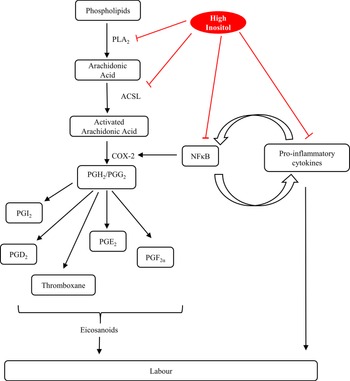
Eicosanoids are central to the onset and progress of labour, contributing to cervical ripening, uterine contractions and membrane rupture. Eicosanoids are bioactive lipids produced through the oxidation of arachidonic acid (AA) or other long-chained polyunsaturated fatty acids, which are enriched in placental tissue. AA, an omega-6 polyunsaturated fatty acid, is a key precursor of several downstream eicosanoids, including prostaglandin, thromboxane, leukotrienes and lipoxins. Eicosanoid synthesis occurs primarily through the release of AA from phospholipids through the activity of the enzyme phospholipase A2 (PLA2) followed by activities of acyl-CoA synthetase (ACSL, which activates AA)(Reference Kuwata and Hara39) and cyclo-oxygenase-2 (COX-2, which mediates production of downstream eicosanoids, mainly prostaglandins and thromboxanes)(Reference Smith, Urade and Jakobsson40–Reference Sykes, MacIntyre and Teoh42).
Pro-inflammatory cytokines and NFκB
Pro-inflammatory cytokines such as interleukin (IL)-1β, IL-6 and TNF-α are produced by resident leucocytes, infiltrating neutrophils and macrophages within the utero-placental environment(Reference Gotsch, Gotsch and Romero43–Reference Gomez-Lopez, StLouis and Lehr46), and are among the most important cytokines associated with the spontaneous onset of labour. These pro-inflammatory factors act through the NFκB signalling pathway, which is involved in the positive potentiation of labour. Not only is NFκB a prime mediator of pro-inflammatory factor action, but by itself, NFκB also promotes the production of an enhanced pro-inflammatory repertoire to further promote and propel labour(Reference Lindström and Bennett47). Downstream targets of NFκB include labour-associated genes such as several cytokines, COX enzymes, PLA2 and extracellular matrix remodelling enzymes(Reference Allport, Pieber and Slater48). These pro-inflammatory and pro-labour signals then elicit secretion of more chemocytokines, eicosanoids (especially prostaglandins), and matrix metalloproteases (MMPs) within the foetal membranes, myometrium and cervix(Reference Gomez-Lopez, Laresgoiti-Servitje and Olson49). Creation of such a microenvironment promotes weakening of foetal membranes, ripening of the cervix (partly by MMP-mediated degradation of the collagen matrix) and increased myometrial contractility (partly through changes in calcium flux and smooth muscle actin activity), resulting in rupture of membranes, rhythmic myometrial contractions and cervical dilatation(Reference Gomez-Lopez, Laresgoiti-Servitje and Olson49,Reference Sivarajasingam, Imami and Johnson50) .
Myo-inositol threshold – a regulator for onset of labour and PTB risk
We hypothesise that there is a threshold of uteroplacental inositol below which it is ‘permissive’ to labour onset. A physiological decline in uteroplacental inositol content, in concert with a rising pro-inflammatory environment in later gestation, may be permissive to spontaneous membrane rupture and labour onset. Lower uteroplacental inositol or a premature or accelerated decline in uteroplacental inositol levels might thus increase the risk of PTB, which could be mitigated by maternal inositol supplementation, hence reducing the risk of PPROM and PTB (Fig. 1). We further hypothesise that the underlying molecular mechanism, whereby higher placental inositol levels can reduce the risk of PPROM and PTB, is through altering placental and amnio-chorionic membrane lipid metabolism, eicosanoid production and secretion of pro-inflammatory chemocytokines. These inositol-regulated processes together could maintain the tensile strength of foetal membranes, thereby preventing the untimely/premature spontaneous rupture of membranes, as well as suppressing paracrine signals that promote myometrial contractility, to reduce PTB risk.
Proposed role of uteroplacental inositol in determining gestational age of delivery. A suboptimal uteroplacental inositol content coupled with its premature or accelerated decline, in concert with a rising pro-inflammatory uteroplacental environment, is permissive to spontaneous membrane rupture and labour onset, thus increasing the risk of preterm prelabour rupture of membranes (PPROM) and preterm birth (PTB), which we postulate can be mitigated by maternal inositol supplementation (dark blue ---). Different uteroplacental inositol trajectories relate to gestational timing of labour onset (red, preterm; green, term; brown, post-term)

Myo-inositol, fatty acids and eicosanoids
Current data suggest that myo-inositol could alter placental lipid metabolism by affecting upstream pathways such as placental fatty acid (FA) uptake from the maternal circulation and FA activation for lipid synthesis(Reference Watkins, Islam and Selvam51), and the same may plausibly occur in other uteroplacental tissues. However, the pathways affected appear to be FA-specific with polyunsaturated, mono-unsaturated and saturated FAs, each responding differently to myo-inositol treatment in vitro (Reference Watkins, Islam and Selvam51). The FA specificity of different isoforms of enzymes involved in both FA uptake and activation such as acyl-CoA synthetase (ACSL) may thus allow myo-inositol to have multiple separate effects on placental lipid processing depending on FA type(Reference Watkins, Islam and Selvam51). Therefore, myo-inositol may selectively modulate the uptake and activation of AA, the synthesis of AA lipids and, thus, the availability of un-esterified free AA for the generation of eicosanoids. Myo-inositol may also affect AA bioavailability by regulating the release of AA from AA-containing phospholipids by enzymes such as PLA2. This notion is plausible given findings in GDM where placentae have a higher level of PLA2 expression(Reference Varastehpour, Radaelli and Minium52,Reference Gauster, Desoye and Tötsch53) and lower placental inositol content(Reference Pillai, Islam and Selvam54).
This leads us to postulate that, in uncomplicated pregnancy, inositol may suppress eicosanoid production by decreasing the bioavailability of un-esterified free AA through decreased AA uptake, increases in AA-lipid synthesis and decreases in AA-lipid catabolism, thus ensuring that, until the physiological uteroplacental inositol decline reaches a critical threshold, the uteroplacental environment is not permissive to labour onset and uterine quiescence is maintained.
Myo-inositol, inflammation and matrix metalloproteases
Research supporting a role of inositol in regulating inflammation has come mainly from the cancer field. For example, in a mouse model of lung cancer, mice fed with a myo-inositol-enriched diet showed a significant decrease in pulmonary IL-6 levels(Reference Unver, Delgado and Zeleke55). It has been reported that inositol hexaphosphate (phytic acid) may limit inflammatory events in the colonic epithelium and prevent development of colon carcinomas by further modulating the synthesis and secretion of prostaglandins, leukotrienes and pro-inflammatory cytokines(Reference Kapral, Wawszczyk and Sośnicki56). Constitutive activation of NFκB also seems to be inhibited by inositol hexaphosphate, especially in the cancer setting. Specifically, myo-inositol deficiency in young grass carps has been shown to increase levels of the p65 subunit of NFκB, suggestive of increased NFκB pathway activation(Reference Li, Jiang and Feng57). As mentioned earlier, these pro-inflammatory chemocytokines and prostaglandins can also amplify each other in a feed-forward loop and further induce production of several MMPs within foetal membranes, cervix and myometrium, which are involved in extracellular matrix degradation thus resulting in membrane rupture, cervical ripening and dilatation(Reference Gomez-Lopez, Laresgoiti-Servitje and Olson49). There are also reports of inositol hexaphosphate reducing the expression of several MMPs in colon cancer epithelial cells when induced with IL-1β, pointing to a possible role for inositol in also modulating MMPs and subsequent collagen matrix degradation(Reference Kapral, Wawszczyk and Jurzak58). This suggests that inositol might also inhibit MMP activity, which is required for spontaneous foetal membrane rupture.
Such postulated immunomodulatory roles of myo-inositol parallel those reported with another compound, alpha-lipoic acid (ALA), which has also shown effects in reducing the risk of PTB. However, unlike the myo-inositol supplementation trials in pre-symptomatic women, studies of ALA have mainly focused on pregnant women who had already manifested symptoms of threatened preterm labour. ALA has immunomodulating activity through regulation of both pro- and anti-inflammatory pathways(Reference Monastra, De Grazia and Cilaker Micili59,Reference Parente, Colannino and Ferrara60) . An RCT in women after primary tocolysis showed that vaginal ALA treatment significantly increased the production of cervical anti-inflammatory cytokines associated with stabilisation of cervical length(Reference Grandi, Pignatti and Ferrari61), whilst other studies reported reduction in symptoms of preterm labour such as pelvic pain and uterine contractions(Reference Parente, Colannino and Ferrara60,Reference Vitrano, Mocera and Guardino62) . It has even been suggested that ALA and myo-inositol may have synergistic effects as demonstrated in the treatment of other conditions such as polycystic ovary syndrome in women(Reference Genazzani, Despini and Santagni63,Reference Genazzani, Prati and Marchini64) and diabetic neuropathy in rats(Reference Kishi, Schmelzer and Yao65). It remains to be seen if such synergistic effects could also be applicable to preterm labour.
Role of the foetoplacental unit in labour onset and progress
The foetoplacental unit in part dictates the timing of labour onset through a coordinated series of endocrine and paracrine signalling, and positive potentiation loops, involving the foetal hypothalamic–pituitary–adrenal–placental axis, and the myometrium(Reference Alcántara-Alonso, Panetta and de Gortari66). The role of foetal corticotropin-releasing hormone signalling, withdrawal of the suppressive action of progesterone on myometrial contractility and maternal oxytocin secretion in the neuro-myometrial loop, working in concert with eicosanoids and inflammation to influence labour onset, have all been described over the last few decades.
Now we also postulate that placental and foetal production of inositol might also contribute to determination of timing of labour onset and labour progress. The contribution of endogenous placental synthesis of myo-inositol appears important, with evidence that placental expression of IMPA1 (enzyme that synthesises myo-inositol) is strongly associated with placental inositol content(Reference Pillai, Islam and Selvam54). Moreover, foetal tissues, including lungs, kidneys, liver, skeletal muscle and central nervous system, are enriched with inositol, with many expressing enzymes capable of inositol synthesis(Reference Watkins, Yong and Sharma20). Studies have reported a decline in foetal circulating inositol concentration with advancing gestation, with 125 μM inositol in umbilical cord blood at mid-gestation falling to 86 μM inositol in cord blood at term(Reference Quirk and Bleasdale67,Reference Pereira, Baker and Egler68) . Furthermore, since the concentrations of inositol both within the foetal circulation (∼86 μM) and amniotic fluid (∼80 μM) at term are higher than corresponding maternal circulation (∼25 μM)(Reference Brusati, Jóźwik and Jóźwik69,Reference Santamaria, Corrado and Baviera70) , it is likely that the foetoplacental unit makes a larger contribution to the general uteroplacental inositol levels than the mother. However, factors that regulate foetal and placental inositol synthesis and metabolism are not yet understood, but will be important to establish in order to fully elucidate inositol’s role in human parturition.
Uteroplacental myo-inositol and parturition
It remains to be determined whether a decline to a critical threshold of uteroplacental myo-inositol acts as a direct trigger for onset of spontaneous labour or acts to release suppression of the triggers of labour, or if the myo-inositol decline merely acts to create a general permissive environment that promotes labour onset and progress. It is likely to be through a combination of different pathways with myo-inositol working at multiple levels, contributing to determination of timing of labour onset as well as regulating the labour process itself.
We firstly hypothesise that higher placental inositol content could restrain the onset of labour by suppressing placental eicosanoid synthesis and production by reducing AA bioavailability for eicosanoid synthesis or by reducing the activity of enzymes involved in eicosanoid synthesis (Fig. 2). Additionally, inositol could shift AA metabolism towards the production of anti-inflammatory rather than pro-inflammatory eicosanoids, hence regulating the overall balance of pro- and anti-inflammatory factors to suppress the premature onset of labour. Secondly, we hypothesise that inositol might dampen the pro-inflammatory environment by inhibiting the secretion of chemocytokines within the uteroplacental compartment, just as observed in cancer studies, together with inhibiting the activation of the NFκB pathway that is responsible for downstream induction of COX-2-mediated eicosanoid synthesis and other pro-labour entities. As a result, there is an overall suppression of the pro-inflammatory state within the uteroplacental environment (Fig. 2).
Hypothetical mechanism of inositol in inhibiting premature onset of labour and lowering preterm birth risk. We hypothesise firstly that high inositol alters the lipid metabolism within the phospholipid membranes by suppressing the release and activation of AA from membrane phospholipids by inhibiting the enzymes PLA2 and ACSL. Secondly, high inositol levels inhibit the synthesis and secretion of pro-inflammatory chemocytokines, and activation of the NFκB pathway, which further reduces the production of COX-2 mediated eicosanoid synthesis, thereby resulting in an overall suppression of the pro-inflammatory environment responsible for rupture of membranes and onset of labour, and hence, reduce the risk of preterm prelabour rupture of membranes (PPROM) and preterm birth (PTB). AA, arachidonic acid; PLA2, phospholipase A2; ACSL, acyl-CoA synthetase; COX-2, cyclooxygenase-2

We propose that higher uteroplacental inositol levels and diminution in these events could be promoted by maternal inositol supplementation. Although endogenous foetoplacental inositol are postulated to be major contributors to the prevailing level of uteroplacental inositol, we believe that maternal supplementation could still make an appreciable contribution to uteroplacental and amnio-chorionic membrane inositol content. If so, maternal myo-inositol supplementation may act to delay the rupture of membranes and onset of labour and reduce PPROM and PTB risk.
To verify these hypotheses in the laboratory setting, levels of myo-inositol in uteroplacental tissues and amnio-chorionic membranes, both in ex vivo frozen biopsies (comparing tissues from myo-inositol supplemented and unsupplemented women) and in vitro explant cultures (treated with varying doses of myo-inositol), could be quantified and associated with different AA-containing lipids and eicosanoids. This could be coupled with measurements of expression changes in the enzymes and lipids involved in eicosanoid production, levels of pro-inflammatory and anti-inflammatory chemocytokines, and subsequent activation of the NFκB pathway. Furthermore, the combined effect of these myo-inositol-associated changes on the overall tensile strength of amnio-chorionic membranes could be measured and the paracrine effects on myometrial contractility examined. Such studies will be crucial in increasing our mechanistic understanding of inositol’s possible role in the labour process and confirming whether maternal myo-inositol supplementation acts through these mechanisms to reduce PPROM and PTB.
Conclusion
Currently in standard obstetric practice, there are no clinically efficacious interventions that can safely regulate uteroplacental inflammatory processes and lipid/eicosanoid metabolism to inhibit or delay the onset of PTB in the general obstetric population. Thus, identifying such candidates remains a research priority. Multiple studies have reported myo-inositol as a safe compound with no apparent side effects when used up to a dosage of 4 g/d throughout pregnancy. Additionally, myo-inositol is easy to administer as an oral supplement, with high compliance reported. Nevertheless, potential adverse effects of myo-inositol supplementation, in particular on rarer pregnancy outcomes, which present studies are underpowered to assess adequately, need to be studied in more detail. This will ensure a favourable risk-to-benefit ratio as well as cost-effectiveness, before any widespread supplementation can be recommended. Myo-inositol’s potential use as a mainstream clinical intervention for prophylaxis against PPROM and PTB could have a significant impact should large clinical trials demonstrate efficacy. However, uncovering the biological mechanisms and understanding how inositol could play a key role in delaying the spontaneous onset of labour in PTB pathologies will enable us to more precisely target critical time windows (preconception or during specific gestational periods) and relevant populations for maternal myo-inositol supplementation in new randomised controlled trials designed specifically to definitively address the clinical efficacy and safety of myo-inositol prophylaxis against PPROM and PTB.
Financial support
This study is supported by a Clinician Scientist Award awarded to Chan S.Y. from the Singapore National Medical Research Council (NMRC/CSA-INV/0010/2016; MOH-CSAINV19nov-0002), by the National University of Singapore, National University Health System Singapore and the A*STAR Singapore Institute for Clinical Sciences. Godfrey K.M. is supported by the UK Medical Research Council (MC_UU_12011/4), the National Institute for Health Research (NIHR Senior Investigator (NF-SI-0515-10042) and NIHR Southampton Biomedical Research Centre (IS-BRC-1215-20004)), the European Union (Erasmus+ Programme ImpENSA 598488-EPP-1-2018-1-DE-EPPKA2-CBHE-JP) and the British Heart Foundation (RG/15/17/3174).
Conflict of Interest
Chan S.Y., Cutfield W. and Godfrey K.M. are part of an academic consortium that has received grants from Société Des Produits Nestlé S.A. and are co-inventors on patent filings by Nestlé S.A. relating to inositols in human health applications. Chan S.Y. has received reimbursement and honoraria into her research funds from Nestlé S.A. for a half-day consultancy and for speaking at a conference. All other authors have no conflict of interest to declare.
Authorship
Manuscript was written by Sharma N. and Chan S.Y., with content, advice and editing provided by Watkins O.C., Chu A.H.Y., Cutfield W., Godfrey K.M. and Yong H.E.J. Chan S.Y. provided critical revision of the manuscript for intellectual content.