Introduction
Following the World Health Organization’s (WHO) declaration of a global health emergency on 30 January 2020, upgraded to a ‘pandemic’ on 11 March (WHO, 2020), governments across the world implemented social distancing measures to delay the spread of the virus. Such measures are considered the cornerstone of public health interventions for addressing widespread disease transmission (Kass, Reference Kass2001), and for containing COVID-19 in particular (Matrajt and Leung, Reference Matrajt and Leung2020). While most governments experienced a high degree of public support at the start of the crisis, continued acceptance of lockdown measures increasingly came under pressure in many countries (Boin et al., Reference Boin, Lodge and Luesink2020). Epidemiologists would attribute this to the ‘prevention paradox’, whereby measures that have a major impact on public health are difficult to implement, if individuals perceive a low probability of being affected by the disease (Rose, Reference Rose1985). This paradox has urgent practical and political dimensions, since measures that limit civil liberties, democratic rights, and economic activities may face strong public opposition over time, potentially fuelled by conspiracy theories and populist mobilizations. This article provides a rigorous analysis of the drivers of public support for social distancing, a question of urgent comparative importance, drawing on empirical data collected at the start of the crisis, which provide a relatively clean ‘laboratory setting’ to study political behaviour and attitudes, at their formative stage.
Research indicates that support for social distancing is influenced by multiple factors, but studies have yet to consider the interplay between them to determine their relative explanatory power. Early empirical studies focussed on health-related variables and demographic characteristics to account for behavioural differences between social groups, noting decreased compliance amongst people with low educational attainment and health literacy (Wolf et al., Reference Wolf, Haddock, Manstead and Maio2020), amongst members of racial/ethnic minorities (Van Scoy et al., Reference Van Scoy, Green, Witt, Bramble, Richardson, Putzig, Toyobo, Wasserman, Chinchilli, Tucci and Levi2020), and amongst men and those experiencing health or economic vulnerability (Lancet, Reference Lancet2020). Social psychologists have focused on the influence of personal norms, values, and social identities in driving behaviour (Jetten et al. Reference Jetten, Reicher, Haslam and Cruwys2020; Wolf et al. Reference Wolf, Haddock, Manstead and Maio2020), which are more susceptible to targeted interventions within a particular societal context compared to demographic factors, as research on climate change has shown (e.g. Hornsey et al., Reference Hornsey, Harris, Bain and Fielding2016). The role of context to account for individual attitudes and behaviours is also highlighted, implicitly, by Lennon et al. (Reference Lennon, Sakya, Miller, Snyder, Yaman, Zgierska, Ruffin and Van Scoy2020) who found ‘marked regional differences in intent to follow key public health recommendations’. Sociopolitical factors explain regional variation, with higher levels of compliance, for example, reported in the USA amongst residents in Democratic counties, compared to Republican ones (Painter and Qiu, Reference Painter and Qiu2020). More broadly, trust in institutions, ideology, and partisanship have consistently been found to influence public attitudes during the pandemic (Allcott et al., Reference Allcott, Boxell, Conway, Gentzkow, Thaler and Yang2020; Barrios and Hochberg, Reference Barrios and Hochberg2020).
One specific area that has, so far, received surprisingly little attention concerns the effect of political cues on public attitudes, which in previous crises was shown to drive support for exceptional and unprecedented measures, controlling for socio-economic and political factors (e.g. Karyotis and Rüdig, Reference Karyotis and Rüdig2015). After all, persuasion, short of pure coercion, ‘is the most direct way to mobilise or paralyse a group’ (Cruz, Reference Cruz2000, 275) and is considered ‘the main currency of crisis management’ (‘t Hart and Tindall, Reference ‘t Hart, Tindall, ’t Hart and Tindall2009, 23). The ability of political elites to use language to set the parameters for audiences to interpret, categorize, and evaluate complex or unexpected developments, such as the pandemic, is amplified at times of crises (Benford and Snow, Reference Benford and Snow2000). Crises generate fast and contradictory information, which forms competing frames concerning a crisis’ nature and severity, the responsibility for its occurrence or escalation, and the appropriate response and sacrifices it requires to curtail its development. Framing around these exact dimensions takes a central stage (Entman, Reference Entman1993; Boin et al., Reference Boin, ’t Hart and McConnell2009). Simonov et al. (Reference Simonov, Sacher, Dubé and Biswas2020) demonstrated that exposure to Fox News coverage, for example, predicts opposition to social distancing, which is suggestive of an effect of differential messaging by politicians. Mintrom and O’Connor (Reference Mintrom and O’Connor2020) also analysed the variations in the narratives promoted by four USA state governors, convincingly arguing that these influenced the local policy development and implementation of social distancing measures, without, however, exploring how the public, as the audience of these narratives, perceived them. These, fruitfully, suggest that more systematic efforts are required to analytically dovetail the attitudes of citizens with the messages of their leaders during the pandemic.
The article seeks to address this gap, by synthesizing insights from crisis management, political behaviour and securitization literatures, and utilizing Britain, as an ‘extreme case-study’. Extreme case studies correspond to a case that is considered to be paradigmatic of a broader process or development. The focus on a case that lies far away from the mean of a given distribution facilitates exploratory analysis that may disconfirm or confirm a prevalent understanding (see Seawright and Gerring, Reference Seawright and Gerring2008). The lacklustre response of the United Kingdom (UK) government at the early stages of the pandemic, when nearly all countries in the world had taken decisive measures to contain the spread of the virus, provides an ideal research setting. This allows us to empirically test the dominant understanding in the emerging literature on COVID-19 that support for social distancing is largely dependent on personal circumstances, health and economic vulnerabilities, and political factors (such as ideology and trust). Through a series of regression analyses, we explore the explanatory power of corresponding models, while also contrasting them to models that are explicitly drawn from the crisis management literature and, specifically, the key framing contests in the UK about the nature, severity, responsibility, and appropriate response to the pandemic.
To analyse the drivers of support for social distancing, the article employs mixed methods. First, thematic analysis of public discourse is employed to map how the main frames that crisis management theory draws attention to were represented in public debates during the first month of the UK lockdown, and by whom. Second, to assess the extent to which these key frames had an impact on public attitudes, we analyse original and pertinent survey evidence of a representative sample of the UK population (n = 2100), administered online between 10 and 15 April 2020. This was shortly after the initial implementation of social distancing measures but prior to the subsequent politicization around the government’s crisis management performance. We begin the analysis by engaging with theoretical debates about the role of framing in crisis management and securitization literatures, and their implications for pandemic politics, before introducing our data and methods. Next, framing contests in the UK on the nature, severity, blame attribution, and appropriate response, which ‘follows the science’ are matched with public attitudes along the same dimensions, showing a remarkable degree of alignment, in most cases. Our analysis of unique and pertinent survey data in the final section demonstrates that the variables inspired by the crisis management and securitization literatures produce, by far, the strongest model to explain support, or opposition, for social distancing in the UK in comparison to models that rely on health, economic, and political variables. This challenges the prevailing understanding of what drives public attitudes and has significant theoretical and empirical implications, which are discussed in the conclusion.
Crisis management, securitization theory, and pandemic politics
The role of elite framing and language as drivers of public attitudes is emphasized by both crisis management and securitization literatures, amongst others. Crises can be understood as the combined products of sudden events and social perceptions, largely defined by the dominant narratives surrounding them (Rosenthal et al., Reference Rosenthal, Charles and ‘t Hart1989). In highly polarized contexts, this produces greater competition between political actors, attempting to either ‘contain or exploit crisis-induced opportunity space for political posturing and policy change’ (‘t Hart and Tindall, Reference ‘t Hart, Tindall, ’t Hart and Tindall2009, 23). From a social constructivist understanding of security (Buzan et al., Reference Buzan, Wæver and De Wilde1998), elites – usually political leaders – employ the rhetoric of ‘existential threat’ in order to mobilize support for the implementation of ‘extraordinary’ measures, with the consent of a specific audience – usually the general public (Williams, Reference Williams1998, 435). Henceforth, convincing an empowering audience that a ‘referent object’ they value is facing an existential threat provides authorities with a green light to legitimize exceptional emergency measures, beyond ‘normal politics’, a process known as ‘securitisation’ (Buzan et al., Reference Buzan, Wæver and De Wilde1998).
From both perspectives, political elites are assumed to be the protagonists of crisis management and, by virtue of their position and/or expertise, the dominant actors in producing ‘legitimate’ security discourses. Governments have no choice, in times of crisis, but to ‘attempt to reduce public and political uncertainty and inspire confidence in crisis leaders by formulating and imposing a convincing narrative’ (Boin et al., Reference Boin, ’t Hart, Stern and Sundelius2016, 79). Elites manipulate, strategize, and fight to have their frame accepted as the dominant narrative (Brändström and Kuipers, Reference Brändström and Kuipers2003). Therefore, frames are typically in direct competition with one another, while also constrained by ‘pre-existing meaning structures or schemas’ that apply to a particular context (Scheufele, Reference Scheufele1999, 105). Successful framing ‘occurs when in the course of describing a campaign, issue, problem, or event, a speaker’s emphasis on a subset of potentially relevant considerations causes individuals to focus on those considerations when constructing their opinions’ (Druckman, Reference Druckman2001, 1042). Making some aspects of a crisis more salient in discourse promotes a particular causal interpretation, moral evaluation, and treatment/recommendation (Entman, Reference Entman1993, 52). The implication is that when it comes to the politics of crisis and security, perceptions matter more than the objective reality, with political elites assumed to be the main actors that shape public attitudes and behaviours, from the top down.
However, in the context of the COVID-19 pandemic, there are two main reasons why this may not necessarily apply. First, prior research has shown that with regards to health issues, domestic and international health experts play an equally, if not more important, role than domestic political elites in facilitating support for extraordinary public health interventions (Davies, Reference Davies2008; Curley and Herington, Reference Curley and Herington2011; Bengtsson and Rhinard, Reference Bengtsson and Rhinard2019). Second, in the face of a global threat, the public may come to appreciate its severity through a multitude of sources and, accordingly, pressure their governments to act. Infectious disease outbreaks are characteristic of a global challenge that impacts upon populations, irrespective of the political borders that surround them, with the timing of response being of the essence (Curley and Herington, Reference Curley and Herington2011). In protracted crises, similarly to protracted conflicts, securitization processes are not expected to follow a top-down path but may also follow a horizontal and even bottom-up trajectory, particularly as the salience of the threat rises and countermeasures are adopted internationally (Adamides, Reference Adamides2020). Indeed, evidence from the UK suggests that some people supported and practiced social distancing even before the imposition of the national lockdown (Christakis, Reference Christakis2020), with, for example, walk-ins and reservations in seated diners plummeting 2 days after the WHO declared COVID-19 a pandemic.
Overall, and drawing on the extant literature, it is possible to identify, deductively, four main battlegrounds in crisis-induced framing contests. Two are ‘diagnostic’ (concerned with how a problem is represented) and two are ‘prognostic’ (concerned with the articulation of concrete solutions to the problem) (Benford and Snow, Reference Benford and Snow2000). The first contest is about the severity and nature of the crisis. Global health issues are by no means new, however, their salience only increased after the end of the Cold War. Since the 1990s, states, particularly in the West, and international organizations like the WHO, increased their efforts to define infectious diseases as an urgent security threat that necessitates the design of new rules and behaviours for their successful containment (Davies, Reference Davies2008). Health experts, economists, defence strategists, academics, entrepreneurs, and politicians sounded the alarm about the dire potential consequences, if governments failed to prepare adequately for an outbreak. For example, the WHO (2005) referred to the inescapability of a deadly pandemic influenza that could kill anywhere between 2 and 12 million people globally. Other actors and agents used war-like metaphors to stress the severity and multifaceted nature of natural or manufactured deadly pathogens (Sanders and Chopra, Reference Sanders, Chopra and Kelley2003). However, typically, domestic contextual factors and short-term electoral calculations determine whether political elites downplay or emphasize how serious a threat is and how it should be principally understood (Boin et al., Reference Boin, ’t Hart and McConnell2009).
During the COVID-19 pandemic, some governments, notably the British, delayed framing the virus as an existential threat and introducing emergency measures, which may have contributed to the UK having one of the highest death counts in Europe. According to securitization theory, however, the objective severity of a threat measured, for example, in terms of casualties, is not important; what matters is perceived severity (Buzan et al., Reference Buzan, Wæver and De Wilde1998). While frames have ‘to be based on an accepted empirically valid reality’, a multifaceted crisis provides opportunities for elite actors to draw attention to a sub-set of considerations and set the parameters within which the severity and nature of a threat are interpreted by the audience. Evidence from Italy by Briscese et al. (Reference Briscese, Lacetera, Macis and Tonin2020) indicates that the management of public expectations, through effective communication mechanisms, is a predictor of support for social distancing measures, more so than objective markers, such as the duration of lockdowns. Similarly, in the UK case, we may expect that the actual number of deaths, as a proxy of objective severity, does not influence public attitudes. Instead, public perceptions about the presence of a serious threat to a ‘referent object’, whose survival is framed to be at stake, is what securitization theory predicts would drive support for emergency measures (Buzan et al., Reference Buzan, Wæver and De Wilde1998). During a global health crisis, human lives are the obvious referent object. However, concern about other objects that are valued in a particular context, such as social identities, economic and political values, or important structures and national institutions, would likely also influence attitudes to social distancing through successful framing.
The second contest involves blame attribution dynamics – efforts to avoid culpability and manoeuvrings to allocate responsibility (Hood, Reference Hood2002; Kuipers and Brändström, Reference Kuipers and Brändström2020). This contest may not only make or break the viability of implemented policies, but also the political fortunes of incumbent leaders (’t Hart and Tindall, Reference ‘t Hart, Tindall, ’t Hart and Tindall2009, 28). While government elites have an electoral self-interest in avoiding being held accountable for negative developments, it is intuitive that this would also likely undermine public support for crisis measures. To prevent this, it is common for governments to adopt an exogenous frame, a form of othering, whereby the reasons for the emergence of a crisis, or its escalation, are portrayed as beyond their control in order to deflect blame and attention away from any policy mishaps (‘t Hart and Tindall, Reference ‘t Hart, Tindall, ’t Hart and Tindall2009, 28–29). This can be done through defensive narratives, like disqualifying critics, accusing the accusers, or diverting the blame to others (Bovens et al., Reference Bovens, ‘t Hart, Dekker, Verheuvel and Anheier1999). However, it may also be achieved through positive messaging, designed to override the ‘prevention paradox’ (Rose, Reference Rose1985) and ‘collective action problem’ (Olson, Reference Olson1965), which de-incentivize those with perceived declining probabilities of contracting COVID-19 from supporting social distancing. Social psychologists have shown that promoting ‘altruistic’ and ‘pro-environmental’ values impacts on attitudes and behaviours, ‘for example by framing pro-environmental action as a form of patriotism or as an investment in ‘green’ technologies’ (Hornsey et al., Reference Hornsey, Harris, Bain and Fielding2016, 625). Similarly, in the case of the pandemic, we would expect that people would be more likely to support measures, if they were instilled with positive incentives to contribute to a ‘public good’. This is, perhaps, of even greater importance in the face of a novel and immediate threat to life, compared to the long-standing but perhaps more intangible risks associated with climate change, which facilitate the activation of pre-existing norms to influence public behaviour.
The third contest is about remedies and trade-offs – competing frames about how to respond to a crisis, and at what cost. The comparative and theoretical literature provides us with a non-exhaustive blueprint of prognostic frames that typically compete during a crisis, whose relevance as predictors of attitudes during the pandemic we examine in the UK context. The most potent framing strategy to mobilize public support, according to securitization theory, is to convince an audience that ‘There Is No Alternative’ (TINA) to the introduction of extraordinary but necessary measures, before it is too late (Buzan et al., Reference Buzan, Wæver and De Wilde1998). Empirical evidence from the Great Recession demonstrates both the salience (e.g. Boin et al., Reference Boin, ’t Hart and McConnell2009) and the impact of TINA on political behaviour (e.g. Karyotis and Rüdig, Reference Karyotis and Rüdig2015). Furthermore, a ‘crisis as opportunity’ frame would likely help energize public support on the promise that we will ultimately be emerging stronger from the crisis. On the other hand, fatalistic frames, such as that ‘nothing can be done’ to stop the spread of COVID-19, would likely reduce compliance and support for social distancing, which may also be the indirect effect of frames that undermine confidence on the fairness of measures introduced by the government. Crucially, the multifaceted nature of the crisis also allows for ‘counter-securitisation’ frames to develop around perceived trade-offs, whereby the response to the pandemic is presented as a greater threat to other referent objects, such as liberties or economic growth, than the virus itself (Paterson and Karyotis, Reference Paterson and Karyotis2020). Successful invocation of such frames would likely increase opposition to social distancing.
Cutting across these framing contests is a fourth contest about the role of science and scientific experts. This is a rather novel and emerging dimension in crisis management but not a surprising one, since, as noted, health experts are often more influential than politicians in shaping understandings. In a fast-moving and confusing context, it is essential that governments draw on the latest scientific evidence to inform debates about the origin, nature and severity of a threat, but also, crucially, to determine appropriate diagnostics and treatments (Berling, Reference Berling2011). Governments across the world have repeatedly and emphatically claimed to be ‘following the science’ to legitimize the measures designed to reduce the spread of COVID-19, which was celebrated as ‘a welcome return of scientific expertise to the heart of government’, since governments need scientific evidence ‘right here, right now’, to guide their responses, in real time (Bronk, Reference Bronk2021). Nevertheless, the literature calls for some caution to be exercised about this type of framing. For one, research on advice taking suggests that ‘decision-makers tend to overweight their opinions relative to those of an advisor leading to inferior outcomes, even when the advisor is recognized as a highly-trained expert’ (Simonov et al., Reference Simonov, Sacher, Dubé and Biswas2020). Evidence from the UK and the USA indicate that decision makers may suppress scientific perspectives that are not congruent with their promoted crisis narrative or contradict other political objectives and values (Abbasi, Reference Abbasi2020). Furthermore, rather than ‘de facto’ and absolute truths, scientific results should be treated as provisional and open to audit by other scientists, as well as appropriate revisions, when new evidence becomes available (Bronk, Reference Bronk2021). These open up the possibility for the politicization of science in ways that allow governments to push political agendas and value choices, while shielding themselves from responsibility for outcomes.
Anti-science attitudes have also been shown to increase climate change scepticism (Hornsey et al., Reference Hornsey, Harris, Bain and Fielding2016) and have more recently been linked with a revolt against the ‘overeducated’ (Szabados, Reference Szabados2019), perhaps reflecting deeper divides in society, that may also influence political behaviour during the pandemic. Indeed, Swami and Barron (Reference Swami and Barron2020) found that analytical thinking and rejection of COVID-19 conspiracy theories are strongly associated with compliance with social distancing. In our case, we would similarly expect that those that reject ‘conspiracy’ theories about the origins of COVID-19 to be more likely to support social distancing. The question, however, that is most directly susceptible to framing effects is whether people trust the scientific experts that advise their government. Our expectation is that those who do would be more likely to support social distancing, irrespective of their general attitudes towards science.
Overall, our empirical analysis allows us to explore how these four framing contests played out in debates in the UK at the start of the crisis, and the extent to which the public’s positioning along these key dimensions drives support, or opposition, for social distancing, which is our principal aim.
Data and methods
Crisis management research in political and policy studies has generally focused on the role of political leaders and institutional responses to threats and crises, at multiple levels of governance (Boin et al., Reference Boin, ’t Hart and McConnell2009; Brändström and Kuipers, Reference Brändström and Kuipers2003). An explanation of this is that crisis research in politics emerges from the public administration (public management) and organizational (management) disciplines. Indeed, the word ‘management’ itself brings with it connotations of resource mobilization, based on command and control orientation to governance. With this in mind, crisis studies have had a degree of qualitative bias because the implications of the decisions of managers and leaders (and their deficiencies) have meant that studies, and their accompanying methods, adopt more of a relational perspective. For example, qualitative case study designs, using interviews and focus groups, are commonly employed to study the nature of collaborations between actors within different phases of the crisis management process (Brändström and Kuipers, Reference Brändström and Kuipers2003; Boin et al., Reference Boin, ’t Hart and McConnell2009). At the same time, political scientists have tended to focus, perhaps disproportionately so, on examining routine problems, which has led to a degree of fragmentation in crisis management scholarship (Lipscy, Reference Lipscy2020). Footnote 1 The outcome of this is that the ‘structures’ or institutions of crisis governance often outweigh the attention given to the roles and perspectives of the ‘agents’ (or the public) within crisis research.
As a result, there is a distinct lack of crisis management studies that employ quantitative methods to empirically measure the extent to which frames correspond to, or indeed, influence public understandings and attitudes during a crisis. The same methodological imbalance is present in securitization theory. Buzan et al. (Reference Buzan, Wæver and De Wilde1998, 176–7) prescribe discourse analysis as the ‘obvious method’ to study security, without the need for ‘sophisticated linguistic or quantitative techniques’. Instead, they argue, ‘the technique is simple: Read, looking for arguments that take the rhetorical and logical form defined here as Security’. Accordingly, ‘most securitisation research focusses on elite constructions of the security frame alone, without consideration of the public’s evaluations of this message’ (Paterson and Karyotis, Reference Paterson and Karyotis2020, 17). This article helps to address the poorly cultivated quantitative field of crisis management and securitization research through mixed methods.
First, we use thematic analysis to map, in the UK context, the four key framing contests identified in the literature review. Thematic analysis is a method for searching, identifying, and analysing theoretically informed patterns of meaning or themes in a dataset (Daly et al., Reference Daly, Kellehear and Gliksman1997). Our dataset comprised of news articles and official elite communication (e.g. state, government and opposition official communications), as well as scientific experts’ and advisers’ public announcements and press releases published between 15 February 2020 (2 weeks before the first recorded cases of local transmission in the UK) and 15 April 2020 (the end date of our survey). This constitutes the timeframe for our study.
Data were collected and analysed manually by two independent coders. We followed a hybrid approach to thematic analysis, drawing upon both the data-driven (i.e. inductive) (see Boyatzis, Reference Boyatzis1998) and theoretically informed (i.e. deductive) approaches (see Crabtree and Miller, Reference Crabtree, Miller, Crabtree and Miller1999). This was an iterative and reflexive process with the data collection and analysis being conducted concurrently. Data collection and analysis was based on four both deductively and inductively generated broad thematic categories: severity (death projections/estimates) and nature (health, economic, social, political repercussions of the pandemic); blame/responsibility (actors and phenomena associated with the spread of the virus); political value choices (TINA; opportunity; fatalism; fairness); policy trade-offs (public health vs. civil liberties and the economy); and references to the role of science/scientists in pandemic policymaking. Regular coding clinics were held amongst the two researchers to ensure the reliability of data collection and analysis.
Second, we quantitatively analysed pertinent survey evidence to determine what drives support for social distancing in the UK. Our data comes from an original survey conducted online by the polling organization Deltapoll. The sample consisted of n = 2100 British adults and is representative in terms of age, gender, and region. With respect to gender, 47% of respondents are male (n = 984) and 53% female (n = 1116). 10% of the sample self-identified as being Black, Asian, or from an ethnic minority (BAME) (n = 224). The survey took place between 10 and 15 April 2020, while the UK was entering the third week of the first lockdown. Prime Minister (PM) Boris Johnson was himself hospitalized after contracting COVID-19, which may have amplified the ‘rally around the flag’ effect by altering the emotional context. Indeed, public attitudes are particularly volatile to contextual changes, which typically accelerate during crises.
Since we are interested in attitudes, rather than behaviours, our dependent variable focuses on support for ‘allowing people to leave their homes only for essential reasons (work, shopping, medical appointments)’, which represents the essence of social distancing and was the central theme of the first UK lockdown. Answers to this variable take values between 1 (strongly oppose) and 5 (strongly support). Descriptively, 84% of respondents supported (36%) or strongly supported (48%) the lockdown, 10% neither supported nor opposed, 4% opposed, and 2% strongly opposed it. As in other countries (Boin et al., Reference Boin, Lodge and Luesink2020), there was very high support for social distancing at the start of the crisis, indicating that the public had been convinced that COVID-19 represented an existential threat that justified the suspension of normal life.
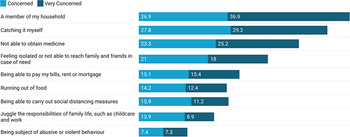
The timing of our survey allows us to provide a comprehensive account of the drivers of support for measures at the start of the crisis by testing the explanatory value of health, socio-economic and political models, that have dominated current debates, compared to models centred around the four framing contests deriving from the crisis and securitization literatures. Figure 1 shows that, when thinking about their personal circumstances, health-related worries are the greatest cause of concern, with variant but significant levels of concern also in relation to economic and social parameters. Our rich and tailor-made questionnaire, which also included measurements of the emerging key frames identified in the thematic analysis, allows us to assess the extent to which such considerations impact on public attitudes.
Main personal worries during the COVID-19 pandemic.

Framing contests and corresponding public attitudes
This section employs thematic analysis to map public discourse around each of the four main framing contests identified in the theoretical literature, and the corresponding attitudes of the British public. The discussion here also serves to operationalize the variables and derive models that we use in the subsequent regression analyses, which seek to identify the drivers of support for social distancing.
Severity and nature
On the day the lockdown was announced, PM Johnson claimed that COVID-19 posed the ‘biggest threat this country has faced for decades’ (UK Government, 2020a). While the projected number of deaths did not feature in the government’s discourse in this early stage of the pandemic, such estimates varied greatly amongst the scientific community. Experts placed the number of projected deaths between 500,000 (Kitching, Reference Kitching2020) – the worst-case scenario of the ‘herd immunity’ strategy – and 20,000 (Merrick, Reference Merrick2020a) – the best-case scenario. From the very beginning, predominantly public health characteristics were ascribed to the threat. These were emphasized by Johnson referencing the rapidly growing number of ‘victims and fatalities’, the continued ‘sacrifice of key workers’, and also the need to defend the ‘functionality’ of the NHS (UK Government, 2020b), which were the central elements of the government’s communications (‘stay at home, protect the NHS, save lives’). Experts, such as the UK Chief Medical Officer, openly warned that under a worst-case scenario the NHS could run out of beds for COVID-19 victims (House of Commons, 2020).
However, different economic, social, and political aspects, which painted a complex threat, also featured in public discourse. The PM acknowledged that there was a serious, multifaceted threat posed to the NHS, the economy, and British lives (UK Government, 2020a), while a week earlier he had emphasized the need to defend the national economy (UK Government, 2020b). Experts warned that COVID-19 looked set to hike the UK unemployment rates (Andrews, Reference Andrews2020), while the Office for Budget Responsibility (OBR), warned that the country faced a ‘large (but hopefully temporary) shock to the economy’ (Williams-Grut, Reference Williams-Grut2020). The threat of social unrest made its appearance for the first time in public discourse in mid-March, when supermarkets’ supply chains were put under pressure from stockpiling customers (Evans and Yorke, Reference Evans and Yorke2020). Lastly, the threat of Britain becoming a ‘Police State’ can be traced back to the days following the introduction of the ‘Coronavirus Bill’ on 25 March, which imposed unprecedented restrictions on civil liberties in peacetime (Jacobs, Reference Jacobs2020).
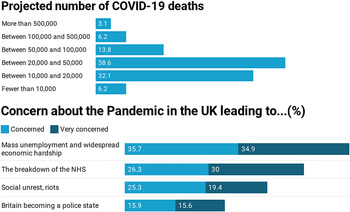
Descriptive survey results (Figure 2) show that, in general, the British public was in line with the more conservative estimates of the expected casualties, with 71% estimating that between 10,000 and 50,000 people would eventually die in the UK. At the time, 60,733 had tested positive for coronavirus and, of those hospitalized, 7097 had died.Footnote 2 Perhaps surprisingly, more people were worried about economic implications (71%), rather than the breakdown of the NHS (56%) which featured heavily in the government’s discourse as the second referent object, after ‘saving lives’. People worried far less about social unrest (45%) or Britain becoming a police state (32%), which was not promoted by mainstream political actors. In our analysis, the first model draws on these variables, relevant to the perceived nature and severity of the threat.
Severity and nature of the threat.

Blame attribution
The government also sought to diffuse responsibility and deflect blame for the crisis by continually referencing the global and shared threat that COVID-19 posed. For example, Johnson commenced his lockdown speech by stating: ‘this country is not alone. All over the world, we are seeing the devastating impact of this invisible killer’ (UK Government, 2020a). As soon as Britain’s death toll from the pandemic reached four figures in late March 2020, some government ministers, such as Michael Gove, started ‘outsourcing’ the blame for the UK’s lack of mass testing on China. However, this frame was not very salient, and certainly far less so in comparison to the USA (see Proctor, Reference Proctor2020).
The UK government, instead, directed attention towards personal responsibility, as the central positive incentive for the public to embrace the measures and one that can be traced to the country’s historical legacy. One week before the introduction of the lockdown, the PM appealed to the public to unite like it had done in the past: ‘The country will get through this epidemic [sic], just as it has got through many tougher experiences before if we look out for each other and commit wholeheartedly to a full national effort… we are all enlisted’ (UK Government, 2020b). These types of historical analogies – likening the situation to the rallying cries of WW2 – were utilized regularly by the government. Personal responsibility was the dominant frame in the PM’s speech announcing the lockdown, noting that: ‘in this fight we can be in no doubt that each and every one of us is … obliged to join together and stay at home’ (UK Government, 2020b).
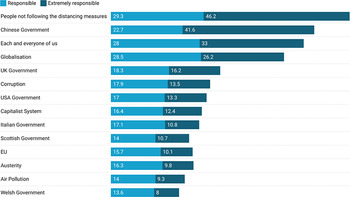
Figure 3 shows that an overwhelming majority of the British public embraced the government’s message to ‘stay at home and save lives’, identifying ‘those that do not follow the social distancing measures’ (75%) as responsible for the outbreak. The complementary message that ‘we are all in this together’ also resonated with people, with 61% blaming ‘each and every one of us’ for the pandemic. 65% of respondents blamed the Chinese government and 54% blamed globalization, while only 35% blamed the UK government. This second framing contest is operationalized in our regression through a model that includes the top five factors that participants identified as responsible for the spread of COVID-19 in the UK.
Blame attribution.

Remedies and trade-offs
The initial UK government response was to delay implementing social distancing measures. Reflecting a fatalistic frame, Johnson suggested on the ‘This Morning’ television show on 5 March that ‘one of the theories is perhaps you could take it on the chin, take it all in one go, and allow the disease, as it were, to move through the population, without taking as many draconian measures. I think we need to strike a balance’ (Simanowitz, Reference Simanowitz2020). Although Johnson never clearly advocated the ‘take it on the chin’ theory in public, this seems to have informed the government’s ‘herd immunity’ response up until the announcement of school closures on 20th March. Following public and international pressure, the UK government shifted from its delay phase to a contain phase, by introducing a number of mandated social distancing requirements on 25th March (Cabinet Office, 2020).
Johnson encouraged the acceptance of these ‘necessary’ measures in order to reduce the number of ‘victims and fatalities, and protect the NHS’ (UK Government, 2020a). The emphasis on saving lives and protecting a valued institution implied that there was no alternative. The TINA frame was not challenged by any salient mainstream actor in the UK, with political leaders rallying around the flag in the face of a perceived existential threat. Opposing the measures would likely turn any challenger into a villain, as President Ford’s political opponents found out during the 1976 USA Swine Flu crisis (Boin et al., Reference Boin, ’t Hart, Stern and Sundelius2016). Instead, the ‘crisis as opportunity’ frame attempted to point to an alternative, potentially positive, side of the emerging harsh reality, by envisioning the possibility of a better tomorrow following these dark times. For example, in a widely read and circulated article in the Financial Times in early April, novelist Arundhati Roy (Reference Roy2020) described COVID-19 as a portal, stating that ‘[h]istorically, pandemics have forced humans to break with the past and imagine their world anew. This one is no different’.
Indeed, the main frame that challenged TINA focused on criticizing the UK government for not doing more, sooner, and in a fairer way at the start of the crisis. Partly in response, on March 20, the government announced a comprehensive job retention furlough scheme, followed by a package for the self-employed workers on 26 March. Jeremy Corbyn (then leader of the Opposition) argued that the plans announced did not offer equal ‘economic security’ to everyone, with concerns for those in need of ‘sick pay, self-employed, those reliant on social security, renters, and others’ (UK Labour Party, 2020). Corbyn also criticized the introduction of limited measures tailored to the NHS, such as the lack of ‘PPE, testing and protection for social care workers’, which threatened the health of ‘key workers’ (UK Parliament, 2020).
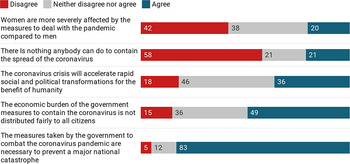
Operationalizing this framing contest in our questionnaire required careful consideration. First, we asked participants a battery of questions that corresponded to the four salient prognostic frames identified deductively in the theoretical literature and inductively in our thematic analysis. Results are presented in Figure 4. The British public overwhelmingly accepted the government’s TINA narrative (83%), but strongly rejected the fatalistic frame (58%), which seemed to have guided its initial response. At the same time, half of our respondents (49%) embraced the message that the economic burden of the introduced measures was unevenly distributed, which was mainly advocated by the Leader of the Opposition. Nearly one in two (46%) also embraced the ‘crisis as opportunity’ frame, despite this not featured in the government’s messaging. These are included in our third regression model.
Public attitudes on key crisis frames.

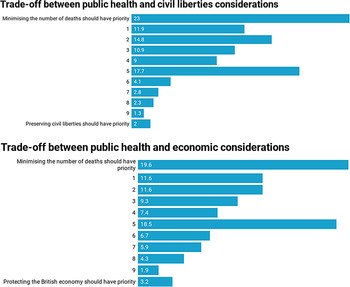
Second, we included two survey instruments to accurately capture public positioning on the perceived policy trade-offs between public health and the economy or civil liberties. Figure 5 shows that the public was strongly in favour of prioritizing public health over anything else, in line with the dominant political frames. More specifically, on a scale between these four positions, 59% and 70% of our respondents leaned towards minimizing the number of deaths, whereas only 22% and 13% believed the economy and civil liberties, respectively, should take priority. The two variables complete the model on remedies and trade-offs.
Public attitudes and perceived trade-offs.

Science and scientific expertise
This last framing contest, which cuts across the previous three, is about who has the necessary expertise and authority to inform how we understand and respond to a pandemic, as well as who takes the blame if/when things go wrong. In mid-March 2020, the WHO’s director-general stated that every possible action needs to be taken: ‘Not testing alone. Not contact tracing alone. Not quarantine alone. Not social distancing alone. Do it all’ (Boseley, Reference Boseley2020). About 400 UK-based scientists and medical experts signed an open letter in mid-March urging the government to implement more social distancing measures ‘with immediate effect’.Footnote 3 Expert advice is based on the assumption that governments are willing and capable of instigating policy change, although this advice is not always followed (Simonov et al., Reference Simonov, Sacher, Dubé and Biswas2020). The government’s testing strategy, and more specifically, the ‘pivotal’ decision on March 12 to halt community testing and retreat to testing mainly within hospitals, attracted heavy criticism, with Public Health England and the Department for Health and Social Care blaming each other (Merrick, Reference Merrick2020b). Perhaps to deflect blame, both the PM and the Foreign Secretary stressed that the government was following the guidelines of ‘world-leading scientists’ since the very beginning (UK Government 2020a, c). Beyond this, science also provides answers as to what caused the pandemic. This did not attract attention in public debates in the UK but featured in conspiracy theories and in the discourse of other leaders, with USA President Trump, for example, claiming to have seen undisclosed evidence that COVID-19 escaped from a laboratory in Wuhan, China.Footnote 4
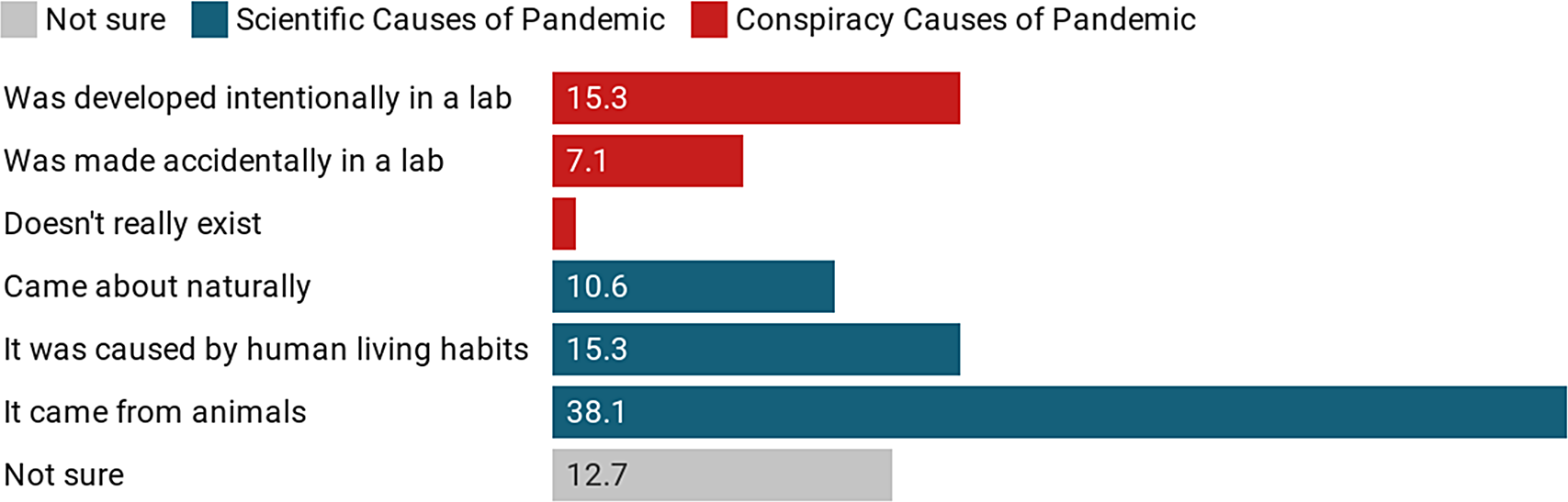
Our fourth crisis model captures these dimensions. We asked participants to indicate their trust in scientists advising the government on a 0 (no trust at all) to 10 (complete trust) scale. The median value for trust is 7, indicating a relatively high trust in them. Respondents were also asked to indicate, from what they heard or read, what they thought were the causes of the pandemic. Figure 6 shows that a majority (64%) agreed with ‘scientific’ explanations, but 24% endorsed ‘conspiracy’ theories. Our model is completed with three variables measuring broader attitudes to science, which people may use as ‘cognitive heuristics’, or ‘rules of thumb’ in the face of very high complexity (Hornsey et al., Reference Hornsey, Harris, Bain and Fielding2016, 623). Descriptively, 27% of respondents considered that science does more harm than good, while 25% considered that we believe too often in science, and not enough in feelings.Footnote 5 Attitudes to climate change are also indicative of and influenced by scientific views, with 51% believing it is completely true that climate change will, if unchecked, do great damage to the earth’s environment and only 5% finding this completely untrue.
Perceived causes of the pandemic.

Our empirical analysis allows us to compare the explanatory power of our four crisis models, to others that relate to health, economic, and political considerations, which dominated policy and academic attention at the start of the crisis. Prior studies provide established measurements of economic and political variables (e.g. Karyotis and Rüdig, Reference Karyotis and Rüdig2015), while the health model relates more specifically to the particularities of the pandemic (e.g. Lancet, Reference Lancet2020) and the prevention paradox (Rose, Reference Rose1985). The selection of what variables to include in each of our models is grounded in theory and grouped thematically. To ensure that these clusters actually exist in the minds of people and influence their thinking, we used Confirmatory Factor Analysis (CFA). This is a multivariate statistical procedure that is used to test how well the measured variables represent the number of constructs, predicting the patterns of correlations in our observations and question items. Results of the CFA (in the Appendix) indicate that each item included is a significant component of the model (stat. significant P < 0.001). The Root Mean Square Error of Approximation (RMSEA) is 0.087 and 0.071 for the Socio-Political (health, economic and political constructs) and Crisis Management Models (Severity and Nature, Blame Attribution, Remedies and Trade-Offs, Science and Scientific Expertise constructs), respectively. Values are below 0.1, which is the cut-off value for a reasonably good fit of the data to the specific, theory-derived measurement model. Thus, we are confident that each item included is a significant component of the model and that models are consistent with the theory.
The drivers of support for social distancing
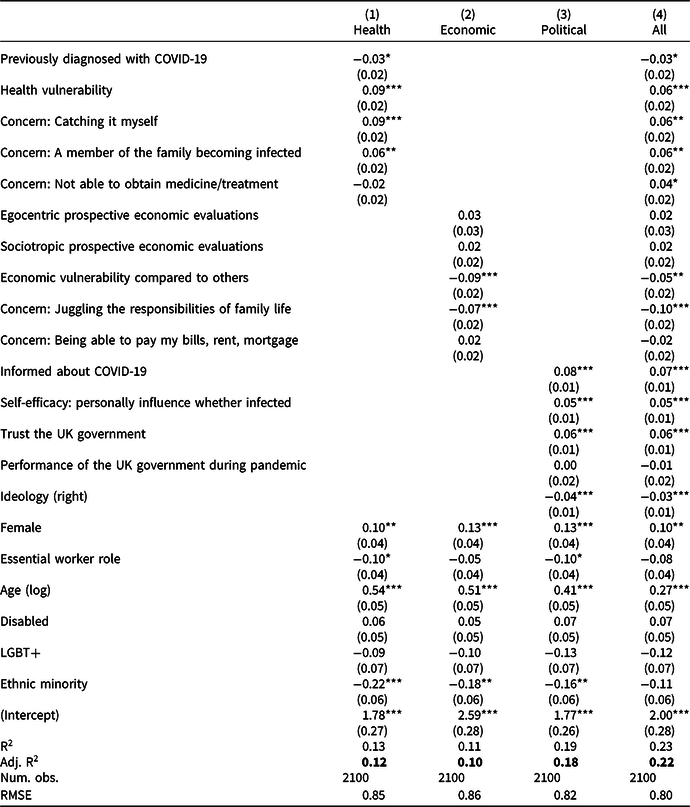
Academic and policy attention has mainly pointed towards personal circumstances and socio-economic factors to predict support for social distancing, which our data allows us to test using a series of OLS models. Before turning our attention to crisis framing dynamics, in Table 1 we present a comprehensive socio-economic model, constituted by separate health, economic and political sub-models. The coefficients obtained in these are large as expected from the literature. First, the prevention paradox is confirmed (Rose, Reference Rose1985), with people already diagnosed with COVID-19 being statistically less likely to support the lockdown. Health vulnerability and concern about one’s self or a member of one’s family catching the virus increases support for measures, with health variables shown robustness to the addition of economic and political variables (as shown in the final column in Table 1). Second, the economic model confirms that people with caring responsibilities and those that feel economically more vulnerable than others are significantly less likely to support the measures. Concerns over paying bills and prospective evaluations about personal and national economic circumstances do not impact on attitudes. Third, people who consider that they can personally influence whether they get infected, are better informed about the pandemic crisis and trust the British government, are significantly more likely to support the measures – evaluations about its performance in managing the pandemic make no difference, at this early stage. Untypically, it is left, and not right wing, ideology that increases public support for draconian measures in the face of a public health emergency, which requires sacrifices for the collective good. This, and questions about the perceived efficacy, not only of individuals, but also of specific policy measures (e.g. wearing masks) should be explored in future research.
Socio-economic predictors of support for social distancing

Signif. codes: * 0.05, ** 0.01, *** 0.001.
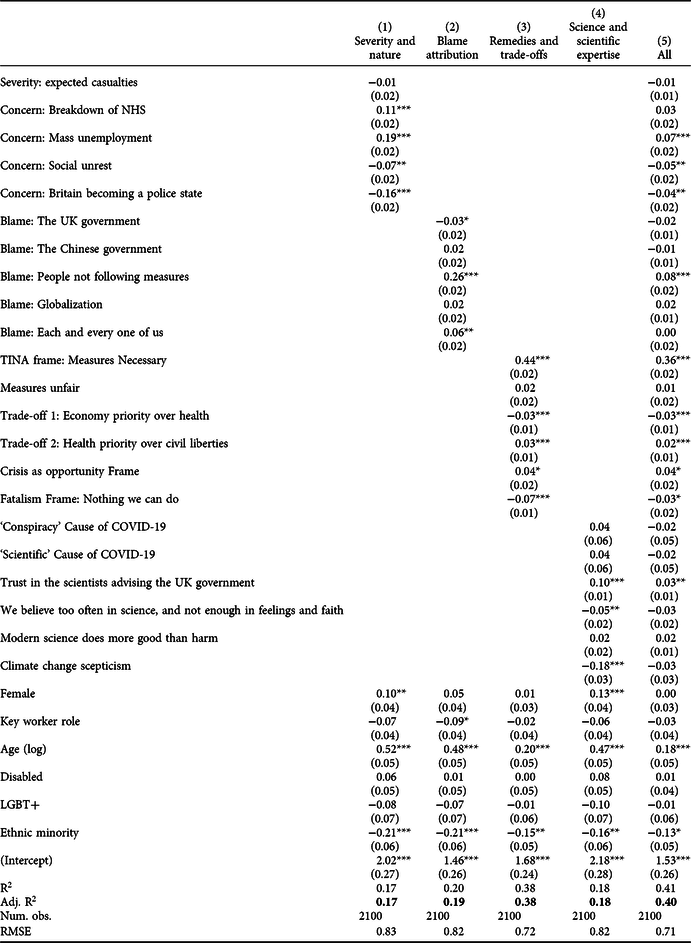
Overall, the adjusted R2 in Table 1 indicates that 12% of the variation of the dependent variable is explained by health factors, 10% by economic, and 18% by political considerations. Taken together, the socio-economic model explains only 22% of the variation in support for the lockdown, indicating that other factors also play an important role in shaping support for social distancing. Our theoretical expectation is that framing may account for some of the missing variances. Table 2 presents a Crisis Management composite model, consisted of four sub-models, each corresponding to the four framing contests discussed earlier.
Crisis management theory predictors of support for social distancing

Signif. codes: * 0.05, ** 0.01, *** 0.001.
Starting with the Nature and Severity model, coefficients show that people who see the crisis as a threat that may overwhelm the NHS or increase unemployment, are significantly more likely to support the measures. On the other hand, those concerned about social unrest or Britain becoming a police state, are significantly more likely to oppose them. Interestingly, concern over the NHS is not a robust predictor of public attitudes, as the last column in Table 2 shows, which indicates that a central element in the government’s crisis communications failed to register with the public. The number of expected deaths, as a proxy for the crisis’ objective severity, has no impact on public attitudes on the lockdown, confirming our hypothesis. Overall, the adjusted R2 of the model indicates that it explains 17% of the variance of our dependent variable.
Personal responsibility allocated to people not following social distancing has the strongest positive effect in explaining support for social distancing measures in the Blame Attribution model, in line with the government’s key messaging. Individuals who assign high levels of blame to each member of society also show significantly more support for social distancing measures. As expected, those blaming the UK government are less likely to support social distancing, but this finding is not robust to the addition of other explanations and control variables at this early stage of the crisis. On the other hand, exogenizing blame to the Chinese government or globalization, does not impact on public attitudes, arguably because such frames were neither as salient nor as weaponized in UK political debates, as was, for instance, the case in the USA. Overall, these results suggest that levels of support are higher amongst individuals, who shifted the government’s responsibility to the individuals in society. The R2 indicates that the model explains 19% of the variation of the dependent variable.
The third framing contest (the remedies and perceived trade-offs required to contain the pandemic) holds, by far, the strongest explanatory power, explaining 38% of the variance in our dependent variable. Our regression analysis shows that the perceived necessity of measures plays the biggest role in driving support, while the fairness frame, invoked by the opposition party mainly, does not make any statistical difference. This replicates findings from the Eurozone crisis and is in line with securitization theory (Karyotis and Rüdig, Reference Karyotis and Rüdig2015). Those who see the crisis as an opportunity are significantly more likely to support social distancing measures, while the ‘fatalist’ frame decreases the level of support for social distancing. Both of the perceived trade-offs are statistically significant, confirming that people are less likely to support social distancing measures when they consider that the state of the economy or the protection of civil liberties should be prioritized over the health of the population. All these variables are robust to the addition of other explanations and control variables, as shown in the last column of Table 2.
Lastly, the scientific model explains 18% of the variance of our dependent variable, more than both the health and economic models (see Table 1). Contrary to expectations, perceptions about the causes of the pandemic, scientific, or conspiracy ones, have no impact on public support for social distancing, likely because they were largely absent in UK debates, unlike the USA. Our results also show that climate change sceptics, and those privileging faith over science, are significantly less likely to support government measures. However, once control variables and other framing contests are taken into account, the only variable from this model that remains robust in its effect is whether people trust the scientists advising the UK government: those who do so are significantly more likely to support the social distancing measures, as hypothesized.
As shown in Tables 1 and 2, the demographics of age, gender, and ethnicity, produces consistent and statistically significant results that are in line with the expectations derived from the literature. Older people and females are more likely to support government measures (Lancet, Reference Lancet2020) but those from an ethnic minority background are less likely to do so (Van Scoy et al., Reference Van Scoy, Green, Witt, Bramble, Richardson, Putzig, Toyobo, Wasserman, Chinchilli, Tucci and Levi2020). Interestingly, key workers are less supportive of social distancing measures, but the effect loses its significance in some models, indicating that variation in support for the lockdown from key workers is contingent on other factors.
Overall, our findings highlight the importance of the previously unexplored significance of framing contests around the nature, severity, and appropriate response to a crisis in shaping public attitudes, and in this case, driving support for social distancing. The crisis management framing comprehensive model has an adjusted R2 twice the size of that of the socio-economic model (0.40 and 0.20, respectively), indicating that it offers a better fit. This is further corroborated by the Akaike Information Criterion and a series of goodness of fit tests (see Table A3 and A4 in the Appendix) which, in all cases, indicate that the crisis management model represents a significant improvement over the other models. Our results are not driven by any possible problem of multicollinearity between predictors, since the Variance Inflation Factor present in all cases, values closer to 1 (absence of multicollinearity) and smaller than 5 (problematic levels of multicollinearity between variables in the model), as can be observed in Table A5 in the Appendix.
Conclusion
This article sought to explore the drivers of support for social distancing, using the UK as a case study. While our analysis confirms the influence of a range of health, socio-economic and political factors, we show that framing dynamics around key framing contests drive public attitudes, more than anything else. This empirically demonstrates that socially constructed narratives impact policy outcomes and play a crucial, but underappreciated, role in the effectiveness of responses to COVID-19 (Mintrom and O’Connor, Reference Mintrom and O’Connor2020). In line with theoretical expectations, we find that perceptions about the nature and severity of the threat influence public attitudes more than objective considerations (Buzan et al., Reference Buzan, Wæver and De Wilde1998). Interestingly, placing not only ‘public health’ but also ‘employment’ as the referent object that is to be protected, enhances support for measures in the UK. This implies that health and the economy are not inherently understood as a trade-off during the pandemic. It is only when they are presented as such in discourse that they drive attitudes in antithetical directions. Counter-securitization frames about the lockdown posing a greater threat to the economy or civil liberties may, however, find fertile ground to develop during a protracted crisis, unless governments are able to construct, and sustain, convincing narratives about the nature/severity, responsibility for escalation, and appropriate response to the pandemic.
Our analysis shows that the UK government’s initial fatalistic messaging (‘herd immunity’) had a detrimental and lasting effect on support for later-mandated measures. However, once it adopted securitizing rhetoric, and with other actors rallying around the flag, its key diagnostic and, especially, its prognostic frames resonated with the public and drove support for social distancing. Its core message, about the necessity to ‘stay home’ to ‘save lives’, was particularly effective in mobilizing public support, alongside its frame emphasizing personal responsibility, as a positive incentive to support a common good. Its other key message, however, about the need to ‘protect the NHS’, as a secondary referent object, failed to impact on attitudes. This may plausibly be attributed to the inability of the government to ‘practice what it preached’, by ensuring, at the very least, that sufficient personal protective equipment (PPE) is available for NHS staff. As Mintrom and O’Connor (Reference Mintrom and O’Connor2020, 218) note, ‘No matter how compelling a narrative is and how engaging the delivery, if the policies that are implemented contradict that narrative, then trust and cooperation will wane’. Policy failures and contradictions may therefore undermine the ability of governments to maintain public support, especially as the crisis deepens.
The British case is atypical in that demands for securitization emerged from the bottom-up, with the government delaying the adoption of extraordinary measures to contain the spread of COVID-19. In a globalized world, the public may exert upward pressure or be influenced by external debates, as, for example, indicated by the high percentage of Brits blaming the Chinese Government or agreeing with conspiracy theories that the virus escaped from a lab in Wuhan. However, neither of these, nor the frame promoted by political opponents that the measures were unfair, had any impact on driving public attitudes. The only prognostic frame that did not feature in political debates at the start of the crisis but which, we find, predicts support for social distancing is the ‘crisis as opportunity’ frame. Such a message, if invoked by governments successfully as another form of positive incentivization, may be a particularly effective framing strategy to enhance continuing support for measures during a prolonged crisis. These findings resonate with the literatures on crisis management and securitization theory that governmental elites are best positioned to shape security attitudes, at least at the start of a crisis (e.g. Buzan et al., Reference Buzan, Wæver and De Wilde1998; Boin et al., Reference Boin, ’t Hart, Stern and Sundelius2016).
Overall, our analysis strengthens the case for further research on how elite frames and narratives influence public attitudes during a crisis, to fully understand the dynamics of crisis communication and identify causal pathways, which likely requires panel data. Employing mixed methods, as proposed in this article, provides us with the required tools to examine both the salience and resonance of framing contests, in a specific context. Finally, future research may fruitfully explore how attitudes to science influence political behaviour, not only because trusting the scientists advising the government is shown to have a significant effect in enhancing public support for social distancing but also because this area is perhaps emerging as a new cleavage in the Western world, which may be particularly politicized during the COVID-19 pandemic.
Acknowledgements
A previous version of this paper was presented at the Government Department’s speaker series at the University of Essex on 26 January 2021. We are grateful to workshop participants and to the journal’s anonymous reviewers for their invaluable feedback, as well as to Alastair Stark, Allan McConnell, Paul Whiteley, and Martin Boon, for constructive advice. Financial support for this research was provided by the Universities of Newcastle, Strathclyde, and West of Scotland. For project details, please see www.PandemicPolitics.net.
Supplementary Material
To view supplementary material for this article, please visit https://doi.org/10.1017/S1755773921000205.
Georgios Karyotis is Professor of Security Politics at the University of Glasgow. His research follows contemporary crises, drawing on securitisation theory, political behaviour and framing theories. He has studied protest and voting behaviour in the context of the Eurozone crisis (see www.AusterityPolitics.net), citizens’ attitudes and refugees’ lived experiences during the migration crisis (see www.RefugeePolitics.net) and, currently, public attitudes during the COVID-19 pandemic (see www.PandemicPolitics.net).
John Connolly is a Professor in Public Policy at the University of the West of Scotland. He researches and publishes in the areas of governance reform and crisis management, particularly in the context of public health. He also researches public value and management in the context of British and European governance. He is the Editor of Contemporary Social Science academic journal.
Dr Sofia Collignon is a Lecturer in Political Communication and Deputy Director of the New Political Communication Unit at Royal Holloway, University of London. Her main research interests include a) the effects of public opinion in the formation of public policy, b) the study of candidates, elections and parties and c) harassment and intimidation of political elites. Her research is comparative and she uses mainly quantitative methods. Her work has been published in Electoral Studies, Party Politics and West European Politics, among other leading academic journals.
Andrew Judge is a Lecturer in International Relations at the University of Glasgow. His research focuses on securitisation theory, energy security, crisis governance and European Union policymaking, particularly in the energy sector.
Iakovos Makropoulos is a Research Assistant at University of Strathclyde working on the Representative Audit of Britain project currently conducting the 2019 candidate survey. His main research interests are political behaviour, comparative politics and political methodology
Wolfgang Rüdig is Reader in Politics at the University of Strathclyde, Glasgow, Scotland. His main research interest is the study of political behaviour, in particular election candidates, party members and protest participants.
Dr Dimitris Skleparis is Lecturer in the Politics of Security at Newcastle University. He received his PhD in Political Science from Queen Mary University of London (2015) with a specialisation in the securitisation of migration and the politics of migrant activism. Dimitris’s research focuses on the dynamics between security discourse and practice and their human impact. He approaches these issues from an interdisciplinary, and mixed methods standpoint. He has published in a range of international peer-reviewed journals and has contributed to several edited volumes, research project reports, and policy briefs.