Implications
The results of this study show that changing the breeding policy on hill flocks by using Cheviot, Lleyn or Texel sires rather than Blackface sires to produce replacement females will lead to significant increases in carcass weight and carcass conformation score of lambs sourced from hill sheep flocks. Using crossbred ewes did not benefit live weight gain or feed conversion efficiency, which may limit the environmental benefits for hill flocks, in terms of reducing greenhouse gas emissions. Including oilseed rape in lamb finishing diets had only minor negative effects on carcass weight and fat content. In comparison, feeding fish oil or grass pellets reduced lamb growth rate and carcass weight considerably, which in practice could make these feeding options economically unviable.
Introduction
The hill sheep sector is a major contributor to lamb production in Europe. Within the EU-25, >90% of breeding ewes are located within less favoured areas (European Commission, 2006), whereas in Great Britain, almost 60% of lambs slaughtered originate from hill flocks (Pollott and Stone, Reference Pollott and Stone2006). Consequently, breeding and management decisions taken by hill sheep producers have a significant impact on the EU sheepmeat industry as a whole.
The hill sheep sectors of the United Kingdom and Ireland are dominated by ewes of hill-breed types, predominantly the Scottish Blackface (BF) and Welsh Mountain, which are mainly bred pure (Pollott and Stone, Reference Pollott and Stone2006). However, lamb output from purebred hill flocks is often constrained by poor reproductive performance of hill-breed ewes alongside low growth rates of the purebred lambs (Carson et al., Reference Carson, Irwin and Kilpatrick2001a). Long-term economic pressures combined with recent policy changes throughout Europe have increased interest among hill sheep producers in using crossbred ewes to address these issues. A major on-farm research programme, which evaluated a range of crossbred ewe genotypes on commercial hill flocks, has identified improvements in weaned lamb output by up to 15% (0.18 lambs per ewe mated) by using crossbred rather than pure BF ewes (Annett et al., Reference Annett, Carson, Dawson, Irwin and Kilpatrick2011). However, changing the breeding structure of hill flocks has important implications for lamb growth and carcass characteristics. The effects of sire breed (McClinton and Carson, Reference McClinton and Carson2000; Dawson and Carson, Reference Dawson and Carson2002; Dawson et al., Reference Dawson, Carson, McClinton, Kilpatrick and Moss2003) and dam breed (Dawson and Carson, Reference Dawson and Carson2002; Dawson et al., Reference Dawson, Carson, McClinton, Kilpatrick and Moss2003, Afolayan et al., Reference Afolayan, Fogarty, Ingham, Gilmour, Gaunt, Cummins and Pollard2007) on lamb growth and carcass characteristics have been extensively studied within lowland-breed flocks. Sire breed has also been shown to influence carcass quality in hill-breed lambs (Carson et al., Reference Carson, Moss, Dawson and Kilpatrick2001b; McLean et al., Reference McLean, Davies, Evans and Wolf2006; Speijers et al., Reference Speijers, Carson, Dawson and Gordon2009) but studies comparing hill-breed dams are few in number and largely limited to purebred stocks (Carson et al., Reference Carson, Moss, Dawson and Kilpatrick2001b; van Heelsum et al., Reference van Heelsum, Lewis, Davis and Haresign2003). Therefore, a key aim of this study was to investigate growth, feed efficiency and carcass characteristics of lambs sourced from crossbred hill ewes.
Intake of long chain polyunsaturated fatty acids (PUFA) of the n-3 series, such as eicosapentaenoic acid (EPA, 20:5n-3) and docosahexaenoic acid (DHA, 22:6n-3), has been linked with a lower risk of coronary heart disease in humans (Department of Health, 1994) and it is now widely accepted that intake of these fatty acids should increase. Sheep meat has a higher fat content than most other proteins sources and contains lower levels of PUFA compared with pork or fish (Enser et al., Reference Enser, Hallet, Hewitt, Fursey and Wood1996). However, there is some scope to increase the n-3 PUFA content of lamb meat by inclusion of whole oilseeds (e.g. linseed) or fish oil in lamb finishing diets (Wachira et al., Reference Wachira, Sinclair, Wilkinson, Enser, Wood and Fisher2002; Demirel et al., Reference Demirel, Wachira, Sinclair, Wilkinson, Wood and Enser2004). A significant amount of research has focused on the benefits of lipid supplementation on the PUFA content of lamb meat but its effects on animal performance and carcass composition, which are of greatest economic importance, have received little attention. Supplementing ewes with fish oil during pregnancy and lactation has been shown to improve neonatal lamb vigour (Capper et al., Reference Capper, Wilkinson, MacKenzie and Sinclair2006) but depresses milk yield and fat concentration (Annett et al., Reference Annett, Carson and Dawson2008 and Reference Annett, Dawson, Edgar and Carson2009), which can reduce growth rate of their lambs (Capper et al., Reference Capper, Wilkinson, MacKenzie and Sinclair2007; Annett et al., Reference Annett, Carson and Dawson2008). There is also evidence that PUFA supplementation can reduce dry matter intake (DMI) in sheep (Annett et al., Reference Annett, Carson and Dawson2008), which could further impinge on lamb growth and make these feeding strategies uneconomical. Therefore, a second objective of this study was to investigate the effect of dietary lipid source on lamb performance and carcass quality.
Material and methods
Animals
This study was carried out over a 2-year period (2004 and 2005) using 305 entire male (157 in year 1 and 148 in year 2) and 283 female (132 in year 1 and 151 in year 2) lambs. The lambs were sourced from six hill flocks (75 to 116 per farm) participating in an on-farm research programme to investigate the merits of using crossbred ewes in the hill sheep sector. Details of the sires and dams of these lambs were reported by Annett et al. (Reference Annett, Carson, Dawson, Irwin and Kilpatrick2011). Lambs were the progeny of one of five crossbred (1 : 1) ewe genotypes – BF (BF × BF), Swaledale (SW) × BF, North Country Cheviot (CH) × BF, Lleyn(LL) × BF and Texel (T) × BF. In year 1, all lambs were sired by either T or Dorset rams, whereas in year 2, lambs were sired by T, Dorset and LL rams. All of the lamb sires were from UK genetic improvement programmes and represented the top 25% of recorded sires for each breed.
Lambs within a target weight range of 25 to 30 kg were pre-selected for the study approximately 1 month before weaning. After weaning at 133 ± 9.5 days old, lambs were moved to the Agri-Food and Biosciences Institute, Hillsborough, where they were housed in slatted pens and offered grass pellets (GP) ad libitum during a 3-week acclimatisation period. During this period the lambs were walked through a zinc sulphate foot bath for three consecutive days, given a clostridial vaccine (Heptavac-P Plus, Intervet UK Ltd, Milton Keynes, UK) and treated with an injectable ivermectin (Cydectin, Fort Dodge Animal Health, Southampton, UK) to control internal and external parasites.
Treatments
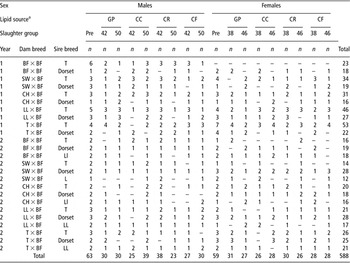
Prior to commencing the study, a representative sample of all lamb genotypes, comprising 63 entire male (n = 31 in year 1 and n = 32 in year 2) and 59 female (n = 29 in year 1 and n = 30 in year 2) lambs aged 172 ± 15.1 days and weighing 33 ± 6.0 kg, were randomly selected from across all farms and slaughtered to enable initial carcass weight of experimental lambs to be estimated. All remaining lambs were randomly allocated to one of four treatment groups (n = 57 to 58 per treatment in year 1 and n = 56 to 61 per treatment in year 2) balanced for live weight, genotype and sex as much as possible. Finally, within each genotype and treatment group, entire male lambs were randomly allocated for slaughter at either 42 or 50 kg live weight, and female lambs at 38 or 46 kg live weight. Details of the number and genotype of the lambs in each dietary treatment are presented in Table 1.
Number of lambs of each sex and genotype allocated to each treatment and slaughter group over the 2-year study

GP = grass pellets; CC = cereal-based concentrate; CR = CC enriched with oilseed rape; CF = CC enriched with fish oil; BF = Blackface; SW = Swaledale; CH = Cheviot; LL = Lleyn; T = Texel.
a100% dried GP; 100% CC; 100% CR and 100% CF.
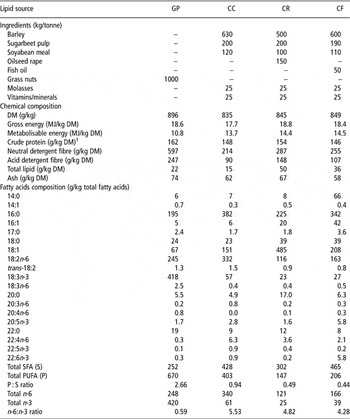
Four treatment diets containing different sources of long chain PUFA were investigated: GP, cereal-based concentrate (CC), CC enriched with full-fat oilseed rape (CR) and CC enriched with fish oil (CF). The ingredient and chemical composition of these concentrates are described in Table 2. Fish oil used in the concentrates originated from white fish species (mainly herring and mackerel) caught in the North Atlantic (United Fish Industries Ltd, Killybegs, Co., Donegal, Ireland). All diets were in a pelleted form and were offered ad libitum (10% refusal rate) throughout the study. Lambs were also offered 25 g/head per day chopped straw to reduce the risk of acidosis. Within each treatment, lambs of the same sex were housed in groups of four to six lambs per pen, with at least two lambs from each slaughter group in the same pen.
Ingredients and chemical composition of experimental diets

GP = grass pellets; CC = cereal-based concentrate; CR = CC enriched with oilseed rape; CF = CC enriched with fish oil; DM = dry matter; SFA = saturated fatty acids; PUFA = polyunsaturated fatty acids.
1Total nitrogen × 6.25.
Measurements
Concentrate intake was recorded daily for each pen throughout the study and used to estimate individual food intake. Representative samples of fresh concentrates were bulked daily and analysed weekly for oven dry matter (DM), total lipid and fatty acid concentrations. Dried concentrate samples were milled through a 1 mm screen and analysed for gross energy (GE), total nitrogen (N), neutral detergent fibre (NDF), acid detergent fibre (ADF) and ash concentrations. Metabolisable energy (ME) concentration of each diet was estimated from the absorption of GE in four castrated male sheep (60 ± 5.7 kg) fed at maintenance energy level (Steen, Reference Steen1986). Food intake and the outputs of urine and faeces were recorded and bulked daily for 6 days. After thorough mixing, representative samples of fresh concentrates and faeces were dried at 100°C, milled through a 1 mm screen and analysed for GE concentration. Representative samples of fresh urine were also analysed for GE concentration. ME concentration was then calculated using the equations of the Agriculture and Food Research Council (AFRC, 1993) and assumed methane energy output was equivalent to 0.06 × GE intake (Blaxter and Clapperton, Reference Blaxter and Clapperton1965).
Lambs were weighed weekly (to the nearest 0.5 kg) throughout the study and were slaughtered at a local abattoir within 48 h of reaching their allocated slaughter weight (± 1 kg live weight). Lambs were stunned, eviscerated and skinned and the carcasses were graded for conformation, using the EUROP classification system (E = excellent and P = poor conformation) and fat cover (1 = low and 5 = very high fat cover; Commission Regulation (EC) No. 1249/2008 and 461/93). Carcasses were then chilled at 4°C for 48 h. Following chilling, cold carcass weight was recorded and expressed relative to the pre-slaughter live weight to determine carcass-dressing proportion. Linear measurements of carcass length, depth of chest, width of shoulder and circumference of the buttocks were recorded to the nearest millimetre using the methods described by Fisher and de Boer (Reference Fisher and de Boer1994).
Carcasses were split into three sections by making two cuts in a transverse plane (i) separating the leg from the loin and (ii) between the 12th and 13th ribs, separating the bracelet from the loin (United States Department of Agriculture, 1996). Subcutaneous fat and tissue depth measurements were then recorded to the nearest 0.01 mm using a digital vernier caliper (Sealey, Bury St Edmunds, UK). Subcutaneous fat depth was measured at the bracelet–loin separation and perpendicular to the carcass outer surface (i) above the eye muscle (Longissimus dorsi) 50 mm from the mid-dorsal line and (ii) immediately lateral to the Iliocostalis thoracis muscle. Fat depth was also recorded at the loin–leg separation and perpendicular to the carcass outer surface (i) above the Gluteus medius muscle 35 mm from the mid-dorsal line and (ii) at the dorsal edge of the Obliquus internus abdominis muscle. Total tissue depth over the 12th and 13th rib, 110 mm from the mid-dorsal line, was also measured. Perinephric and retroperitoneal (PR) fat was removed and weighed.
Chemical analysis
GE, total N and ash concentrations in urine, faeces and concentrate samples were measured using the methods described by Speijers et al. (Reference Speijers, Carson, Dawson and Gordon2009), with total N expressed as crude protein (CP; 6.25 × total N). The NDF and ADF contents of concentrate samples were determined using the methods of Speijers et al. (Reference Speijers, Carson, Dawson and Gordon2009). All NDF analyses were carried out using both α-amylase and sodium sulphite in the assay (ISO 16472:2006) and values are expressed exclusive of residual ash. Total lipid concentration of the concentrates was determined after acid hydrolysis by boiling a 3 g sample in hydrochloric acid for 60 min. Lipid was then extracted by boiling with petroleum ether using the method described by Sanderson (Reference Sanderson1986). For determination of fatty acid composition, methyl esters of the fatty acids were prepared using boron trifluoride–methanol solution (Morrison and Smith, Reference Morrison and Smith1964). These were then separated on a gas chromatograph (model 3600; Varian Associates Inc. Chromatograph Systems, Palo Alto, CA, USA) fitted with a capillary column (Rtx-2330, 105 m × 0.25 mm i.d.; Restek Corporation, Bellefonte, PA, USA) using helium as a carrier. The initial temperature of 140°C was increased at 2°C per min to a maximum of 220°C. Individual gas chromatogram peaks were determined against a standard mixture (Supelco, Sigma-Aldrich Ltd, Dorset, UK).
Statistical analysis
Daily live weight gain (LWG) of each lamb was determined by linear regression of the individual live weight data from the start of the experiment until slaughter. Within the pre-slaughter group, carcass-dressing proportion was calculated for each lamb genotype. These data were then used to predict initial carcass weight and carcass weight gain (CWG) of the experimental lambs. For statistical analysis, conformation grade and fat class were converted to numerical values using a 5-point scoring system for conformation (E = 5, U = 4, R = 3, O = 2 and P = 1) and a 6-point scoring system for fat (1 = 1, 2 = 2, 3 = 3, 4L = 4, 4H = 4.5 and 5 = 5).
All data were analysed using Genstat (2009). Mean values were predicted for lambs slaughtered at a constant 20 kg cold carcass weight and fat score 3 to represent the different criteria used commercially to select lambs for slaughter. Data from seven lambs that died during the experiment (two from treatment GP, one from treatment CC and four from treatment CF) were treated as missing values in the analysis. Owing to the unbalanced nature of the design, residual maximum likelihood (REML) analysis was used to analyse linear mixed models for continuous variables. LWG, CWG, cold carcass weight, CS, dressing proportion, carcass linear measurements and fat depth data were analysed with the following fixed model: year + farm of origin + sire breed + sex + cold carcass weight (or fat score, depending on the endpoint) + dam breed + lipid source + dam breed × lipid source, with individual animal data as the experimental unit. Days to slaughter data were analysed by REML using the same model outlined above but included initial live weight as an additional covariate. Intake and feed efficiency data were analysed by REML using a fixed model for farm of origin + sire breed + sex + cold carcass weight (or fat score) + dam breed + lipid source + dam breed × lipid source and included year/pen as the random model to account for pen as the experimental unit. Where treatment effects were significant (P < 0.05), pairs of means were compared using the least significant difference (LSD).
Carcass classification data were analysed with generalised linear mixed models, assuming a binomial distribution with a logit-link function, with fitted fixed effects for year + farm of origin + sire breed + sex + cold carcass weight (or fat score) + dam breed × lipid source. Where effects were significant, Student's t-probabilities of all pairwise comparisons were used to test for significant differences between treatments.
The main objective of this study was to investigate effects of dam breed and lipid source on lamb growth and carcass characteristics. The effects of year, farm of origin, lamb sex and sire breed, although included in statistical models, are not presented in this paper. The results presented are means for the main treatment effects of dam breed and lipid source, together with their interactions where these are significant.
Results
Diets
The ingredient composition, chemical composition and fatty acids composition of the treatment diets are presented in Table 2. GP had a lower ME concentration and supplied higher levels of ADF, NDF and CP than the cereal-based diets (CC, CR and CF). Inclusion of full-fat oilseed rape or fish oil increased total lipid content of the cereal-based diets by 35 and 21 g/kg DM, respectively and increased ME concentration by 0.7 and 0.8 MJ/kg DM, respectively. The principle fatty acids in CC were palmitic acid (16:0) and linoleic acid (18:2n-6). Inclusion of oilseed rape (CR) increased the level of oleic acid (18:1) by 3.21 but reduced levels of 18:2n-6, α-linolenic acid (18:3n-3), EPA (20:5n-3), docosapentaenoic acid (DPA, 22:5n-3) DHA (22:6n-3), total n-3 and total n-6 to proportionately 0.35, 0.40, 0.56, 0.39, 0.24, 0.41 and 0.36 of the levels in CC, respectively. Fish oil inclusion (CF) reduced 18:2n-6, 18:3n-3, 22:5n-3, total n-3 and total n-6 to proportionately 0.49, 0.47, 0.26, 0.63 and 0.49 of levels in CC, respectively but increased the levels of 18:1, 20:5n-3 and 22:6n-3 by 1.37, 2.10 and 6.1, respectively. GP contained the highest levels of 18:3n-3, 18:3n-6 and 20:4n-6 (arachidonic acid), and had the lowest n-6 : n-3 ratio of all the diets fed.
LWG and CWG
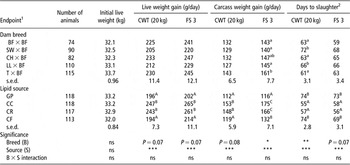
Dam breed had no significant effect on LWG during the finishing period (Table 3), although there was a tendency at both endpoints for lambs with SW × BF dams to have lower (P = 0.07) weight gains than those from CH × BF dams. Lambs from T × BF ewes, slaughtered at fat score 3, achieved a higher (P < 0.05) average CWG compared with BF × BF, SW × BF or LL × BF. For lambs slaughtered at a constant carcass weight, lambs with SW × BF and LL × BF dams required a longer (P < 0.01) finishing period than those with BF × BF, CH × BF or T × BF dams. At both endpoints, lambs fed CC and CR had higher LWG (P < 0.001), higher CWG (P < 0.001) and were slaughtered up to 19 days earlier (P < 0.001) than those fed GP or CF. When lambs were slaughtered at fat score 3, lambs fed CF achieved a higher CWG (P < 0.001) than those fed GP.
Effects of dam breed and lipid source on slaughter weight, growth rate and days to slaughter

CWT = cold carcass weight; FS = fat score; BF = Blackface; SW = Swaledale; CH = Cheviot; LL = Lleyn; T = Texel; GP = grass pellets; CC = cereal-based concentrate; CR = CC enriched with oilseed rape; CF = CC enriched with fish oil.
Means within the same column sharing the same letter in their superscript are not significantly different (P > 0.05).
1Endpoints taken at a 20 kg CWT and FS 3.
2Corrected for differences in initial live weight.
Feed intake and feed conversion efficiency
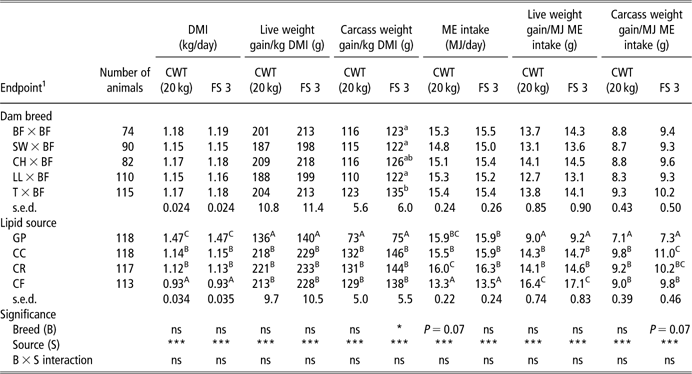
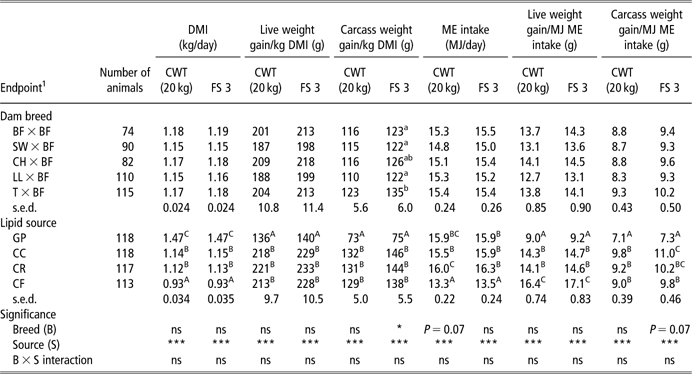
Dam breed had no effects on DMI, ME intake (MEI) or feed conversion efficiency (Table 4). However, as a result of their superior CWG, lambs from T × BF dams slaughtered at fat score 3 achieved a higher (P < 0.05) CWG per kg DMI compared with those with BF × BF, SW × BF or LL × BF dams, and tended (P = 0.07) to have higher CWG per MJ MEI than lambs from these dam breeds. Treatment diet had significant effects on DM intake (GP > CC = CR > CF; P < 0.001), LWG/kg DMI (CC = CR = CF > GP; P < 0.001), CWG/kg DMI (CC = CR = CF > GP; P < 0.001), MEI (GP = CC = CR > CF; P < 0.001) and LWG/MJ MEI (CF > CC = CR > GP; P < 0.001) at both endpoints. CWG per MJ MEI was lower (P < 0.001) for lambs fed GP compared with the cereal-based diets and was higher (P < 0.001) for lambs fed CC compared with CF.
Effects of dam breed and lipid source on DMI and feed conversion efficiencies
DMI = dry matter intake; ME = metabolisable energy; CWT = cold carcass weight; FS = fat score; BF = Blackface; SW = Swaledale; CH = Cheviot; LL = Lleyn; T = Texel; GP = grass pellets; CC = cereal-based concentrate; CR = CC enriched with oilseed rape; CF = CC enriched with fish oil.
Means within the same column sharing the same letter in their superscript are not significantly different (P > 0.05).
1Endpoint taken at a 20 kg CWT and FS 3.
Carcass weight, conformation, dressing proportion and linear traits
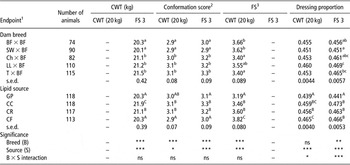
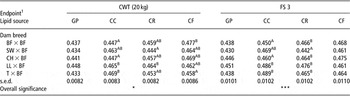
At a fat score 3 endpoint, lambs from BF × BF and SW × BF dams produced lighter (P < 0.001) carcasses with a lower (P < 0.001) CS than those from CH × BF, LL × BF or T × BF dams (Table 5). When lambs were slaughtered at a constant carcass weight, these breed differences in conformation remained, and carcass fat score was higher (P < 0.001) in lambs from BF × BF and SW × BF dams compared with CH × BF or T × BF dams. At both endpoints, lambs fed CF produced lighter (P < 0.001) carcasses with a lower (P < 0.001) CS than those fed CC or CR. Cold carcass weight at fat score 3 was higher (P < 0.001) in lambs fed CC compared with CR. When slaughtered at 20 kg carcass weight, GP lambs had the lowest (P < 0.001) fat scores of all treatment diets. Inclusion of fish oil within the cereal-based diets led to a 0.22 to 0.36 increase (P < 0.001) in carcass fat score. At both endpoints, a significant dam breed × lipid source interaction revealed that dam breed had no effect on the dressing proportion of lambs fed GP (Table 6). However, lambs from LL × BF and T × BF dams fed CC achieved a higher dressing proportion than those from BF × BF or CH × BF dams. Lambs from SW × BF fed CR achieved a lower (P < 0.001) dressing proportion than all other dam breeds when lambs were slaughtered at fat score 3; however, when adjusted to a constant carcass weight, dressing proportion of SW × BF dams was lower (P < 0.05) than LL × BF dams only. Dam breed had no effect on the dressing proportion of lambs fed CF when lambs were slaughtered at a constant fat score. However, lambs from BF × BF dams fed CF and slaughtered at a constant carcass weight achieved a higher (P < 0.05) dressing proportion than T × BF.
Effects of dam breed and lipid source on carcass weight, conformation score, FS and dressing proportion

FS = fat score; CWT = cold carcass weight; BF = Blackface; SW = Swaledale; CH = Cheviot; LL = Lleyn; T = Texel; GP = grass pellets; CC = cereal-based concentrate; CR = CC enriched with oilseed rape; CF = CC enriched with fish oil.
Means within the same column sharing the same letter in their superscript are not significantly different (P > 0.05).
1Endpoint taken at a 20 kg CWT and FS 3.
2Carcass conformation scored on a 5-point scale based on the EUROP classification system (E = 5, U = 4, R = 3, O = 2 and P = 1).
3Carcass FS on a 6-point scale (1 = 1, 2 = 2, 3 = 3, 4L = 4, 4H = 4.5 and 5 = 5).
Interactions of dam breed and lipid source for carcass dressing proportion

CWT = cold carcass weight; FS = fat score; GP = grass pellets; CC = cereal-based concentrate; CR = CC enriched with oilseed rape; CF = CC enriched with fish oil; BF = Blackface; SW = Swaledale; CH = Cheviot; LL = Lleyn; T = Texel.
Means within rows (lower case) and within columns (upper case) sharing the same letter in their superscript are not significantly different (P > 0.05).
1Endpoint taken at a 20 kg CWT and FS 3.
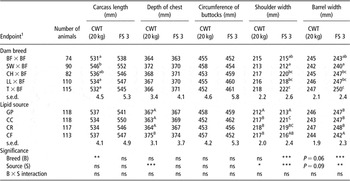
Chest depth and buttocks circumference were not influenced by dam breed at either slaughter endpoint (Table 7). Carcass length did not vary between dam breeds when lambs were slaughtered at fat score 3. However, lambs from SW × BF dams produced longer (P < 0.01) carcasses than those from BF × BF, LL × BF or T × BF dams when slaughtered at a constant carcass weight. SW × BF and BF × BF dams produced carcasses with a narrower shoulder width (P < 0.001) and narrower barrel width (P < 0.001) than T × BF dams when lambs were slaughtered at a constant fat score; however, these breed effects were no longer significant when slaughtered at a constant carcass weight. Treatment diet had no effect on carcass length or buttocks circumference. Lambs fed CF produced carcasses with a larger (P < 0.001) chest depth than any other diet when compared at a constant carcass weight. GP-fed lambs had a narrower (P < 0.001) shoulder width than those fed CC or CR at both endpoints. At a constant fat score, carcasses of lambs fed CF had a smaller (P < 0.01) barrel width than all other treatment diets.
Effects of dam breed and lipid source on carcass linear traits

CWT = cold carcass weight; FS = fat score; BF = Blackface; SW = Swaledale; CH = Cheviot; LL = Lleyn; T = Texel; GP = grass pellets; CC = cereal-based concentrate; CR = CC enriched with oilseed rape; CF = CC enriched with fish oil.
Means within the same column sharing the same letter in their superscript are not significantly different (P > 0.05).
1Endpoint taken at a 20 kg CWT and FS 3.
Carcass confirmation grade and fat class
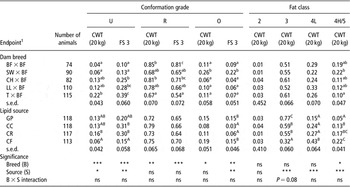
When slaughtered at fat score 3, BF × BF and SW × BF dams produced a lower (P < 0.001) proportion of U-grade lambs compared with CH × BF, LL × BF and T × BF dams (Table 8). T × BF dams achieved a higher (P < 0.001) proportion of U grades and a lower (P < 0.001) proportion of R grades than CH × BF dams. The proportion of R-grade lambs from BF × BF ewes was higher (P < 0.001) than all other dam breeds except CH × BF. Overall, just 0.78 of lamb carcasses from SW × BF dams achieved the target EUR specification compared with 0.91 to 0.96 for the other dam breeds (P < 0.01). Breed effects were similar when lambs were slaughtered at a constant carcass weight. Lambs fed CC and CR, and slaughtered at fat score 3 achieved a higher (P < 0.01) proportion of U grades and a lower (P < 0.01) proportion of O grades compared with those fed CF. There were no dietary effects on the proportions of R-grade lambs. Overall, 0.94 to 0.97 of lambs fed diets CC or CR achieved the target EUR specification at a fat score 3 endpoint compared with 0.85 of lambs fed GP or CF (P < 0.01). There were no dietary effects on conformation grade when lambs were slaughtered at a constant carcass weight.
Effects of dam breed and lipid source on the proportion of carcasses attaining each EUROP conformation grade and Livestock & Meat Commission fat class

CWT = cold carcass weight; FS = fat score; BF = Blackface; SW = Swaledale; CH = Cheviot; LL = Lleyn; T = Texel; GP = grass pellets; CC = cereal-based concentrate; CR = CC enriched with oilseed rape; CF = CC enriched with fish oil.
Means within the same column sharing the same letter in their superscript are not significantly different (P > 0.05).
1Endpoint taken at a 20 kg CWT and FS 3.
Dam breed had no effect on the proportions of lamb carcasses achieving fat classes 2, 3 or 4L when compared at a 20 kg carcass weight (Table 8). However, a higher (P < 0.05) proportion of lambs from SW × BF dams were excessively fat (fat classes 4H/5) compared with T × BF dams. Lambs fed CF produced a lower (P < 0.001) proportion of fat class 3 carcasses and a higher (P < 0.001) proportion of fat class 4L carcasses compared with the other treatment diets. GP produced a higher (P < 0.001) proportion of fat class 3 carcasses than all other diets. The proportion of fat class 4H/5 carcasses was higher (P < 0.001) with diet CF than GP or CC.
Carcass fat and tissue depth
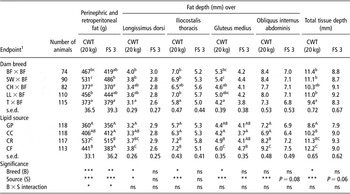
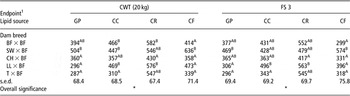
Dam breed had no effect on subcutaneous fat depth or tissue depth over the 12th and 13th ribs when lambs were slaughtered at fat score 3 (Table 9). However, at a constant carcass weight, lambs from BF × BF and SW × BF dams had a greater (P < 0.05) depth of fat over the L. dorsi, I. thoracis and G. medius, and a greater (P < 0.05) total tissue depth over the 12th and 13th ribs compared with lambs from T × BF dams. Lambs fed CF and slaughtered at a constant carcass weight had a greater depth of fat over the L. dorsi (P < 0.05), I. thoracis (P < 0.001) and O. internus abdominis (P < 0.001) and a greater (P < 0.001) total tissue depth compared with those fed GP or CC. However, these effects were removed when lambs were slaughtered at fat score 3. Fat depth over the G. medius was greater (P < 0.01) in lambs fed CF than CC at both endpoints. A significant dam breed × lipid source interaction was observed for the weight of PR fat (Table 10). At a fat score 3 endpoint, lambs from T × BF dams contained less (P < 0.05) PR fat than those from SW × BF or LL × BF dams when fed GP or CC, respectively. PR fat weight was higher (P < 0.05) for LL × BF than CH × BF dams fed CR, whereas SW × BF dams produced higher (P < 0.05) PR fat weight than the other dam breeds when lambs were fed CF. Similar responses were observed at a 20 kg carcass weight endpoint.
Effects of dam breed and lipid source on carcass fat and tissue depth

CWT = cold carcass weight; FS = fat score; BF = Blackface; SW = Swaledale; CH = Cheviot; LL = Lleyn; T = Texel; GP = grass pellets; CC = cereal-based concentrate; CR = CC enriched with oilseed rape; CF = CC enriched with fish oil.
Means within the same column sharing the same letter in their superscript are not significantly different (P > 0.05).
1Endpoint taken at a 20 kg CWT and FS 3.
Interactions of dam breed and lipid source for the weight of perinephric and retroperitoneal fat (g)

CWT = cold carcass weight; FS = fat score; GP = grass pellets; CC = cereal-based concentrate; CR = CC enriched with oilseed rape; CF = CC enriched with fish oil; BF = Blackface; SW = Swaledale; CH = Cheviot; LL = Lleyn; T = Texel.
Means within columns sharing the same letter in their superscript are not significantly different (P > 0.05).
1Endpoint taken at a 20 kg CWT and FS 3.
Discussion
Food intake and lamb performance
Overall, the majority of lambs achieved DMIs similar to or above the reported intake range for sheep of 77 to 81 g DM/kg live weight0.75 (Etheridge et al., Reference Etheridge, Stockdale and Cranwell1993). Consistent with earlier studies in which lamb diets contained whole oilseeds (Wachira et al., Reference Wachira, Sinclair, Wilkinson, Enser, Wood and Fisher2002; Demirel et al., Reference Demirel, Wachira, Sinclair, Wilkinson, Wood and Enser2004, Speijers et al., Reference Speijers, Carson, Dawson and Gordon2009), inclusion of oilseed rape had no effect on DMI, animal performance or feed conversion efficiency. The decrease in DMI of lambs fed fish oil is consistent with studies in adult ewes (Kitessa et al., Reference Kitessa, Peake, Bencini and Williams2003; Annett et al., Reference Annett, Carson and Dawson2008), although the intake depression in lambs (−14 g/kg W0.75) was much less than the level reported by Wachira et al. (Reference Wachira, Sinclair, Wilkinson, Enser, Wood and Fisher2002;−0.39 g/kg W0.75), which may reflect the lower fat content of experimental diets in this study. Fish oil-induced intake depression has been attributed to impaired fibre digestion (Wachira et al., Reference Wachira, Sinclair, Wilkinson, Hallett, Enser and Wood2000) and rumen bio-hydrogenation of long chain PUFAs (Kitessa et al., Reference Kitessa, Gulati, Ashes, Fleck, Scott and Nichols2001). It is possible that fish oil could also reduce the palatability of the ration, although there was no evidence of significant oxidation or rancidity problems in this study. As a result of their lower DMI, fish oil reduced daily LWG (−51 g/day) and CWG (−43 g/day) of lambs and extended the finishing period by up to 19 days compared with those offered diet CC. However, in agreement with Wachira et al. (Reference Wachira, Sinclair, Wilkinson, Enser, Wood and Fisher2002), fish oil had no effects on feed conversion efficiency so the impact on total feed requirements of lambs during the finishing period was minimal.
Despite its lower ME content, DMI of lambs fed GP (94 g/kg W0.75) was higher than the concentrate-fed lambs, which is surprising as feed intake in sheep is highly correlated with diet digestibility (Chestnutt, Reference Chestnutt1989). The high intake characteristics of GP concur with findings from a preceding study (Speijers et al., Reference Speijers, Carson, Dawson and Gordon2009) in which mixed concentrate GP diets resulted in above average intake (83 to 85 g/kg W0.75), probably due to the reduction in starch concentration. Although the increased DMI was sufficient to maintain a total MEI approximately 16 MJ/day on both grass-based and concentrate-based systems, lambs fed CC and CR achieved 60% higher daily LWG and were slaughtered up to 19 days earlier than those fed GP. These differences closely reflect the higher metabolisability (q m = [ME]/[GE]) of the concentrate-based diets, which is a key determinant of the efficiency of utilisation of ME for growth (k g; AFRC, 1993). Therefore, it is not surprising that feed conversion efficiency was lower for the grass-fed lambs, as shown by Carson et al. (Reference Carson, Moss, Dawson and Kilpatrick2001b) and Speijers et al. (Reference Speijers, Carson, Dawson and Gordon2009).
Lamb sire breed has been shown to influence feed intake, feed conversion efficiency and daily LWG during the finishing period (Carson et al., Reference Carson, Moss, Dawson and Kilpatrick2001b; van Heelsum et al., Reference van Heelsum, Lewis, Davis and Haresign2003; Speijers et al., Reference Speijers, Carson, Dawson and Gordon2009). In a preceding study, Speijers et al. (Reference Speijers, Carson, Dawson and Gordon2009) reported DMI of SW-sired lambs could be up to 0.23 kg/day lower than CH-, LL- or T-sired lambs, resulting in lower growth rates and reduced feed conversion efficiency. In this study, similar trends were observed for these breeds as maternal grand sires, although breed differences were small and, in terms of daily feed intake, LWG and food conversion efficiency (LWG/kg DMI), were not significantly different. For lambs finished at fat score 3, breed differences in DMI, LWG and CWG were on average 0.35, 0.53 and 0.26 of the sire effects reported for entire male lambs by Speijers et al. (Reference Speijers, Carson, Dawson and Gordon2009) and are smaller than might be expected considering the genetic contribution of the maternal grand sire is half that of the sire. The lower DMI, LWG and CWG of female lambs (not reported) could explain the lower average responses observed here, although diet × sex interactions were not investigated in this paper.
Within commercial sheep systems lamb carcass value is mainly determined by weight. However, a major deficiency in lamb finishing studies is that lamb performance is often determined on the basis of LWG (Dawson et al., Reference Dawson, Carson, McClinton, Kilpatrick and Moss2003; Afolayan et al., Reference Afolayan, Fogarty, Ingham, Gilmour, Gaunt, Cummins and Pollard2007), which can be confounded by treatment effects on carcass-dressing proportion (Carson et al., Reference Carson, Moss, Dawson and Kilpatrick2001b; Speijers et al., Reference Speijers, Carson, Dawson and Gordon2009). For this reason, a representative sample of lambs was slaughtered at the start of the study to estimate CWG. Dam breed had no effect on LWG; however, when performance was assessed on the basis of CWG, lambs from T × BF dams were superior to BF × BF, SW × BF or LL × BF. Although these differences closely reflect the heavier mature weight of T × BF ewes reported by Annett et al. (2010), the increase in CWG was due to more efficient conversion of feed into carcass rather than increased feed intake, which often results from using heavier mature weight breeds (Carson et al., Reference Carson, Moss, Dawson and Kilpatrick2001b; Speijers et al., Reference Speijers, Carson, Dawson and Gordon2009). CWG of lambs born to BF × BF dams was similar to the T × BF lambs reported in a preceding study by Speijers et al. (Reference Speijers, Carson, Dawson and Gordon2009). Comparing both studies indicates that changing the breeding policy of hill sheep flocks, from a traditional flock of BF ewes producing purebred lambs to a flock of crossbreds that are mated to terminal sires, has the potential to increase CWG by up to 60% (60 g/day), resulting in significant economic and environmental benefits for hill sheep producers.
Lamb carcass characteristics
Producer payment systems for lambs within the EU are determined by carcass weight, conformation grade and fat cover. The heavier carcass weight of lambs finished on concentrate-based rather than grass-based diets is consistent with plane of nutrition effects reported by Carson et al. (Reference Carson, Moss, Dawson and Kilpatrick2001b) and Speijers et al. (Reference Speijers, Carson, Dawson and Gordon2009), and broadly resembles the higher CWG of these lambs. Inclusion of oilseed rape reduced carcass weight by 0.8 kg due to the combined effects of (i) lower mean CWG, (ii) greater mean fat score at a constant carcass weight and (iii) shorter average finishing period (−2 days) to reach fat score 3, although none of these individual effects were significant. Studies involving entire male lambs slaughtered at a constant fat score have reported lower average carcass weight in lambs fed oilseed-enriched diets, although differences were small and non-significant (Demirel et al., Reference Demirel, Wachira, Sinclair, Wilkinson, Wood and Enser2004; Speijers et al., Reference Speijers, Carson, Dawson and Gordon2009). However, the lower carcass weight and higher fat scores of female lambs in this study (not reported) could exacerbate the decline in carcass weight from feeding high energy density diets. Lambs fed the fish oil-enriched concentrate produced similar carcass weight to grass-fed lambs, despite their superior CWG, because they reached the target fat score for slaughter on average 4 days earlier. When compared at a constant carcass weight, fish oil-supplemented lambs were slaughtered at the same age as grass-fed lambs but produced the highest fat scores of all diets investigated. Wachira et al. (Reference Wachira, Sinclair, Wilkinson, Enser, Wood and Fisher2002) also reported fat scores were highest in fish oil-supplemented lambs, although these were confounded by carcass weight effects. Across all treatments, dietary effects on carcass fat score more closely resembled differences in dietary ME concentration rather than total MEI, which would suggest that the higher fat scores of lambs fed CR and CF could be due to an energy–protein imbalance (Black, Reference Black1983) rather than a lipid source effect per se. Increasing dietary protein content could help to counteract the negative effects of fat supplementation on animal performance and carcass fat and warrants further investigation.
Dam breed has been shown to influence carcass weight of both hill- (Lee, Reference Lee1984; van Heelsum et al., Reference van Heelsum, Lewis, Davis and Haresign2003) and lowland- (Afolayan et al., Reference Afolayan, Fogarty, Ingham, Gilmour, Gaunt, Cummins and Pollard2007) breed lambs. Carcasses of lambs from BF × BF and SW × BF dams were 0.8 to 1.4 kg lighter than those from the other dam breeds when slaughtered at fat score 3. These differences are consistent with their lower CWGs and the lower mature weight of adult BF × BF and SW × BF ewes (Annett et al., Reference Annett, Carson, Dawson, Irwin and Kilpatrick2011), although the use of heavier mature weight ewes is not a prerequisite for heavier lamb carcass weight (Carson et al., Reference Carson, Moss, Dawson and Kilpatrick2001b). The heavier carcass weight between LL × BF and T × BF dams is comparable to the 0.8 to 1.7 kg increase achieved by Speijers et al. (Reference Speijers, Carson, Dawson and Gordon2009) using LL and T sires.
Finishing lambs on a high plane of nutrition has been shown to benefit carcass conformation through its effects on carcass weight and subcutaneous fat content (Carson et al., Reference Carson, Moss, Dawson and Kilpatrick2001b). In this study, the superior carcass conformation of CC and CR lambs was due mainly to their heavier carcass weight, although dietary effects on conformation remained when compared at a constant carcass weight. CS of lambs from BF × BF ewes was similar to levels previously reported for terminal sire × BF lambs (Carson et al., Reference Carson, Moss, Dawson and Kilpatrick2001b; Speijers et al., Reference Speijers, Carson, Dawson and Gordon2009). With the exception of the SW × BF dams, CS was 0.2 to 0.4 units higher for crossbred than purebred dams, although this was reduced to 0.1 to 0.2 units when the effects of carcass weight were removed. Breed effects on conformation were positively related to shoulder width but not buttocks circumference of the lambs. Dam breed has been shown to influence shoulder width in both lowland- (Dawson et al., Reference Dawson, Carson, McClinton, Kilpatrick and Moss2003) and hill- (van Heelsum et al., Reference van Heelsum, Lewis, Davis and Haresign2003) breed lambs and may be a contributing factor to the higher levels of dystocia in the crossbred hill ewes (Annett et al., Reference Annett, Carson, Dawson, Irwin and Kilpatrick2011). Consistent with studies in lowland flocks (Dawson and Carson, Reference Dawson and Carson2002; Dawson et al., Reference Dawson, Carson, McClinton, Kilpatrick and Moss2003), T-sired ewes achieved the greatest improvement in lamb carcass conformation that mirrors the effects of maternal sire breed on conformation of the dam (Speijers et al., Reference Speijers, Carson, Dawson and Gordon2009).
In commercial practice, the distribution of conformation grades is of greater importance than the average score. Despite their lower CSs, >90% lambs from BF × BF dams achieved the target U and R grades for conformation and, on this basis, mating BF ewes with a terminal sire such as T could be regarded as a suitable option to produce hill lambs to market specification. However, the higher proportion of U-grade carcasses achieved using CH × BF, LL × BF and T × BF ewes, combined with their heavier carcass weight, is likely to result in a significant price premium over BF × BF ewes. Overall, improvements in carcass value need to be considered alongside the added labour requirements due to higher levels of dystocia in crossbred ewes (Annett et al., Reference Annett, Carson, Dawson, Irwin and Kilpatrick2011) and the limited benefits for saleable meat yield of increasing carcass conformation (Kempster et al., Reference Kempster, Jones and Wolf1986). SW × BF dams resulted in a high proportion (0.23) of lambs failing to meet conformation targets, which is likely to reduce their carcass value. Considering their weaning rate was similar to BF (Annett et al., Reference Annett, Carson, Dawson, Irwin and Kilpatrick2011), the financial benefits of using SW × BF ewes in hill flocks is likely to be lower than the other crosses.
Breed effects on carcass fat have been reported in lambs slaughtered at a fixed live weight (Dawson et al., Reference Dawson, Carson, McClinton, Kilpatrick and Moss2003) and carcass weight (Fogarty et al., Reference Fogarty, Hopkins and van de Ven2000; Afolayan et al., Reference Afolayan, Fogarty, Ingham, Gilmour, Gaunt, Cummins and Pollard2007; Speijers et al., Reference Speijers, Carson, Dawson and Gordon2009). Typically, breeds with a heavier mature weight contain less fat at the same weight than those with a lower mature weight (Black, Reference Black1983), which is consistent with the lower subcutaneous fat depth in lambs from T × BF than BF × BF or SW × BF dams when compared at the same carcass weight. By adjusting the data to a constant fat class, we attempted to remove these maturity effects. However, within fat score-corrected lambs, CH × BF and T × BF dams produced lower levels of PR fat than SW × BF. There was also evidence of scaling, with lambs from the lower mature weight crosses (BF × BF, SW × BF and LL × BF) depositing more PR fat as MEI increased, whereas the heavier crosses (CH × BF and T × BF) were leaner and less sensitive to changes in energy intake. When comparing breeds of similar growth potential at the same weight, breed effects on PR fat deposition have been associated with increased LWG (Dawson et al., Reference Dawson, Carson, McClinton, Kilpatrick and Moss2003). However, significant differences in carcass fat have been observed when breeds with contrasting mature weight are compared at the same fat class (van Heelsum et al., Reference van Heelsum, Lewis, Davis and Haresign2003; Speijers et al., Reference Speijers, Carson, Dawson and Gordon2009). These data show that using crossbred dams sired by breeds with a high growth potential, such as CH and T, reduces carcass fat independently of growth rate effects. Inclusion of fish oil in lamb finishing diets has been reported to increase fat score and subcutaneous fat percentage in lambs (Wachira et al., Reference Wachira, Sinclair, Wilkinson, Enser, Wood and Fisher2002). In this study, fish oil increased subcutaneous fat depth over the hindquarters (G. medius and O. internus abdominis), but not the loin area. However, it should be noted that the effects of fish oil on fat deposition were small (up to 1 mm) when lambs were compared at a constant fat class and are unlikely to influence consumer choice when purchasing lamb meat.
Acknowledgements
The authors express sincere thanks to the Department of Agriculture and Rural Development (DARDNI) for funding this project; the management and staff at Dunbia (Dungannon) Ltd for the use of their facilities to undertake the carcass measurements, and Mr M. Porter and the laboratory staff for undertaking the feed analysis.