


Introduction
Daycare and early education for young children have emerged as key social policy domains, corresponding to the social investment paradigm. This paradigm emphasises strengthening social security through ex-ante mechanisms rather than relying primarily on classical ex-post redistribution (Häusermann et al., Reference Häusermann, Garritzmann, Palier, Garritzmann, Häusermann and Palier2022). The proven benefits of high-quality childcare consist in improved employment opportunities for parents (particularly mothers) and educational advancements for children (Felfe & Lalive, Reference Felfe and Lalive2018). In recent decades, growing public demand across Europe has led governments to expand childcare opportunities through a range of policy measures. However, the benefits of these policies disproportionately go to families with higher socio-economic status, perpetuating entrenched inequalities in childcare access (van Lancker, Reference van Lancker2018). This is particularly problematic as the expected returns from childcare are larger for poorer families, yet persistent inequalities risk enlarging socio-economic disparities (Felfe & Lalive, Reference Felfe and Lalive2018). The assumed reasons for these inequalities are variegated, reaching from cost barriers, lack of information and discrimination, to socially structured preferences and family norms, to the institutional organisation of childcare (Hermes et al., Reference Hermes, Lergetporer, Mierisch, Peter and Wiederhold2023; van Lancker & Ghysels, Reference van Lancker and Ghysels2016).
In this paper, we explore a particular mechanism that may reinforce these inequalities: the locational choices of childcare providers within a given municipality. Even in contexts where profit interests play little role in daycare provision, such choices expectedly lead to denser, better childcare infrastructure in neighbourhoods where families are better off. We assume that the background to this unequal provision is resource scarcity: providers gravitate towards areas with fewer social challenges, higher social capital, particular religious composition and more supportive infrastructure, which can make their operations easier under conditions of general resource strain. While public authorities could in principle compensate for these patterns of unequal provision by non-profit actors, their own resource scarcities hamper compensatory provision. These locational patterns are consequential because proximity to a family’s home matters for childcare as it signals availability, lowers the time spent in transit and favours the formation of local support networks (Jessen et al., Reference Jessen, Spieß, Waights and Judy2020, p. 275; Small et al., Reference Small, Jacobs and Massengill2008). Spatial proximity is especially relevant for lower-income households, as existing evidence shows (Blasius et al., Reference Blasius, Friedrichs and Klöckner2008; Groos et al., Reference Groos, Trappmann and Jehles2018; Hogrebe, Reference Hogrebe2016; Huebener et al., Reference Huebener, Schmitz, Spies and Binger2023). If, in situations of scarcity, providers prefer to locate where privileged, rather than disadvantaged, families live, they help to reproduce unequal patterns of childcare access and use.
We provide suggestive evidence for this argument by studying the case of Germany. In the 2000s, the German government embraced the social investment paradigm, promoting child allowances and benefits for stay-at-home mothers while also expanding childcare services (Häusermann, Reference Häusermann2018). In 2008, legal entitlement to childcare for children between one and three years was approved. Subsequently, municipalities – as the responsible public authorities – have massively expanded spending, with a large share directed toward new childcare facilities operated by non-profit providers. However, demand has grown even faster, leading to an estimated gap of around 300,000 places in 2025 (Geis-Thöne, Reference Geis-Thöne2025). In Germany, the childcare enrolment rates for children under the age of three (U3) from lower-income families, those with low educational qualifications and/or a migration background, are significantly lower than those from families with higher incomes and where parents have higher educational qualifications (Autor:innengruppe Bildungsberichterstattung, 2024; Jessen et al., Reference Jessen, Spieß, Waights and Judy2020).
Inequalities in childcare provision have thus persisted in the wake of legal entitlements and expanded supply (Huebener et al., Reference Huebener, Schmitz, Spies and Binger2023). What explains this rather surprising pattern – in a country with guaranteed access and high public funding? The literature suggests that the existence of fees, which complement public funding, may hamper access for poorer families, though such fees are often staggered according to income and are non-existent in several municipalities. Socio-economically structured family preferences may also affect unequal participation, though existing research raises doubts about the weight of such demand-side arguments (van Lancker & Ghysels, Reference van Lancker and Ghysels2016). Moreover, there exists a daycare provision gap – a discrepancy between desired care and actual access – for socio-demographically vulnerable households that is larger than that for families with higher educational degrees (Jessen et al., Reference Jessen, Spieß, Waights and Judy2020).
We thus turn to the locational choices on the supply side, potentially driven by scarcities in public funding and at the level of the increasingly important non-profit provider organisations. Moreover, we investigate the extent to which municipalities correct for potential inequalities in childcare provision by these non-profits across socially diverse neighbourhoods. For that purpose, we investigate childcare coverage in fifty-two German cities with 2,607 neighbourhoods, representing 27 per cent of the overall German population. Using Google Nearby Search API data, we classify whether the respective providers are public or non-public non-profit (denominational and other). By assigning the daycare centres to neighbourhoods, we use 17,099 georeferenced daycare centres to determine a neighbourhood-based coverage level per child by daycare provider, which we compare to the total coverage of the respective city. We capture the socio-economic segregation of the neighbourhoods via the proportion of people in households who receive social benefits. The use of the Google Nearby Search API has various limitations but comprehensively addresses a major gap in German official statistics at this point.
The results show that households from different social strata, increasingly living in socio-economically segregated cities (Helbig, Reference Helbig2023), are confronted with unequal levels of daycare provision. Among the neighbourhoods surveyed, those with higher shares of social benefit recipients are significantly worse off regarding daycare provision than the respective city average. These inequalities are exclusively due to daycare centres operated by non-public, non-profit providers, whose presence in different neighbourhoods is highly segregated. We show that these patterns apply to both eastern and western Germany. Daycare centres directly run by the municipalities, on the other hand, fail to counteract the dominant inequality trend sufficiently. These results remain robust when we test for various heterogeneities in the data.
Our paper makes two contributions. First, our analysis adds another piece of the puzzle for explaining persistent inequalities in childcare provision even in countries that have massively expanded such social investment policies and, as in Germany, introduced legal entitlements for families. In line with the recent literature, we shift the emphasis from the demand to the supply side and particularly emphasise the interplay between biased locational decisions by non-profit providers on the one hand, and weak municipal childcare planning on the other. Our key empirical contribution thus consists in showing, for the first time, consistent inequalities in childcare provision across larger German cities and to reveal the central role of non-profit providers in the production of these inequalities. Accordingly, our study signals a need for much stronger public childcare planning particularly targeted at those vulnerable groups that risk ending up on the losing end of growing educational and occupational inequalities (OECD, 2016; SVR, 2016). While we primarily aim to contribute to research on childcare, our study also extends segregation studies (Gresch et al., Reference Gresch, Hoffmann and Lorenz2023; Helbig, Reference Helbig2023, Reference Helbig2010; Nonnenmacher, Reference Nonnenmacher2007; Oberwittler, Reference Oberwittler, Oberwittler and Karstedt2004), showing how, even in countries with relatively generous welfare states, growing inequalities can emerge from a mutual reinforcement of structural disadvantages in some neighbourhoods and the under-provision of social services in these local settings.
In the following section, we review relevant literature on possible mechanisms to explain persistent inequalities in childcare provision and on the supply structures that can affect these patterns. The section concludes with a derivation of research hypotheses. Section 3 discusses the related data basis and empirical strategy: for the first time, this analysis employs a combination of georeferenced locations of daycare centres, taken from the Google Places API, with the dataset of the inner-city monitoring (IRB) (BBSR, 2023). Section 4 presents the empirical results and summarises which research hypotheses stand up to empirical scrutiny. In the closing section, we derive conclusions about actionable insights for early childhood education.
Literature
Socio-economic inequalities in daycare provision
The use of childcare services is crucial not only for children’s short-term development but also for their long-term educational and career outcomes. In most countries, children who have attended early childhood education for more than two years achieve higher performance scores in mathematics in high school (OECD, 2025). The positive effects of early childhood education are particularly pronounced among vulnerable children and those from socio-economically disadvantaged households. Hence, investments in early childhood education and care are a promising cost-effective way to close achievement gaps before they become entrenched or even arise (Cornelissen et al., Reference Cornelissen, Dustmann, Raute and Schönberg2018; Felfe & Lalive, Reference Felfe and Lalive2018; Spieß, Reference Spieß2021; Spieß et al., Reference Spieß, Büchel and Wagner2003). Childcare also has demonstrated positive effects on parental employment, particularly for mothers (Bousselin, Reference Bousselin2022; Vuri, Reference Vuri2016).
Therefore, under the social investment paradigm, almost all European countries have increased their expenditures on childcare over the past decades (van Lancker, Reference van Lancker2018). However, while higher spending on childcare is associated with increased levels of childcare usage, it does not necessarily reduce inequality (van Lancker, Reference van Lancker2018). This finding is consistent with observations across OECD countries: although childcare enrolment has risen over the past decade, the socio-economic enrolment gap has widened in eight out of twenty-eight countries. The increase in childcare participation has been disproportionately concentrated among children from socio-economically advantaged households, relative to their disadvantaged peers (OECD, 2025). As a potential consequence, performance gaps between socio-economically advantaged and disadvantaged students at age fifteen have widened in most countries between 2015 and 2022 (OECD, 2025, based on PISA data).
In Germany, there has been a substantial expansion of childcare centres following the introduction of the legal entitlement to a childcare place from the age of one in 2013, resulting in a 22 per cent increase in the number of daycare centres for under three-year-olds between 2012 and 2022 (Statistisches Bundesamt, 2022). Despite this expansion, an estimated demand of 300,000 childcare places remains unmet in 2025 (Geis-Thöne, Reference Geis-Thöne2025). Moreover, the difference between desired and actual access to childcare use is relatively larger among socio-demographically disadvantaged households in Germany (Jessen et al., Reference Jessen, Spieß, Waights and Judy2020). Consequently, as in many countries, Germany faces not only a general shortage of childcare places, but also hardening patterns of inequality, which ironically have increased after the introduction of a childcare place guarantee for children aged two and older in 2013 (Spieß, Reference Spieß2021).
What explains these persistent inequalities in childcare provision in advanced welfare states in a period of rising public spending? Recent literature focuses primarily on supply-side factors as demand differences hold relatively little explanatory power. Van Lancker and Ghysels (Reference van Lancker and Ghysels2016) find that the degrees and specific institutional mechanisms of state involvement in childcare provision have the strongest effects. For instance, in countries with commercial providers and voucher systems for low-income families, inequalities are larger than in countries where the state directly provides or finances daycare centres as a public social infrastructure.
However, studies indicate that inequalities even persist in countries with a model of social provisioning. For instance, in research on Vienna, Austria, Pennerstorfer and Pennerstorfer (Reference Pennerstorfer and Pennerstorfer2021) and Pennerstorfer et al. (Reference Pennerstorfer, Pennerstorfer and Neumayr2024) find unequal patterns of access despite comprehensive public funding. For Germany, statistics equally suggest persistent inequalities despite public guaranteed access after the age of one and a funding model in which the state covers the bulk of childcare costs directly, while parents – depending on the specific municipality – are asked to contribute income-dependent fees (Huebener et al., Reference Huebener, Schmitz, Spies and Binger2023).
We focus on these puzzling cases of persistent inequalities despite significant public sector involvement. We suggest that even rising public funding (see van Lancker, Reference van Lancker2018) might go hand in hand with inequalities if demand outstrips supply. In situations of rationing, the demand by higher-income families is prioritised over that of poorer ones, contributing to persistent or even rising inequalities. We are particularly interested in how this general mechanism (differentiated below for provider types) plays out in cities, where the supply-demand gap is most pronounced. Discrimination, we suggest, works via locational choices: daycare centres locate in better-off neighbourhoods to cater to the prioritised demand groups.
We consider various reasons why providers and public policy makers decide to prioritise the better-off: for instance, parents from higher-income households are potentially better positioned to signal their needs and demands (Hermes et al., Reference Hermes, Lergetporer, Peter and Wiederhold2021). Public administrations presumably respond to these demand signals for political reasons or to prevent possible lawsuits in contexts like Germany, where parents are given an access guarantee. Moreover, while fees only cover small shares of overall costs, municipalities may still optimise for their revenues from these fees by prioritising higher-income families, especially if fiscal resources are scarce (Neimanns & Faggin, Reference Neimanns and Faggin2025). Another factor at the facility level is that households with more resources can better support daycare centres where staff are generally strained (Pennerstorfer & Pennerstorfer, Reference Pennerstorfer and Pennerstorfer2021). Moreover, children from low-income, disadvantaged households generate additional burdens (Jehles, Reference Jehles and Marquardsen2022) that providers and facilities may like to avoid. Taken together, we expect a correlative relationship between the share of socially disadvantaged households and inequality as regards the provision of childcare facilities.
Hypothesis 1: Coverage of early childhood education services is lower in neighbourhoods with socio-demographic difficulties than in neighbourhoods dominated by better-off households.
Differences in locational choices across daycare providers
In addition to inequalities in the provision and use of childcare, the literature discusses differences across facilities and providers. Segregation, expressed in the over-or under-representation of certain population groups in specific facilities, is viewed critically from the perspective of both research on childhood development and democracy research. Some studies identify segregation patterns at the level of specific municipalities (Groos et al., Reference Groos, Trappmann and Jehles2018; Jehles, Reference Jehles and Marquardsen2022; Strohmeier et al., Reference Strohmeier, Gehne, Groos and Jehles2014). These findings have not yet been confirmed in Germany-wide analyses (Hogrebe & Mierendorff, Reference Hogrebe and Mierendorff2023), although segregation is likely to be more pronounced in cities than in rural municipalities (Helbig, Reference Helbig2023; Jehles, Reference Jehles and Marquardsen2022). The research on institutional segregation is of interest in the context discussed here, as it implies that different providers focus on different client groups. For Vienna, it was shown that a spatial increase in inequality is attributable to the strong expansion of non-state (but state-funded) early childhood education centres (Pennerstorfer & Pennerstorfer, Reference Pennerstorfer and Pennerstorfer2021).
In Germany, there exists considerable heterogeneity in the composition of providers at the level of the federal states and, in some cases, municipalities. This reflects different religious traditions, lingering differences in early childcare in the Federal Republic of Germany and German Democratic Republic (GDR) different funding models in the federal states and municipalities and the different anchoring of civil society organisations (Wallußek et al., Reference Wallußek, Böwing-Schmalenbrock and Meiner-Teubner2022). Over the past decade, the considerable expansion of childcare provision has been predominantly driven by non-public providers, as over 70 per cent of the 8,500 additional daycare centres established between 2010 and 2022 were attributable to this group (Destatis, 2022). This is consistent with the clear trend of increasing importance of non-public, non-denominational providers (Wallußek et al., Reference Wallußek, Böwing-Schmalenbrock and Meiner-Teubner2022). German social law provides the legal foundations for this strong role of non-profit providers, as it stipulates: ‘Insofar as suitable facilities, services and events can be operated by recognised non-profit welfare organisations or can be created by these in a timely manner, public youth welfare services shall refrain from taking their own measures’.Footnote 1
In principle, German local authorities can steer the services offered by these non-profit providers in the context of their demand planning. However, low planning capacities together with a large surplus demand presumably mean that the non-profit providers have considerable room for manoeuvre when deciding where to locate. In the case of denominational providers, children and parents with a corresponding religious affiliation could be prioritised (Groos et al., Reference Groos, Trappmann and Jehles2018). Parent-initiative daycare centres may focus on families from networks of acquaintances and those who have resources relevant to the facility (and can therefore make voluntary financial contributions or provide services, for example). Consequently, parent-initiative daycare centres might rather emerge in urban neighbourhoods with socio-economically betteroff families. Indeed, Pennerstorfer et al. (Reference Pennerstorfer, Pennerstorfer and Neumayr2024) show for the case of Vienna that religious and small non-profit daycare centres prioritise neighbourhoods with high-income families and thus drive overall inequalities. Even if these non-profit facilities are on average smaller than public ones, we expect that their central role in covering the recent demand growth means that their locational choices will affect the overall degree of inequalities in neighbourhood-level coverage. Taken together, these arguments suggest that the great and growing importance of non-public, non-profit providers may be largely responsible for the inequalities in provision across different urban social spaces.
Hypothesis 2: The inequality in the coverage of early childhood education services is due to the spatial concentration of non-public, non-profit daycare facilities.
Our third hypothesis concerns the role of public providers. As noted above, there exists a subsidiary principle: municipalities only open their own daycare centres if they observe that non-profit providers leave an uncovered demand. Expectedly, then, public childcare is offered precisely in those neighbourhoods that the non-profit providers eschew. A caveat is that, in addition to general funding constraints associated with the operational costs of childcare (which also affect subsidised non-profit providers), municipalities need planning resources to effectively fulfil this compensatory role. Moreover, their incentives for concentrating efforts on the better-situated neighbourhoods may be aligned with those of the non-profit providers, thus leaving a provision gap for the poorer neighbourhoods. We test this with the following proposition:
Hypothesis 3: Public daycare centres compensate for the unequal spatial coverage by non-profit providers by being overrepresented in neighbourhoods with high poverty rates.
Data and empirical strategy
Our empirical analysis is based on a combination of georeferenced daycare centre data collected via the Google Places API and data provided by the Federal Institute for Research on Building, Urban Affairs and Spatial Development (BBSR) inner-city monitoring. The regression analyses are conducted at neighbourhood level.
Data basis: daycare centres
The locations of daycare centres in Germany were retrieved via Google Places API 2024. For the details of our data sources and data collection strategy, see Appendix A. We extracted a sample of 17,099 facilities in 2,607 neighbourhoods in fifty-two German cities.Footnote 2 To assign daycare centres to public or non-public, i.e. denominational or other non-profit providers, we employed manually created and automated filters.
When choosing a daycare centre for a child, the time required to travel to the childcare location is a decisive aspect for the parents. Neighbourhoods often represent a naturally defined area for the choice of a facility. However, daycare centres located in adjacent neighbourhoods are also frequently considered as viable options. The following analysis therefore assumes that all daycare centres are accessible from a neighbourhood if they can be reached within five minutes by car from its geographical centre. We use the Open Source Routing Machine (OSRM) (Luxen & Vetter, Reference Luxen and Vetter2011) based on OpenStreetMap maps of Germany (OpenStreetMap contributors, 2017) to determine which daycare facilities can be reached within five minutes from each neighbourhood.
If a daycare centre can be reached from more than one neighbourhood, it is proportionally allocated to all respective neighbourhoods. To take account of differences in demand within each neighbourhood, the number of accessible daycare centres is related to the respective number of children under the age of six.Footnote
3
In addition, this neighbourhood-specific daycare centre-to-children ratio is divided by the average provision of the respective provider within the city. This produces an interpretable percentage indicator of over-or under-provision in each neighbourhood.
 $Provider\;specific\;daycare\;coverag{e_{np}}$
shows the corresponding variable:
 $$provider\;specific\;daycare\;coverag{e_{np}} = \;\;{{{{Centre\;{{\left( { + 5\;min} \right)}_{np}}} \over {Chil{d_n}}}} \over {{{Centr{e_{pC}}} \over {Chil{d_C}}}}}$$
Daycare centre coverage in neighbourhood n and city C is calculated for all providers p (public, denominational, non-denominational or non-classified daycare centres) and serves as the key variable of interest in the following analysis. Separate analyses of daycare centre coverage allow us to take into account provider-specific differences in quality and size. Nevertheless, a distortion of the results by socio-economic-specific quality differences in childcare cannot be completely ruled out.Footnote 4 Due to data limitations, the coverage indicator cannot take into account individual differences in the quality and size of daycare centres. Nevertheless, national figures about the size of daycare centres by provider type are available (Bertelsmann Stiftung, 2024). A daycare centre operated by a public provider serves on average fifty-eight children, denominational non-profit providers run slightly larger centres hosting on average sixty-one children, and other non-profit providers offer smaller centres with fifty children on average.
To aggregate the daycare centre supply to measure overall coverage, we include provider-specific weights
 ${w_p}$
that correct for the differences in size based on the described national figures:
 $$overall\;daycare\;coverag{e_n} = \;\;{{{{\sum\nolimits_p{{w_p}} Centre\;{{\left( { + 5\;min} \right)}_{np}}} \over {Chil{d_n}}}} \over {{{\sum\nolimits_{pn}{{w_p}} Centr{e_{pC}}} \over {Chil{d_C}}}}}$$
Figure 1 provides an overview of the daycare centre coverage of all daycare centres for the cities of Berlin, Erfurt, Cologne and Solingen. Neighbourhoods with below-average daycare provision (0.5 = half as good) in relation to the number of children living there are highlighted in dark. Districts with an above-average provision of daycare (2 = twice as good) in relation to the number of children living there are displayed in white.
Daycare centre coverage (total) at neighbourhood level.
Source: Own presentation, data sources: Google Places API, neighbourhood boundaries from BBSR (2023).

Figure 1. Long description
Panel A: Berlin. A map of Berlin showing daycare coverage as a share of the city mean. The map is divided into various neighborhoods, each shaded in different colors representing the coverage levels. Darker shades indicate lower coverage, while lighter shades indicate higher coverage. Panel B: Erfurt. A map of Erfurt with similar shading to represent daycare coverage levels. Panel C: Cologne. A map of Cologne with neighborhoods shaded to show daycare coverage levels. Panel D: Solingen. A map of Solingen with neighborhoods shaded to indicate daycare coverage levels. Each map uses a legend to denote the coverage levels, ranging from below 0.5 to over 2.
Data basis: socio-demographics at neighbourhood level
To analyse the relationship between the provision of daycare facilities and the socio-economic profiles within a city, we use IRB data provided by the Federal Institute for Research on Building, Urban Affairs and Spatial Development (BBSR, 2023). Our analysis is based on the latest available cross-section for 2021 from fifty-two cities in the IRB, eleven of which (including Berlin) are located in eastern Germany.Footnote 5
For our analysis, we calculate the percentage of people who live in households receiving social benefits in each district. This proportion approximates a poverty indicator in neighbourhood-based segregation research (Helbig, Reference Helbig2023). Figure 2 provides an overview of the distribution of social benefit recipients in representative cities in relation to the daycare centres by provider. At first glance, the importance of daycare centres run by non-profit providers comes to the fore. In combination with Figure 1, it becomes clear that some neighbourhoods with a high share of social benefit recipients, such as Neukölln in Berlin, Johannesplatz in Erfurt, Chorweiler or Meschenich in Cologne or Solingen Mitte, are underserved despite the high number of daycare centres. This is because of the disproportionately large number of children living there. It is also evident that daycare centres with non-public providers are comparatively less common in neighbourhoods with a high share of social benefit recipients. In neighbourhoods in Berlin where less than 10 per cent of residents live in households that receive social benefits, the coverage of non-denominational, non-profit daycare centres is around 36 per cent higher than the city average; 32 per cent in Erfurt; 44 per cent in Cologne; and 21 per cent in Solingen.
Georeferenced daycare centres and the share of social benefit recipients at neighbourhood level.
Source: Own presentation, data sources: BBSR (2023) and Google Places API.

Empirical strategy
To analyse the relationship between the socio-economic profiles of neighbourhoods and the overall access to daycare facilities, we estimate the following regression model using ordinary least squares (OLS):
 $$daycare\;coverag{e_n} = \;{\beta _0} + {\beta _{SB\_share}}SB\_shar{e_n} + \;\theta \;{Z_C} + \gamma \;{R_n} + \eta {U_e} + {\varepsilon _{nC}}$$
The dependent variable is the overall
 $daycare\;coverag{e_n}$
, which we calculate at neighbourhood level n. For each neighbourhood, this variable incorporates provider-specific weights based on the national average size of daycare centres by provider type (see Formula 2).
 ${\beta _0}$
is the constant. The dependent variable
 $SB\_shar{e_n}$
represents the percentage of people in households that receive social benefits in neighbourhood n (
 ${\beta _{B\_share}}\;$
represents the respective regression coefficient).
While the share of social benefit recipients is measured at the place of residence, access to daycare is not limited to the residential neighbourhood. However, spatial proximity remains a key determinant of childcare: less than a third of the families surveyed stated not having a daycare centre in their immediate vicinity (Huebener et al., Reference Huebener, Schmitz, Spies and Binger2023). To absorb unobserved confounding factors and regional differences, we include
 $\;{Z_C}\;$
fixed effects at the city level (regression coefficient:
 $\theta$
),
 ${R_s}$
fixed effects for inner-city spatial structures s (city centre, city centre fringe, city outskirts) (regression coefficient:
 $\gamma$
) and
 $\;{U_e}$
regional fixed effects for cities in eastern Germany e (regression coefficient:
 $\eta$
). Whereas city fixed effects capture all time-invariant characteristics at the city level, the East Germany indicator accounts for systematic differences between eastern and western German cities. The error term is represented by
 ${\varepsilon _{nC}}$
. Since the error terms at the level of neighbourhoods can be correlated within a city, we cluster the standard errors at the city level. To assign a higher weight in the regression to districts with a higher demand effect, we weight neighbourhoods by the number of children aged under six years living there. For all specifications, confidence intervals are shown on the basis of heteroskedasticity-robust standard errors.
For a more detailed analysis of the correlation between daycare centre coverage of different providers
 $p$
(public, non-profit denominational, other non-profit and childcare centres we were not able to categorise) and the share of social benefit recipients in the neighbourhood, we estimate the coverage of the different providers separately using the same characteristics as in Formula 3.
 $$daycare\;coverag{e_{np}} = \;{\beta _0} + {\beta _{SB\_share}}SB\_shar{e_n} + \;\theta \;{Z_C} + \gamma \;{R_n} + \eta {U_e} + {\varepsilon _{nC}}$$
Because of long-standing differences between eastern and western Germany – such as patterns of segregation, types of daycare providers and childcare supply and demand, as noted in previous research (Helbig, Reference Helbig2023) – we take an additional step in our analysis. We examine the relationship between socio-economic factors and daycare centre coverage (as defined in Formulas 1 and 2) separately for cities in eastern and western Germany. Further analyses of heterogeneity such as the linearity of our results and the impact of daycare fees are presented in Appendix B. To test the robustness of the results (Appendix C), we include additional covariates, employ official public data for the cities of Cologne and Berlin, and we alter the dependent variable.Footnote 6
Empirical results
Main results
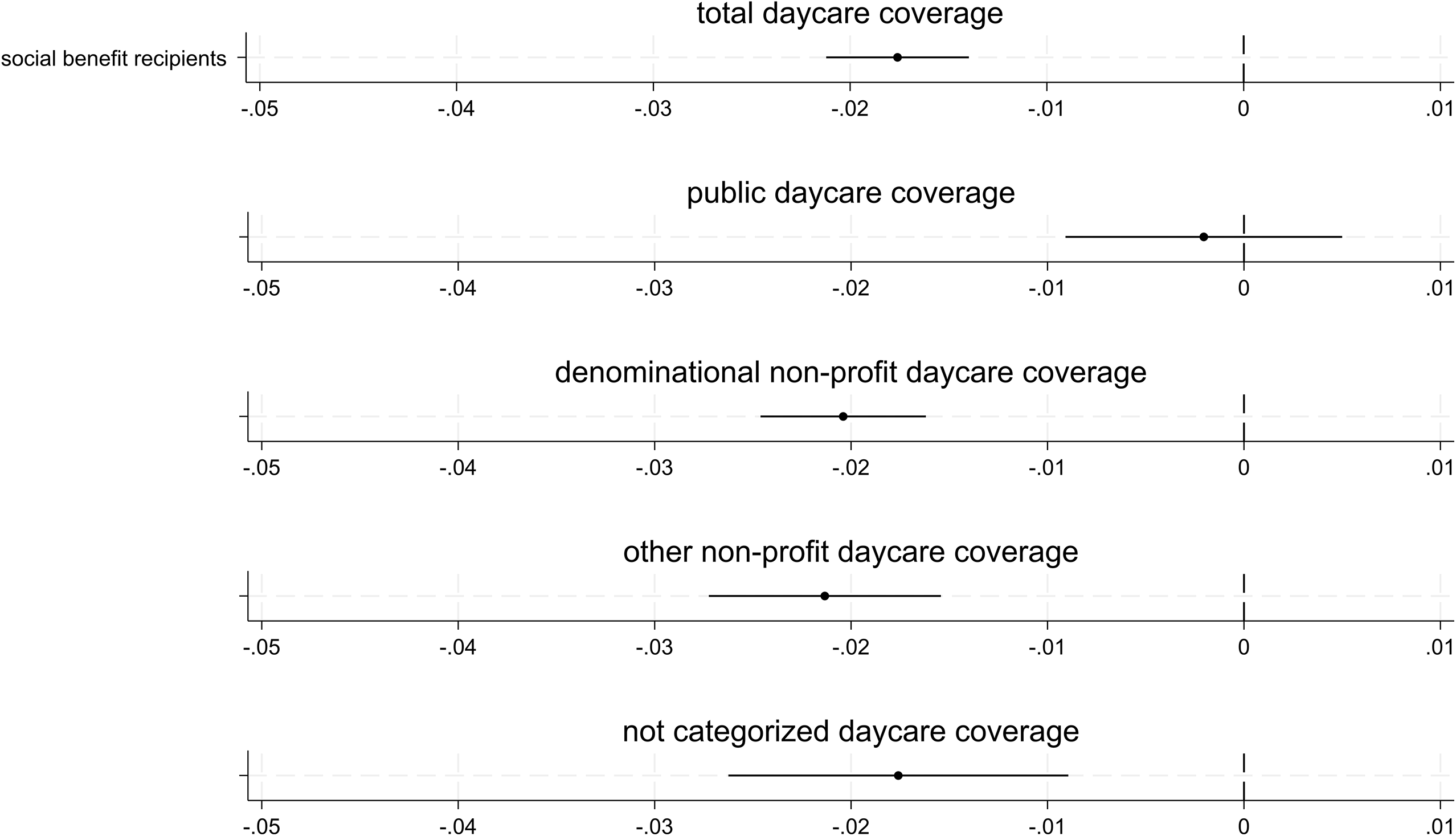
Our baseline analysis regresses overall daycare coverage on the share of residents receiving social benefits in each of the 2,607 neighbourhoods located in the fifty-two cities. The OLS estimates (based on Formula 3) show a statistically significant negative correlation (Figure 3, top): neighbourhoods with higher poverty rates have fewer daycare centres accessible – given the number of children living there – compared to neighbourhoods where fewer people receive social benefits. An increase in the share of social benefit recipients by one percentage point is associated with a lower overall daycare coverage by 0.0176. Hence, we fail to reject Hypothesis 1. A stronger welfare dependency in a neighbourhood goes along with a lower coverage of daycare facilities compared to other neighbourhoods in the same city. The effect size is socio-economically meaningful: a higher proportion of social benefit recipients by 10 percentage points – within the observed variation across neighbourhoods – compared to the average neighbourhood goes along with a daycare coverage 17.6 per cent below the city average.Footnote 7
Daycare centre distribution coefficient plots according to the share of social benefit recipients, top: total; bottom: according to provider.
Note: individual OLS regressions with 95% confidence intervals above and below, independent variable: share of social benefit recipients, robust standard errors clustered at city level. Regressions include east, neighbourhood N = 2,607 neighbourhoods in 52 cities.

Figure 3 (bottom) makes it possible to trace the reasons for this unequal provision in the context of the different provider types (Formula 1). The split sample regressions (based on Formula 4) clearly indicate that the poorer daycare provision in socio-economically vulnerable neighbourhoods is due to a lower availability of non-public daycare centres. A recipient in a neighbourhood is associated with lower coverage by denominational non-profit providers of 0.0204 index points. Similarly, a one percentage point higher proportion of social benefit recipients in a neighbourhood is associated with a 0.0213 index points lower provision of other non-profit daycare coverage. Thus, we fail to reject Hypothesis 2. In fact, the inequality in the coverage of early childhood education services is due to the spatial concentration of non-public, non-profit daycare facilities. The described effect sizes are larger than for the overall daycare coverage: a neighbourhood with a 10 percentage points higher proportion of social benefits recipients than the respective city average exhibits a 20.4 per cent lower coverage by denominational non-profit providers and a 21.3 per cent lower coverage by other non-profit providers than the city average.Footnote 8
On the other hand, it becomes clear that public daycare centres are not overrepresented in neighbourhoods with a higher proportion of social benefit recipients and therefore do not compensate for the unequal spatial coverage by non-public providers. Hence, we reject Hypothesis 3. Among all provider types considered, publicly provided daycare is the only category that does not concentrate in neighbourhoods with lower shares of social benefit recipients. At the same time, however, public providers do not appear to systematically target the economically disadvantaged neighbourhoods either. Given that these neighbourhoods are undersupplied by non-public providers, German social law would imply that public providers should act to compensate for these disparities in daycare provision.
Analysis of heterogeneity: Eastern and western Germany
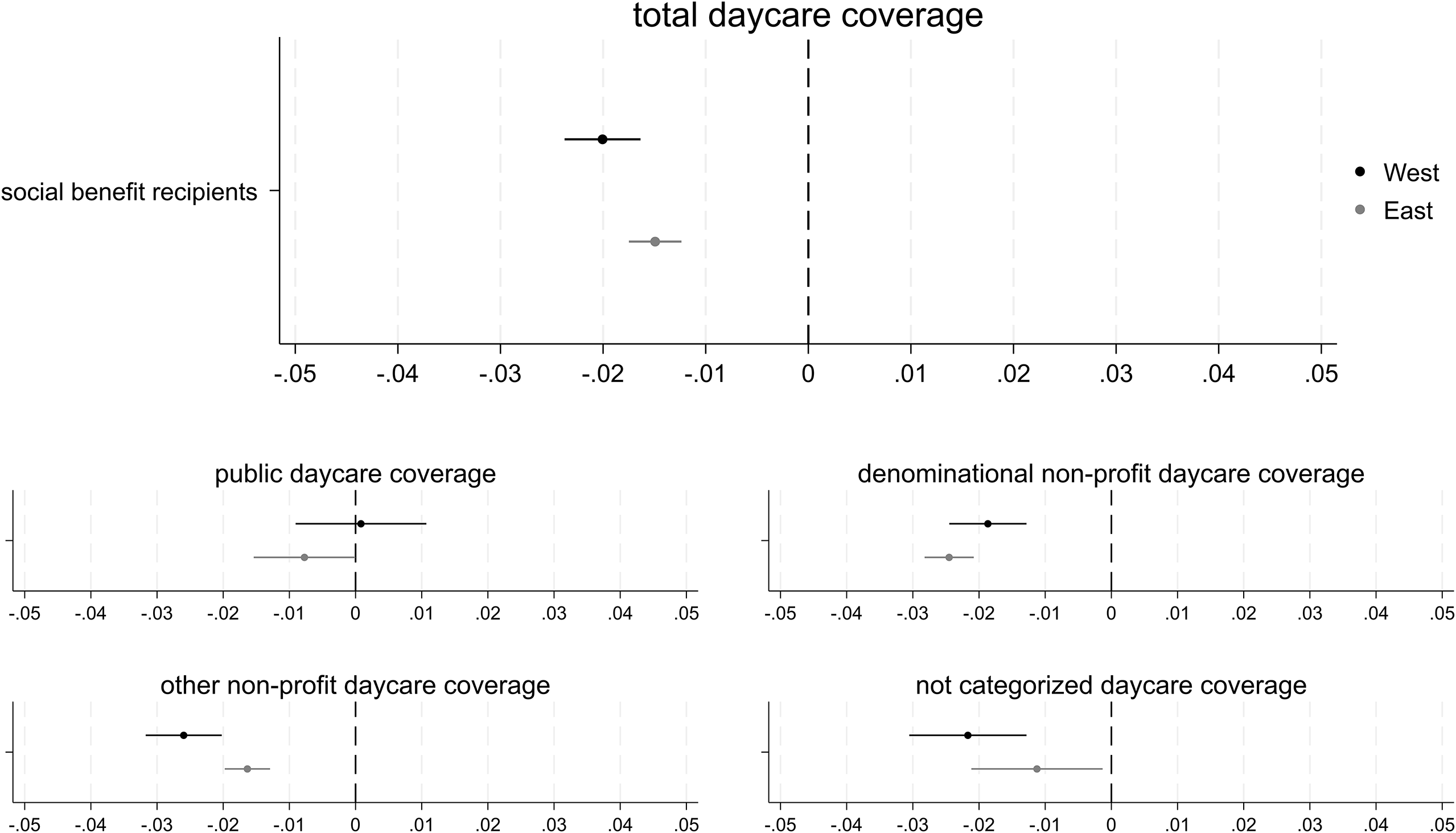
To explore regional differences, we conduct separate regression analyses for eastern and western German cities, examining the relationship between overall daycare provision and the proportion of residents receiving social benefits (based on eleven cities in the east and forty-one in the west). Interpreting the results requires consideration of the broader context. Although the share of children aged under three years who do not receive a daycare spot despite parental demand is nearly twice as high in western Germany (around 15 per cent) compared to the east, in the former GDR, 8 per cent of families seeking daycare for their child are unsuccessful (Geis-Thöne, Reference Geis-Thöne2024). The split sample regression coefficients are shown in Figure 4 (top) and reveal a statistically significant negative correlation between daycare centre provision and the share of social benefit receivers for both eastern and western German cities. Neighbourhoods with socio-economic challenges are slightly more disadvantaged in western Germany than in eastern Germany when it comes to daycare provision – given the number of children living there. A one percentage point higher proportion of social benefit recipients is associated with a lower overall daycare centre index of 0.02 in western Germany and 0.015 in eastern Germany.
Daycare centre distribution coefficient plots according to the share of social benefit recipients in East and West Germany, top: total; bottom: according to provider.
Note: individual regressions for the sample of cities in eastern and western Germany, OLS with 95% confidence intervals, dependent variable: share of social benefit recipients, robust standard errors clustered at city level. Regression contains neighbourhood location and city fixed effects. Daycare centre provision by provider is the coverage as shown in Formula 1. Total daycare centre provision is the coverage as shown in Formula 2. Regressions are weighted by children aged below 6 years. West: N = 1,724 in 41 cities; East: N = 883 in 11 cities.

By differentiating the daycare centre providers, it is possible to analyse this difference in the provision of daycare centres in eastern and western Germany in more detail. The provider-specific regressions estimated separately for the east and west (analogous to Formula 4) are shown together in Figure 4 (bottom). These models are estimated independently of the regressions in the top panel of Figure 4. The results show that the social gradient of other non-profit daycare provision is particularly pronounced in western Germany. Daycare coverage inequalities due to other non-profit providers are weaker in eastern Germany.Footnote 9 These results can be corroborated by introducing an East Germany interaction term into the full sample analysis.Footnote 10 The East-West differences in the relationship between overall and other non-profit daycare coverage and local poverty rates are statistically significant.Footnote 11
Hence, the poorer provision in socio-economically vulnerable districts in eastern and western German cities is due to a lower provision of non-public non-profit daycare centres. In neither eastern nor western Germany does public daycare provision offset the negative relationship between public daycare centre coverage and the share of social benefit recipients.Footnote 12
Robustness of results
The main findings prove to be robust across various checks.
First, the inclusion of additional control variables – such as the change in the number of children younger than six years between 2011 and 2021, the share of the population older than sixty-five years, the share of marginal employment and the share of non-German children at the neighbourhood level – does not alter the negative association between the share of social benefit recipients and overall daycare provision.Footnote 13
Second, the childcare coverage indicator, derived through web scraping using the Google Places API, yields results that align with the few official georeferenced data available from larger cities.Footnote 14 For Berlin and Cologne, we corroborate the statistically significant correlation between non-public daycare coverage and the share of welfare recipients.Footnote 15 However, these city-specific findings should be interpreted with caution given the limited number of observations.Footnote 16 Interestingly, Berlin reveals a social gradient for all types of providers under analysis – including public. The regression coefficients show only slight differences when either the indicator based on the Google Places API or the official database is used.Footnote 17 Moreover, the strong correlation (≥0.8) between the number of daycare centres and available places across neighbourhoods in Cologne and Berlin indicates that the number of centres provides a valid proxy for actual coverage.Footnote 18 In addition, we calculate our coverage indicator based on the number of childcare places instead of childcare centres. As expected, these models show slightly smaller effect sizes, indicating that larger childcare centres are based in neighbourhoods with higher shares of social welfare recipients.Footnote 19
Third, the main regression results barely change if, instead of the general share of benefit recipients, the proportion of children living in households that receive benefits is regressed on the overall or provider-specific daycare centre coverage.Footnote 20 Although the regression coefficients are slightly smaller, they retain their statistical significance.
Lastly, the results are not distorted by neighbourhoods with an extremely small population. Firstly, there is only one district in our sample that has fewer than fifty inhabitants (Mundenhof in Freiburg). Secondly, neighbourhoods with a low number of inhabitants or children are included in the regressions with a lower weight.
Discussion and conclusion
This article adds another piece to the puzzle of why, in the context of expansions of childcare provision and corresponding increases in public funding, socio-economic inequalities in access to these types of ‘social investments’ have persisted (van Lancker, Reference van Lancker2018). This persistence is all the more surprising in countries with relatively comprehensive public funding, direct provisioning by the state or a state-financed non-profit sector, guarantees for universal access and a legal mandate requiring the state to fill gaps in childcare provision. All these attributes apply to Germany, where municipalities are obliged to offer childcare for every child beyond the age of one and by and large fund such childcare from public resources, though parental income-staggered fees exist in most places. Also, German social law implies that public providers are obliged to compensate for place-based disparities caused by non-public daycare provision. Yet, access to childcare remains unequal for families with different income and educational levels, entrenching disadvantages on labour markets and in children’s educational trajectories.
As we have shown in this paper, one mechanism that reproduces these inequalities consists in the locational decisions of non-profit daycare centre providers under conditions of supply shortages. Neighbourhoods with greater socio-economic difficulties encounter a weaker provision of daycare centres – given the number of children living there – than those with a lower proportion of people receiving social benefits. This is due in particular to the fact that fewer non-profit daycare centres are located in socio-economically disadvantaged districts. While public daycare centres do not exacerbate this pattern, they also do not offset the resulting inequalities sufficiently.
The central contribution of this paper thus lies in empirically documenting inequalities in childcare provision across a large sample of German cities for the first time and tracing these disparities to the pivotal role of non-profit providers in shaping their spatial disparities. These patterns of unequal geographic provision have previously been hidden from view, due to a lack of data availability. By drawing on the Google Places API, we circumvent these limitations; we have scraped georeferenced data of daycare centres in Germany’s fifty-two largest cities that we have coded according to different providers (public, denominational non-profit, other non-profit). Our results are limited to urban areas, where dissatisfaction with the provision of daycare centres is particularly pronounced.
Theoretically, this analysis reveals how patterns of inequality can be reproduced even under conditions of expanding public spending and the institutionalisation of childcare as a public good: under conditions of rationing, weak public steering can lead to situationally adapted and/or opportunistic behaviours across various levels of social policy implementation that produce undesired overall effects. In particular, municipalities may fail to counteract biased locational choices amongst non-profit providers if public authorities perceive scarcities ‘everywhere’ and/or if they are themselves more attentive to the demands signalled by families higher up the income distribution. In turn, non-profit providers choose where to locate and decide to prioritise more privileged neighbourhoods in order to tap into resources from higher-income families and to avoid higher workload in ‘problematic’ neighbourhoods, in which staff are structurally overburdened. While we only have anecdotal evidence to support these motivations, this would suggest the need for more complex explanations of persistent inequalities in childcare than currently offered in the literature (in line with Pennerstorfer & Pennerstorfer, Reference Pennerstorfer and Pennerstorfer2021).
These mechanisms reproducing childcare inequalities require continued scientific and political attention. Unequal access, mediated by the observed locational choices, contributes to the reproduction of socio-economic inequalities of opportunity, especially in a situation in which the supply gap is widening, and urban segregation is increasing. Although daycare has a much stronger positive effect on children and parents from lower-income households, the resulting social and educational potential is not being sufficiently utilised. This could also have political consequences, as the perception of neighbourhood-related public services has an influence on attitudes and voting behaviour (Diermeier et al., Reference Diermeier, Doliesen, Fremerey, Böhmer, Engler and Wendt2026; Fitzgerald, Reference Fitzgerald2018; Manthe, Reference Manthe2024; Neu et al., Reference Neu, Riedel and Stichnoth2020).
The lack of daycare centres in socio-economically vulnerable neighbourhoods is also problematic in the context of the PISA results (OECD, 2023): these revealed that the differences in maths, reading and science skills among the ninth-graders studied were greater in Germany than in almost any other country. The disparities in school success are correlated with the children’s socio-economic background.
The results of the analysis highlight the need for more public funding as well as stronger municipal daycare planning that better controls the location decisions of non-public, non-profit providers. If the state does not compensate for the inequalities generated by non-public providers, it becomes all the more important to address and mitigate these disparities at the outset. Therefore, a closer co-operation between public and non-public providers is necessary to guarantee comprehensive and needs-based early childhood education in urban areas. Also, support and information services for setting up non-profit parents’-initiated daycare centres could be concentrated in socially precarious neighbourhoods.
Our study provides an empirical basis for such considerations. However, it is not without limitations. Although the georeferenced dataset of daycare centres in Germany we used withstands complex robustness checks, it cannot claim the scope and quality standards of corresponding public statistics. Furthermore, although the share of social benefit recipients employed here is an important feature of the socio-economic situation of a district, it barely allows for any differentiation between districts dominated by the middle or upper classes.
The limitations of our analysis point towards future paths of research. One important extension would consist of the consideration of time-series data as well as the quality and number of children in care for obtaining a more comprehensive picture of the early childhood education landscape. It may be worthwhile to investigate whether larger daycare centres located in neighbourhoods with higher poverty rates provide lower-quality services. This additional dimension could lead to a more precise analysis and make it possible to derive more targeted measures to improve early childhood education. In addition, future research will need to better understand the causes of the unequal care patterns identified. So far, we can only offer conjectures as to why non-public, non-profit providers in particular make locational choices that lead to these inequalities. More targeted policy recommendations could then be formulated on the basis of causal analyses.
Supplementary material
The supplementary material for this article can be found at https://doi.org/10.1017/S0047279426101652
Competing interests
The authors declare no competing interests related to this submission.




 Open access

