


The Federal Reserve System was founded in 1913 to stabilize the American banking system by offering banks access to its discount window and to take over the existing interbank reserve network. However, many banks spurned the Fed’s vision of a unified system, choosing to avoid its regulatory requirements and gain indirect access to the window through correspondent banks. Less than 6.5 percent of all state-chartered commercial banks (which had the option to remain outside the Fed system) had become Fed members going into the Great Depression. Studies of the determinants of Fed membership have focused on either state-specific (White Reference White1983) or bank-specific characteristics (Anderson et al. Reference Anderson, Calomiris, Jaremski and Richardson2018).Footnote 1 By examining data for 43 states, this paper provides a comprehensive analysis of membership choice that accounts for both bank-level and state regulatory characteristics in order to understand which factors matter most for explaining banks’ decisions about Fed membership. The decision to remain out of the Fed is argued to have great consequences as non-member banks have been blamed for the depth of the Depression (Mitchener and Richardson 2018).
Understanding the decision behind joining the Fed is as relevant today as it was in the historical period. The United States’ dual supervisory approach still provides opportunities for banks to choose their regulators in order to minimize their regulatory burden. Agarwal et al. (Reference Agarwal, Lucca, Seru and Trebbi2014) find that state regulators tend to be more lenient than federal regulators, and Rezende (Reference Rezende2014) finds that some banks switch their charters to obtain more lenient regulation and improve their supervisory ratings.Footnote 2 And a growing proportion of lending and payments services are provided by FinTech firms operating largely outside the chartered banking system. A key challenge for policymakers today is to find a way to incorporate these fast-growing innovators into the banking system. If they fail to do so, the regulatory apparatus and the bank safety net that accompanies it will become increasingly irrelevant for managing systemic risk. Encouraging FinTech firms to become chartered national banks (with access to the Fed discount window) would improve systemic stability for several reasons, not least because access to the Fed would substantially reduce shadow banks’ liquidity risk.
The topic of Fed membership still arises in current policy debates. In September of 2015, Jeb Hensarling (R-Texas), Chairman of the House Financial Services Committee, asked the Government Accountability Office to study the history of and rationale for Federal Reserve membership in order to determine the impact of changes on the operation of the central bank and the financial system.Footnote 3 Around that same time, many policymakers, including Janet Yellen (Reference Yellen2015), questioned the effect the Fixing America’s Surface Transportation (FAST) Act (Pub. L. No. 114-94) could have on Fed membership. Passed in December of 2015, FAST substantially reduced the dividend that large member banks received on Federal Reserve stock. As most membership decisions were made during the first decade of the Fed, the historical period offers the best opportunity to understand banks’ decisions to join the Fed and, more generally, to observe how banks trade off the benefits of gaining access to the safety net against the costs of regulation that accompany that greater access.
The pre-Fed era was characterized by the high volatility of loan interest rates and frequent banking panics.Footnote 4 The panics were not random from either a cyclical or seasonal perspective. They occurred at seasonal loan-demand peaks (spring and fall) that were also near business cycle peaks (Calomiris and Gorton Reference Calomiris, Gorton and Glenn Hubbard1991). At moments of high seasonal demand for lending, banks were relatively highly levered and had larger than normal loan-to-asset ratios, both of which implied the possibility that available cash assets would be inadequate to meet deposit withdrawals even for solvent banks. Banking panics in the United States were the result of the coincidence of sufficiently bad news about bank loan quality with sufficiently high bank balance sheet exposure to those insolvency/liquidity shocks (see also Miron Reference Miron1986; Bernstein, Hughson, and Weidenmier Reference Bernstein, Hughson and Weidenmier2010).
Charged with developing a response to the nation’s banking panics, the National Monetary Commission of 1910 documented the greater instability of U.S. banking relative to other countries and specifically pointed to the fragmented nature of its “unit” (single-office) banking system as a contributor to the vulnerability to cyclical and seasonal variation. While the fragmented structure was politically untouchable, the Commission believed it was possible to attenuate some of the liquidity risks that resulted from seasonal swings in loan demand through the establishment of a central banking system.Footnote 5 The resulting Federal Reserve Banks served as safe repositories of excess reserves during periods of low demand and a source of additional reserves (via either lending to members or buying assets from them, e.g., discounting their commercial bills) during high-demand periods. The system resulted in lower liquidity risk and muted seasonal interest rate swings. Miron (Reference Miron1986) shows that the Federal Reserve’s founding was associated with reduced seasonal variability of interest rates and increased seasonal variability of lending. Bernstein, Hughson, and Weidenmier (Reference Bernstein, Hughson and Weidenmier2010) find that the Federal Reserve substantially reduced both stock return and interest rate volatility. But the Fed failed to stabilize the economy during the Great Depression, and part of that failure reflected the fact that many banks had not become Fed members (Mitchener and Richardson 2018; Calomiris, Jaremski, and Wheelock Reference Calomiris, Jaremski and Wheelock2021).
Why did so few banks become Fed members? Tippetts’ (Reference Tippetts1929) narrative approach to addressing that question argues that non-Fed members could indirectly access the discount window through correspondent relationships with Fed members, thereby avoiding higher required reserves for members, which also were held at the Fed without earning interest. Following a related logic, White (Reference White1983) analyzes the membership choices of newly entering banks during the 1920s as a function of the differences between state and federal regulation. He finds that entering banks were less likely to be Fed members in states with lower minimum capital requirements and reserve requirements or those with deposit insurance or branching. Looking within New York’s particular state regulatory environment, Anderson et al. (Reference Anderson, Calomiris, Jaremski and Richardson2018) find that the banks established before 1914 in New York that also occupied important positions in the interbank network as takers of deposits were the first to join the Fed. They did so, in part, to provide pass-through liquidity to their respondent banks. Other large banks without a network of respondents, especially those with high loan-demand seasonality, were also more likely to join the Fed, but they waited a few years until legal changes lowered the costs of membership sufficiently to make joining attractive.
Both of these empirical studies highlight important factors but fall short of a complete analysis. The focus of Anderson et al. (Reference Anderson, Calomiris, Jaremski and Richardson2018) on New York does not allow the measurement of the effects of specific legislative differences across states, while White (Reference White1983) does not collect data on individual bank characteristics, which can complicate inferences about aggregate state-level consequences from legislation. Moreover, regulatory and individual bank factors are intertwined. For example, states with higher capital requirements were more likely to produce large banks that were capable of meeting the Fed’s regulatory standards, whereas states that did not pass sufficient statutes enabling banks to join the Fed without hindrance (which we refer to as “enabling legislation”) would have prevented many banks from joining irrespective of whether their particular circumstances made them more or less disposed to join the Fed. Only by including both types of variables in a single model can we determine the relative importance of each variable type, and understand why so few state-chartered banks joined the Fed system.
We combine the previous approaches by looking at the individual balance sheets of state-chartered banks in almost every state just before the establishment of the Fed and measuring the probability of becoming a member by 1920. We make use of the most comprehensive pre-Great Depression database on state-chartered banks in the United States. The model contains both state-level regulations and bank-level factors that have been found useful for predicting membership in previous studies. By including both types of factors in a single model, we can avoid any omitted variable bias that might otherwise affect the estimates when including only one type of variable in the model at a time.
In the fully specified model that includes both types of variables, states where there was enabling legislation, states for which state law did not provide substitutes for the protection of the discount window (in other words, state-wide branch banking or mandatory deposit insurance), states that set higher reserve requirements on demand deposits and states that imposed double liability on failed banks’ stockholders or had higher minimum capital requirements had significantly higher Fed membership rates. As we will explain more fully later, each of these regulatory differences affected either the costs or the benefits of becoming a Fed member bank.
With respect to bank-specific characteristics, in the fully-specified models, we find that access to the Federal Reserve’s discount window—and the greater ability to reduce liquidity risk that such access affords—seems to have been recognized by state-chartered banks as the primary attraction of joining the Federal Reserve. For starters, the position of a bank in the correspondent network influenced Fed membership. Large banks that occupied important positions in the interbank network were especially willing to become members because access to the Federal Reserve improved their importance as conduits of liquidity to other banks. On the other side of the network, banks in states with high seasonality in their loan demand (and consequently, greater liquidity risk) were more likely to join in order to reduce their liquidity risk. The timing of membership choices suggests that large banks with extensive respondent networks that were located in Federal Reserve Bank cities were more likely to immediately join, whereas most banks needing to reduce seasonal liquidity risk only joined after the changes in 1917 removed the ability of non-member banks to access the discount window directly.
The combined models also allow us to provide additional contextual detail on the relative importance of bank-specific and state-specific regulatory factors included in the model. First, comparing the fully-specified model to models with either just the regulatory factors or just bank-level factors, we find that when bank-level effects are added to the model, the effects of limited branching and mandatory deposit insurance are reduced but not eliminated, and the effect of minimum capital requirements is increased. Furthermore, the effect of being a trust company becomes statistically significant as an explanatory factor only when state-level factors are added. In other words, the two types of variables sometimes assist each other in the regressions and sometimes compete with each other. Second, and more importantly, we find that a number of bank-level factors, especially the size of a bank’s assets and its relative position in the interbank network, are among the most important factors in the choice of membership, and overall they explain a larger proportion of the variation in bank membership. Although we confirm that bank regulation played an important role in the decision to join the Fed, our findings imply that bank-level characteristics were relatively important in explaining Fed membership.
The remainder of the paper is organized as follows. In the second section, we review the details of the regulatory environment at the time of the Fed’s founding. The third section highlights the potential factors that drive membership decisions. The fourth section describes the data used in this study. The fifth section presents the empirical findings, and the sixth section concludes.
DUAL BANKING, REGULATORY DIFFERENCES, AND FED MEMBERSHIP
Tasked with studying banking systems around the world after the Panic of 1907, the United States National Monetary Commission’s final report to Congress (1912, p. 6) summarized 17 “principal defects in our banking system,” of which 13 were related to what economists now refer to as liquidity risk. The United States was prone to liquidity risk because of its unit (single-office) banking structure and unique pyramidal network of interbank relationships (see, for instance, Calomiris and Wilson Reference Calomiris and Wilson2004; Carlson, Mitchener, and Richardson Reference Carlson, Mitchener and Richardson2011; Mitchener and Richardson 2018). The reserve pyramid connected the deposits of so-called country “respondent” banks to the stability of “correspondent” banks located in “reserve cities.” Both reserve city and country banks deposited funds in banks located in the “central reserve cities” of New York City, Chicago, and St. Louis. Interbank connections within the network served to channel both interregional payments and interbank loans to fund seasonal peaks in local lending that exceeded local retail deposits.Footnote 6 Liquidity risk was an unintended by-product of the pyramidal network. Country banks suffered liquidity risk because their correspondent banks might suspend the convertibility of deposits into cash, leaving the country banks without a means to fund their withdrawals. Central reserve city banks suffered liquidity risk because they might be faced with sudden demands for withdrawals of deposits by respondent banks. Reserve city correspondents suffered liquidity risk from both sides. The network, therefore, transmitted shocks across the banking system when demand for liquidity spiked and money center banks were forced to suspend deposit withdrawals, as in the Panics of 1893 and 1907 (Wicker Reference Wicker2000; Carlson Reference Carlson2005; Calomiris and Carlson Reference Calomiris and Carlson2017).
Reformers sought to protect local markets from disruptions elsewhere in the system as well as to lessen the banking system’s dependence on the interbank market and the central role of the major New York City banks in particular. Based on the National Monetary Commission’s findings, the Federal Reserve Act of 1913 called for the establishment of relatively autonomous regional districts, each with a Reserve Bank to hold the legal reserves of its member banks, “rediscount” their commercial and agricultural loans (and thereby furnish “elastic” supplies of currency and reserves), and operate the payments system.
The Federal Reserve was built on top of the existing interbank network, taking on its pattern and main functions. The choice of Reserve Bank cities and district boundaries was based on existing correspondent relationships among banks (Jaremski and Wheelock Reference Jaremski and Wheelock2017). The Fed took over the nation’s check clearing, thereby eliminating one reason for correspondent relationships. The Fed required member banks to hold reserves at the Fed instead of at correspondent banks, reducing the amount of liquid funds that member banks had available to place in New York City and other former central reserve cities. The Fed discount windows allowed illiquid banks to obtain funds during panics and periods of high seasonal loan demand, acting as a substitute for borrowing from correspondents. In return for purchasing the required stock in the Federal Reserve, member banks also earned dividends on their stock.
The Federal Reserve Board (1915, p. 11) expressed hope that the new System would develop a unified and universal network in which all banks—not just large city banks—would become part of the System. Many high-profile proponents of the Federal Reserve also campaigned for greater state bank involvement. While the creation of the discount window offered a new source of liquidity, access to the window was available only to member banks. Therefore, in order to be able to protect the entire system, the Fed needed membership to be as high as possible. Yet while national banks (in other words, banks chartered by the Comptroller of the Currency) were required to join the Fed, Congress gave state-chartered banks and trust companies (in other words, financial institutions chartered by a state’s legislature) the choice to join.Footnote 7
Despite the urging of Fed officials and leading bankers, state banks were slow to join. Only 37 of the over 20,000 state-chartered banks joined the Federal Reserve by the end of 1916. The Federal Reserve conducted surveys and held hearings to understand the lack of adoption. Some regulatory actions were identified as easy scapegoats for the lack of membership. First, WWI and the ensuing financial panic forced the Federal Reserve to begin operations earlier than anticipated and to permit non-members to have direct access to the discount window using war bonds as collateral. According to Tippetts (Reference Tippetts1929, pp. 63–64), many prominent bankers, including the American Bankers Association, expressed concern over the inexperience of the Board and the Reserve Banks’ ability to pay the stipulated dividends.
Second, state banks were concerned that the Comptroller of the Currency was given the right to examine and compel reports from any state member bank. The Comptroller at the time, John Skelton Williams, was regarded by state bankers as someone likely to penalize state banks simply for not being national banks (Tippetts Reference Tippetts1929, pp. 67–68).Footnote 8
Third, the Federal Reserve maintained that member banks could not collect fees for routing checks, thereby stripping banks of a substantial revenue stream. Based on a survey of banks, the American Bankers Association’s Journal in May 1916 concluded that there was “an overwhelming opposition on the part of country bankers to the par collection plan” and that “the par collection plan is a serious factor in the decision of a majority of non-members to remain out of the Federal reserve system” (p. 992).
Finally, the Federal Reserve’s reserve requirements were higher than most state laws, particularly because they required reserves for both demand and time deposits, which differed from the practice of several states requiring reserves for only demand deposits. The Bankers Magazine published in May 1916 remarks on “Why Some State Bankers do not Join the Federal Reserve System”: “[N]ational banks have been forced to yield up a huge sum of money to the Federal Reserve System for which they have received no substantial return” (Youngman 1916, p. 598). The American Bankers Association and many other state banking organizations recommended lowering the requirements substantially in order to allow state banks to join.
The Federal Reserve took steps to make the system more conducive to state banks through a series of amendments and clarifications starting in 1917. First, the reforms gave state banks the right to be examined by state regulators rather than by the Comptroller of the Currency, and permitted them to retain branches, make loans on improved real estate, retain overlapping directorships with other financial institutions, withdraw from Fed membership should they wish, and retain most other rights and powers of state-chartered banks. Second, the Fed eliminated the ability of non-member banks to use the discount window after the war. Third, they were successful in forcing both member and non-member banks to clear checks at par, thereby eliminating an incentive to avoid membership.Footnote 9 Finally, Fed reserve requirements were lowered, but all reserves had to be placed in a Federal Reserve Bank instead of at correspondents.
By all accounts, these changes were expected to result in a massive increase in Fed membership. However, the 1917 reforms did not produce the dramatic change that had been expected. While more banks chose to become members after 1917, most state banks remained outside the Fed system. The number of state bank members grew to 936 by the end of 1918 and 1,487 by the end of 1920. However, the system’s growth slowed and fewer than 100 new state banks per year became members afterward, with most of these being de novo banks rather than incumbent banks. Even at its pre-1930 height, Fed membership represented less than 8 percent of state commercial banks and only one-third of all the commercial banks in the nation.
Fed membership rates varied greatly across states. As shown in Table 1, the average state bank membership rate in 1920 was around 8.4 percent, but ranged from zero in Vermont to 34 percent in Utah. The lack of adoption in some states reflected “unfavorable” laws. Tippetts (Reference Tippetts1929) describes laws that restricted state banks from subscribing to the stock of a Federal Reserve Bank, or prohibited sharing information with the Fed, or did not count reserves at the Fed toward satisfying the state reserve requirements. According to Tippetts (Reference Tippetts1929, p. 133), 16 states still had not reduced all the regulatory barriers by 1919. As described by Tippetts, most states by 1920 did not explicitly prohibit Fed membership because they allowed state banks to purchase Federal Reserve stock and share information with the Fed; however, one of the remaining sticking points was whether state banks could count their reserves at the Fed towards their state requirements. States that did not allow reserves at the Fed to count as state-required reserves did not prohibit Fed membership, but they effectively required state banks that joined to the Fed to hold extra reserves in order to do so.
STATE BANK FED MEMBERSHIP RATES AND REGULATION BY STATE IN 1920

Notes: Table provides the membership rate and bank regulation for each state in 1920. The membership rate is calculated by dividing the number of Fed state member banks in 1920 by the number of state banks in 1920 (Federal Reserve Board 1959).
Source: See Data section for the bank membership and regulatory sources.
The absence of enabling legislation might have impeded Fed membership, but it was not the only factor affecting membership. Even after accounting for the presence of enabling legislation, the pattern of membership was not split clearly along population or industry. Urban states such as New York and New Jersey had high membership rates, but so did rural states such as Idaho and Montana. Southern agricultural states that experienced large seasonal swings were not among those with the highest membership rates, but neither were states along the Manufacturing Belt. Some of this variation is likely due to other state regulatory choices, as well as the underlying size distributions and portfolio distributions of the banks in each state. The following section considers the regulatory and bank-level factors potentially limiting Fed membership that have been suggested by the literature.
REGULATORY AND BANK-LEVEL FACTORS FOR MEMBERSHIP
Branching
The studies of the National Monetary Commission found that countries with branching were better able to avoid panics. By opening branches across geographic regions, a bank can diversify its loan portfolio in a way that a unit bank simply cannot. Branching also may have allowed banks to meet depositor demand at one location with excess reserves from another. To put it another way, large banks with distant branches were better able to mitigate their exposure to seasonal loan fluctuations and could have received cash injections from across their branch system instead of through the correspondent network. Branching thus may have reduced a bank’s need for the Fed’s discount window. For example, Canada, which enjoyed a nationwide system of branching banks, never suffered a banking panic, despite the absence of a central bank prior to 1935 (Calomiris and Haber Reference Calomiris and Haber2014; Bordo, Redish, and Rockoff 2015).
While the United States prohibited nationwide branching until the last decades of the twentieth century, some states allowed banks to branch within their borders in the early 1900s. Summarized in Table 1, 27 states had some state-wide branches (in other words, branches outside the head office’s city) and another 3 only had branches only within a city’s borders in 1920. Comparing membership rates in 1920, the average membership rate in states with state-wide branches and those without any branches was about the same (about 8.2 and 7.5 percent, respectively), while the three states with only limited branching had the highest membership rate (about 14.3 percent). The low membership rate associated with state-wide branching matches what we would expect as the ability to widely branch would have reduced liquidity risk, whereas the high membership rate associated with limited branching is likely driven by the fact that within city branching was insufficient to reduce liquidity and loan risk.
Deposit Insurance
Some states attempted to protect depositors through insurance funds. By promising that deposits would be repaid out of the fund even after a bank’s closure, state legislatures hoped to remove the incentives for individuals to run on their banks.Footnote 10 However, because insurance reduces the incentive for depositors to monitor, it allowed banks to take on more risk. Wheelock and Kumbhakar (Reference Wheelock and Kumbhakar1994) and Calomiris and Jaremski (Reference Calomiris and Jaremski2019), for instance, show that insured banks were able to maintain significantly lower capital to asset ratios than non-insured banks during the period. As such, insured banks may not have chosen to join the Fed as they were not subject to as much liquidity risk and wanted to capitalize on the lack of market discipline that state deposit insurance schemes offered.
Banks in the eight states with deposit insurance were much less likely to join the Fed. The rate of membership in 1920 was about 4 percent in mandatory deposit insurance states, and yet was over 9 percent in other states. The voluntary deposit states of Kansas and Washington had among the lowest and highest rates of membership, 1 percent and 17 percent, respectively. In addition to the potential environmental factors that led to the passage of deposit insurance in the first place, the pattern could also have arisen from insured banks’ wanting to exercise their opportunity to undertake risk without the worry of depositor discipline.
Reserve Requirements
The Federal Reserve’s costly reserve requirements were reported to have played a significant role in the low membership rates. The Fed required members to hold deposits against demand and time deposits. Moreover, after the amendment in 1917, member banks were required to hold all reserves at the Federal Reserve instead of at a qualified correspondent (where deposits typically earned 2 percent interest rather than zero at the Fed). Thirty states did not require reserves to be held against time deposits or set them lower than 15 percent in 1909, and nearly all states allowed half or more of required reserves to be on deposit at a correspondent bank (White Reference White1983). Many states also actively competed to keep reserves in local correspondents rather than at the Fed by lowering reserve requirements for non-Fed member banks. Fifteen states lowered their requirements between 1913 and 1915, and 12 states lowered them between 1915 and 1928 (White Reference White1983). This competition further increased the cost of joining the Fed. Indeed, states with high reserve requirements on either demand or time deposits had higher Fed membership rates than other states, particularly among the states that allowed a significant portion to be placed on reserve at a correspondent bank.
Double Liability
Double liability requires that all bank shareholders—including directors, chief executive officers, chief financial officers, and others—would have to pay an amount equal to the par value of their shares in the event of bank failure. Bankers in double-liability states may have been more eager to avoid failure and, consequently, more likely to join the Fed. While many states got rid of double liability during and after the Great Depression, 34 states had it in 1920. States with double liability had an average membership rate of 8.3 percent, while other states had an average of about 8.4 percent.
Minimum Capital Requirements
Banks in rural and agricultural areas were typically required to hold much less capital than the minimum amount required by the Fed, while banks in most urban and manufacturing areas maintained capital that was above the Fed’s minimum requirement. About half of non-member banks in the early 1920s—mainly small banks in agricultural areas—would have needed to increase their capital before joining the Fed (Federal Reserve Board 1924, p. 138). States with a minimum capital requirement of $10,000 or less had an average membership rate smaller than other states (6.3 percent vs. 10.1 percent).
Need for Seasonal Liquidity
The most prominent benefit of joining the Federal Reserve is that membership gives banks access to seasonal liquidity through the discount window. Therefore, banks that had substantial seasonal variation in their loan portfolios reaped the greatest liquidity risk reduction benefits from access to the discount window. Similarly, those banks with relatively large loan portfolios relative to assets may have been more exposed to sudden depositor withdrawals, and this may have made them more inclined to join the Fed. At the same time, however, greater loan ratios may reflect a greater taste for risk by banks, and a risk-taking strategy might have been incongruent with Fed regulations. Furthermore, the benefit of access to Fed liquidity might have been lower for respondent banks that had alternative means of accessing liquidity. By 1920, the discount window was only open to member banks, and for the most part, the Fed was the only consistent source of seasonal lending. However, respondent banks could obtain some seasonal liquidity pass through from their correspondents that were Fed members, especially if the correspondents were located in their district’s Reserve Bank city or Fed branch office cities.Footnote 11 We, therefore, would expect banks with higher seasonal needs to be more likely to join the Fed, and those with indirect access to the discount window through correspondent Fed member banks in Reserve Bank cities to be less likely to join.
Expansion of Interbank Connections
By the same token, banks playing a central role in the interbank network also had an extra incentive to join the Fed. In particular, banks that acted as intermediaries, channeling the benefits of access to the Fed’s discount window to non-member country banks, would have profited off the additional interbank deposits. For instance, a joint Congressional Committee in 1920 investigating the low adoption rate of state banks found that non-member banks were able to circumvent the restrictions and access cash related to their seasonal or cyclical needs through correspondent banks that were members of the Federal Reserve System (Congressional Quarterly 1923). We therefore expect banks that act as correspondents for other banks to be more likely to become Fed members in order to expand their position in the interbank network.
Bank Size
A bank’s size also mattered for its capacity to bear the overhead costs of becoming a Fed member. Adoption came with compliance costs that had a large fixed cost component. Large banks were better able to shoulder the compliance burdens of Fed membership, implying that asset size per se should be positively correlated with Fed membership, ceteris paribus.
DATA
The only available data on state commercial banks are contained in the reports published by each state. We have collected and digitized the balance sheets contained in the reports that were published in 1914.Footnote 12 We picked 1914 because the vast majority of states published individual bank data during that year. Moreover, the Fed became operational relatively late in the year, which was faster than expected due to the start of WWI, and only six state banks obtained membership by the end of the year. In this way, our balance sheet observations typically come before the Fed opening and are unlikely to be biased by its opening.Footnote 13 We were unable to obtain data for Arizona, Delaware, New Mexico, Tennessee, and Wyoming because those states did not begin to publish bank data before 1915. These states typically had relatively few banks, allowing our sample to cover 43 states and over 95 percent of all banks in the country.
We consult the Annual Report of the Federal Reserve Board to determine whether a bank was a member of the Federal Reserve by 1920.Footnote 14 The report contains a list of all state member banks by district each year. We then matched these lists to the balance sheet data and dropped all commercial banks that closed before 1920.Footnote 15
Figure 1 displays the number of state banks that were active members of the Fed in each year as well as the number of new members in each year. The figure indicates why we chose 1920 as a cutoff. Between the end of 1921 and the end of 1930, fewer than 500 new state banks opted into the Fed system, and the majority of those were de novo banks that became Fed members before they entered. Newly entering banks could not be included in the sample because we would not be able to observe a pre-Fed membership balance sheet or to separate the decision to enter from the decision to become a member. Moreover, including the 1920s would eliminate many pre-existing banks in the sample due to failures arising from the large crop price decline of the early 1920s (Jaremski and Wheelock 2020a).
STATE BANK MEMBERS BY YEAR (1916–1930)
Notes: Figure provides the total number of state banks and trust companies that were members in each year and the number of new members that adopted membership in that specific year.
Source: Authors’ compilation.

We augment the bank data in a variety of ways. First, we document each bank’s correspondents and respondents in 1910 and whether the bank was located in a city with a clearinghouse in 1920 from the Rand McNally Bankers Directory. Second, we add county-level Census information for 1920 from the database assembled by Haines (Reference Haines2004).Footnote 16 Fourth, we add state-level data on national bank loan variation over time from the Annual Report of the Comptroller of the Currency. Finally, we add information on bank regulation in 1920 from a variety of sources. A list of states that passed enabling legislation and data on state bank reserve requirements are obtained from White (Reference White1983). The numbers of state-wide and within-city branches are obtained from the Board of Governors of the Federal Reserve System (1959). The dates of effective deposit insurance come from Calomiris and Jaremski (Reference Calomiris and Jaremski2019). The dates of double liability are obtained from Grossman (Reference Grossman2001) and Mitchener and Richardson (Reference Mitchener and Richardson2013). Each state’s minimum required capital level is obtained from Wheelock (Reference Wheelock1993).
EXPLAINING MEMBERSHIP CHOICES OF STATE-CHARTERED BANKS
We use a linear probability model to examine the cross-sectional determinants of joining the Federal Reserve between 1914 and 1920.Footnote 17 We include in our sample state banks that were present from 1910 through 1920. The model is:
 \begin{align}Membe{r_{i,1920}} &= {\beta _1}StateFactor{s_{i,1920}} + {\beta _2}BankFactor{s_{i,1914}}\\
&\quad + {\beta _3}CountyFactor{s_{i,1920}} + {e_i}\;,\end{align}
where
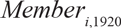 $$Membe{r_{i,1920}}$$
is an indicator variable that takes a value of 1 if the bank became a Fed member before the end of 1920.
 $$StateFactor{s_{i,1920}}$$
is a vector of state regulatory factors,
 $$BankFactor{s_{i,1914}}$$
is a vector of bank-specific factors, and
 $$CountyFactor{s_{i,1920}}$$
is a vector of county-specific factors.
 $${e_i}\;$$
is the robust error term clustered by county.Footnote
18
The summary statistics of these variables are included in Appendix Table A1.
 $$StateFactor{s_{i,1920}}$$
include dummies for whether the state had any state-wide branches, had only within-city branches, had mandatory deposit insurance, had voluntary deposit insurance, subjected stockholders to more than single liability, and did not have proper enabling legislation for state banks to become Fed members. We also include the reserve requirements on demand deposits, the reserve requirement on time deposits for non-member state banks, and the fraction of reserves that banks were allowed to keep on deposit at a correspondent. Finally, we include the state’s minimum capital level in thousands of dollars.
We also include a variety of bank-level factors (
 $$BankFactor{s_{i,1914}}$$
). First, we control for the size of a bank’s assets in 1914 to capture the fact that large banks would have been better able to shoulder the burdens of Fed membership. Second, we control for banks’ proportions of loans to assets in 1914, as banks with higher loan ratios may have been more sensitive to shocks affecting loan portfolios. Third, we measure the ability of individual banks to access alternative means of liquidity by including the number of correspondents a bank listed in the bank directories in 1910 and the share of those correspondents in their Federal Reserve district’s Reserve Bank city or branch office cities to capture a bank’s ability to receive liquidity through interbank relationships. Fourth, we measure a bank’s place in the interbank network using each bank’s number of respondent connections in 1910 and indicator variables for whether the bank was a trust company and whether the bank was located in a city with a clearinghouse in 1920.Footnote
19
Finally, we include the logarithm of the number of national banks in the bank’s location in 1914 to capture the effect of having other Fed members around prior to the state bank’s decision to join.
Because very few states reported quarterly bank-level data, we are not able to observe the seasonal loan swing of each bank. Instead, we include a state-level measure of seasonal loan volatility from the quarterly call reports of national banks published by the Comptroller of the Currency each year. The data allow us to calculate the average absolute value of the percent change in loans per bank between the third and fourth quarters across the years 1910, 1911, 1912, and 1913.
We also control for the characteristics of a bank’s location in 1920.Footnote 20 Because we are interested in identifying the effects of state-level regulation, we cannot introduce county-fixed effects that would capture constant location characteristics (e.g., soil suitability, terrain, climatic, and so on). Instead, we control for a location’s size and economic composition using the county’s population, the fraction of the population living in an area of 2,500 or more people, the fraction of the population that is illiterate, each county’s farm output per person, each county’s manufacturing output per person, and the fraction of each county’s improved acres planted in cereal.Footnote 21 Finally, to further control for the ability to access Fed liquidity support indirectly without becoming a Fed member, we control for whether the bank was in a Federal Reserve Bank city, whether it was in a Fed branch office city, or whether it was in a Comptroller of the Currency’s Reserve City that did not become a Fed city.
Our modeling approach seeks to avoid potential endogeneity problems. First, as noted previously, we examine only state commercial banks and trust companies that existed for all years between 1910 and 1920. This removes new institutions that immediately joined the Fed, whose entry might have been influenced by the increasing attractiveness of Federal Reserve membership. Second, we use bank-specific balance sheet data just before the establishment of the Fed and correspondent data from 1910. This avoids the influence of any endogenous changes the bank experienced in response to the operation of the Federal Reserve or to the decision to become a Fed member (see Anderson et al. (Reference Anderson, Calomiris, Jaremski and Richardson2018) for a discussion of balance sheet changes after membership adoption and Jaremski and Wheelock (2020b) for a discussion of network changes after the establishment of the Fed).
The results of Equation (1) are provided in Table 2. In order to give some idea of the impact of each group of controls, we show a variety of specifications in the table. The first column provides basic location controls for whether a bank is located in a Fed or Office of the Comptroller of the Currency (OCC) city or a city with the clearinghouse; the second column includes the location controls and the state-level bank regulation measures; the third column includes the location controls and the bank-level measures; the fourth column includes all the control groups; and finally, the last column replaces the state bank regulation characteristics with a set of state-fixed effects. All specifications contain the county-level Census controls in 1920, but the coefficients on these controls are unreported to economize on space.
DETERMINANTS OF FED MEMBERSHIP (1914–1920)

* = Significant at the 10 percent level.
** = Significant at the 5 percent level.
*** = Significant at the 1 percent level.
Notes: The table presents the results of an OLS regression. The dependent variable is an indicator variable for whether the bank joined the Fed by 1920. Each observation is a bank in 1914. Only banks that survived through 1920 are included. County-level controls for 1920 include the logarithms of county population, manufacturing output per person, and the fraction of acres planted in cereal as well as the fraction of county population living in a city or town of 2,500 or more persons. Robust standard errors clustered by county are provided in parentheses below the coefficients.
Source: See Data section for sources.
Focusing on Column (4), which contains the full set of controls, states that did not pass Fed enabling legislation consequently had significantly lower membership rates. We emphasize that the absence of enabling legislation did not constitute a prohibition; many states without enabling legislation still allowed banks to join the Fed if they were willing to meet extra requirements, such as holding extra reserves outside the Fed to meet their state requirements. In Column (4), we also find that banks in states with double liability, within-city branching, or high reserve requirements on demand deposits were more likely to adopt membership, whereas banks in states with mandatory deposit insurance, state-wide branching, or higher minimum capital requirements were less likely to join. Taken together, the results indicate that even controlling for the bank’s characteristics, states with generally looser prudential regulatory requirements, more restrictions related to Fed membership, or regulations that reduce the benefits of accessing the discount window (e.g., branching, mandatory deposit insurance, or more limited shareholder liability) tend to have significantly fewer member banks.
Bank-level characteristics also significantly affect the decision to adopt Fed membership (see Cols. (3)–(5)). Focusing on Column (4), which contains the full set of controls, large banks were significantly more likely to become Fed members, as were trust companies. Seasonal liquidity needs of a bank also mattered. A bank in a state with relatively higher seasonal loan swings was more likely to join the Fed.Footnote 22 That said, we find that banks with exceptionally high loan to asset ratios were less likely to join the Fed. This may have reflected differences in banks’ risk preferences: banks with higher lending ratios may not have wanted to be constrained by the higher regulations and reporting requirements they would experience under Fed rules. Banks that had more central roles in the interbank network (in other words, banks with more respondents) were more likely to join the Fed, yet banks with a large proportion of connections to Fed cities within their district were less likely to join.Footnote 23 This pair of results likely signals that large banks at the center of the interbank network joined the Fed in order to provide pass-through liquidity to their network connections, and that respondents with more network connections subsequently did not need to join the Fed. Indeed, Jaremski and Wheelock (2020b) show that the number of network connections to member banks in Fed cities rose dramatically between 1910 and 1919. Finally, after controlling for other influences, we find that being located in any of the designated financial centers has no effect.
Comparing the coefficients between Columns (2) through (4), we find that omitted variable bias was not driving most of the results reported in previous papers. The addition of bank-level factors (particularly the size of assets) reduces but does not eliminate the statistical significance of limited branching and mandatory deposit insurance, but increases the statistical significance of minimum capital requirements. The additions also increase the size of the effect of enabling legislation as large banks in those states still often join the Fed despite the potential costs and double liability.Footnote 24 On the other hand, the addition of state-level factors increases the statistical significance of being a trust company. The changes indicate why a combined model is needed to study the factors leading to Fed membership.
Using the R-squared values as a proxy for the amount of variation in membership explained by the right-hand side variables, the first column shows that the locational characteristics and Census measures explain relatively little of the decision to join the Federal Reserve. Compared to the baseline specification, the state regulations add some additional explanatory power, but the bank-level variables add considerably more. This pattern would be expected from Table 1. No state had more than a 35 percent membership rate, and thus while state regulation helps explain the order of magnitude of membership across states, it is the bank-level factors that explain which banks choose membership within the states. Comparing the results with and without the state-fixed effects, the results suggest that state regulatory factors make up about half of the explanatory power of state-level fixed effects.
Building on the R-squared analysis, we estimate “Best Subsets” regressions as described by Lawless and Singhal (Reference Lawless and Singhal1978). The approach estimates all combinations of the state- and bank-level variables in Column (4) of Table 2 and selects the best-fitting models that contain one variable, two variables, three variables, and so on. The approach thus identifies factors that had the largest statistical connection to the Fed membership decision and whether the importance of a variable relies on the inclusion of other variables in the model. The variables contained in each of the Best Subsets are presented in Table 3. The size of a bank’s assets stands out as the most important variable relating to the choice of Fed membershipFootnote 25 , and while limited branching is selected in the second, it is quickly replaced by the number of a bank’s respondent connections, state-wide branching, double liability, and enabling legislation. Overall, the evidence suggests that a bank’s size and relative importance in the interbank network are particularly important variables for its decision to join the Fed, but state-level regulation still plays a role.
EXAMINING THE EXPLANATORY POWER OF VARIABLES USING BEST SUBSETS REGRESSIONS

Notes: The rows indicate whether the variable described in the column heading was included in the best subset with that number of variables. The county-level control variables are included in all models and are not counted towards the number of variables in the subset.
Source: Results of Best Subsets Regressions of Equation (1).
Next, we separate banks based on whether they are located in a designated financial center by either the OCC or the Federal Reserve. As these cities were generally chosen because they represented national or regional financial centers where banks were doing substantial interbank business (Jaremski and Wheelock Reference Jaremski and Wheelock2017), banks located there might choose to become members for different reasons than others. The results for country banks in the first two columns of Table 4 are remarkably similar to those in Table 2. The only differences are that the number of correspondents and the fraction of correspondents in the bank’s Fed district cities are not significant. It should be noted, however, that few banks outside the largest cities had more than three correspondents, and the coefficient on the fraction of correspondents in Fed cities is marginally insignificant. The results for large city banks in the last two columns of Table 4, on the other hand, indicate that regulation was less important in the financial centers and interbank connections were more important, again signaling the value of correspondent banks’ passing through liquidity to respondents in their networks.
SEPARATING OCC AND FED CITIES

* = Significant at the 10 percent level.
** = Significant at the 5 percent level.
*** = Significant at the 1 percent level.
Notes: The table presents the results of an OLS regression. The dependent variable is an indicator variable for whether the bank joined the Fed by 1920. Each observation is a bank in 1914. The sample of banks included is described in the column heading. County-level controls for 1920 include the logarithms of county population, manufacturing output per person, and the fraction of acres planted in cereal as well as the fraction of county population living in a city or town of 2,500 or more persons. Robust standard errors clustered by county are provided in parentheses below the coefficients.
Source: See Data section for sources.
In the final set of specifications, we test whether the determinants of membership have varied over time. Specifically, we consider the rule changes in 1917, which lowered state bank-member requirements and the closure of the discount window to non-members. These should have had an immediate effect on the types of banks that would want to join the Fed going forward. We examine this effect by running three separate regressions. The first examines the membership choices before 1917; the second examines membership choices in 1917; and the third examines the membership choices between 1918 and 1920. In the second and third regressions, we drop those banks that joined the Fed in previous years in order to provide a clean control group of non-members.
The results displayed in Table 5 show a difference in membership choice over time. Early adoptions mainly consisted of large banks in Fed Reserve Bank cities that were connected to many other respondent banks, whereas later adoptions have a much larger correlation with the seasonal variation in loan swing and a lack of connections to correspondent banks in Fed cities. This pattern echoes the findings of Anderson et al. (Reference Anderson, Calomiris, Jaremski and Richardson2018) and adds more supporting evidence that banks that joined the Fed initially were those in Fed cities that had network connections throughout the country, which were seeking to provide indirect liquidity to their respondent networks, whereas later adopters joined to mitigate their liquidity risk, which became especially important after the discount window was closed to non-members after WWI.
TIMING OF MEMBERSHIP DECISION

* = Significant at the 10 percent level.
** = Significant at the 5 percent level.
*** = Significant at the 1 percent level.
Notes: The table presents the results of an OLS regression. The dependent variable is either an indicator variable for whether the bank joined the Fed between 1914 and 1916, during 1917, or between 1918 and 1920. Each observation is a bank in 1914. Only banks that survived through 1920 are included. For the second set of columns, banks that joined the Fed before 1917 are dropped. For the third set of columns, banks that joined the Fed before 1918 are dropped. County-level controls for 1920 include the logarithms of county population, manufacturing output per person, and the fraction of acres planted in cereal as well as the fraction of county population living in a city or town of 2,500 or more persons. Robust standard errors clustered by county are provided in parentheses below the coefficients.
Source: See Data section for sources.
CONCLUSION
This paper studies the early history of a fundamental choice banks still make today: whether or not to join the Federal Reserve. The Fed both raised reserve (and other prudential) requirements and offered liquidity to member banks to limit liquidity risk and prevent panic. Relatively few banks that were given a choice to become Fed members did so. This paper provides a comprehensive analysis of the membership choices of banks to identify which factors encouraged banks to join and which costs prevented them from joining.
The results illustrate that a variety of regulatory and bank-level factors were at play in the decision to become a Fed member. States where prudential regulation was already strict or where Fed-enabling legislation existed had higher Fed membership rates. States with regulatory environments that made access to the Fed discount window less important (branching, mandatory deposit insurance, or more limited shareholder liability) also saw lower membership rates. Bank-specific characteristics also mattered. Access to the Federal Reserve’s discount window—and the greater ability to reduce liquidity risk that such access afforded—seems to have been recognized by state-chartered banks as the primary attraction of joining the Federal Reserve. Banks in states with high seasonality in their loan demand (and consequently, greater liquidity risk), but not necessarily those with the highest loans-to-assets ratios, were more likely to join. At the same time, large banks that occupied important positions in the interbank network were especially willing to become members at an early date because access to the Federal Reserve improved their importance as conduits of liquidity to other banks. Overall, we find that bank-level factors (and particularly a bank’s size and its importance in the interbank network) provide more explanatory power for Fed membership than state-level factors.
The regulatory competition that limited Fed membership increased the systemic interbank risk of the banking system, as non-member banks relied on their large member bank correspondents to provide liquidity. When liquidity froze in financial centers during the Great Depression, the fact that much of the banking network lacked a direct connection to the Fed magnified bank distress and helped to spread distress to initially unaffected banks throughout the nation (Mitchener and Richardson 2018). Calomiris, Jaremski, and Wheelock (Reference Calomiris, Jaremski and Wheelock2021) show that the founding of the Fed may have even had a destabilizing effect on the outcome. The Fed’s presence weakened incentives for the most systemically important banks to maintain capital and cash buffers against liquidity risk, further reducing the resiliency of the system.
The most important lesson our evidence holds for current policymakers is that making the regulatory costs of joining the officially chartered and safety net-protected banking system too onerous relative to its private benefits for prospective members, such as today’s FinTech firms, has adverse systemic consequences. When the effect of regulatory cost on membership decisions is factored in, the optimal regulatory choice shifts toward regulations with lower costs than regulators would otherwise choose. When banks opt out of the chartered system, that can have systemic consequences. Shadow banks lack access to Fed lending and other aspects of the chartered bank safety net. As the recent crisis of 2007–2009 showed, chartered banks ended up relying on Fed loans and guarantees, as well as on emergency extensions of FDIC protection and on government preferred and common stock investments in weak banks. Shadow banks without access to these protections will be more likely to hoard cash or sell risky assets during a crisis, which can lead to systemically destabilizing declines in credit availability and risky asset prices. The lack of state banks that had joined the Fed in its early years reduced the availability of the Fed’s protection against liquidity risk during the Great Depression. Non-member banks not only suffered from this lack of protection, but their deposit withdrawals from member banks also created systemic illiquidity pressures that would have been avoided if they had chosen to become Fed members prior to the Depression.
Appendix
MEAN OF REGRESSION VARIABLES

Source: Summary statistics for the variables included in the regression in Table 2.
USING A HAZARD FUNCTION (1914–1920)

* = Significant at the 10 percent level.
** = Significant at the 5 percent level.
*** = Significant at the 1 percent level.
Notes: The table presents the coefficients of a Cox proportional hazard model. The dependent variable is an indicator variable for whether the bank joined the Fed in the year. Each observation is a bank-year. Only banks that survived through 1920 are included. County-level controls for 1920 include the logarithms of county population, manufacturing output per person, and the fraction of acres planted in cereal as well as the fraction of county population living in a city or town of 2,500 or more persons. Robust standard errors clustered by county are provided in parentheses below the coefficients.
Source: See Data section for sources.



