Ashurbanipal's libraries represent the single most important collection of literary tablets from first millennium Mesopotamia, and they will continue to do so for the foreseeable future. Almost all genres are represented within them, and the reliability and legibility of their manuscripts have proven an invaluable touchstone when confronted with duplicates from different cities and periods. Despite the intensive work of several generations of scholars, their wealth is far from exhausted, and many of their texts still remain unpublished and many of the fragments unidentified. This makes the possibility of accessing the entirety of their contents at the click of a button, via the British Museum's online database of photographs,Footnote 1 particularly welcome news for the student of Babylonian literature. Such a resource has allowed the identification of many hitherto unplaced small fragments, a selection of which is published here by the kind permission of the Trustees of the British Museum.Footnote 2
1. Finish Humbaba! (Gilgameš V 195–206 = 264–74)
In the fifth tablet of the Standard Babylonian version of Gilgameš, Humbaba, overpowered by Gilgameš with the help of Šamaš's fierce tempests (SB Gilg V 160–66),Footnote 3 pleads with his captor for his life. Enkidu, however, counters Humbaba's pleas in a series of speeches which, together with Humbaba's rejoinders, occupy more than one hundred verses (ll. 167–284). This dialogue, in which Enkidu addresses Gilgameš, and Humbaba begs alternately Gilgameš and Enkidu, concludes with Humbaba's defeat and his subsequent beheading (ll. 285–90).
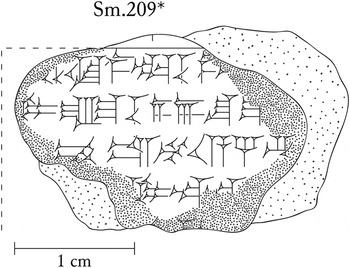
The small fragment Sm.209 (fig. 1) preserves part of one of Enkidu's speeches from this episode. It belongs most likely to the fourth or fifth column of the same tablet as K.3252+ (MS H1, George Reference George2003: pls. 72–73) and K.8591 (MS H2, olim MS AA, George Reference George2003: pl. 70 and al-Rawi & George Reference Al-Rawi and George2014: 73), and could therefore be termed H3. The speech of Enkidu in question is repeated twice in the preserved text of Gilgameš V (ll. 196–204 = 266–72),Footnote 4 and the fragment could conceivably belong to either occasion.
Fig. 1


***
Two unusual aspects of this fragment call for explanation, namely the co-occurrence of two almost contiguous doubled-up lines (196 f. = 265 f. and 200 f. = 269 f.) and the omission of several lines that are preserved in other manuscripts (199 = 268 and 202–04 = 271–72). The existence of two doubled-up lines in such a small fragment becomes explicable if one considers that doubled-up lines occur only in clusters elsewhere in MS H (e.g. Gilg V 29 f., 37 f., 39 f., 46 f.; and 95 f., 100 f., 104 f.). Secondly, the absence of some lines present in the duplicates can be attributed to recensional variation when the situation of other manuscripts is examined. Indeed, the omissions of ll. 268 and 271–72 in this fragment parallel that of l. 268 in MS dd (Uruk), and of ll. 271–72 in MS ff (Babylonia). The Nineveh fragment, however, preserves the shortest known version of the speech.Footnote 5
2. The marshland and the reeds (Gilgameš VI 113–18)
The sixth tablet of Gilgameš narrates Ištar's failed attempt to seduce Gilgameš, and the revenge undertaken by the rejected goddess: summoning the Bull of Heaven, she brings it to Uruk, where it wreaks havoc.
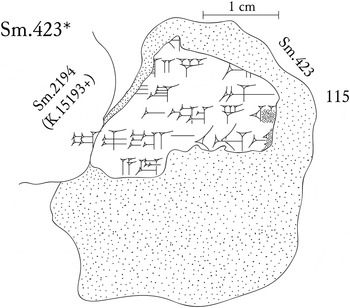
Sm.423 (fig. 2) joins K.15193+ (Q3, copied in George Reference George2003: pl. 88), one of the three known Nineveh exemplars of SB Gilgameš VI, duplicating the lines where Anu accedes to Ištar's pleas and grants her the Bull of Heaven. It contains no new text, but confirms A.R. George's restoration of the Ninevite version of l. 117:
113. [iš-me]-⸢e⸣-ma d a-nu an-[na-a] ⸢qa⸣-[ba-a d iš-tar]
114. [ù ṣer-r]et a-lim-ma a-n[a qātī(š]umin)-šá i[š-kun]
115. [o o (o)]-ma i-red-[da-á]š-šú d[iš-tar]
116. ⸢a⸣-n[a ? ma-a-tu]m šá uruk(unugki) ina ka-šá-d[i-šú]
117. ú-⸢tab-bil⸣ qišta([gi]štir) ap-pa-ra u qa-n[a-a]
118. ú-rid a-⸢na nāri(íd)⸣ [sebe(7) ammat(1.kù]š) nāru(íd) [um-da-ṭi]
113. Anu [list]ened to this speech of [Ištar]
114. [then] p[ut the lead-ro]pe of the bull in her [ha]nds.
115. [Ištar departed], leading it on,
116. when [it] arrived in the [land] of Uruk,
117. it withered the forest, the marshland and the re[eds],
118. it went down to the river, the water level [dropped seven cubi]ts.
Fig. 2

3. May she accept it! (Gilgameš VIII 135–42)
A great part of the eighth tablet of Gilgameš consists of a list of chthonic deities whose favour Gilgameš seeks to win on behalf of his recently deceased friend, Enkidu. In a complex ritual, strongly reminiscent of funerary rites described in other Babylonian texts, Gilgameš displays an offering to each deity and beseeches that each in return welcome Enkidu into their realm.
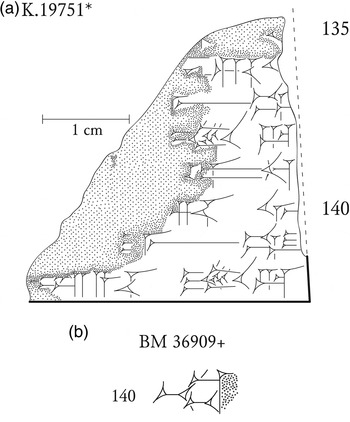
The tiny fragment K.19751 (fig. 3) belongs to the end of the third column of one of the Kuyunjik manuscripts of Gilgameš VIII, MS V (K.8281(+) K.8565+ (+) K.8587(+) K.19549, copied in George Reference George2003: pls. 102–03), and should therefore be termed V5. The lines preserved fall at the beginning of the funeral ceremony.
135. [ta-am-ḫi ? -ṣu (?) kal-li-re-e iṣ-ṣi] e[l]-l[im]
136. [a-na d iš-tar šar-ra-tum rabītu(gal-tum) šamaš(dutu) u]k-tal-li[m]
137. [lim-ḫur d iš-tar šar-ra-tum rabītu(g]al-tu[m])
138. [a-na pān(igi) ib-ri-ia lu-ú ḫa-da-at-ma i-da-a-šú] lil-lik
139. [o o x-na-am o o o te]-di-qa
140. [a-na bēlet-ilī(dingir-mah) šarratu (?) rabītu(gal-tum) šamaš(dutu) uk-t]al-lim
141. [lim-ḫur bēlet-ilī(dingir-mah) šarratu (?)] rabītu(⸢gal⸣-tum)
142. [a-na pān(igi) ib-ri-ia lu-ú ḫa-da-at-ma] ⸢i⸣-da-a-šú lil-lik
135. [A throwstick of ..., the pu]re [wood],
136. [for Ištar, the great queen, he] displayed it [to Šamaš]:
137. “[May Ištar, the] great [queen, accept this]!
138. [may she rejoice at my friend] and walk [at his side]!”
139. [... a dr]ess.
140. “[May she rejoice at my friend and] walk at [his side]!”
141. [For Bēlet-ilī], the great [queen, he disp]layed it [to Šamaš]:
142. “[May Bēlet-ilī], the great [queen, accept this]!
143. [May she rejoice at my friend and] walk at his side!”
Fig. 3

***
The fragment suggests that the divinity invoked in ll. 140 ff. is a feminine one, so the previous decipherment of the name as Ašim-babbar should be questioned. The only traces of the god name, preserved in BM 36909+ (MS m1, see I.L. Finkel's copy in George Reference George2003: pl. 104), are probably to be read as [ding]ir.ma[h], i.e. Bēlet-ilī (see the adjoining copy in Fig. 3b). After the goddess's name, the epithet may have been the same one Ištar receives, viz. [šarratu] rabītu, which is Bēlet-ili's sobriquet in a number of texts.Footnote 6
Although Bēlet-ilī does not appear in any of the standard lists of Netherworld deities, Ninhursag, a goddess with similar functions, does occur among the chthonic gods in the Sumerian poem The Death of Gilgameš (see George Reference George2003: 489–90).
4. The onager that nibbles the lushest grass (Theodicy 46–51)
In the Theodicy the sufferer questions the righteousness of divine judgment by presenting a series of situations where evil actions are rewarded, while fair behavior is punished. These situations, he argues, are not limited to the human world: animals are also ruled by this inverted moral law.
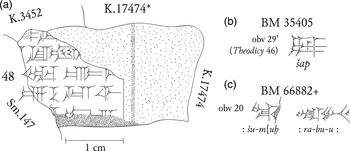
The line of reasoning of the sufferer can now be understood better thanks to the joining of K.17474 (fig. 4) to K.3452+ (MS C+ of Theodicy, copied in Lambert Reference Lambert1960 pl. 20 and 25),Footnote 7 which restores the end of l. 48.Footnote 8 The text presented here is that of MS C+ , restored by means of several published and unpublished duplicates:
48. [ak-ka-an-nu sír-ri-mu ša] iṭ-pu-pu šu-muḫ šam-⸢me⸣
49. [ak-kab-ti-i pak-ki] ili(dingir-dingir) ú-zu-un-šú ib-ši
50. [ag-gu la-b]u šá i-tak-ka-lu du-muq [š]⸢i-i-ri⸣
51. [ak-ki-mil-t]i il-ti-i šup-ṭu-ri ú-bi[l maṣ-ḫat-su]
48. The onager, the wild ass, which nibbles the lushest grass,
49. did he pay attention to the noble plans of a god?
50. The savage lion that devours the choicest meat,
51. did he offer flour to assuage the wrath of a goddess?
48. Only one other attestation of šumuḫ šamme is booked in the dictionaries, namely its occurrence in the Marduk Prophecy (Borger Reference Borger1971: 10 Assur IV 12), which represents perhaps an allusion to the Theodicy: rubû šū šumuḫ šammīšu māta ušakkal, “that prince will feed the land with his lushest grass.”
In the ancient commentary BM 66882 + , line 20 was previously thought to refer to Theodicy 49. However, inspection of the tablet reveals that this section of the commentary refers rather to l. 48, and that it is to be read, against the copy in Lambert Reference Lambert1960 pl. 26 (see the adjoining collation, Fig. 4c), as šu-m[uḫ* : šá-ma-ḫ]u : banû(dù-u) : min : ra*-bu*-u*, “‘abunda[nce’ (šumuḫ) (derives from the verb) ‘to grow abunda]ntly’ (šamāḫu), (which means) ‘to grow’ (banû); the same (sc. šamāḫu) (also means) ‘to become big’ (rabû).”Footnote 9
A different view of the diet of the serrēmu is offered in the Neo-Babylonian letter ABL 1000 obv 8'f. (de Vaan Reference de Vaan1995: 292–93): zēru ša ú sungirti | ša serrēmu ikkalu, “the seed of the sungirtu-plant, which only a wild ass would eat.”
49. The beginning of the line is here restored with BM 68589, which at this point reads ak-kab-ti-ia.Footnote 10
Fig. 4

5. Once you reach old age, who will be your support? (A fragment of a wisdom text)
Due to the fragmentary state of reconstruction of Mesopotamian literature, Assyriologists are often confronted with what G. Genette called “hypertexts of unknown hypotexts” (Genette Reference Genette1982: 433). One of them occurs in a line from a famous letter addressed to Ashurbanipal, where Urad-Gula, Chief Scribe of the Assyrian court, lists the difficulties he encounters in his daily life. This “forlorn scholar” (Parpola 1987) has no change of clothes, cannot afford a pair of sandals, owes six minas of silver and, to make matters worse, is no longer a youngster:
[ù ana šanātī(m]u-an-nameš)-ia ma-a a-na ši-bu-ti tak-šu-da tu-kul-ta-ka lu-u man-nu
[Moreover, regarding m]y age, it is said: “once you reach old age, who will be your support?”
ABL 1285 = SAA 10 294 r 30
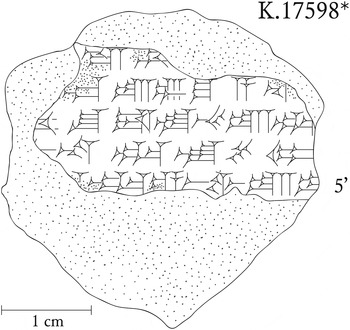
In this line Urad-Gula quotes from a poem, as shown, on the one hand, by the metrical structure of the line (ana šībūti | takšuda || tukultaka | lū mannu); on the other, by the fact that it is introduced by the direct speech particle (mā).Footnote 11 A small fragment from Kuyunjik (K.17598, fig. 5) confirms that this is an allusion and provides a context, albeit scant, for it. Although the work to which it belongs is uncertain, the phraseology is strongly reminiscent of the Theodicy.Footnote 12
1'. [o o o o o o] ša ta[q-bu-ú (?) o o o o]
2'. [o o o o ta-a]t-ta-lak-ma a-n[a o o o o]
3'. [a-na ši-bu-ti ta]k-šu-da tu-kul-ta-ka [lu-ú man-nu]
4'. [o o o b]u-na-ka tu-še-mi [o o-iš]
5'. [o o o]-x-ka e-dil pe-ta(-)t[a o o-ka]
1'. [...] what you s[aid ...]
2'. [... you have] walked to [...].
3'. Once [you hav]e reached [old age, who will be] your support?
4'. [...] you have reduced your features to [...],
5'. your [...] is closed, but [your ...] is open.
4'. Compare Theodicy 15: namrūti zīmīka ukkuliš tu-še-e-ma, “you have reduced your bright face to a scowl.”
Fig. 5

6. The entrails expert (BBR 1–20 1–28)
Anyone wishing to become a diviner in ancient Mesopotamia had to fulfil a series of requirements. To have been born in Nippur, Sippar or Babylon, and into a family of diviners, were sine qua non, as was to have bodily features without blemish and, of course, a thorough command of the entire corpus of divination. Such qualifications are the object of several treatises found at Nineveh, a list of which, together with general remarks on the group, can be found in Lambert Reference Lambert and Maul1998a.
Lambert divides the treatises into six sections, which contain complementary, if not identical, information. Of these, the first (BBR 1–20 ll. 1–115) is the least well preserved: its manuscripts are “very incomplete” and “often break the lines at different points so that its reconstruction is especially difficult” (Lambert Reference Lambert and Maul1998a: 142 n. 1).
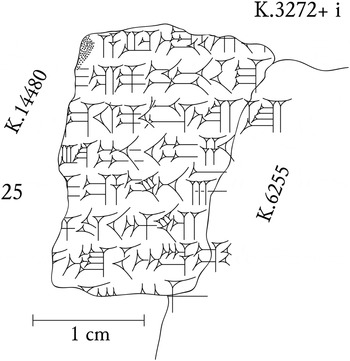
This situation is partially amended by the discovery of a new fragment, K.14480, which joins K.3272+ (BBR 3) and allows a better understanding of ll. 21–28. In addition, several fragments have been identified in the course of the last fifty years by R. Borger, W.G. Lambert and C.B.F. Walker, and as a result the only edition of the text, that of Zimmern's (Reference Zimmern1901: 95–105), is now substantially outdated. A re-edition of the whole ritual constitutes a desideratum that would go beyond the scope of this paper, but the identification of the new material calls for a fresh reappraisal of the opening lines. The known manuscripts of this first section are as follows:Footnote 13

MSS B, C, and D exhibit sign forms which, while different from one another, are all probably older than the 7th century BC, whereas MS A looks like a typical Ashurbanipal copy. MSS B and C are one-column tablets, but both MS A and D have two columns per side. MS B preserves a colophon on the lower edge stating that it was copied from a wooden writing-board, while MS D has a Nabû-zuqup-kēna colophon according to which it was copied from “older tablets.”Footnote 14

2 B u : C ù 4 B lu-u : C lu 6 B te-ḫi : C [t]e 10 B [o o o]-⸢ṭu⸣? -šú : AC broken | AC -du-šu : B -du-šú 12 AB im-bu-u : C im-bu-ú 14 A i-gir-ta-šú i-nam-di-nu-šu : C [i-gir-t]a-šu i-nam-di-nu : B broken 17 C im-nu-šu : A [im-nu-š]u ? : B broken 18 C pi-i-šú : B ka-šú : A [o š]u ? 19 A iḫ-zi-⸢šu⸣ : D [iḫ-z]i-⸢šú⸣ : BC broken | A [s]a-⸢na⸣*-⸢qu⸣* : B [s]a-na-qu : C ⸢sa-na-qu⸣ : D broken 20 A ra-bi-i : D ra-bi-ia (see above n. 10) : BC broken 21 A e-zib-šú : BCD ez-zib-šú 23 C ina <a > -šar : A [ina a-ša]r !? | A su-lu-ú : D su-lu-u 26 AD : C caret | A tu-kan-nu-šú : D tu-kan-nu-šu 27 AD : C ⸢ina* iti*gu4⸣* [itisig4 u itid]u6-kù* 28 A [ina iti]⸢meš an⸣-nu-ti : D ina i[timeš o o o] : C caret
(1) If the diviner is to prepare a sacrifice (2) and to approach the truthful territory of Šamaš and Adad, (3) [a territory] frightful as a great dragon, (where) the gods shall descend to him, (4) [his body ...] must have perfect limbs. (5) The blind, the gap-toothed, or the finger amputee (6) shall not approach the place of the divinatory decision – it is a taboo of Šullat and Ḫaniš.
(7) The diviner shall ponder and check the answer of Šamaš. (8) [Omens pertaining ...] sheep, intestines, oil, and birds (9) [...] he shall enumerate. (9) The subtleties of divination, (10) which he shall interpret with the help of the word lists, they (sc. the gods) shall [...] him and shall make him understand. (11) [...] and the mathematical tablets – secrets of extispicy (12) which Ea called into existence, the father (13) shall teach his favorite son under oath with tablet (14) and stylus, and he shall give them to him as his assignment.
(15) [He who gathers (the knowledge of)] the word lists and the collections of omens and edicts (16) may approach the place of the decision, in the presence of Šamaš and Adad. (17) Cedar – the tree beloved by the great gods – shall take in his right hand, (18) so that they [...] in his mouth the [...], the secret oracle of divination.
(19) He who has not mastered his learning, [...] to check, (20) should he draw near their great sacred (place) (sc. of Šamaš's and Adad's), (21) [...] he who walks ahead, [...] will abandon him, (22) the gods will give him [...] to drink and will [...] him; (23) [in the pl]ace of the oracular decision there will be lies and falsehood.
(24) [The expert in] the omen-yielding liver, the gatherer (of the knowledge) of the oracle-yielding liver, (25) [the kn]ower of the entrails, the diviner who has mastered the lore of his city; (26) [to the presence of Š]amaš and Adad you shall take him, (27) so that [they rev]eal to him (26) the secret oracle. (27) In the months of Ayyāru (II), Simanu (III), and Tašrītu (VII): (28) [during] these [month]s he shall search (for it).
2-3. These lines are duplicated in BBR 75-78 ll. 19–20.
5. On zaqta īnī, “sharp of eyes,” as a euphemism for “blind,” see Stol Reference Stol1986: 295. On [ḫes]ir šinnī, see Lambert Reference Lambert and Maul1998a: 144 and n. 2. On the meaning “to stub” (said of fingers) of nakāpu, see George Reference George2013: 163–64.
9. This line is paralleled in BBR 24+ 17–18 (Lambert Reference Lambert and Maul1998a: 149) (...) pirišti ani enlil u ea | šá itti(ki) ṣa-a-ti enūma(ud) anu(an) d en-líl u arâ(a-rá-a) šu-ta-bu-l[u]. The most problematic part of the sentence, ša itti ṣâti, was interpreted by Lambert Reference Lambert1967a: 133 (and id. 1998a: 144 with n. 4) as “that with commentary,” a phrase of uncertain meaning. This understanding was questioned by Koch-Westenholz Reference Koch-[Westenholz]2000: 26, who, however, does not propose an alternative.
A different interpretation is offered here. Rather than governing the phrase itti ṣâti, ša may govern the infinitive verb, šutābulu. It can then be interpreted as a nominalized command,Footnote 15 “(the secrets) which (the diviner) ought to interpret with (the help) of ṣâtu-lists.”Footnote 16 The diviner would thus be advised not to take divinatory texts at face value, but to seek their deeper meaning with the help of ṣâtu-lists — which are in fact often mentioned as the source of the equations in extispicy commentaries.
“The subtleties of divination” (nik-lat bārûti, Lambert Reference Lambert and Maul1998a: 144) parallels pirišti ani enlil u ea in BBR 24+. However, nik-mat bārûti, “the compilation of the divination texts,” also seems feasible in the light of the phrase ḫimmāt šummī u mīšarī in l. 15 (q.v.).
11-12. The first word of l. 11 is perhaps [... lišān]i (see n. 16). Compare the second part of the line with niṣirti bārûti (...) ša ina gán.diš ea ibnû, “the secret of extispicy, (...) which Ea created in Gandiš” (Koch Reference Koch-[Westenholz]2005: 60).
12-14. The same formula can be found in BBR 24+ 20–22 (Lambert Reference Lambert and Maul1998a: 149) and in several niṣirti bārûti texts (Koch Reference Koch-[Westenholz]2005: 543 iii 62f, 546 3'f). The -u endings of the verbs suggest parsing them as subjunctive, but this would result in cumbersome syntax, especially in the case of inaddinūšu. For want of a better explanation it is assumed here that an attraction to the nearby subjunctive verbs (cf. l. 12 imbû and irammu) has happened.
14. i-gir-ta-šú has been translated by Læssøe Reference Læssøe and Hvidberg1953: 213 as “his commentary,” and by Lambert Reference Lambert and Maul1998a: 146 as “his certificate,” in both cases assuming that it represents an elsewhere unparalleled writing of egirtu, “one column tablet” (for this term, see Radner Reference Radner1997: 60-62). AHw 897b, however, reads i-piš-ta-šu, a term that elsewhere can mean “(tablet inscribed with a) literary work” (Finkel Reference Finkel, Meyer and Sommerfeld1999: 332 ad 82).
15. The first word is restored after l. 24.Footnote 17 ḫimmat šummī u mīšarī is a baffling expression. šummu could be translated as “clause beginning with ‘if’,” i.e., “omen” (thus e.g. Oppenheim Reference Oppenheim1956: 256 n. 2, AHw 1273b, CAD Š/3 280b, and George Reference George2013: 103); but a meaning “law” for mīšaru makes little sense in this context.Footnote 18 mīšaru could conceivably designate an as yet unidentifiable category of extispicy text or, as B.R. Foster suggests (privatim), an “oracular response,” since legal terminology is frequently used to express the outcome of extispicy (cf. dīnšu ul iššir below in the commentary to line 23).
18. No restoration suggests itself for the verb before pīšu; elsewhere the tāmīt pirišti is “revealed” (ipattûšu) or “said” (itammûšu) (CAD T 124b and l. 26f below).
19. ⸢ú⸣!? -sa-na-qu (sanāqu D?) is unlikely both epigraphically and grammatically, since three different manuscripts (MSS ABC) preserve the same reading (sa-na-qu) with no gemination.
21. Compare BBR 24+ 60–61 (Lambert Reference Lambert and Maul1998a: 150): [inadd]ûšu šēdūšu lamassātūšu izzibāšū-ma, “his (sc., the bad diviner's) protective gods shall forsake him, his protective goddesses shall abandon him.”
23. On the phrase sullû u surrātu see Jiménez Reference Jiménez2013: 243. Here it represents a functional equivalent of dīnšu ul iššir, “his judgment will be wrong,” in BBR 24+ 47 (Lambert Reference Lambert and Maul1998a: 149).
24. The first word is tentatively restored after the phrase “an expert in oil” (abgal ì +giš), said of the diviner in a series of texts (Lambert Reference Lambert and Maul1998a: 153). The “liver (tākaltu)Footnote 19 of the omen” is probably to be interpreted as the liver in which the gods have written the omen: compare the expression ṭuppi ilī tākalta pirišti šamê u erṣeti, “the tablet of the gods, the liver, a secret of heaven and earth,” in BBR 24+ 8, 14, and 16 (Lambert Reference Lambert and Maul1998a: 148–49).
25. ⸢uru⸣ -šú follows Lambert Reference Lambert and Maul1998a: 145 n. 5, who regards ⸢su⸣ and ⸢zu⸣ as equally possible.
7. Anu created you to destroy the wicked (BMS 8+ BMS 48+)
As part of the ceremony of the Bīt salāʾ mê, literally “House of sprinkling of water,” the king had to spend a night in a cage made of reeds. During this time, he was meant to recite almost thirty incantation-prayers to sundry gods and constellations. At least in the libraries of Ashurbanipal these incantations were collected in several tablets whose subscripts identify them as “sections” (pirsu) of Bīt salāʾ mê. One of these tablets, dubbed the 8th section and furnished with an Ashurbanipal Typ c-e colophon, contains incantations to Madānu, Ištar, and the Sebetti.
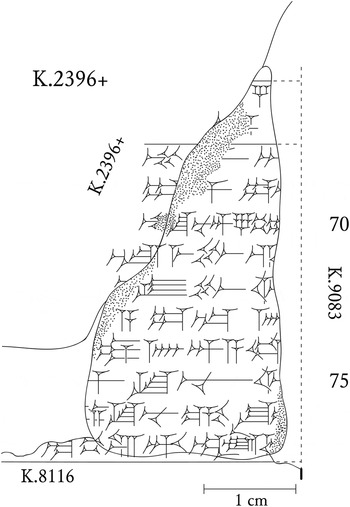
The last incantation, addressed to the Seven Gods, can now be restored thanks to the identification of a new fragment, K.9083 (fig. 7), which joins two further pieces of this tablet, K.2396+ (BMS 8) and K.8116 (BMS 48). The text of the 8th pirsu of Bīt salāʾ mê has recently been edited and studied by Ambos Reference Ambos2013: 196–200, who kindly made his book available when it was still in proofs.
Fig. 6

Fig. 7


70. If the restoration is correct, the second MUL should have been written over the edge. The appositive use of mul-mul and d inim-bi is attested also e.g. in Mulapin I i 44 (mul-mul d imin-bi dingir meš gal meš, see further Hunger Reference Hunger2003/2005).
72. The first word is perhaps a form of the verb rakāsu, “to tie up, to gird,” or a cognate noun, such as maksûtu, “binding.”
77. Restored from the end of the prayer Kaksisa 2/3 = Ninurta 4 (Mayer Reference Mayer1990: 471 ll. 24–25):
ina šīrīya ṭurud namtara lemna ša ana nakās napištīya izzazzu
kīma mê nāri eššūti iṭrudū labīrūti
Send away from my body the evil Namtaru-demon, who stands by to cut my throat,
just as the fresh water from a river expelled the old!
***
The incantation shows many phraseological parallels with the epic of Erra and Išum. For instance, the phrase būla šumqutu, “to destroy the animals” (l. 72), is elsewhere attested only in the epic, where it appears in IIc 26 and IV 147; and, as būl šakkan šumqutu, “to destroy the wild animals,” in I 43, I 85 and III 15. Also the phrase tâmta dalāhu, “to roil the sea” (l. 73) appears there in I 70, IId 27 and IIId 5. The birth of the Sebetti from the sky god Anu (l. 70 and 74) is narrated in Erra and Išum I 28-40. All these parallels suggest that a borrowing took place, either from Erra and Išum to this prayer or vice versa.
8. Signs from the series Tukumbi Apinduata (The Diviner's Manual)
The Diviner's Manual is an astrological treatise which instructs the diviner on how to counterbalance an ominous sign with a series of ingenious manipulations, mostly peculiar to this text.Footnote 20 Before the instructional part, however, it contains in its first section (ll. 1–37) a catalogue of incipits of the tablets of two series. The first portion (ll. 1–24) lists the tablets of the otherwise poorly attested series Tukumbi Apinduata,Footnote 21 which in ll. 22 is said to consist of “terrestrial omens” (idāt erṣeti). The second portion (ll. 25–37) contains the incipits of the tablets of the equally unknown series Kakkabu ša ina pānīšu ṣipru, identified in l. 36 as consisting of “celestial omens” (idāt šamê). After both catalogues, the Diviner's Manual famously proclaims the equivalence of terrestrial and celestial signs, and instructs the astrologer on how to annul negative prognoses.
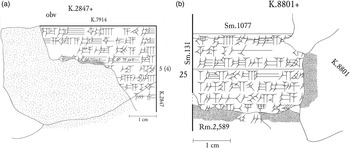
K.7914 joins K.2847, a manuscript of the Diviner's Manual. This join helps to restore almost the whole of the beginning of the text, the only part of it that was missing, and allows a better understanding of the first section of the text, the catalogue of the series Tukumbi Apinduata. The text offered here is the transcription of K.2847+ K.7914, restored with all the other duplicates (for which see below):Footnote 22
1. (1) [diš tukum-bi ittu(giskim)] lemettu(hul-tum) ittu(giskim) a-ḫi-tum
2. [o o o o (2) i-ta-a-t]um ḫa-ṭa-a-tum lem-né-e-tum
3. [šá libbū(šà) tukum-bi] itiapin-du8-a-ta
4. (3) [diš tukum-bi gú-gal] ⸢kù-babbar šám⸣-šám-da
5. (4) [diš zag-gàr-ra] ⸢uru⸣ na-nam
6. (5) [šumma(diš) iṣṣūr(mušen) šamê(an-e) a-ḫu-ú
ša ki-i amēlūti(nam-lú-u18-lu) ziqna(su6) zaq-na-at (6) appa(ka) b]u-un-na-át
7. [eli(ugu) šēpī(gìrmin)-šú ziq-pa izzazzu(gub-zu) ip-par-šam-ma
(7) i-na āli(uru) u na-m]e-e-šú innammar(igi)
8. [pī(ka)-šú petī(bad)-ma amâtū(inimmeš)-šú aṣâni(è]meš -ni)
(1) [If an] unfavorable [sign] or an abnormal sign (2) [...] the ominous and unfavorable signs (3) [which are mentioned in (the tablets) “If] from the month Araḫsamna on,” (4) [“If the king] buys silver,” (5) “[If] there is a city,” (6) [“If a strange bird, which is bearded like a human being, whose beak is ex]quisite, (7) [which (normally) stands upright on its legs] is observed fluttering about in the city or its surroundings (8), [it has its mouth opened and words] are coming out from it.”
4. This omen is known from SpTU 1 85 o 7'–9' (see Römer Reference Römer and Kaiser1986: 5455). Other bilingual omens are published in SpTU 1 86, SpTU 1 145 (see Cavigneaux Reference Cavigneaux1988), SpTU 3 86 (see Geller Reference Geller1991/1992: 181–182), and CTN 4 89.Footnote 23 Likewise, several unpublished fragments of bilingual omens from Kuyunjik are mentioned in Borger Reference Borger1975: 215; Lambert Reference Lambert1978/1979: 111b; and Reiner Reference Reiner, Boardman, Edwards, Hammond, Sommerfeld and Walker1991: 320 n. 124. To these K.13495 should now be added.
5. diš zag-gàr-ra, not translated by Oppenheim (cf. Oppenheim Reference Oppenheim1974: 203 n. 13), is probably to be taken together with diš as the conditional conjuction, like diš tukumbi in the previous lines. Note that Nabnītu IVa 366-68 (Finkel Reference Finkel1982: 91) and NBGT III ii 11–13 (Hallock and Landsberger Reference Hallock, Landsberger, Landsberger, Hallock, Jacobsen and Falkenstein1956: 160) equate the following words with šumma:

The last word, za(g)ga(r)ra, is the only one with a variant orthography, so a writing zag-gàr-ra, like in the Diviner's Manual, should not surprise.
uru-na-nam is the name of (a sanctuary in) Nippur (see George Reference George1992: 316 and 446 and Michalowski Reference Michalowski, Michalowski and Veldhuis2006: 157), but this seems to have no bearing on the present text.
***
Scholars have often remarked on the puzzling fact that, although the astrological contents of the Diviner's Manual are unique, the great number of manuscripts in which it was preserved suggests that it belonged to the “stream of tradition.”Footnote 24 However, over the last forty years the ten manuscripts used by Oppenheim in his edition have been found to belong to three basic manuscripts, one in Babylonian and two in Assyrian script, and to three further tablets which contain additional astrological material. For the reader's convenience, an updated list of manuscripts and new sigla are given here (the letters in parentheses correspond to the sigla in Oppenheim's edition, fragments not used by Oppenheim are in bold):

As noted by Oppenheim, a ḫepi-gloss appears in the same place (l. 67) in MSS NinAss1, NinAss2 and NinVar2, which makes it very likely that these three MSS go back to the same Vorlage.Footnote 27 That all six Ninevite manuscripts had the same Vorlage cannot be proven, however, inasmuch as the line in question is not preserved in NinVar1, NinVar3, and NinBab1. The last of these, NinBab1, is the only exemplar written in Babylonian script, and it was in all likelihood brought to Nineveh from a Babylonian city. The fact that it has a small lacuna at this point leaves the possibility open that this was in fact the Vorlage for all the Assyrian duplicates.
9. My bed is the ground! (penitential prayer alsīka ilī)
The prayer alsīka ilī is one of the few extant examples of the group of the šigû-prayers, individual laments addressed to a deity in which the penitent acknowledges his sins and asks the god for absolution.Footnote 28 Until now this prayer was known from two small Nineveh tablets preserving two different recensions: K.2425 (Babyloniaca 3 32) and K.9252 (van der Toorn Reference van der Toorn1985: pl. 2, with an Asb Typ c–e colophon). It has been edited by Seux Reference Seux, Caquot and Delcor1981: 434–35 and, more recently, by van der Toorn Reference van der Toorn1985: 137–38.
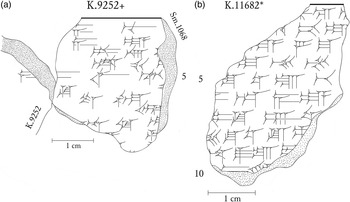
Two new fragments have been identified: the first one, K.11682 (Fig. 9b), follows the former recension, while the second, Sm.1068 (Fig. 9a), joins the only known manuscript of the latter version, K.9252.
Fig. 8

Fig. 9


1. Incantation šigû: I have called upon you. My god, relent!
2. Relent, my god! Accept my supplication!
3. Harken to my weary prayers!
4. Learn at once the disgrace that has befallen me!
5. Keep listening to my lament, which I have made!
6. May the night bring you the tears which I weep!
7. Since the day (you), my lord, punished me,
8. and (you), the god who created me, became furious with me,
9. (since the day) you turned my house into my prison,
10. my bed is the ground, my sleeping place is dust,
11. I am deprived of sleep, distressed by nightmares,
12. I am troubled [in my ...], confused [in my ...].
B 9. I have been enduring a punishment [that I cannot bear.]
A 4. This line finds a parallel in an incantation addressed to Šamaš (Abusch & Schwemer Reference Abusch and Schwemer2011: 338 l. 22).
A 5. The traces at the end of the line in K.9252+ seem to belong to the same long DÙ-sign as the traces at the beginning of Sm.1068. However, no likely reading suggests itself – the reading adopted by van der Toorn Reference van der Toorn1985: 137, tānēḫīya ša ēpušu, “my laments which I have made,” followed by CAD T 172a, results in awkward syntax.
A 10. Cf. (mihi) cubile terra, “my bed is the ground” (Cicero, Tusculanae disputationes 5, 90). The restoration of mūšab mūšīya in the second half of the verse follows van der Toorn Reference van der Toorn1985: 137; if correct, the elsewhere unattested phrase mūšab mūši, “night abode,” would be a synonym of mayyāl mūši, “night bed.”
B 9. Cf. K.3515 (OECT 6 13) r 5', which could now be restored as [ar-n]a áš-ta-da-ad našâ ul ileʾʾe.
10. The god of unfathomable heart (Ashurbanipal's Dedicatory Inscription to Marduk)
A hymn whose main character is the Assyrian king Ashurbanipal records the dedication of a golden basket (masab ḫurāṣi) or, according to one manuscript, of a golden censer (nignak ḫurāṣi), to the god Marduk. Of its three parts, the first (ll. 1–13) is a hymnic introduction celebrating the god's preeminence. The second (ll. 14–25/26), which begins with a self-introduction of the king (l. 14, anāku aššur-bāni-apli), narrates the defeat he inflicted upon Tugdammê, the king of the Cimmerians, and his son. The third section (ll. 25/26–50) describes the votive object itself. The historical character of the second part of the text motivated its inclusion in Borger's edition of Ashurbanipal's inscriptions (Borger Reference Borger1996: 201–03), the most recent edition of the text.
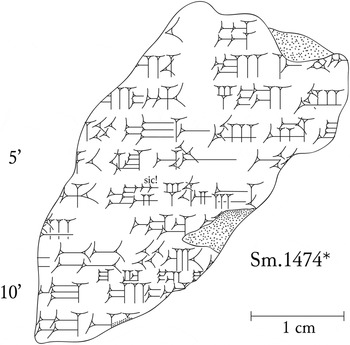
The hymn is known from a long Neo-Babylonian manuscript from Kuyunjik and several smaller Neo-Assyrian fragments. Two new manuscripts have come to light since Borger's edition, both of them from the first part of the inscription, the hymnic introduction. The first of them, K.12582 (OECT 6 5) joins the big Neo-Babylonian manuscript and restores ll. 6–12. The second, Sm.1474, is written in Neo-Assyrian script and might be part of MS C or, less likely, of MS D. The manuscripts known for the text are:
a K.120B+ K.144+ K.3265+ K.3298 (all of them ABRT 1 pl. 10–13 and ABRT 2 p. ix)+ K.12582 (OECT 6 5) // 1–51
B K.3412 (IWA pls. 38-39)// 1–12, 38–50
C K.11797+ K.13885 (unpubl.)// 31–43
D 80-7-19,333 (Iraq 30 pl. xxv)// 48–51
E Sm.1474 (Fig. 10)// 6–10d
Fig. 10

The new manuscripts, and in particular OECT 6 5, suggest a different reconstruction from that adopted by Borger, and the line numeration should be altered accordingly. In the following edition the corresponding numbers from Borger's edition are given in parentheses.
5. a. (// B 5) bēlu(en) kab-tu gít-⸢ma-lum⸣ š[a i]-ta-a-šú la in-né-ti-qu x [...]
6. a. dšà-zu mu-de-e libbi(šà) ilī(d[ingirme]š) mu-bal-lu-u nap-ḫar rag-gi šá [...]
E 1' (// B 6). [dšà-zu mu-bal-lu]-u nap-[ḫar ...]
6b. (7) E 2' (// B 7). [pa-qid kul-lat nap-ḫa]-ri ta-me-e[ḫ ṣer-re-ti šamê u erṣeti (?) ...]
6c. (8) E 5' (// B 8). [mu-kil mar-kas 4 šamê(an]-⸢e⸣) u erṣeti(ki-tim) mu-[...]
7. (α) a. a-pir agê(aga) bēlūti(en-ú-ti) šá ra-šub-ba-tú za-ʾ-nu pul-ḫa-a-[ti lab-šu ...]
E 3' (// B 9). [o o o bēlūti(en]-ú-ti šá ra-šub-[ba-tú ...]
7b. (β) E 4' (// B 10). [šamši(dutu-ši) ilī(dingirmeš) z]i-i-me ru-uš-š[u-ti ...]
8. (γ) a. le-ʾ le-ʾ-ú-ti rap-šá uznī(geštumin) er-šú šal-ba-bu pa[l-ku-ú ...]
E 6' (// B 11). [o o le-ʾ-ú-t]i rap ! -šá uznī(geštumin) er-šú [...]
8b. (δ) E 7' (// B 12). [šad-lu ṣur-r]u ka-⸢raš⸣ [ta-šim-ti ...]
8c. (ε)E 8' (// B 13). [libbu(šà-bu) ru]-⸢ú⸣-qu muš-t[a-bil nēmeqi (?) ...]
8d. (ζ)B 14 (E caret). šá ṭè-em-šú la il-lam-ma-du x [...]
9.a. libbu(šà) ru-ú-qu ma-lik ra-ma-ni-šú ⸢šá⸣ ina gi-mir NU TIL ina ta-[...]
E 9' (B caret). [o o o] ma-lik ra-ma-[ni-šú ...]
10.a. be-el kup-pi nag-bi e-de-e u ta-ma-a-ti x [...]
B 15 (E caret). be-el kup-pi nag-bi e-de-e u [...]
10b. (η)B 16 (E caret). ba-nu-ú ṣal-mat qaqqadi(sag-du) bēl(en) nab-n[i-ti ...]
10c.E 10' (B caret). [o o o] la ú-t[a-...]
10d.E 11' (B caret). [o o o] ab-x [...]
11. a (// B 17). bēlu(en) réme-nu-ú le-qu-ú un-nin-ni še-mu-ú [...]
12.a (// B 18). šar(lugal) bābili(ká-dingir-raki) bēl(en) é-sag-íl ēkal(é-gal) šamê(an-⸢e⸣) [u erṣeti...]
5. Noble, perfect lord, whose boundaries cannot be transgressed, [...],
6. Šazu, who knows the heart of the gods, who destroys all enemies, who [...],
6b. [Guardian of the Univer]se, the holde[r of the lead rope of Heaven and Earth ...],
6c. [Sustainer of the bond of Heav]en and Earth, the [...].
7. Who is crowned with the lordly tiara, adorned with terror and clad with fearsome aura [...],
7b. [Sun-god of the gods,] whose features are fiery [...],
8. Most capable of the capable, wise and expert, ingenious and lear[ned ...],
8b. Magnanimous, of all-penetrating mind, [...],
8c. Of unfathomable heart, who ponders [wisdom ...],
8d. Whose intentions cannot be understood [...],
9. (The god) of unfathomable heart, the counselor of himself, who in all [...]
10. The lord of springs, floods and seas, [...]
10b. Creator of the black-headed people, the lord of the crea[tion ...],
10c-d. ...
11. Merciful lord who accepts prayers and heeds [supplications, ...],
12. King of Babylon, lord of Esagil – the palace of Heaven [and Earth ...]
5. Cf. mamman ina ilī itukka lā ittiq “no one among the gods can transgress his boundaries” (Enūma Eliš IV 10).
6. The etymological explanation of the name Šazu as mūdê libbi ilī appears in MS a but is absent from all the Assyrian manuscripts. Elsewhere it occurs, among other texts, in Enūma Eliš VII 35 (see Hurowitz Reference Hurowitz, Horowitz, Gabbay and Vukosavović2010: 91 and Lambert Reference Lambert2013: 484–85).
7. The restoration [labšu] follows CAD Z 48a.
7b. On this line, see George Reference George1992: 139 n. 37 and Hurowitz Reference Hurowitz, Horowitz, Gabbay and Vukosavović2010: 90.
8c. muštābil nēmeqi is restored after a prayer to Marduk edited by Mayer Reference Mayer1990: 456 l. 3.
8c–9. The fact that both lines 8c and 9 begin with libbu rūqu prompted a homoeoteleuton in MSS B and E. While the scribe of MS E omitted l. 8d and 9, and only later did he try to amend his error by copying l. 9 in small script beneath 8c (see copy); that of MS B omitted l. 9 altogether.
libbu rūqu, “distant (i.e., unfathomable) heart” is a common epithet of Marduk (CAD R 425a). According to Lambert Reference Lambert, Coggins and Houlden1990: 215b and 2013: 484–485, it is a literal translation from the Sumerian šà sù, whence its occasional use as a playful translation of the divine name Šazu.
10c–d. The text in MS E seems not to be duplicated by either MS a or MS B.
***
The Babylonian (MS a) and the Assyrian versions (all other MSS) of this text exhibit profound divergences. However, the tablets written in Assyrian script, which preserve longer versions of the poem, also disagree with one another in detail. As already mentioned, one of the Assyrian manuscripts (MS B) states that the hymn was accompanied by the offering of a “golden censer” (nignak ḫurāṣi), while the Babylonian manuscript, and one of the Assyrian ones (MS D), speaks of a “golden basket” (masab ḫurāṣi). Moreover, the subscript of the Babylonian tablet states that the tablet has a total of 50 lines, while one of the Assyrian fragments, MS D preserves the number 55. The other Assyrian manuscripts might have been even longer, since the portion of the text that they preserve contains no fewer than nine lines absent from the Babylonian version.
It is obvious from this that there existed not only two versions of this hymn — one Babylonian and one Assyrian —, but rather a spectrum of them, adapted on different occasions to accompany different offerings. It is conceivable that these different versions also recorded different historical events, not only the Elamite defeat by Ashurbanipal, but this is as yet difficult to ascertain, since the historical section of the inscription (ll. 14–25/26) is so far attested only in the Babylonian manuscript.
11. The caring hands of the god (Muššuʾu VII)
The seventh tablet of the exorcistic series Muššuʾu opens with a long and elaborate bilingual incantation that aims at exorcizing whatever disease is affecting the patient. It is divided into three parts: the first one (ll. 1–19) is a long list of god names, some of them only poorly attested elsewhere. This is seamlessly followed by a list of diseases (ll. 20–26), which is combined with the list of gods in the final part of the incantation (ll. 27–32), where the gods from the former list are invoked to expel the diseases mentioned in the latter.Footnote 29
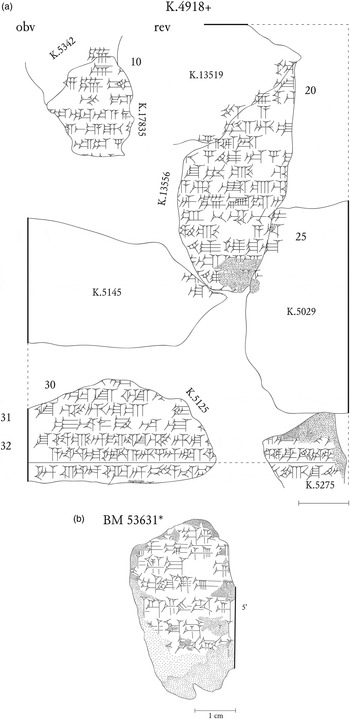
This incantation is preserved in tablets from Babylon, Uruk, Sippar, and Kuyunjik. Two Ninevite manuscripts of it are known: the small fragment Sm.1668+ Sm.2181 (MS C+ E, now rejoined), and K.4918+ (MS D). The latter is a very broken tablet: when first copied by B. Böck (Reference Böck2007: pls. xxxiv–xxxv), it consisted of 12 fragments; now three more fragments have been identified, so this small tablet currently consists of 15 rejoined pieces.Footnote 30
The text has been recently edited in Böck Reference Böck2007: 241–60, with updates in Böck Reference Böck2009: 133–37 and Lambert Reference Lambert2013: 157–58. A recent translation can be found in Böck Reference Böck, Janowski and Schwemer2010: 149–50.
10. [db]ur-nun-sa5 lú [hul-ĝál s]ág-⸢ke4⸣
dmin sa-k[ip ø l]em-[n]i
11. [dgan]-dìm-me-kù lúér[im-ma-bi šu-zag-ság o] x
[d]⸢min⸣ mu-ra-[ʾi-bat a-a-bi o o o]
12. [dgada-lá-ab]zu ka-ba-a-ni u[š11-zu o o o o]
[dpap-sukkal š]a ina e-piš p[i-i-šú kiš-pi o o o o]
13. [densí-ĝál]-abzu níĝ-[zi níĝ-si-sá ki áĝ-ĝá (?)]
traces
***
19. dnin-gìrim nin a-gúb-ba dadda[g-ga]
dmin be-let a-gub-bé-e e[l-li]
20. saĝ-gig zú-gig sa-gig s[u-gig]
mu-ru-uṣ qaq-qa-di min šin-ni ki-is-sa-tú e[k-ke-tú]
21. aš-gar mu-⸢ú⸣*-a te-a [zé-zé (?)]
di-ʾi š[at-t]i si-ḫi-il-ti ṣ[i-rip-tú (?)]
22. a-za-ad mu-⸢ú-a⸣ ⸢a šed7⸣-da [diri-ga]
šu-ru-up-p[a-a šat-t]i šá ḫur-ba-šá m[a-lu-u]
23. ud-da-tab-ba i[m-ri-a] šu-tag-ga na[m-tar-ra]
ḫi-miṭ ṣe-[e-ti ši-biṭ šá]-a-ri li-pit na[m-ta-ri]
24. udug ĝar [(o o) dsìg-g]a (?) dlugal-ùr-ra a[n-ta-šu]b-⸢ba⸣
ši-kin š[e-e-di d š]u-lak be-en-nu mi-qit šamê(an-e)
25. udug gedi[m gi]g-ga a-na-me-a-bi
ú-tuk-ku ⸢e⸣-ṭ[em-mu] mur-ṣu ma-la ba-šu-u
26. zú-muš-ì-gu7-e s[u l]ú-u19-lu-⸢ke4⸣ ì-ĝál-la
pa-šit-tum ša ina zu-mur ⸢a⸣-me-li ba-šá-tu 4
27. su-bu5-ra hul-ĝál-la-⸢bi-ta⸣ zi-ge-eš
ina tir-rat le-mut-ti [l]i-is-su-ḫu-ka
***
30. [ninda a-me]š ka-zu [hé-ni-í]b-dùg-ga-e-ne
[a]-ka-lu ù mu-⸢ú⸣ [ina pi-i-k]a li-ṭib-bu
31. ki nam-ti-la-ke4 ĝìri-[zu gu]b-⸢bu-dè⸣
i-na qaq-qar ba-la-ṭ[i še-ep-ka li-iz-zi-zu]
32. šu sig5-ga diĝir-ra-na-šè nam-ti-la si[lim-ma-(mu) hé]-⸢ni-íb-túm-mu⸣-n[e]
a-na qa-at dam-qa-a-ti šá ilī(dingir)-ka ana š[ul-mi ù b]a ? -<lá > -ṭi lip-qi-du-k[a én]
Catchline and rubric. én udug-hul an-edin-na r[e6-a dub 7-k]am muš-šu-ʾ[u]
Colophon. Asb Typ q (Hunger Reference Hunger1968: 103 no. 329)
10. Burnunsa, he who overthrows the enemy,
11. Gandimmeku, she who makes the foe [...] tremble,
12. Gadalabzu / Papsukkal, at whose command witchcraft [is destroyed],
13. Ensigalabzu, he who loves truth and justice, (...)
19. (and) Ningirim, the lady of the holy water vessel.
20. Head disease, tooth disease, muscle disease and b[ody disease] (Akk. skin disease and itching),
21. Seasonal headache, puncture wound, di[scoloration],
22. Seasonal cold, [full of cold water] (Akk. which is full of shivers),
23. Heat stroke, wind burn, deathly plague,
24. “Appearance of the šēdu-spirit,” Šulak, “lord of the roof” (Akk. epilepsy), and “falling sickness,”
25. demons, ghosts and diseases, as many as there are,
26. “obliterator,” who is in a person's body,
27. May they (sc., the gods mentioned in ll. 1–19) expel them
(the above mentioned diseases) with the lash of evil!
(...)
30. May they make food and drink agreeable to your taste!
31. Your foot shall stand on a land of life! (Akk. May your feet stand on a land of life!)
32. May they entrust you, sound and safe, to the caring hands of your god! [Incantation].
Catchline and rubric. “Incantation: The evil demon who walks in the steppe.”
[Seven]th tablet of Muššuʾu.
11. In An = Anu Gandimmeku is a daughter of Ea or Namtar (Lambert Reference Lambert1972/1975). The reading of her name here follows Selz apud Jursa Reference Jursa2001/2002: 85a.
20. For the sequence of diseases su-gú sa-gú || kissatu ekketu cf. the medical commentaries SpTU 1 51 r 5 and 52 6–7. Compare also Muššuʾu VI 12: su-gu7-e sa-gu7-e || kissatu ekketu, after which the end of this line is tentatively restored.
21. mu-ú-a is assumed to represent mu, “year,” with a genitive ending. On the orthography, cf. mu-ú-a, “in (this) year,” in MSL 12 51 l. 511 and in the proverb SP 5 A 72 (see Gordon Reference Gordon1958: 53b and Alster Reference Alster1997: I 133 and II 405, note that a similar bilingual proverb from Kuyunjik cited ibid. reads mu-àm). BM 46297+ (MS A) reads perhaps mu-u8 !-ú-a at this point.
The restoration at the end is tentative. The equation zé-zé = ṣiriptu would be otherwise unattested, but compare zé-zé = ṣurrupu in Nabnītu XXIII 156 (Finkel Reference Finkel1982: 216).
22. BM 46297+ (MS A) reads šu-ru-up-pe-e šat*-t[um ...]. On “seasonal” diʾu and šuruppû diseases, see Stol Reference Stol, Finkel and Geller2007: 15–16 and Lambert Reference Lambert2007: 36-37 ll. 245–46.
27. su-bu5-ra || tirratu is an unknown equation, where neither the Sumerian nor the Akkadian is clear (cf. Scurlock Reference Scurlock2011: 101).
31. On the interpretation of this line see Schramm Reference Schramm2008: 225 ad 37/38.
32. Compare the similar line in Šurpu V–VI 170 f.: šu sa6-ga dingir-r[a-na-šè hé]-en-ši-in-gi4-gi4 || a-na qa-at dam-[qa-a-t]i šá ilī(dingir)-šú lip-pa-qid, and in Saggig (CT 17 22 ii 145 f., SpTU 3 65 r 15 f. = Muššuʾu II 50, and SpTU 2 2 104 f.). Sm.1668+ Sm.2181 (MS C+ E) reads [... b]a-lá-ṭi l[ip*-qi-du-ka ...].
***
A new manuscript of this incantation was identified while studying literary fragments from the British Museum's “Sippar Collection,” after the above was submitted. BM 53631 (82-3-23,4669, here Fig. 11b) preserves the line ends of Muššuʾu VII 7–10. It could be part of the same manuscript as BM 69903 (AH.82-9-18,9903), a small fragment from Sippar published by Böck Reference Böck2009: 135, but the script of the new fragment is considerably less slanted.
Fig. 11

The new fragment adds little to the known text, but it contains some remarkable spellings, such as ab-tu-lu-ú-⸢a⸣ (cf. ab-tu-lu-u8-a in K.4918+), or zag-ga-k[e4] (cf. [s]ág-⸢ke4⸣ in K.4918+).
1'. (7) [dtu-tu šìr-kù-ga-bi uš11-r]i-a ab-zi-[ir-zi-ir]
2'. (7) [marduk ša ina šerkugêšu ruḫê] ⸢ú⸣-pa-as-sa-su
3'. (8) [dšà-zu diĝir suḫ é]rim-ma-ke4
[marduk ilu muballû a-a-b]i
4'. (8a) [den-bi-lu-lu gaba ḫul-ĝá]l ab-tu-lu-ú-⸢a⸣
[marduk muneʾʾe irti lemni]
5' (9). [dnamma šu dnam-tar-r]a? gá-ge-da-ke4
[d min ša ina qāt namtari igammelu]
6'. (9a) [dnanše šu tag-ga-bi urì-e (?) a]k?-ke-e-[k]e4
[d min ša lipit qātīšu nāṣiru]
7'. (10) [dbur-nun-sa5 lú ḫul-ĝá]l zag-ga-k[e4]
[d min sākip lemni]
***
As is often the case, the first edition of a text facilitates the identification of additional manuscripts. In the case of the series Muššuʾu, several small pieces have been identified by the author, which are cursorily listed here for the convenience of a future editor: BM 37243 (Muššuʾu I 49–55 and II 1), K.13821 (Muššuʾu IV 67–73), BM 38066 (Muššuʾu V 112-119), K.16347 (Muššuʾu V 123-128), UM 55-21-29 (obv b = Muššuʾu VIII 44–50).