Introduction
Medical developments have substantially extended human lifespan. An increase in age, however, comes hand-in-hand with co-morbidities, such as cognitive decline, muscle weakness, frailty, polypharmacy, and falling (Inouye et al., Reference Inouye, Studenski, Tinetti and Kuchel2007). Hence, we can anticipate that an increase in the number of “older old adults” will need specialized geriatric care (i.e. geriatric patients) to slow functional decline. Cognitive impairment is a frequent geriatric condition substantially affecting independence, mobility, and quality of life. If applied in time, tailored interventions could delay disease onset and perhaps extend the asymptomatic phase. Predicting future cognitive loss is therefore important in this vulnerable population, in which walking ability has recently emerged as a non-invasive sub-clinical marker that predicts cognitive decline (Kikkert et al., Reference Kikkert, Vuillerme, van Campen, Hortobagyi and Lamoth2016).
The view that walking is no longer considered an automatic task supports its potential to serve as an early marker of cognitive decline. Because brain areas affected by cognitive impairment partly overlap with brain areas activated during walking (Holtzer et al., Reference Holtzer, Epstein, Mahoney, Izzetoglu and Blumen2014), subtle, pre-clinical changes in gait could be precursors of evolving cognitive impairment. Such an overlap gave rise to the concepts of the “Motoric Cognitive Risk” syndrome (Verghese et al., Reference Verghese, Wang, Lipton and Holtzer2013), a “Gait Phenotype” of cognitive decline (Allali et al., Reference Allali2016), and the “Motor Signature” of cognitive decline (Montero-Odasso et al., Reference Montero-Odasso2014). Longitudinal studies confirmed the close relation between gait and cognition (Beauchet et al., Reference Beauchet2016; Kikkert et al., Reference Kikkert, Vuillerme, van Campen, Hortobagyi and Lamoth2016), with the majority of prediction studies focussing on gait speed as the main predictor of cognitive decline (Kikkert et al., Reference Kikkert, Vuillerme, van Campen, Hortobagyi and Lamoth2016). Individuals who developed Mild Cognitive Impairment (MCI) or dementia presented with a slower baseline gait speed (0.91 and 0.80 m/s, respectively) as compared to individuals who remained cognitively intact (1.11 m/s) (Kikkert et al., Reference Kikkert, Vuillerme, van Campen, Hortobagyi and Lamoth2016). While a slow walking speed provides an important marker of multiple adverse outcomes (e.g. falling, hospitalization, and even survival) (Studenski et al., Reference Studenski2011), more delicate gait measures could unravel why geriatric patients walk slow, with final gait speed being the cumulative result of interactions between multiple, subtle gait functions. Hence, we hypothesize that those gait details could increase the specificity of the gait–cognition link. Key principles of the aging neuro-musculo-skeletal system (NMSS) provide a theoretical framework for the latter hypothesis.
Although age- and pathology-related declines in neural, sensory motor, cognitive, and muscular function, i.e. declines in NMSS, are generally examined separately, such a view limits our understanding of the aging NMSS as a whole (Sleimen-Malkoun et al., Reference Sleimen-Malkoun, Temprado and Hong2014). Because vulnerable geriatric patients show degradation in multiple interacting systems, we propose the idea to place the gait–cognition link into a more encompassing perspective to better understand the coupling and coordination between elements of the NMSS (i.e. gait and cognition). To this idea, we consider a key phenomenon of the aging NMSS, namely the “loss of complexity” (LOC). The LOC theory is derived from the field of non-linear dynamics, and suggests that even healthy aging is associated with a (neuro)physiological breakdown of system elements that causes a loss of overall complexity (Lipsitz and Goldberger, Reference Lipsitz and Goldberger1992). This LOC, in turn, leads to a reduced adaptive capacity and most likely to poor functional outcomes, such as frailty and an increased fall risk (Lipsitz, Reference Lipsitz2002). Indeed, frail versus healthy old adults and fallers versus non-fallers are characterized by a global LOC (Lipsitz, Reference Lipsitz2002), and a LOC indicates transitions from healthy to frail aging (Lang et al., Reference Lang, Michel and Zekry2009). (Neuro)physiological decline and cognitive impairment may add to this LOC, and possibly becomes manifested in gait function. A loss of gait complexity is characterized by an increased gait regularity/predictability, in which perfect regular signals would resemble a sine function. Coordination dynamics constitute a conceptual framework to quantify complexity caused by physiological breakdown because it can capture changes of functional status over time by means of, for example, indexing coupling and self-organization properties (Sleimen-Malkoun et al., Reference Sleimen-Malkoun, Temprado and Hong2014).
Trunk accelerations have demonstrated their ability to quantify non-linear coordination dynamics of gait function, including self-affinity, regularity, complexity, variability, and stability (Lamoth et al., Reference Lamoth, Beek and Meijer2002; Riva et al., Reference Riva, Toebes, Pijnappels, Stagni and van Dieen2013; Kobsar et al., Reference Kobsar, Olson, Paranjape, Hadjistavropoulos and Barden2014; Rispens et al., Reference Rispens, Pijnappels, van Schooten, Beek, Daffertshofer and van Dieen2014). Such gait dynamics describe overall gait coordination and the ability to overcome or adequately respond to perturbations. Cross-sectionally, gait dynamics distinguished old adults with and without cognitive impairment, with cognitively impaired old adults presenting with a less variable and less-stable gait pattern (Lamoth et al., Reference Lamoth, van Deudekom, van Campen, Appels, de Vries and Pijnappels2011). Longitudinally, adding gait dynamics to clinical tests increased the accuracy of a fall prediction model by 14% (van Schooten et al., Reference van Schooten, Pijnappels, Rispens, Elders, Lips and van Dieen2015), and the specificity of a fall classification model from 60% to 80% (Kikkert et al., Reference Kikkert2017). However, less is known about the longitudinal link between gait dynamics and cognitive decline. In addition to more traditional outcomes, such as gait speed, it is quite possible that an age- and pathology-related LOC is expressed in detailed dynamic gait outcomes derived from non-linear analyses. Gait dynamics could therefore assist to index and predict long-term cognitive change and provide insights into (unconscious) strategies old adults use to compensate for this anticipated cognitive loss. Hence, the aim of the present prospective pilot study was to examine the relationship between baseline gait function and future cognitive decline, and to identify indicators of future cognitive decline in terms of a geriatric patient's gait. We hypothesize that a LOC of the aging NMSS translates to gait function, and is reflected in measures that quantify dynamic aspects of gait.
Methods
Patients
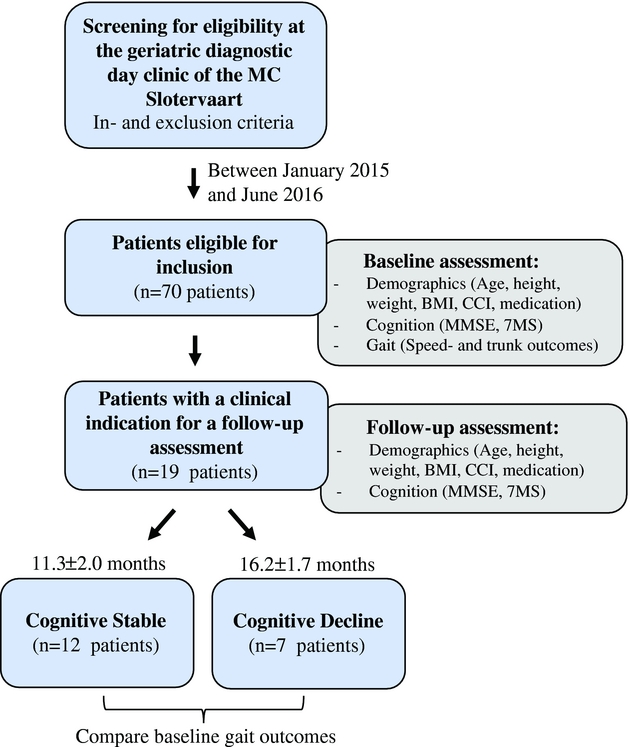
In total, 70 geriatric patients were recruited from the geriatric diagnostic day clinic of the MC Slotervaart hospital in Amsterdam between January 2015 and July 2016 (mean age 80 ±6.6; 53% women). Patients were referred by a general practitioner based on general or specific decline, and underwent extensive screening for physical and cognitive functioning during their seven-hour visit. Inclusion criteria were as follows: age 65 years or older. Exclusion criteria were as follows: (1) inability to walk for three minutes without a walking aid, (2) the presence of neurological disorders other than dementia related (e.g. Parkinson's disease), (3) having neurological or orthopedic disabilities that limit mobility function (e.g. recent surgery), and (4) inability to speak and understand Dutch. Only patients at risk for (further) cognitive deterioration were invited for a re-evaluation in approximately one year. However, this referral depended on subjective and objective evaluations of the clinical geriatrician who treated the patient. Hence, 19 patients were included in the present pilot study. While all patients were at risk for cognitive impairment, 10 out of 19 patients actually had a diagnosis of MCI at baseline. The protocol was approved by the Medical Ethical Committee of the MC Slotervaart hospital. Because some of the test results could directly be used by the involved clinical geriatrician (e.g. gait speed, hand grip strength, and frailty), the tests were part of a standard clinical evaluation when a researcher was present who could administer the measurements. It was therefore not necessary to obtain informed consent from patients.
Demographic information, including age, height, weight, and Body Mass Index (BMI), were extracted from medical records. The Charlson Comorbidity Index (CCI) quantified the number and severity of comorbidities, and polypharmacy was denoted when patients used >4 medications. Cognitive performance was evaluated with the Mini-Mental State Examination (MMSE) and with the seven-minute screen (7MS) test. The 7MS assessed memory function using the Benton's Temporal Orientation (BTO) (range 0–113) and the Enhanced Cued Recall (ECR) test (range 0–16), and executive and visuospatial function using the animal verbal fluency (range 0–45) and clock-drawing test (range 0–14). A logistic regression formula based on the four sub-tests resulted in a total 7MS-score, with a score of 0 corresponding to a 50% chance that a patient has dementia, and negative and positive scores corresponding to a lower and higher than 50% chance to have dementia, respectively. We refer to our previous study for references of the cognitive screening batteries (Kikkert et al., Reference Kikkert2017). The Reliable Change Index (RCI) quantified the magnitude of cognitive change and to determine whether the changes in cognition were clinically meaningful and statistically reliable, with a RCI of >1.96 indicating a significant change between baseline and follow-up outcomes (p <0.05) (Jacobson and Truax, Reference Jacobson and Truax1991). Patients who showed a reliable decline in both, MMSE and 7MS-score (average RCI score >1.96), were coded as the “Cognitive Decline” group. Patients who remained cognitively stable or showed non-significant changes in cognition formed the “Cognitive Stable” group. Figure 1 illustrates the study protocol.
Syntax of the study protocol. Abbreviations used in Figure 1: BMI = Body Mass Index; CCI = Charlson Comorbidity Index; MMSE = Mini-Mental State Examination; 7MS = Seven-Minute Screen.

Procedures and pre-processing
At baseline, patients walked for three minutes at habitual gait speed on a 10-m long course marked with cones. Accelerations of the lower trunk (near the level of the third lumbar vertebra) were registered using a built-in accelerometer of an iPod touch G4 (iOS 6, Apple Inc.; sample frequency ±100 Hz). The validity of gait and standing posture parameters from trunk accelerations as indicated by intra-class correlation (ICC) was high (ICC = 0.85–0.99), and test–retest reliability was good (ICC = 0.81–0.97) in old adults, under varying conditions (Kosse et al., Reference Kosse, Caljouw, Vervoort, Vuillerme and Lamoth2015). A custom-made application “iMoveDetection” stored the acceleration signals in anterior-posterior (AP), medio-lateral (ML), and vertical (V) directions (Kosse et al., Reference Kosse, Caljouw, Vervoort, Vuillerme and Lamoth2015). The signals were then transferred via blue tooth to an online platform and analyzed with custom MATLAB software (version 2014b, The MathWorks Inc.). All times series were de-trended, corrected for horizontal tilt, and low-pass filtered using a fourth-order Butterworth filter (cut-off frequency of 10 Hz).
Gait outcomes
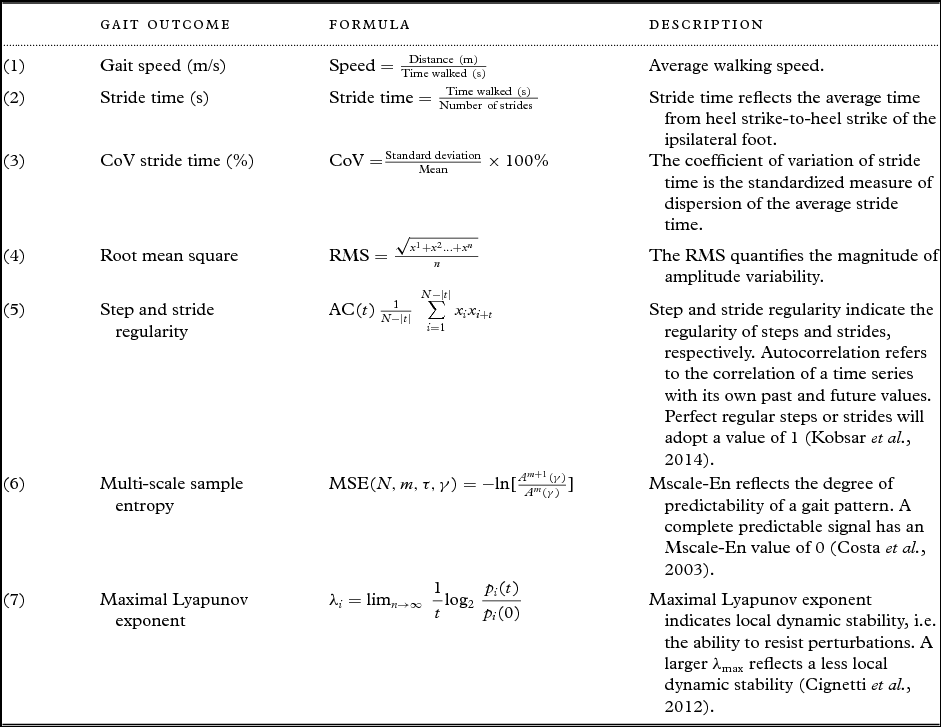
We previously identified gait outcomes that characterized the same population of geriatric patients with and without cognitive impairment in a cross-sectional study (submitted), and therefore included those outcomes in the present longitudinal analysis. In addition, average stride time and the Coefficient of Variation (CoV) of stride time were computed. Time indices of foot contacts were manually identified from peaks in the AP acceleration signals to calculate stride-related gait outcomes. The magnitude of the resultant vector of the AP, ML, and V signals was calculated according to the following equation:  ${\rm{R}} = \ \sqrt {{\rm{A}}{{\rm{P}}^2} + {\rm{M}}{{\rm{L}}^2} + {{\rm{V}}^2}}$. The dynamic gait outcomes were quantified over this “summary” signal. Table 1 describes stride-related (outcomes 1–3) and dynamic (outcomes 4–7) gait outcomes.
Descriptions and formula of the quantified gait outcomes

Statistical analysis
Statistical analyses were performed using SPSS version 24. Group differences (“Cognitive Decline” vs. “Cognitive Stable”) were examined with the Mann–Whitney's U test, and within-group differences (baseline vs. follow-up) with a repeated measure analysis of variance (ANOVA). Correlations between baseline gait and longitudinal cognitive change in MMSE and 7MS scores were computed using Spearman's Rho correlation coefficients (ρ) for non-linear data. Perfect monotonic relations would reveal a ρ of 1 or −1. Significance was set at 0.05.
Results
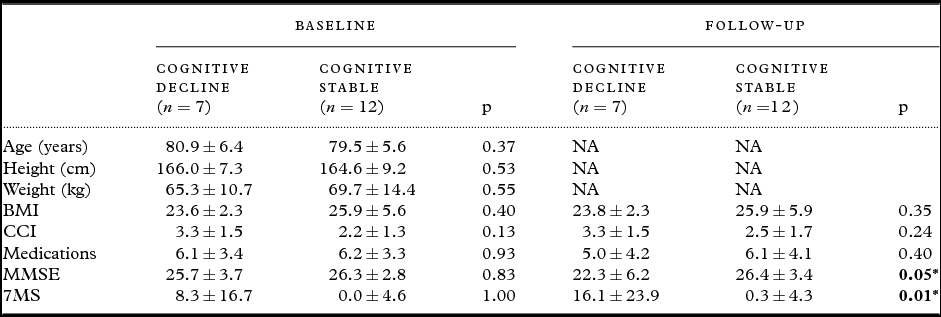
In total, 19 patients were followed for 14.4±6.6 months (age 80.0±5.8; 63% women). Based on average RCI scores of MMSE and 7MS, 7 of 19 patients (37%) showed significant cognitive decline over time and were retrospectively classified as the “Cognitive Decline” group (average follow-up time was 11.3±2.0 months). The other 12 patients remained cognitively stable or slightly increased in cognitive function and formed the “Cognitive Stable” group (average follow-up time was 16.2±1.7 months). At baseline, the groups were comparable in terms of age, height, weight, BMI, CCI, the number of medication used, MMSE-score, and 7MS-score (all p >0.05). At follow-up, the groups only differed in MMSE (p = 0.05) and 7MS (p = 0.01). The MMSE (p = 0.05) and the 7MSE scores (p = 0.01) decreased in the “Cognitive Decline” group but not in the “Cognitive Stable” group (MMSE: p = 1.0; 7MS: p = 0.83). Other outcomes did not significantly change (p >0.05) in either group (Table 2).
Patient demographics (mean±SD) by final cognitive state. Differences were evaluated with the Mann–Whitney's U test, with significant differences between groups indicated in bold

*p<0.05.
BMI = Body Mass Index; CCI = Charlson Comorbidity Index; MMSE = Mini-Mental State Examination; 7MS = Seven-Minute Screen; NA = Not Applicable.
Relationship between baseline gait and future cognitive change
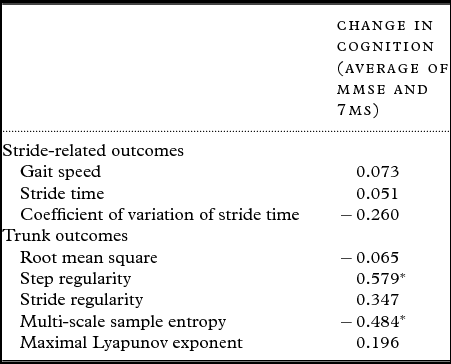
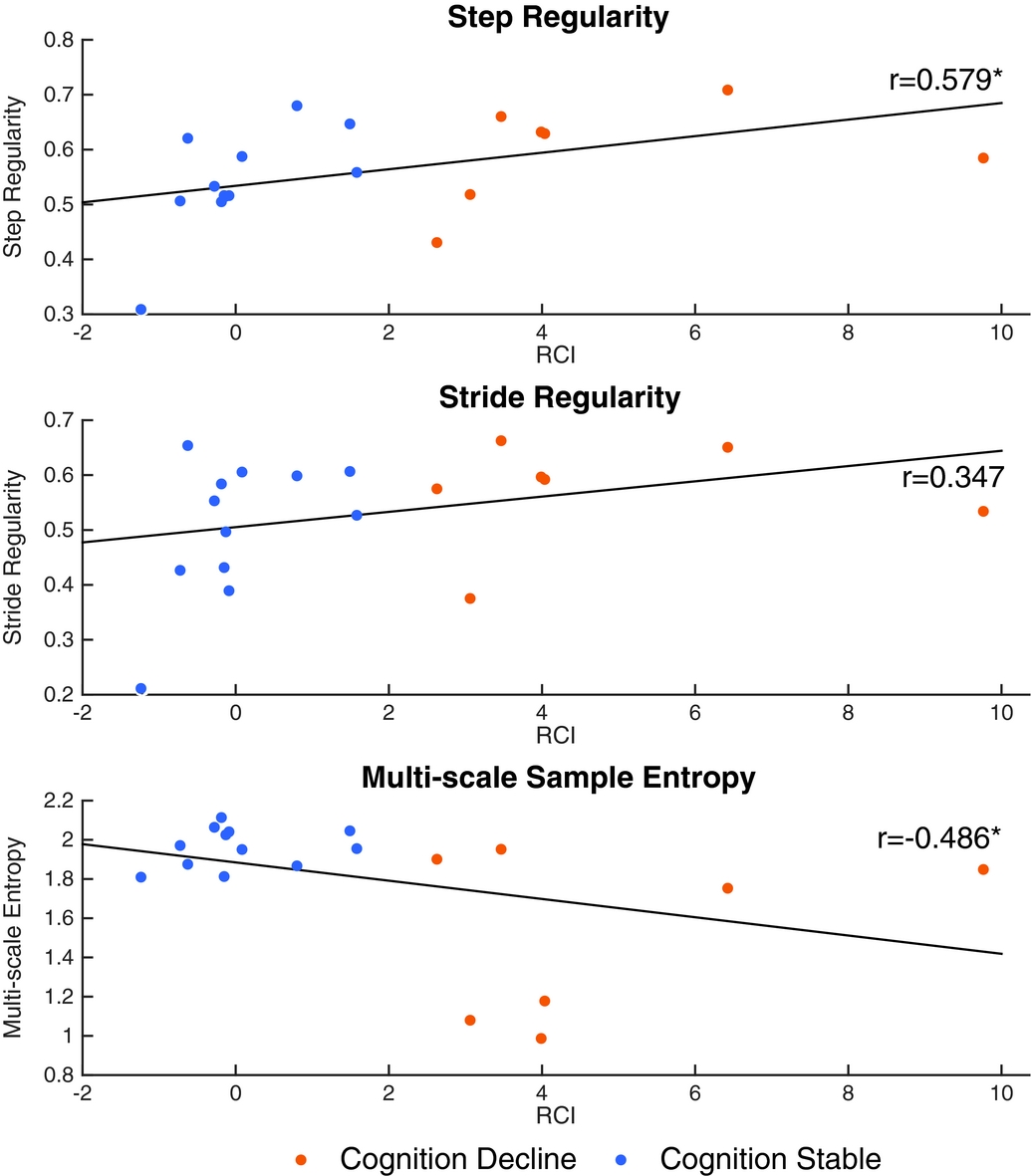
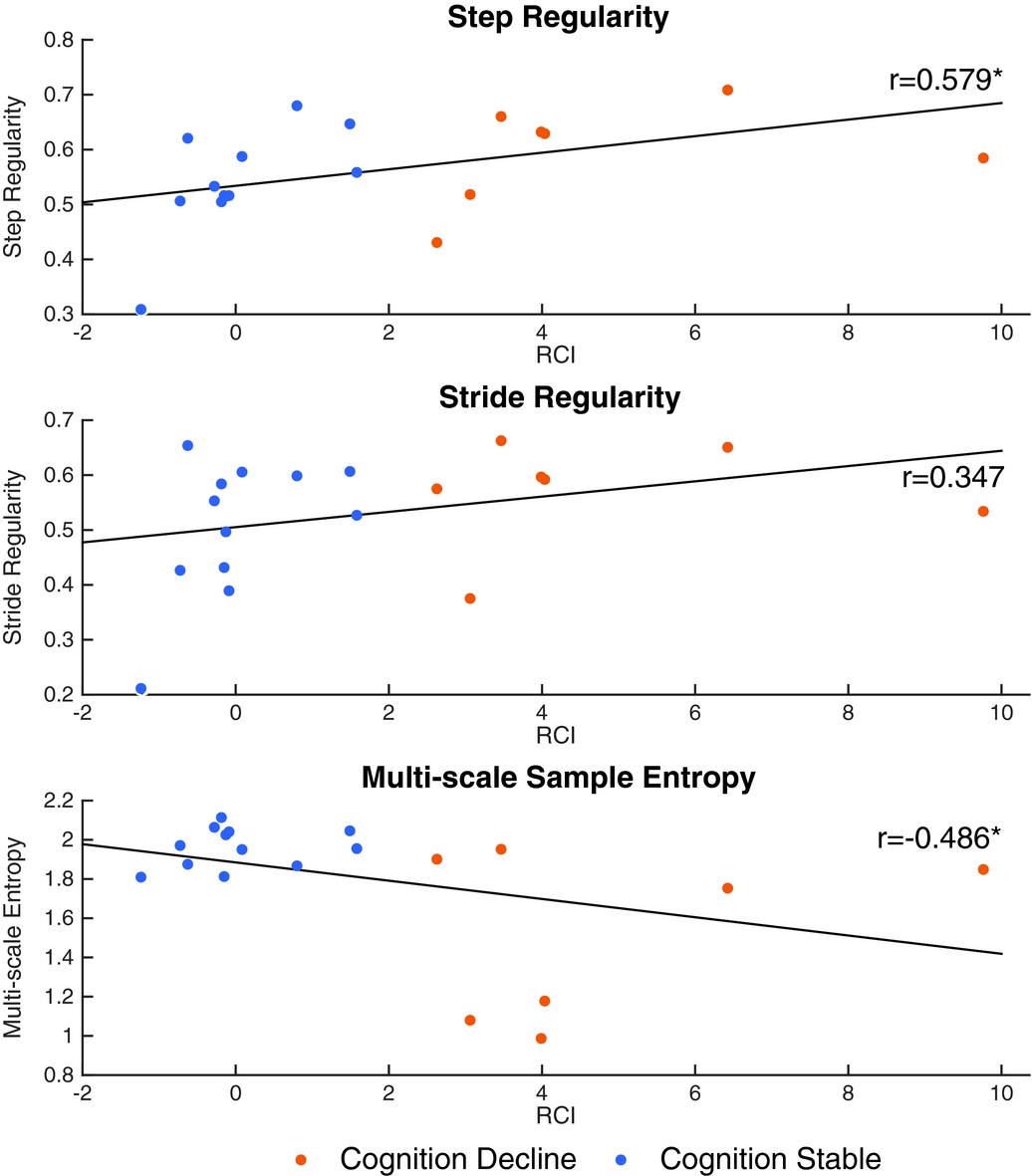
Table 3 presents correlations between baseline gait outcomes and changes in cognitive function 14 months later. Stride-related outcomes (gait speed, stride time, CoV of stride time) did not correlate with changes in cognition (ρ <0.3). Trunk outcomes showed modest correlations with changes in cognition, with a decline in cognition corresponding to more regular steps (ρ = 0.579*) and strides (ρ = 0.347), and a more predictable gait (ρ = −0.484*). Figure 2 shows the correlations between gait outcomes (step regularity, stride regularity, and multi-scale sample entropy) and changes in cognition in each group. Correlations between baseline gait and cognition in MMSE and 7MS separately were in the same direction, in which some gait outcomes related more to change in MMSE, while others were more closely linked to change in 7MS. For example, stride regularity correlated more strongly with ΔMMSE (ρ = 0.339) than with Δ7MS (ρ = 0.230), while multi-scale sample entropy correlated more strongly with 7MS (ρ = −0.509*) as compared to MMSE (ρ = −0.321).
Spearmans’ Rho (ρ) correlations between baseline gait and future change in cognition in 19 geriatric patients. The degree of decline in cognition is expressed using the Reliable Change Index (RCI), combining MMSE and 7MS-scores

*p <0.05.
Correlations between baseline gait outcomes and future decline in cognition (MMSE+7MS). The degree of cognitive change was quantified with the Reliable Change Index (RCI), with an RCI>1.96 indicating significant cognitive change over time (p <0.05). Each symbol denotes an individual patient. Patients whose MMSE and 7MS decreased are colored in orange (n = 7) and those patients who remained cognitively stable are colored in blue (n = 12). *p <0.05.
Discussion
The present prospective pilot study examined whether baseline gait characteristics predicted changes in cognition 14.4±6.6 months later in 19 geriatric patients (mean age 80.0±5.8). The results revealed that a more regular and predictable gait pattern correlated with future cognitive decline in geriatric patients admitted to an outpatient diagnostic clinic. We discuss these results from a theoretical perspective in terms of the “LOC hypothesis,” and from a clinical perspective in terms of how smart devices that extract gait details could possibly facilitate the prediction of cognitive decline and the development of early tailored interventions.
While population-based studies reported that gait speed predicts cognitive decline (Kikkert et al., Reference Kikkert, Vuillerme, van Campen, Hortobagyi and Lamoth2016; Savica et al., Reference Savica2017), the present analyses did not confirm these results. Patient characteristics may account for the discrepant data. While previous studies focused on relatively young and healthy old adults with a mean age around 65, our geriatric patients had a mean age of 80. Geriatric syndromes that are also linked to gait slowing (e.g. muscle weakness, polypharmacy, falling, osteoporosis-related factors) (de Groot et al., Reference de Groot, van der Jagt-Willems, van Campen, Lems, Beijnen and Lamoth2014; Reference de Groot, van Campen, Kosse, de Vries, Beijnen and Lamoth2016) may have caused a slower gait, also in the group that remained cognitively stable. Gait speed alone might thus not be specific enough to predict future cognitive decline in geriatric patients that suffer from multi-system degeneration (de Groot et al., Reference de Groot, van Campen, Kosse, de Vries, Beijnen and Lamoth2016). These results are in agreement with a recent population study that concluded that a slow baseline gait speed was only modestly related to future cognitive decline, and provided no early marker of clinical progression to dementia (Hooghiemstra et al., Reference Hooghiemstra2017). The short follow-up period in the present study could also account for the discrepancies relative to previous studies, as our average follow-up time versus the average follow-up time of a systematic review were 1.2 and 4.5 years, respectively.
Cognitive decline over time correlated with a more regular (higher autocorrelation coefficients) and more predictable (lower multi-scale sample entropy) baseline gait pattern. Because increases in stride regularity and predictability during gait reflect a decline in gait complexity (Costa et al., Reference Costa, Peng, Goldberger and Hausdorff2003), we confirm our hypothesis that the “LOC hypothesis” (Lipsitz and Goldberger, Reference Lipsitz and Goldberger1992) could provide a theoretical framework to relate those findings to health status. The LOC theory suggests that a deterioration in age-related and pathological physiological functioning leads to a breakdown of system elements, causing a decline in variability and overall complexity (Lipsitz and Goldberger, Reference Lipsitz and Goldberger1992). This LOC, in turn, relates to a reduced adaptive capacity and most likely relate to poor functional outcomes, such as an increased fall risk (Lipsitz, Reference Lipsitz2002). Our results are in agreement with postural control studies that reported a reduced complexity of postural fluctuations (as quantified by the multi-scale sample entropy) in older adults with sensory impairments as compared to age-matched controls (Manor et al., Reference Manor2010). A sample of frail and pre-frail older adults (who closely compare to the present sample of geriatric patients) exhibited less postural complexity as compared to non-frail controls (Kang et al., Reference Kang2009). Physiological decline related to cognitive loss possibly adds to this LOC and the association between cognitive decline and higher gait regularity and predictability might thus reflect a LOC of the aging system. Although increased regularity and predictability may seem beneficial, such a strategy reduces the ability to resist and recover from perturbations and may actually promote gait instability and increase the risk of falling (Sleimen-Malkoun et al., Reference Sleimen-Malkoun, Temprado and Hong2014). The latter is in agreement with studies that reported a decline in gait stability in old adults with dementia as compared to age-matched controls (Lamoth et al., Reference Lamoth, van Deudekom, van Campen, Appels, de Vries and Pijnappels2011). However, given the limited sample size and explorative nature of the present study, the results should be taken with caution and need replication in larger cohorts.
The finding that trunk outcomes versus more traditional gait outcomes (i.e. gait speed) were more closely correlated to future cognitive decline provides support for the use of wearable sensors in clinics. Indeed, the compact size, relatively low cost, and ease of operation facilitate the incorporation of sensor technologies in gait analysis. Based on the present preliminary results, it seems that the use of dynamical systems in gait analyses could make prediction of cognitive decline more accurate as compared to the use of traditional gait outcomes, such as gait speed. Except for its use in the prediction of cognitive decline, monitoring gait dynamics is encouraged because such details also relate to one's ability to act independently and autonomously. Intervention strategies could, in turn, specifically tailor gait functions in an aim to remain activities of daily living and to reduce fall risk. Although studies that examined the effects of exercise on gait and cognition showed contradictory results, a recent population-based study highlighted that transitions in gait as well as in cognitive function were mutable and reversible over a nine-year period, even in the oldest old (Qualls et al., Reference Qualls2017). However, despite technological and clinical advantages of incorporating gait analysis derived from wearable sensors, future studies should confirm the clinical utility and the predictive ability of such technologies, and applications should be built to translate gait details to clinical outcomes.
Procedures at the MC Slotervaart hospital are highly patient oriented. While this provided us with an extensive characterization of this vulnerable population in terms of demographic, physical, and social information, standard procedures at the hospital also placed some difficulties. For example, even though the protocol for a follow-up appointment is set to be at one year, the actual follow-up period always depends on organizational and patient factors. This resulted in a large variation in follow-up time between patients (follow-up period is 14.4±6.6 months), which can be considered a limitation of the present study. For the same reasons, we were unable to measure gait function at follow-up. Because there is a clear theoretical and experimental basis for the relationship between gait and cognitive impairment (Beauchet et al., Reference Beauchet2016; Kikkert et al., Reference Kikkert, Vuillerme, van Campen, Hortobagyi and Lamoth2016), we expected that gait would have been changed in the patient group who presented with significant cognitive decline over time, and that correlations between gait and cognition would have become stronger. A recent study highlighted the sensitivity of changes in gait speed over a follow-up period of one year in healthy old adults aged 75. This study showed that 25% of healthy old adults showed a gait speed decline of more than 0.1 m/s per year (Brach et al., Reference Brach, Perera, Van Swearingen, Hile, Wert and Studenski2011). We therefore expected that those changes in mobility may also be reflected in elements of mobility that underlie gait speed, i.e. gait dynamics. Finally, the small sample size places a limitation of the present study.
In conclusion, the present pilot study revealed that a more regular and predictable gait pattern was correlated with future cognitive decline in geriatric patients admitted to an outpatient diagnostic clinic. Those results could reflect a LOC of the aging NMSS. In addition to traditional outcomes, such as gait speed, trunk outcomes derived from wearable sensors are promising indicators of cognitive as well as physical decline. Hence, we recommend the incorporation of a non-invasive detailed gait analysis in predicting, diagnosing, and monitoring health status in vulnerable geriatric patients. However, our results and interpretations are preliminary and need replication in larger cohorts, as for now, our conclusions are based on a small sample size and a relatively short follow-up period.
Conflict of interest
None.
Description of authors’ roles
CJCL, TH, NV, and LHJK created the concept and design of the study. LHJK collected the data. BAA and JPVC were responsible for clinical aspects, such as patient inclusion, diagnoses, and ethical issues. LHJK analyzed the data, and the results were interpreted by CJCL, TH, and LHJK. LHJK wrote a draft of the full manuscript. CJCL, TH, NV, BAA, and JPVC critically revised the manuscript and approved the final version.
Acknowledgments
This work was supported by the French National Research Agency in the framework of the "Investissements d'avenir” program (ANR-10-AIRT-05 and ANR-15-IDEX-02).