INTRODUCTION
What are the roadblocks that prevent antidiscrimination laws and diversity programs from better remedying inequalities and social stratification in the workplace? This question is a crucial paradox discussed by organizational theorists and law and society scholars (Pager and Shepherd Reference Pager and Shepherd2008; Berrey Reference Berrey2015; Edelman Reference Edelman2016). Lauren Edelman (Reference Edelman2016, 216) posits that we live in a “symbolic civil rights society … where substantial discrimination and inequalities persist,” despite civil rights, affirmative action, and equal employment opportunity measures as well as a plethora of diversity management structures. In The Enigma of Diversity, Ellen Berrey (Reference Berrey2015, 197) states that current diversity efforts in corporations often only serve “those at the top of the class hierarchy,” helping overskilled women or minorities without undermining workplace stratification any further.
Scholars have looked at this paradox in different ways. At the state level, they have explored the ambiguous and overly broad scope of antidiscrimination laws (Edelman Reference Edelman1992; Dobbin and Sutton Reference Dobbin and Sutton1998; Dobbin Reference Dobbin2009), the toothless character of enforcement agencies (Pedriana and Stryker Reference Pedriana and Stryker2004), and the deregulation that has weakened compliance review tools (Kalev and Dobbin Reference Kalev and Dobbin2006, 862). From a judicial standpoint, researchers have analyzed the doctrinal evolutions that have weakened employees’ agency to challenge discriminatory behaviors in courts (Edelman Reference Edelman2016, 53) and the judicial deference to symbolic “good practices” promoted by corporations (Edelman et al. Reference Edelman, Krieger, Eliason, Albiston and Mellema2011). From a corporate standpoint, scholars have explored how companies have “managerialized” the law in a way that depoliticizes and dejudicializes it (Edelman, Leachman, and McAdam Reference Edelman, Leachman and McAdam2010) in order to provide a symbolic defense against lawsuits without substantively improving equal opportunity (Edelman Reference Edelman1991, Reference Edelman1992; Edelman, Fuller, and Mara‐Drita Reference Edelman, Fuller and Mara‐Drita2001). Sociologists have claimed that the impact of diversity programs depends on the different commitment of corporations and organizational factors, such as the existence of internal advocacy efforts (Dobbin, Kim, and Kalev Reference Dobbin, Kim and Kalev2012; Dobbin, Schrage, and Kalev Reference Dobbin, Schrage and Kalev2015).
To further explore this question, more research needs to be conducted on how antidiscrimination laws have influenced the first logical step of any diversity effort: changing hiring practices. Scholars have explored the refashioning and rebranding of human resources departments at large (Dobbin Reference Dobbin2009) and how transparency in the hiring process reduces bias in recruitment (Dobbin, Schrage, and Kalev Reference Dobbin, Schrage and Kalev2015), but we still have limited qualitative data about the decision-making processes involved in assessing job applicants (see the following section for further exploration of this literature). To bring new perspectives about how recruitment practices can change to comply with new affirmative action laws, my research explores how the reinforcement of the disability employment quota in France refashioned the assessment practices of job applicants with disabilities.
Quotas are an outcome-oriented form of affirmative actionFootnote 1 as well as a significant tool for repairing previous and ongoing structural inequalities in previously homogeneous or segregated social settings (Stryker Reference Stryker2001; Collins Reference Collins2012). While quotas technically set up stringent demographic goals for organizations (here, 6 percent of the workforce in French organizations of more than twenty employees should have a disability), they give significant leeway for organizations to decide how they should meet this target.Footnote 2 In this article, I observe how this flexibility for meeting the employment quota favored changes in the recruitment practices of workers with disabilities, which may increase the number of individuals with disabilities hired but may also facilitate “selective inclusion”Footnote 3 and trigger significant risks associated with the emotional recruitment of individuals with disabilities. First, I analyze how companies increasingly relied on brokers to access job seekers with disabilities. I found that nonprofits helped companies bypass contradictory injunctions that the implementation of this quota created for recruiters. Second, I discuss how, in these venues, recruiters drastically changed their assessment processes to avoid systemic discrimination of job seekers with disabilities. This was visible both through changes in the recruiters’ profiles and in the process of assessment itself, and it facilitated the positive assessment of an increased number of job seekers with disabilities. Third, I analyze how these new conventions of assessment led to new flaws in the recruitment process (what I call “emotional recruitment”). Last, I analyze how these changes in hiring practices did not undermine altogether discrimination but, instead, may have displaced it (creating new differentiation between job seekers with disabilities).
To meet their quota, recruiters challenged the role of resume sorting, thus increasing attention to face-to-face interviews and emphasizing the personal trajectory of job seekers to the point of incentivizing the disclosure of disability status and pathologies.Footnote 4 These new practices helped more people with disabilities access jobsFootnote 5 but kept those with more severe disabilities trapped in the recruitment pipeline, therefore creating stratification among job seekers with disabilities. Indeed, the more information recruiters have access to regarding the nature of a disability, the more they might be able to assess (or feel like they can assess) the upcoming health challenges of a candidate (for example, have enough information to know whether a given disease is going to evolve). These findings are context specific, but they provide new theoretical insights to explain the paradox of how companies’ diversity efforts have led to the recreation of workplace stratifications and overselectivity among minorities (Fishkin Reference Fishkin2014; Sarfati Reference Sarfati2014; Berrey Reference Berrey2015). This sheds light on the double penalty endured by minorities who are hired through these pipelines because of the invisibility of their disabilities; even if their recruitment was based on stricter criteria, employers still hint that their hiring was a “generosity” effort and that they might not be as “deserving” as other nonminority candidates (Everaere Reference Everaere2010; Santos, Amâncio, and Alves Reference Santos, Amâncio and Alves2013; Ovichegan Reference Ovichegan2015).
LABOR MARKET AND DISCRIMINATION IN THE RECRUITMENT PROCESS
Recruitment practices are a central mechanism explaining stratification and inequalities in the workplace (Rieucau and Marchal Reference Rieucau and Marchal2010; Berrey Reference Berrey2015; Rivera and Tilcsik Reference Rivera and Tilcsik2016). Intermediaries in the labor market do not play a neutral role. They contribute to shaping the conditions of an unequal access to work, discrepancies in working conditions, and even “categorical unemployment” (Rieucau and Marchal Reference Rieucau and Marchal2010, 93).Footnote 6 Scholars have identified subtle mechanisms of discrimination, such as social network selection, that discriminate in a way that does not seem illegitimate at face value (Royster Reference Royster2009; Berrey Reference Berrey2015), higher evaluative standards for nonprestigious schools (Rivera and Tilcsik Reference Rivera and Tilcsik2016, 1124), or standardization processes that seem rational but always exclude the same categories of populations (Eymard-Duvernay and Marchal Reference Eymard-Duvernay and Marchal2000). Even in face-to-face job interviews, skills sorting competes with “cultural matching,” when evaluators search for cultural affinities with job applicants (Rivera Reference Rivera2012b, 1000). Homophily and direct discrimination exist next to more subtle processes of selection based on “similarities in culture and experience,” (1016) which produce emotional connections and excitement that facilitate hiring decisions and reproduce discrimination through proxies, as cultural signals often crystallize around certain identities (Rivera Reference Rivera2015).
Recruiters also indulge in “statistical discrimination,” relying on generalization of stereotypes that “although quite overbroad and from one point of view invidious, provide an economically rational basis for employment decisions” (Sunstein Reference Sunstein1991, 28). Women in the workforce are the epitome of such a mechanism: employers might assume that women are more likely to desire children; they know women are the only ones who can get pregnant and thus consider that they would have to take leave during and after their pregnancy; they also assume that women will be less involved in their career after giving birth. With these premises, based on statistical evidence and prejudices, employers tend to favor men for consequential promotions. Statistical discrimination can explain the resilience of discriminatory patterns in the recruitment strategies of corporations, beyond a nefarious intent from recruiters (Sunstein Reference Sunstein1991; Pager and Shepherd Reference Pager and Shepherd2008).
One response to resilient discrimination patterns on the job market is antidiscrimination laws (Pager and Shepherd Reference Pager and Shepherd2008, 195). Yet these laws are not enough to undermine all forms of discrimination. They trigger macrochanges in the human resources department: rebranding, the expansion of recruitment pools (Kalev and Dobbin Reference Kalev and Dobbin2006, 686), and the formalization of human resources processes, but recruiters often still have “discretion” at the interpersonal level where discrimination takes place (Munnell, Browne, and Mceneaney Reference Munnell, Browne and Mceneaney1996). Diversity efforts often remain decoupled from actual hiring decisions (Rivera Reference Rivera2012a) and can lead to “selective inclusion” that leaves out the less privileged people among discriminated groups (Berrey Reference Berrey2015, 8). In the context of the United States, scholars have also discussed how such laws or programs could also displace an intergroup discrimination problem—“employers preferring whites over blacks”—to an intragroup discrimination problem—“employers preferring racially palatable blacks over racially salient ones” (Carbado and Gulati Reference Carbado and Gulati2013, 2)—through the development of “intraracial screening” in assessment processes (Carbado Reference Carbado2013, 1147). Further exploring the changes in assessment practices and their unintended consequences in the context of the implementation of a disability quota in France, I draw on these scholars’ insights to look at how the corporate endogenous response to the law changes recruitment practices. What types of changes are implemented to tackle previous recruitment biases in the process of recruitment or assessment? How do these quotas undermine or displace discrimination in organizations?
QUOTAS AND DISABILITY POLICIES IN FRANCE
Government-imposed employment quotas for workers with disabilities—widespread in European and Asian countries (Collins Reference Collins2012; Heyer Reference Heyer2015)—are a form of affirmative action historically associated with “the social welfare model” of disability policies and distinguished from the civil rights approach to disability policies (Heyer Reference Heyer, Laura and Robert2005, 242). One major criticism of these policies of employment quotas for people with disabilities is that, historically, they were not enforced but, rather, were first perceived as a “de facto disability tax for employers, rather than an incentive to hire disabled workers” (244). Rather than supporting the inclusion of people with disabilities in “ordinary” workplaces,Footnote 7 these laws enabled the collection of taxes that could subsidize separate institutions for people with disabilities. In the following paragraphs, I will discuss how French disability quota laws have evolved to be increasingly stringent and efficient for the inclusion of workers with disability in French workplaces as well as the implementation challenges that remain salient today.
Initially conceived as a national duty of solidarity for the people injured in the First World War in 1924 (Calvès Reference Calvès2016, 64), the French approach of disability policies was first dominated by a charity mindset based on the medical model of disability that saw disabilities as personal tragedy (Oliver Reference Oliver1990) and promoted separate institutions such as “special schools, sheltered workshop or assisted living centers” (Heyer Reference Heyer, Laura and Robert2005, 239).Footnote 8 Employment priority for veterans was one of the initial “facet[s] of this national solidarity” that began after 1924 (Maggi-Germain Reference Maggi-Germain2010, 99). Disability laws evolved drastically throughout the twentieth century in France. First, the laws extended their scope from war-mutilated individuals to civilians with an increasingly wide array of impairment, and the overarching legal category of “workers with disabilities” developed through two laws in 1957 and 1975 that equalized the rights and benefits available to all people with disabilities (Barral Reference Barral2008; Romien Reference Romien2005, 236–38).Footnote 9 Second, they moved away from the medical model of disability, notably under the pressure of disability rights activists, and increasingly embraced the social model of disability (Oliver Reference Oliver2013) through deinstitutionalizing schools, claiming equal rights, and making public spaces accessible (Baudot, Borelle, and Revillard Reference Baudot, Borelle and Revillard2013).Footnote 10
Considering employment policies, the legislative battle was to move from a symbolic law that mainly favored raising revenues for institutions for people with disabilities through corporate taxes (Heyer Reference Heyer, Laura and Robert2005) to employment policies that favored the professional integration of people with disabilities. The employment priority of war-mutilated veterans from 1924 was extended to people with disabilities and work-related injuries in 1957 but remained a symbolic and theoretical priority—a mere “procedural requirement”—before the institution of a quota in 1987 (Maggi-Germain Reference Maggi-Germain2010, 100). This quota lowered the threshold from 10 percent to 6 percent, but its main goal established a financial penalty for noncompliance (100). It created a national agency that collected a financial contribution proportional to the number of missing employees with disabilities and used this funding to sponsor the professional integration and workplace accommodation of workers with disabilities: the Management Agency for the Fund for the Professional Integration of People with Disabilities (“Association de gestion du fonds pour l’insertion professionnelle des personnes handicapées,” in French). While this quota did compel consequences for noncompliance, it also offered alternatives to direct employment of workers with disabilities, such as paying the fine for non-compliance, hiring service providers that were organizations specifically accommodated for workers with disabilities,Footnote 11 or signing collective agreements that enabled companies to elaborate triannual plans to meet their quotas at their own pace (101). This system enabled companies to keep paying the fine rather than hire (Barnay et al. Reference Barnay, Duguet, Le Clainche and Videau2016). As the French disability policies moved away from the medical model of disability and discouraged institutionalization through a “layering of new rights on top of old frameworks,” the quota was reinforced through increased financial penalty for non-compliance (Baudot Reference Baudot2018, 117). In 2005, the state designed a new disability law that drastically increased the fine for not meeting the quota.Footnote 12 The new law also transposed the concept of “reasonable accommodations” into the national legal framework, stating that employers have a duty to accommodate their workers with disabilities and that failing to do so was liability for discrimination,Footnote 13 therefore further enmeshing the rights and welfare models of disability policies (Collins Reference Collins2012, 997).
While this quota rule provides an alternative to the direct recruitment of workers with disabilities,Footnote 14 the new law, both because of the increased financial penalty and the emphasis on direct recruitment, compelled organizations to take more action for the inclusion of workers with disabilities. In 2016, the rate of direct recruitment of workers with disabilities in the organizations targeted by the 2005 law was 3.5 percent (DARES 2018). Organizations reached this level not only through hiring new individuals and diversifying their recruitment pools but also through maintaining the employment of workers with disabilities in their workplace, accommodating the position of people with new disabilities or identifying employees who previously had a disability but did not disclose their disability status to their company by providing them with their disabled worker’s certificate.Footnote 15 While there are many aspects of the implementation of this quota in organizations, this research focuses on the strategies surrounding recruitment. The quota indeed pressured companies to recruit more employees with disabilities and to make sure that they collected their disabled workers’ certificates (which was necessary to count them in the quota).
Yet the French legislation regarding antidiscrimination requires that companies do not use extraprofessional characteristics to select job applicants to ensure formal equality (Cortéséro et al. Reference Cortéséro, Kerbourc’h, Mélo and Poli2013; Monchatre Reference Monchatre2014). The legislation also protects job seekers with disabilities from pressure to disclose their disability status. In order to be counted in the quota of disabled workers, employees need to voluntarily provide their company with official administrative proof of their disabled worker’s certificate. Companies, therefore, sought to access these certificates from their workers in order to meet their quota, avoid paying the fine for noncompliance, and construct an image of themselves as being inclusive (L. Bertrand, Caradec, and Eideliman Reference Bertrand, Caradec and Eideliman2014; Blatge Reference Blatge2010). Yet the French legal framework gave full rights to disabled job seekers and disabled workers not to disclose their disability status, let alone provide their company with their disabled worker’s certificate. For instance, through documentation written as a series of questions and answers by Rights Defender (a state antidiscrimination agency in France), the French state provides a script that shows that recruiters cannot require information or documentation on the disability status of their (future) employees:
Is anyone required to disclose their disability during a recruitment process?
No. The employer cannot impose to the job applicant to inform them about their disability status. Disabilities belong to the private sphere of individuals, just as familial situation, sexual orientation, health status. … It is therefore in the purview of people with disabilities to choose whether or not they wish to disclose their disabilities during a recruitment process. (Défenseur des Droits 2012, 33)
In cases where job seekers would have mentioned their disability in their resume or cover letter, the script that the state provides was framed in this way:
A [job seeker] might have chosen to disclose their disability status on their resume or during the job interview. In this case, the recruiter must not question the jobseeker on their pathology or the nature of their disability – which is a private life matter – but may inquire about potential needs for accommodations. (Défenseur des Droits, 2012, 43)
While companies are strongly incentivized to collect the disabled worker certificate of their employees—and while they might even get fined for not doing so—the law gives full power to the disabled employee or job candidate to disclose or not disclose their disability. The following court decisions further reinforce this legal prerogative of workers with disabilities:
An employee shall not be forced to disclose to their employer the fact that they are disabled, and do not commit any misdemeanor by refraining from it.Footnote 16
Whenever an employer proceeds to fire a worker whose disability has been officially acknowledged [by the administration in charge for it], they cannot reproach to this employee not to have disclosed to them previous information on his health status or his disability, because he does not have to disclose this information. Such an abstention, which is not faulty, cannot therefore deprive the employee, once he has received a notification for being fired, to his rights to claim the benefits related to his disability, and granted by the article L323-7 from the Labor Code, in relation with leave period.Footnote 17
These legal and juridical dispositions create an information asymmetry in favor of disabled workers, especially if those workers have an invisible disability, which does not need immediate accommodation.Footnote 18 As Christophe Everaere (Reference Everaere2010, 19) discusses, only 15 percent of people with disabilities have visible disabilities, and only 20 percent of workers with a disability granted with a disabled worker’s certificate will need accommodations. Companies pay attention to people with invisible disabilities to avoid cutting themselves from the largest share of the job market pool.
Additionally, hiring people with disabilities but with no need for accommodation has become a profitable enterprise since companies do not have to pay the cost of accommodation but can still benefit from reducing their financial penalty related to the quota. As described by Sophie Dalle-Nazebi and Sylvain Kerbourc’h (Reference Dalle-Nazébi and Kerbourc’h2013, 163), one of the unintended effects of the 2005 law was the practice of computing hiring and accommodation within a “financial calculus,” by which companies attempt to minimize the cost of hiring workers with disabilities. However, most people with invisible disabilities and no need for accommodation are reluctant to provide firms with their disabled worker’s certificate since they may be scared to be stigmatized, deemed less capable, and denied promotions or excluded (Dalle-Nazébi and Kerbourc’h Reference Dalle-Nazébi and Kerbourc’h2013).Footnote 19 This makes their open recruitment (that is, both being recruited and volunteering their disabled worker’s certificate) through traditional pipelines much harder for companies.Footnote 20 Based on this conundrum, companies therefore seek to recruit people with disabilities who would be open to disclosing their disability status and willingly providing their company with their disabled worker’s certificate. I will argue that this complex situation plays a role in the emergence of specialized job market intermediaries and disability managers.
CASE STUDY AND METHODS
Scholars working on discrimination in recruitment extensively discussed the challenges of studying assessment practices (Rieucau and Marchal Reference Rieucau and Marchal2010; Rivera Reference Rivera2012b, Reference Rivera2015). Most research on these questions has relied on quantitative research design or longitudinal research on organizational archives (M. Bertrand and Mullainathan Reference Bertrand and Mullainathan2004; Edelman Reference Edelman2016). The qualitative studies that explored assessment practices had only limited access to the job interviews themselves and focused instead on interviewing the actors involved in the recruitment, observing public recruitment events, or observing debriefing between evaluators (Rivera Reference Rivera2012b, Reference Rivera2015).
My approach in examining how this quota changed the assessment tools for job seekers with disabilities was to focus on the job market brokers who created recruitment channels for job seekers with disabilities after the 2005 law. Observing job market intermediaries is a useful strategy to access information about recruitment practices and avoid desirability bias from corporate recruiters (Sarfati Reference Sarfati2014, 71). Because expectations for recruitment need to be clearly stated when private recruiters resort to brokers on the job market, I could access underlying expectations and assumptions about recruitment. In these recruitment channels, there were two different types of intermediaries: disability managers in private companies (that is, the employees in charge of the professional integration of workers with disabilities to help meet the quota) and the job market brokers (that is, the specialized nonprofit organizations that operated as recruitment channels focused on job seekers with disabilities). Since I interviewed disability managers from private companies, they taught me that large companies made widespread use of these organizations to meet their quotas.
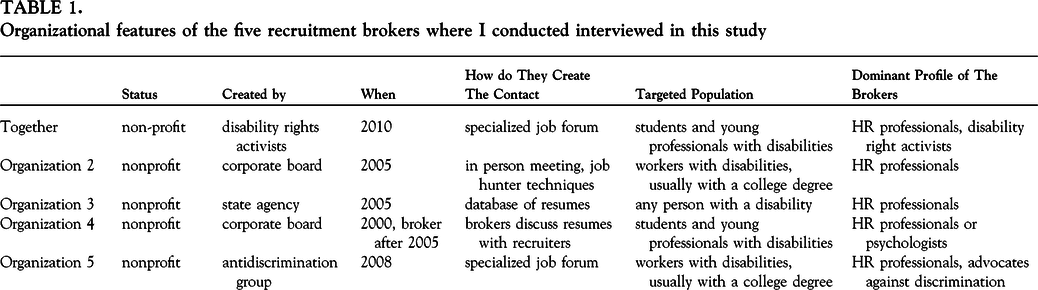
I interviewed employees in five organizations that created recruitment pipelines for job seekers with disabilities on behalf of companies. These organizations were all created after the 2005 law that reinforced the quota of workers with disabilities. Some were created by a fund pooled together by private companies; others emerged from anti-discrimination activists or a public fund initiative for the professional insertion of workers with disabilities. They also had different levels of human resources expertise and different practices to connect job seekers with disabilities and private companies. I summarize their differences in Table 1 and will expand on the variation in their practices throughout this article.
Organizational features of the five recruitment brokers where I conducted interviewed in this study

Yet these organizations shared four major features: (1) they were all nonprofits; (2) they all only sourced job applicants with disabilities; (3) they all mainly targeted job seekers with some level of higher education; and (4) their main clients were large private corporations. I selected them through a snowball sampling technique whereby I reached out to the organizations that were mentioned by the disability managers whom I had interviewed. These were not the only organizations working as brokers between job seekers with disabilities and companies, but they were the most renowned among the disability managers whom I interviewed. They are also representative of the diversity of approaches that these types of brokers developed.Footnote 21
Overall, I interviewed twenty-nine disability managers, ten individuals involved in building recruitment pipelines for people with disabilities, and about twenty job applicants with disabilities.Footnote 22 Because of my choice of fieldwork, I had only access to one aspect of the recruitment of workers with disabilities: the intentional efforts set up by mainly large private companies. This article does not provide information about the hiring practices for job seekers with disabilities who apply to a company in traditional ways (for example, when someone with an invisible disability just sends their resume to the company’s recruitment department). Instead, this study lays the groundwork for understanding the strategic and intentional implementation of recruitment processes fostering diversity. My aim was to study the underpinnings of these targeted strategies of recruitment: Why were they created, what purpose did they serve, and what was their impact?
In addition to the interviews, I also conducted eight months of ethnographic observations in one of the organizations, which created a pipeline for job seekers with disabilities, called Together.Footnote 23 Together is a not-for-profit organization that advocates for disability rights in France. Its board is mostly made up of people with disabilities, and it promotes the educational achievement and professional integration of teenagers and young adults with disabilities. Together was created in 2010, and, in 2015, it had five full-time employees and more than five hundred members across the country. These members were for the most part young adults with disabilities, either still in their studies, job seekers, or junior professionals. Together received important funding from private companies, which sponsored many of its programs (accessible sporting events, fellowships, and mentoring). Its most famous program was a universally accessible job forum: Disabili-Tea. The year of my fieldwork (between the end of 2014 and 2015), Together organized more than thirty Disabili-Tea forums throughout the country, which traditionally took place within broader university job fairs, creating a distinct space to bring together job seekers with disabilities and recruiters. The companies that pay to participate in Disabili-Teas are usually large companies. Each Disabili-Tea involves ten to fifteen recruiters and twenty to forty-five job seekers.Footnote 24 I chose this site of study because this organization was the most cited among the disability managers whom I interviewed (n = 14) between 2014 and 2016. It was under public scrutiny since it had received a national award from the French government for being a leading organization in the nonprofit sector and social economy sector and combined service provision for companies with advocacy work, and its members were therefore reflexive about its impact as a recruitment channel. More pragmatically, Together accepted my offer to volunteer within the programs that involved corporate representatives (recruiters, disability managers), while other organizations only accepted my volunteer action for back office work.
I volunteered for the organization during the job interviews. My work was to set up the events, work on the logistics to bring recruiters, disability managers, and job seekers with disabilities together, and accommodate the people present at the forum (bringing drinks and coffee to the participants and the recruiters, finding chairs for people who were waiting, guiding an eye-impaired job applicant to the next recruiter, and so on). These basic volunteering tasks enabled me to observe some job interview interactions and to triangulate and contrast the viewpoints of all of the actors involved in the recruitment process to offer a more comprehensive perspective on this organizational change. I could thus exchange with the brokers, recruiters, disability managers, and job applicants at the beginning of the job interviews and discuss their impressions afterwards.
My methodological posture was interpretivist, which means that I was trying to grasp, through interviews and observation, how the actors themselves were giving meaning to their actions and how they were defining their own strategies, goals, and impact (Daly Reference Daly2007, 49). My goal was to provide empirical insights about an understudied theoretical question: How do laws change the assessment process? Because of this interpretivist lens, I did not have data to study the impact (how many people were recruited) or the scope of changes (how many companies relied on these newly designed assessment processes). Instead, I provided thick descriptions of local renegotiations of hiring practices that my interviewees saw as necessary to comply with the law as a way to lay the groundwork for understanding how antidiscrimination laws change hiring practices.
FINDINGS
Fishing in the Right Pond: Specialized Recruitment Channels
For the large, private firms that turned to broker organizations for recruitment, the new law to more vigorously enforce the quota did not change recruitment processes altogether; it created an alternative process of recruitment and assessment for workers with disabilities. This process involved different recruiters, different practices of recruitment, and different pipelines for sourcing candidates. As I interviewed disability managers in private corporations, many claimed to proactively source job applicants through specialized recruitment pipelines. While scholars have studied this reliance on new recruitment pools or recruitment programs as a way of complying with antidiscrimination laws (Dobbin Reference Dobbin2009; Carbado and Gulati Reference Carbado and Gulati2013; Dobbin and Kalev Reference Dobbin and Kalev2013), I discuss how such structures played out specifically for the recruitment of workers with disabilities in France. This section discusses some of the features of the recruitment channels that specialize in people with disabilities (for example, universal accessibility, accommodations) and highlights why the implementation of the quota might have triggered such an increased reliance on specialized brokers as a new strategy of recruitment: notably, to identify people who would be willing to give their disabled worker’s certificate to their company. It will also discuss how these specialized recruitment channels affect the inclusion of people with disabilities.
The common feature of all of the brokers I analyzed was that they provided access to a pool of applicants where everyone, without exception, had an administratively acknowledged disability. One broker had created an online database of the resumes of job seekers with disabilities. Others, including Together, created specialized job forums for people with disabilities. Another nonprofit broker mirrored the work of headhunting agencies (highly skilled, specialized profiles) but only focused on individuals with disabilities. Last, one broker conducted preinterviews with people with disabilities before presenting their applications to recruiters in professional meetings. Although these brokers varied in their initial screening methods of job applicants and the modus operandi through which they introduced job applicants to private employers, all of them provided a pipeline specifically for job seekers with disabilities.
These pipelines increased the pool of potential applicants with disabilities for corporations to meet their quota. However, I would argue that these sourcing services became a way for companies to circumvent a legal ambiguity—namely, how to meet their quota without selecting individuals for their disability status. Companies cannot legally select someone because of their disability, and they are not always aware of who is disabled (as 80 percent of people with disabilities have invisible forms of disabilities). Therefore, these brokers became a way to “fish in the right pond,” as one recruiter explained to me once, meaning that they were sure to hire someone with a disability by recruiting through these pipelines. Looking more closely at my ethnography, I will show how recruiting through Disabili-Tea forums was a way for companies to outsource the discriminatory part of recruitment, which would be favoring someone because of their disability to meet their quota, since the pool of applicants only included people with disabilities.
Together operated as a specialized recruitment channel as its members worked ahead of time to source job applicants with disabilities to come to their forum and meet with company representatives (the companies paid a service fee to have a place in the forum). Together did not operate any prematching based on degrees or skills and did not select applicants based on their credentials; they selected individuals with disabilities and inquired about their disabilities so that they could accommodate them during the event.Footnote 25 Its services specifically excluded job seekers without a disability, as I realized during one Disabili-Tea organized in a very underprivileged school. This university had few appealing companies present on their forum, and, therefore, Disabili-Tea’s collaboration with Fortune 100 companies stood out. My work as a volunteer became to control the entrance of the Disabili-Tea event and make sure that no students without disabilities would enter the recruitment space, as a large share of the job seekers did not have a visible disability. Some applicants for Disabili-Tea brought a copy of their disabled worker’s certificate, along with their resumes. I later asked Karl, the main project manager of Together, about this phenomenon, and he responded: “Oh well, this is true. … [Our recruiters at Disabili-Tea] need a disabled worker’s certificate; otherwise they can’t lift a finger!”Footnote 26
Since Together excluded job seekers without a disability from its pipeline, companies were sure that the people recruited through these channels had a disability. For companies, sourcing through Disabili-Teas served to control the thorny issue of diversifying without discriminating by accessing job applicants within a pool where there were only people with disabilities. Companies cannot discriminate based on job applicants’ disability status neither by denying them a position nor by giving them priority for their disability status (Défenseur des Droits 2012). Additionally, firms could expect that their new employees would provide their certificate as soon as they got recruited. As I interviewed disability managers, they emphasized how obtaining their employees’ disabled worker’s certificate was a concern, especially for people with invisible disabilities (who were particularly attractive to recruiters since the cost of their professional inclusion and assimilation within work teams was deemed lower by companies).
Changing the Recruiters: Fostering Cultural Matching and Trust by Selecting Experts on Disabilities
Another alteration of the hiring practices to help meet the quota of workers with disabilities was by changing the profile of the recruiters in charge of hiring people with disabilities. While most of the recruiters had little expertise on disabilities, the assessment and hiring of workers with disabilities often involved recruiters with extensive knowledge about disabilities. I argue that this corporate strategy had two main impacts: facilitating recruitment and fostering more trust from job applicants.
In my fieldwork, contrasting the profile of recruiters on Disabili-Teas with the recruiters at the larger job fairs showed a knowledge gap between these two types of recruiters. In the main forum, recruiters were mostly junior professionals. Large companies sent interns to these events to collect a maximum of resumes and have a quick on-the-spot assessment of them. By contrast, at the Disabili-Teas, the recruiters were usually experienced disability managers. The ones whom I interviewed during this research project all had solid expertise about disabilities, and half of them were themselves disabled or had engaged in disability rights activism outside of their corporations.
At the Disabili-Tea forums, the classic recruitment team was a group of two employees for each company: the disability manager and a recruiter. For the recruiters with no expertise on disabilities, this forum was framed as an opportunity to gain hands-on experience and receive training for nondiscriminatory practices regarding disabilities. One example I could provide of this situation was a disability manager from a large company producing consumption goods who had worked in her company for more than fifteen years on the question of disabilities and had a visual impairment herself. After she finished her last interview with job seekers at the Disabili-Tea forum, I asked her why she had come with another recruiter. She answered: “Once they have seen that, they will react differently when I call their units to try and get one of my applicants hired.” She went on to explain how she was sometimes frustrated by the fact that some human resources professionals from her company sounded stressed when she called them with an applicant with a disability, as if it was just a complication for them to deal with.
In his work, Everaere (Reference Everaere2010) discusses the role of disability managers as a resource that can adjust management practices to the specific needs of people with disabilities, yet he does not discuss why so many of them have a disability nor why many have strong ties with nonprofit organizations. I argue that their knowledge about, and experience with, disabilities has refashioned their ways of assessing job applicants. Their expertise can be understood as facilitating “cultural matching,” as Rivera (Reference Rivera2012b) discusses. Disability scholars have indeed explored how a cultural lens could help explain more of the social and cultural barriers separating people with disabilities from different social institutions (Barnes, Oliver, and Barton Reference Barnes, Oliver and Barton2002, 14). Assessment tools are culturally and socially shaped, and “cultural and institutional expectations [often] value ‘normal’ bodies and minds” (Manago, Davis, and Goar Reference Manago, Davis and Goar2017, 174). These cultural barriers vary according to the types of disabilities. Per Måseide and Håvar Grøttland (Reference Måseide and Grøttland2015, 594), for instance, discuss how “we live within a culture dominated by ocularcentrism, where sight is privileged compared to other senses,” which can lead to systemic and structural discrimination as well as limiting this ability for cultural understanding and matching. Experts on disabilities can prevent prejudices, foster deeper understanding of these job seekers’ trajectories and challenges, and elicit more excitement than stigma toward the job applicants. Knowledgeable recruiters could assess the application of these individuals without structurally rejecting them based on misfit assessment tools. Rivera (Reference Rivera2012b, 1017) focuses on class cultures (leisure, extracurricular activities, self-presentation styles) to show how this process is an informal, yet still central, factor within hiring decisions. Cultural proximity elicits “affective processes” and “excitement” that facilitate hiring (1014). Without such expertise, cultural distance (stigma) might have adverse effects on the recruitment of people with disabilities.
This cultural matching also helps bypassing prejudices about people’s capabilities. For example, one disability manager discussed with me how, before her recruitment, another recruiter from her firm had denied the position of secretary to a blind job applicant because they felt that she could not handle phone calls and computer work. Once one has working knowledge about blindness, claimed the disability manager, one will know that most blind individuals are perfectly proficient with phones and computers. She thus argued that her position was required to both provide a nonprejudiced assessment of the applicants’ skills and also to convey this knowledge to the hirees’ future colleagues.
Disability managers also attempted to change the perspectives of their colleagues. During an informal conversation, one disability manager discussed how she was constantly explaining that visual impairment did not prevent the use of computers and phone technologies in order to make sure that people with visual impairment were not systematically dismissed when applying to jobs requiring the use of computers. Another disability manager on the forum recounted an anecdote that she deemed shocking. She remembered a recruiter from her company who said that they could not hire someone in a wheelchair because the workplace was not wheelchair accessible. After this declaration, she responded that it was illegal for a workplace to not be wheelchair accessible and all the more illegal to not recruit someone based on this factor, as this was indirect discrimination. Many anecdotes such as this one show how disability managers attempted to diffuse a more politicized legal consciousness of disability laws and antiableist perspectives on recruitment within their corporation (Buchter Reference Buchter2019).Footnote 27 Dismantling the beliefs about the professional limitations of people with disabilities or reminding others of the context of the law and illegality was important to changing the assessment of people with disabilities.
Beyond facilitating recruitment and professional integration, disability managers played the role of “allies” for job seekers so that they would not dread disclosing their disabilities. One goal of the Disabili-Tea forum was to create a “safe space” for job seekers with disabilities (Polletta Reference Polletta1999), where recruiters could convey to job seekers with disabilities the message that they did not have to do the same work of “impression management” to conceal their disabilities (Goffman Reference Goffman1959). After a Disabili-Tea forum, I had an informal conversation with one job seeker with motor disabilities. “For me it takes away half of the stress,” he commented. “Usually I am all obsessed about how are recruiters going to react to my way of walking: will they ask awkward questions? Will there be a weird silence around the topic? Should I start the conversation or just focus on proving my competences? Did they already make up their mind when they saw me limp my way to them? It’s just exhausting.”
These questions of impression management—that is, of both when and how to disclose one’s disability as well as the level of disclosure—were important for most of the job seekers with disabilities whom I interviewed. They mentioned different questions: should people mention their disability status and certificate on their resume; should they discuss it within the body of the text of their cover letter to be able to provide some more potentially reassuring contexts or have the ability to frame it; should they wait until they meet with recruiters face to face; should they hide it until they access the position; should they keep it as confidential as possible? Together organized different workshops and events for its members that addressed these questions specifically, from after-work gatherings to peer-organized mentoring groups that met during their biannual gatherings. In these workshops, disability managers were often the ones to volunteer to facilitate conversations about professional integration, which was another sign of their positioning as both allies and mentors, and specifically addressed these questions of disclosure and provisions of disability certificates.
The attitude of the recruiters also often contributed to reinforcing this feeling of trust. At one of the forums, Nick, the disability manager of the largest French oil company, shook the hands of the early job seekers and cracked a joke with Karl about the fact that he was happy he was now on the other side; he used to be a Disabili-Tea job seeker, and it was much more stressful. He explained how he had been part of Together for years and even part of the direction committee for a couple of years. At this forum, Nick’s proximity to Karl, his greeting the job seekers and mentioning his own disability, and his past commitment as a disability rights organizer reinforced the climate of trust. In many ways, Disabili-Tea conveyed the message that such forums are safe spaces for job seekers to apply to jobs without being faced with prejudice or discriminatory behaviors toward disabilities. This was highly valued by the recruiters, as we can see from this interview excerpt from Solange, one of the disability managers:
At first [Together] was only marketing Disabili-Tea. I thought the concept was amazing. … Before that they were no connection between the world of disability and the world of companies. … So Disabili-Tea it’s a bridge. … It’s a way for a company to have a foot in this world. Because at the moment you became known in the Disabili-Teas, that you are known for taking part in several Disabili-Teas, well you are known in the disability world. … And this, this is worth all PR efforts in the world. … After that, saying anything to the press: “we hire, we hire disabled people,” but it will never be as impactful as taking part in several Disabili-Teas. (Solange, disability manager of a large information technology company, herself disabled)
Solange stressed the necessity of improving corporate reputation in the “disability world.” For companies, hiring the sourcing services of Disabili-Tea was a way to build their reputation as being inclusive. Because it created a place where job applicants felt safe, it also enabled companies—through their disability managers who behaved as allies—to build trust with job applicants. When an applicant was done with meeting the recruiters, my role as a volunteer was to get feedback about how the encounters went and to hand them an anonymous evaluation to assess the level of inclusion in the forum (openness of the recruiters, accessibility of the place, setting of the forum, overall degree of satisfaction, assessment of the staff’s helpfulness, and so on). In my informal discussion with the job seekers, many expressed approbation or relief about their interaction with recruiters regarding their disability status. I took note of some of the comments: “she was very good at listening,” “he was not constantly gazing at my hand,” and “she helped me find my way to the next recruiter.”
From Sorting Resumes to Meeting People: Changing the Recruitment Rules
Among my interviewees, most argued that traditional methods of recruitment were hindering the recruitment of workers with disabilities. This claim was the grounds for a reengineering of recruitment practices throughout these specialized pipelines. Most notably, specialized brokers tended to refuse the act of sorting through resumes as a preliminary step in the recruitment process, and, instead, they emphasized the need for direct contact with job applicants. This section will explore how these specialized brokers both criticized and transformed recruitment processes as well as the impacts of such changes. First, some brokers, and, notably, Together, emphasized how traditional job fairs were usually not accessible to people with disabilities. Since Disabili-Tea forums often took place within the broader forum for the employment of graduate students, I could observe the differences between the general job fair and the Disabili-Tea forum and can provide some of my observations in the field:
For the broader job fair, recruiters were standing up behind a counter, receiving each candidate only briefly. They talked a little (the length depended on whether there was an important queue in front of their stand), took applicants’ resumes and moved on to the next applicant. These general job fairs were adjusted to the employers’ need, not to the candidates, and helped recruiters maximize the number of resumes they could collect in a minimum amount of time. Standing in line in an over-crowded space was also not accessible to all people with disabilities. The Disability-Tea forum contrasted strongly with these settings. Usually, it was physically secluded from the rest of the job fair: specific carpet on the floor, ranges of chairs to separate it from the “public” forum, installation of screen or kakemono presenting the concept of the forum at the entrance of the Disabili-Tea place to mark it as a separate space, efforts to soundproof the space and make sure that they were not too many echoes for people with hearing impairment, etc. By contrast with the public forum where everyone is standing up, the Disabili-Tea forums were organized around tables for each recruiter, either coffee tables or school tables borrowed for the occasion, and both the recruiters and the job applicants had chairs to be seated. As a volunteer, I was asked to make sure that the space was accessible for most people with disabilities: ensuring wheelchair passage; making wider space between the tables and make sure that earing-impaired people get enough space to be able to focus without too many noise; organizing spaces to rest for anyone uncomfortable in standing positions; making sure that I reached out to people to see if they needed help accessing a recruiters, for instance for visually impaired individuals, etc. (Memo: accessibility differences between Disabili-Teas and the general job fairs within which they took place)
Both nonprofit brokers and disability managers were very intentional in their desire to challenge preexisting flaws in the design of recruitment practices. They often highlighted the changes described above as a cue for what better recruitment practices would look like. The accessibility of traditional recruitment channels (here, job fairs) was therefore questioned through the organization of these specifically accessible forums. Disability managers and brokers also often questioned the accessibility of other recruitment strategies: Was a job advertisement accessible for visually impaired individuals (that is, formatted in such a way that it could be read through assistive device); did recruiters check in with the accommodation needs of an applicant before inviting them for a face-to-face job interview where potential accessibility roadblocks might exist?
Similarly, both the brokers I studied and the disability managers whom I interviewed underlined some problematic aspects of the assessment process. While most of the prescreening of job applicants in France seems to revolve around resume sorting (Rieucau and Marchal Reference Rieucau and Marchal2010), these intermediaries contended that the best practice to recruit more job seekers with disabilities was to do the reverse. In traditional companies, a recruiter sorts through a pile of dozens of resumes to meet a couple of applicants. In these specialized recruitment channels, recruiters met every applicant, and the resume only served to support the interpretive discussion of job seekers’ trajectories. I provide some of my observations about the place of the resumes in the assessment of job seekers with disabilities during the Disabili-Tea forums:
Before the beginning of the forum, the volunteers from Together posted both the resumes of job applicants and job advertisements from the companies on the wall, on an equal footing with one another. The recruiters did not receive the resumes of the jobseekers ahead of time, and job seekers brought their resumes along as they went to meet with the recruiters. Most of the time, the job interviews started before the recruiters took a look at the resumes. In some interactions, one of the recruiters looked at the resumes while the other discussed with the job applicants. In other cases, both the job seeker and the recruiters looked at the resumes together, giving space for the job seeker to comment on his trajectory while the recruiters were looking at the document. (Memo: the place of the resumes in Disabili-Tea forums)
Many of my interviewees stressed that companies need to change their processes of recruitment to be more inclusive of workers with disabilities. As I inquired further, some disability managers emphasized several characteristics that necessitated an adjustment of the hiring process. When an ordinary recruiter had to sort through many resumes, they would usually sort through diplomas (that is, looking at the higher degree obtained rather than at the reputation of the school or university) and then use proxies to assess individuals’ efficiency and productivity (Rieucau and Marchal Reference Rieucau and Marchal2010). They usually took out any resume with a blank year—whether it was during schooling or professional life—because it was associated with laziness, lack of perseverance, and being held back a year in school for lack of work. They saw blanks in resumes during professional life as a potential sign of someone having been fired, which hinted that they were not good enough to keep their jobs. The same logic applied to the length of studies: recruiters were usually suspicious about extended time to complete a degree (for example, seven years for a master’s degree while the average time is five years).
These signs were enough to dismiss resumes in many large companies (where recruiters receive over a hundred resumes for one job offer). These criteria seemed rational to select applicants quickly because they were associated with assumptions about what a gap year, professional interruption, and length of study meant about the productivity of job seekers. Yet, for job applicants with disabilities, these could just be the symptoms of treatment years, hospitalization, health crisis, or part-time work in relation to their own health. Anne Dujin and Bruno Maresca (Reference Dujin and Maresca2010) discuss, for instance, the impact of extended sick leaves.
Research has shown how skipping the stage of resume sorting is much more beneficial for many people since the face-to-face interview elicits more empathy and connection and enables assessments of other skills (communication, presentation) that could balance the pure reading of a resume (Eymard-Duvernay and Marchal Reference Eymard-Duvernay and Marchal2000). Yet there is no analysis of how it specifically impedes people with disabilities. Recruiters saw this prescreening through resumes as the reason why traditional recruitment would typically exclude the resumes of people with disabilities. Therefore, to recruit people with disabilities, companies altered their processes of recruitment locally. They did not altogether refashion their recruitment strategies but only changed them for disability managers or when dealing with brokers specifically presenting job seekers with disabilities. Disabili-Teas provided a way to undercut the centrality of resumes in the French recruitment process by replacing resume screenings with face-to-face encounters. These face-to-face encounters had at least two assets. First, they enabled the job applicants to make a good first impression without being rejected based on a formalized reading of their trajectory. Second, they enabled job seekers to mediate the interpretation of their resume and to explain why a certain diploma required so many years, why they had a three-year interruption within their studies, why they lost their jobs, and so on. The external sorting of resumes was replaced by an interpersonal heuristic for interpreting their educational and professional trajectories.Footnote 28
Among the brokers that I interviewed, only one of them—the online database of resumes—provided unmediated access to the resumes of job seekers with disabilities. The other brokers either triggered face-to-face encounters between employers and job seekers or preinterviewed applicants before discussing their application with the recruiters to provide a mediated interpretation of the resumes. Disability managers also played this role of mediating between job applicants’ resumes and other employees and recruiters in their companies. As I asked them how they introduced job applicants to the managers for whom they would work, they oftentimes used the word “reassure” to express their role in this interaction. This reassurance was related to “gaps in the resume,” work capabilities, or fear of disabilities. Hence, I argue that these brokers and disability managers played the role of “trust devices” between job seekers and their employers (Karpik Reference Karpik2007): they provide information and endorse applicants in a way that reassures managers and reduces their prejudices about disabilities.
Emotional Recruitment: Tell Me Your Story
The recruitment of people with disabilities also involved a more affective assessment of job applicants and elicited more personal disclosure than traditional job interviews. As I was volunteering at a Disabili-Tea forum, the opening question of a job interview—“Tell me your story”—caught my attention. I found it was a very peculiar way of starting a job interview, as the word “story” steered the conversation toward a personal, rather than professional, narrative. Most of the job seekers I talked to after their interviews said that they did discuss their disabilities during these interviews. Face-to-face encounters enabled them to reframe “gaps in their resume” from a proxy for lack of efficiency or productivity to a story of challenges that had been overcome and a narrative of resilience. Recruiters often relied on emotional discourses to discuss job seekers’ past trajectory. The following interview excerpt, from a disability manager, shows this emotional assessment well:
Why is it important for you to come to these events?
It’s always beautiful encounters, beautiful meetings with the young people. … And usually the young people whom we hired within our company come back. … So yes, a lot of nice encounters every time with the youths, and every time it is a life lesson, honestly. (Interview excerpt, Margaux, disability manager of Technip)
This statement clearly shows that the recruitment had a strong emotional component. The words “beautiful encounters” and “life lesson”—that is, the idea that witnessing these people gave her lessons for conducting life—denote an emotional assessment associated with positive emotions such as admiration (Cahill and Eggleston Reference Cahill and Eggleston1994, 304) or the trope that people with disabilities are “inspirational” or “heroic figures” (Chrisman Reference Chrisman2011). Through observation and interview, I noted that most of these interviews also infused the recruitment process with mentoring and helping practices. Together stated that recruiters at Disabili-Tea were also mentors for the job seekers. Another organization I interviewed hired psychotherapists to conduct the pre-screenings of job applicants and provide them with “helpful” advice before they put them in contact with recruiters. This overlap of recruitment processes with help relationships seemed frequent and opened up more vulnerable discussions of job seeker’s disabilities, which created some additional challenges that are explored below.
Additionally, recruiters came to Together to access and assess the personal trajectory of job seekers with disabilities and to build the case for their applications based on narratives of resilience. To prove this, we can look more closely at another service that Together provides for companies to foster more informal and indirect venues of recruitment: graduate student fellowships. By sponsoring “deserving” students with disabilities throughout their studies, recruiters accessed fellowship applications that provided very personal accounts of candidates’ disabilities and abilities to overcome challenges. Disability managers explicitly used these fellowship programs as an indirect sourcing strategy, as is made clear in this interview with a disability manager:
And what got you interested in this particular program for scholarships?
So for me the idea was to say: there are two things. There is the support of actions related to our disability program, but there is also a more operational aspect, if you will. … So, by implementing this program for scholarships, the idea was to say that of course, in the flow of potential applicants for the scholarship, there would also be applicants that fit our profile and that could come and work at HUB. And clearly, it worked. (Henry, disability manager of HUB, a telecommunication company)
As I looked closer at the ways in which these fellowship applications were designed, the questions also pointed to the dual agenda of the fellowship: providing grants and sourcing future employees. First, the document states that applications without a resume attached would not be reviewed. Then, after the demographic questions (name, contact, and so on), one mandatory question asks for the type of disabilities of the applicants (along with a prewritten list of six types of disabilities: sensory disability, motor disability, crippling disease, mental illness, cognitive impairment, and multiple disability). Not answering this question prevents anyone from sending in an application. Although these types of questions are banned from recruitment processes (because recruiters do not have the right to inquire about the pathology of job applicants), they seem more natural for fellowships developed by a disability rights nonprofit organization and sponsored by corporations. The open-ended prompts (namely, “your trajectory or path,” “your academic project,” “your needs”) invite a rather personal narrative of the applicants’ trajectory.
To confirm this analysis, I looked at the testimonies of the grantees available online (all of the people who received a fellowship were invited to write a comment or a thank you note after receiving the grant). In these testimonies, only one applicant did not mention her disability at all. All of the other grantees mentioned it, either as a reason for their career ambition (one of the grantees is doing a doctoral degree on robotics for helping people with motor disability and is using the grant to work on a prototype for his own arm) or as a challenge to overcome. For instance, another applicant explained how his cancer resurgence had jeopardized his financial ability to access expensive business schools. These kinds of narratives not only provided insights into the nature of the disability and its challenges but also connected them to stories of resilience, strong will, and motivations. They all emphasized the determination and willpower of the applicants and their desire to overcome any challenges that might cross their paths. Along those lines, these testimonies were filled with motivational quotes and incentives for action. One of the questions regarded the grantees’ personal mottos, and answers often emphasized their resilience in the face of challenges, such as “when life makes us suffer, only we can decide to stand up again.”
The emotional nature of these statements is at odds with the expectations of the French recruitment process, which is fully focused on skills and professional credentials (Eymard-Duverney and Marchal Reference Eymard-Duvernay and Marchal2000). Yet, when interviewing the corporate sponsors of this grant program, they perceived the nature of the information provided in these applications as valuable. By providing access to an insider’s knowledge of the applicants’ trajectories and personal challenges with disabilities, the grant process enables the employers to build an emotional connection with candidates who have a disability. Rose’s interview in this respect is enlightening:
So it’s connected to our hiring requirements, but also more broadly to support the academic trajectory of young students with disabilities, because we become aware that there are situations of high risk. And also poverty, uh, clearly. … So yes, it compels us to support them, and also their way to surpass their challenges and to overcome … one’s own physical limitations or else … So it is also … A life experience, and it corresponds to [our company’s] values. (Rose, disability manager in a large consulting organization)
In this interview, she emotionally discusses the personal trajectories of the candidates (high risks, poverty) following the trope of disabilities as a “personal tragedy” (Oliver Reference Oliver1990)—that is, as a “deficit from the norm, a malady to be fixed through physical therapy, technological devices, and personal willpower” (Manago, Davis, and Goar Reference Manago, Davis and Goar2017, 170). She then describes how helping these people would align with her company’s values. She uses this as a strategic discourse to garner the interest of the company to support and potentially hire these applicants. Yet this emotional recruitment—that intertwines sourcing with helping and mentoring job applicants—might create unequal status and treatment of workers within companies. Everaere (Reference Everaere2010, 23) discusses how the management of workers with disabilities is oftentimes too imbued with emotional answers, along with how some recruitment of workers with disabilities is framed in terms of “generosity,” which is dismissive of workers’ capabilities.
Encouraging Disclosure of Disabilities and Refined Statistical Discrimination
This section analyzes two limitations of these alternative hiring processes for workers with disabilities. First, recruiting through brokers specialized in disabilities elicits the disclosure of disabilities in the workplace, where the law is attempting to protect workers with disabilities. Second, the increased reliance on personal information in assessing applicants enabled what I will characterize as a refined form of “statistical discrimination.”Footnote 29 These two limitations were brought up by many of my interviewees (job seekers, Together’s employees and members, and recruiters).
In companies, the legal norm is that people with disabilities have a say regarding whether to discuss their disabilities. In practice, I met many workers with disabilities, especially with invisible disabilities, who were reluctant to discuss their disability with immediate colleagues and managers to avoid being pitied, excluded from decisions and promotions, or misjudged. One indirect effect of these brokers was to compel more openness about disabilities down the line. Laure, a hearing-impaired young professional, recounted her hiring process after taking part in a Disabili-Tea forum. At Disabili-Tea, she met with the disability manager of one of the largest leisure companies in France. When this disability manager decided that her profile matched one of the human resources needs of the companies, she set up an interview with the manager of the team where the job position was open. The manager seemed quite sold on her application during the interview. Yet, as it came to an end, he declared: “I would be very excited to have you in my team. But if you don’t mind, I wanted to ask what your disability is. It has been messing with my head the whole time, because I have no clue what it is.”
This interaction is off-limits as far as the French laws regulating hiring are concerned. In this case though, Laure answered the question and received the position regardless. The disability manager operated as a “trust device” since she managed to induce trust in the relation between the manager and Laure for a job interview process (Karpik Reference Karpik2007). Because Laure and her disability manager established “trust” during the Disabili-Tea, she did not dread answering the question nor did she call it out as a discriminatory or out-of-bounds question.
This informally encouraged disclosure of disabilities can lead to complications. Everaere (Reference Everaere2010, 23) shows how the management of workers with disabilities is often too emotional and fraught with misplaced “generosity,” which is problematic and could lead to professional downgrading: companies give positions to graduate employees with master’s degrees that require neither credentials nor qualifications, on the grounds that they have a disability (20). This professional downgrading has both psychological impacts (it depreciates people’s ability) and economic impacts (lower revenue, less chance for promotion). This fear of professional downgrading was prominent in the statements of the members of Together whom I interviewed or whom I followed during my fieldwork, regardless of whether they already had a position in a company or were still looking for employment. For instance, this was a crucial topic of discussion in the after-work events held by these organizations for managers with disabilities.Footnote 30 At these after-work events, many of the professional limitations that employees with a disability should watch for once they were recruited were discussed: making sure that their career would not stagnate because of their disability and that they could also become team managers, access promotions, or mobility. The goal of these events was to facilitate peer mentoring and empower Together’s members to seek out the career evolution they deserved regardless of their disabilities (Gardien Reference Gardien2010).
Laure’s case, described above, clearly reveals how building trust makes the infringement on legal requirements easier, which is related to the rights of privacy within work teams. In a different context, this question could have been called out as illegal, yet Laure was already trusting through her interaction with the disability manager from Disabili-Tea. However, the lightness with which Laure took this experience might also be related to the nature of her disability, which appears mostly nonthreatening to people not versed in disabilities: she is hearing-impaired and can read people’s lips quite smoothly. Laure once said that, in her work team, she needed to explain to her coworkers how to adjust to her disability. Since her disability is mostly invisible (she does not have a visible hearing apparatus, and the sound of her voice does not give away the fact that she is hearing impaired), people behave in ways that are not always adjusted (talking while not being in front of her so that she cannot read their lips). Being explicit about her disability, therefore, is a requirement for her own integration in her work environment.
However, other disabilities breed more prejudices and stigma, as this comment from Karl, the project manager of Together, about the necessity of hiding some psychological disabilities shows:
Concerning psychological disability, there are a lot of people who manage to hide it during. … Over the hiring trial, or who manage to reassure sufficiently the recruiter to manage to get integrated. … Well, indeed, you always have. … You won’t tell that you have schizophrenia, right? You should not. … You should say that you had a small depression, but. … So yes either they hide it, or they manage to tackle it without getting into the specifics. Because otherwise they would not be hired. The schizophrenics have a much lower chance of getting hire. (Karl, project manager at Together)
Therefore, the behavior of this recruiter could lead to potential refusal or exclusion for other types of disabilities. Throughout my fieldwork, I saw recruiters making hierarchical classifications among the types of disabilities. Some of these differentiations were based on prejudices or fears: schizophrenia was perceived as being too dangerous, along with most personality disorders. A recruiter described epilepsy as “too scary” for future colleagues. Some other rationales for sorting out disability were based on the expectation of future troubles. This was the case for progressive diseases (for example, multiple sclerosis), which were expected to create complications in the future. One job applicant told me that a manager claimed that her disability might “create too much trouble for future workplace accommodation.” I heard another recruiter comment on the risk of relapse for a certain type of cancer. Similarly, I witnessed many discussions about the cost of specific accommodations (implying that hiring someone with less costly accommodations would be more advantageous).
By contrast, recruiters perceived some applicants as highly “marketable,” through a combination of less disruptive and evolving disabilities, good diplomas, and a willingness to provide their disabled worker’s certificate to their hiring corporation. At a forum, I witnessed a scene where two recruiters from different companies got excited about one job applicant with a particularly “marketable” profile. He had an engineering degree and only had back problems that would necessitate a chair in which to sit more comfortably.Footnote 31 The two recruiters were jokingly competing with each other to see which company would get the applicant. Here, we can see how they took the minimal constraints of his disability—along with his diploma and his status as having a disability—into account to assess that this applicant was outstanding. This shows how personal information given to recruiters enables them to make more refined judgments about their disabilities.
I analyze this last mechanism—of sorting through disabilities and creating new internal hierarchies based on a combination of fear, prejudices, expectations about challenges to come, and costs entailed in recruiting—as “refined statistical discrimination.” In the past, recruiters avoided hiring people with disabilities altogether since they assumed some limitations in their capabilities on average (Barnay et al. Reference Barnay, Duguet, Le Clainche and Videau2016). Through these new recruitment processes, they could now usually make a fine-grained differentiation between disabilities that they appraised as being more or less serious, and Disabili-Tea forums—and other brokers focused on job applicants with disabilities—opened the way for more vulnerable conversations about disabilities. This meant that more severe disabilities still produced discrimination and that these brokers indirectly helped companies to recruit workers with less consequential disabilities.
DISCUSSION AND CONCLUSION
This article offers qualitative evidence about how recruitment processes can be altered after the reinforcement of a quota, and it analyzes how such changes could partly elucidate the paradoxical idea that affirmative action mostly produces “selective inclusion” that leaves out the less privileged people among discriminated groups (Berrey Reference Berrey2015, 8). More specifically, I have observed the development of specialized recruitment channels and assessment tools designed to increase the workforce of workers with disabilities in private companies after the strengthening of a quota in France. Two questions led to this empirical inquiry: what are the changes in the process of recruitment and assessment of workers with disabilities that were implemented to attempt to meet this quota and how can we explain that these changes still leave room for discrimination and selective inclusion of some workers with disabilities?
This research shows how the requirements of this quota altered recruitment practices not by changing overall processes of recruitment but, rather, by creating alternative channels of recruitment for job seekers with disabilities that coexist next to traditional recruitment practices. While the development of new recruitment pools is an expected strategy to comply with affirmative action measures (Stryker Reference Stryker2001; Kalev and Dobbin Reference Kalev and Dobbin2006), I also observed how these recruitment channels operated according to different logic and changed the convention of assessment and recruitment. Among these changes, such channels of recruitment involved specific recruiters with an expertise on disabilities: disability managers. I have explored how these disability managers restructured recruitment processes to help meet this quota. They argued that the standard skills assessment processes would not hold for workers with disabilities because proxies to assess job seekers’ skills and reliability exclude people who have interrupted their studies or careers. Based on this claim, they developed both specific recruitment channels (disability-only sourcing pools) and reformed the recruitment process in a way that often moves away from objective “skill sorting” (Rivera Reference Rivera2012b)—a notion that many scholars challenged (Eymard-Duvernay and Marchal Reference Eymard-Duvernay and Marchal2000; Rivera Reference Rivera2015)—and fosters a subjective, emotional, and interpretive assessment of the trajectory of job applicants with disabilities. I have described these changes as being both useful in increasing the recruitment of job seekers with disabilities as well as having unintended consequences that reinforce internal stratifications among people with disabilities and facilitate a generosity-tainted assessment of future employees that could lead to issues for their career evolution (Everaere Reference Everaere2010). I have outlined how these practices lead to fostering the selection of job applicants with less incapacitating disabilities and put more emphasis on the emotional assessment of job seekers.
This article further challenges the paradigm of objective “skill sorting,” which is alleged to govern hiring processes in private corporations. Following Lauren Rivera (Reference Rivera2012b), I argue that the subjective assessment of job applicants might be even more instrumental in the evaluation of discriminated minorities and might elicit challenges for new employees. The choice to recruit people who have an expertise on disability or are even disabled themselves could favor a form of “cultural matching” (Rivera Reference Rivera2012b). Here, I follow the analysis of culture as producing distance or affective connections (Rivera Reference Rivera2015). Cultural distance produces stigma (Goffman Reference Goffman1959), and the discrimination against people with disabilities is partly rooted within this cultural distance (Barnes, Oliver, and Barton Reference Barnes, Oliver and Barton2002; Måseide and Grøttland Reference Måseide and Grøttland2015). With their expertise and experience of disabilities, these recruiters could share with job seekers a common rejection of the medical model of disability, an awareness of the social and cultural barriers keeping people with disabilities away, and a more nuanced understanding of the capabilities of individuals with disabilities. As Rivera (Reference Rivera2012b, 1014) has analyzed, this cultural proximity could elicit “affective processes” and “excitement” that, in turn, could facilitate hiring.
Yet I also discuss how the assessment of job applicants with disabilities took an emotional turn by focusing on narratives of resilience and giving recruiters a dual role of recruiting and “helping” job seekers overcome challenges. Similarly, the fact that these disability managers and brokers developed a place that felt more like a “safe space” to job seekers appeared as a double-edged sword (Polletta Reference Polletta1999); it created more trustworthy spaces and reassured job seekers, but, in the future, it could also compel more disclosure of disabilities, which is against the law. Moreover, this emotional recruitment might induce different treatment of workers with disabilities in the workplace (with a potential effect on career advancement), a phenomenon that Everaere (Reference Everaere2010) sees as an overemphasis on generosity in the management of workers with disabilities.
This article therefore contributes to our understanding of the impact of diversity policies and shows why some legal tensions translate into organizational challenges. In France, in particular, but also in the United States, the goal of diversity is commonly acknowledged and has been slowly backed up by targeted legislation (Pager and Shepherd Reference Pager and Shepherd2008), but it lies in tension with the institutional emphasis on neutrality, universalism, indifference to difference, and formal equality (Sénac Reference Sénac2012; Cortéséro et al. Reference Cortéséro, Kerbourc’h, Mélo and Poli2013; Calvès Reference Calvès2016). In the specific case of this disability quota, I have explored how the state created this tension by requiring companies to collect the disabled worker’s certificate from their employees, while protecting employees against forced disclosure. An interesting effect from this law is that it created a buffer zone that was presented as a safe space for workers with disabilities and favored the recruitment of disability experts but without changing the broader structures that were deemed discriminatory. This tension led to the coexistence of two different recruitment processes: one stressing the broad collection and sorting of resumes and one that refused this practice because of its discriminatory biases. Additionally, the quota laws not only created quantified targets that seemed quite stringent but also gave a wide leeway to companies to implement them. This led to different challenges, from corporations preferring to pay the fine rather than hire individuals with disabilities (Barnay et al. Reference Barnay, Duguet, Le Clainche and Videau2016) to new recruitment practices that facilitated differentiation among job seekers with disabilities.
The creation of this quota did not erase the discrimination of workers with disabilities altogether, but it redrew the lines of this discrimination—akin to what Ellen Berrey (Reference Berrey2015) calls “selective inclusion”—within the population of people with disabilities to sort out individuals with “marketable” and “non-marketable” disabilities. I argue that the “irrational prejudices” and stereotypes at the root of the statistical discrimination of people with disabilities has given way to more informed, but no more rational, prejudices, as recruiters have gained more knowledge about the disabilities and pathologies of job seekers, therefore enabling a form of refined statistical discrimination (Sunstein Reference Sunstein1991). The quota has enhanced an interest for invisible, nonevolving, less costly, and less intimidating disabilities. Changes in recruitment have facilitated the identification of such disabilities (fostering disclosure and encouraging more personal job interviews).
I have analyzed this as an unanticipated effect of this quota that shows how laws that make broad mandates for diversity can create new stratifications within the discriminated minority groups that they were meant to support. These changes to hiring processes should not surprise us in light of the literature that shows how the managerialization of the law create symbolic compliance in diversity programs that could sometimes depoliticize the law (Edelman Reference Edelman2016). Companies attempt to minimize changes for themselves and keep close to the preexisting practices while appearing to comply with the law (Dobbin Reference Dobbin2009). My contribution to this literature is to discuss how antidiscrimination laws also impact the market tools of hiring by offering alternative assessment tools. The companies did recruit more people with disabilities, but they focused their recruitment on people who have less severe or less visible disabilities. Traditional recruitment practices remain unchanged, despite recruiters’ analysis that they tend to exclude workers with disabilities, and recruitment channels that are devoted to job seekers with disabilities seem fraught with more emotional assessment and emphasis on personal life.
One solution to such challenges could be that legislators keep a close eye on how their policies produce unintended consequences and amend their legislation to avoid these issues. Quota laws, in particular, set general recruitment targets but give significant leeway to organizations regarding how to meet these goals. Since these mechanisms of selective inclusion seem to be a recurring pattern, this might mean that the laws need to develop safeguards against those mechanisms in order to expand inclusion beyond cases of minorities who appear the most palatable to organizations (Rodríguez Reference Rodríguez2008; Carbado Reference Carbado2013; Berrey Reference Berrey2015). Such changes are underway in the case mentioned above, as recent amendments have attempted to change companies’ attitudes toward the seriousness of a disability by providing subsidies to incentivize the recruitment of workers with more severe disabilities.Footnote 32
In order to understand the limitations of affirmative action and antidiscrimination laws, we will need more qualitative analysis of recruitment processes. Although this study is limited to a specific social setting, it provides insight on how companies have interpreted quota laws and sheds new light on the role of recruitment processes to explain the limited impact of these laws. Similar government-imposed employment quota exist in many other European and Asian countries, and it would be useful to see if comparable mechanisms explain the limitation of their impact (Heyer Reference Heyer, Laura and Robert2005, Reference Heyer2015; Collins Reference Collins2012). Moreover, this article helps us to understand why antidiscrimination law translates into recruitment processes that still lead to workplace stratification and overselectivity within minorities (Berrey Reference Berrey2015; Edelman Reference Edelman2016). Recruiters develop refined forms of statistical discrimination to work toward legal mandates while keeping particularly vulnerable minorities at bay. Additionally, these recruitments compel more disclosure of disabilities in the workplace and draw on emotional tools for assessment that might raise challenges for professional integration. Previous scholars have discussed how the work of workers with disabilities is often imbued with too much “emotional management” and notions of generosity (Everaere Reference Everaere2010), which is dismissive and potentially harmful. Others have discussed how quotas lead to casting unsubstantiated doubts about beneficiaries’ merits (Santos, Amâncio, and Alves Reference Santos, Amâncio and Alves2013; Ovichegan Reference Ovichegan2015). This article has shown where some of these biases have emerged in the new recruitment rules designed after the quota because recruiters are approaching job applicants on a more personal level and framing their actions as both assessing and mentoring.