Implications
Moringa oleifera (MO) is produced in Egypt and many other countries. As a low price feed, the foliage of this tree fodder may have good potential in ruminant nutrition. In recent years, MO has been fed to ruminant and also used consistently in dairy goat rations with impressive results. Replacement of conventional berseem clover (BC) forage with MO meal may improve feed utilisation, ruminal fermentation, and milk yield, composition and fatty acid profile of goats. These may enhance dairy farmers’ gain and reduce the risk of cardiovascular disorders associated with human consumption of milk high in saturated fatty acids (SFAs).
Introduction
One of the major challenges confronting livestock production is price and availability of good quality feeds throughout the year. The potential of locally and readily available feed resources for improving goat production has been documented. In the developing countries, leaves of multipurpose trees are potential source of nutrients that can be used to improve the production of ruminants due to their relatively high CP content, and ability of their foliage to remain green and maintain their CP content (Kholif et al., Reference Kholif, Gouda, Morsy, Salem, Lopez and Kholif2015 and Reference Kholif, Gouda, Morsy, Anele and Galyean2016a).
Moringa oleifera Lam (syns. Moringa pterygosperm, family Moringaceae) is an evergreen tree fodder and a promising alternative protein source in the diets of ruminants (Kholif et al., Reference Kholif, Gouda, Morsy, Salem, Lopez and Kholif2015). In Egypt, MO is widely cultivated because of its adaptability to different environmental conditions and all types of soils in cultivable areas (Kholif et al., Reference Kholif, Gouda, Morsy, Anele and Galyean2016a). Thus the leaves are abundantly available throughout the year. The CP content of MO leaf meal ranges from 180 to 280 g/kg dry matter (DM) (Kholif et al., Reference Kholif, Gouda, Morsy, Anele and Galyean2016a) and 470 g/kg of the CP is bypass protein (Becker, Reference Becker1995). Earlier studies on MO foliage in the diets of goats (Kholif et al., Reference Kholif, Gouda, Morsy, Salem, Lopez and Kholif2015 and Reference Kholif, Gouda, Morsy, Anele and Galyean2016a) showed improved performance compared with conventional diets.
We hypothesised that the bioactive compounds in MO leaves and twigs would affect feed utilisation and ruminal fermentation, resulting in enhanced performance of does. Therefore, the study aimed to investigate the effects of replacing BC (Trifolium alexandrinum) with MO at different levels on feed utilisation, ruminal fermentation, and milk yield and quality of lactating Nubian goats.
Material and methods
Planting and preparation of Moringa oleifera
Viable, clean and disease-free MO seeds were soaked in clean water for 24 h and then kept in the dark for 24 h before planting in density of 100 000 to 150 000 seeds/ha. The field was irrigated biweekly with 900 m3 water/ha, without using any fertiliser. Before starting the experiment, a uniformity cut (at 5 to 7 cm cutting height) was carried out 65 days after seeding, when plants reached a height of 65 to 70 cm. For this particular experiment, MO biomass (composed of leaves and thin twigs, branches and stems) was harvested in a different way following a cut-and-carry approach so that the amount of Moringa biomass required to feed the goats was collected daily from the field every morning, mixed with the diet and immediately offered to the goats (Kholif et al., Reference Kholif, Gouda, Morsy, Salem, Lopez and Kholif2015).
The concentrations of condensed tannins (CT) (Makkar, Reference Makkar2003), total phenolics (Meier et al., Reference Meier, Julkunen-Tiitto, Tahvanainen and Sticher1988) and saponins (Ahmad et al., Reference Ahmad, Perveen and Bano1990) in MO leaves and BC were determined. For the chemical constituents determination, 100 g of MO leaves were soaked in 150 ml of methanol, acetone and hexane (1 : 1 : 1 v/v) solvent at room temperature. After 24 h of soaking, the extract was filtered through Whatman No.1 paper and over active charcoal to remove chlorophyll. The extract was then concentrated to 20 ml and lyophilised with a freeze dryer to obtain dried extract; 10 ml of the extract was analysed using gas chromatography–mass spectrometry (GC-MS) (Thermo Scientific, Trace GC Ultra/ISQ Single Quadrupole MS, TG-5MS fused silica capillary column (30 m long, 0.25 mm internal diameter and 0.1 mm film thickness)). A tentative identification of the compounds was performed based on the comparison of their relative retention time and mass spectra with those of the NIST, WILLY library data of the GC-MS system.
Does, feeding and experimental design
A total of 16 lactating Nubian does, weighing 36.2±0.8 kg and in the first week of lactation, were randomly assigned to four experimental treatments in a quadruplicated 4×4 Latin square design, with four treatments, four periods and four does per treatment within each period, resulting in 16 replicates per treatment. Goats were stratified according to parity and expected average milk yield. The four experimental treatments were assigned randomly to the four groups in the first period, after which a predetermined sequence was followed that allowed each doe to receive each treatment.
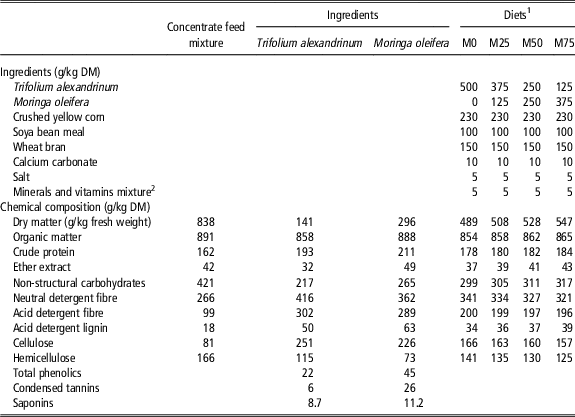
Does were individually housed in soil-surfaced pens under shade, without bedding and with free access to water. Kids were kept with their mothers all through the experimental period, with exception of days when feed intake and nutrient digestibility were determined. Does were offered the experimental diets to meet their nutrient requirements according to NRC (2007) recommendations. Adjustments were made to the diets to ensure collection of orts. The basal diet fed to the goats (M0 treatment) contained 500 g of Egyptian BC (Trifolium alexandrinum) and 500 g concentrate feed mixture (DM basis). In the other experimental diets, 250, 500 or 750 g/kg of the BC were replaced with MO by including 125 (M25 treatment), 250 (M50 treatment) or 375 (M75 treatment) g of MO per kg diet (on DM basis). The ingredient and chemical contents of the diets are in Table 1. Diets were offered to the does individually at 0800 and 1600 h in two equal portions. Each experimental period lasted 22 days; 15 days of adaptation to the new diet, and 7 days for measurements (feed intake, milk yield) and sample collection (sampling of feed and orts, faeces, ruminal fluid, blood and milk).
Ingredient and chemical composition of feedstuffs and total mixed rations fed to the lactating Nubian goats

DM=dry matter.
1 Moringa oleifera added at 0% (M0), 12.5% (M25), 25% (M50) and 37.5% (M75), replacing 0%, 25%, 50% and 75% of berseem clover, respectively.
2 Containing per kg: 141 g Ca, 87 g P, 45 g Mg, 14 g S, 120 g Na, 6 g K, 944 mg Fe, 1613 mg Zn, 484 mg Cu, 1748 mg Mn, 58 mg I, 51 mg Co, 13 mg Se, 248 000 IU vitamin A, 74 000 IU vitamin D3, 1656 IU vitamin E.
Nutrient digestibility and chemical analyses
During the collection period, feed intake was recorded daily. Faecal outputs were collected twice daily from each doe at 0700 and 1500 h and stored at −10°C for later analysis. About 100 g (as-is basis) of faeces from each doe was taken daily and pooled within each period. The composited samples were dried in a forced-air oven at 65°C for 72 h, ground along with feed and orts samples to pass a 1-mm screen using a Wiley mill grinder, and retained for compositional analyses.
Feed, orts and faecal samples were analysed for DM, ash, nitrogen, ether extract (EE) and ADF according to AOAC (1997) official methods. Neutral detergent fibre (without the use of alpha amylase but with sodium sulphite) and lignin (by solubilisation of cellulose with sulphuric acid in the ADF residue) were determined by the procedure of Van Soest et al. (Reference Ulbricht and Southgate1991).
Sampling and analyses of ruminal fluid
On the last day of each experimental period, ruminal contents were sampled at 3 h after the morning feeding to determine the pH and concentration of fermentation end-products. Ruminal contents (~100 ml) were collected by using a stomach tube and hand pump, and the composite samples taken from each doe were strained through four layers of cheesecloth. Ruminal fluid pH was measured immediately using a pH meter (HI98127 pHep®4 pH/Temperature Tester; Hanna Instruments, Villafranca padovana PD, Italy).
A subsample of 5 ml was preserved in 5 ml of 0.2 M HCl for ammonia-N analysis (AOAC, 1997), and 0.8 ml of ruminal liquor was mixed with 0.2 ml of a solution containing 250 g of metaphosphoric acid/l for total volatile fatty acids (VFA) analysis by titration, after steam distillation of a 4-ml sample. Samples collected at 3 h after feeding were analysed for individual VFA. All samples were stored at −20°C until analysed in the laboratory. Individual VFA were measured by gas–liquid chromatography (Varian 3700; Varian Specialties Ltd, Brockville, Ontario, Canada).
Sampling and analyses of blood serum
On the last day of each experimental period, blood samples (10 ml) were taken 4 h after feeding from the jugular vein of each doe into a clean dry tube without anticoagulants. Blood samples were centrifuged at 4000×g at 4°C for 20 min. Serum was separated into 2-ml clean dried Eppendorf tubes and frozen at −20°C until analysis. Concentrations of some blood measurements were analysed in blood serum samples using specific kits (Stanbio Laboratory, Boerne, Texas, USA), following manufacturer instructions.
Milk sampling, milk composition and fatty acids analyses
During the last 7 days of each experimental period, does were milked by hand twice daily at 0900 and 2100 h, and samples (10% of recorded milk yield) were collected at each milking. A mixed sample of morning and evening milk was taken daily. Milk samples were analysed for total solids, fat, protein and lactose using infrared spectrophotometry (Foss 120 Milko-Scan; Foss Electric, Hillerød, Denmark). The milk ash content was determined after heating in a muffle furnace at 550°C for 8 h. Milk fatty acids were determined using methyl esters prepared by base-catalysed methanolysis of the glycerides (KOH in methanol) according to International Standards of the International Dairy Federation (15884-IDF 182). Fatty acid methyl esters were separated using a Cp-Sil 88 fused silica capillary column (100 m×0.25 mm internal diameter×0.2 µm film thickness; Chrompack, Middelburg, the Netherlands) in a gas chromatography (Model 6890; Hewlett-Packard, Palo Alto, CA, USA) equipped with a flame ionisation detector. The identification of fatty acids was based on the comparison of retention times of standard methyl esters containing fatty acid methyl esters mixture (Sigma-Aldrich, MO, USA) and on equivalent chain length.
Average yields (g/day) of each milk component were calculated for individual does by multiplying milk yield by the component content (g/kg) of milk. Milk gross energy content was calculated according to Tyrell and Reid (Reference Tyrell and Reid1965). Energy corrected milk (ECM) was calculated according to Sjaunja et al. (Reference Sjaunja, Baevre, Junkkarinen, Pedersen and Setälä1991).
Statistical analyses
Data were analysed using a quadruplicated 4×4 Latin square design, with four periods and four treatments. The statistical model included the fixed effect of square and treatment, and the random effects of period and goat nested within square: Y ijkl =μ+S i +T j +P k +G l (S i )+E ijkl , where Y ijkl is the each individual observation for a given variable, μ the overall mean, S i the square effect, T j is the treatment effect, P k is the period effect, G l (S i ) is the effect of goat within square and E ijkl is the residual error. Statistical analyses were performed using PROC MIXED of SAS (SAS Institute Inc., Cary, NC, USA). The probability of difference option of the least squares means statement was used for multiple comparisons of means, and polynomial (linear and quadratic) contrasts (for the equal spacing of treatments) were used to examine does’ responses to increasing doses of MO.
Results
Chemical composition and principal chemical constituents
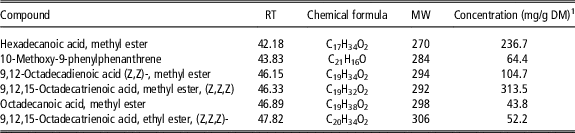
Except for NDF, ADF, cellulose and hemicellulose which decreased, DM and other nutrients increased with increasing level of MO leaf meal in the diets (Table 1). Tannins and saponins were detected in both fodders. Whereas CT and total phenolics were higher for MO, saponins were lower for BC. Table 2 shows the identified principal phytochemical constituents of MO. A total of 30 peaks from the leaf extract of MO were detected in the GC-MS chromatograms, with the retention time ranging from 16.64 to 61.11 min; all were identified as C10 to C43 compounds.
Principal identified phytoconstituents of Moringa oleifera leaves by gas chromatography–mass spectrometry analysis

RT=retention time (min); MW=molecular weight of the compound (g/mol).
1 Concentration based on the total areas of the identified peaks.
Feed intake and nutrient digestibility
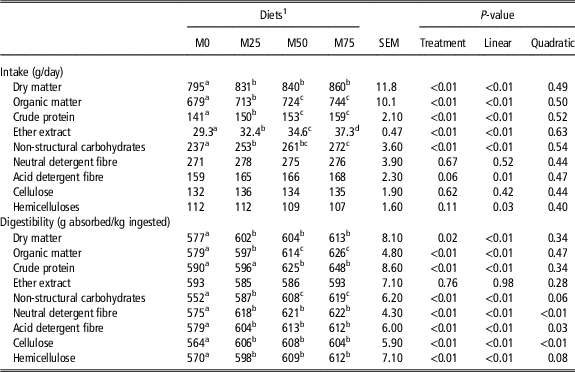
Intakes of DM, organic matter (OM), CP, EE and non-structural carbohydrates (NSC) were increased (linear; P<0.01) for MO compared with the control (Table 3). There were no differences in intakes of NDF, cellulose and hemicellulose. Though intake of ADF was similar among the diets, it was higher for MO diets (linear; P=0.01). Digestibilities of DM, OM, CP, NSC and hemicellulose (linear; P<0.01), and NDF, ADF and cellulose (linear and quadratic; P<0.01) were greater for MO.
Feed intake, nutrient digestibility and nutritive value of diets with different levels of Moringa oleifera replacing berseem clover and fed to lactating Nubian goats (n=16 goats per treatment)

a,b,cValues within a row with different superscripts differ significantly at P<0.05.
1 Moringa oleifera added at 0% (M0), 12.5% (M25), 25% (M50) and 37.5% (M75), replacing 0%, 25%, 50% and 75% of berseem clover, respectively.
Ruminal fermentation measurements
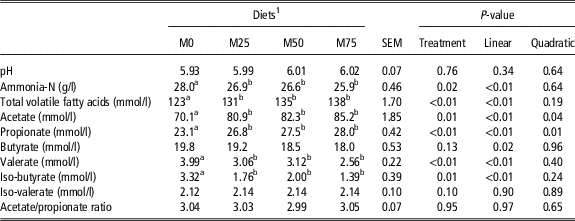
Diet effects on ruminal pH, butyrate, iso-valerate and acetate/propionate ratio were marginal. Ruminal ammonia-N, valerate, iso-butyrate and butyrate were decreased (linear; P<0.01) in MO diets compared with the control diet. Conversely, total VFA (linear; P<0.01), acetate (linear, P<0.01; quadratic, P=0.04) and propionate (linear and quadratic; P<0.01) were increased in MO diets relative to control diet (Table 4).
Ruminal fermentation measurements in lactating Nubian goats fed diets with different levels of Moringa oleifera replacing berseem clover (n=16 goats per treatment)

a,bValues within a row with different superscripts differ significantly at P<0.05.
1 Moringa oleifera added at 0% (M0), 12.5% (M25), 25% (M50) and 37.5% (M75), replacing 0%, 25%, 50% and 75% of berseem clover, respectively.
Blood serum measurements
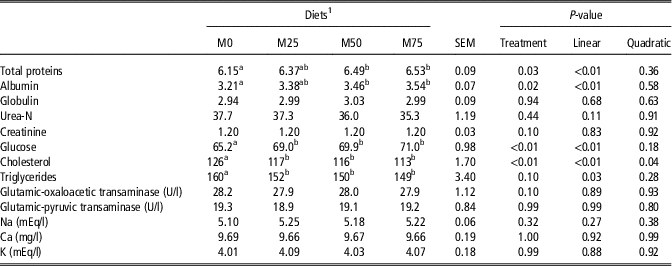
Increased serum total protein, albumin and glucose (P<0.01) were observed in goats fed MO diets, but serum cholesterol (linear, P<0.01; quadratic, P=0.04) and triglycerides (linear; P=0.03) of MO goats were lower than those of control goats (Table 5). Diet effects on serum albumin, globulin, urea-N, creatinine, glutamate-oxaloacetate transaminase, glutamate-pyruvate transaminase, Na, Ca and K were not pronounced.
Blood serum measurements (g/l, unless stated otherwise) in lactating Nubian goats fed diets with different levels of Moringa oleifera replacing berseem clover (n=16 goats per treatment)

a,bValues within a row with different superscripts differ significantly at P<0.05.
1 Moringa oleifera added at 0% (M0), 12.5% (M25), 25% (M50) and 37.5% (M75), replacing 0%, 25%, 50% and 75% of berseem clover, respectively.
Milk yield, milk composition and milk fatty acids
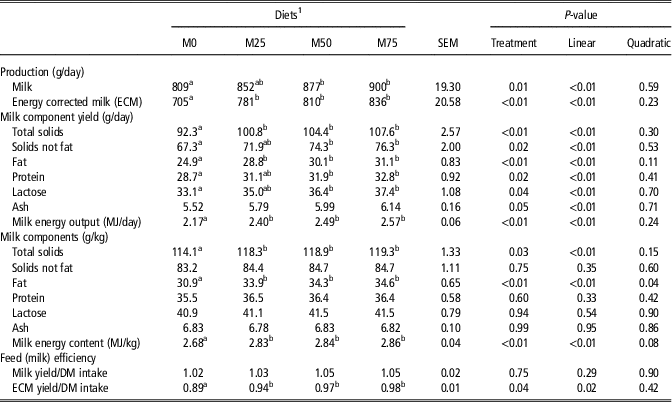
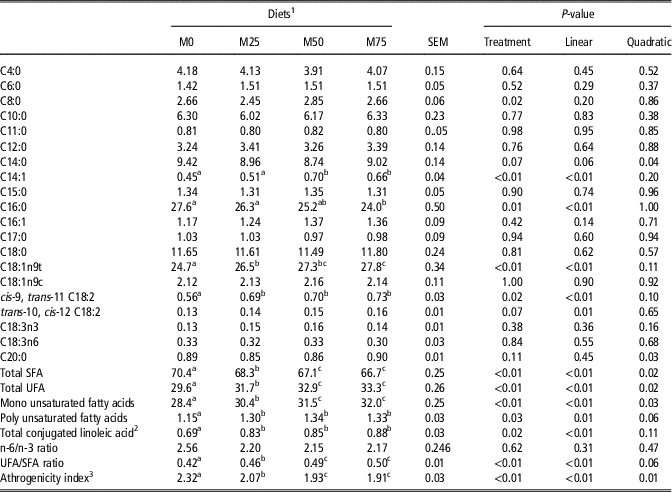
Milk yield, ECM yield, and milk total solids and energy contents, all milk component and energy outputs (linear; P<0.01), milk fat content (linear, P<0.01; quadratic, P=0.04) and ECM yield/DM intake ratio (linear; P=0.02) increased in MO diets compared with control diet (Table 6). Replacement of BC with MO resulted in pronounced alterations of some milk fatty acid profile (Table 7). Moringa oleifera diets increased C14:1, C18:1n9t, cis-9, trans-11 C18:2, total conjugated linoleic acid (CLA) and UFA/SFA ratio (linear; P<0.01), total unsaturated fatty acids (UFAs) and mono unsaturated fatty acids (MUFA) (linear, P<0.01; quadratic, P<0.05) and polyunsaturated fatty acids (PUFA; linear, P=0.01) but reduced C16:0 (linear; P<0.01), total SFAs (linear, P<0.01; quadratic, P=0.02) and athrogenicity index (AI; linear, P<0.01; quadratic, P=0.01).
Milk yield and composition in lactating Nubian goats fed diets with different levels of Moringa oleifera replacing berseem clover (n=16 goats per treatment)

DM=dry matter.
a,bValues within a row with different superscripts differ significantly at P<0.05.
1 Moringa oleifera added at 0% (M0), 12.5% (M25), 25% (M50) and 37.5% (M75), replacing 0%, 25%, 50% and 75% of berseem clover, respectively.
Fatty acids profile (g/100 g total fatty acids) in milk of lactating Nubian goats fed on diets with different levels of Moringa oleifera replacing berseem clover (n=16 goats per treatment)

UFA=unsaturated fatty acid; SFA=saturated fatty acid.
a,b,cValues within a row with different superscripts differ significantly at P<0.05.
1 Moringa oleifera added at 0% (M0), 12.5% (M25), 25% (M50) and 37.5% (M75), replacing 0%, 25%, 50% and 75% of berseem clover, respectively.
2 Total conjugated linoleic acid=trans-10, cis-12 C18:2+cis-9, trans-11 C18:2.
3 Calculated according to Ulbricht and Southgate (Reference Tyrell and Reid1991): Athrogenicity index=(C12:0+4×C14:0+C16:0)/∑ of UFA.
Discussion
Chemical composition and principal chemical constituents
The chemical constituents of both BC and MO are consistent with previously reported values (Kholif et al., Reference Kholif, Gouda, Morsy, Salem, Lopez and Kholif2015 and Reference Kholif, Gouda, Morsy, Anele and Galyean2016a). The high CP, and moderate fibre fractions and CT of MO indicate its good potential as a source of supplementary protein for ruminants. The CP content is above the 16% CP recommended for dairy goats (NRC, 2007); this justifies its inclusion as a cheap protein supplement to match such recommendation. While the CT content of BC is far below the beneficial level, the CT content of MO is within range of moderate doses of 2% to 4% DM reported to reduce ruminal protein degradation and increase intestinal protein flow (Min et al., 2003). Generally, tannins reduce CH4 emission either directly by reducing the methanogenic archaea or indirectly by reducing the protozoa (Cieslak et al., Reference Cieslak, Szumacher-Strabel, Stochmal and Oleszek2013). Tannins can also reduce in vitro DM digestibility in ruminal fermentation due to their antinutritional effect. The function of tannins is similar to saponins which are lipid compounds that alter cell membrane structures of protozoa, destroy protozoal growth and change the pattern of fermentation in the rumen ecosystem (Wencelová et al., Reference Wallace, McEwan, McIntosh, Teferedegne and Newbold2015 and Reference Wencelová, Váradyová, Pristaš, Čobanová, Plachá and Kišidayová2016).
In addition, the GC-MS results identified 30 compounds but the major antimicrobial compounds representing 66% of total identified compounds were hexadecanoic acid, methyl ester, 9,12,15-octadecatrienoic acid, methyl ester, (Z,Z,Z) and 9,12-octadecadienoic acid (Z,Z)-, methyl ester (Rahman et al., Reference Rahman, Ahmad, Mohamed and Ab Rahman2014). There is a paucity of information on the biological activity of most of the identified compounds; however, the antibacterial, antiinflammatory, hypocholesterolemic, hepatoprotective, nematicide, insectifuge and 5-alpha reductase inhibitor activity of 9,12,15-octadecatrienoic acid, methyl ester (Z,Z,Z) has been reported (Devi and Muthu, Reference Devi and Muthu2014). Additionally, hexadecanoic acid, methyl ester possesses some antibacterial and antifungal, and antioxidant activities (Chandrasekaran et al., Reference Chandrasekaran, Senthilkumar and Venkatesalu2011), while octadecanoic acid methyl ester possesses antioxidant and antimicrobial properties (Rahman et al., Reference Rahman, Ahmad, Mohamed and Ab Rahman2014). These beneficial biological activities may be responsible for the positive effects of feeding MO leaves in the present experiment. More detailed explanations of how these biological activities relate to on our findings are later stated. However, further studies are essential to explore the bioactive phytoconstituents of pharmaceutical importance.
Feed intake and nutrient digestibility
The higher feed intake with MO suggests that it was more palatable and acceptable by the goats than BC. Kholif et al. (Reference Kholif, Gouda, Morsy, Salem, Lopez and Kholif2015) observed improved palatability of MO relative to sesame meal in the diets of lactating goats. Similarly, the low ruminal degradability of MO protein may be another probable reason for its increased feed intake because increased provision of rumen escape protein due to reduced ruminal protein degradability increases feed intake (Kholif et al., Reference Kholif, Gouda, Morsy, Salem, Lopez and Kholif2015). The improved fibre digestibility of MO resulting in reduced gut fill and faster digesta outflow rate from the rumen could have also enhanced the intake of MO diets (Olafadehan et al., Reference Olafadehan, Njidda, Okunade, Adewumi, Awosanmi, Ijanmi and Raymond2016). Greater intake of most of the nutrients with MO diet reflects the DM intake and composition of the nutrients in the diets (Olafadehan and Adebayo, Reference Olafadehan and Adebayo2016).
The increased digestibility of MO diets suggests enhanced ruminal fermentation kinetics (Kholif et al., Reference Kholif, Gouda, Morsy, Salem, Lopez and Kholif2015). The ability of ruminal microbes to degrade and use low to moderate levels of secondary metabolites as energy sources without adversely effecting ruminal fermentation and feed digestibility has been documented (Salem et al., Reference Salem, Kholif, Elghandour, Buendía, Mariezcurrena, Hernandez and Camacho2014). Since a large proportion of feed is digested in the rumen, the lower NSC of the control diet may be responsible for its decreased digestibility because readily fermentable carbohydrates are required by rumen microbiota for effective ruminal degradation (Olafadehan and Adebayo, Reference Olafadehan and Adebayo2016; Olafadehan et al., Reference Olafadehan, Njidda, Okunade, Adewumi, Awosanmi, Ijanmi and Raymond2016). The higher CP digestibility of the MO diets confirms the beneficial effect of the CT of MO. The nutritional benefit of CT in ruminant’s diet is due primarily to the protection of dietary proteins from ruminal microbial degradation and the resultant increased digestibility and protein flow to the intestines (Waghorm et al., Reference Van Soest, Robertson and Lewis1987). The low ruminal degradability of MO protein must have undoubtedly increased protein digestion in the lower gut due to increased availability of escape diet protein.
Ruminal fermentation measurements
Reduced ruminal ammonia-N of MO diets relative to the control is the consequence of the low ruminal protein degradability of Moringa foliage due to its content of tannins which have the ability to bind dietary protein and protect it from rumen degradation (Kholif et al., Reference Kholif, Gouda, Morsy, Salem, Lopez and Kholif2015). Parallel results have been reported (Kholif et al., Reference Kholif, Gouda, Morsy, Salem, Lopez and Kholif2015 and Reference Kholif, Gouda, Morsy, Anele and Galyean2016a). Increased total VFA and propionate of MO diets may be due to the higher readily fermentable NSC of the diets and improved digestibility (Kholif et al., Reference Kholif, Gouda, Morsy, Salem, Lopez and Kholif2015 and Reference Kholif, Gouda, Morsy, Anele and Galyean2016a). The reduced ruminal ammonia-N and increased total VFA concentrations of MO diets are nutritionally desirable for improved performance of ruminants as the VFA is used as an energy source and as substrates for the synthesis of other compounds (Ahmed et al., Reference Ahmed, Salem, Zeweil, Sun, Kholif, Elghandour and Bahar2015). The increased total VFA of MO diets resulted in improved propionate and acetate. Moringa diets were more efficient in energy metabolism than the control diet due to the higher production of propionate which has been reported to be positively related to efficiency of energy utilisation (Olafadehan and Okunade, Reference Olafadehan and Okunadein press). In addition, MO diets showed greater ruminal VFA, acetate and propionate, and lower valerate and iso-butyrate concentrations compared with BC, indicating differences in ruminal fermentation patterns of MO and BC. Vanhatalo et al. (Reference Vanhatalo, Varvikko and Huhtanen2003) submitted that increased proportion of ruminal propionate is beneficial in ruminant nutrition and dairy production, because lactose biosynthesis depends on propionate, the primary gluconeogenic VFA. Increased ruminal acetate proportion for Moringa-fed goats may be related to improved ruminal fibre degradation as a result of enhanced ruminal activity of cellulolytic bacteria (Kholif et al., Reference Kholif, Gouda, Morsy, Anele and Galyean2016a; Olafadehan and Okunade, Reference Olafadehan and Okunadein press), and could have a beneficial effect on the concentration of milk fat as discussed later. Generally, altered ruminal individual VFA might be related to the positive effects of MO leaves and its secondary metabolites potentially inhibiting Gram-positive bacteria and favouring propionate-producing bacteria species, thereby resulting in greater accumulation of propionate in the rumen (Wallace et al., Reference Wales, Kolver, Egan and Roche2002).
Blood chemistry measurements
All the serum metabolites, in the current study, were within the normal physiological ranges (Boyd, Reference Boyd1984). Increased serum total protein and albumin with MO diets suggests improved protein utilisation probably due to increased CP and OM intakes and digestibilities (Kholif et al., Reference Kholif, Morsy, Abd El Tawab, Anele and Galyean2016b). Serum glucose increased with MO diets in response to increased OM digestibility, energy concentration, propionic acid and total VFA. Parallel results were observed in goats fed fresh Moringa and Moringa silage (Kholif et al., Reference Kholif, Gouda, Morsy, Anele and Galyean2016a). Of interest in the results of the present study is the decrease in serum cholesterol and triglyceride concentrations of goats fed with MO diets. The functional effect of phenolics compounds in MO may be responsible. It has been reported that phytochemical compounds decrease the synthesis and absorption of cholesterol (Gryglewski et al., Reference Gryglewski, Korbut and Robak1987; Kholif et al., Reference Kholif, Gouda, Morsy, Anele and Galyean2016a). The biological activities of phenolic acids have been implicated for reduced blood cholesterol and triglycerides in rabbits (Gryglewski et al., Reference Gryglewski, Korbut and Robak1987). Lowered serum cholesterol and tryglycerides have been reported in goats fed MO (Kholif et al., Reference Kholif, Gouda, Morsy, Anele and Galyean2016a).
Milk yield, composition and efficiency
Milk yield and ECM yield were increased by 5% to 11% and 11% to 19% respectively in goats fed MO diets. An increased milk yield of 10% to 15% with improved milk composition was earlier reported by Kholif et al. (Reference Kholif, Gouda, Morsy, Salem, Lopez and Kholif2015) in goats offered MO as a protein source. Milk efficiency, measured as ECM/DMI, also increased by 8% in control v. Moringa. Earlier studies on different forms of MO in the diets of goats reported increased milk production, ECM yield and milk efficiency (Kholif et al., Reference Kholif, Gouda, Morsy, Anele and Galyean2016a). The increased milk production, ECM and milk efficiency is the direct consequence of greater feed intake and digestibility, undegraded feed protein, and improved rumen environment and fermentation (Kholif et al., Reference Kholif, Morsy, Abd El Tawab, Anele and Galyean2016b). Higher energy and ruminal propionate levels of MO diets may be another probable reason for the higher milk production. Propionate plays a vital role as a precursor in gluconeogenesis and lactogenesis, and thus increases milk yield (Vanhatalo et al., Reference Vanhatalo, Varvikko and Huhtanen2003). Moringa diets increased milk fat and milk fat yield by 20% and 11% respectively. Increased milk fat of MO diets may be due to the greater fibre digestibility and ruminal acetate concentration which is the precursor for fat biosynthesis. Whereas propionate is glucogenic, actate is lipogenic and favours increased milk butterfat synthesis. Increased milk yield with improved milk composition of MO diets is in agreement with previous reports (Kholif et al., Reference Kholif, Gouda, Morsy, Salem, Lopez and Kholif2015 and Reference Kholif, Gouda, Morsy, Anele and Galyean2016a).
Milk fatty acid profile
Moringa oleifera diets decreased milk total SFA by 4%, and increased total UFA by 10%, PUFA by 15% and total CLA by 23% compared with the control diet. Kholif et al. (Reference Kholif, Gouda, Morsy, Salem, Lopez and Kholif2015 and 2016a) observed decreased SFA, and increased UFA, PUFA and CLA with MO diets relative to the control diet. Greater PUFA level of MO diets may due to high level of PUFA in MO (Kholif et al., Reference Kholif, Gouda, Morsy, Salem, Lopez and Kholif2015). The decreased total SFA and increased PUFA associated with MO diets are important from nutritional and health points of view. Whereas SFA have negative consequences on human health by increasing the danger of cardiovascular disorders and level of blood plasma cholesterol (Wales et al., Reference Waghorm, Ulyatt, John and Fisher2009), PUFA are precursors of long-chain n-3 PUFA needed as bio-regulators of numerous cellular processes, and are associated with immune system deveolpment and functionality. Feeding MO diets thus produced a nutritional healthier milk compared with the control diet. The variation in milk fatty acids indicates different fatty acid profiles of the test ingredients (BC and MO), in consistence with the previous reports (Kholif et al., Reference Kholif, Gouda, Morsy, Salem, Lopez and Kholif2015 and Reference Kholif, Gouda, Morsy, Anele and Galyean2016a). Milk total CLA and AI increased and decreased, respectively, with MO diets indicating healthy milk. The increased milk CLA has some health merits for humans because of its anticarcinogenic principles. The decreased AI is also beneficial due to the importance of AI in relating the milk fatty acid profile to the risk of cardiovascular disorders (Lima et al., Reference Lima, Oliveira, Bagaldo, Neto, Ribeiro and Lanna2011).
Conclusion
Replacement of BC with MO foliage in lactating goat diets improved feed intake, digestibility, ruminal fermentation, and milk yield, composition and fatty acid profile. The results demonstrated the superior nutritive value of MO forage to BC forage in the diets of lactating goats. Therefore, inclusion of 375 g/kg DM of MO to replace 75% of the BC in the diets of lactating goats is recommended under the current experimental conditions.
Acknowledgements
Kholif, A.E. thanks the National Council for Science and Technology (CONACyT, Mexico) and The World Academy of Sciences (TWAS, Italy) for supporting his postdoctoral fellowship at the Facultad de Medicina Veterinaria y Zootecnia, Universidad Autónoma del Estado de México. Moreover, Kholif would like to thank Dr. A.Z.M. Salem for hosting his fellowship.