Introduction
Anthropometric characteristics defining the dimensions and proportions of the human body are widely used to diagnose overweight/obesity, as well as to accurately assess the tissue composition of the body (Gharib & Shah, Reference Gharib and Shah2009; Debnath et al., Reference Debnath, Mondal and Sen2017). They particularly important in field research as they do not require the use of additional, special devices such as DEXA scanners (dual-energy X-ray absorptiometry), which are both expensive and difficult, or even impossible, to transport. In addition, the anthropometric method is extremely practical in world regions such as India where other techniques cannot be used, or their use is exceptionally hard (Mondal & Sen, Reference Mondal and Sen2010; Sen & Mondal, Reference Sen and Mondal2013; Debnath et al., Reference Debnath, Mondal and Sen2017; Kryst et al., Reference Kryst, Żegleń, Wronka, Woronkowicz, Bilińska-Pawlak and Das2019a).
Mid-upper-arm anthropometry can undoubtedly be of great importance in determining abnormalities in body weight and tissue composition. For example, upper-arm girth is characterized by 90% sensitivity and specificity as an indicator of overweight/obesity (Jaiswal et al., Reference Jaiswal, Bansal and Agarwal2017). Also, the correlation of MUAC (mid-upper-arm circumference) with both body weight and level of adiposity has been confirmed in previous studies for the Indian population. Kryst et al. (Reference Kryst, Żegleń, Wronka, Woronkowicz, Bilińska-Pawlak and Das2019b) showed that children with higher BMI and adiposity values are generally characterized by greater upper-arm circumferences. A similar relationship was observed in a study in South Asia (Dasgupta et al., Reference Dasgupta, Butt, Saha, Basu, Chattopadhyay and Mukherjee2010). Thus, MUAC can be used not only as a tool for the diagnosis of undernutrition, but also as a predictor of level of adiposity (Mazıcıoğlu et al., Reference Mazıcıoğlu, Hatipoğlu, Oztürk, Ciçek, Ustünbaş and Kurtoğlu2010; Chaput et al., Reference Chaput, Katzmarzyk, Barnes, Fogelholm, Hu and Kuriyan2017). In addition to the arm circumference itself, other anthropometric features of the mid-upper-arm, such as area of fat or muscle tissue, are crucial predictors of nutrition level, body weight and adiposity (Debnath et al., Reference Debnath, Mondal and Sen2017). It has even been suggested that the fat area of the upper arm is the most suitable index to monitor obesity in prepubertal and pubertal children and adolescents (Cândido et al., Reference Cândido, Freitas and Machado-Coelho2011). In addition, the muscle area of the arm can be successfully used as an indicator of overall muscle mass (Monir et al., Reference Monir, Monir, Galal, Erfan and Ruby2008).
Mid-upper-arm anthropometry has been widely used to assess levels of nutrition, but little research has been done on the changes in mid-upper-arm circumference between subsequent generations (Bolzan et al., Reference Bolzan, Guimarey and Frisancho1999; Chowdhury & Ghosh, Reference Chowdhury and Ghosh2009; Çiçek et al., Reference Çiçek, Öztürk, Mazicioğlu, Elmali, Turp and Kurtoğlu2009; Basu et al, Reference Basu, Sun, Banerjee, Singh, Kalita and Rao2010; Debnath et al., Reference Debnath, Mondal and Sen2017). However, secular trends can provide important information, especially in developing countries such as India (International Statistical Institute, 2017). Developing countries are subject to economic and social changes that can have significant impacts on the growth and development of children and adolescents (Eveleth & Tanner, Reference Eveleth and Tanner1976; Komlos & Baten, Reference Komlos and Baten2004; Bielicki et al., Reference Bielicki, Szklarska, Kozieł and Ulijaszek2005). The analysis of the direction and pace of inter-generational changes is one of the methods most often used to study the impact of socioeconomic factors on these processes (Dasgupta et al., Reference Dasgupta, Saha and Nubé2008; Kryst et al., Reference Kryst, Kowal, Woronkowicz, Sobiecki and Cichocka2012; Mori, Reference Mori2016). The anthropometric features of the upper arm are an accurate reflection of nutrition level, body weight and composition. Therefore, their changes with time are particularly interesting in the context of the so-called ‘double burden’ of over- and under-nutrition seen in India in recent years. This is the co-existence of an increasing prevalence of overweight and obesity (especially in the last 10 years) and high levels of underweight and undernutrition (Dasgupta et al., Reference Dasgupta, Saha and Nubé2008; Singhal et al., Reference Singhal, Misra, Shah, Rastogi and Vikram2010; Arora et al., Reference Arora, Shinde and Patwardhan2017; UNICEF and WHO, 2017).
The aim of this study was to compare the time trends in mid-upper-arm anthropometry characteristics of two cohorts (1982–83 and 2005–2011) of Bengali boys aged 7–16 years from Kolkata, India.
Methods
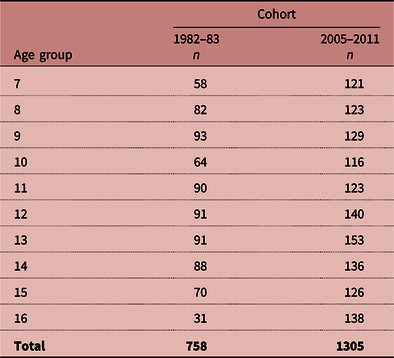
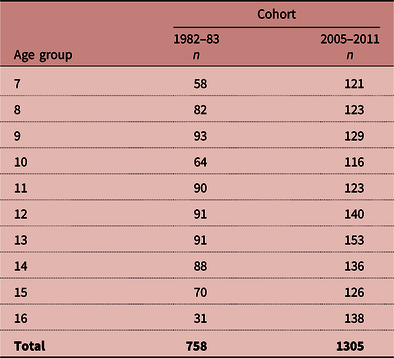
The study data comprised two series of anthropometric measurements of 2063 Bengali boys aged 7–16, from predominantly middle-class families (classified on the basis of per capita monthly family expenditure, parental occupation, parental education, school affiliation, household assets and housing condition). Both studies were cross-sectional in design. The cohort examined in 1982–83 consisted of 758 individuals and the 2005–11 cohort included 1305 individuals (Table 1). For both cohorts, measurements were made on the subjects’ birthdays (±3 days, verified through hospital discharge certificates). Only boys of good overall health and whose parents gave their consent were included in the study.
Distribution of Bengali boys aged 7–16 by age group and cohort
Measurement of the mid-upper-arm circumference (MUAC) was taken using a measuring non-stretchable tape-measure (0.5 cm accuracy). Intra- and inter-observer errors for this measurement were 0.044 and 0.152 cm, respectively. Triceps skinfold thickness (TSF) was measured on the left arm using a Lange skinfold calliper (Beta Technology, USA) with a constant standard pressure of 10 g/mm2 (1 mm accuracy). Intra- and inter-observer errors for this measurement were 0.223 and 0.806 mm, respectively. The measurement methods were analogous in both surveys and full details, as well as the exact characteristics of the study sample, are available in previous publications (Dasgupta et al., Reference Dasgupta, Nube, Sengupta and de Onis2015; Das et al., Reference Das, Das, Datta Banik, Saha, Chakraborty and Dasgupta2016).
From the direct measurement of the mid-upper arm circumference and triceps skinfold thickness the following indicators were calculated, according to the formulae of Frisancho (Reference Frisancho1990):
Mid-upper-arm area (MUAA) = MUAC2/(4π)
Mid-upper-arm muscle circumference (MUAMC) = MUAC–(π×TSF/10)
Mid-upper-arm muscle area (MUAMA) = MUAMC2/(4π)
Mid-upper-arm fat area (MUAFA) = MUAA–MUAMA
Arm Fat Index (AFI) = (MUAFA/MUAA)×100
The measurements for the 1982–83 cohort were taken from the results of the Kolkata Growth Study-1 (KG-1) (Pakrasi et al., Reference Pakrasi, Dasgupta, Dasgupta and Majumder1988; Dasgupta & Das, Reference Dasgupta and Das1997).
The statistical significance of the differences between both cohorts was assessed using two-way ANOVA, with statistical significance at p≤0.05, performed using Statistica 12.0.
Results
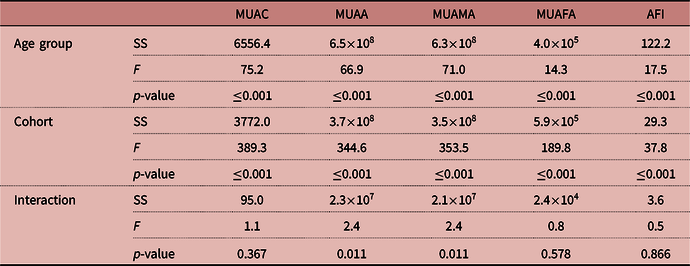
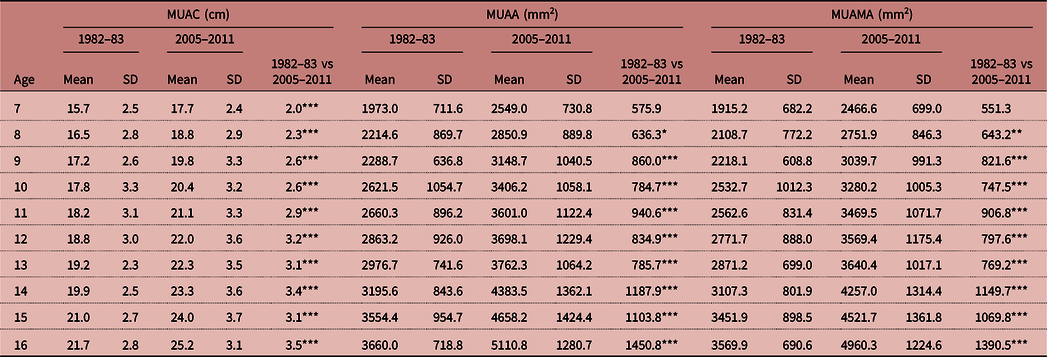
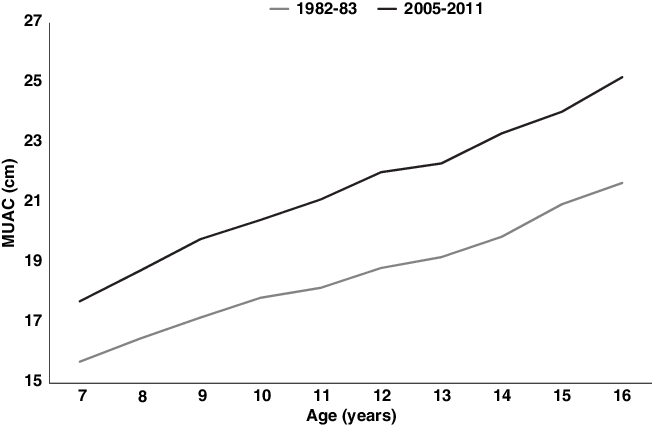
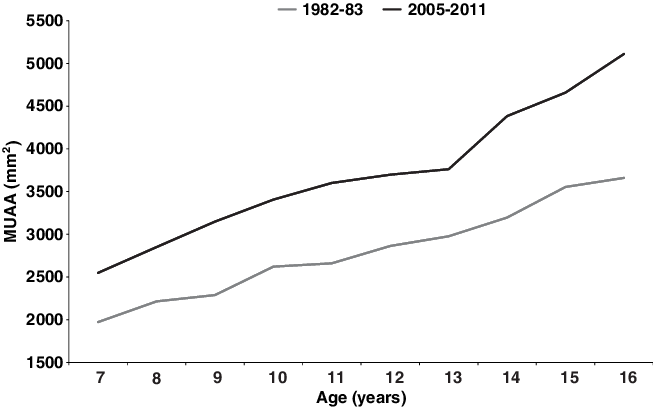
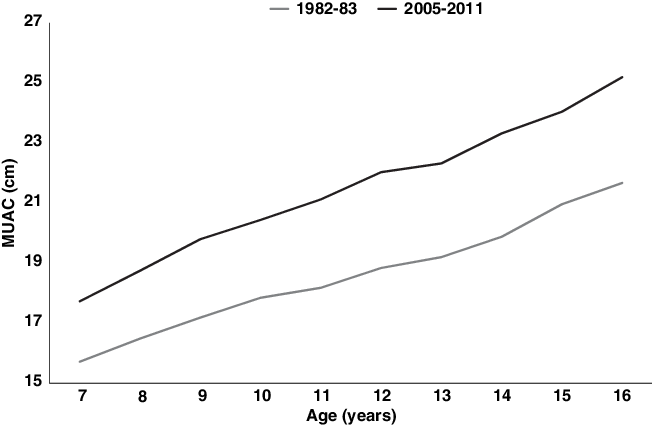
Both age and cohort significantly differentiated MUAC (Table 2). A statistically significant, positive secular trend was present in all age groups. The largest differences were noted in 14- and 16-year-olds, while the smallest were observed in the youngest boys (Table 3, Fig. 1).
Two-way analysis of variance comparing the anthropometric characteristics of Bengali boys in the 1982–83 and 2005–2011 cohorts
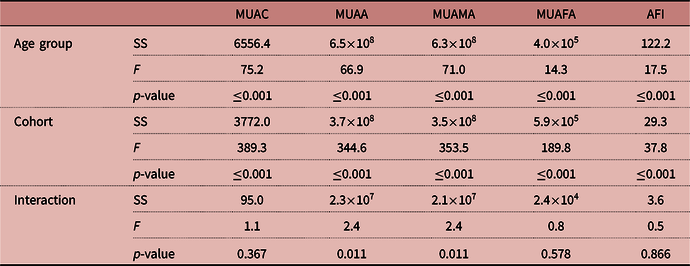
SS: sum of squares.
Results of Tukey’s post hoc (HSD) test comparing MUAC, MUAA and MUAMA for the 1982–83 and 2005–2011 cohorts by age group
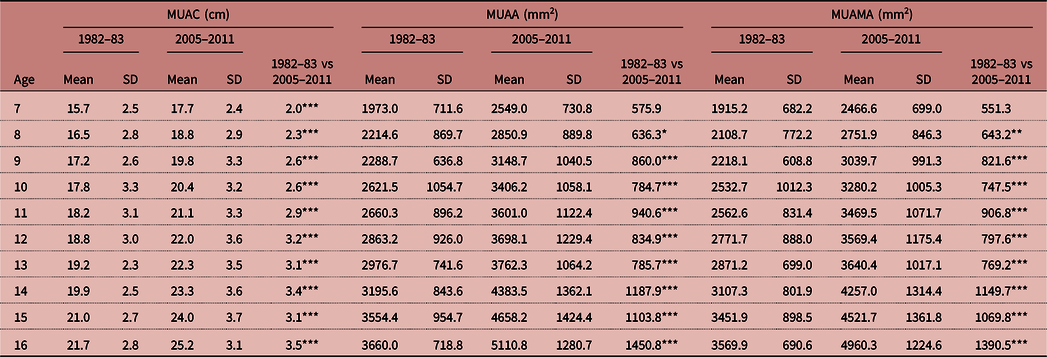
*p≤0.05; **p≤0.01; ***p≤0.001.
Mean MUAC values by age groups and cohort.
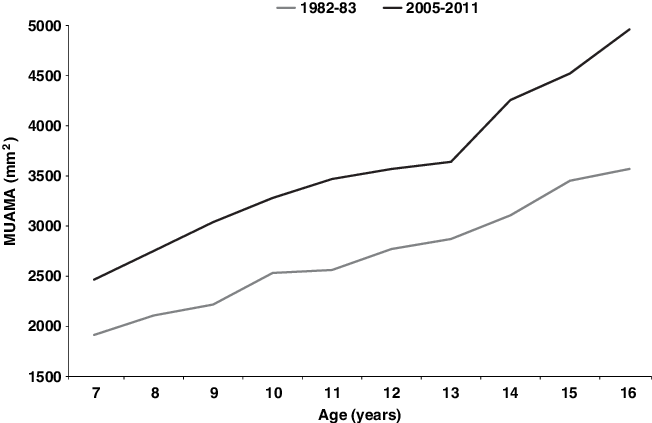
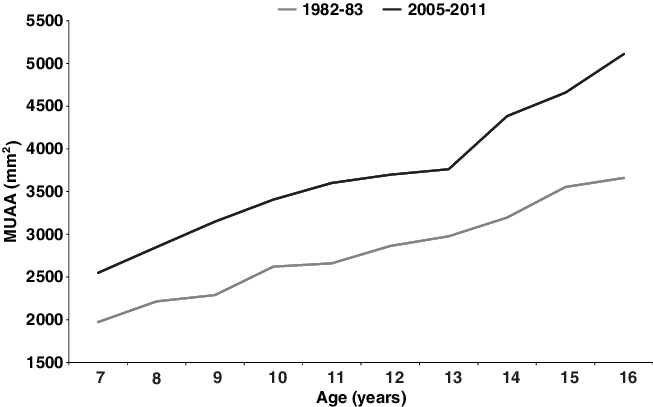
Due to the secular increase in arm circumference, contemporary boys were also characterized by a higher mid-upper-arm area (MUAA) (Fig. 2). This was significantly different between the two age groups and for both cohorts. Also, the interaction of these factors significantly differentiated MUAA (Table 2). Again, the greatest differences were observed in the oldest age groups (Table 3, Fig. 2).
Mean MUAA values by age groups and cohort.
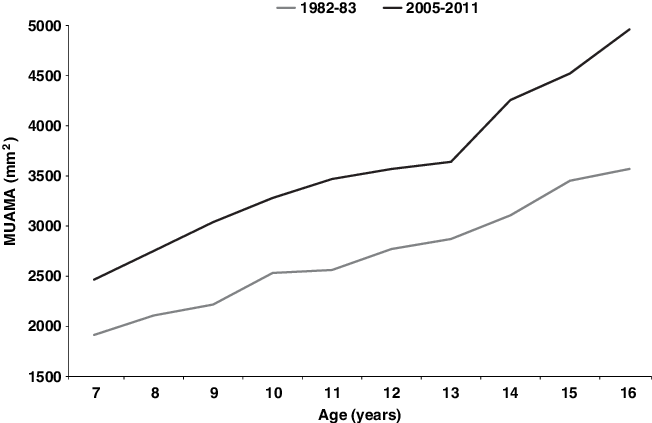
The change of the overall arm area (MUAA) was also found to be associated with significant differences in the areas of individual tissues. Mid-upper-arm muscle area (MUAMA) differed between the age groups and cohorts, and also in the interaction of these factors (Table 2). In all age groups, boys examined in 2005–2011 had a higher muscle area than those from the earlier cohort. These differences were significant in almost all age groups, and were largest, once again, among 14- to 16-year-olds (Table 3, Fig. 3).
Mean MUAMA values by age group and cohort.
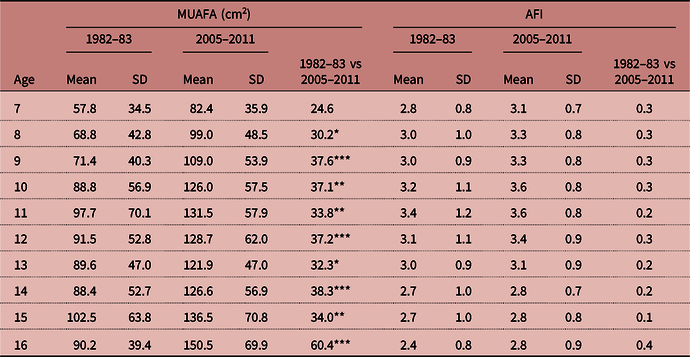
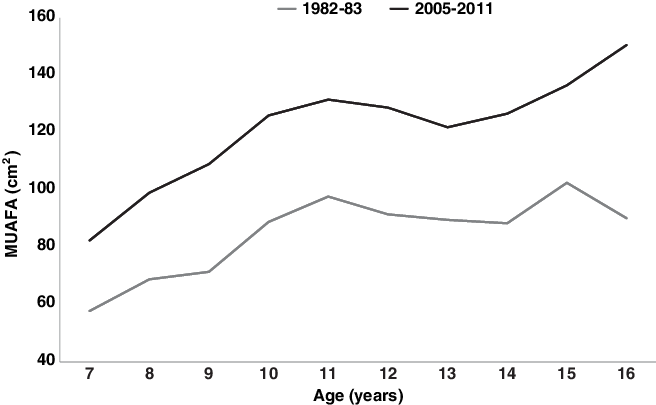
A positive secular trend was also observed for the fat tissue area of the arm, as indicated by the mid-upper-arm fat area (MUAFA). This differed significantly between age groups and cohorts (Table 2). Again, the differences were greatest among the oldest boys. The differences were statistically significant for all age groups, except for 7-year-olds (Table 4, Fig. 4).
Results of Tukey’s post hoc (HSD) test comparing MUAFA and AFI for the 1982–83 and 2005–2011 cohorts by age group
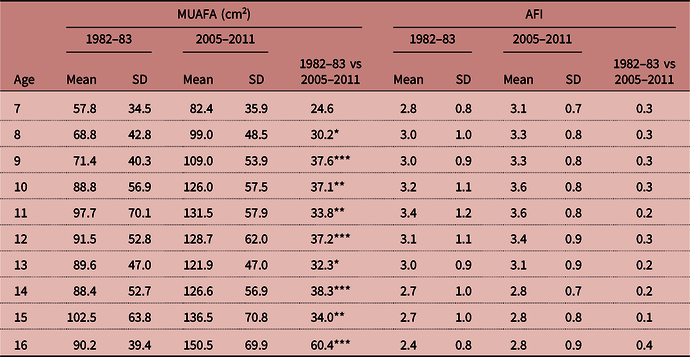
*p≤0.05; **p≤0.01; ***p≤0.001.
Mean MUAFA values by age group and cohort.
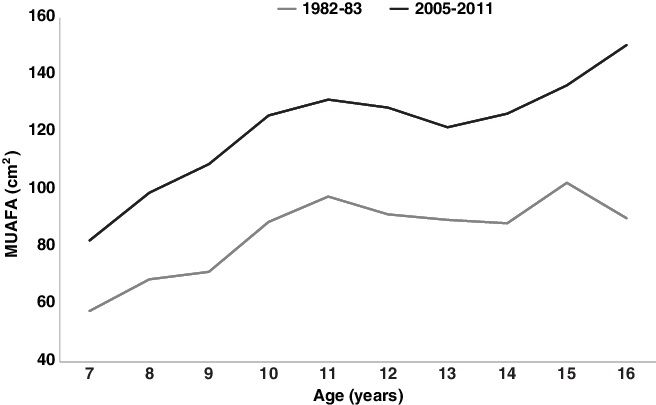
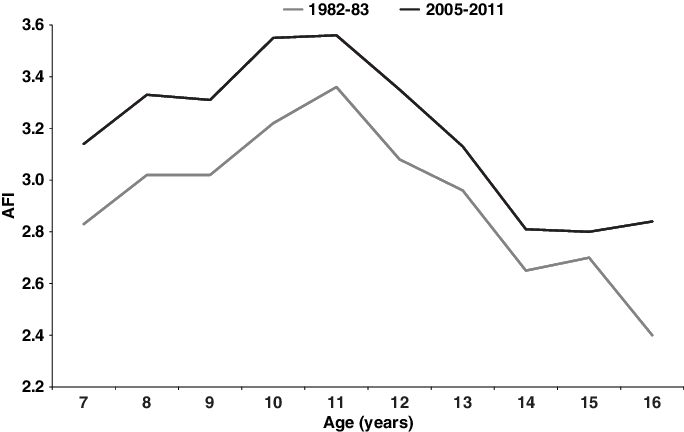
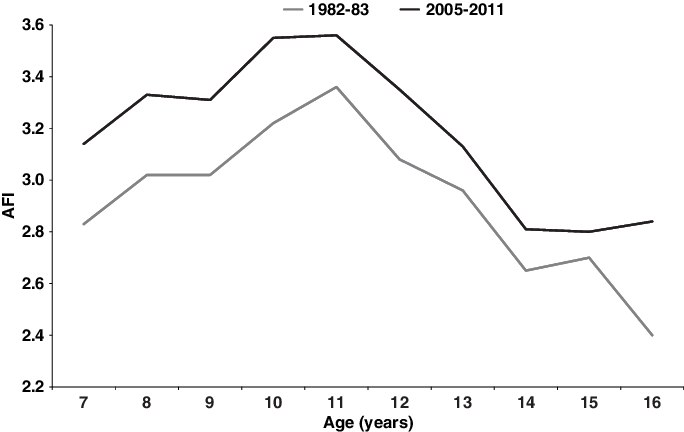
It can be concluded that, in the contemporary boys, the observed increases in the circumferences and areas of the arm resulted from greater muscle mass and adiposity. It also can be noted that the secular growth of the amount of both tissues was proportional because no statistically significant differences in the Arm Fat Index (AFI) were observed between the two cohorts, or between any of the age groups (Table 4, Fig. 5). However, both age groups and cohorts significantly differentiated the value of the Arm Fat Index (Table 2).
Mean AFI values by age group and cohort.
Discussion
Positive time trends in the mid-upper-arm anthropometry of Indian boys were observed in this study for almost all of the studied traits. In the contemporary population, the total mid-upper arm circumference, as well as the area of the arm, and muscle tissue content and adiposity, had increased.
A similar tendency was observed in a previous study conducted using data from newborns in India (Bhalla & Kaur, Reference Bhalla and Kaur2016), which found a positive secular trend in MUAC. Sousa et al. (Reference Sousa, Oliveira and de Almeida2012) observed an increase in the total circumference of the mid-upper arm in contemporary children from Portugal, but no significant changes in boys’ triceps skinfold thickness. Similar inter-generational changes have also been observed in Polish children and adolescents (Kryst et al., Reference Kryst, Woronkowicz, Kowal and Sobiecki2018).
An important finding in the current study was that these changes were particularly pronounced in boys (Kryst et al., Reference Kryst, Woronkowicz, Kowal and Sobiecki2018). Likewise, Sedlak et al. (Reference Sedlak, Pařízková, Procházková, Cvrčková and Dvořáková2017), in their research of pre-school children in the Czech Republic, noted an increase in the overall level of body fat in the more recent population. In this case, however, unlike in the present research, the total circumference of the arm also decreased. This suggests that in these Czech children there was also a negative secular trend in the amount of muscle tissue in the arm, which was also different from the results observed in the present Indian population. This may be related to differences in the levels of economic development in the two countries. According to the World Bank, the Czech Republic is a high-income country, while India is currently classified as a middle-income country. Those socioeconomic differences are also seen in mean life expectancy at birth and GDP (Gross Domestic Product) (World Bank, 2018a, b). An inter-generational increase in MUAC co-existing with a slight increase in general body fat has also been observed in Croatian children, between cohorts from 1998 and 2013 (Horvat et al., Reference Horvat, Hraski and Sindik2017). What is interesting, however, is that the same study found a decrease in upper-arm adiposity, as measured by triceps skinfold thickness, between the 2003 and 2013 cohorts
An Argentinean study, similarly as in the present analysis, observed a positive secular trend rin both MUAC and upper-arm adiposity (Guimarey et al., Reference Guimarey, Castro, Torres, Cesani, Luis, Quintero and Oyhenart2014). However, unlike in the current Bengali population, there was also a decrease in muscle mass. According to the authors, this was related to the increase in the intake of the energy-dense foods and the popularization of a sedentary lifestyle. In recent years, similar changes in the level of activity and diets of children and adolescents have been observed in India. Arora et al. (Reference Arora, Shinde and Patwardhan2017) and Gamit et al. (Reference Gamit, Moitra and Verma2015) observed that contemporary Indian teenagers preferred to travel by car or bus rather than biking or walking.
Changes in the level of physical activity of children and adolescents can significantly affect the bone frame. Less-active children and adolescents are characterized by a significantly lower Frame Index – an indicator of the relative robustness of the skeleton, based on elbow breadth in proportion to body height. Thus physical activity is important to maintain skeletal robustness, and therefore an appropriate body composition (Rietsch et al., Reference Rietsch, Eccard and Scheffler2013). Moreover, Hajare et al. (Reference Hajare, Deoke and Saoji2016) reported that over 36% of teenagers in India ate ‘junk food’ more than three times a week. However, the present results suggest that these activity and diet changes are not yet strong enough, at least in the West Bengal area, to negatively affect the body structure of boys. The observed positive inter-generational changes were probably, to a large extent, associated with a significant reduction in the prevalence of stunting and wasting that occurred between the years between the two examined cohorts (Rao et al., Reference Rao, Kanade, Joshi and SarodeRao2012). This phenomenon could be due to the economic and social progress made in India over recent decades. There has been progress in various socioeconomic population characteristics, such as level of nutrition, education, parents’ occupations and quality of health care (Bhalla & Kaur, Reference Bhalla and Kaur2016).
Improving environmental conditions are in turn correlated with a better realization of genetic potential, which is reflected in secular trends in the dimensions, proportions and composition of the human body (Malina, Reference Malina1990). Fuller implementation of the genetic potential of the Indian population is expressed, for example, in the positive inter-generational changes in body height observed in recent years (Dasgupta et al., Reference Dasgupta, Nube, Sengupta and de Onis2015). These changes could be responsible for the differences observed between the examined cohorts in the present study. Body height can significantly influence MUAC values, as well as mid-upper-arm adiposity and muscle area (Addo et al., Reference Addo, Himes and Zemel2017; Heymsfield & Stevens, Reference Heymsfield and Stevens2017). However, according to Scheffler et al. (Reference Scheffler, Krützfeldt, Dasgupta and Hermanussen2018), fat tissue has no correlation with body height in the Bengali population.
In addition, this study’s observed changes in mid-upper-arm anthropometry may be directly connected to improvements in development conditions. The sensitivity of those characteristics to the environment has been shown in studies of the Turkish population (Gültekin et al., Reference Gültekin, Özer, Katayama and Akın2007; Cândido et al., Reference Cândido, Freitas and Machado-Coelho2011; Çiçek et al., Reference Çiçek, Öztürk, Mazıcıoğlu and Kurtoğlu2014). These studies highlighted the significant impact of socioeconomic status on the muscle and fat tissue area of the upper arm. The association between the anthropometric characteristics of the mid-upper arm and developmental conditions has also been confirmed by research carried out in the National Capital Territory of Delhi by Sharma et al. (Reference Sharma, Sharma and Mathur2007). Children were found to have significantly higher values of both MUAC and triceps skinfold thickness than the National Centre for Health Statistics standards, which are derived using data from various regions of the country. It is also interesting that the highest MUAC values in Delhi boys were observed at the ages of 12–14 years – the age at which the present study found the differences between the two cohorts to be often the greatest.
However, the positive inter-generational transformations observed in the present analysis may also be a consequence of the improved eating habits of the examined boys. Özdemir et al. (Reference Özdemir, Önal and Özer2014), in their study of the Turkish population, suggested that lower values of MUAMA and MUAFA could be related to a poorer and less-diverse diet. The positive impact of well-balanced eating on anthropometric dimensions of the mid-upper arm has also been confirmed by da Silva et al. (Reference da Silva, de Antunes, da Silva, da Silva, da Silva and Brandao-Neto2014). They analysed the effectiveness of a nutrition programme on children. They found that calorie–protein adjustments can cause a significant increase in the muscle area of the arm, as well as in triceps skinfold thickness. The MUAMA is also sensitive to protein–energy malnutrition (Caballero et al., Reference Caballero, Himes, Lohman, Davis, Stevens and Evans2003; Monir et al., Reference Monir, Monir, Galal, Erfan and Ruby2008). Thus, the diet of contemporary Indian boys is probably not only richer overall, but also better balanced in terms of individual nutrients. Additionally, the obtained results also suggest that between the analysed cohorts, the diet at the youngest ages has improved, for inadequate nutrition during early childhood has been proven to be associated with poor upper-arm composition, even at a later age (Monir et al., Reference Monir, Monir, Galal, Erfan and Ruby2008).
The results of this study provide some interesting and useful information about the mid-upper arm anthropometry of the Bengali population. The study of these variables, and their changes in subsequent generations, remains important and relevant, especially in developing countries. There are, of course, a wide variety of anthropometric characteristics that are accurate indicators of malnutrition, waist circumference being a good example (Kryst et al., Reference Kryst, Woronkowicz, Kowal, Pilecki and Sobiecki2016). However, these alternatives can often be affected by respiratory movements and postprandial abdominal distension. In contrast, arm anthropometry is not affected by such problems, and hence may be a more reliable indicator for overweight and obesity diagnosis (Çiçek et al., Reference Çiçek, Öztürk, Mazıcıoğlu and Kurtoğlu2014). It is, therefore, important to obtain new information regarding the middle-upper-arm anthropometry in different populations, as this could significantly improve the process of screening for all forms of malnutrition and related health problems to help body weight and composition management.
Funding
This study was sponsored by the Neys van Hoogstraten Foundation, The Netherlands (ID158), and the Indian Statistical Institute, Kolkata, India.
Conflicts of Interest
The authors have no conflicts of interest to declare.
Ethical Approval
The authors assert that all procedures contributing to this work comply with the ethical standards of the relevant national and institutional committees on human experimentation and with the Helsinki Declaration of 1975, as revised in 2008.