Despite a large and growing literature about violent nonstate groups, scholars know little about perhaps the most basic decision these groups make: whether to attack with terrorist or guerrilla tactics. Most existing literature exclusively examines either terrorist or guerrilla tactics and does not explore the strategic calculations behind groups' decisions to use one tactic over the other.Footnote 1 Relatedly, it is common for studies to at least implicitly make sharp distinction between “terrorist groups” that target civilians and “guerrilla groups” that target state security forces. As applied to groups this distinction is often misleading because many groups use both guerrilla and terrorist tactics. Moreover, the idea that violent nonstate groups are strategic actors is widely held among political scientists and policy-makers. Accordingly, prominent theoryFootnote 2 and case studiesFootnote 3 suggest that groups strategically plan attacks taking into account how they expect the state to respond.
Extant theory suggests two seemingly contradictory ways that anticipated state responses to attacks can enter into the strategic calculus of groups. First, attacks that provoke the usually more powerful state to respond with force can endanger group survival. Thus, groups often actively avoid potentially fatal direct engagement with state forces. For example, in a 1971 treatise on the urban guerrilla, leaders of the Red Army Faction (RAF), a small urban guerrilla group based in West Germany, note that it is dangerous “to push [the group] into confrontations that can only lead to defeat.”Footnote 4 Second, it can also sometimes be good strategy for groups to provoke the state to use its firepower in a way that causes civilian collateral damage, but is not fatal to the group. In internal and public discussions of ideal strategy for urban guerrillas, RAF leaders repeatedly cite Brazilian guerrilla and public theorist Carlos Marighella, who advocated provocation. RAF leader Andreas Baader begins a January 1972 letter to the press with the following quote from Marighella: “The cops will continue to fumble about in the dark, until circumstances oblige them to see that the political situation has become a military situation.”Footnote 5 The premise of a provocation strategy is to carry out attacks that elicit a forceful response that harms civilians more than group members, helping groups gain the support and power needed to escalate the conflict. However, provocation can be fatal if the state is able to precisely apply force to group members.
Data from post–World War II Western Europe highlight an important connection between tactics and state responses: just under 1 percent of all terrorist attacks elicit a forceful state response whereas nearly 7 percent of all guerrilla attacks do. A critical element that helps explain this pattern is groups' expectation about whether state retaliation will occur and whether it is likely to involve precision strikes against group members or attacks that seem destined to produce civilian casualties. Western European states are better at discriminating group members from civilians following guerrilla attacks relative to terrorist attacks, which makes forceful response much more likely after guerrilla attacks. Thus, it is counterintuitive from the group's perspective that guerrilla tactics are associated with provocation, whereas terrorist tactics are associated with avoiding state response. Clearly, groups prefer to provoke the state the more inaccurate it is, which suggests that terrorist tactics should be associated with provocation. However, the state is provoked only when it has a great enough ability to discriminate group members from civilians. Accordingly, groups use guerrilla attacks to provoke when the state is moderately accurate in its response so that it is still precise enough to find forceful response worthwhile but not so accurate to deter the group from using guerrilla tactics. Overall, the empirical model provides new and nuanced evidence that groups are surprisingly good at choosing tactics to avoid precise forceful responses that effectively target group members, while choosing tactics to provoke forceful responses that harm civilians but do not impose much damage on group members.
The finding that guerrilla attacks are more likely to generate forceful state response because of accuracy in state responses to guerrilla attacks sheds new light on why high-capacity states, such as wealthy democracies, experience high rates of terrorist violenceFootnote 6 but are unlikely to experience a high volume of guerrilla attacks.Footnote 7 Scholars of violent politics have long argued that states' power to respond to terrorist or guerrilla attacks is a central challenge for violent nonstate groups.Footnote 8 Carrying out attacks in states with high capacity to respond to violence is thought to be relatively unattractive and risky. However, one of the most replicated findings in the literature is that advanced democracies experience a relatively high number of attacks against civilians. For example, from the 1960s through the 1980s, Western Europe experienced a large number of terrorist attacks relative to other regions.Footnote 9 Given that Western European democracies are relatively wealthy and high capacity, this pattern is rather puzzling. Violent nonstate groups targeting Western European democracies in the post–World War II era carried out around 200 percent more terrorist attacks, targeting civilians, than guerrilla attacks, targeting state forces. The lack of attacks against state forces in Europe is surprising given that more than 90 percent of the attacking groups have antistate primary goals. My findings suggest that a key reason that terrorist attacks are more common than guerrilla attacks is that the state is generally better at employing effective responses to guerrilla attacks.
Despite the central role that state capacity to respond plays in the literature, it has not been explicitly integrated into a model of group attacks. I illustrate how groups' choice of tactics depend on anticipated state response and provide new evidence for when and why groups choose tactics to avoid or provoke a forceful state response. The empirical model I develop is uniquely suited to assessing groups’ strategic motivations and helps to deal with the specific endogeneity problems arising from the strategic relationship between groups' choice of tactics and states' decisions to respond with force. The strategic empirical model I estimate easily outperforms nonstrategic models of tactical choice. Additionally, I discuss several difficult robustness and model-specification tests that rebut the idea that the results are driven by factors like group strength and a number of other possible objections.
Provocation or Avoidance? Tactics and State Response
The idea that violent nonstate groups strategically plan and carry out attacks is firmly established in the existing literature.Footnote 10 On the one hand, a number of scholars suggest that groups plan attacks to provoke a draconian state response that produces collateral civilian damage.Footnote 11 Recent literature that examines provocation as a strategy focuses mostly on terrorism: Merari discusses provocation as a “terrorist strategy” and Kydd and Walter classify provocation as one of five major strategies of terrorism. Existing evidence suggests provocation is a tenable idea because recent public opinion data show that state-caused civilian collateral damage has a significant and lasting effect on whether citizen preferences are radical, that is, amenable to the use of violence, or moderate.Footnote 12 Given that terrorist tactics are often thought of as the preeminent “weapon of the weak,” a provocation strategy is plausible because it can serve to redress the imbalance between the group and state.Footnote 13 Yet guerrilla tactics can also provoke a draconian state response. English notes that Irish Republican Army (IRA) attacks against British security forces frequently elicited a draconian response that was helpful to the IRA. He points out that from 1918 to 1921, “Crown Forces, frustrated at not being able to convict those responsible for attacking, injuring and killing their comrades, resorted to reprisals targeted against violent opponents, but affecting (and causing disaffection among) much wider numbers than that.”Footnote 14 Similarly, in his highly influential treatise on guerrilla conflict, Marighella advocates the use of guerrilla tactics to provoke imprecise state response.Footnote 15
On the other hand, much of the literature on political violence suggests that groups strategically attack to avoid a harsh state response. Because violent nonstate groups are almost always a lot weaker than the state, avoiding potentially debilitating forceful state responses is essential. In an influential article about the causes of terrorism, Crenshaw emphasizes that the most salient deterrent of terrorism is the state's ability to react repressively to violence.Footnote 16 McAdam provides evidence that a lack of repression facilitated the use of political violence by groups in the fight for civil rights in the United States.Footnote 17 More recently, Li argues that the constraints on a state's ability to effectively react to attacks increases groups' strategic incentives to use violence.Footnote 18 In contrast, attacks are less likely in countries where the state can respond forcefully. In a similar vein, the theoretical frameworks of Sandler, Tschirhart, and Couley and Bueno de Mesquita both suggest that counterterrorism actions have a negative effect on a group's welfare.Footnote 19 The larger implication of these studies is that if the net effect of a harsh state response is negative for a group, it will try to plan attacks that do not provoke a forceful response.
The literature suggests that both strategies of provocation and avoidance make attacks against democratic states relatively attractive to groups.Footnote 20 Scholars such as Li and Pape suggest that democracies are attractive targets because they are unable to respond swiftly and forcefully to groups.Footnote 21 Scholars argue that a provocation strategy is effective against democracies who are unable to employ a maximally brutal “scorched earth” response to an attack because of constraints on executives' power to use force.Footnote 22 Although democratic states usually face real constraints, they also face more direct public pressures to respond in a firm and observable way to attacks.Footnote 23 This pressure often leads to measures that increase the government's ability to use force against groups, such as the development of special antiterrorism unitsFootnote 24 or restrictions on civil liberties.Footnote 25 The coupling of significant constraints on the use of force with incentives to respond observably to threats leads democracies to be especially prone to a strategy of provocation.
The literature highlights both the idea that violent groups choose tactics to provoke the state and the idea that they choose tactics to avoid forceful response. However, existing evidence does not provide a clear sense of under what conditions groups plan attacks to strategically avoid or provoke forceful state response. I argue that the precision with which democratic states can respond to attacks is central to whether groups prefer provocation or avoidance of forceful response. Relatedly, if a state's forceful response to a tactic is too imprecise, a democratic state is unlikely to find forceful response attractive. Unfortunately, scholars know little about the precision with which states can forcefully respond to terrorist or guerrilla attacks.
Theoretical Model
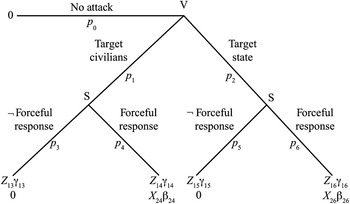
I develop the simplest possible theoretical model that allows analysis of the circumstances under which a group's optimal strategy is to use either terrorist or guerrilla tactics, or both, to provoke or avoid forceful response from a completely informed state.Footnote 26 The game has the structure depicted in Figure 1. First, the violent group (denoted V) decides whether to carry out a terrorist attack, a guerrilla attack, or no attack. If the group does not attack, both players receive the status quo payoff of 0. If the group chooses to attack, employing either terrorist or guerrilla tactics, the state (denoted S) decides whether to respond forcefully or not. If the group employs terrorist tactics and the state does not respond forcefully, the group receives a payoff of c t − k t , while the state receives a payoff of − c t . The parameter c t represents the damage imposed by a terrorist attack, of which the most prominent element involves civilian deaths and injuries. The group receives higher payoffs from more damaging attacks, whereas the state pays higher costs for an attack because it imposes more damage. The costs of carrying out the attack for a group are captured by k t > 0.
The strategic attacks game

If the group carries out an attack and the state responds with force, the players' payoffs reflect the damage the state response imposes on the group and the collateral damage to civilians. If the group targets civilians and the state responds forcefully, the group receives a payoff of c t − k t − α t π + (1 − α t )π. The α t ∈ [0, 1] parameter represents the proportion of damage that the state's response to a terrorist attack imposes on group members versus civilians. The parameter π > 0 captures the amount of human damage that results from the state's forceful response. Thus, as α t → 1, the state is becoming increasingly precise in targeting group members, while as α t → 0 the state response is becoming increasingly imprecise, producing collateral damage among civilians. The group benefits when the proportion of the damage from the state's response inflicted on civilians increases, and is harmed as the state is able to more precisely target group members. The state's payoff following a terrorist attack and its forceful response is −c t + α t π − (1 − α t )π − ω t . Thus, it benefits from accurately targeting group members and pays a cost for collateral damage it imposes on the civilian population.
Forceful response to a terrorist attack carries costs to the state in addition to those incurred from collateral damage. For instance, states with more resources and greater capacity will find forceful response less costly to employ. It is also possible that when states face a group with a territorial goal, the costs of forceful response might be lower because their members are much more likely to be clustered in the area they make claims over and thus less difficult to locate, for example, the PIRA in Northern Ireland.Footnote 27 Alternatively, secessionist groups with territorial goals may be more costly for the state to target because they are located in areas relatively dense with supporters. Also, factors such as the ideology of a state's government and its winning coalition of voters likely affects the political cost of using force in response to a violent attack. I capture this cost to responding with force with the parameter ω t ≥ 0.
If the group chooses to directly target state forces by employing guerrilla tactics, group and state payoffs are analogously defined. The only difference is that both players' payoffs are subscripted by g, to indicate that the group carried out a guerrilla attack, rather than t, which indicates a terrorist attack. For example, if the group carries out a guerrilla attack and the state responds forcefully, the group receives a payoff of c g − k g − α g π + (1 − α g )π and the state receives − c g + α g π − (1 − α g )π − ω g . This formulation allows the damage imposed by a guerrilla and terrorist attack to differ, the costs of the two tactics to differ for the group, and the state's precision in its response to each tactic to differ. Figure 1 summarizes the players' payoffs for each possible outcome in the game.
The model is consistent with several prominent mechanisms by which provocation helps the group and hurts the state. For instance, Bueno de Mesquita argues that state response can generate economic externalities that facilitate recruitment, whereas Lake and Kydd and Walter argue that forceful state response radicalizes moderates and facilitates recruitment.Footnote 28 Similarly, Rosendorff and Sandler suggest that forceful state responses increase grievances among the population, which aids group recruitment efforts.Footnote 29 I simply assume that when a forceful state response causes civilian casualties and damage, this hurts the state and helps the group.
There are two potential objections to the assumptions of the model that I briefly address here. First, the idea that groups benefit from all civilian casualties resulting from terrorist attacks is contestable. It is possible that the group tries to target civilians that are from a portion of society that are not potential supporters (for example, Catholics versus Protestants in Northern Ireland), and that it actually pays a cost for hitting the “wrong” civilians. If a group hits the “wrong” civilians, the backlash to the group from its target constituency could plausibly be analogous to the backlash the state receives when it harms civilians with forceful responses. To account for this idea, I also analyze a version of the model in which the group gains only from casualties among a portion of civilians and pays costs for harming the “wrong” civilians. The basic character of the results is the same, although the conditions under which carrying out terrorist or guerrilla attacks makes sense for the group are more restrictive as the group's accuracy decreases.Footnote 30
A second potential objection is that the model does not contain any bargaining between the state and group. Bargaining often makes conflict under complete information inefficient, which might make both violent group attacks and forceful state responses suboptimal.Footnote 31 However, the set of violent substate groups I focus on in this article are almost always far too weak to be involved in negotiations with the state. The literature on violent nonstate actors emphasizes that groups carry out painful attacks to demonstrate to the state that they are capable enough to be taken seriously.Footnote 32 Groups that are very successful might eventually be seen as serious enough threats to become involved in negotiations with the target state, but this is rare and typically takes place after years of successfully having shown itself to be a force to be reckoned with via painful attacks. Thus the idea that relatively weak groups try to demonstrate and build on their capabilities by carrying out as damaging of attacks as possible (conditional on the cost, k i , not being too high) is theoretically reasonable.Footnote 33
Equilibrium Conditions
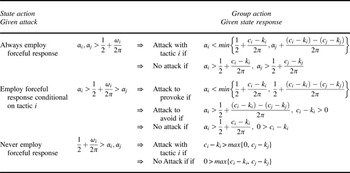
I use the subgame perfect equilibrium (SPE) refinement to analyze the game. Because play is sequential and the players have complete and perfect information, there is a unique equilibrium in pure strategies for any distribution of the model's parameters.Footnote 34 Table 1 summarizes the equilibrium conditions for the state and group in the game. The table outlines each possible equilibrium path of play for the state and group along with the corresponding equilibrium conditions that must hold for each path of play to be optimal.Footnote 35
Summary of results

The table reflects the logic of backward induction, with each row representing a possible equilibrium path of play for the state and violent group. Thus the column on the far left lists the three possible equilibrium paths of play for the state when it has experienced an attack. The equilibrium condition that must hold for this path of play to be optimal for the state is noted in the next column to the right. The column to the right of the state's equilibrium conditions lists the possible paths of play for the group given that the state plays the strategy listed to the left in the same row. The final column states the equilibrium condition for the group that must hold for the path of play to be optimal. To simplify the notation in the table, I denote the tactic the group chooses as tactic i, whereas the tactic not chosen is tactic j. This notation facilitates the presentation of general and succinct equilibrium conditions.Footnote 36 Accordingly, I subscript all parameters in the players' utilities here with i and j, where i ∈ {t, g} and i ≠ j. If the chosen tactic is a guerrilla attack, then i = g and j = t, which means that the tactic not chosen is terrorism.
The state's decision to employ a forceful response to an attack using tactic i hinges on its precision in targeting group members, that is, α
i
. The state uses force in response to either tactic if enough of the damage it will inflict hits group members rather than civilians. In all the state's equilibrium conditions, when ω
i
= 0 at least 50 percent of the damage sustained from a forceful response must target group members.Footnote
37
As the costs to forceful response in addition to collateral damage increase, that is, ω
i
increases above 0, the state's threshold increases above the baseline of
 ${\alpha _i} = \displaystyle{1 \over 2}$
. This straightforward equilibrium condition suggests that the state is quite careful in its use of force because it will use force only when more of the resulting damage hurts group members than civilians.
The group's equilibrium behavior when a forceful response is possible also depends on α i , the precision of the state's response. If the state responds forcefully to the use of tactic i, the group will employ the provocative tactic i if a large enough proportion of the damage from the response afflicts the civilian population rather than its own members. As a baseline, if c i − k i = 0 then at least 50 percent of the damage from the forceful response must afflict the civilian population, which is the opposite of the state's condition on α i . The group is willing to tolerate a smaller (larger) proportion of civilian (group) casualties as the difference between the direct payoff from using tactic i, that is, c i − k i , versus either tactic j or refraining from carrying out an attack increases. This allows it to be simultaneously optimal for the group to provoke the state and for the state to be provoked. For example, if the relevant comparison to tactic i is no attack, then the group compares α i with (c i − k i ) − 0. If both tactics are provocative, the baseline level of damage in the comparison between tactics i and j is α j , or the proportion of damage from the state's response that the group would face if it employed tactic j. Finally, if neither tactic provokes a state response, that is, the final row of the table, the group's tactical choice is driven solely by the direct payoffs from the attack.
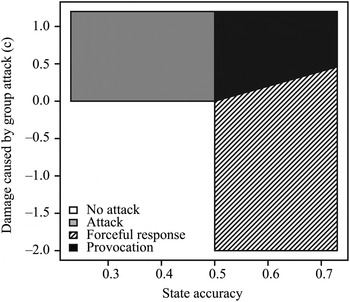
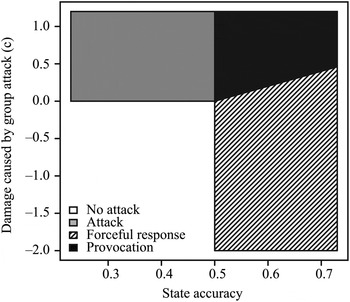
Figure 2 depicts the range of parameters for which provocation is possible in equilibrium.Footnote 38 State accuracy in targeting group members with force is depicted on the x axis, whereas the severity of the group's attack, c i , is varied on the y axis.Footnote 39 The area of the plot shaded with black diagonal lines depicts the region where the state would employ forceful response, but the group does not provoke such a response because it is too damaging relative to its payoff. The solid black shaded region depicts the area where the state forcefully responds and the group provocatively attacks. The area shaded by solid gray shows the region for which the group attacks and the state does not forcefully respond, whereas the remaining white area depicts the range of parameters where no attacks occur and the state would never forcefully respond. The diagonal boundary between the black shaded region and the region where the group does not provocatively attack (shaded with black diagonal lines) shows how the group tolerates higher casualty rates, that is, the x axis, as its direct payoff to attack increases, that is, the y axis. In fact, when state accuracy is greater than 50 percent, which makes forceful response optimal for the state, the group's direct payoff from attack has to be positive for provocation to occur.
State accuracy, group attack payoffs, and provocation
Empirical Implications
Analysis of the model's equilibrium allows us to develop hypotheses about connections between tactical choice and the provocation of a forceful state response. Using the language of the statistical model, I discuss the actors' choices probabilistically. All else equal, if increasing a parameter makes the equilibrium condition for the group's decision to provoke the state using a guerrilla attack easier to satisfy, that is, less restrictive, this increases the probability that the guerrilla tactic is chosen.Footnote 40 I focus primarily on the implications for provocation and avoidance here because this is the central theoretical focus.
All three inequalities in the second column of Table 1 indicate that the state is more likely to respond to an attack that employs either terrorist or guerrilla tactics as its precision in targeting group members, that is, α i , increases. Accordingly, the probability of a forceful response should increase in α i regardless of the tactic chosen. The first expectation summarizes the relationship between α i and the probability of a forceful state response.
E1
All else equal, the state is more likely to respond forcefully to an attack as the proportion of the damage it inflicts on group members relative to civilians, or α i , increases.
Given my interest in understanding whether and how state response varies with the tactic chosen, I outline how the probability of a forceful response can vary by tactic. The state's equilibrium conditions in Table 1 suggest that the state is more likely to employ a forceful response to tactic i than tactic j if it can target group members with greater precision following tactic i. For example, the state may be able to more effectively target group members following a terrorist attack than a guerrilla attack, that is, α t > α g . States need information on the attackers and their whereabouts to precisely use force. Attacks on civilians typically take place in crowded areas where there are a lot of potential witnesses to the attack and its set-up. In contrast, attacks on state forces often take place at police barracks or areas that are less populated with bystanders who can provide information.
E2A
All else equal, if α t > α g , the probability the state responds forcefully is higher following a terrorist attack than a guerrilla attack.
On the other hand, it is quite plausible that states are more effective at responding forcefully to attacks on their own security forces than to attacks on civilians. Attacks on state forces directly threaten state authority. Della Porta notes that in post–World War II Germany and Italy guerrilla attacks against state forces were closely associated with forceful responses.Footnote 41 Given that the group directly attacks state forces, it is plausible that the government can more precisely target group members in response to guerrilla attacks. Members of the police forces or military actually observe attacks against their own forces and thus do not need to rely as heavily on information from civilian witnesses. This line of argument suggests that the state has better intelligence following guerrilla attacks, which facilitates more precise forceful response.
E2B
All else equal, if α g > α t , the probability the state responds forcefully is higher following a guerrilla attack than a terrorist attack.
These expectations are helpful building blocks—their assessment is essential to understanding whether either guerrilla or terrorist tactics are associated with provoking or avoiding forceful state response. Provocation is not a tenable strategy if neither terrorist nor guerrilla tactics are likely to provoke a forceful response. From the equilibrium conditions in Table 1, a tactic i is provocative to the state if
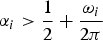 ${\alpha _i} \gt \displaystyle{1 \over 2} + \displaystyle{{{\omega _i}} \over {2\pi}} $
. For groups wanting to provoke or avoid state response, anticipating the state's propensity to respond forcefully to different tactics is essential.
The state's ability to discriminate between hurting civilians and group members with its forceful response is also crucial to group strategy. The group's equilibrium conditions in Table 1 make clear that when a tactic will provoke forceful response, there is a cut-point on α
i
that determines whether provocation is optimal for the group. If only tactic i is provocative, while tactic j avoids state response, then α
i
must be smaller than the threshold identified in the second row of Table 1, which I denote σ for convenience.Footnote
42
Similarly, if we analyze the group's comparison of tactics i and j when they are both provocative, that is,
 ${\alpha _i} \lt {\alpha _j} + \displaystyle{{({c_i} - {k_i}) - ({c_j} - {k_j})} \over {2\pi}} $
, we see again that there is a cut-point,
 $\sigma = {\alpha _j} + \displaystyle{{({c_i} - {k_i}) - ({c_j} - {k_j})} \over {2\pi}} $
, after which α
i
is too high for provocation using tactic i to be optimal. The upshot is that, all else equal, there will be a cut-point for α
i
after which provocation is not optimal because of the high proportion of damage inflicted on the group's organization and membership.
There are numerous historical examples of terrorist tactics employed as part of a provocation strategy. For instance, fledgling Armenian rebels used a provocation strategy against the Ottomans in the 1890s. Laqueur notes that “since they could not possibly hope to overthrow the government, their strategy had to be based on provocation. They assumed that their attacks on the Turks would provoke savage retaliation, and that as a result the Armenian population would be radicalized.”Footnote 43 Indeed, the Program of the Armenian Revolutionary Foundation, drafted in an 1892 meeting at Tiflis, stated that rebels were “to stimulate fighting and to terrorize government officials.”Footnote 44 The Armenian rebels chose to attack civilians connected to the Ottoman state in the expectation that state forces would mercilessly respond and impose a high proportion of collateral civilian damage. E3A summarizes the idea that terrorist tactics are connected to a strategy of provocation. The expectation applies when provocation is an optimal strategy for the group, meaning that α t is less than the relevant cut-point identified in the last column of Table 1.
E3A
All else equal, if terrorist tactics are more provocative, meaning α t > α g , the probability of a terrorist attack is greater than the probability of a guerrilla attack until a specific threshold of state-caused damage hurts the group, or α t = σ.
The idea that guerrilla tactics are effective in provoking a forceful state response also finds numerous instances of support in the historical record. In a study of the repression of political movements in nineteenth-century Europe, Goldstein notes that states employing more forceful responses to attacks on their forces also subsequently experienced more violent groups.Footnote 45 The violent responses were seen as a means to force the state to disrupt citizens' daily lives and foster sympathy for the group. Similarly, in post–World War II Germany and Italy the state's propensity to forcefully respond to attacks on its security forces were explicitly used as reason to target them. Thus, forceful police responses such as the one in West Berlin that led to the death of activist Benno Ohnesorg in 1967 helped make more activists amenable to the use of violence. The public outcry over Ohnesorg's death (and over numerous others being injured) demonstrated the effectiveness of this strategy in discrediting the state. In fact, the Brazilian Marxist revolutionary Carlos Marighella explicitly advocated targeting government forces to provoke a draconian response. He argued that following guerrilla attacks “the government has no alternative except to intensify repression. The police networks, house searches, arrests of innocent people and of suspects, closing off streets, make life in the city unbearable.”Footnote 46
E3B summarizes the idea that guerrilla attacks are the preferred tactic in a strategy of provocation. Analogous to E3A, E3B applies when provocation via guerrilla attack is an optimal strategy for the group, meaning that α g is less than the relevant cut-point identified in the last column of Table 1.
E3B
All else equal, if guerrilla tactics are more provocative, meaning α g > α t , the probability of a guerrilla attack is greater than for a terrorist attack until a specific threshold of state-caused damage hurts the group, or α g = σ.
Two things must be true to observe provocation. First, the state must find the use of a forceful response to be optimal for at least one tactic. Second, the group must be able to absorb the costs to its membership of a forceful response. In other words, the state must not be so accurate that too large a proportion of the damage from forceful response afflicts group members, that is, α
i
< σ. For these points to be satisfied it must be true that
 ${\alpha _i} \in \left( {\displaystyle{1 \over 2} + \displaystyle{{{\omega _i}} \over {2\pi}}, \sigma} \right)$
, where σ is the relevant cut-point for the group in the last column of Table 1.
On the other hand, if the state's level of precision is too high for a provocative tactic, that is, α i > σ, then provocation is never an optimal strategy. If this is the case, the group will be significantly less likely to employ a provocative tactic. Thus, if guerrilla attacks are provocative and terrorist attacks are not, all else equal, the group will always be less likely to use guerrilla tactics relative to terrorist tactics or not attacking. Consequently, neither E3A nor E3B will find support. The following expectation summarizes the possibility that provocation is never an optimal strategy.
E4
If the state's level of precision in targeting group members with a forceful response is too high for both tactics, meaning that σ < α g , α t , a strategy of provocation is never optimal.
An Empirical Approach
I derive a statistical model that includes the group's choice to refrain from attack, to carry out an attack against civilians, or to carry out an attack against state forces, and the model also includes the state's choice to respond with force or not to either an attack against civilians or its own security forces. Given that the theory and all of its predictions presume that violent groups choose tactics strategically, a model with the same strategic structure as the theoretical model allows unbiased estimation of group and state utilities.Footnote 47 Furthermore, by explicitly modeling how group tactical choice strategically anticipates state response, I am able to deal with endogeneity problems in analyzing group tactical choice that result from strategic interaction.Footnote 48
In the theoretical model depicted in Figure 1, both the state and the group make no errors in their decision making, an assumption that I relax to make the theoretical model a statistical model. Specifically, in the statistical model I make the plausible assumption that both the group and the state are boundedly rational.Footnote 49 That is, for each possible choice in the game they randomly err in making the optimal choice. Given a probability distribution for the error terms, I derive a variant of the quantal response equilibrium (QRE) solution concept. The subgame perfect equilibrium solution concept used to solve the theoretical model is a special case of the QRE in which neither the state nor the group make errors.Footnote 50 Thus, although the empirical model is structurally consistent with the theoretical model, it is also more general because it accommodates the idea that groups and states at times make decision-making errors.Footnote 51
I outline the logic behind the statistical model by first deriving the equations used to estimate the state's choice probabilities and then those for the group's choice probabilities. Both the state and the group compare the expected utility of each possible choice in the game and make the optimal choice (with error). The state has two possible choices in the game. First, if the group carries out a terrorist attack, the state decides whether to forcefully respond or not. Similarly, the state also decides to forcefully respond or not following a guerrilla attack. Suppose that in observation i, the group carries out a terrorist attack; then, the probability the state forcefully responds depends on a comparison of the expected utilities for forceful responding, denoted F, and not forceful responding, denoted ¬F:Footnote 52
 $${\,p_{i,4}} = Pr[{U_S}(Terror\;F) + {{\epsilon} _4} \gt {U_S}(Terror\;\neg F) + {{\epsilon} _3}].$$
If the group carries out a guerrilla attack, the probability the state responds forcefully or not to a guerrilla attack is analogously written as follows:
 $${\,p_{i,6}} = Pr[{U_S}(Guer\;F) + {{\epsilon} _6} \gt {U_S}(Guer\;\neg F) + {{\epsilon} _5}].$$
As is central to the theory undergirding this study, the group strategically anticipates expected government response in deciding to carry out an attack against civilians, against government security forces, or to refrain from attack. Thus, the group makes an expected utility calculation that incorporates the probability the government will respond with force to either tactic. For instance, the probability it carries out a terrorist attack is written as:
 $$\eqalign{{\,p_{i,1}} =& Pr[{U_V}(Terror\;F) \ast {\,p_{i,4}} + {U_V}(Terror\;\neg F)*{\,p_{i,3}} + {{\epsilon} _1} \cr &\gt}$$
 $$\eqalign{& \max \{ {U_V}(Guer\;F) \ast {\,p_{i,6}} \cr & \quad + {U_V}(Guer\;\neg F)*{\,p_{i,5}} + {{\epsilon} _2},\;{U_V}(\neg \;Attack) + {{\epsilon} _0}\} ].}$$
Thus, the probability the group attacks civilians, or p i,1, depends on comparing its expected utility for a terrorist attack (expression 3) with both its expected utility for a guerrilla attack and its utility for not carrying out an attack (expression 4). The expected utilities incorporate both the group's utility for each outcome, for example, U V (Terror F), and the probability the state will respond such that the outcome is realized, for example, p i,4. The probabilities that the group chooses to carry out a guerrilla attack (p i,2) or to refrain from attack (p i,0) are defined analogously.
I do two things to make statistical estimation of these choice probabilities possible. First, I specify the group and state utilities over outcomes, for example, U V (Terror F), with substantive regressors.Footnote 53 Figure 3 shows how the players' utilities are specified with regressors in the game. I normalize the group's utility for not carrying out an attack to 0, and also normalize the state's utilities for not forcefully responding to an attack to 0.Footnote 54 This aids in identification of the model and also ensures that the coefficients in the group's utilities are interpreted relative to no attack, whereas the coefficients in the state's utilities are interpreted relative to if it had not forcefully responded to an attack.
The strategic attacks game

Second, I specify a probability distribution for the error terms that yields a probability model. I assume that the error terms, ε ij , are independently and identically distributed Type 1 Extreme Value, which yields the widely used logit probability expressions.Footnote 55 Thus, the probability the government responds with force to a terrorist attack, that is, p i,4, is estimated with the following equation:
 $${\,p_4} = \displaystyle{{{e^{{X_{24}}{\beta _{24}}}}} \over {1 + {e^{{X_{24}}{\beta _{24}}}}}},$$
 $${\,p_3} = 1 - {\,p_4}.$$
Equation (5) indicates that a logit model can be used to estimate the probability the state forcefully responds to the group's attack. The probability the state responds with force or not following a guerrilla attack, p 6, is analogously defined.
The group's choice of tactics is more complicated because it is conditioned on the expected reaction of the state. Given the same distributional assumptions as in equations (5) and (6), the probabilities the group chooses to directly attack the state via guerrilla tactics, p 2, chooses to attack civilians, p 1, or chooses to refrain from attacking, p 0, are as follows:
 $${\,p_2} = \displaystyle{{{e^{({\,p_5}{Z_{15}}{\gamma _{15}} + {\,p_6}{Z_{16}}{\gamma _{16}})}}} \over {1 + {e^{({\,p_3}{Z_{13}}{\gamma _{13}} + {\,p_4}{Z_{14}}{\gamma _{14}})}} + {e^{({\,p_5}{Z_{15}}{\gamma _{15}} + {\,p_6}{Z_{16}}{\gamma _{16}})}}}}$$
 $${\,p_1} = \displaystyle{{{e^{({\,p_3}{Z_{13}}{\gamma _{13}} + {\,p_4}{Z_{14}}{\gamma _{14}})}}} \over {1 + {e^{({\,p_3}{Z_{13}}{\gamma _{13}} + {\,p_4}{Z_{14}}{\gamma _{14}})}} + {e^{({\,p_5}{Z_{15}}{\gamma _{15}} + {\,p_6}{Z_{16}}{\gamma _{16}})}}}}$$
 $${\,p_0} = 1 - {\,p_2} - {\,p_1}.$$
The probability the state responds to a particular tactic with force or not is estimated as outlined earlier. For example, the probability the state responds with force to a terrorist attack, that is, p 4, is estimated using equation (5). This builds a (game-theoretic) probability model with boundedly rational players.
Given that I can now estimate the state's and group's choice probabilities, I construct a log-likelihood function to maximize. I use data on the observed actions of the group and state to create variables, d i,j , that indicate for each observation i = 1…n (which outcome is reached in the model), where the possible outcomes are j ∈ {0, 3, 4, 5, 6}.Footnote 56
 $$\eqalign{ln(L) & = \sum\limits_{i = 1}^n \;{d_{i,0}}ln({\,p_{i,0}}) + {d_{i,3}}ln({\,p_{i,3}}) + {d_{i,4}}ln({\,p_{i,4}}) \cr & \quad + {d_{i,5}}ln({\,p_{i,5}}) + {d_{i,6}}ln({\,p_{i,6}}).}$$
The log-likelihood is estimated in three steps via statistical backward induction (SBI). First, I estimate a model for the state's response to an attack on civilians, that is, equation (5). Second, I estimate a model for the state's response to an attack on its security forces. Finally, I estimate a model of the group's choice of tactics conditional on the expected state response, that is, equations (7) and (8), using the probability estimates, that is, p i,3 − p i,6, from the first two stages to account for government response. Bas, Signorino, and Walker demonstrate that a method of statistical backward induction (SBI) works well in the estimation of this type of discrete choice game.Footnote 57 Although the SBI technique is employed by separately estimating the appropriate equation for each possible decision in the game rather than simultaneously estimating the full system of equations, this does not at all change the underlying probability model. Assurance of concave likelihood functions and ease of estimation are among the advantages of SBI over simultaneous estimation of the full system of recursive equations. One known issue with the SBI technique that affects the strategic attacks game is that the standard errors for any estimates at stages prior to the final move in the game are biased downward. The bias results from treating the estimated probabilities as fixed data when they are estimated with error. In our context, this suggests that the standard errors for the group's utilities are biased if left uncorrected. Following Bas, Signorino, and Walker, I bootstrap to correct the standard errors.
Data
I utilize data from the Terrorism in Western Europe Event Data (TWEED) project.Footnote 58 The data include all violent attacks carried out by a domestically based group that occurred in Western Europe from 1950 to 2004. Importantly, it includes attacks on civilians and attacks on state forces, and it contains detailed information on state response to each attack. The unit of analysis is the attack where for each attack a group decides whether to target civilians or to target state security forces. This formulation is consistent with the observation that many groups mix terrorist and guerrilla tactics—a group can choose to attack civilians today and target state security forces subsequently. Focusing on attacks by domestic groups is an important strength given that forceful state response is generally more complicated for groups whose primary bases are on foreign soil.Footnote 59 The TWEED data provide unusually good temporal coverage, which allows for variation within countries on key variables. Given the theoretical focus on democratic countries, I include only the approximately 95 percent of observations where a country is democratic.Footnote 60
The focus on Western Europe has several important advantages. First, Western Europe experienced a significant amount of political violence, especially from the 1960s to 1980s.Footnote 61 Second, the vast majority of states in post–World War II Western Europe are democratic, which suggests that both provocation and avoidance hypotheses are plausible, considering such states cannot easily carry out maximally brutal strategies but remain susceptible to public pressure to respond forcefully. More specifically, during the period of study a number of Western European countries, such as West Germany, France, Spain, the United Kingdom, and Italy, passed legislation that granted far greater repressive powers to their security forces to deal with terrorism and also created antiterrorist assault forces to forcefully target groups. The special antiterrorist assault forces created during the 1960s and 1970s represented a departure from the principle of “minimum force” to an overriding concern to sustain “minimum losses” to their own personnel. Chalk notes that militarily trained units, such as Germany's GSG-9, in practicing the principle of “minimum losses” in effect began to resemble units using “maximum force.” In other words, the key states in question are relatively constrained democracies that empowered their security forces to deal forcefully with groups. Finally, the focus on a specific region with a relatively high level of homogeneity in potentially important factors such as regime type or state capacity makes the “all else equal” statements much more plausible in the empirical model. In sum, Western Europe of the post–World War II era has the key characteristics necessary, is perhaps even ideal given our theoretical focus, and affords important inferential advantages relative to a more heterogeneous cross-national sample.
Dependent Variables
The model depicted in Figure 3 has three dependent variables. The first indicates the group's choice of tactics, whereas the second and third indicate whether the state responds forcefully to attacks on civilians or state forces, respectively. I first describe the variable that indicates the group's choice of tactics, then discuss the coding of the state's response.
Identification of whether a group attack targets civilians or state security forces is quite straightforward because the TWEED data identify the intended target of the group's attack. I code an attack target as state security forces if the group targets either military or police forces. Otherwise, I code an attack as targeting civilians. Identifying nonattacks is potentially difficult because the TWEED data identify only attacks. I use information drawn from the TWEED data on the number of active violent groups in a country to generate observations in which no-attack was chosen by a group. I count a group as being active after it has carried out an attack.Footnote 62 I use the number of active groups to generate two types of nonattack observations. First, in country-years in which no attacks take place, each active group makes one nonattack decision. Second, in country-years in which attacks are observed, I generate a nonattack observation for each active group that does not carry out an attack. This generates 6,073 nonattack observations.Footnote 63
Three pieces of information are necessary to construct dependent variables that indicate state response to an attack. First, I need information on whether the state reacted directly to a given attack or not. Given the structure of interaction the model assumes, it is essential not to treat state actions that are not directly related to a given attack as responses to that attack simply because the timing of the attack and response coincides. The data distinguish between general state reactions to attacks that are independent of an individual attack and state actions that are a direct and immediate response to a particular attack.Footnote 64 Second, a forceful response requires action by either the state's military, police, or secret services. Thus, I do not consider reactions from nonsecurity departments such as the judiciary as forceful responses. Third, the data distinguish between “information reactions” (for example, public pronouncements) and physical force. To ensure that the dependent variable does not include pronouncements as forceful responses, I exclude information reactions and include only responses that entail physical uses of force.
In the modal outcome, the group carries out an attack against civilians and the state does not respond forcefully. Although guerrilla attacks against state forces are less prevalent than terrorist attacks, forceful responses are much more common in response to guerrilla attacks.
Empirical Specification of Utilities
I specify group and state utilities with regressors that measure variables of importance to the theoretical model. I first discuss the specification of the state's utilities and then discuss the group's utilities, which are depicted in Figure 3.
Specification of State Utilities
I outline here the empirical specification of the state's utilities, Xβ, where X are the variables and β are the estimated coefficients. Given that the X are treated as fixed data, when I multiply X by the estimated coefficients β I obtain the values of each of the parameters in the model. The state has four utilities:
 $${X_{23}} = - {c_t}$$
 $${X_{24}} = {\alpha _t}\pi - (1 - {\alpha _t})\pi - {c_t} - {\omega _t}$$
 $${X_{25}} = - {c_g}$$
 $${X_{26}} = {\alpha _g}\pi - (1 - {\alpha _g})\pi - {c_g} - {\omega _g}.$$
I normalize both the state's utility when a terrorist attack is not responded to with force, X 23, and its utility when a guerrilla attack is not responded to forcefully, X 25, to 0. This is justified by the fact that both of these utilities contain only the −c i terms in the theoretical model, which cancel out of these two utilities because they are also contained in X 24 and X 26, the state's utilities when it forcefully responds to either tactic.Footnote 65 In what follows, I outline the measurement of each of the parameters in X 24 and X 26.
In the theoretical model, π denotes the overall damage that results from a forceful state response, whereas α i indicates the proportion of π that targets group members following a forceful response to tactic i. In the state's utility functions for forceful response to either a terrorist or guerrilla attack, α i π represents the benefits of forceful response because it measures the number of violent group members that are correctly targeted. In contrast, (1 − α i )π represents the costs of forceful response to either tactic for the state because it measures the number of civilians that are incorrectly targeted. In the tables and figures, I also refer to α i π as State-Caused Group Damage, whereas (1 − α i )π is referred to as State-Caused Civilian Damage. To keep things consistent with the theory, I distinguish between state-caused group damage that follows a terrorist attack α t π and state-caused group damage that follows a guerrilla attack α g π. The same distinction is made between (1 − α t )π and (1 − α g )π in the measurement of state-caused civilian damage.
I operationalize α t π, or State-Caused Group Damage, measuring the number of group member deaths, injuries, and arrests that lead to convictions resulting from the government's forceful response to a terrorist attack. Similarly, (1 − α t )π, or State-Caused Civilian Damage, measures the number of civilian casualties, injuries, and arrests that do not lead to conviction directly resulting from the government's forceful response to a terrorist attack. The variables α g π and (1 − α g )π are measured analogously following guerrilla attacks. Forceful responses by the state that lead to civilian deaths and injuries are obviously harmful to the government. Wrongful arrests are also a harmful form of collateral damage to civilians. Jamieson notes the role that wrongful arrests played in the Italian state's battle with left-wing terrorists.Footnote 66 In response to an “unprecedented series of attacks” carried out by the Red Brigades (BR) in March 1978, “unprepared and unable to identify the sources of spiraling violence, the forces of law and order reacted in an ad hoc, spasmodic fashion, making numerous arrests only to release suspects for lack of evidence.”Footnote 67 This response made the state look incompetent and added to the grievances of individuals who were plausible BR supporters.Footnote 68 Both variables are coded using information in the TWEED data on each forceful state response.Footnote 69
There are two potential issues with the State-Caused Group Damage and State-Caused Civilian Damage variables. First, including the raw damage variables in group and state utilities suggests that both players precisely know the implications of a government response that has not yet occurred. However, it is more likely that both the state and group know the government's ability to effectively target group members in response to an attack via prior experience with forceful response. Accordingly, I measure both State-Caused Group Damage and State-Caused Civilian Damage using the damage that resulted from the state's prior forceful response to the given tactic. Thus, for each attack in the data, the damage from state response is measured as the damage from the prior event.Footnote 70 Second, because both variables are right-skewed, I include the natural log of both variables.
In contrast to the measurement of α i π and (1 − α i )π, where individual variables that measure state-caused group casualties and state-caused civilian casualties respectively were constructed, here I use several variables to measure ω i . I measure the parameter ω i , or the cost of forceful response for the state, as the sum of five variables. Specifically, ω i is a function of whether the identity of the attacking group is known or not, whether the stated goals of a known group are territorial or not, the left-right ideological orientation of the government in charge of the state, the logged gross domestic product (GDP) per capita of the state, that is, state capacity, and the months since the state last responded with force to the same tactic. The five variables that make up ω i are not measured distinctly across tactics, with the exception of Time Since Last Response. However, the empirical model identifies how each variable distinctly affects the costs of forceful response to each tactic because the state's decision to forcefully respond to a tactic, for example, terrorism, is conditioned on having experienced a terrorist attack. Thus, the effect of a variable such as Unknown Group on the state's propensity to respond with force to a terrorist attack is identified relative to the population of terrorist attacks in the sample, whereas the effect of Unknown Group on the state's propensity to respond to a guerrilla attack is identified relative to the guerrilla attacks in the sample. Consequently, for each attack, the influence of a variable on the state's propensity to respond forcefully is identified relative to its within-tactic mean, which allows us to effectively measure the components of ω i distinctly across tactics.
The costs of responding forcefully for the state are higher when the attacking group's identity is not known relative to when the responsible group is known. If the identity of the group is not known, which often indicates “one-hit wonders” or loner attacks, the costs of responding with force are often prohibitive because the state cannot effectively target an unknown group. For 75 percent of the attacks in the data, the group is identified. Groups often self-identify when they explicitly take credit for an attack, or alternatively when their methods are well known enough to identify their attacks. Whether a group has territorial goals or not also affects the state's costs of responding with force. Given that territorial groups contest a specific piece of land, it is possibly less costly to use force against them because their location is better known, for example, Corsican separatists in France.Footnote 71 Alternatively, it is plausible that territorial groups with separatist goals are more costly to target because they are more likely to be based among like-minded individuals in the region they claim. Accordingly, I code a variable that indicates whether a group has territorial goals or not, where groups that have irredentist or separatist goals are coded as territorial, and all other groups are not territorial.
It is plausible that both Unknown Group and Territorial Goals not only affect ω i but are also relevant to the state accuracy, that is, the state-caused damage variables. In short, if a group's identity is unknown, this affects the state's accuracy, or α i , and whether a group claims a specific region or piece of territory also likely affects state accuracy. Including Unknown Group and Territorial Goals captures this because both of these variables are essentially fixed effects for these two group characteristics. Accordingly, inclusion of Unknown Group in the state's utilities for forceful response ensures that the state identifies variation in the other variables, for example, State-Caused Group Damage and State-Caused Civilian Damage, relative to the mean within the sample of known or unknown groups. The same is true for groups with territorial goals.Footnote 72
Second, the government's ideological orientation and the political orientation of its supporters, or winning coalition, should affect the costs (and political pressure) of responding to an attack forcefully. The extant literature suggests that it is less costly for right-wing governments to respond with force to violent attacks relative to left-wing governments. Right-wing governments' winning coalitions are generally composed of individuals with more “hawkish” views who place higher value on crushing violent groups.Footnote 73 To measure the government's left-right orientation and assess these possibilities, I use the measure developed by Kim and Fording that is continuous and takes into account both the ideology of the party (or parties) in power and the relative share of cabinet posts each party occupies.Footnote 74 Kim and Fording measure party ideology by coding the content of party manifestos on a left-right scale. I scale the measure so that 0 indicates a fully left-leaning government, and 1 indicates a fully right-leaning government. Thus, as the government ideology variable increases, the relevant government is increasingly right-wing.
I also include a measure of GDP per capita as a proxy specifically for a state's fiscal constraints and more generally for a state's capacity to respond to violent groups.Footnote 75 Thus I include the logged GDP per capita in thousands of constant US dollars to capture the idea that it is more costly for less wealthy countries to deal with political violence.Footnote 76 Despite the fact that the sample includes only Western European democracies, there is variation—the minimum GDP per capita is $3,256, the maximum is $33,720, and the mean is $15,560. Finally, I also include the time since the state last responded forcefully to each tactic. If the state recently responded forcefully to an attack, this should make it less costly to respond forcefully again because police or military forces have recently carried out a similar operation.
In sum, taking into account the different variables that affect ω i , or the costs of responding with force to an attack, I write ω i as
 $$\eqalign{{\omega _i} & = Unknown\;{Group_i} + Territorial\;Goal{s_i} + Govt\;Ideolog{y_i} \cr & \quad + lnGD{P_{\,p{c_i}}} + Time\;Since\;Last\;Respons{e_i}.}$$
It is highly likely that each of these five variables have effects of different magnitude on ω i . Accordingly, I include them as separate variables and estimate each of their effects on the probability the state responds to an attack with force separately as well.
Specification of Violent Group Utilities
To specify the violent group's utilities, Zγ, Z are the variables and γ are the estimated coefficients. The group utilities that have to be estimated are as follows:
 $${Z_{13}} = {c_t} - {k_t}$$
 $${Z_{14}} = {c_t} - {k_t} - {\alpha _t}\pi + (1 - {\alpha _t})\pi $$
 $${Z_{15}} = {c_g} - {k_g}$$
 $${Z_{16}} = {c_g} - {k_g} - {\alpha _g}\pi + (1 - {\alpha _g})\pi. $$
I normalize the utility for not carrying out an attack to 0, because this is consistent with the theoretical model.Footnote 77
My measurement strategy for α i π and (1 − α i )π is the same as in state utilities. Thus, I include the same two variables, State-Caused Group Damage (α i π), which measures the level of damage inflicted on group members and State-Caused Civilian Damage ((1 − α i )π), which measures the level of damage inflicted on the civilian population. I include both of these variables in the group's utility for attacking civilians and eliciting a forceful response, U V (Terror F), and in its utility for attacking state forces and eliciting a forceful response, U V (Guer F).
Measures of the parameters c t and c g are relatively straightforward. First, as a measure of c t , which is termed Group-Caused Civilian Casualties, I measure the natural log of the number of civilians killed or injured by the group's attack.Footnote 78 Second, as a measure of c g , termed Group-Caused State Casualties, I measure the logged number of government members killed or injured by the group's attack.Footnote 79 Including these casualty variables builds on the idea that groups are able to systematically plan the severity of their attacks. Thus I assume that groups are able to choose tactics and calibrate their attack's severity. Given that groups choose both the target and the mode of attack, that is, firebomb, direct fire, and so on, this seems reasonable.Footnote 80 Including group-caused casualties in the group's utilities also helps account for group strength because stronger groups can carry out more severe attacks.
I also include the variable that indicates whether the group has territorial goals or not in the group's utilities for attacking and receiving forceful response. It is quite plausible that guerrilla attacks provide greater payoff to a territorial group because attacks against state forces can facilitate taking control of contested land from the state.Footnote 81 In terms of the model's parameters, this suggests that whether a group has territorial goals can positively affect c g . Given that attacks against civilians do not have much direct relation to territorial control, it is also plausible that groups with territorial goals receive a lower payoff from terrorist attacks, or c t . I include the Territorial Goals variable in the group's utility for carrying out a terrorist attack that receives forceful response, U V (Terror F), its utility for carrying out a guerrilla attack that does not elicit forceful response, U V (Guer ¬F), and in its utility for carrying out a guerrilla attack that receives forceful response, U V (Guer F).
Three variables capture the cost to the group for carrying out an attack, k i in the theoretical model. First, I include a variable that indicates whether the group that carried out the attack is publicly identified. Attacks for which the culprit is not identified are less severe and usually are less costly to carry out. Furthermore, not being identified is a choice—it is relatively easy for a group to claim an attack. I include a variable indicating whether the attacking group is identified in the group's utilities for carrying out either a guerrilla or terrorist attack and experiencing a forceful response as well as the group's utility for carrying out a guerrilla attack that does not elicit forceful response. Additionally, groups that are unknown are typically much weaker than identified groups that often have carried out multiple attacks across time. Thus, Unknown Group serves as a reasonable proxy for group strength.Footnote 82 Second, I include the left-right ideological orientation of the state in the group's utility for carrying out a terrorist attack that receives forceful response, U V (Terror F), its utility for carrying out a guerrilla attack that does not elicit forceful response, U V (Guer ¬F), and in its utility for carrying out a guerrilla attack that receives forceful response, U V (Guer F). Scholars argue that right-wing governments are more costly to attack because they are willing to take measures to enhance security that left-leaning governments do not.Footnote 83 I measure left-right orientation using the data developed by Kim and Fording exactly as described eariler. Finally, I also include the time since the state last forcefully responded to a given tactic in the same utilities as the Unknown Group and Govt Ideology variables. It is plausible that the time since forceful response to a given tactic could either positively or negatively affect the costs of attack. Recent forceful responses (unless α i = 0) deplete group resources and are often accompanied by stricter security measures, which may make attacks more costly. However, recent forceful responses may also strain the state's forces or clarify the state's methods to the group, which can lower the costs of attacks.Footnote 84
In sum, taking into account the different variables that affect k i , or the costs to the violent group of carrying out an attack with tactic i, I write k i as
 $$\eqalign{{k_i} & = Unknown\;{Group_i} + Govt\;Ideolog{y_i} \cr & \quad + Time\;Since\;Last\;Respons{e_i}.}$$
Since each of these variables is bound to have effects of different magnitude on k i , I include them as separate variables and estimate each of their effects on the probability the group carries out an attack using tactic i separately.
Results
Before I discuss the statistical model's estimates, I briefly show some patterns in the raw data to probe the plausibility of the theoretical expectations relative to provocation and avoidance of state response. States are much more likely to respond to guerrilla attacks with force than terrorist attacks: 7 percent of guerrilla attacks elicit forceful response while only 1 percent of terrorist attacks elicit forceful response. The theory I develop suggests that variation in how precisely states can respond explains these differences. Specifically, the logic behind E2B suggests that states are more precise following guerrilla attacks than following terrorist attacks. The raw data are consistent with this logic because the mean proportion of damage the state imposes on groups following guerrilla attacks is 53 percent, whereas the mean proportion of damage the state is able to impose on groups in response to terrorist attacks is only 22 percent.Footnote 85 This suggests that states are not often provoked into forcefully responding to terrorist attacks because their responses tend to mostly harm civilians.
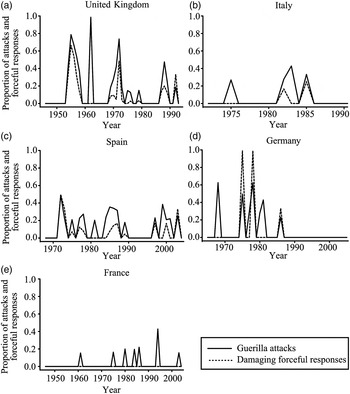
The graphs in Figure 4 further probe the relationship between guerrilla attacks, forceful state response, and collateral damage. I focus on the five countries in the data that experience the most violence: United Kingdom, Germany, Spain, Italy, and France. The graphs for each country show (1) the proportion of attacks that target state security forces across time (the solid black lines) and (2) the proportion of attacks that receive a damaging forceful response (the dotted black lines).Footnote 86 Given what the raw data suggest thus far, I expect to see the two lines track each other across time. In other words, I expect more guerrilla attacks to be accompanied by more state responses that result in some collateral damage. In four out of the five high-violence cases, this is true. In fact, for the UK, Germany, Spain, and Italy, the spikes in guerrilla attacks across time coincide with damaging state responses to a remarkable degree. France is the only exception to the pattern because it rarely responds forcefully to attacks despite a number of years in which guerrilla attacks are prominent.Footnote 87 These results suggest at least two things. First, groups are targeting security forces when the state is responding forcefully to attacks and imposing some civilian damage. Second, the pattern is consistent with all but one of the five high-violence cases. These results rely on raw data, so I further explore patterns with the statistical version of our theoretical model that also controls for other plausible confounding factors.
Guerilla attacks and damaging forceful response: Raw data

State response and group tactics

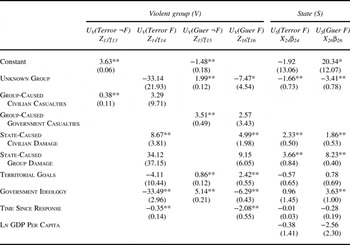
The estimated utilities for the violent group and targeted state appear in Table 2. Each column contains the estimates for either the group's utility for an outcome (that is, columns 1–4) or the state's utility for an outcome (that is, columns 5–6). For example, the first column shows how the regressors affect the group's utility for carrying out an attack against civilians that does not result in a forceful response from the state, or U V (Terror ¬F). In what follows, I first discuss the results for the state and then move on to discuss the group's utilities. Throughout the discussion I refer to predicted probabilities and graphical depictions of the results because the graphs are more straightforward to interpret than raw coefficients.
Results for strategic attacks game

Number of observations = 14,203. Group standard errors are bootstrapped; government standard errors are clustered by country. * indicates significance at 0.10 level; ** indicates significance at 0.05 level.
State Decision to Respond with Force
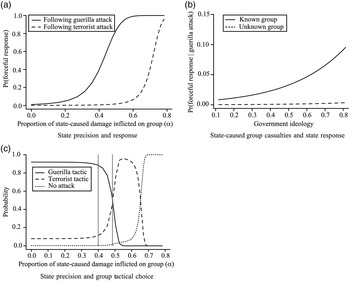
The theory suggests that a state's decision to respond to an attack with force or not depends crucially on its accuracy. Despite the potential downside to forceful response, states make a sensible calculation in responding to violence. This view contrasts with much writing on state response to political violence, which often emphasizes overreaction.Footnote 88 The results corroborate the theory: I find that the probability of forceful response increases in state accuracy and that forceful response to different tactics is nuanced. The graph in Figure 5(a) clearly shows that states are more likely to respond with force when they are better able to target group members, which provides support for E1. The solid black line depicts the probability of a forceful response to an attack on state forces, whereas the dotted line depicts the probability of a forceful response to an attack on civilians. Both probabilities increase sharply after a sizable proportion of the individuals targeted by the state's response are group members, that is, as α i increases. Thus, regardless of tactic, state behavior exhibits the expected relationship between α i and the probability of a forceful response. I next explore which tactic is more likely to provoke a state response.
The raw data analyzed suggest support for the idea that the state is more effective at using force to target group members in response to a guerrilla attack, meaning that E2B finds support. The graph in Figure 5(a) corroborates this. The graph shows that the probability of a forceful state response following a guerrilla attack is uniformly higher than the probability following a terrorist attack. Moreover, the probability of a forceful response to a guerrilla attack increases more quickly in the proportion of damage directed toward group members than the probability of a forceful response to a terrorist attack. In fact, the state's propensity to respond forcefully to a guerrilla attack increases as the percentage of damage that targets group members increases above 35 to 40 percent. In contrast, the probability of a forceful response to a terrorist attack does not start to increase until above 60 percent of the damage targets group members, which is not common in the data. In sum, the results strongly suggest two things. They suggest that the logic of the theoretical model is empirically sound because E1 finds strong support regardless of tactic. The results also provide support for E2B because states are uniformly more likely to respond to guerrilla attacks with force. Of course, an analysis of group behavior is necessary to obtain a full picture.
Figure 5(a) explores how state response to attacks changes as a function of the benefits and costs of forceful response in terms of who is targeted, that is, α i π versus − (1 − α)π. However, the additional costs of forceful response, ω i in the theoretical model, can also affect the state's propensity to use force following an attack. The estimates in Table 2 show that when a group's identity is unknown, this has a significant and negative effect on the probability of a forceful response to either tactic. This is consistent with expectation because Unknown Group is thought to increase ω i . In fact, Unknown Group is the only variable included in ω i that is significant when the state experiences a terrorist attack. All else equal, when the identity of the group behind a terrorist attack is unknown, this decreases the probability of forceful response by more than 80 percent.
The cost of forceful response to a guerrilla attack is significantly influenced by the government's ideological orientation as well as whether a group's identity is known. As governments become more right-wing in their overall composition, the probability they respond with force to attacks on their security forces increases considerably. This is consistent with the idea that the costs of using force are lower for right-wing governments because their winning coalitions are more hawkish. Figure 5(b) shows how the probability the state forcefully responds to a guerrilla attack is affected by both government ideology and whether the group's identity is known. First, the graph shows that the effect of whether the group's identity is known has a large effect on the likelihood of forceful response. When the group's identity is unknown, the probability of forceful response is exceedingly low regardless of the government's ideology. In contrast, when the group's identity is known, meaning ω i is much smaller, the probability of forceful response is much higher and increases with the right-wing orientation of the government. Specifically, when 47 percent of cabinet positions are occupied by right-wing party members, which is the sample mean, the probability of a forceful state response to an attack on security forces is about 0.04. When the government is 65 percent right-wing, which is one standard deviation increase, the probability of a forceful response increases by more than 75 percent. If the government is around 28 percent right-wing, which is one standard deviation decrease, the probability decreases by around 75 percent.
The other variables included to measure ω i are not significant predictors of forceful response. These results suggest that the state's accuracy in responding forcefully to attacks, that is, α i π and (1 − α i )π, are central to state response because these two variables are the most consistent statistically and substantively significant predictors of state response.
Group Tactical Choice and Provocation
The results for state utilities clearly suggest that states respond quite differently to the use of different tactics. The raw data examined in discussing state behavior are consistent with the idea that groups at times use guerrilla tactics to provoke, whereas terrorist tactics are associated with avoiding state response. For example, the plots for four of the five high-violence countries in Figure 4 show that guerrilla attacks closely track damaging state responses. Consistent with the raw data, the results for group utilities suggest that tactical choice is strongly influenced by the expected state response. Furthermore, the results suggest that violent groups can benefit from a harsh state response and that the provocation dynamic is more relevant to guerrilla attacks than to attacks against civilians. Together with the results for the state's utilities, these results complete a coherent and theoretically consistent empirical picture.
Terrorist attacks generally avoid the state rather than provoke it, whereas guerrilla attacks can be part of a provocation strategy. In combination with the results for the state's propensity to respond, the graph in Figure 5(c) provides striking evidence that guerrilla attacks are associated with provoking state response, and terrorist attacks with avoiding state response. On the y axis the graph plots the probabilities the group carries out a guerrilla attack (the solid line), the group carries out a terrorist attack (the dashed line), and the probability the group refrains from attack (the dotted line). The x axis depicts the proportion of damage from the state response that afflicts group members following an attack, α. The graph shows that groups switch tactics as the accuracy of state response changes. At low to moderate levels of state accuracy, the group chooses guerrilla tactics. When the state becomes a little bit more than 50 percent accurate, the group abruptly switches to terrorist tactics. Finally, when the state becomes unusually accurate, targeting more than 60 percent of group members following an attack, the group becomes very likely to refrain from attack.
Figures 5(c) and 5(a) show how these results are consistent with the idea that guerrilla attacks are used to provoke the state. The group is predicted to prefer guerrilla attacks in a subset of the range of α in which forceful response is likely. Specifically, in the range where α is between 0.4 and 0.49, the state is likely to respond forcefully to a guerrilla attack and the group is likely to carry one out. In Figure 5(c), the point at which α is too high for the group for provocation via guerrilla attack to be optimal, that is, α = σ, is approximately 0.5. The gray vertical lines in Figure 5(c) indicate the moderate range of α for which provocation occurs. The graphs provide compelling support for E3B because guerrilla attacks are more provocative than terrorist attacks, that is, Figure 5(a), and the probability of a guerrilla attack is greater than that of a terrorist attack up until a specific threshold where α takes a moderate value. The same pattern is not found for terrorist attacks. Rather, terrorist attacks become likely when α is greater than 0.5 but less than about 0.65. The graph in Figure 5(a) shows that the model predicts the state to forcefully respond to terrorist attacks only when α is almost 0.70. This provides compelling evidence in favor of the idea that terrorist tactics are associated with avoiding state response because the group switches to not attacking at all when the state becomes accurate enough to favor forceful response to terrorist tactics. In sum, guerrilla attacks are consistent with a provocation strategy, whereas terrorist attacks are not. Thus, although E3B finds support, E3A does not.
The graph in Figure 6 nicely illustrates the group's sensitivity to the number of members damaged from a state response. The two horizontal axes vary the number of civilians adversely affected by state response, or (1 − α)π and the number of group members adversely affected by forceful response, or απ, while the vertical axis shows the probability of a guerrilla attack. Focusing first on state-caused civilian casualties, or (1 − α)π, the graph clearly shows that groups are increasingly likely to target state security forces as they face states whose crackdowns damage civilians. Together with the finding that states are more likely to respond to guerrilla attacks with force, that is, support for E2B, these findings suggest that guerrilla tactics are used as part of a provocation strategy, that is, E3B finds further support.
Tactical choice and state-caused civilian casualities

The graph in Figure 6 suggests that groups quite effectively navigate the positive and negative implications of forceful state response. The strong positive effect of state-caused civilian collateral damage on the group's propensity to carry out a guerrilla attack is highly conditional on state-caused group damage. At low and moderate levels of expected group damage, Figure 6 shows that as expected civilian damage increases the probability of a guerrilla attack also sharply increases. Specifically, increasing expected civilian damage significantly increases the probability of a guerrilla attack until the expected number of group casualties is about 3, which corresponds to slightly more than 1 in the graph (which depicts the log number of individuals). However, after the level of group damage increases above this point, the probability of a guerrilla attack plummets. In fact, when the state's forceful response results in a loss of more than a few members of the group, the probability it provocatively attacks state forces is close to 0. This is true regardless of the prior level of civilian collateral damage caused by forceful state response.
The results for the group's utilities provide unique and nuanced evidence of how groups plan attacks in anticipation of state response. The results do not provide much evidence that groups use terrorist tactics to provoke state responses. Rather, terrorist tactics are associated with avoiding forceful state response. However, there is compelling evidence that guerrilla tactics are associated with a strategy of provocation. First, basic patterns in the data suggest that guerrilla tactics are more likely to provoke the government. Furthermore, because the prior state response is associated with higher levels of civilian collateral damage, groups are increasingly likely to employ guerrilla tactics. The increase in a guerrilla attack's probability shown in Figures 5(c) and 6 is striking. However, groups are also very sensitive to losing their own members. Thus, the prospect of provoking a state to generate civilian collateral damage quickly loses its appeal to groups as they themselves face the prospect of serious casualties. All in all, these results provide support for E3B, which together with the support for E2B in the state's utilities provides a coherent overall picture of how group attacks relate to state response and strategies of provocation and avoidance.
Robustness Tests
The results of the strategic attacks model are robust to exploring numerous potential objections. I highlight several of the more important robustness checks here, although the details and results of all robustness checks appear in the online appendix. First, the idea that direct attacks drive the finding that guerrilla attacks are more provocative than terrorist attacks is potentially troublesome. The potential objection is that guerrilla attacks are much more likely than terrorist attacks to involve direct attacks in which group members are physically present at the time of the attack, for example, attacks via direct fire, rocket attacks, or grenade attacks. Second, it is possible that the set of groups that carry out guerrilla attacks is distinct from the set of groups that carry out terrorist attacks. If this is the case, modeling the strategic choice between the two tactics would not make much sense. However, more than 30 percent of groups in the sample employ both guerrilla and terrorist tactics. More than 65 percent of groups in the sample exclusively employ terrorist attacks, while only about 6 percent of groups exclusively employ guerrilla attacks against state security forces. In sum, given that almost a third of groups use a mix of tactics, analyzing a choice between terrorist and guerrilla tactics for groups is merited. Furthermore, the finding that only 6 percent of groups exclusively use guerrilla tactics suggests that the study of guerrilla and insurgent groups in isolation is problematic. Third and relatedly, it is possible that tactical choice is very dependent on group strength in a manner not captured in the main empirical model. I address this by measuring observable group strength as the number of prior attacks carried out by a given group.Footnote 89 Fourth, I address the possibility that the logic of the model does not apply to (very few) groups involved in negotiations with the government. Finally, I estimate several alternative model specifications, including a linear probability model with country fixed effects, to ensure that the results are not too dependent on the specification reported in Table 2. The key results survive all of these robustness checks, which are outlined in detail in the online appendix.
Are Attacks Strategic? Comparing Models
The results in Table 2 provide consistent and compelling evidence that groups strategically choose tactics in a manner that anticipates state response. However, is it really appropriate to assume that terrorist groups plan attacks strategically? Although policy-makers and the bulk of scholars argue that groups are strategic, so far I have not directly tested the assumption that attacks are strategic. The obvious way to do this is to use comparative model testing methods to compare the strategic model in Table 2 with a nonstrategic model of attack.Footnote 90
In this case, I rely on a simple likelihood ratio test, which is a well-known and easy-to-implement test appropriate for nested models. The model of the group's choice of tactic in Table 2 assumes that the group conditions its choice on how it expects the state to react. However, if the group makes a nonstrategic decision I do not need to condition its choice on the state's expected response. Rather, I can just include all of the same substantive regressors included in the group's utilities without conditioning their influence on the probability of response or the probability of nonresponse respectively. This simpler model is nested within the strategic estimator because it is technically the same model with the assumption that the probabilities are constants, for example, equal to 0 or 1. As Clarke notes, two models are nested if the “unrestricted” model can be reduced to the “restricted” model by imposing a set of linear restrictions.Footnote 91 The restriction here states that the probability the state responds forcefully is irrelevant to the group's choice of severity. Comparing the log-likelihoods for the two models suggests that the strategic model of tactical choice is vastly better. The likelihood ratio statistic is far above any statistical threshold with eighteen degrees of freedom (for the eighteen additional parameters in the strategic model). This indicates that the strategic model of attack severity is easily better than the nonstrategic version.
As an additional test, I compare the predictive power of the strategic model of tactical choice and its nonstrategic equivalent. The strategic model correctly predicts 91 percent of group decisions, which is essentially the same as the performance of the full model shown in Table 2. In contrast, the nonstrategic model of groups' tactical choice correctly predicts only 65 percent of observations. This indicates that allowing for the fact that groups anticipate state response improves the predictive power of the model by 40 percent. The strategic model of tactical choice clearly outperforms the simpler nonstrategic model.
Conclusion
The idea that violent substate groups plan their attacks in anticipation of state responses is ubiquitous among scholars and policy-makers. For example, in a description of Basque Homeland and Freedom (ETA) strategy, Zirakzadeh notes that group members “reasoned that selective attacks against government bullies would provoke the government into excessive and nondiscriminatory retaliation against all Basque residents.”Footnote 92 ETA leaders further reasoned that “droves of residents, angered by the state's random violence, would demonstrate tumultuously.”Footnote 93 Of course, states also recognize that groups strategically use violence. The preface of the US government's initial National Strategy for Homeland Security bluntly states that “one fact dominates all homeland security threat assessments: terrorists are strategic actors.”Footnote 94 Despite the importance of the strategic interactions between groups and states in determining groups' tactical choice and states' response to the groups, existing literature has not provided us with direct empirical evidence that groups strategically plan attacks.
This is the first study, to my knowledge, to provide broad and direct empirical evidence that groups strategically plan attacks in anticipation of state response. My analysis uses data on more than five decades of violent attacks and state responses to these attacks in Western European democracies. Western Europe is an ideal region to study how group strategy relates to provocation or avoidance of forceful state response. First, this region of the world experienced a significant amount of substate violence. Chalk notes that Western Europe experienced more terrorism between the 1960s and 1980s than other regions.Footnote 95 Comparing the volume of incidents coded by the Global Terrorism Database (GTD) in Western Europe relative to incidents in the Middle East and North Africa from 1970 to the present corroborates that Europe experienced more terrorism up until the 1990s.Footnote 96 Second, Western European states are overwhelmingly democratic, an advantage given extant theory suggesting that provocation is most plausible in democraciesFootnote 97 and that attacks in democracies avoid harsh state response because of democratic states' constraints on the use of overwhelming force.Footnote 98 Finally, the groups in Western Europe are predominantly urban groups that face significant disadvantages relative to high-capacity states, which makes the findings especially striking. From the standpoint of making credible inferences, the relative homogeneity of Western European democracies in terms of important variables like regime type and state capacity is another advantage.
The evidence presented in this article shows that guerrilla attacks are much more likely to be part of a strategy of provocation, whereas terrorist attacks, which are much more common, are associated with groups' avoidance of forceful state response. I uncover striking evidence that violent groups choose tactics in a way that quite effectively anticipates how precise a potential forceful state response will be in targeting group members. When anticipated damage to group members from a forceful state response is moderately low, groups are increasingly likely to choose provocative guerrilla attacks as the anticipated collateral civilian damage imposed by state forces increases. However, after the group anticipates losing a significant number of members, the propensity to carry out provocative attacks disappears. This study's findings suggest the need for further empirical work on the strategic decisions of violent nonstate groups. Furthermore, the finding that groups' choice to target state security forces or civilians is strategic suggests that it is problematic to study terrorist attacks or guerrilla attacks in isolation, marshaling empirical evidence for a theoretical point made by Bueno de Mesquita.Footnote 99 This is a significant concern because much work in terrorism and civil war literatures seeks to explain why some countries experience more violence than others. Given that groups strategically choose terrorist or guerrilla attacks, it is important to account for groups' tactical choices to understand why some countries might experience more terrorist attacks, but have a significantly fewer guerrilla attacks, or vice versa.
The results also suggest that integration of tactical choice and state response is important to understanding why the high-capacity states of post–World War II Western Europe experienced such high levels of terrorist violence from domestic groups. Despite the noted advantages of focusing on Europe, I acknowledge that the findings for the developed democracies of Western Europe are likely to differ in important ways from conflicts with quite different contexts. Given the findings in this study, I would expect states with lower capacity to respond to experience more direct attacks on their own state forces relative to attacks on civilians. Although data that explicitly link individual group attacks to state responses are currently unavailable for other geographic regions or countries, raw data on the distribution of guerrilla and terrorist attacks suggest that my expectation is plausible. Although there are about 200 percent more terrorist attacks than guerrilla attacks in Western Europe, the patterns are strikingly different in other less-developed and democratic regions. For instance, in the Middle East and North Africa from 1970 to 1990, there are more guerrilla attacks than terrorist attacks.Footnote 100 This pattern is present in other regions such as South Asia as well.Footnote 101 The high volume of terrorist violence in Western Europe by primarily antistate groups is in a sense a product of state success in precisely responding to guerrilla attacks.
Supplementary Material
Supplementary material for this article is available at http://dx.doi.org/10.1017/S0020818315000351.