According to the Ministry of Health (2007), Mexico has over 22 million youth between the ages of 10 and 19, representing 20.6% of the Mexican population. Of these youth, 25.7% of males and 42.2% of females experienced one or more DSM-IV disorders within the last year (Benjet et al., Reference Benjet, Borges, Medina-Mora, Méndez, Fleiz, Rojas and Cruz2009). Unfortunately, few people in Mexico receive mental health services. Although 28.6% of the population sometime in their lives experiences one or more of the 23 mental disorders in the International Classification of Illnesses, only 10–20% receive medical or psychological attention (Medina-Mora et al., Reference Medina-Mora, Borges, Lara, Benjet, Blanco, Fleiz and Aguilar-Gaxiola2003). Even if parents observe symptoms or behaviors that require attention, it is unlikely that adolescents receive professional help. For instance, in a large sample of Mexican parents with children between 4 and 16 years old, half reported symptoms in their children, but only 25% thought health care was necessary and only 13% sought care (Caraveo-Anduaga, Colmenares-Bermúdez, & Martínez-Vélez, Reference Caraveo-Anduaga, Colmenares-Bermúdez and Martínez-Vélez2002). In summary, the mental health needs of Mexican youth receive far less attention than might be beneficial. This is not only a problem in its own right, but it is also unfortunate, because epidemiological studies indicate that many mental health problems begin in adolescence (Benjet et al., Reference Benjet, Borges, Medina-Mora, Méndez, Fleiz, Rojas and Cruz2009; Medina-Mora et al., Reference Medina-Mora, Borges, Lara, Benjet, Blanco, Fleiz and Aguilar-Gaxiola2003), and the mental health trajectory and psychological wellbeing might be improved with intervention at this critical juncture.
The present research focuses on the potential mental health needs and characteristics of angry Mexican youth. Since the recognition of anger problems in adolescents has been poorly studied, we sought to determine if there was a sizable, meaningful group of high anger youth who thought their anger led to problems and wanted help in solving them (i.e., high anger, problem recognizing or HR youth). We then explored anger, anger expression, and aggression characteristics of this group and one set of associated factors that might contribute to their problems (i.e., parental anger). We approached these goals by comparing HR youth to two other groups—high anger youth who reported not having problems due to their anger (HNR) and low anger youth who reported not having anger problems (LNR).
High trait anger is usually associated with negative conditions. Studies of HR and LNR U.S. college students show that HR students have anger triggered by more situations, experience more frequent and intense anger episodes, express their anger in more outward, negative and less controlled ways, engage in more verbally and physically aggressive and antagonistic behavior, and report more frequent and, in some cases, more severe anger consequences (Deffenbacher, Demm, & Brandon, Reference Deffenbacher, Demm and Brandon1986; Deffenbacher et al., Reference Deffenbacher, Oetting, Thwaites, Lynch, Baker, Stark and Eiswerth-Cox1996). A recent study with Mexican college students found similar results (Alcázar, Deffenbacher, Hernández-Guzmán, & Wilson, Reference Alcázar, Deffenbacher, Hernández-Guzmán and Wilson2011). HR students reported (a) less control of behavior when angry, (b) greater anger suppression, (c) greater outward, negative anger expression, and (d) more physical aggression. It is not clear, however, whether findings from older, educationally and in some cases culturally different groups would extend to Mexican youth. Simply, high and low trait angry youth have not been studied with regard to recognition of anger problems. The closest study (Silver, Field, Sanders, & Diego, Reference Silver, Field, Sanders and Diego2000) compared adolescents based on their response to the statement “Sometimes I get so angry that I worry I will become violent.” Those who responded affirmatively to this statement reported less intimacy with parents, greater depression, more marijuana use, less close relationships with siblings, and lower grade point averages. The present study sought to clarify potential characteristics of angry youth who do and do not report anger problems (HR and HNR).
While different factors may influence the development of anger in adolescents (Quigley, Jaycox, McCaffrey, & Marshall, Reference Quigley, Jaycox, McCaffrey and Marshall2006), parental behaviors may directly impact or function as models for adolescent anger (Adams, Reference Adams2007). For example, greater exposure to physical family abusiveness correlated with more overt hostility and likelihood of experiencing anger without a specific provoking situation in undergraduates (Hoglund & Nicholas, Reference Hoglund and Nicholas1995). Similarly, compared to men who did not engage in intimate partner violence, batterers had significantly higher trait anger and witnessed more verbal and physical marital violence in their families of origin (Beasley & Stoltenberg, Reference Beasley and Stoltenberg1992). Moreover, parental trait anger served as a mediator between parental depression and emotional and behavioral problems of adolescents (Renk, Phares, & Epps, Reference Renk, Phares and Epps1999). Based on such findings, we explored differences in perceived parental trait anger as a potential associated factor for anger in youth.
This research also sought to test hypotheses of the State-Trait Anger Theory (Deffenbacher et al., Reference Deffenbacher, Oetting, Thwaites, Lynch, Baker, Stark and Eiswerth-Cox1996; Spielberger, Reference Spielberger1988, Reference Spielberger1999). This theory suggests that, compared to low trait anger individuals, those high in trait anger will become angered by more situations (elicitation hypothesis), respond with more frequent and intense anger (frequency and intensity hypotheses), express anger in more aggressive (aggression hypothesis) and less adaptive, constructive ways (reduced positive coping hypotheses), and experience more frequent and severe anger-related consequences (consequence hypothesis). Although research supports this theory in adults (e.g., Alcázar et al., Reference Alcázar, Deffenbacher, Hernández-Guzmán and Wilson2011; Deffenbacher et al., Reference Deffenbacher, Filetti, Richards, Lynch and Oetting2003; Deffenbacher et al., Reference Deffenbacher, Oetting, Thwaites, Lynch, Baker, Stark and Eiswerth-Cox1996; Spielberger, Reference Spielberger1999), the theory has not been tested with Mexican youth. Present research tested the intensity, reduced positive coping, and aggression hypotheses by comparing high and low anger groups.
Therefore, the present research had four goals. First, it assessed if there was a sizable group of high anger Mexican youth who reported problems from their anger and a desire to solve those problems. This group served as a meaningful analog of youth with problem anger and who might respond to anger reduction interventions if such interventions were available. Second, the study started mapping the anger, anger expression, and aggression characteristics of angry youth who do and do not report anger problems (HR and HNR). These findings not only aid in understanding angry youth, but potentially identify parameters to include in intervention design. Third, it tested three predictions from State-Trait Anger Theory (Deffenbacher et al., Reference Deffenbacher, Oetting, Thwaites, Lynch, Baker, Stark and Eiswerth-Cox1996; Spielberger, Reference Spielberger1988, Reference Spielberger1999), the intensity, reduced positive coping, and aggression hypotheses. Fourth, it assessed parental trait anger as a potential risk/associated factor.
Method
Participants
Groups were drawn from 478 (186 male, 292 female) high school students (M age = 16.09, SD = 0.91) from a Mexican public school (228 first year, 152 second year, and 98 third year students) located in Puebla, in the central region of Mexico. The school is free, and students in Mexican public schools are usually from the lower and middle socioeconomic classes. Of the 478 students, 360 lived with both parents, 97 with the mother, 8 with the father, and 13 participants did not report with whom they lived. Religious affiliation was 82.4% Catholic, 8.4% other, and 9.2% no religious preference.
High and low trait anger groups were defined by the upper (TAS > 22) and lower (TAS < 16) quartiles from the current sample’s distribution on the Trait Anger Scale (TAS) from the Multicultural Latin American Inventory of Anger Expression and Hostility (ML-STAXI) (Moscoso, Reference Moscoso2000; Moscoso & Spielberger, 1999). In response to the question, “Which of the following phrases describes you better?” adolescents chose either (1) I think I have problems because of my anger and I would like to solve them, or (2) I do not have problems because of my anger. Problem recognizers were those who picked the first choice, and problem non-reporters were those who picked the second choice. Combining these criteria led to 99 (17 male, 82 female) HR, 38 (17 male, 21 female) HNR, and 89 (53 male, 36 female) LNR participants. This sample addressed the first three research goals (i.e., size group of high anger students identifying anger problems, beginning to map their characteristics, and evaluating hypotheses from the State-Trait Theory). To investigate the fourth goal (i.e., parental anger characteristics of groups), we sampled students who lived with both parents, which resulted in 78 (12 male, 66 female) HR, 24 (10 male, 14 male) HNR, and 60 (33 male, 27 female) LNR participants. We sampled only students who lived with both parents to assure that they had ongoing contact with both parents and could accurately report their perceptions of parental anger.
Instruments
ML-STAXI/Revised for Mexican Adolescents
The Multicultural Latin American Inventory of Anger Expression and Hostility (ML-STAXI) was developed for adult Spanish speakers in Latin America (Moscoso, Reference Moscoso2000; Moscoso & Spielberger, 1999). Because of linguistic differences across Latin American countries (e.g., the ML-STAXI used the word cólera, which is rarely used to describe anger in Mexico) and because the original ML-STAXI was developed with adults, Alcázar-Olán, Deffenbacher, Pool, Reyes, and Hernández-Guzmán (in press) changed some wording (e.g., use of the word enojo, rather than cólera) and normed the measure on Mexican adolescents. Factor analyses replicated four of the original factors (Alcázar-Olán et al., Reference Alcázar-Olán, Deffenbacher, Pool Cibrián, Reyes Pérez, Hernández-Guzmán, Penrod and Paulkin press), revised others slightly, and emerged a new factor.
The ML-STAXI/Revised for Mexican Adolescents (Alcázar-Olán et al., Reference Alcázar-Olán, Deffenbacher, Pool Cibrián, Reyes Pérez, Hernández-Guzmán, Penrod and Paulkin press) was employed in the current study. Students rated items on a 4-point scale (1 = almost never, 4 = almost always) with regard to how of he/she felt or did the content of the item. Higher scores reflected more of the characteristic assessed. The 5-item Angry Feelings (α = .74) (e.g., feeling furious) and the 5-item Desire to Express Anger Physically and Verbally (α = .85) (e.g., feeling like hitting or insulting someone) assess state reactions or how the person was reacting at the moment, in this case the time when the questionnaire was administered. The 5-item Trait Anger-Temperament (α = .79) (e.g., I am a hotheaded person or I get angry very easily) and 5-item Trait Anger-Reaction (α = .78) (e.g., being furious when criticized in front of others) measure general characteristics existing across time and situations. These two scales can be added into the 10-item Trait Anger Scale (α = .81), providing a measure of general anger or anger proneness. There were five measures of how the person reacts or expresses his/her anger. The 6-item Anger-In scale (α = .63) (e.g., suppressing anger for hours) assesses the tendency to suppress angry feelings and harbor grudges when angry. The 3-item Anger-Out scale (α = .65) (e.g., showing anger to other individuals) measures the tendency to express anger externally to others. The 4-item Anger Control-In scale (α = .78) (e.g., breathing deeply to relax) measures the person’s efforts to manage and reduce angry feelings. The 6-item Anger Control-Out (α = .78) (e.g., controlling the way I act) addresses the person’s efforts to change or modulate his/her behavior in a controlled manner when angry. The 2-item Anger Control-Quick (α = .88) (e.g., reducing anger as soon as possible) assesses the person’s attempts to reduce anger as quickly as possible.
Trait and state measures, anger-out and anger-in are positively correlated with each other and negatively with anger control measures, which correlate positively with each other (Alcázar-Olán et al., Reference Alcázar-Olán, Deffenbacher, Pool Cibrián, Reyes Pérez, Hernández-Guzmán, Penrod and Paulkin press). Correlations between measures tend to be small to moderate, suggesting that measures assess related but somewhat independent constructs.
Questionnaire about Anger Expression with Physical Aggression (QAEPA)
The revised ML-STAXI did not assess expressing anger in physically aggressive ways. The QAEPA was constructed to assess this dimension and assist in the testing of the aggression hypothesis of the State-Trait Theory. The 6-item QAEPA included items involving pushing someone, hitting someone, throwing things at someone, damaging or breaking things, hitting objects (e.g., wall, table), and doing something to hurt one’s own body (e.g., cutting yourself or injuring your own body). In response to the question, “How often, being angry do you…,” participants rated on a 10-point scale how often they engaged in the behavior when angry (1 = I never do it, 10 = I do it 10 times per week). Higher scores reflected greater reported use of that form of physical aggression when angry. Factor analyses of the QAEPA items revealed two scales (see Instrument Development and Evaluation section of Results). The 3-item Physical Aggression toward Others (α = .77) assessed physical anger expression towards people, whereas the 3-item Physical Aggression toward Self and Objects scale (α = .70) measured anger directed toward the participant and objects.
Trait Anger Scale for Parents
The 10-item TAS from the ML-STAXI was adapted to measure how adolescents perceived anger in their parents. The original 4-point rating scale (1 = almost never, 4 = almost always) was retained, and item content was rephrased to refer to the student’s mother or father. For example, “I have an angry mood” was reworded to “My mother has an angry mood,” and “My father has an angry mood.” Factor analyses (see Instrument Development and Evaluation section of Results) replicated the 10-item Trait Anger Scales (αs = .87 and .91 for mothers and fathers, respectively), as well as the 5-item Trait Temperament (αs = .89 and .91) and Trait Reaction (αs = .77 and .86), assessing adolescent’s perceptions of these anger constructs in their parents. Higher scores on each measure reflected higher perceived parental anger.
Procedures
Research was conducted as approved by institutional and school review processes, which deemed parental consent was not necessary because the task was judged free of risk (i.e., completing questionnaires regarding material that was not offensive), responses were anonymous (i.e., no personally identifying information was gathered, only age, gender, and religious affiliation), and participation was completely voluntary (i.e., students could decline or withdraw from participation at any point in time without penalty).
Research assistants administered questionnaires during class. They informed students that the project would take approximately 20 minutes. Directions began with “Your responses are completely anonymous, therefore, please be as honest as possible.” Research assistants read this aloud. Students then completed the instruments in the order in which they are presented in the Instruments section. Pilot testing showed this order is appropriate to make sense to participants as they moved from answering about anger, then anger expression, aggression, and parent’s anger. When all had completed questionnaires, research assistants thanked students and gave them a brochure entitled Phrases to Reduce Anger.
Results
Instrument Development and Evaluation
QAEPA
Because the QAEPA had not been employed with youth, its measurement characteristics were unknown. A principal component analysis with a promax rotation revealed two factors. The first factor involved Physically Aggressive Anger Expression toward People (i.e., push, hit, and throw things at someone) and accounted for 50.57% of the variance. The second 3-item factor involved Physically Aggressive Anger Expression toward Self and Objects (i.e., hurt own body, damage/break things, and hit objects) and accounted for 17.27% of variance (see Instruments for current reliabilities). Physical aggression toward others and toward self/objects correlated positively with each other (r = .47) and, respectively, with State Angry Feelings (rs = .13 and .26), State Desire to Aggress, (rs = .29 and .26), Anger Control-In, (rs = –.04 and –.09), Anger Control-Out (rs = –.18 and –.25), Anger Control-Quick (rs = –.12 and –.19), Anger-In (rs = .17 and .37), and Anger-Out (rs = .21 and .21). Only the correlation between Anger Control-In and physically aggressive anger expression was not significant. Correlations suggested that although aggression measures formed small correlations with measures of anger and anger expression, they were fairly independent of these and added another important dimension to the study. In summary, the two factor structure and the correlations supported the construct validity of the measure to assess the physically aggressive anger expression.
Perceived Trait Anger for Parents
These measures were created for this research, and their psychometric properties were unknown. Because the 10-item Trait Anger scale originally factored into 5-item Trait Temperament and Trait Reaction scales (Moscoso & Spielberger, 1999), conceptual clarity was compared to this structure. Two principal component analyses, one for items for mothers and the other for fathers, showed that the same factors emerged with the same five items in each scale as in the original ML-STAXI (Moscoso & Spielberger, 1999). These results replicated the TAS structure as applied to adolescents’ perceptions of parental trait anger, providing construct validity of the measure. Trait Temperament accounted for 47.88% and 51.17% of variance for mothers and fathers, respectively, and Trait Reaction 14.23% and 12.99% of variance (see Instruments for reliabilities of measures).
Statistical Considerations and Preliminary Analyses
To assess gender distributions overall and within groups, we conducted binomial differences in proportions tests. There were more females than males overall, z = 3.45, p < .01, and in the HR group, z = 6.53, p < .001; HNR and LNR groups did not differ by gender, zs = 0.64 and 1.80. Thus, the overall sample contained disproportionately more females than males, but this appeared primarily due to the HR group.
Most preliminary and primary analyses involved multivariate analyses of variance (MANOVA) and employed Wilks’s λ. Univariate ANOVAs followed significant multivariate effects, and Tukey post hoc tests evaluated significant univariate group and interaction effects. Partial eta squared (η 2 ) served as the measure of effect size and was interpreted within Cohen’s (Reference Cohen1988) criterion in which values from .01 to .04 are considered small, .04 to .14 moderate, and greater than .14 large.
In exploring possible differences in perceived parental anger, we sampled only students who lived with both parents. However, this raised the possibility that they differed in their degree of involvement with parents. To clarify this issue, we used four additional indicators (two associated with mother and two associated with father) about the involvement that participants had with their parents. Questions were: “How often do you have conversations with your mother/father?” and “Usually, how often do your mother/father and you eat together during the week (by ‘eat’ together we mean any of these: breakfast, lunch, or dinner).” A 2 (Living status with both parents or not) x 2 (Gender) MANOVA on these four measures revealed a multivariate effect for living status and gender, λs = 0.80 and 0.97, F(4, 390) = 24.79 and 3.38, p < .001 and .05 η2 = 0.203 and 0.034, but not for the interaction, F(4, 390) = 1.23. Univariate analyses revealed only one significant gender effect on conversations with mother, F(1, 395) = 8.50, p < .01, η2= 0.021, due to young women talking to their mothers more often than young men (M = 4.12 and 3.73).
All univariate living status analyses revealed significant differences. Compared to students not living with both parents, students living with both parents conversed more with their mothers (M = 3.71 and 4.00) and fathers (M = 2.81 and 3.20) and ate together more often with their mothers (M = 3.98 and 4.51) and fathers (M = 1.26 and 3.82), F(1, 395) = 4.31, 7.09, 6.76, and 95.28, p < .05, .05, .05, and .001, η2 = 0.011, 0.018, 0.013, and 0.195, respectively. Living status effect sizes were small, except for the large effect size on eating together with fathers. Those living with both parents reported more contact with parents as reflected by conversing and eating with parents. This greater contact provided a better basis for asking them about their perceptions of parental anger. A 2 (Gender) x 3 (Anger Group) MANOVA on these four variables did not reveal multivariate effects for gender, F(4,161) = 1.35, or group or the interaction, F(8, 322) = 1.52 and 0.80, suggesting that high and low anger groups did not differ on frequency of contact with parents.
Is There a Meaningful Group of High Anger, Problem Recognizing Youth?
High anger youth who reported anger problems and a desire to solve them (HR) comprised 20.7% of the total sample and 72.3% of the high anger youth (i.e., HR and HNR combined). The ratio of HR to HNR students is 2.6 to 1. These findings indicated that HR adolescents were a large group compared to youth overall and to other high anger youth in particular.
Comparison of Anger Groups
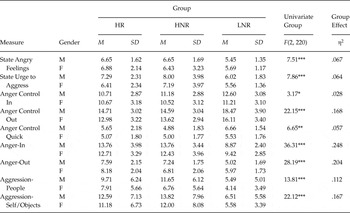
Because HR students constituted a sizable group who are most likely to take advantage of counseling for anger reduction, we compared groups further to see if we could identify characteristics that might differentiate groups and inform intervention design. Because group effects were of primary interest, univariate group effects and effect sizes are summarized in Table 1, whereas univariate gender and interaction effects are in the text.
Anger and Anger Expression as a Function of Gender and Anger Group

Note:
M = Male; F = Female; HR = High anger, recognition of the problem; HNR = High anger, No recognition; and LNR = Low anger, No recognition.
* p < .05; **p < .01; ***p < .001.
State measures (angry feelings and desire to aggress) revealed a moderate multivariate effect for group, λ = 0.90, F(4, 438) = 5.79, p < .001, η2 = 0.050, but not for gender, F(2, 219) = 2.40, or the interaction, F(4, 438) = 0.18. Univariate analyses showed moderate group effects for state angry feelings and urges to aggress (Table 1). HR (M = 6.84) and HNR (M = 6.43) groups did not differ on angry feelings, but reported significantly more angry feelings than the LNR group (M = 5.55). The HNR group reported significantly more desires to aggress (M = 7.66) than the LNR group (M = 5.83), whereas HR (M = 6.57) did not differ significantly from either other group on the desire to aggress physically and verbally.
Anger expression revealed a large multivariate group effect, λ = 0.58, F(10, 432) = 13.70, p < .001, η2 = 0.241, and a moderate multivariate gender effect, λ = 0.946, F(5, 216) = 2.47, p < .05, η2 = 0.054, but no interaction effect, F(10, 432) = 0.97. Only Anger Control-Out demonstrated a significant univariate gender effect, F(1, 240) = 10.06, p < .01, η2 = 0.044. The effect was moderate in size and due to males reporting more behavioral attempts to control their anger than females (M = 16.16 and 14.47). All forms of anger expression yielded significant group effects (Table 1). In terms of anger control, HR (M = 10.68, 13.27, and 5.17) and HNR (M = 10.82, 14.05, and 4.95) groups did not differ from each other, but reported significantly lower tendencies to calm their angry feelings (Anger Control-In), to manage their angry behavior (Anger Control-Out), and to control their anger quickly (Anger Control-Quick) than the LNR group (M = 12.04, 17.52, and 6.20). HR (M = 12.89 and 8.08) and HNR (M = 13.03 and 7.00) groups also did not differ on their tendencies to suppress their anger and harbor grudges (Anger-In) or express their anger (Anger-Out), but reported significantly more of these then the LNR group (M = 9.09 and 5.40).
Reported aggressive anger expression (aggression toward people and toward self/objects) revealed moderate multivariate effects for gender, λ = 0.96, F(2, 219) = 5.13, p < .01, η2 = 0.045, and group, λ = 0.80, F(4, 438) = 12.66, p < .001, η2 = 0.104, but no effect for the interaction, F(4, 438) = 0.79. Only physical aggression toward other people demonstrated a significant univariate gender effect, F(1, 220) = 10.23, p< .01, η2 = 0.044. Males reported more physical aggression towards others than females (M = 7.52 and 6.76), and the effect size was moderate. Both aggression toward others and self/objects revealed significant group effects (Table 1) with moderate and large effects, respectively. HR (M = 8.22 and 11.42) and HNR (M = 8.95 and 12.82) participants did not differ from one another on these variables, but reported significantly more of both types of aggressive anger expression than did the LNR group (M = 4.94 and 6.13).
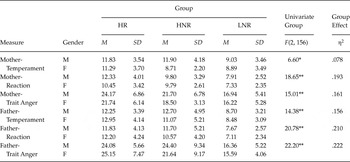
Perceived mother and father anger measures (Table 2) yielded a large multivariate effect for group, λ = 0.71, F(8, 306) = 7.24, p < .001, η2 = 0.159, but no effects for gender, F(4, 153) = .95, or the interaction, F(8, 306) = 1.34. Perceived parental anger measures demonstrated large univariate group effects, except for the moderate effect size on mother Trait Temperament. HR (M = 11.37, 10.74, and 22.12) and HNR (M = 10.04, 9.79, and 19.83) groups did not differ from one another, but reported significantly more perceived Trait Temperament, Trait Reaction, and overall Trait Anger in their mothers than did LNR students (M = 8.97, 7.65, and 16.62). The same pattern emerged for perceived paternal anger. HR (M = 12.85, 12.14, and 24.99) and HNR (M = 11.75, 11.04, and 22.79) students did not differ from each other, but reported significant more Trait Temperament, Trait Reaction, and Trait Anger in their fathers than did the LNR group (M = 8.60, 7.42, and 16.02).
Perceived Parental Anger as a Function of Gender and Anger Group

Note:
M = Male; F = Female; HR = High anger, recognition of the problem; HNR = High anger, No recognition; and LNR = Low anger, No recognition.
* p < .01; **p < .001.
Discussion
This study, like any study, has its limitations. First, all instruments were self-report in nature. Possibly, students biased, consciously or unconsciously, their reports. While this is possible, current findings are consistent with other research (Alcázar et al., Reference Alcázar, Deffenbacher, Hernández-Guzmán and Wilson2011; Deffenbacher et al., Reference Deffenbacher, Oetting, Thwaites, Lynch, Baker, Stark and Eiswerth-Cox1996), suggesting convergence of findings. Moreover, self-report is an appropriate and valid method for assessing internal or hard to observe constructs like anger (Kazdin, Reference Kazdin2003). Future research certainly should employ other methodologies (e.g., collateral reports and archival data such as school records documenting aggressive behavior), but self-report is a valuable approach to understand anger in youth.
A second limitation was the method by which parental anger was assessed. Students reported their perception of their parents’ anger, rather than directly assessing parent anger level. If the adolescent had an unsatisfactory relationship with his/her parent, then he/she might over-report anger or if he/she were afraid of his/her parent, then he/she might under-report anger. It is possible that adolescents reported less anger to project a positive image or to protect their parents. In this research we cannot conclude that parents of high anger students are angrier than parents of low anger students. What we can conclude is that high anger students perceived their parents as angrier than low anger students. Although objective measures should be considered, adolescents’ perceptions of their parents are important because perceptions are valid predictors of the anger that another person has (Kneip et al., Reference Kneip, Delamater, Ismond, Milford, Salvia and Schwartz1993). Moreover, the perceived parenting style is linked to internal and external characteristics including anger and aggression in youth (Yahav, Reference Yahav2007), suggesting a relation between what adolescents perceive in their parents and adolescents’ emotions and behaviors. Therefore, because the self-report of perceptions is a valid tool (Finley, Mira, & Schwartz, Reference Finley, Mira and Schwartz2008), it may be that student perception is as important or more important in understanding the impact of parents as the actual level of parental anger. Additionally, instructions and data collection emphasized the anonymous nature of findings and honesty of responding, which is a strategy to minimize either of these limitations (Kazdin, Reference Kazdin2003).
A third limitation refers to the phrase used to indicate anger problems (i.e., I think I have problems because of my anger and I would like to solve them). Although it is informative about the need of help, it does not translate directly into service utilization and retention, if the treatment were available. A next step would be to study whether the perception of anger problems reflects actual service utilization and retention.
The fourth limitation refers to choosing a non-random sample which reduces generalization of findings. However, the study is a first step in instrument development, initial identification of the characteristics of angry students, and potentially identifying needs for intervention. A next research can employ the instruments with students from multiple schools and assess more actively student interest in anger programs were they available in their school.
Fifth, there were more women than men in the full sample (292 vs 186), in the HR, HNR, and LNR groups (139 vs 87), and in the HR group (82 vs 17), suggesting that women were overrepresented. Not only the proportion of women exceeded in 3 to 1 that of men in the full sample, but the proportion of women was even bigger, of 4.8 to 1, in the HR group. Although this may be a chance finding and more studies should replicate it, other possibilities exist. First, it could be that young women are more aware of their anger and the consequences and therefore more likely to report that their anger is a problem. That would account for greater numbers reporting. Second, it is possible that angry young men are less likely to see their anger as problematic because it gives them “social status” with their peers, underreporting that anger is a problem and therefore fewer in the HR group. Third, in general (and probably also in anger problems) women are more likely to accept psychological help and use psychological services (Drapeau, Boyer, & Lesage, Reference Drapeau, Boyer and Lesage2009). Fourth, some cultural contexts use to see men’s anger as normal and even desirable, and inappropriate in women because it does not correspond with “correct” social rules (Castañeda, Reference Castañeda2007). And fifth, men are usually afraid of stigma if they receive psychological help (Pepin, Segal, & Coolidge, Reference Pepin, Segal and Coolidge2009). These possibilities may form obstacles for men to recognize anger problems, as reflected in the minor number of men versus women in the HR group.
Future studies should replicate whether young women with anger problems are more interested in treatment than men. If it replicates, then researchers could explore the possibilities mentioned above. Because in this research groups were not balanced for gender, it is not possible to draw conclusions of whether gender plays a role in recognizing or not anger problems or in belonging to HR, HNR, and LNR groups. Other studies should equalize groups by gender to assess if it has an impact on recognizing anger problems or being in either group. Nonetheless, a large group of high anger youth, even if young women were overrepresented, identified their anger as a problem with which they would like help.
With regard to anger groups, high anger adolescents who reported that their anger led to problems and who wanted help in solving those problems (HR) comprised 21% of all youth sampled and 72% of high anger youth. That is, HR youth represented over a fifth of all youth and over seven out of 10 high anger youth. Moreover, compared to their low anger peers, these youth reported more angry feelings, urges to verbal and physical aggression, and greater aggression toward other people, objects, and their bodies. They also reported greater anger suppression and less emotionally, behaviorally and rapid controlled anger expression. Thus, they were not only large in numbers, but also high in anger and dysfunctional ways of experiencing and expressing it. In summary, the HR group represents a sizable group of Mexican youth who reported problems and desires for help and who might benefit from anger reduction interventions aimed at lowering anger and dysfunctional forms of anger expression as well as enhancing constructive, controlled forms of anger expression (e.g., Deffenbacher & Alcázar, Reference Deffenbacher, Alcázar, Gullotta and Bloomin press). Additionally, because there were few gender differences, which is consistent with previous studies (Archer, Reference Archer2004), group interventions for Mexican youth might effectively combine both genders. This research also provides additional information on mental health service needs of Mexican youth (Caraveo-Anduaga et al., Reference Caraveo-Anduaga, Colmenares-Bermúdez and Martínez-Vélez2002), because most surveys of potential mental health needs do not address anger-related issues. In summary, a significant portion of high anger youth identified their anger as leading to problems with which they wanted assistance.
Parental anger, at least as perceived by their offspring, also differed for high and low anger youth. High anger youth reported that their fathers demonstrated more anger temperament, reaction and overall trait anger. A similar pattern was found for perceived anger in mothers, but the HNR group did not differ from the LNR group on temperament and overall trait anger. Although these findings need replication, they point to the importance of parent anger as a potential risk factor in the development of anger in adolescents (Adams, Reference Adams2007). Moreover, fathers’ anger accounted for more variance than mothers’ anger, suggesting that fathers may have a bigger impact on adolescents’ anger. Probably fathers have a stronger role for modeling anger and adolescents may stereotype their parents and have a schema that suggests that males (i.e., fathers) express more anger than females (i.e., mothers). Future studies should clarify the differential impact from mother and father on adolescents’ anger.
No student or parental characteristic discriminated between HR and HNR participants. That is, HR and HNR groups looked very much alike on reported anger and forms of anger expression. Neither did they differ on perceived parental anger, suggesting that this factor did not contribute differentially to their anger problems. From the present study, it is not clear what leads some angry youth to report problems and want help and others not to do so. Perhaps, differences lie in variables not assessed in this study. It may be that HR youth respond in more intense and dysfunctional ways which leads to more frequent and/or severe consequences. This, in turn, could lead to a greater awareness of problems. Conversely, the experiences, behaviors, and consequences may be highly similar for HR and HNR youth, but defensive processes lead HNR adolescents not to recognize and report anger problems. Future research should assess a broader array of ways anger is experienced and expressed, the frequency and severity of anger consequences, and qualitative explorations of the experiences and outcomes of HR and HNR youth to understand what determines whether a high anger student reports a problem or not.
Perhaps the lack of differences between the HR and HNR groups led to not finding differences in the perceived parental anger. That is, should clearly different groups exists where the HR individuals show the characteristics that the HNR do not have, then the perceived parental anger or other variables could reveal differences. In addition, the lack of differences between HR and HNR participants could be related to parenting style, involvement or other parenting characteristics. Perhaps authoritative parents promote adolescents who are more willing to admit and discuss their problems because their needs are important, whereas authoritarian parents promote adolescents who ignore or deny their own needs, unwilling to accept help from others and thus unwilling to admit need for help. Involved parenting may lead to more open discussion and acceptance of help whereas uninvolved parenting may lead to a more independent attitude where adolescents believe they have to solve their own problems. Future studies should focus on the parent characteristics leading to admit or not adolescent problems in general, and anger-problems in particular.
Findings generally supported the three hypotheses tested from the State-Trait Theory of Anger (Deffenbacher et al., Reference Deffenbacher, Oetting, Thwaites, Lynch, Baker, Stark and Eiswerth-Cox1996; Spielberger, Reference Spielberger1988, Reference Spielberger1999), and extend them cross-culturally to Mexican adolescents. High anger participants (HR and HNR combined) reported more intense angry feelings (supporting the intensity hypothesis), even in the relatively benign environment of completing questionnaires in their classrooms. Larger differences may have been found had the environment been more frustrating, conflict ridden, or provocative. High anger youth reported more anger-in and less emotionally and behaviorally controlled anger suppression (supporting the reduced positive coping hypothesis) and greater urges toward outward anger expression and more physical aggression directed toward other people, objects and self (supporting the aggression hypothesis). In summary, findings supported the intensity, aggression, and reduced positive coping hypotheses of the State-Trait Theory.
This theory and related research may be useful to identify potential anger related conditions in adolescents’ contexts (e.g., school, family, peer-relationships). For example, the model predicts that compared to low anger adolescents, those with high anger will: 1) experience more intense angry feelings when facing frustrating, provocative or conflict laden situations; 2) keep their anger inwards (anger-in) becoming more likely to harbor grudges and engage in less anger control-in (e.g., breathing deeply) and control-out (e.g., being patient with others); 3) desire to express anger physically (e.g., hitting) and behave aggressively with other people (e.g., beating someone), objects (e.g., punching a wall, slamming a table), and self (e.g., cutting oneself); and 4) experience more frequent and severe anger-related consequences (e.g., be dismissed from school for fighting, losing friends because of anger, feel anxious or depressed because of anger). Thus, high anger in adolescents may have a negative impact in their selves and in those around them.