INTRODUCTION
The number of hospital based palliative care programs has grown appreciably in recent years (Kuehn, 2007). The Center to Advance Palliative Care reports that the number of hospitals with formal in-house palliative care programs grew by 96% from 2000 to 2005 (Kuehn, 2007). Concurrently, 2000 United States Census data reveal that: (1) the vast majority (85%) of United States residents report a preference to die at home, and (2) there has been a 17% decrease in the number of individuals who died in the hospital between 1990 and 2000 (Meier, Reference Meier2006). Therefore, the role and importance of palliative care teams continues to expand throughout the United States.
The primary aim of the multidisciplinary Palliative Care Consultation (PCC) is to relieve patient suffering by improving quality of life for patients with advanced illness and for their families by focusing on symptom management and communication enhancement (Ripamonti & Bruera, Reference Ripamonti and Bruera1997; Bruera, Reference Bruera1997; Portenoy, 1999; Block, Reference Block2001). The palliative care team places great importance on assessing and managing symptoms such as pain, anxiety, depression, insomnia, constipation, and shortness of breath. O'Mahony et al. (Reference O'Mahony, Blank and Zallman2005) identify the most common recommendations made by the palliative consultation service: advance care planning (62%), pain management (53%), symptom management (48%), and discharge planning (46%).
The PCC provides the attending physician with patient management advice, anywhere in the hospital. The consultation serves as a way to bridge palliative knowledge with other medical services in the hospital to minimize suffering and improve quality of life (Weissman, Reference Weissman1997).
Whereas the benefits of hospital-based palliative care are now well documented, each program must develop ways to report outcomes to internal and external audiences. Authors of a recent systematic review of quality indicators for palliative care (Roeline et al., Reference Roeline, Pasman and Brandt2009), concluded that whereas a substantial number of quality indicators for palliative care are available, most have not been described in detail and more detailed methodological specifications are needed to accurately monitor the quality of palliative care.
Present Study
This project evaluates the impact of a hospital-based PCC service utilizing a common practice: the resident mortality review conference. Resident physicians have historically been asked to review the hospital charts of patients who die, and present the cases at a mortality review conference. That process has been used to identify quality issues (such as errors), as well as knowledge deficits and documentation issues (Deis et al., Reference Deis, Smith and Warren2005). Our project attempted to transform this common practice into a methodology for collecting data that could be used as a platform for quality improvement in palliative care. In this review, the residents are asked not only “what didn't we do?” but “what did we do?” to relieve the patient's and family's suffering. The Clinical Practice Guidelines for Quality Palliative Care–National Consensus Project, April, 2004, and the newly published National Quality Forum quality standards (2004) were used as a basis for the chart review tool.
Mortality review data summarize clinical information for all patient deaths in the Department of Medicine at Long Island Jewish (LIJ) Medical Center. LIJ is a 450 bed tertiary care facility that provides care to a diverse group of New York City and Long Island residents. PCCs were provided by a multidisciplinary medical consultation team established in January 2003.
Hypothesis
We hypothesized that the mortality review process could be used to develop a tool to evaluate end-of-life care for patients in the acute care setting. This article presents the results of a review utilizing this tool.
METHOD
The palliative care mortality review process was established in 2006. As part of its quality of care surveillance activities, all in-hospital deaths were reviewed by the mortality committee. This included a structured retrospective chart review by residents as part of their quality improvement activities using an instrument based upon the Clinical Practice Guidelines for Quality Palliative Care (2004). Utilizing this information in a retrospective chart review was approved by the Institutional Review Board at the North Shore LIJ Health System.
The Mortality Review Tool was composed of data elements that were critical to the quality process and relevant to reviews by regulatory agencies such as the Joint Commission and the New York State Department of Health, as well as Consensus Guidelines that would indicate appropriate palliative care (National Quality Forum, 2004; Clinical Practice Guidelines for Quality Palliative Care, 2004). These included documentation of family goals of care discussions, assessment and treatment of pain and other symptoms, and consultation by the palliative care team.
Creation of the Structured Chart Abstraction Tool
The chart abstraction tool was created after a process that defined the minimum documentation for each measurable element of good care (Appendix I). For example, “DNR obtained” might represent the end of a long and complex discussion, but it would not meet the standard for evidence of a family meeting. A project team member then identified six patients who had recently died while under the care of the LIJ Department of Medicine. Four physicians, the Senior Data Analyst, and the Administrative Director of Palliative Care Services independently reviewed each case with the chart abstraction instrument, which includes patient and clinician demographics; diagnoses; patient date of death; use of specialty care and consultations; care planning (e.g., advanced directives, plan-of-care meetings between the patient or family and clinicians); assessments; and clinician actions regarding agitation, constipation, dyspnea, and nausea/vomiting near the end of life. When there was sufficient agreement among the project team, after several modifications, the cases, along with the final versions of the abstraction tool and abstractor's guide, became the six gold standard cases.
Author LE trained the residents using these gold standard cases. Residents were assigned to a regular schedule of chart review for 2 hours every week. Following each session, author LE reviewed the cases and made corrections as necessary, providing feedback to the residents regarding what might have been overlooked or what did not meet the criteria for data element inclusion.
Analytics
Data were entered into a statistical software package for analysis (SAS version 9.1.3, SAS Institute, Cary, NC) and expressed as mean ± SD, percentages, percentiles, and medians. Categorical variables were tested using χ2 or Fisher's exact test as appropriate. Continuous variables were evaluated using t-tests. Non-parametric evaluation included median tests.
RESULTS
Patient data were collected via a standardized chart abstraction tool for 1,135 deaths occurring throughout 2006 and 2007 (N = 590 and 545 deaths, respectively). Approximately 25% of patients who died while under the care of the Department of Medicine consistently received a PCC throughout the 2-year review period.
Patient Demographics and Diagnoses
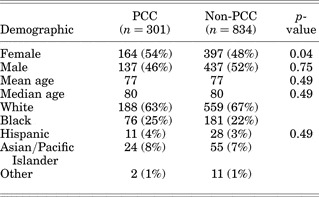
Table 1 shows basic patient demographics for those receiving a PCC prior to death in comparison to those who did not. As can be seen, there was no difference in the age of patients receiving a PCC and those who did not; the mean and median ages of the patients were 77 and 80, respectively. Similarly, the rate of PCCs did not differ significantly by race and ethnicity. However, females were significantly more likely to have received a PCC. Specifically, 55% of females and 48% of males received a PCC (p < 0.04).
Patient demographics for PCC and non-PCC groups

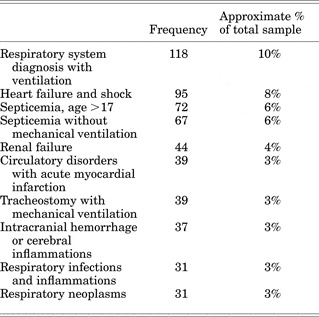
Primary hospital-related terminal conditions, as defined by principal diagnosis related groups (DRGs) discharge data are consistent with conventional clinical end-of -life expectations. Respiratory failure, shock, and sepsis were the most common diagnostic categories for patients who died during this study Table 2 lists the DRGs that constitute roughly 50% of the most frequent principal diagnoses for the terminal hospital stay.
Frequency of PCCs for the top ten most common DRGs

Symptom Assessment
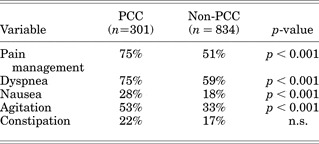
The chart review indicated that the majority of symptoms were addressed at a higher rate for those patients who received a PCC than for those who did not (Table 3). The following symptoms were addressed at a higher rate for patients receiving a PCC: pain (75% vs. 51%, p < 0.001), dyspnea (75% vs. 59%, p < 0.0001), nausea (28% vs. 18%, p < 0.0001), and agitation (53% vs. 33%, p < 0.0001). Symptoms of constipation were addressed for patients receiving a PCC at a higher rate than those who did not receive one (22% vs. 17 %); this difference did not reach statistical significance (p < 0.09).
Symptom management percentage of PCC and non-PCC

Advance Directives (ADs)
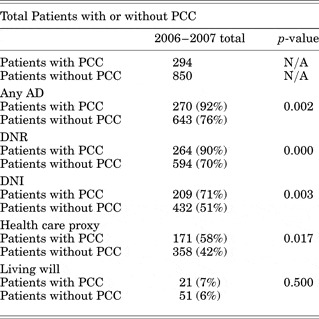
Table 4 presents the frequency and percentages of a documented AD for patients with and without PCCs. There was minimal variation in frequency and distribution of PCCs and AD types across each quarter of the 2-year study period. As can be seen from Table 4, with the exception of the living will, patients who received a PCC were more likely to have a documented AD (i.e., a DNR, DNI, or health care proxy) than those who did not receive a PCC.
Frequency and percentage of PCC and non-PCC with a documented AD

The authors wondered whether the primary team might have requested a PCC primarily to obtain a DNR just prior to death. The data do not support this. First, 81% of the patients had executed an AD prior to the PCC. Second, those patients receiving an AD after the PCC did not differ in terms of median time from PCC to death in comparison to the entire cohort: 10% died within 1 day of the PCC, 25% died within 2 days of the PCC, 50% died within 5 days of the PCC, 75% within 12 days, 90% within 3 weeks, and 95% died within 40 days of the PCC.
DISCUSSION
The mortality review process was found to be a feasible method to assess care delivery for patients at end of life. The chart review tool yielded results consistent with findings of other studies looking at pain and symptom management, advance care planning, and the rate of PCCs across major diagnostic categories.
Rate and Distribution of PCCs
The present study found no differences in the rate of palliative care consults by age and is consistent with findings from Morrison et al. (2008). The present study found that females were significantly more likely to have received a PCC (p < 0.04), consistent with the findings of Perkins et al. (Reference Perkins, Geppert and Gonzales2002) that females are more likely to embrace advance care planning at the end of life, more often delineating when and where they want to die.
Pain and Symptom Control
Patients with a PCC in our study were found to have a higher likelihood of symptom control. Pain symptoms were addressed for patients receiving a PCC at an almost 50% higher rate than those who did not receive one, consistent with findings reported by O'Mahony et al. (Reference O'Mahony, Blank and Zallman2005), Ciemins et al. (Reference Ciemins, Blum and Nunley2007), and Hanson et al. (2008).
In the present study, dyspnea symptoms were also addressed for patients receiving a PCC at a higher rate than those who did not receive one, consistent with findings of Rabow et al. (Reference Rabow, Dibble and Pantilat2004), O'Mahony et al. (Reference O'Mahony, Blank and Zallman2005), Ciemins et al. (Reference Ciemins, Blum and Nunley2007), and Hanson et al. (2008). Similarly, the present study found symptoms of nausea addressed for patients receiving a PCC at a higher rate than those who did not receive one, consistent with the findings of O'Mahony et al. (Reference O'Mahony, Blank and Zallman2005) and Hanson et al. (2008). Finally, symptoms of agitation were addressed for patients receiving a PCC at a higher rate than those who did not receive one, consistent with findings from O'Mahony et al. (Reference O'Mahony, Blank and Zallman2005).
Although symptoms of constipation were addressed for patients receiving a PCC at a higher rate than those who did not receive one (22% vs. 17%), this difference did not reach statistical significance. This trend was consistent with findings from O'Mahony et al. (Reference O'Mahony, Blank and Zallman2005), which specifically reported decreased symptoms of constipation in patients receiving a PCC.
Advance Care Planning
The present study found that patients receiving a PCC were more likely to have a documented AD (either DNR, DNI, or health care proxy) than those who did not receive a PCC, with the exception of the living will. These results, as well as the timing of AD execution, are consistent with previous findings (Morrison et al., 2008).
Summary and Limitations
Because our results supported findings of previous studies examining pain and symptom management and advance care planning, we found the mortality review process with a revised tool to be a feasible method for assessing care delivery for patients at end of life. As an added benefit, it served as an educational forum for Internal Medicine residents, meeting the Accreditation Council in Graduate Medical Education requirements for Practice-Based Learning and Improvement, which require “skills in and the practice of self-evaluation and reflection to engage in habitual planning for quality improvement at the individual practice level.” The chart review process has the potential to promote this kind of self-assessment and reflection under the direction of a palliative care team and faculty.
The process had several limitations, however. There was considerable pressure to use the tool and complete reviews to meet the deadline for the Department of Medicine Quality Committee. Consequently, lead clinical investigators reported that corrections were frequently required, although most were related to administrative elements, such as physical location of death. Perhaps a more structured approach in resident education may have resulted in a more effective educational use of the tool.
Despite these limitations, the process created a platform for quality improvement. and the reports raised awareness that the PCC team, even in its early days, was improving end of life care for patients who died in the hospital. Given that the results of the mortality review process are commonly disseminated to many audiences, our study supports its utilization as a dissemination platform for assessing quality in end of life care, and can contribute to hospital support for a formal palliative medicine service.
ACKNOWLEDGMENTS
The authors acknowledge the support of this study by the United Hospital Fund of New York, UJA-Federation of New York, and the Fan Fox and Leslie R. Samuels Foundation.
APPENDIX I. DEPARTMENT OF MEDICINE RESIDENT MORTALITY REVIEW TOOL
MR#: ___________________ Initials: ______ Admitting Service: ______ ______ __
Adm. Date/Time/Source: ______ ______ ____ Location: ______ ______ ______ ____
Expiration Date/Time: ______ ______ ______ _ Attending/Attg#: ______ ______ ____
ED Admitting Dx: ______ ______ ______ ____ Service at expiration: ______ ______
Med Admitting Dx: ______ ______ ______ ___ Location: ______ ______ ______ ____
Final Diagnosis: ______ ______ ______ _____ Attending/Attg#: ______ ______ _____
Advanced Directives: YES / NO
DNR / DNI / Withdrawal of care Date(s):______ _
Unit Evaluation: YES / NO Admitted: YES / NO Unit: ______ ____
Summary of Case: ______ ______ ______ ______ ______ ______ ______ ______ ______ ______ ______ ______ ______ ______ ______ ______ ______ ______ ______ ______ ______ ______ ______ ______ ______ ______ ______ ______ ______ ______ ______ ______ ______ ______ ______ ______ ______ ______ ______ ______ ______ ______ ______ ______ ______ ______ ____
Consults Requested:
______ ______ ______ ______ ______ ______ ______ ______ ______ ______ ______ ______ ______ ______ ______ ______ ______ ______ ______ ______ ______ ______ ______ __
Evaluation & Conclusions:
______ ______ ______ ______ ______ ______ ______ ______ ______ ______ ______ ______ ______ ______ ______ ______ ______ ______ ______ ______ ______ ______ ______ __
Action: ______ ______ ______ ______ ______ ______ ______ ______ ______ ______ ______ ______ ______ ______ ______ ______ ______ ______ ______ ______ ______ ______ ______ __
Autopsy requested? YES / NO Autopsy performed? YES / NO
Expiration expected based on patients condition at admission? YES / NO
Expiration within 48 hours of invasive procedure? YES / NO
Expiration within 48 hours of transfer in/out ICU? YES / NO
Any significant abnormal diagnostic test or lab not addressed? YES / NO
Any complications noted requiring intervention/treatment? YES / NO
Comments: ______ ______ ______ ______ ______ ______ ______ ______ ______ ______ ______ ______ ______ ______ ______ ______ ______ ______ ______ ______ ______ ______ ______ __
Documentation complete including admission H&P, treatment plan? YES / NO
Communication between attending and HS/PA clearly documented? YES / NO
All entries dated and timed? HS/PA: YES / NO Attending: YES / NO
Unexpected death/major permanent loss of function from health-care acquired infection? YES / NO