Introduction
Mexico is considered a mega diverse country for plant resources (Ramamoorthy et al., Reference Ramamoorthy, Bye, Lot and Fa1993), and perhaps it is the American country with the highest registered endemism in its territory (Villaseñor, Reference Villaseñor2003). Notwithstanding, in temperate fruit crops, there are not enough studies about native underutilized fruits. In this respect, the Rosaceae family in Mexico has 29 genera and around 200 species (Villaseñor, Reference Villaseñor2003), but is not considered one of the most diverse botanical families in Mexico (Villaseñor et al., Reference Villaseñor, Maeda, Rosell and Ortiz2007). Nevertheless, in the study of plant genetic resources, species of the Rosaceae family stand out in Mexico as native temperate fruits (Borys and Leszczyñska-Borys, Reference Borys and Leszczyñska-Borys2001).
The genus Malacomeles represents several fruit shrubs belonging to the family Rosaceae subtribe Pyrinae (formerly subfamily Maloideae), which is distributed in North and Central America, from southern USA to Honduras and Guatemala, although this genus is mainly distributed in Mexico (Phipps et al., Reference Phipps, Robertson, Smith and Rohrer1990; Rzedowski and Calderon de Rzedowski, Reference Rzedowski and Calderón de Rzedowski2005; Turner, Reference Turner2011).
Jones (Reference Jones1945) described Malacomeles as a new genus, but closely related to Amelanchier and Peraphyllum. The main differences between Amelanchier and Malacomeles are that Malacomeles have barely connate carpels, markedly coriaceous leaves, and suborbicular petals (Robertson et al., Reference Robertson, Phipps, Rohrer and Smith1991). Currently, Turner (Reference Turner2011) has rendered a recension of the predominant Mexican genus Malacomeles and recognized five species.
Little information about the uses of species of this genus has been reported. However, recently, Núñez-Colín and Hernández-Martínez (Reference Núñez-Colín and Hernández-Martínez2011) reviewed the uses of Malacomeles denticulata in central Mexico. They reported in a qualitative preliminary test that the Mexican serviceberry (M. denticulata) is tolerant to several environmental conditions such as frost, drought, poor drainage and clay soil conditions with pH between 7 and 8. Moreover, in 2009, the authors found that this species grows naturally in shallow and poor soils, practically on the stones. Furthermore, Núñez-Colín and Hernández-Martínez (Reference Núñez-Colín and Hernández-Martínez2011) also reported that the Mexican serviceberry has vegetative compatibility with apple, making it a probable rootstock of apple and other Rosaceae fruits for poor soils.
On the other hand, alternative berry crops belonging to the Rosaceae family, such as tejocote (Crataegus spp.), mayhaw (Crataegus series Aestivales), saskatoon berry (Amelanchier alnifolia) and other species of the genus Amelanchier native to North America, have a great importance in the USA and Canadian agribusiness and some of them have been incorporated into juices and jams with cranberry and blueberry (genus Vaccinium), either in blends or as a substitute (Payne and Krewer, Reference Payne, Krewer, Janick and Simon1990; Stushnoff, Reference Stushnoff1991; Mazza and Davidson, Reference Mazza, Davidson, Janick and Simon1993; Núñez-Colín, Reference Núñez-Colín2009; Núñez-Colín and Hernández-Martínez, Reference Núñez-Colín and Hernández-Martínez2011). As with the tejocote (Crataegus spp.), Mexican serviceberry has great commercial potential as fresh and processed fruit in Mexico. It has the advantage that it does not have hard endocarps like the tejocote, making it more attractive for processing in juices, syrups and jams (Núñez-Colín, Reference Núñez-Colín2009; Núñez-Colín and Hernández-Martínez, Reference Núñez-Colín and Hernández-Martínez2011).
The five recognized species of Malacomeles are distributed in Mexico (CONABIO, 2011). However, there are not studies about where to collect the germplasm of Malacomeles in Mexico. This study aims to map the diversity and species richness of this genus in order to identify the best regions of Mexico to collect germplasm.
Materials and methods
Passport data of 430 herbarium specimens of the five species of Malacomeles were obtained. All data were provided by means of the Global Network about Biodiversity Information (Red Mundial de Información sobre Biodiversidad, REMIB) of the Mexico's National Commission for Knowledge and Use of the Biodiversity (CONABIO, 2011; Supplementary Table S1, available online only at http://journals.cambridge.org).
The Mexican species considered in this study were M. denticulata (Kunth) Jones (286 passport data), Malacomeles nervosa (Decne) Jones (23 passport data), Malacomeles paniculata (Rehder) Phipps (24 passport data), Malacomeles pringlei (Koehne) Turner (15 passport data) and Malacomeles psilantha (Schneid) Turner (82 passport data).
The observed species richness was calculated based on the number of specimens of different species that are located on each cell in a grid of 1° latitude per 1° longitude. Besides, the Chao estimator of species richness was also calculated, which assumes that all cells in the grid have the same collecting points. This estimator of species richness is a non-parametric method to estimate the number of different classes and was originally proposed to be a lower bound (lower limit of integration). This bound is quite sharp and used as a point estimate, and it has recently been justified under practical assumptions (Shen et al., Reference Shen, Chao and Lin2003). Finally, Brillouin's diversity index was also obtained to estimate potential biodiversity based on the number of specimens and the number of different species on each cell of the grid; this index has the advantage that the measure of diversity is calculated using a fully counted sample, and it is not an estimate measure of an unknown universe; in addition, this index is not greatly affected by sample size (Greene, Reference Greene and Bascom1975). All these indices were calculated by DIVA-GIS software version 7.1.7 (www.diva-gis.org; Hijmans et al., Reference Hijmans, Guarino, Bussink, Mathur, Cruz, Barrantes and Rojas2004).
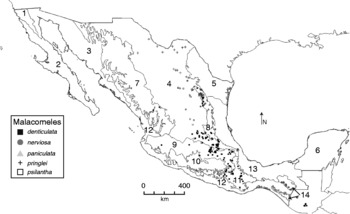
All maps illustrated over the biogeographic provinces proposed by Morrone (Reference Morrone2005) for Mexico (Fig. 1), although the states of Mexico are also mentioned that are related to their potential distribution.
Map of the distribution of the species of the genus Malacomeles on the biogeographic provinces in Mexico proposed by Morrone (Reference Morrone2005). 1, California; 2, Baja California; 3, Sonora; 4, Mexican Plateau; 5, Tamaulipas; 6, Yucatan Peninsula; 7, Sierra Madre Occidental; 8, Sierra Madre Oriental; 9, Trans-Mexican Volcanic Axis; 10, Basin of the Balsas; 11, Sierra Madre del Sur; 12, Mexican Pacific Coast; 13, Gulf of Mexico; 14, Chiapas.

Results
The Malacomeles species are distributed in several mountainous ranges of Mexico corresponding to six different biogeographic provinces proposed by Morrone (Reference Morrone2005) (Mexican Plateau, Trans-Mexican Volcanic Axis, Sierra Madre Oriental, Sierra Madre Occidental, Sierra Madre del Sur and Chiapas; Fig. 1). All have temperate climate, from climate BS (dry steppe climate, 18–22°C average temperature and 300–600 mm rainfall) to climate Cw (sub-humid temperate climate, 18–22°C average temperature and 600–1000 mm rainfall) and climate Cf (humid temperate climate, 8–22°C average temperature and 2000–4000 mm rainfall) in the scale of Köppen modified by García (Reference García1988). The results indicated that M. pringlei is distributed in the states of Chihuahua and Coahuila (only in the biogeographic province of the Mexican Plateau), while M. paniculata is distributed in the states of Nuevo Leon and Tamaulipas (only in the biogeographic province of Sierra Madre Oriental).
Besides, M. psilantha is distributed in Coahuila, San Luis Potosi, Guanajuato, Queretaro, Puebla and Oaxaca. This species is distributed in the biogeographic provinces of Mexican Plateau, Trans-Mexican Volcanic Axis, Sierra Madre Occidental and Sierra Madre del Sur, while M. nervosa is distributed in all east mountainous ranges of the country, from the states of Nuevo Leon and Coahuila in the north to the state of Chiapas in the south (specifically in the biogeographic provinces of Mexican Plateau, Sierra Madre Oriental and Chiapas); however, this species is mainly distributed in southern Mexico in the biogeographic province of Chiapas.
Finally, M. denticulata is the most distributed species of the genus Malacomeles in Mexico. M. denticulata is mainly distributed in central Mexico, specifically in the States of Guanajuato, Queretaro, Hidalgo, State of Mexico, Puebla, Oaxaca and Tlaxcala; although M. denticulata is distributed in five biogeographic provinces: Trans-Mexican Volcanic Axis; Mexican Plateau; Sierra Madre Oriental; Sierra Madre del Sur; Sierra Madre Occidental. However, most of the accessions are located in Trans-Mexican Volcanic Axis, Mexican Plateau and Sierra Madre del Sur (Fig. 1).
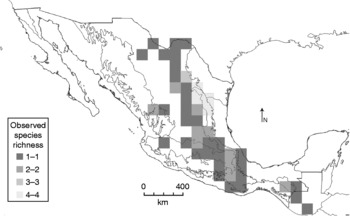
The map of the observed species richness showed that only in four cells of the grid, the highest species richness of Malacomeles was located (Fig. 2). All of them were found in northeast Mexico, mainly in the biogeographic province of Sierra Madre Oriental.
Map of the observed species richness of the genus Malacomeles in Mexico.

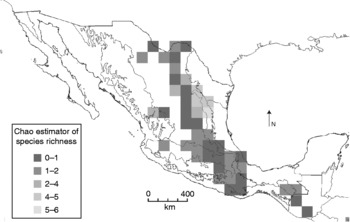
The map using the Chao estimator of species richness showed a similar pattern to that of the observed species richness (Fig. 3), which means the same cells as those in the observed species richness in northeast Mexico had a higher species richness value; nonetheless, in this case, only one cell had the highest species richness which was found in the biogeographic province of Sierra Madre Oriental.
Map of the Chao's estimator of species richness of the genus Malacomeles in Mexico.

In central Mexico, where most specimens were found, both the aforementioned maps showed a lower species richness than shown in northern Mexico, mainly in the biogeographic provinces of Trans-Mexican Volcanic Axis and Sierra Madre del Sur, and in the southern province of the Mexican Plateau (Figs 2 and 3).
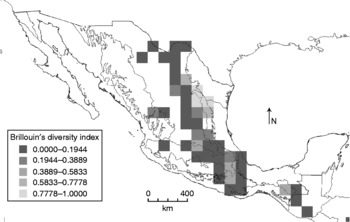
Finally, the map of Brillouin's diversity index showed that northeast Mexico, mainly in the biogeographic province of Sierra Madre Oriental, has the highest diversity, followed by a cell of Coahuila in the biogeographic province of the Mexican Plateau. Moreover, four cells showed intermediate diversity: one cell in the intersection among the provinces of Trans-Mexican Volcanic Axis with the Mexican Plateau; two cells in the intersection among the provinces of Trans-Mexican Volcanic Axis with Sierra Madre del Sur; one cell in the province of Chiapas. All other regions showed a low diversity (Fig. 4).
Map of Brillouin's diversity index of the genus Malacomeles in Mexico.

Discussion
M. denticulata is the most distributed and interesting species from the perspective of plant genetic resources, but there are not enough studies about its diversity. Hernández-Martínez et al. (Reference Hernández-Martínez, Núñez-Colín, Guzmán-Maldonado, Espinosa-Trujillo and Herrera-Hernández2011) had the first insight into its diversity using seed traits of six M. denticulata populations. These authors found that the six populations have high diversity, both intra- and inter-population, in its seeds. In addition, Núñez-Colín (Reference Núñez-Colín2010) reported the distribution of this species in Mexico and found that M. denticulata grows in three different climatic conditions.
Recently, Hernández-Martínez et al. (Reference Hernández-Martínez, Espinosa-Trujillo and Núñez-Colín2010) and Núñez-Colín and Hernández-Martínez (Reference Núñez-Colín and Hernández-Martínez2011) described several uses of the Mexican serviceberry in central Mexico. In this sense, this species is used for wood mainly as a fire starter, for construction, as a fodder plant, as a fresh food, and to make jams, juices, syrups, etc.; also, this species can be used as a rootstock for apple and other Rosaceae because it has a good vegetative compatibility (Núñez-Colín and Hernández-Martínez, Reference Núñez-Colín and Hernández-Martínez2011). Nonetheless, all other species of Malacomeles in Mexico unfortunately only have taxonomic information.
On the other hand, this study showed that M. denticulata is the most widely distributed species in Mexico followed by M. psilantha, with both species converging in central and southern Mexico. These results agree with the study by Turner (Reference Turner2011). In addition, although M. nervosa is distributed in three biogeographic provinces, its main distribution is in southern Mexico, which agrees with the study by Turner (Reference Turner2011), who mentioned that this species is only distributed in Chiapas and Central America.
Conversely, the other two species had a restricted distribution in Mexico: M. paniculata is only distributed in south Nuevo Leon and southwest Tamaulipas (Hinton and Hinton, Reference Hinton and Hinton1995; Turner, Reference Turner2011), while M. pringlei is restricted to Chihuahua and Coahuila (Turner, Reference Turner2011).
The highest values of species richness and diversity were concentrated in cells of northeast Mexico, where the majority of the taxonomical studies in Rosaceae were done (Hinton and Hinton, Reference Hinton and Hinton1995; Phipps, Reference Phipps1997). In addition, it is one of the most important regions in Mexico with reference to plant diversity and endemism (Hinton and Hinton, Reference Hinton and Hinton1995; Villarreal-Quintanilla and Encina-Domínguez, Reference Villarreal-Quintanilla and Encina-Domínguez2005). Consequently, this area can be considered as the priority area to collect the germplasm of Malacomeles (Guarino et al., Reference Guarino, Jarvis, Hijmans, Maxted, Engels, Ramanatha Rao, Brown and Jackson2002). The results of this study also showed that it is important to collect into the four cells with intermediate diversity, which are located in the intersection among the provinces of Trans-Mexican Volcanic Axis with the Mexican Plateau, in the intersection among the provinces of Trans-Mexican Volcanic Axis with Sierra Madre del Sur, and in the province of Chiapas; thus, this can also be considered as a secondary priority area for germplasm collection (Guarino et al., Reference Guarino, Jarvis, Hijmans, Maxted, Engels, Ramanatha Rao, Brown and Jackson2002).
This study showed that it is important to collect germplasm in regions with endemic species to preserve the diversity of Malacomeles in Mexico. However, the germplasm to be collected must be focused in the predominant Mexican species of Malacomeles found in this study: M. denticulata. That is because this species has a greater probability to be found with higher genetic variability, it can be used in a breeding programme (Zagaja, Reference Zagaja, Moore and Janick1988). In this study, this species is mainly distributed in central and southern Mexico, which agrees with several botanical studies about Malacomeles distribution (Phipps et al., Reference Phipps, Robertson, Smith and Rohrer1990; Rzedowski and Calderon de Rzedowski, Reference Rzedowski and Calderón de Rzedowski2005; Vibrans et al., Reference Vibrans, Hanan Alipi, Mondragón Pichardo, Tenorio Lezama and Vibrans2006; Núñez-Colín, Reference Núñez-Colín2010; Turner, Reference Turner2011).
Acknowledgements
This study was supported by the Science and Technology Council at the State of Guanajuato (CONCYTEG) by means of the project ‘Colecta, Conservación y Diversidad del Membrillo cimarrón (Amelanchier denticulata), un frutal nativo del Estado de Guanajuato’ and by the Mexico's National Council for Science and Technology (CONACYT) by mean of the project CB2009/134193: ‘Estudios básicos sobre diversidad y potencial agroalimentario del membrillo cimarrón (A. denticulata (Kunth) Koch) en el centro de México’. The authors thank Dr Eduardo Espitia-Rangel and Dr Irail Cortinas-López for the review of the manuscript and for editing the English language.