Introduction
The importance of accurate trauma triage is clear, but current field triage protocols have been unsuccessful in fulfilling national targets for under-triage and over-triage.Reference Sasser, Hunt, Sullivent and Wald 1 Studies have shown that treatment of a severely injured patient at a Level I trauma center compared to a non-trauma center has a 25% lower mortality.Reference MacKenzie, Rivara and Jurkovich 2 , Reference Cudnik, Newgard, Sayre and Steinberg 3 Many field triage protocols have been created and tested over the past decades to properly identify patients in-need of the highest level of trauma care.Reference Baxt, Jones and Fortlage 4 – Reference Hamada, Gauss and Duchateau 6 However, these protocols rely on parameters measured in the field only upon arrival of first responders and have not reliably triaged patients to appropriate levels of care. Recent literature continues to identify under-triage as a “vexing” problem and highlights the need for innovative methods in field triage.Reference Newgard, Uribe-Leitz and Haider 7 Under-triage is especially prevalent and problematic in older trauma patients, a growing population that suffers worse outcomes than their younger peers from similar or less-severe injuries.Reference Sasser, Hunt and Faul 5 , Reference Staudenmayer, Hsia, Mann, Spain and Newgard 8 – Reference Newgard, Fu and Lerner 10
Motor vehicle collisions (MVCs) are the single leading cause of injury and comprise 11% of deaths due to traumatic injury. In 2015, MVCs caused 24,000 deaths and 2.6 million non-fatal injuries among vehicle occupants. 11 , 12 Improved computing and telecommunications have led to major innovations in vehicle communications and safety. Advanced Automotive Collision Notification (AACN), the successor to Automatic Crash Notification (ACN), can determine when a crash has occurred through input from crash sensors and transmits data regarding crash direction and severity, as well as restraint use. It can then communicate with telematics service providers such as OnStar (OnStar Corporation; General Motors; Detroit, Michigan USA) and ATX (ATX Group; Agero; Medford, Massachusetts USA) to transmit Global Positioning System (GPS) and crash data, and connect the vehicle’s telecommunications channel to an emergency call center. 13 , Reference Hunt 14 Communication between emergency call centers and vehicle occupants can provide additional information such as age, gender, and level-of-consciousness to inform collision data.
With growing opportunities for telemetry-based field triage, an expert panel on AACN and Triage of the Injured Patient was convened in 2007-2008. The expert panel recommended that collisions with ≥20% risk of severe injury, defined as Injury Severity Score (ISS) greater than 15, warrant transfer to the highest level of care within the trauma system. 13 While prior AACN prediction algorithms had been created, their sensitivities were much lower than recommendations by the Centers for Disease Control and Prevention (CDC; Atlanta, Georgia USA), which target under-triage (1-sensitivity) of five percent and over-triage (1-specificity) of 35%.Reference Sasser, Hunt and Faul 5 , Reference Kononen, Flannagan and Wang 15 These metrics translate to a protocol sensitivity of 95% and specificity of 65%.
The objective of the study was to compare sensitivities and specificities between traditional field triage protocols and a vehicle telemetry-based injury severity prediction (ISP) algorithm in predicting ISS 15+ injuries in planar, non-rollover MVCs.
Methods
This project was approved by the Institutional Review Board of the Michigan Department of Health and Human Services (Lansing, Michigan USA; 861-HPRPCVSC-EA).
National Automotive Sampling System Crashworthiness Data System (NASS-CDS)
The NASS-CDS is a database of passenger vehicle crashes investigated and maintained by the National Highway Traffic Safety Administration (NHTSA; Washington, DC USA). Field research teams investigate a representative, random sample of approximately 5,000 minor, serious, and fatal crashes per year involving passenger cars, vans, light trucks, and utility vehicles. Data are collected on vehicle characteristics, crash parameters, and passenger factors. Cases are reviewed by NASS Zone Centers for quality control.
OnStar
The OnStar Corporation is subscription-based service that is a subsidiary of General Motors. It consists of four technologies: cellular, voice recognition, GPS, and vehicle telemetry. It provides security services, navigation, remote diagnostics, and emergency services including automatic crash response. 16 This work was supported in part by a grant from the General Motors Corporation.
Logistic Model Design
This work builds upon previous work in ISP using vehicle telemetry.Reference Kononen, Flannagan and Wang 15 Data from 1999-2013 from NASS-CDS were used to develop a logistic regression model to predict the probability that a planar, non-rollover crash would result in one or more occupants with an ISS greater than 15. The analysis was restricted to cars, lights trucks, and vans, model year 2000 and newer. Model covariates included: change in velocity (Delta-V); multiple versus single impacts; presence of an occupant ≥55 years; presence of a female occupant; presence of a right-sided passenger; seatbelt use; vehicle type (car, pickup truck, sport utility, or van); and principal direction of force (PDOF; 0 to 360 degrees with 10 degree-increments). The effect of PDOF to injury severity and its interaction with presence of a right-sided passenger were both modeled as non-parametric cyclic curves. Functional data analysis was performed to estimate these curves using cyclic basis splines with 10 degrees of freedom for the PDOF main effect and five degrees of freedom for its interaction with the presence of a right-sided passenger.
All analyses were performed in R software Version 3.5.2 (R Foundation for Statistical Computing; Vienna, Austria). A forward/backward selection procedure was used to develop the predictive model that minimized Akaike Information Criterion. The importance of each variable was calculated based on information loss when corresponding variables were removed from the model.
Validating Sensitivity and Specificity of ISP Algorithm
The model was validated using 2008-2011 crash data from Michigan vehicles with AACN capabilities identified from OnStar records. Telemetry crash data sent from the vehicles were confirmed using police crash reports. Medical records and imaging data for patients transported from the scene for evaluation and treatment were obtained. The ISS was assumed to be ≤15 for MVC occupants not transported for medical assessment. The ISP algorithm and transmitted telemetry data were used to predict the probability that an occupant had ISS 15+ injuries. The observed injuries for each occupant and each vehicle were then compared to the predictions.
Sensitivity and Specificity of Prehospital Triage
Sensitivities and specificities of prehospital triage protocols were obtained from a recent systematic review of 21 articles by van Rein and colleagues.Reference van Rein, Houwert, Gunning, Lichtveld, Leenen and van Heijl 17 The analysis was limited to well-established, consensus-based triage criteria that used ISS 15+ as the primary outcome measure for severe injury. Protocols included in the study were: Trauma Score (TS); Revised Trauma Score for Triage (T-RTS); Field Triage Decision Scheme (FTDS); Prehospital Index (PHI); and Circulation, Respiration, Abdomen, Motor, and Speech Criteria (CRAMS). Sensitivities and specificities of varying cut-off values were included for these criteria (eg, TS<13 and TS<15), but excluded results from studies that added additional criteria to the original protocol (eg, TS<15 versus TS<15+ child struck by car). Confidence intervals (CIs) for sensitivities and specificities were abstracted from the original article or calculated via Binomial CIs using the logit parameterization.
Calculating Weighted Average of Sensitivity and Specificity
To compare a composite measure of sensitivity and specificity between studies, two weighted averages were calculated with differential weighting. The first weighted average assumes equal 1:1 importance of sensitivity and specificity (sensitivity x 0.5 + specificity x 0.5), and the second weighted average assumes a 7:1 ratio of importance for sensitivity and specificity, corresponding to the CDC recommended five percent under-triage rate and 35% over-triage rate.Reference van Rein, Houwert, Gunning, Lichtveld, Leenen and van Heijl 17
Results
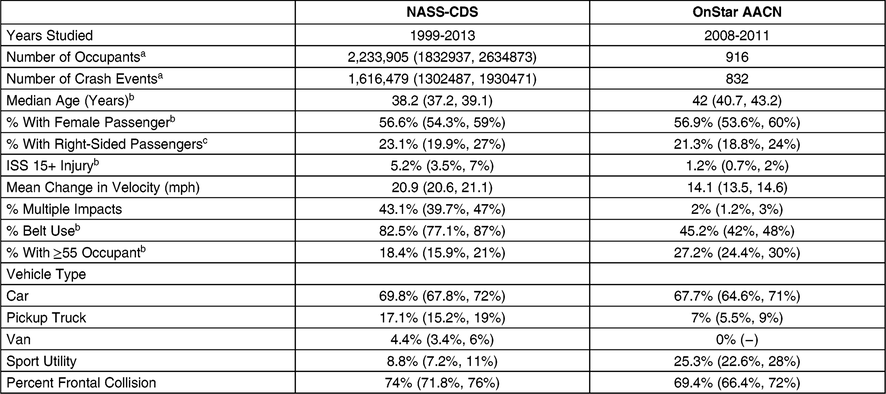
Table 1 describes the demographics of the NASS-CDS and OnStar populations. The OnStar population had less belt use, lower frequency of multiple impacts, and fewer ISS 15+ injuries than the NASS-CDS population.
Demographics of NASS-CDS and OnStar Data
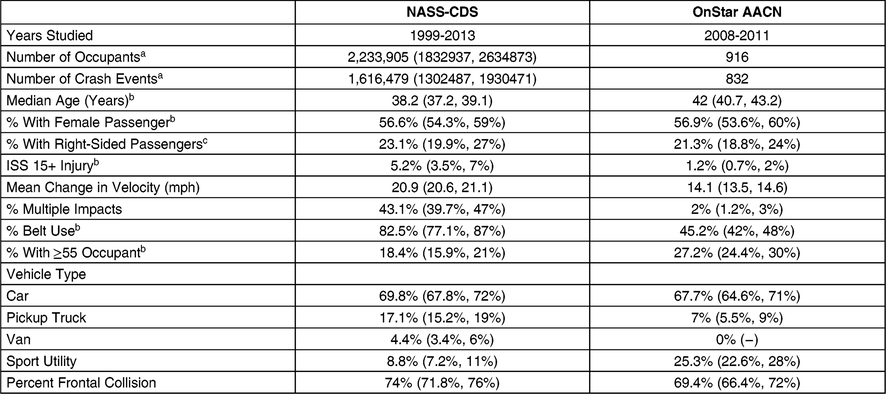
Abbreviations: AACN, Advanced Automotive Collision Notification; ISS, Injury Severity Score; NASS-CDS, National Automotive Sampling System Crashworthiness Data System.
a NASS studies a representative sample of collisions across the United States weighted by collision characteristics. A total of 8,013 NASS collected crash cases were included in the analysis. Numbers shown in the table are the representative population total considering the NASS weighting scheme.
b Numbers shown in the NASS column represent worst scenario in the car. That is to say, age represents the oldest age in the car; female passenger represents at least one female passenger; ISS 15 represents at least one person with ISS ≥15 injury; belt represents all passengers are belted. For OnStar AACN, data are shown at the person level.
c OnStar AACN also includes 28 back-seat passengers.
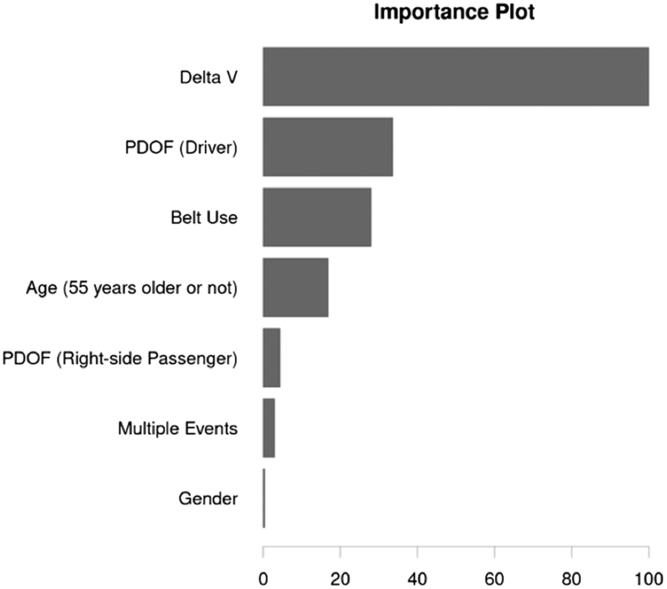
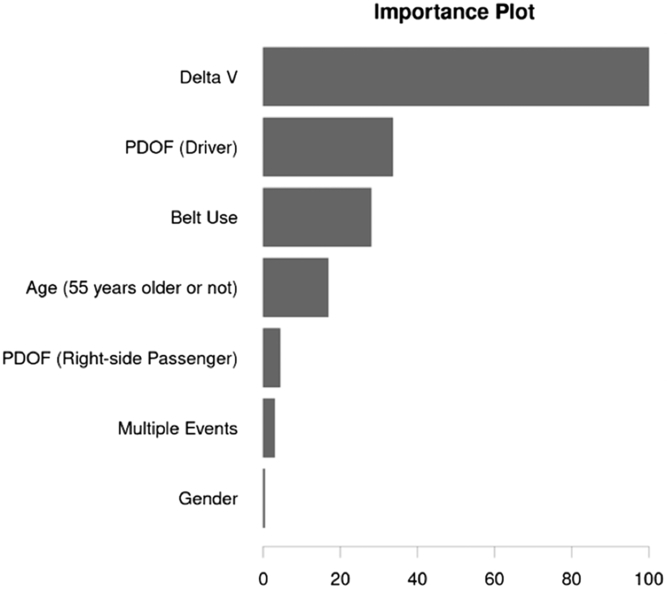
The relative importance of each variable is presented in Figure 1. Mechanistic variables such as Delta V, PDOF, and seatbelt use were the most important variables. The least important variable was gender.
Importance Plot of Logistic Regression Analysis Variables.
Variables Associated with Increased Risk of ISS 15+
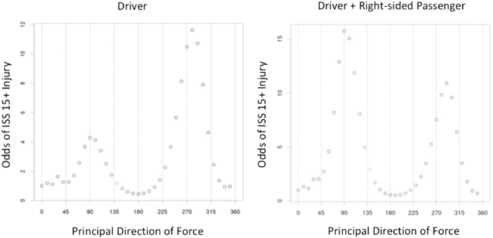
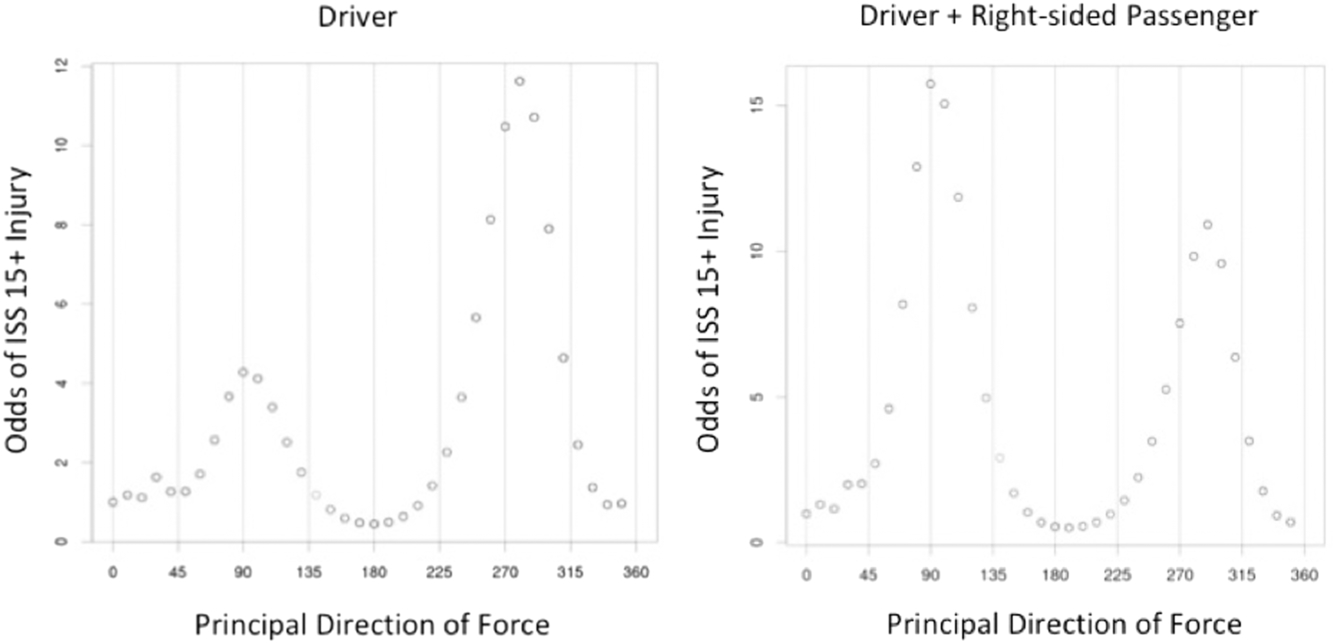
The odds of ISS 15+ injury were significantly increased by higher Delta-V, presence of an occupant ≥55 years, and multiple impacts. Presence of a female passenger trended to significance and had higher odds of an ISS 15+ injury. Unsurprisingly, seatbelt use significantly decreased odds of ISS 15+ injury (Table 2). In PDOF functional curve analysis (Figure 2), odds of ISS 15+ injury peaked at 275 degrees for a driver and at 90 degrees for a right-sided passenger.
Odds Ratio for ISS 15+ Injury

Abbreviations: ln Delta-V, natural log of change in velocity; ISS, Injury Severity Score.
a Odds as compared to baseline odds of ISS 15+ injury in driver-only frontal collision with all other variables held constant.
Analysis of Effect of Principal Direction of Force (PDOF) on Odds of Injury Severity Score (ISS) 15+ Injury.
Model Validation Sensitivity and Specificity
Validation of the model against crash data from Michigan vehicles with AACN capabilities revealed a sensitivity of 72.7% (95% CI, 41%-91%) and specificity of 93% (95% CI, 92%-95%; Table 3). The telemetry-based ISP model correctly predicted eight out of 11 ISS 15+ injuries and 852 out of 913 ISS ≤15 injuries (n = 924). The weighted average of sensitivity and specificity for the model was 83% with 1:1 weighting and 75% with 7:1 weighting.
Model Validation Against OnStar Field Data

Abbreviation: ISS, Injury Severity Score.
Literature Review: Sensitivities Range and Specificities Range
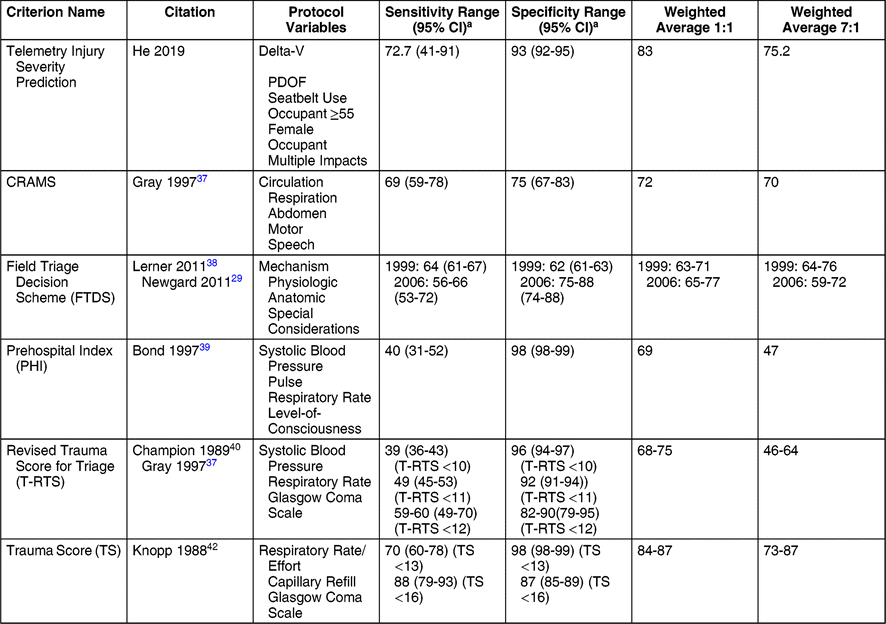
Review of relevant literature demonstrated a wide-range of sensitivities and specificities (Table 4).Reference Gray, Goyder, Goodacre and Johnson 18 – Reference Knopp, Yanagi, Kallsen, Geide and Doehring 23 Reviewed protocols with the greatest sensitivities were: TS<16 (sensitivity 88%, specificity 87%); CRAMS (sensitivity 69%, specificity 75%); and 1999 FTDS (sensitivity 64%, specificity 62%). The protocols with the highest specificities were: PHI (sensitivity 40%, specificity 98%) and TS<13 (sensitivity 70%, specificity 98%).
Prehospital triage protocol sensitivities and specificities for Injury Severity Score (ISS) 15+ injuries.
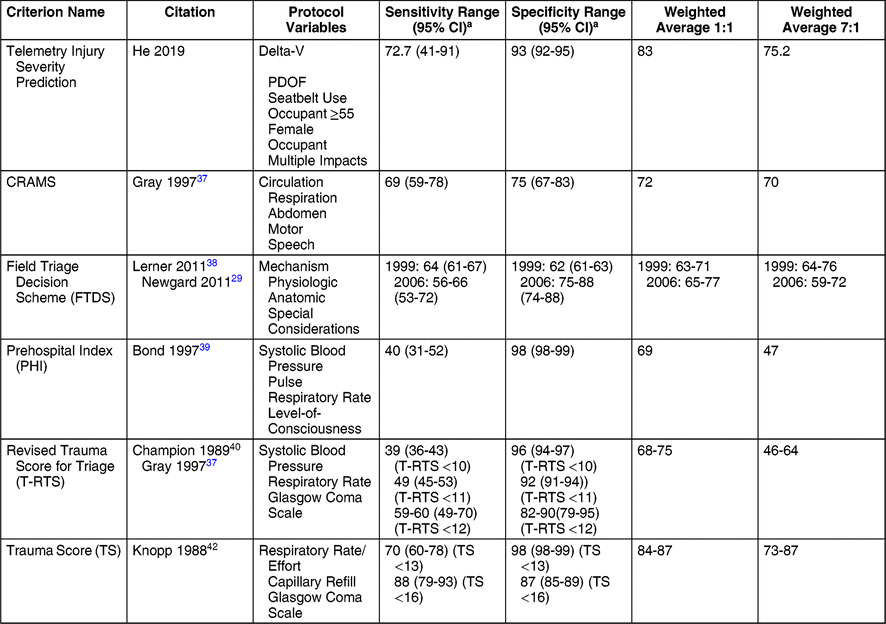
Abbreviations: CRAMS, Circulation, Respiration, Abdomen, Motor, Speech criteria; Delta-V, change in velocity; PDOF, principal direction of force.
a Confidence interval as reported or calculated via Binomial confidence intervals using the logit parameterization.
ISP Algorithm is Comparable or Superior to All Other Triage Protocols
Weighted averages ranged 63%-87% for equal weighting and 46-87 for 7:1 (sensitivity:specificity) weighting. Based on 1:1 weighting, the telemetry-based ISP algorithm (weighted average 83%) was comparable to, or out-performed by, the TS and comparable to or out-performed CRAMS, the 2006 and 2011 FTDS, PHI, and T-RTS. Based on 7:1 weighting, the telemetry-based ISP (weighted average 75) was comparable to the 1999 FTDS and TS, and was comparable to or out-performed CRAMS, 2006 FTDS, PHI, and T-RTS.
ISP Model Out-Performs 2006 FTDS in Specificity
The 2006 FTDS had a sensitivity of 56%-66% (95% CI, 53%-72%) and specificity of 75%-88% (95% CI, 74%-88%). Weighted averages were 65%-77% for equal weighting and 59%-72% for 7:1 weighting. The telemetry-based ISP algorithm demonstrated favorable characteristics (sensitivity, specificity, 1:1 weighting, and 7:1 weighting) in comparison to the 2006 FTDS. The ISP model was found to have a statistically significant improved specificity; however, the increased sensitivity was not statistically significant.
Discussion
National benchmarks for field triage set by the CDC and American College of Surgeons Committee on Trauma (ACS COT; Chicago, Illinois USA) target a sensitivity of 95% and specificity of 65%.Reference van Rein, Houwert, Gunning, Lichtveld, Leenen and van Heijl 17 The ISP algorithm had a sensitivity of 72.7% (95%, CI 41%-91%) and specificity of 93% (95% CI, 92%-95%).Reference Kononen, Flannagan and Wang 15 Review of literature found sensitivities ranging 39%-88% and specificities ranging 62%-98%. As expected and highlighted in recent literature, protocols with higher sensitivities had lower specificities, and vice versa.Reference Newgard, Hsia and Mann 24 Overall, the telemetry-based ISP performed comparably or better than all other prehospital triage protocols, although these differences were, in many cases, not statistically significant. Most notably, the algorithm had favorable sensitivity and specificity in identifying ISS 15+ injury as compared to the 2006 FTDS (sensitivity 56%-66%; specificity 75%-88%), which is the triage guideline created by the CDC and ACS COT.Reference Sasser, Hunt and Faul 5
Considerations for Trauma Triage Protocol Inclusion
Studies used a variety of definitions for “severe injury,” including resource-based definitions such as fluid resuscitation or intensive care unit (ICU) admission.Reference Baxt, Jones and Fortlage 4 , Reference Tamim, Joseph, Mulder, Battista, Lavoie and Sampalis 25 The analysis was limited to protocols using ISS 15+ as the primary outcome measure, which is the measure the ACS COT uses to track trauma triage performance.Reference Sasser, Hunt and Faul 5 Although the Vittel Triage Criteria of France has been shown to have excellent sensitivity (98%-99%), it was excluded from the analysis due to non-generalizability to the United States triage system. In the French emergency medical system, Service Mobile d’Urgence et Reanimation (SMUR) units staffed by qualified physicians are dispatched to incidents with a high-likelihood of severe injury. The SMUR units conduct a comprehensive set of examinations and interventions before hospital transport, which accounts for its favorable triage protocol metrics.Reference Hamada, Gauss and Duchateau 26
ISP in the Context of National Targets
While the ISP algorithm represents an improvement on current triage guidelines, it still does not meet the national target of 95% sensitivity and 65% specificity. However, it has been shown that a high-sensitivity approach to field triage that satisfies national targets of 95% sensitivity is not cost-effective due to treatment of non-severely injured patients at Level I trauma centers.Reference Newgard, Yang and Nishijima 27 To that end, lower sensitivity thresholds have been proposed to reduce the costs of over-triage.Reference Newgard, Hsia and Mann 24 , Reference Newgard, Yang and Nishijima 27 , Reference Newgard, Staudenmayer and Hsia 28 The AACN ISP algorithm has the potential to contribute to greater cost savings due to its low over-triage rate of seven percent.
Telemetry-Based ISP Improves Information Quality and Speed of Response
Telemetry-based ISP algorithms have improved information quality and quicker response times than traditional prehospital triage protocols. The AACN has the ability to provide detailed mechanistic information on changes in velocity (Delta-V), belt use, and number of impacts that surpasses the observational abilities of first responders. Immediate information transfer is another distinct advantage – telemetry can provide information including GPS location immediately following collision, which is particularly important in rural areas, which account for 48% of MVC deaths. 29 Adoption of AACN ISP could additionally capture patients missed in national trauma databases. Previous studies have shown that adoption of national field triage guidelines such as FTDS have been variable and inconsistent among first responders.Reference Barnett, Wang and Sahni 30 , Reference Sasser, Ossmann, Wald, Lerner and Hunt 31 Implementation of AACN ISP triage protocols occurs at the car manufacturer and telemetry service provider level, which enables wide-spread standardization of telemetry-based triage.
Implications for the Elderly Trauma Population
Telemetry-based ISP has important implications for elderly trauma patients. It has been well-documented that geriatric populations are under-triaged in both prehospital triage protocols and inter-hospital transfers,Reference Kodadek, Selvarajah, Velopulos, Haut and Haider 9 , Reference Newgard, Zive and Holmes 20 , Reference Nakamura, Daya and Bulger 32 , Reference Garwe, Stewart and Stoner 33 and that elderly patients experience greater morbidity and mortality for the same ISS injury.Reference Morris, MacKenzie, Damiano and Bass 34 , Reference Shifflette, Lorenzo, Mangram, Truitt, Amos and Dunn 35 Under-triage has also shown to be associated with $21,000 higher median per-patient costs.Reference Staudenmayer, Hsia, Mann, Spain and Newgard 8 Alternative triage criteria have been suggested to better identify elderly patients necessitating trauma center transfer.Reference Newgard, Holmes and Haukoos 36 , Reference Newgard, Richardson and Holmes 37 The presence of an occupant ≥55 years was statistically significant in the ISP logistic regression, and with all other variables equal, had 3.25-times the odds of an ISS 15+ injury. A telemetry-based ISP has the potential to more quickly identify severely injured elderly patients.
Limitations
This study has several limitations. This was a retrospective study of prospectively collected data. The OnStar crash population study was conducted using only the state of Michigan crashes. However, the sample does include crashes from varying years, seasons, weather conditions, times of day, and days of the week. The use of ISS 15+ injury, while widely accepted, has been shown to perform poorly in comparison to consensus-based criterion standard.Reference Willenbring, Lerner and Brasel 38 , Reference Newgard, Hedges, Diggs and Mullins 39 The OnStar telemetry data are limited to crashes in which the airbag deployed. While the risk of severe injury in collisions without airbag deployment is low, it was not possible to evaluate the burden of severe injury in these cases. Additionally, severe injury in backseat passengers was not able to be evaluated due to low prevalence in the dataset, and thus, this study is limited to front row occupants. The telemetry-based algorithm was also limited to planar vehicle crashes. However, in 2015, over 80% of vehicles involved in fatal crashes did not roll over and over 70% of fatalities were attributed to the driver, indicating that the ISP algorithm is generalizable to model the majority of crash fatalities. 11
Conclusion
This telemetry-based ISP algorithm predicts ISS 15+ injury with 72.7% sensitivity and 93% specificity. This algorithm is at least equivalent to, and may out-perform, commonly used field triage practices. It has the potential to decrease time to medical intervention, improve information quality, and reduce variability in triage protocols. While the ISP algorithm does not satisfy national targets set by the ACS COT, it represents a significant step towards improved accuracy in identifying crash occupants who necessitate transfer to a Level I trauma center. Further research is warranted on combining telemetry-based and Emergency Medical Services-based field triage protocols to better identify severely injured patients needing transfer to a trauma center.
Conflicts of interest/disclosure
This paper was presented as an oral presentation at the 13th Annual Academic Surgical Congress in Jacksonville, Florida USA on January 30-February 1, 2018. PZ was partially supported by funds from the US Department of National Institutes of Health (K01 DK106296). This work was supported in part by a grant from the General Motors Corporation. SCW’s work was supported in part by a grant from the General Motors Corporation. PZ and KH report no conflicts of interest.