INTRODUCTION
Hurricane Katrina made landfall on August 25, 2005, and ultimately killed approximately 1200 individuals, displaced another 400,000 (FEMA 2005), and also affected as many as 10 million residents of the area (U.S. Bureau of the Census 2005a, 2005b). During the next few weeks, television and print journalists focused on the individuals who were seemingly abandoned by the U.S. government as they waited for help. While Americans are somewhat used to seeing the physical devastation and loss of lives from natural disasters in developing countries—for instance, the December 2004 Tsunami in Southeast Asia, killing more than 280,000 individuals, or the October 2005 Earthquake in Pakistan, which killed 73,000—Americans are not accustomed to seeing such moving photos and stories of masses of homeless individuals in a major city waiting for days for help from the U.S. government. What was most striking about these visual images was the preponderance of African Americans who seemed stranded on the streets; it seemed to many journalistic and casual observers that somehow the lack of timely response was associated with the race and socioeconomic status of many of the victims.
While many of its victims were African Americans, many of the residents of the area were African Americans. According to the report by Knight Ridder Newspapers on December 30, 2005, mortality figures suggest that African American poor residents were no more likely to die from Hurricane Katrina than their White non-poor counterparts (Simerman et al., 2005). However, nearly three out of four victims were elderly, although they were not at the forefront of the visual images projected to television audience. The point here is not whether African Americans were disproportionately affected by the hurricane—their poverty levels and patterns of residential segregation undoubtedly meant that they were—but simply that media portrayals are necessarily simplistic and cater to the sensationalism to which the public has grown accustomed.
The limited scope of mainstream media depiction was somewhat offset by reports by primarily Asian and Hispanic journalists who sought to cover these nearly invisible minority populations. According to my tabulations from data from the 2000 U.S. Census listing all of the ninety counties affected by the hurricane, almost 70,000 Asians and 124,000 Hispanics lived in these counties (U.S. Bureau of the Census 2000b). There are approximately 30,000 Vietnamese in Louisiana alone, many of whom work in the shrimping industry. Many Latinos, on the other hand, work in poultry processing plants, some of which were destroyed by the hurricane. Because many of the Asian and Hispanic victims have limited English proficiency, they cannot even complain in English to television journalists. How does their marginalization from discussions of race and poverty in the coverage of Hurricane Katrina speak to the invisibility of these populations in broad considerations of ethnicity and social class in the United States in 2006?
My essay proceeds as follows. First, I will briefly summarize the themes that journalists who wrote about Asian (largely Vietnamese) and Hispanic (largely Mexican) residents used to tell their stories. In fact, there were many comparable themes in reports of both Vietnamese and Mexican victims. Second, I examine the discourses used by the journalists. Next, I briefly examine possible rationales for the absence of Asians and Hispanics from discussions of race and poverty in the U.S. Finally, I ponder the implications of current discussions and what the future might hold.
WHO ARE THE ASIAN AND HISPANIC RESIDENTS OF THE CENTRAL GULF COAST?
Significant numbers of Vietnamese residents in the Gulf Coast area work in the shrimping industry. For instance, nearly 33% of the residents of Bayou LaBatre (near Mobile, Alabama) are Asian (Hoffman 2005). There are also small numbers of Cambodians, Koreans, South Asians, and other Asian Americans in the area. Unlike most Asian Americans, the Vietnamese in this area live in rural areas and are more likely to live in poverty. While the national poverty rate for Asian Americans was 9.8% in 2004 (U.S. Bureau of the Census 2004), it was double that for Vietnamese Americans nationally. In other words, because the Vietnamese (and Cambodians and Laotians) are lumped together with other higher socioeconomic (SES) Asian Americans, their high poverty rates and low levels of household income are often overlooked.
Most of the Southeast Asians came to the United States after the Fall of Saigon in 1975. Unlike other Asian Americans, they are a refugee population who were poorer upon arrival, but who also received government assistance (unlike other immigrants). First-generation (those born outside of the U.S.) Vietnamese, Cambodian, and Laotian Americans experienced firsthand the destruction that comes with war. In fact, journalists and their interviewees often employed this image as they recounted their experiences with Hurricane Katrina. The sudden evacuation and the ensuing loss of family members and material goods were reminiscent of their abrupt departure from their homelands. This narrative concludes with stories of their survival in the U.S. despite the odds against them. For many Vietnamese residents who planned to relocate to Houston and other surrounding areas, this parallel was also effective in the telling of their experiences. In a way, Hurricane Katrina seemed to be a pale comparison with the wars in Southeast Asia, and so these narratives may have worked to help victims cope with their difficult circumstances.
According to journalist Ciria-Cruz, approximately 40,000 Hispanics live in the New Orleans area alone, and there may be up to 150,000 Hondurans and 100,000 Mexicans in the affected areas (Ciria-Cruz 2005). Even conservative commentator Linda Chavez noted in her column that there was a complete absence of Hispanic faces from the images of Katrina victims in the mainstream media. She argued that because Hispanics work in unskilled occupations and are already invisible, it was easy to not think about them in the wake of this disaster. Moreover, they are more likely than other immigrant groups to be undocumented, which makes them even less visible and less willing (or able) to seek federal or local assistance (Chavez 2005), an idea expressed in virtually all of the articles regarding Hispanic Katrina victims. Finally, similar to Asian Americans in the area, Hispanics are also more likely to have limited proficiency in English, which further constrains their ability to seek help except from other coethnics.
SIMILARITIES IN DISCOURSE
What were remarkable in my survey of print journalists' accounts of Asian and Hispanic Katrina victims were the common discourses used to describe the experiences of these two seemingly different populations. First, there was the confusion about evacuation: most information came to residents in English and was hence inaccessible to immigrants who did not speak English. Then, there was the shock of sudden evacuation (which all residents, regardless of ethnicity, faced). What was different, however, was that, particularly for the Vietnamese, the accounts of evacuation from Katrina were similar to their memories of leaving Vietnam. Moreover, even the sounds of roofs being destroyed by the Hurricane reminded some of bombs dropping on their houses in Vietnam. As Quan Hong Huyn eloquently states in an interview with a journalist from the Associated Press, “We have experience about escape, about evacuation.” He also described the damage he witnessed, stating that “It looked like bombs from a B-52” (Associated Press 2005). Similarly, in a Houston Chronicle article by Dai Huynh, she quotes Ngoc Dung Nguyen, who explains:
Thirty years ago, we left our homeland for America… Thirty years later, we left our home again—for Houston… My parents fled North Vietnam for South Vietnam in 1954. I fled from Vietnam for America in 1975. Now in 2005, my children fled from the only home they knew, much like I did, except they fled in a car and I fled on a boat… Is this the fate of the Vietnamese people? To always flee? (Houston Chronicle 2005).
There is no clearer sign that Hondurans in the Central Gulf Coast are marginalized than in their complete absence from the coverage of Katrina victims. Despite the fact that this area probably hosts the largest community of Hondurans in the United States, I found very little coverage of this population. Indeed, they may be at the greatest risk of survival not only because of their immigrant status and their limited English proficiency, but also because their tenuous legal status makes them leery of seeking help from federal and state agencies. Perhaps even more distressing is the fact that many Hondurans left Central America after Hurricane Mitch in 1998, and were given temporary legal status by the U.S. government (Avila and Dellios, 2005). However, many Hondurans are undocumented workers in the fishing industry and in the ports of Louisiana; hence, they can be reluctant to come forward for help. In fact, their fears are not unwarranted, given that the Department of Homeland Security has not assured that individuals who seek help will be protected from prosecution and deportation. Certainly they also share the common experience of being forced to migrate at a moment's notice under similar circumstances. Nonetheless, these individuals cannot rely on government officials for help.
The fact that native-born and foreign-born minorities feel abandoned by the U.S. government speaks to their marginal status. It seems that while native-born African Americans (and some Asian Americans) feel that it is their right to receive help, many foreign-born individuals must rely solely on coethnics for assistance. Their status as Americans is tenuous, not only in terms of their legal status, but, more importantly, in terms of their visibility to and acceptance by other Americans. Hence, they must tell themselves that they are survivors because of their (forced) independence.
MARGINAL STATUS PARALLELS
How do the discourse (or lack thereof) and the experiences of Asian and Hispanic Katrina victims parallel those of Asians and Hispanics in the United States more generally? Certainly, the absence of discussions and their invisibility from the mainstream media point to their marginal status even within discussions of race and ethnicity in the U.S. For example, according to the Gay and Lesbian Alliance Against Defamation survey of fall 2005's scripted television shows on network TV, about 14% of the recurring characters were African American, compared to 6% for Hispanics and 3% for Asians. Recall that Hispanics are a larger minority group than African Americans (at approximately 13% in the 2000 U.S. Census compared to 12% for African Americans), while Asians comprise 4% of the U.S. population. What is more troubling is that many television shows are set in large cities, where minorities comprise a much larger proportion of the population than they do nationally.
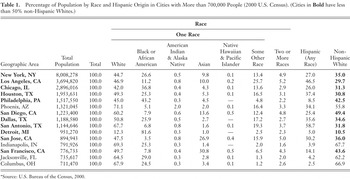
Table 1 presents the percentage of the population by race and Hispanic origin of cities whose population is more than 700,000. Those cities highlighted in bold already have less than 50% non-Hispanic Whites. In other words, in television shows that take place in large cities, one might expect a majority minority cast, at least among the casual characters in any given television show. Specifically, among the ten largest cities in the United States, nine of them are more than 50% minority: 35% of New York City, 30% of Los Angeles, 32% of Chicago and of Houston, 43% of Philadelphia, 49% of San Diego, 35% of Dallas, 32% of San Antonio, 11% of Detroit, and 36% of San Jose is non-Hispanic White. Among the ten largest cities, only Phoenix still has a majority non-Hispanic White population (56%). This means that one should expect to see a large number of minorities in most large cities. In addition, many of these cities have a sizable Hispanic population and they often outnumber African Americans. In the four large cities in California listed in Table 1, Asians comprise from 10% to 31% of its residents; 31% of San Francisco is Asian American.
Percentage of Population by Race and Hispanic Origin in Cities with More than 700,000 People (2000 U.S. Census). (Cities in Bold have less than 50% non-Hispanic Whites.)

So why are Asians and Hispanics relatively absent from media representations or discussions of race and ethnicity in the United States? There are three possible reasons: (1) the relative recency of their arrival to the U.S.; (2) their relatively small sizes compared to African Americans; and finally (3) the difficulty or ease in understanding these complex groups. I will review each of these possibilities in turn.
Recency of Arrival
One might argue that Asians and Hispanics are relatively recent migrants to the United States compared to African Americans and Whites. While it is true that the vast majority of Asians and Hispanics migrated after the 1965 Immigration and Naturalization Act (also known as “Hart-Cellar”), Mexicans have been in the western part of the United States since before those states were annexed during the Mexican-American War (1845–1848). Moreover, Chinese immigrants first came to the United States as laborers building the railroads and working in the coalmines. The arrival of these two groups was prior to most of the immigration from southern and eastern Europe. However, because they currently comprise three-quarters of all immigrants arriving in the U.S. today, it is possible that the U.S. has trouble viewing the newest residents as part of the traditional rubric of American life. Moreover, the dichotomy of African American versus White in the United States was long established prior to the growth of these two groups, and, for the most part, new minorities were seen, in a sense, as the new “African Americans” (i.e., non-Whites) upon their arrival to the U.S.
Relative Size of Asian and Hispanic Populations in the United States
Another possible explanation of the absence of some minorities from everyday discussions of race may have to do with their relatively small size. However, while this may be true of Asian Americans, who now comprise approximately 4% of the U.S. population (in the 2000 Census), it is not true of Hispanics, who currently make up 13% of the U.S. population, compared with 12% for African Americans. When one considers the growth of the Asian and Hispanic populations, it is even more surprising that their presence in the American imagination is not more apparent. Between 1990 and 2000, the Hispanic population grew by 58% (Guzman 2001). Similarly, the Asian American population grew by somewhere between 48% and 72%.1
The large range is due to the change in the 2000 Census allowing individuals to choose more than one race, so the computations of the population size in 2000 can include those who choose Asian alone and/or those who choose Asian in combination with another race. This is true for estimates of the African American and White population as well, but not for Hispanics, since they are not considered to be a racial group by the definitions employed by the U.S. Census Bureau (Barnes and Bennett, 2002).
The Relative Complexity of Understanding Asians and Hispanics
It is also possible that most Americans do not want to be bothered with learning about more minority groups. The immigration histories of the disparate ethnic and national groups within the Asian and Hispanic panethnic categories would be dizzying to most any observer. The U.S. Census Bureau reports figures for approximately twenty-five Asian and twenty-five Hispanic ethnic/national groups. It is probably not an overstatement that, for most native-born Americans, identifying all Asians as simply “Chinese” and Hispanics as simply “Mexicans” suffices. Moreover, the national origin, ethnicity, and social class of Asians who arrived to the U.S. in 2000 are not the same as those who arrived in 1980, and the same is true of Hispanic immigrants.
So, what do Americans do? They simply place Asian and Hispanic ethnic and national groups into the familiar and dichotomous categories of African American (non-White) and White. For most of our history, all minorities were considered “African American” in the sense that they were “non-White.” While the Irish and the Italians eventually became White as earlier European groups accepted them, the same has not been true of those who are racially distinct. Hispanics are often seen as similar to African Americans due to their lower socioeconomic status at arrival, their lower school outcomes as compared to Whites or Asians, and their lower occupational status. More recently, with the view of Asian Americans (especially youth and their educational outcomes) as “model minorities,” some have argued that Asians may be seen as the new “honorary” Whites (Kao 1995; Tuan 1998). While I strongly believe that Hispanics and Asians are not reducible to the categories of African American and White, it is clear that through the myopic lens that many Americans view U.S. race relationships, they see Asians and Hispanics as, in effect, the next incarnation of African Americans and Whites. Perhaps this is why Americans can turn a blind eye to these groups.
CONCLUSION
What does the future hold for us? Despite the tone of this essay, I am optimistic about improvements in increasing visibility of these groups over time. The coverage of Katrina was sobering, but the important roles that minority journalists performed was also clear. Their numbers are growing, and they are well organized under umbrella minority journalists associations (UNITY, the association for all journalists of color), as well as the national and local chapters of ethnic journalists such as the National Association of Black Journalists (NABJ), National Association of Hispanic Journalists (NAHJ), Asian American Journalists Association (AAJA), and the Native American Journalists Association (NAJA). Moreover, there are similar types of organizations of lawyers, public policy makers, academics, professionals, media watchdogs, and college administrators, in addition to the general organizations such as the large well-known organizations such as the NAACP, JACL (Japanese American Citizens League), and the OCA (Organization of Chinese Americans). In fact, many of the once ethnic-specific Asian American groups now explicitly serve all Asian Americans.
There is a lesson here that we can learn from W. E. B. Du Bois, who, as an African American, conducted some of the first systematic empirical studies of African Americans. Similarly, Robert Park's Asian American research assistants conducted some of the first empirical studies of Asian Americans by the Chicago School of Sociology (Yu 2001). This does not mean we should privilege minority actors (not in the dramatic sense, although certainly including those actors as well) in promoting the visibility of minority ethnic groups in all spheres of life. However, minorities are obligated to lead the charge when nonminorities lack the motivation or interest to do so. As in the media coverage of Katrina, there would be no stories of those invisible minorities had its coethnic journalists not taken the lead.