The 1925, whites-only referendum in Pietermaritzburg, Natal, overruled strongly-expressed African opinion on the question of where to locate the proposed municipally-managed urban township. Voters decided in favour of putting the city's showpiece African housing project next to the ‘conservancy depot’, that is, a stinking open pit where most of the city's night soil removals and animal carcasses ended up. Numerous scholars have interpreted this as prima facie evidence of what historian Maynard Swanson influentially termed ‘the sanitation syndrome’.Footnote 1 Swanson was referring to the invocation by white officials of a dire health threat to the white population from diseased Africans or ‘Orientals’ in order to justify the removal of same to distant townships, notwithstanding that Africans and Asians were in many cases neither the main vectors nor major victims of various epidemic diseases like bubonic plague. It was a sophisticated expression of fundamentally racist values that had long-term, devastating impacts, including, in the case of Pietermaritzburg and environs, some of the highest rates of HIV prevalence in the world. Citing Swanson's work, for example, Howard Phillips describes mass evictions around the country in the wake of the plague (or ‘epidemic expediency’ as he terms it) as having laid the foundations for South Africa's stubbornly racialised urban geography: ‘From small germs do mighty townships grow.’Footnote 2 While Sobantu, as Maritzburg's first township became known, never did become mighty, historians and geographers alike have found it to vindicate Swanson's key idea.Footnote 3
The concept of sanitation syndrome struck a powerful chord among scholars elsewhere in South Africa and far beyond. Not only did it so succinctly problematize science as metaphorical, but it also challenged a self-flattering staple of liberal South African historiography. In effect, it shifted primary responsibility for the antecedents of apartheid away from rural, conservative Afrikaners onto urban, self-styled progressive English-speaking officials and voters. Indeed, Swanson's most important achievement was to illustrate how sometimes-subtle racist or Eurocentric assumptions about Africans and Africa or Indians and ‘the Orient’ imbued the production and application of scientific knowledge to further the pursuit of narrow political or economic goals. Numerous studies from around the continent have since affirmed this over a wide range of public health issues.Footnote 4 The language of science in these cases had a powerful conjuring effect that enabled otherwise good people to make and to justify bad policy decisions. Moreover, the importance of science as a metaphor and ‘point of reconciliation’ between fractious whites actually increased over time as overt racialism grew less socially, scientifically, and politically acceptable. On the latter point Diane Wylie makes a persuasive case that an overweening hubris among whites arising from European scientific achievements significantly broadened political support among whites for National Party rule in the early 1950s.Footnote 5 The ‘malnutrition syndrome’ she describes in a direct nod to Swanson was a tendency to blame Africans for their poor diet choices, weaning, and agricultural practices (rather than low wages and land dispossession). The language of nutritional science thus helped to lay the groundwork for the implementation of grand apartheid by winning sceptical liberal voters over to the cause.
Swanson's insight indisputably helped to sharpen the effectiveness of critiques of the modern, sometimes even enlightened-sounding side of institutionalized racism, and thus deserves great credit in the academic movement to defeat apartheid. That may partly explain why, at the time of this article's publication, Swanson's piece in The Journal of African History remains the journal's single most frequently cited article, with a still-climbing monthly readership.Footnote 6 Yet for all the abundant merits of this critique, more recent warnings of over-simplifying narratives of the past raise concerns. For example, noticeably absent in Swanson's most influential articles from 1976 and 1977 is any substantive discussion of African opinion on the issue of urban segregation. Moreover, Swanson's own language became disconcertingly stronger over time. Whereas his early work was careful in giving municipal officials the benefit of the doubt in the extremely difficult circumstances that they faced, a later iteration suggests that the health and sanitation crisis among Africans in 1930s Durban was largely imagined by white officials, or ‘putative’ rather than real.Footnote 7 In the specific case of Pietermaritzburg, the long history of debate over African housing and health presents some obvious anomalies to such claims. For example, how can a syndrome be responsible for ‘dictating’Footnote 8 a major urban planning decision that took more than seven decades of hapless debate before it was (very partially) settled? How putative was the sanitation crisis when by the early 1930s the river running into Pietermaritzburg from the main area of African settlement was so polluted that raw discharge from a nearby leather tannery ‘would probably have a beneficial effect’?Footnote 9 How powerful could the sanitation syndrome really be when as late as 1970 (twenty years after the proclamation of the Group Areas Act had mandated racially discrete residential zones) almost half the African population still lived within the designated white group area, most commonly on employers’ property?Footnote 10 We might also usefully ask whether Africans were simply and always at the receiving end of such a syndrome, or might they have actively participated in its construction as a social metaphor for their own, possibly diverse purposes?
My worry in posing these questions is that ‘sanitation syndrome’ has become a convenient shorthand for whites’ generalizable and incorrigible if sneaky racism, and that citing it without careful attention to local evidence may blind us to important nuances within complex struggles stretching over many decades. If so, it may undermine the municipality's current stated goals of deploying public history for inclusive community development and postconflict healing.Footnote 11 Querying Swanson in no way exculpates the cultural racism and heavy paternalism that he identified, including as it very evidently pervaded liberal discourse in Natal. But simply reiterating him in a catch-all manner does a disservice to current initiatives to understand and humanize historical actors or groups of people who do not easily fit inherited stereotypes.Footnote 12
With these questions in mind, this article traces the history of debates around African health and housing in Pietermaritzburg up to the opening of the city's first ‘Model Native Village’ (today's Sobantu). I periodize it as follows: first, a long era of ‘laissez-faire’ that included multiple decisions not to create a native (or ‘coolie’) village (1846–1901); a period of science-informed and beer-funded crisis management following the first big plague scare (1901–19), and finally, the post-Spanish influenza era of the development of national policy leading to the infamous decision to build the village beside the conservancy depot (1919–28). I posit that there are better ways to explain municipal decision-making on these matters, and that evidence from Durban (or South Africa's other primary cities) does not necessarily explain evidence from secondary cities like Maritzburg. Moreover, the ‘sanitation syndrome’ is prone to understate the health and sanitation problems confronting the city, to overgeneralize about the lack of integrity of public health officials (and the science they relied upon), and to ignore the diversity of opinion and motives of Africans in the debates. I want in particular to draw attention to the latter, and to the role of an articulate and self-confident African elite in shaping the course of local debates. All told, it leads me to conclude that we might respectfully retire ‘the sanitation syndrome’ as no longer very helpful to contemporary efforts to address the harmful legacies of urban segregation/apartheid.
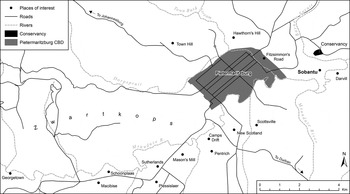
Communities of Peri-urban Pietermaritzburg.

‘LAISSEZ-FAIRE’
Racial segregation came early and fast to the nascent colony of Natal, albeit in ambiguous, fitful and porous ways intended primarily to manage conflict over land. Native Locations (basically rural protectorates) were demarcated around the colony in 1846, including Zwartkop on a stretch of rough-and-tumble land overlooking Pietermaritzburg (which had become the capital of Cape-administered Natal just three years prior). The sale of land within reserves was prohibited in favour of communal land tenure, with disputes adjudicated by loyal and dependent chiefs exercising formalised customary patriarchal law under the state's watchful guidance.Footnote 13
Soon after this, another group of Africans established their own discrete community on the neighbouring farm Edendale, following almost precisely opposed principles. The amakholwa, or ‘converts’, saw themselves as the vanguard of a Christian, educated, market-oriented African elite who could compete on an equal footing with whites in the settler economy. By numerous accounts they achieved many remarkable successes.Footnote 14 As freehold property, however, Edendale was never formally reserved for Africans prior to the application of the Group Areas Act beginning in 1960. Indeed, by the early twentieth century many amakholwa landowners had begun to rent out or to put their shares of the property up for sale. An increasing number of non-Africans became landowners in that way, and by the time of the first official census in 1936, the wider Edendale area comprised one of the most racially diverse peri-urban communities in the country: 277 Europeans, 119 Coloureds, 1,283 Indians, and 7,011 Natives, according to the categories of the time.Footnote 15 To be sure, people tended to live and socialize in discreet enclaves mostly spread out over a large area with a semi-rural ambience. Yet homes were close enough that children played together, and residents eventually came together to form associations that led to a rudimentary multiracial local authority.Footnote 16 The latter drew upon a long history of amakholwa protest against discriminatory laws and settler racism, including through lawsuits, petitions to central government, their own independent press, and even fisticuffs. While rarely successful in their broad demands (such as for self-government, in 1880), amakholwa opinion comprised a significant prick to the conscience of white Natal.Footnote 17
The town of Pietermaritzburg during this period was also never formally reserved for whites only, and indeed became home to traders and labourers from many racial groups.Footnote 18 Its extensive boundaries allowed for an organic growth in and around the formal grid of streets and water channels. City Councillor J. Boshoff in 1855 referred to an unregulated ‘village’ of Africans having sprung up (and eventually been removed) on empty land on the south side of the river where it flowed past the town centre.Footnote 19 Meanwhile, Africans with the means remained free to purchase their own property in town. This they did with the establishment in 1865 of New Scotland, an amakholwa ‘colony’ also just across the Msunduze River from the central grid. The first attempt to quantify African property ownership in 1898 found that Africans occupied 96, and owned 42 ‘buildings’ in the city.Footnote 20 The district surgeon clarified this a few years later as meaning that some ‘possess houses of their own, and live in a more or less civilized manner’.Footnote 21 By the 1920s about fifty Africans owned sometimes substantial brick homes in the mixed-race neighbourhood, often renting to diverse tenants, while an estimated four to five thousand Africans lived as families scattered around the city on town lands or pockets of freehold farms.Footnote 22 A small but relatively diverse coloured population (then still considered more-or-less white), and after the 1870s a rapidly growing Indian population, also found residence in town, primarily in the lower, east end of the grid where real estate was cheap in large part because of chronic water supply problems. Around the turn of the century, a new Indian ‘colony’ was established at Pentrich/Camp's Drift on the west side of the city. A 1952 census found that about 300 Africans lived in Pentrich, mostly renting rooms from Indian landlords but also owning 25 acres (5 per cent) of the area.Footnote 23
That said, and much like almost any city in the world in that era, people from different cultural, linguistic, and class backgrounds tended to self-segregate or cluster into more or less discrete neighbourhoods. Housing and land prices, affected in part by differential access to channelled water, helped consolidate this tendency. Cultural factors also played a role as the great majority of African ‘immigrants’ did not conform, nor aspire to conform to colonial notions of proper urban life. The first generations of non-kholwa Africans in particular tended to regard the city as a stepping stone towards a prosperous life back in the rural areas – a temporary house rather than a cultural home. This quickly led to conflict with property-owners (and voters) over issues like transience, noise, fires, animal smells, nakedness, and other aesthetic questions. The first proposal to establish a segregated, properly managed Native Town already anticipated these issues in 1848. The so-called Gibb scheme put forward by the colonial government envisioned the purchase of 1,000 acres of land two to three miles from the city centres of both Maritzburg and Durban. The first fifty of those acres would be allotted to ‘advanced natives’ who would form the nucleus of a stabilized, monogamous, and appropriately-attired African workforce. As their anticipated prosperity became evident, other Africans would be attracted to the lifestyle and ‘reclaimed’. Far from proposing to expel the desired intelligent and industrious Africans from proximity to the city, Gibb wanted to bring them nearer.
Thus the European and Native population would be brought into more intimate and closer connection with each other, and under more favourable circumstances than can apparently in any other manner be brought about … A nucleus of natives will thus be formed to foster and disseminate enlightened views and principles and the first great difficulty in their improvement be overcome.Footnote 24
Gibb's proposal had the backing of the top official for native affairs in the colony, Theophilus Shepstone. It nonetheless fell through for a variety of reasons, no doubt including ‘want of funds’Footnote 25 but perhaps also unstated anxieties about the precise meaning of ‘intimate’. The founding of Edendale in 1851, and the growth of another Christian mission to the east (Ekukhanyeni) also undermined the initiative by promising to fulfil one of its main objectives without any cost to the colony's purse (that is, providing a place for ‘advanced natives’ to settle and inspire their countrymen). Edendale and Ekukhanyeni, however, were still too far away to be of much use to city employers who wanted cheap, readily available labour. The city thus stepped in with its own proposal in 1855. Its village was conceived as what we would now call a ‘site and service’ project, that is, the city would provide land from within its extensive boundaries for free and give the tenants one year to build on it or lose their claim. The first draft regulations for the village imagined it in spacious, semi-rural terms, with one-acre plots that would allow subsistence cropping and domestic animals as a supplement to the low wages that African workers received, the latter being an assumed necessity both for their employers and for Africans’ own moral welfare.Footnote 26
During the first town council debate on the issue, supporters explained that their main concerns with the unregulated status quo were fourfold. There was the noise that Africans made (‘psalm-singing till late hours in the night was a perfect nuisance’, as one councillor put it).Footnote 27 Closely related to this was the presence of squatters and unemployed visitors who had no means of support except, presumably, petty crime. Third was a desire to protect legitimate African employees from the exorbitant rents that they were required to pay to live in town. Rents of up to £3 a month exceeded the average worker's wage and, since wage hikes were ruled out, virtually required Africans to top up their legal income by other implicitly criminal means like poaching. Cheap, well-managed accommodation would avert this problem while reducing pressure on employers to pay their workers better.
Finally, there was the disruption to service caused when male African workers whose families still lived in the rural areas absconded from work when family called. As the Natal Witness put it in expressing its support for the village, the city could solve that aspect of the labour problem by using its most abundant resource (land) to ‘foster a new class of labourers, and to endeavour to add to their number by holding out inducements for them to settle comfortably with their families near to our labour market’.Footnote 28 Other councillors pointed out the opportunity for the citizens of Maritzburg to fulfil their Christian obligations by providing decent homes for their employees and families, while at the same time conveniently providing the city with a steady new source of rental income.Footnote 29
The main opposition to the motion focused on the potential that such a village had to harbour ‘lazy, dangerous and mutinous vagrants’, as letter-writer ‘Alpha’ put it. His other main fear was that a village would undermine individual white employers’ ability to discipline cheap labour under their direct supervision on private properties. There was an implicit political anxiety in this as well: ‘no encouragement should be given [to Africans] to isolate themselves, or band together in large masses or stations’.Footnote 30 Councillor Boshoff also spoke against the motion but in more liberal terms. Why not allow Africans freedom to ‘build houses and live properly’, dispersed throughout the city on its abundant supply of privately owned but empty plots as determined by the real estate market?Footnote 31
The words ‘sanitation’ or ‘hygiene’ or ‘disease’ among or caused by Africans are strikingly absent from the debate at this stage. Indeed, it must be stressed that whites generally regarded the Zulu as a robust, clean, and environmentally-conscious people. Empirical observation seemed to bear out such views. As late as 1903, for example, mortality from typhoid was lower among rural Africans than it was among whites in the city.Footnote 32 The Native Affairs Department had meanwhile brusquely rejected a city proposal to expel the African population of Zwartkop in order to protect its expensive new source of drinking water, Henley Dam, on the grounds that ‘the Natives in their habits were not likely to pollute the streams’.Footnote 33 Certainly, there were ongoing anxieties about the effects of town living on African health and morale, including from their raggedy Western clothes, ‘wretched’ living conditions, and ‘filthy huts’.Footnote 34 Blame for this, however, was generally cast upon the employers rather than any innate slovenliness among Africans. Shaming whites for their blatant disregard for Africans’ wellbeing was thus a common theme among letter-writers. In the case of some shoddy-looking houses at the Edendale station, Bishop Colenso also exonerated Africans during his visit there in 1854: they had no spare time for home improvements since every effort was being channelled into cash crop farming in order to pay off their debts as quickly as possible for the purchase of the land.Footnote 35
Draft regulations for the proposed village make it clear that town councillors scarcely regarded sanitation as an issue for the projected population at all, notwithstanding their awareness of the recent discovery of the link between contaminated water and cholera. Of fourteen proposed regulations, only one (the very last enunciated) touches on the subject: ‘No broken bottles, bones or other nuisances, to be allowed in the streets of the village.’Footnote 36 Detailed specifications meanwhile provided for minimum house size (24 by 12 feet), number of rooms (2–3), a chimney, and a garden enclosed ‘with a neat and substantial fence’.Footnote 37 They thus ruled out traditional style homesteads and informal structures. They also ruled out certain behaviours (‘no heathenish rite’, polygyny, uncontrolled dogs, and so forth). But the regulations were completely silent on the questions of water supply and of privies.
The motion to create a village where Africans presumably took adequate care of their own sanitary requirements was approved by a vote of 5:2. That decision, however, was quickly overshadowed by a much more heated debate around whether to ‘secure the sanatory [sic] safety’ of city dwellers by imposing residential building standards in Pietermaritzburg itself.Footnote 38 Some councillors probably saw the proposed regulations as a discreet method to push Africans out of town and hence induce a population for the newly approved Native Village. Councillor Boshoff, however, pointedly insisted that the central question was how to compel white property owners to respect their neighbours by maintaining adequate structures and tidiness so as to inhibit the spread of diseases such as cholera and smallpox.Footnote 39 This sparked an uproar. Some councillors construed the motion as an infringement by the state upon individual property rights. To Councillor Leathern it was ‘selfish, arbitrary and calculated to check industry’, ‘not fair to natives’, and ‘discreditable’ to the assumed inherently high standards of English dignity and cleanliness.Footnote 40 The motion nonetheless passed in a watered down form. With regard to African tenants, the approved standard specified only that African-occupied dwellings be limited to one for employees per property. While limiting the quantity of African residences, however, the city tellingly did not interfere with owners’ freedom with quality, leaving the standards of employees’ onsite dwellings completely unregulated. The city did not even require that a privy be provided for employee accommodation.Footnote 41
These compromises appeared to take the wind out of the sails of the approved Native Village, and it never happened. The fact was that open land remained plentiful enough within the city's boundaries to push isolated nuisances out of the way in an informal, ad hoc way using available police powers. The bush along the river, spruits (small streams), and fringes of town was meanwhile thick enough to allow procrastination on the privy issue. Indeed, with procrastination such an easy option, there was insufficient consensus among voters to support a budget for even the most basic needs for workers in town – public latrines connected to sewers for Africans’ use were not considered a justifiable expense until after the Great War.Footnote 42 A deep economic depression lasting from 1865–70 further settled matters in favour of the status quo. A mooted private location at this time, again backed by Shepstone himself, appears to have been abandoned in the face of the financial crisis.Footnote 43 An even more radical proposal by the city's Inspector of Police and of Nuisances in 1873 was to expel all (in his language) ‘Hottentots, Kafirs and Coolies’ from the city and to place them in separate locations two miles beyond city limits. Citing crime, sickness, sexual menace, and property values alike, this idea too sank without a further trace.Footnote 44
Another anxiety persisted well into the nineteenth century that undermined enthusiasm for the village idea among most white officials and voters. This was the fear that an African village, however much it was intended to encourage the development of a stable working class, would inevitably attract a new population of ‘undesirable’ and ‘won't work’ residents. This anxiety may partly explain the failure of yet another village proposal in 1875. This time it was for a site on the town lands rising to the north (agriculturally marginal but today among the city's most valuable real estate). It was well known that Africans squatted in the nooks and crannies of the Town Bush Road area. Why not formalize them and start earning rental income? This village proposal was again approved but then almost immediately abandoned in favour of a counter-proposal for barracks for single men on the lower side of town.Footnote 45 The Fitzsimmons Road barracks better suited a tightly controlled but transient, cheap male labour force than a village, and in any case were far cheaper to build and manage.
Over time, the colonial government's and city's ad hoc approaches to the African presence in the city resulted in a raft of policies and by-laws that somewhat policed Africans’ movement, settlement, behaviour, and attire. Notably, on Shepstone's influence the colonial government sought to impose a coordinated policy by introducing the togt system in 1874. This required Africans to register for labour in all urban jurisdictions on a daily basis and to wear a badge to display their legal status. In addition to the togt requirement, Pietermaritzburg city imposed a curfew on Africans and laws prohibiting the sale of home-brewed liquor in order to keep down the noise at night. However, there was no end of creative ways to get around the rules by all parties, and in practice none of these restrictive laws was particularly well enforced. Swanson notes, for example, that uncooperative employers in Durban meant that never more than one-third of African employees at any given time actually possessed togt passes as required.Footnote 46 As late at 1886, the Natal Witness denounced the togt system as ‘laissez-faire’ and tentatively condoned calls for a harsh crackdown on what they saw as Africans’ dangerous de facto freedom of movement and accommodation.Footnote 47 The fear of proximity in this case centred on black men's supposed uncontrollable lust for white women and the threat of civil wars roiling Zululand.Footnote 48
Cool heads prevailed in this case, and it is important to remember that many settlers regarded the panic surrounding both the so-called Black Peril and the Zulu as a military threat with disdain. The need to secure African labour (and amakholwa loyalty to the Crown) far outstripped the risk of alienating it by harassment and unnecessary restrictions. Indeed, aside from the above unusual, short-term instance of moral panic, a certain laxness toward Africans in town remained pronounced, and is even suggested in official discourse around African health. As the Umgeni District Surgeon D. Campbell Watt observed in 1898:
The health of the Natives in this Division would appear to be very good indeed … Most cases are chicken-pox, brought into town by Kraal Natives, who under the present Borough Regulations, are allowed to come into town, and invade your premises at their own sweet will, calmly taking up their quarters for the night in your Kafir house.Footnote 49
As for liquor laws, an indirect way of restricting the female population in town, these were ‘utterly futile’,Footnote 50 which, in any case, was likely just as well. As The Natal Witness presciently argued in its case against the registration of African workers and in favour of tolerance of discrete (often female-run) shebeens in town, strict laws would only push the problem out of the borough boundaries to form ‘a sort of belt of outer darkness’, far more difficult to manage.Footnote 51
In early iterations of the village debate, the feared ‘loafers’ and ‘spongers’ that a proper village might attract were male. There was also the problem of ‘impudent’ laundrymen known as amaWasha, whose guild-like stranglehold over a critical service industry gave them the economic wherewithal to ignore city attempts to impose restrictions on their movements or their ability to facilitate illegal entry into the city of their togt-less kin.Footnote 52 By the last decade of the nineteenth century, however, a further problem had become increasingly apparent in the form of a growing population of ‘loose’ African women. Radically divergent views on what to do about them complicated the question of a native village. Put simply, if the police and property-owners could not control women and illicit brewing even in their own literal backyards in the heart of the city and middle-class neighbourhoods, then how could a native village be anything other than an open door to uninhibited drunkenness, thieving, and immorality? Taking a pragmatic view, the district surgeon in 1903 proffered a powerful health argument in favour of the status quo, that is, for allowing African women to remain in town even as purveyors of sex and booze:
Many Native girls and women wander from their kraals in the country and take up the profession of prostitutes in the City … Anything like a wholesale banishment of these women to the country is sure to be followed, in my opinion, by an epidemic of what has been termed the ‘social pest’. I am disposed therefore not to be too severe on these women, … and not to trouble so much about those whose relatives make no application for them.Footnote 53
In other words, better to contain the health risk in a known and big but relatively manageable space (Pietermaritzburg), than either disperse it to the rural areas or over-concentrate it in a formally segregated village.
These discussions coincided with a profound challenge to the rustic character of the still-spacious central grid area – the arrival and consolidation of Indian immigrants as significant landowners and economic competitors to the white settlers. It was this group that attracted by far the strongest racism expressed by city officials on issues related to sanitation and health. As the district surgeon bluntly put it, ‘the Indian, in spite of sanitary inspection, still wallows in his native stench and filth’.Footnote 54 To Magistrate Charles Barter, the ‘petulant Indian … has made some of our villages well-nigh uninhabitable, and has seriously increased the difficulties of maintaining sanitary regulations in our towns’.Footnote 55 It was thus the predominantly Asian side of town that was the focus of the first aggressive initiatives to enforce sanitary standards within the city in the 1890s, including through a proposal for the above-mentioned ‘Coolie location’ (unsuccessful) and legal restrictions on the sale of property to Asians (successfully enacted by the colonial government in 1893).Footnote 56 The latter aimed to halt the ‘penetration’ of Indians into existing, predominantly white areas, but allowed the Asian character of the lower downtown to cohere. It also indirectly channelled a growing Indian population out to fringe areas upstream of the city like Camp's Drift and extending into Edendale itself. There, ironically, the almost total lack of sanitary or other controls directly exacerbated the health risks to the city from flooding and grossly polluted water flowing down the Msunduze River.
One other opinion on the matter at the time was only obliquely documented: that of African chiefs in the neighbouring reserves. Heads of households and lineages in the reserves were deeply concerned about the breakdown in traditional social hierarchies that city life implied, and the health costs (like sexually transmitted diseases) that got exported back to the reserves. From Benedict Carton's sympathetic account, chiefs frequently complained to the government that it was supplanting their role as patriarchal authority over young men and women, albeit so ineffectively that it was exacerbating gender and generational conflict. The Bhambata rebellion, or ‘war of the heads’ in 1906, was thus as much a struggle between young and old Africans as between Africans and the white settler state, with elders looking to the state for help in shoring up their eroding authority, while youth turned to violence to assert their own. Chiefs in the reserves around Pietermaritzburg stayed out of the Bhambata fray. However, a joint statement by local chiefs in the run-up to the fighting laid out their grievances. They rued sons who went to the city attracted not only by the possibility of independent income but of sexual exploits with town women. The chiefs wanted government to ‘hound’ the women (the ‘treacle’) out of the town. But where then would the women go? One chief, Ziboni, shared the government's anxieties about deporting them back to the reserves and proposed instead a unique kind of segregated location. As he put it, ‘Can't these bad women be put into a kraal … all by themselves.’Footnote 57
CRISIS MANAGEMENT
Thus far we have seen a bewildering muddle of impractical and self-contradictory opinions that seemed to shift with the breeze of every new labour demand or moral panic and that undermined the political will to do anything meaningful. Did, as Swanson argues, the arrival of bubonic plague in 1901 refine matters enough to swing the argument in favour of formal segregation? Before answering that question from the Maritzburg evidence, it is important to clarify a commonplace misinterpretation of Swanson's work. As he shows in his unpublished dissertation, the plague did not in fact kill many people in Durban, nor were squeamish whites particularly fearful of Africans as the source of contagion. Rather, it was fear of infection from whites that sent African workers in Durban packing for presumed safety at their homes in the rural areas – business came ‘almost to a standstill’ as a result.Footnote 58 As one African man expressed to the Durban police at the time, ‘We are given this disease by the white man, we are carried away to die … either it is a plan to get rid of us or the disease is very dreadful.’Footnote 59 The primary intention of the Native Locations Act that was finally passed into law in 1904 was thus not to protect whites’ health but to stabilize the city's African work force.
The locations idea did not have much traction in Pietermaritzburg, not least of all because the Act of 1904 did not provide for funding. Marcia Wright has also defended the reputation of colonial Natal's public health officials in this period for their level of professionalism and courage (in the context of vested private property interests) to argue against race-based responses to contagious diseases.Footnote 60 Indeed, the Natal Public Health Act of 1901 emphasized holistic approaches to sanitation, which saw different races as part of the same water-sharing community. White private property-owners, private doctors, and self-policing by independent statutory bodies like migrant labour agencies, were in this view the key obstacles to public health. As with earlier attempts to impose building standards in the city, the progressive approach attracted many enemies, but it clearly had the support of key Maritzburg officials and the liberal press at the time of the plague outbreak. One looks in vain, for example, for even between-the-lines allusions to Africans as a source of danger. The Natal Witness ran almost daily reports to follow outbreaks of the disease in the district, in Durban, and elsewhere in the colonies, as well regular editorials under the titles ‘Enteric’, ‘Health’, ‘Public Health’, ‘Our Water Supply’, ‘Some Sanitary Suggestions’, and ‘Inter Alia’ (the last a column that was frequently health oriented). Almost without exception, these articles laid the blame for contagious disease upon irresponsible white property-owners, industry, or the city itself for creating conditions favourable for the spread of infection. The only significant mention of Africans on this topic in the leading daily newspaper in the first big plague year was in an editorial exhortation to white residents and businessmen to protect their employees. It was suggested they do this by, first, cleaning up and disinfecting their employees’ huts, and secondly, by rigidly excluding ‘visiting boys’.Footnote 61 The editorial ‘Some Sanitary Suggestions’ in November also listed underpaid labour among the five priorities citizens needed to address if they hoped to protect the city from health scourges. It recommended the appointment of a full-time professional sanitary inspector whose tasks would be focused primarily on the presumed main proximate threat, ‘European residential quarters’.Footnote 62 City officials meanwhile stressed the danger to the city as coming from outlying commercial farming districts. Maritzburg was thought to be more vulnerable to the disease in that respect than Durban ‘because it was in the centre [of the colony]’ and a transit point for people and rats from all directions.Footnote 63
Different responses to infectious disease reflected not only available scientific knowledge, but different notions of the ‘ideal native’ or stereotypes about tribal cultures. Tellingly, for example, the Durban idea of offering Africans clean accommodation at state expense was greeted with open derision by the Natal Witness. It was not because the editors disagreed so much with the location idea in all cases. On the contrary, the newspaper's editors praised Cape Town's locations, which they noted had lately been ‘improved’ in response to the plague threat there.Footnote 64 Where they found Durban council risible for considering a similar policy in Natal was in the local practicalities. Natives in Natal, they pointed out, even urbanized Christian ones, generally continued to practice polygyny and ukulobola – marriage by cattle. This implied a cultural incompatibility with proper urban life that would make a truly urban native location unfeasible compared to the Cape's mostly coloured or ‘Hottentot’ populations. The example of Edendale, already regarded as worrisomely overstocked with cattle by the late nineteenth century and where amakholwa elites vigorously defended their practice of ‘Marriage presents’, spoke plainly to this stereotype.Footnote 65
Maritzburg's efforts to control the plague while maintaining its cheap labour supply did not seek to resolve these debates. Rather, they centred almost entirely on: (a) killing rats; (b) further compelling or shaming individual white property owners to clean up their premises; and (c) attending to the city's own often poor dumping practices. This approach appeared to work as there were very few cases of plague recorded in town, no exodus of African labour, and basic accord with African leaders.Footnote 66
Rather than the plague, it was another issue altogether that laid the groundwork for ultimately deciding to build an African township. The Natal Native High Court ruled in January 1908 that homebrewed beer (utshwala) was not an intoxicating substance. This ruling removed the power of the police to arrest Africans who brewed beer for sale, and whose backyard shebeens were the focus of much of the noise and prostitution complaints of the past decades. However spottily effective the law had been before, its removal opened the gates to a surge of shebeening within the city, and to the emergence of marketized traditional brew doctored to make it truly intoxicating (isishimeyana). An unsatisfactory but basically tolerable situation suddenly became much worse. As Chief Constable of Police Fred W. Moore put it in his annual report: ‘The outstanding feature of the year is the Increase in Drunkenness among Natives.’Footnote 67 Without the easy target of beer brewers, he continued, he now faced ‘the indiscriminate and promiscuous quartering of such numbers of natives in private yards and locations within the City and suburbs, under such circumstances that it is quite impossible to exercise any proper supervision or control over them’.Footnote 68 A tightly regulated urban location would provide such control, and Moore consequently threw his political weight behind that proposal.
The native beer ruling created a similar crisis in Durban, where politicians mobilized to push a bill through the colonial legislature that would enable the reassertion of control over African brewers and drinkers.Footnote 69 Passed as the Native Beer Act (number 23) of 1908, it provided the means to realize the location idea in practice. First, it allowed municipalities to declare for themselves a monopoly on the production and sale of beer. Then it asserted police powers to arrest not just brewers up to five miles beyond the town boundary, but also anyone transporting homebrewed beer into the city. Anyone consuming beer off the premises of the city's newly established Native Beer Hall committed an offence, as did any African woman or person under the age of fifteen. The majority of people arrested for transgressing the law in its first year of operation were in fact women, which led council to declare success in ‘stamping out’ the shebeen problem within its borders.Footnote 70 Another success was tallied the following year as the city's monopoly on beer sales generated no less than £4,300 in revenue.Footnote 71
In the short run, repression and displacement removed the main need for a properly managed location from the view of the voting population – out of sight, out of mind. More scientific management and improvements to infrastructure also seemed to be paying off, notably, by securing an abundant supply of pure water from the Henley Dam (1901), and by diverting waste water away from the centre of the city (the Southern Intercepting and Outfall Sewer, completed in 1906). To the average citizen, many indicators of sanitation and health in the city thus seemed to be getting dramatically better in this period, and occasional bursts of hyberbolic rhetoric to justify a location simply fell on deaf ears.Footnote 72 The arrival of Spanish influenza in 1918 appeared to confirm satisfaction, if not complacency, with the state of public health. The flu caused only 89 African deaths in the city in that year, less than the toll on a single day in October in Bloemfontein. Africans in Maritzburg (with 1 per cent mortality) were actually less affected by that epidemic than whites in Bloemfontein (2.7 per cent).Footnote 73 Indeed, while admitting to the existence of stubborn pockets of poor housing like Camp's Drift, as late as 1923 the council still believed that the city's relatively dispersed population protected public health from the worst effects: ‘The danger arising from these conditions is, however, greatly minimized at present by the fact that the population is small in relation to the area of land occupied by it.’Footnote 74 Even after a national policy framework had been put in place requiring cities to clean up slum areas and to provide housing to Africans, the mayor's report of 1926 unequivocally refuted the notion that a health threat to Europeans from African housing was the motive to act. The greatest threat of infectious disease to whites from Africans, he asserted, was enteric fever (typhoid), which had nothing to do with the spatial distribution of the races within the city, but with the system of production and distribution of contaminated milk. His solution was not enforced urban racial segregation but a concerted propaganda campaign by the city to educate consumers, establishing or mandating proper latrines for Africans working in and around town, ridding the city of cow sheds, and closing down the remaining dairies within city boundaries. These initiatives continued well into the 1930s and helped to shape the form that the Model Native Village eventually took – that is, suburban as opposed to the earlier semi-rural proposals.Footnote 75
LOCATING THE LOCATION
Crisis management obviously did not address the underlying forces that were increasingly engendering ill health among the African population just outside the city borders. On the contrary, aggressive enforcement of the Native Beer Act simply pushed brewers into increasingly anarchic pockets of freehold land that lay beyond the five-mile enforcement zone. Two areas to the west known as Sutherlands and Macibise became particularly notorious. Maritzburg exacerbated the situation in 1909 by turning the bulk of the so-called town lands into commercial wattle and gum plantations. Any proposal for a native village thereafter had to overcome the obstacles both of the cost of purchasing additional lands (or the loss of plantation revenues) plus local citizens’ resistance to having an African location placed near their neighbourhood. It was precisely the latter (‘very strong objections’) that sank yet another proposal for developing a location near the city's Fitzsimmons (bachelor) barracks in 1919, despite strong lobbying by the mayor.Footnote 76
It needs to be emphasized that these were politically fraught years, and that debates over urban health and sanitation took place in a cauldron of other, frequently violent disputes. The Industrial and Commercial Workers Union (ICU) had been founded in 1919 with the mission of organizing African labourers to demand better wages and working conditions. It quickly grew in strength and militancy, with strikes and boycotts around the country that in many cases were met with violent repression. Edendale itself was quiescent, but Edendale elites or graduates (like Richard and Selby Msimang, Stephen Mini, Albert Luthuli, and Josiah Gumede) were well known to be leaders on the militant side of these developments. In Maritzburg meanwhile, economic and housing travails among whites deeply divided the white population on how to deal with African protests. From 1920, the Labour Party (which the ICU had endorsed as broadly supportive of African nationalist aspirations) held the parliamentary seat for the north of the city. The southern constituency, however, remained loyal to the South African Party, which had crushed both African and white workers’ strikes on the Rand (1920–2).Footnote 77
In this context, and with evidently deteriorating conditions in peri-urban slums all around the country, the Spanish flu sparked national debates on the potential dangers of an ad hoc approach to dealing with African housing and health. Bloemfontein's primary response to the influenza epidemic of 1918–19, notably, was to create Batho, a clean and tightly managed location that not only addressed the immediate health crisis in Bloemfontein but made the city an attractive end-destination for migrant workers coming from Basutoland or Pondoland.Footnote 78 From a certain Johannesburg perspective, this was both a threat to its own insatiable labour requirements, and an inspiring example. Johannesburg consequently led the way in lobbying for a national framework to provide legal mechanisms that would harmonize actions between jurisdictions and economic sectors that were competing for African labour. The resulting Native (Urban Areas) Act of 1923 required that all municipalities establish publicly-owned and managed townships for African families whose husbands worked in the municipality as a prior step to demolishing insanitary quarters.Footnote 79
These developments suited an outspoken but thus far ineffective faction of Maritzburg officials, including the mayor, chief of police, and medical officer of health. The Native (Urban Areas) Act promised a practical means by which one stone could kill three and maybe four old birds at the same time. It would require the city to demolish shacks that presented the most pressing health hazards without causing undue hardship to the affected people; the new homes for evictees would attract and stabilize a section of the African labour force; and, given that many of the worst slum conditions existed on land owned or rented by Indians, those demolitions would create space for ‘the better type of Indian’ to erect their own new homes.Footnote 80 If all went well, income from rentals and beer would not only cover costs, but even generate a profit for the city. Any remaining opposition to the idea (for example, ‘not in my backyard’, or ‘too risky’, or ‘Zulu culture’) could be over-ridden by pointing out that the mandate came from a higher level of government. The model of township proposed by national law was also no longer controversial. Scientific knowledge about enteric fever had by this time clarified that cattle were not welcome within the city. The village would therefore be comprised of standardized homes on a compact grid with room for fenced gardens only. Homes would be rented to qualified African families at sub-economic (below market) rates subsidized primarily by beer revenue so as to protect white rate-payers from the expense. The city reserved for itself wide powers to control the behaviour of residents and the access of non-residents in order to prevent the re-emergence of informal structures, illicit shebeens and lodgers, and ilobolo assets (cattle).Footnote 81
Thus, while Maritzburg council's first response to the national proposal was to say ‘no’, on the grounds that the bill did not explicitly protect the lucrative beer monopoly system, once Pretoria clarified that it would not interfere with local preferences for funding, the city easily agreed to do its part. The only problem then was where exactly to put the proposed location. Anticipating this problem even before the Native (Urban Areas) Act became law, council discreetly purchased an additional 1267 acres (512ha) of private farmland abutting its eastern boundary on Bishopstowe Road. It got a good price in large part because of the farm's proximity to the conservancy depot. Declaring its intention to use this land for the new township, council provoked the very first direct intervention by Africans in the debate. In a March, 1922 petition to city council, African signatories appealed against the Bishopstowe site on the grounds that it was unsanitary. They proposed an alternative site on the west side of town – Mason's Mill, just west and farther upstream from Camp's Drift/Pentrich, and just within the five-mile limit.Footnote 82
Enough councillors were embarrassed by this image of putting the city's African population out to the dump that the decision was put on hold. Yet the pressure intensified, including with a stern letter from the secretary of native affairs in 1924 demanding that the city ‘terminate without delay’ the slum conditions on the west side of the city (in particular, Sutherlands and Macibise, immediately upstream from Mason's Mill).Footnote 83 Meanwhile, the African petitioners picked up some influential allies to support their case, including prominent white liberals in the Native Welfare Society and no less than the Chief Native Commissioner of the province. But objections to Mason's Mill arose amid a range of concerns. Most obviously, at only 44 hectares the available site was a tiny fraction of the size of Bishopstowe and would require another large expense to purchase room for expansion. Mason's Mill, much of which lay on shale, would entail more than double the expenses to hook up to sewer and electricity compared to Bishopstowe, with long delays to be expected from both the technical difficulties and expropriation of rights-of-way from unhappy white owners in the area. Mason's Mill also implied that the city take responsibility for the cleanup of Sutherlands, which could hardly be left in its current anarchic state were the adjacent lands to be developed. Indeed, the river itself testified against the site for that very reason. Mason's Mills sat at a point where run-off from the greater Edendale area including Sutherlands (‘the worst slum that could scarcely be imagined’, as Selby Msimang recalled it)Footnote 84 was most concentrated. The Msunduze River there was little more than ‘an emulsion of faeces and water, with an admixture of urine’, as the Medical Officer of Health later described it.Footnote 85
Notwithstanding the African petitioners and their friends in high places, city officials were aware that African opinion was not united on the issue. In 1923, the city had actually donated a piece of land in Mason's Mills for use by African football clubs. Stingily and belatedly, it was attempting to support a wholesome recreational activity that would be convenient to African men making their way to homes in the Edendale direction after work in the city. But almost unanimously the African clubs rejected the gift on the grounds that it was too close to the Sutherlands shebeens and thus inimical to the health and moral objectives, a ‘Menace’ in the reported word of J. J. Magwaza, secretary of the Maritzburg District Bantu Football Association.Footnote 86
The site of the proposed township then became ‘the shuttlecock question’ of municipal politics, going back and forth without resolution for nearly three years.Footnote 87 In February 1925, Council finally decided to break the deadlock though a plebiscite, which announcement sparked further ‘emphatic’ opposition from concerned Africans and their allies. A mass meeting of an estimated 200 ‘town natives’ in central Pietermaritzburg unanimously resolved to oppose the Bishopstowe site. Their petition, signed by prominent leaders of the Natal Native Congress (including future president of the African National Congress, Josiah Gumede), the amakholwa chiefs of Edendale and the city, and other prominent African property owners, drew headline coverage in the press. This included an unprecedented front-page interview of one of the African leaders, Walter Msimang. Msimang elaborated on the petitioners’ view that ‘natives object to living within the vicinity of filth’.Footnote 88 Bishopstowe was also inappropriate, he reasoned, because it was far removed from existing African communities on the west side of town. It would consequently entail disturbance to whites as Africans commuted across the city to visit their family and friends.
Msimang, and a subsequent petition by African women directly to the Native Affairs Department, did not dispute the principles either of segregation or of population removals for the purpose of improving sanitary conditions. On the contrary, they were strongly in favour of both. As Msimang put it response to his interviewer's question, did he support the idea of a Native Village? ‘Yes; we hope to live in better dwellings. At present many of our people live in immoral and unclean surroundings at the back of Indian dwellings. The village will do away with this sorry state of affairs.’Footnote 89 What they wanted in such a village was enough land for each family to have two cows and a garden, and ‘everything like a European town’. The women's petition also appealed for a segregated village at Mason's Mill in the name of ‘Public Health, Social Welfare and Morality’.
As mothers and persons intimately in touch with native life and much affected socially by existing disintegrating and unwholesome conditions, we are convinced that the establishment of a Native Village in Pietermaritzburg is the only practical remedy towards checking the many social evils that abound.Footnote 90
Council strongly denied that the conservancy presented a health risk and that in any case it was already committed to closing down the alleged nuisance as soon as a modern, underground sewage system then under construction was completed. The intention was to finish that job by the following year.Footnote 91 But this did not imply that council had made up its mind. On the contrary, the advertisements it took out in the press just prior to the plebiscite did not give any explicit guidance or hints of preference. The Times of Natal (a penny daily, read more widely by working class whites than the Natal Witness) denounced this silence as a ‘hopeless failure’ of leadership.Footnote 92 It then proceeded to provide an assessment of the comparative merits of the two sites itself. Conceding that the conservancy depot was a ‘solid objection’ to Bishopstowe, the Times nonetheless came down heavily against Mason's Mill for a long list of reasons but emphasizing its small size, high cost, and proximity to existing slum areas.
Two days later, just over 1,200 white citizens voted roughly 2:1 in favour of the Bishopstowe site. By the end of the year, and privately expressing its regret for ‘running roughshod’ over African opinion in a decision that potentially prejudiced the supply of African labour, the province gave its approval for the site as the best-suited one on health grounds. The proviso was that the city expedited the removal of the conservancy as promised, which was indeed closed in 1927, only slightly behind schedule. The city's remaining slop service was transferred to a sewage farm located a few hundred metres downstream from the village site.Footnote 93 ‘Nuisance’ (smell and flies mostly) remained a concern, however the new site and new technology were generally regarded as a huge improvement from the conservancy era. A year later, the first hundred homes were opened and the demolition of slum housing in the city finally commenced.Footnote 94
Can this decision be interpreted as proof of the ‘sanitation syndrome’, which is to say, of the devious, perhaps unconscious racism of the city's white decision-makers using scientific language to hide itself? Racism and paternalism were certainly there, and would characterize these debates for many decades to come. But a close look at the evidence and the arguments deployed by the two sides suggests a much more complicated story. In the first place, Africans living in approved accommodation in the city (the majority) were not required to move. Secondly, as The Times of Natal had pointed out and as stands the test of time, Bishopstowe was on several levels clearly the more rational choice for the multiple objectives that the housing project was expected to achieve. Mason's Mill was utterly inadequate for accommodating the numbers of people who needed to be housed. It promised both to intercept and to add to the already astronomical burden of faecal pollution that flowed down the Msunduze on the way into Maritzburg. Bishopstowe, at over ten times the area, would allow both for immediate needs, including residences, gardens on a clean tributary stream, public lands, churches and recreational facilities, and for future expansion. Bishopstowe was also significantly closer to the city centre than Mason's Mill (four kilometres from centre to centre instead of six).
The last point reveals an ironic twist to the debate that was noted by some of Mason's Mill's critics, if not subsequent historians. Mason's Mill was more segregationist than Bishopstowe. It fit like a puzzle piece between Edendale, the peri-urbanized chieftaincies of the Zwartkop borderlands, the mixed but largely African communities within the city's western boundary (Pentrich, Camp's Drift, and New Scotland), and two of the most notorious slums in the province just beyond (Sutherlands and Macibise). Mason's Mill as an African location would thus consolidate a wide swathe of mostly non-white communities spilling over at least three jurisdictional boundaries. Anyone on the way out of town for the illicit alcohol and sex readily available in those places would need to pass through Mason's Mill to get there. Anyone from the ‘overberg’ or eastern Cape seeking access to Pietermaritzburg without legal documents would likely use Sutherlands (and thence, Mason's Mills) as their staging point.
By contrast, Bishopstowe's neighbours were mostly white farmers who would provide a buffer between the village and the uncontrolled liquor and prostitution situations found elsewhere, an essential element of the whole project of attracting a ‘decent’ class of African worker. It was for this reason that the police favoured Bishopstowe, as did the president of the Native Welfare Society (Councillor Taylor, who broke with his own membership on this issue). White farmers in the area did not appreciate the role chosen for them, and they opposed the Bishopstowe site by appealing to national policy. As those petitioners put it, the Bishopstowe proposal was ‘in direct conflict with the principle of the Native Land Act [that is, enhanced segregation]’.Footnote 95 That view did not garner much sympathy, and the apparent alliance between Bishopstowe's white residents and black elites from the other side of town puzzled some councillors. As Councillor Meldrum summed up, Bishopstowe was the better site ‘both from a health and get-at-able point of view’, while fellow councillor Simkins added ‘Europeans were content to live there, and why not the natives?’Footnote 96
Why not, indeed, particularly given that the lead African petitioners came from Edendale, New Scotland, or Pietermaritzburg, and whose homes would not be affected by the new law? Some of the reasons they provided in favour of Mason's Mill certainly struck many as disingenuous. Msimang made the claim, for example, that Mason's Mill was attractive to Africans because the railway from Edendale ran through it. Yet few used the existing passenger train service from Edendale, which took a long and circuitous route into town compared to the direct bus link.Footnote 97 And why were English-speaking, landowning teetotallers like Msimang and the Native Women's League advocating to create a respectable working class township directly in between a known slum area overcrowded with ‘Sesotho-speaking rowdies’ (Macibise) and a Zulu reserve full of ‘polygamists and witch-sniffers’ (Zwartkop), both outside of city jurisdiction? The suspicion grew that amakholwa elites of Edendale were using the plebiscite to rally support for a broader political agenda, with the conservancy as a red herring to distract attention. That alleged agenda included consolidating a large African population under ‘radical’ leadership that would press for town status for an aggrandized Edendale. It was also well known that Edendale amakholwa wanted freedom of mobility for Africans across jurisdictional borders, among other citizenship rights. To some voters, therefore, Bishopstowe was thus not just the healthier and cheaper option for the city. To choose it over Mason's Mill was to strike a blow against ‘agitators’ and ‘negrophiles’ who wanted to overthrow the white man in his own country, to use the rhetoric of the time.Footnote 98
Knowing what came later, fears of a power-grab by black elites in Edendale and Maritzburg may seem to readers today as paranoid to an absurd degree. It would be a mistake, however, to underestimate the political insecurity of the times, and to read the certainty of white domination as achieved in the 1950s and 1960s back to those times. The ICU had recently established an office in Maritzburg. One of its founding members in the province came from Edendale (Selby Msimang, nephew of the anti-Bishopstowe leader cited above). Another of the anti-Bishopstowe leaders, lawyer Josiah Gumede, was also a leading figure on the far left of the ANC. Gumede, with the backing of Edendale's Chief Stephen Mini, had the year before mounted what Nicholas Cope has called a ‘coup’ that removed the ANC's conservative leadership and that committed the party to a radical political programme of redistribution of wealth, including land. Indeed, soon after the village plebiscite, Gumede toured the Soviet Union and came out with openly pro-Communist views.Footnote 99
For white voters who paid attention to such things, it was entirely conceivable that an articulate, socially ambitious, and politically astute African leadership based in Edendale could leverage enough white people's guilty consciences to achieve their broader objectives. The amakholwa had appealed above and embarrassed the city before on similar issues. That possibility may well have motivated a higher than expected number of whites to vote in the plebescite in defence, not of their health, but of their power to control municipal structures, rates, wages, and white political supremacy in general.
The eventual ‘remarkable’ turnout for a municipal plebiscite did settle the question of location once and for all.Footnote 100 Subsequent protests from Africans of Edendale and Pietermaritzburg, and by European landowners in the Bishopstowe area did not succeed in moving Council or the Native Affairs Department from respecting the result, and the protests quickly died down. A threatened boycott also fizzled once the village opened in 1928. With electricity, piped water, a mix of types of accommodation at low rents, and strict policing against shebeens, the new village's first one hundred units were 92 per cent let after the first year. True, the Msunduze River itself remained heavily polluted and notoriously smelly at that point for decades to come (a modern water treatment plant on the opposite bank from the village was only opened in 1957). But, on the northeast side of the village, Bayne's Spruit ran more or less straight off the escarpment to provide clean irrigation for market gardens. By the 1940s, middle-class Africans in other townships cited it as the standard to aim for – ‘the best houses offered in Natal’, as the Ashdown Advisory Board put it when protesting their own conditions on the Edendale side of town.Footnote 101
CONCLUSION
Pietermaritzburg did not become formally racially segregated with the opening of the Model Native Village in 1928. Far from it. The majority of Africans within Pietermaritzburg continued to live in barracks or hostels, on private premises, and in New Scotland and other freehold enclaves. Slum clearances throughout the 1920s and 1930s did result in the eviction of hundreds of Africans who could not be accommodated in the new township or other approved housing in the city and who consequently found refuge beyond city boundaries, often in the greater Edendale area where they added to the growing health and sanitation crisis there. However, just as opponents of the Bishopstowe site had warned, residents of the Model Native Village did make a regular practice of commuting through the heart of the city to visit friends, family, and shebeens on the Edendale side. By the early 1950s so many African commuters were passing through the central business district to and from their places of residence on opposite sides that council mooted the construction of a rail line that would skirt the inner city in order to connect Sobantu and Edendale directly.Footnote 102
None of this is to dispute that white Maritzburgers shared much in common with whites elsewhere in South Africa in their desire to protect their quality of life and real estate values with scant regard for African dignity and aspirations. In that sense, Pietermaritzburg was already typical by the late nineteenth century, and not particularly different from de facto segregated cities elsewhere in the colonial world and the United States in that period. However, if whites’ fear of contagion from Africans was a key motivating factor behind the creation of formally segregated and geographically distant African townships, and that the present shape of South African cities can be simply explained by the ‘sanitation syndrome’, then Maritzburg clearly was not typical. I hope to have demonstrated that other issues were more decisive in overcoming the many objections to creating a managed, formally segregated township for African families, and where to place it. These included Africans’ own concerns for their health and morals, scientifically sound assessments by public health officials, and whites’ not-unfounded anxieties about African elites’ political ambitions. These factors were also likely at work in Durban, Cape Town (etc.) but may have been downplayed in the historiography in the 1970s due to the political imperative of defeating apartheid.
That imperative has been achieved, and while racism obviously remains, today's urban struggles are radically different from forty years ago, including postconflict healing, HIV, climate change, xenophobia, and jobless growth. A catchall term from an earlier time, however memorable, does not stand up well to close scrutiny from the perspective of these changed circumstances. Indeed, the ‘sanitation syndrome’ does not capture the complexity of local debates and decision-making in Pietermaritzburg over many decades, distinctive topography, and vibrant political culture. For contemporary public history to be successful in its stated goals of community development and healing, the Maritzburg evidence suggests that it would be better served by closer attention to that local vibrancy and diversity than casual invocations of ‘sanitation syndrome’ allow.