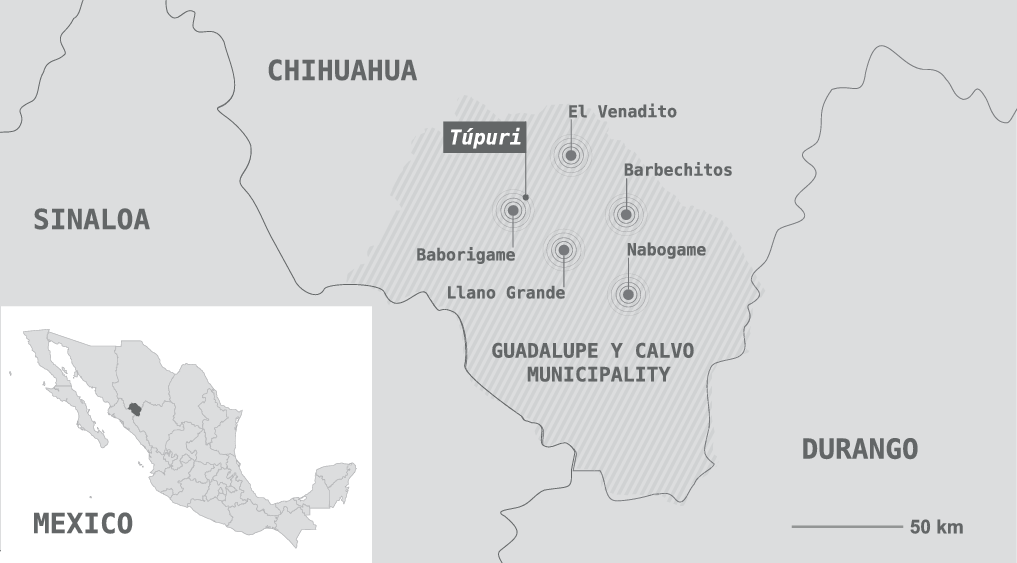
Northern Tepehuan (ISO 639-3: ntp) is one of the 68 native linguistic groupsFootnote 1 currently spoken in Mexico according to the National Institute of Indigenous Languages (INALI 2008). As is the case with many indigenous languages, Northern Tepehuan is under serious threat of disappearance during the next decades as it is spoken by fewer than 9000 people (Carrillo Reference Carrillo2011: 6) whose historical background has been one of social and linguistic marginalization. The Ódami – as the speakers of the language call themselves – live in the alpine valleys of an isolated region known as Sierra Tarahumara, a section of the Sierra Madre Occidental, in Chihuahua State, Mexico. Saucedo Sánchez de Tagle (Reference Rubén2004: 6–9) indicates that the heart of the current Ódami territory is in some sections of the Guadalupe y Calvo municipality, in the southernmost tip of Chihuahua (see Figure 1) but speakers also can be found in the surrounding municipalities of Balleza, Guachochi and Batopilas. Approximately 80% of Northern Tepehuan speakers live in small villages and rural settlements around the population nuclei of Baborigame, Nabogame, Llano Grande, Barbechitos and El Venadito (Saucedo Sánchez de Tagle Reference Rubén2004: 7). There are also some scattered speakers living in the region’s big cities of Chihuahua and Hermosillo.
Map of Northern Tepehuan-speaking area.

Northern Tepehuan is a language of the Uto-Aztecan family, a genetic group spreading from the American Southwest and the Great Basin to Central Mexico in a corridor located alongside the Sierra Madre Occidental (see Miller Reference Miller1984, Mithun Reference Mithun1999, Dakin Reference Dakin, Zarina Estrada, Crescencio Buitimea, Adriana Elizabeth Gurrola, María Elena Castillo and Anabella Carlón2004). Its actual range even encompasses a small region in El Salvador where Pipil Náhuatl is spoken. Northern Tepehuan belongs to the Tepiman branch of the family (Bascom Reference Bascom1965) and therefore is closely related to other northwest Mexico languages like Pima, Tohono O’odham, Southeast Tepehuan and Southwest Tepehuan.
Although there have been some efforts to build a descriptive tradition of the language, many of its aspects remain poorly explored, especially within the phonological and phonetic scopes (for a bibliographic summary of the language see Willett & Willett Reference Willett, Willett and David2001, Gil Burgoin Reference Gil and Ivanhoe2020). During the 1980s, linguists prepared a grammatical sketch (Bascom Reference Bascom and Langacker1982) and more recently, a bilingual dictionary (Bascom & Molina Reference Bascom and Molina2018), but many years passed before the language began to attract interest from descriptive linguists anew. Just recently, some morpho-syntactic research has been added to the Northern Tepehuan bibliography (e.g. Ramos Bierge Reference Ramos Bierge2010, Reference Ramos Bierge2012; Carrillo Reference Carrillo2011, Reference Carrillo2013). In addition, a couple of works have been published focusing on formal accounts of the tonal phenomena (see Woo Reference Woo1970, Kim Reference Kim1997). Nonetheless, the conclusions of these phonological approaches present relevant shortcomings as they have assumed Bascom’s descriptive premises without having direct access to data. The present account seeks to contribute to the renewal of the descriptive tradition of the language.
Data
With respect to dialectal variation within Northern Tepehuan, Molinari, Ruiz & Nolasco (Reference Molinari, Ruiz and Nolasco1995) discuss the possibility of arranging the spatial variation into three dialects: Baborigame (center), Nabogame (south) and Venadito (north) – although further research on this subject needs to be done. In any case, the data presented in this work come from two speakers of the Túpuri village variety, one of the localities belonging to the Baborigame nucleus.
The data were collected through fieldwork interviews. Both speakers are female and were aged in their thirties at the time of recording. The speakers were asked to answer a questionnaire of around 1500 lexical items as well as questionnaires of verbal and nominal paradigms. The recording sessions took place at the University of Sonora, in an acoustically controlled environment although not under laboratory conditions.
Consonants
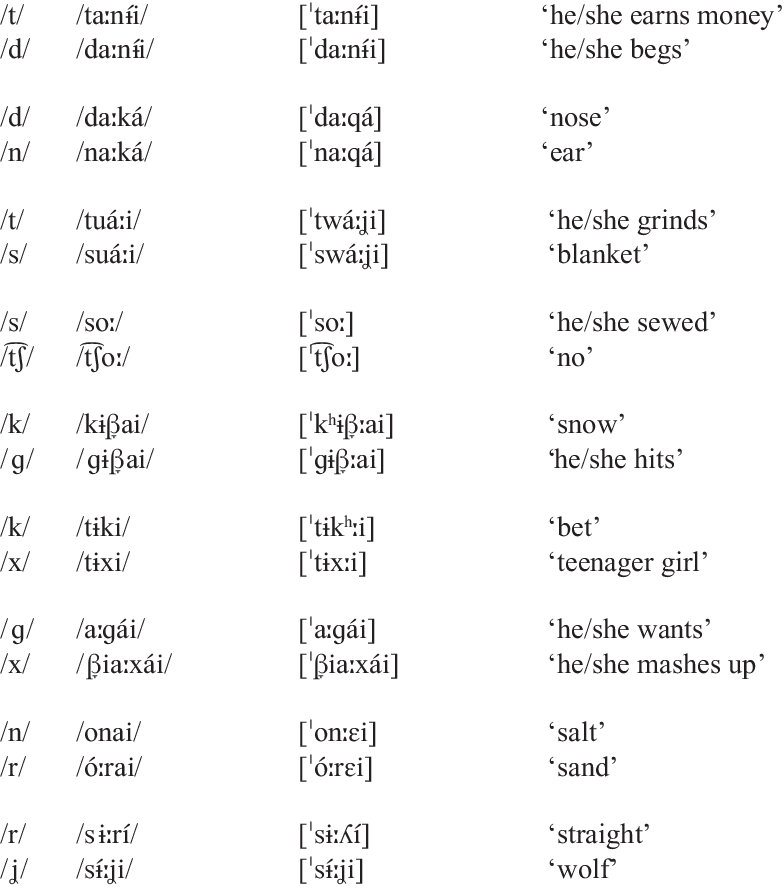
Below, the chart of phonological segments is presented, followed by a list of minimal and near-minimal pairs to show the most relevant contrasts in the language.


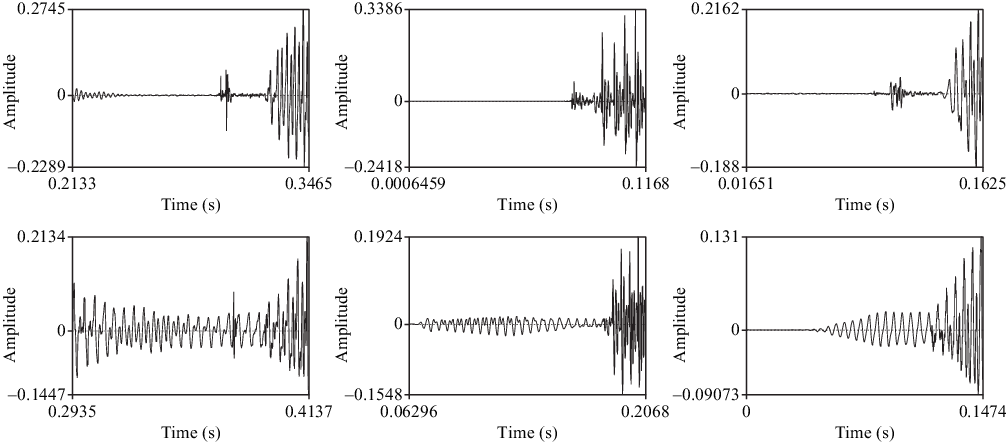
The inventory of consonants of the language consists of 14 segments. Northern Tepehuan has voiced and voiceless plosives in three places of articulation, bilabial, alveolar and velar (see Figure 2). There are also two unvoiced fricatives and one clearly approximant segment.
Waveforms illustrating the voice contrast in (first column) /p/–/b/ /ipuːrai/ [iˈpuːrɛi] ‘dress’ and /ɡibuːrai/ [ɡiˈbuːrɛi] ‘belt’, (second column) /t/–/d/ /taːnƚ́i/ [ˈtaːnƚ́i] ‘he/she earns money’ and /daːká/ [ˈdaːqá] ‘nose’, and (third column) /k/–/ɡ/ /kuːpái/ [ˈkuːpái] ‘hair’ and /ɡuɡuːkai/ [ɡuˈɡuːkɛi] ‘he/she stands up’.

There are also three clearly phonemic sonorants: the nasals /m/ and /n/, the rhotic /r/. On the other hand, the palatal (/ʝ/) appears to be a special case since it is always linked with the presence of /i/ and it is inserted for phonotactic reasons, for instance, avoiding a hiatus or triphthong – see ‘Vowels’ section below – like in /suáːi/ ‘blanket’ whose phonetic form is [ˈswáː.ʝi]. Nonetheless, in a few cases like /sƚ́ːʝi/ ‘wolf’, /ʝ/ can truly contrast with closely similar sounds like [ʎ] – allophone of /r/. It can, therefore, be considered a phonological sound, although it appears to be marginally phonemic.Footnote 2
The affricate /t͡ʃ/ has been said not to belong to the native inventory, allegedly appearing only in loanwords (Ramos Bierge Reference Ramos Bierge2010: 22; Carrillo Reference Carrillo2013: 13). Although it is indeed an infrequent segment, it does occur in a number of native words and roots like /t͡ʃoː/ ‘no’, /t͡ʃukiatai/ ‘few people’, /t͡ʃɨːkı́/ ‘a little’, or /úːt͡ʃai/ ‘canes’. In all these cases there are no traceable phonological motivations for its appearance, i.e. the surrounding segments or position constraints, apart from being lexically specified.Footnote 3 Thus, it should be accepted as a phonemic segment.
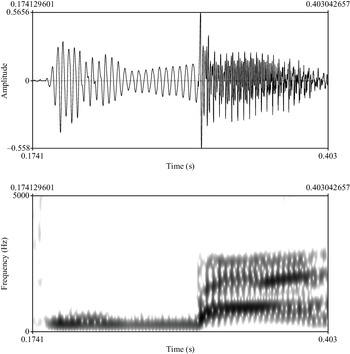
As for the phonetic realization, plosives tend to show a very tense articulation at the beginning of a word, especially voiced plosives. In utterance-initial position, voiced plosives are generally characterized by two traits: (i) the initial phase of the closure is nasalized as seen in Figure 3, illustrating /baxi/ ‘tail’; and (ii) they produce an ‘auditory’ and acoustic impression similar to implosives. In this sense, it can be observed that the amplitude of voicing increases during the closure which typically indicates some degree of lowering of the larynx. However, the proposal of this paper is that these are not true implosives as it is well-documented (Henton, Ladefoged & Maddieson Reference Henton, Ladefoged and Maddieson1992: 71; Ladefoged & Maddieson Reference Ladefoged and Maddieson1996: 119) that pre-nasalized implosives are highly dispreferred sounds in the world’s languages, if not completely absent. The sound pattern described here can rather be characterized as a mechanism that coordinates both pre-nasalization and larynx lowering as a means of sustaining voicing in positions where voicing is aerodynamically difficult, as in utterance-initial position. Ewan & Krones (Reference Ewan and Krones1974) have actually shown that larynx lowering is not unique to implosives, but it is sometimes used to maintain voicing in pulmonic stops. In this respect, Ladefoged & Maddieson (Reference Ladefoged and Maddieson1996: 51) also say that there is a tendency in some languages to associate a sustained vocal fold vibration – as part of the target of a voiced stop – and the downward movement of the larynx, and that there is a continuum between fully voiced stops and implosives.Footnote 4 Thus, a narrower phonetic transcription of /baxi/ ‘tail’ and /daːká/ ‘nose’ could be [ˈmbaxi] and [ˈndaːqá], respectively.
Waveform and spectrum of [mba] in /baxi/ ‘tail’.

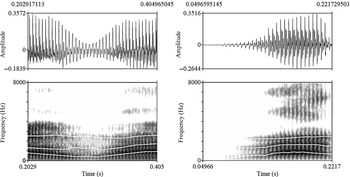
The bilabial approximant /β̞/ corresponds to Southern Tepehuan fricative /β/ – compare with Reyes Taboada (Reference Reyes Taboada2014) data. This approximant is shown in Figure 4 in intervocalic and initial position in the words /kaβ̞ami/ [qaˈβ̞ami] ‘quickly, intensely’ and /β̞araːdɨ/ [β̞aˈraːɖɨ] ‘soup’. It can be noted that, unlike the fricatives, [β̞] lacks a high frequency turbulent noise (Catford Reference Catford1977: 118–121; Martínez Celdrán Reference Martínez Celdrán2004: 203). Voiced labial fricatives like [v] and [β] have a fainter friction than other fricatives, but it can be still observed between 7000 Hz and 8000 Hz – see Jongman, Wayland & Wong (Reference Jongman, Wayland and Wong2000: 1256), Ladefoged & Johnson (Reference Ladefoged and Johnson2010: 202) – which is not the case here. Also, it is expected that voiced fricatives show a considerable decreasing in amplitude compared to approximants, causing a similar effect as a plosive but without its typical burst – see Ladefoged & Maddieson (Reference Ladefoged and Maddieson1996: 325) for examples from Isoko. Approximants exhibit formants and decrease amplitude moderately – see Martínez Celdrán (Reference Martínez Celdrán1991) for Spanish examples – as in the intervocalic example here. In the case of /β̞/ in initial position we observe a weak periodic wave that smoothly increases as it approaches the vowel onset, as is the case with other approximants.
Waveform and spectrum of [aβ̞a] and [β̞a] in /kaβ̞ami/ [qaˈβ̞ami] ‘quickly, intensely’ (left) and /β̞araːdɨ/ [β̞aˈraːɖɨ] ‘soup’ (right).

Alveolar consonants palatalize in the following contexts. Firstly, when an underlying alveolar consonant immediately precedes /i/, it surfaces as palatal – except for /t/. Likewise, in most cases /r/ undergoes a change in its manner of articulation to a lateral approximant [ʎ].Footnote 5 This produces the following alternations: when followed by /i/, /d/ > [ɟ], /n/ > [ɲ], /s/ > [ʃ] and /r/ > [ʎ], as is shown in (1). Additionally, sometimes /r/ may also appear as [ɾ].

In a similar way, preceded by /i/ /t/ > [c], /d/ > [ɟ], /n/ > [ɲ], and /s/ > [ʃ], as in (2). Note that /r/ does not palatalize preceded by /i/.

Palatalization appears also as the result of a morpho-phonological process, as in (3) below, where there are examples of palatalized /s/ and /r/ preceding a following /i/ in the imperative morpheme -/ini/. Observe that a vowel in suffix-initial position deletes the vowel or diphthong at the end of the stem.

Alveolar consonants also palatalize when they come in contact with palatalized consonants so the process can spread across more than one segment, as in /β̞úrsiapai/ [ˈβ̞úʎʃiapai] ‘he/she ties’ or in /ı́ːstukai/ [ˈı́ːʃcuqai] ‘seeds’ where the palatalization caused by /i/ affects /s/ and then the adjacent alveolar consonant – /r/ and /t/ in these cases.
The fricative /s/ also appears as [ʃ] in coda position when in contact with a voiceless stop /t/ or /k/ e.g. /táskari/ [ˈtáʃkaʎi] ‘tortilla’, /káskɨdɨ/ [ˈqáʃkɨɖɨ] ‘thus’, /ástɨkɨi/ [ˈáʃcɨkɨi] ‘he/she throws away’, but not when in contact with /p/ – /araspai/ [aˈraspai] ‘he/she rubs’ – or the nasals /m/ and /n/ – /β̞asmonai/ [β̞asˈmonai] ‘yeast’, /kusna/ [ˈkusna] ‘nape’. Although sC > ʃC without a high/front vocoid is often not regarded as a typologically common process – it certainly does not appear in palatalization surveys as Chen (Reference Chen1973), Bhat (Reference Bhat and Greenberg1978) or Bateman (Reference Bateman2011) – it has been well documented in many Italian dialects (Rohlfs Reference Rohlfs1966) and, diachronically, sk > ʃ/ʃk and st > ʃt occurred in some Germanic languages as High German (Harbert Reference Harbert2007: 49). The abstract nature of this process is still debated, but it can be seen as an instance of assimilation and dissimilation of the feature [anterior] of the coronal /s/ – see Lorenzetti (Reference Lorenzetti, Roberta and Diego2018: 116) for this process in Italian.Footnote 6
An alternative explanation is that an underlying /i/ causes palatalization before being deleted in the sequences /sik/ and /sit/, so the underlying form of [ˈkáʃkɨɖɨ] ‘thus’ would be */kásikɨdɨ/. Nonetheless, there are numerous examples where this rule would not apply, like /ɨsikami/ [ɨˈʃiqami] ‘cropland’, /miːsitu/ [miːˈʃicu] ‘cat’, /βóisiki/ [ˈβóiʃiki] ‘garbage’, /túisiki/ [ˈtwı́ʃiki] ‘patio’, therefore I incline for the first explanation.
The last paragraphs present key evidence for merging the palatal set of phonemes proposed by Bascom (Reference Bascom1965, Reference Bascom and Langacker1982) into the alveolar place of articulation, reducing thus the consonant inventory presented by him. In fact, the necessity of this merge has been noted by some other authors (Carrillo & Estrada 2006; Ramos Bierge Reference Ramos Bierge2010: 22–23; Carrillo Reference Carrillo2013: 14), although they have not provided any analyses. In Bascom’s description, the palatal set includes the proper palatals /c ɟ ɲ/, the postalveolar /ʃ/ – which he represents as ty, dy, ny and š – as well as the alveolar /l/. It should be noted that the lateral approximant represented by /l/ in those works can be better transcribed as a palatal [ʎ]. The analysis of all the materials gathered for this work have shown that [c], [ɟ], [ɲ], [ʃ] and [ʎ] can be characterized as palatalized allophones of the alveolar phonological segments /t/, /d/, /s/, /n/ and /r/ because the palatalized variants only surface in environments contiguous to the high front vowel /i/ – except for /s/ palatalizing in coda.Footnote 7
In rapid speech, however, it is possible to find phonetic sequences of an alveolar consonant plus [i] due to the surface deletion of underlying non-palatalizing vowels that interfere with the palatalization process, e.g. /tiáːnɨi/ ‘he/she orders’ has the form [ˈtiáːnɨi] in isolation but can have the form [ˈtiáːni] in rapid speech, or /tasai/ ‘sun’, in isolation [ˈtasːai], but sometimes [ˈtasːi] in speech – see the recorded passage for rapid speech forms. Similarly, in the case of /s/ becoming [ʃ] before a sequence /ia/ or /iɨ/ the vowel [i] tends to be almost entirely merged with the fricative. It is therefore common to find [ʃa] or [ʃɨ] sequences, especially in rapid speech.
Other frequent consonantal allophones are [q] and [ɖ]. The first of them is an instance of /k/ that usually occurs when adjacent to /a/ or /o/, e.g. in /komi/ [ˈqomːi] ‘back’ or /kaxi/ [ˈqaxːi] ‘thigh’ – and in other previous examples – but not after [ʃ]. The retroflex [ɖ] is an allophone of /d/ that appears before the vowel /ɨ/ as in /dƚ́ːdɨ/ [ˈɖƚ́ːɖɨ] ‘mother’.
Consonants never form clusters and rarely appear in coda position in isolated words. The only consonants allowed in the coda are /s/, /n/ and /r/, as in /táskari/ [ˈtáʃ.ka.ʎi] ‘tortilla’, /kusna/ [ˈkus.na] ‘nape’, /β̞ustai/ [ˈβ̞uʃ.cɛi] ‘he/she blows’, /siaːnkƚ́/ [ˈʃiaːŊ.kƚ́] ‘which’ and /βúrsiapai/ [ˈβ̞úʎ.ʃia.pai] ‘he/she ties’. In rapid speech, however, final vowels can be deleted after /m/, /n/ and /r/ which leads to the existence of final phonetic [m], [n] or [r], for instance in [qaˈβ̞am] or [qaˈβ̞an] – see the recorded passage – whose isolated form is /kaβ̞ami/ [qaˈβ̞ami] ‘quickly, intensely’.
Vowels


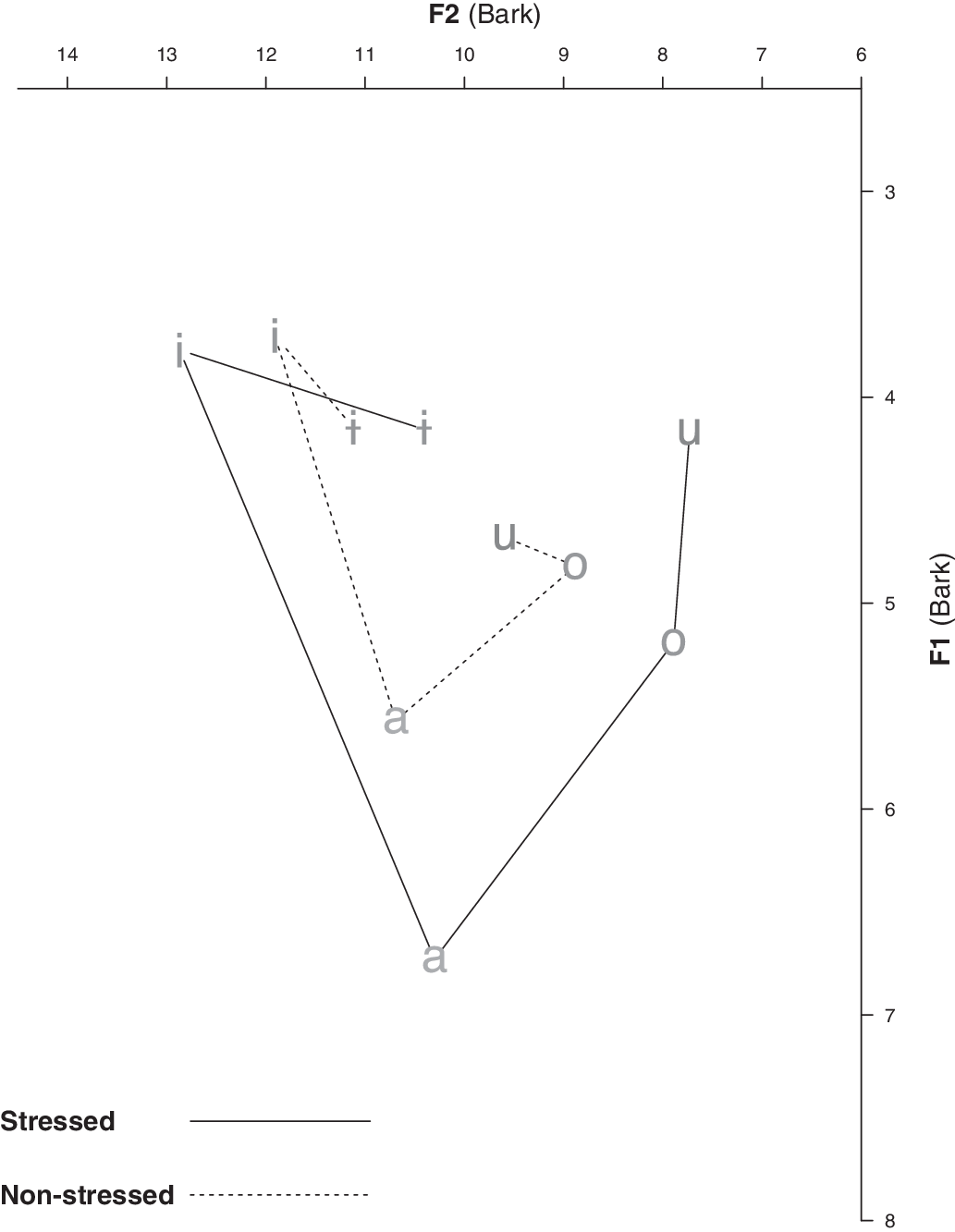
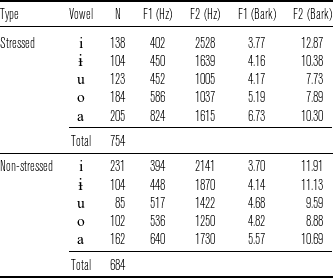
The Northern Tepehuan vowel system comprises five vowels, according to the data collected for this paper: three high vowels, one mid and one low. All of them are equally frequent in stressed syllables. This coincides with the previous accounts of Bascom (Reference Bascom and Langacker1982), Ramos Bierge (Reference Ramos Bierge2010) and Carrillo (Reference Carrillo2013). Figure 5 displays the typical acoustic quality of vowels in stressed syllables and non-stressed syllables of one of the female speakers, also showing that vowels undergo some degree of centralization in non-stressed positions. For this projection, the values of F1 and F2 were measured using Praat (Boersma & Weenink Reference Boersma and Weenink2006) in 754 stressed vowels and 684 unstressed vowels in isolated words – see Table 1 for details. The values in Hertz were converted to Bark according to the equation proposed by Traunmüller (Reference Traunmüller1990). Occasionally, non-stressed vowels can be turned into schwas [ə] in long phonological words in rapid speech. Also, final non-stressed vowels tend to show a slight degree of devoicing.
Mean values of F1 and F2 in stressed and non-stressed vowels.

Values of F1 and F2 of stressed and non-stressed vowels.

In the previous literature, contrastive vowel length has been reported, although never exemplified. In (4) below there are some examples of words that contrast in vowel length. Note also that consonants tend to be longer after a stressed short vowel than after a long vowel, although this is a phonetic operation and might not be implemented.

In Northern Tepehuan the following diphthongs exist (syllabic boundaries are indicated in these examples): /ia/ and /ai/ as in /β̞iaːxái/ [β̞iaː.xái] ‘he/she mashes up’, /io/ as in /tioːdı́/ [ˈtioː.ɟı́] ‘pretty’ and /oi/ as in /sonoi/ [ˈson.ːoi] ‘log’, /ɨi/ as in /imɨi/ [ˈim.ːɨi] ‘he/she goes’, /iu/ as in /kiupai/ [ˈkhiu.pai] ‘church’, /ui/ as in /úːtui/ [ˈúː.twi] ‘fingernail’, and /ua/ as in /ˈkuáːɡi/ [ˈkwáː.ɡi] ‘firewood’. The corpus of over 2000 words shows no evidence of triphthongs or hiatus in the language.
In addition, the vowel /a/ undergoes a process of vocalic raising and fronting, which we would also call some instance of palatalization, although it applies under different conditions than consonants: /a/ remains a low and central vowel when it is contiguous to /i/, like in /kuːpái/ [ˈkuːpái] ‘hair’, but usually it becomes [ɛ] or [ɘ] when preceded by an alveolar consonant and followed by /i/, as in /ipuːrai/ [iˈpuːrɛi] ‘dress’ or /onai/ [ˈonːɘi] ‘salt’. In rapid speech, it is not uncommon to find instances of fronted /a/ adjacent to [i].
Tone and word stress
Northern Tepehuan is a tonal language with a single phonological tone: the high tone H. The alternative equipollent tonal system (H, L) proposed by Bascom (Reference Bascom1959) is less economic as it requires labeling all syllables without high tone with a low tone, a representation indistinguishable from an absence of tone, but one that introduces more phonological features than necessary.
Northern Tepehuan could be better characterized as a language with a low tonal density, as not all morphemes are lexically specified for tone and the H tone is culminative, i.e., it occurs at most once in a phonological word (Kim Reference Kim1997). The H tone only occurs in the first two syllables of a root and in some suffixes (Woo Reference Woo1970). The contrasts between the words in (5) exemplify lexical tone.

It should be noted that a high pitch is also a correlate of stress in toneless words, but stress and high pitch could not coincide when lexical H is present like in (5b, d, f). In cases where the stress and the lexical H are not located on the same syllable, the stress is still observable by vowel quality – see the vowels chart above – and intensity, and it is also identified by native speakers in the first syllable.
Stress is predictable from the size and the tonal pattern of the word. Stress falls on the first syllable in disyllabic words – regardless of lexical tone or vowel duration as shown in (4) and (5) above – and on the second syllable in phonologically toneless words with three or more syllables, as in /ipuːrai/ [iˈpuːrɛi] ‘dress’ or /nakasɨrai/ [naˈqasɨrɛi] ‘scorpion’. However, when a H tone is phonologically specified in the first syllable and the word has three or more syllables, the stress always falls in the H syllable, as in /úːridɨ/ [ˈúːʎiɟɨ] ‘his maternal grandmother’, in contrast, for instance, with /iːbɨxi/ [iːˈbɨxi] ‘he/she breathes’, and /taːtasai/ [taːˈtasəi] ‘he/she splits’. In morphological processes adding syllables to disyllabic words, we observe that a high tone (H) in the first syllable produces initial stress, as in (6a), in trisyllabic words, whereas in words with tone on the second and toneless words the stress is displaced to the second syllable, as in (6b, c).

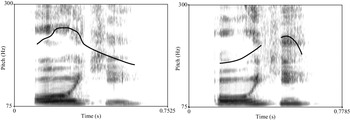
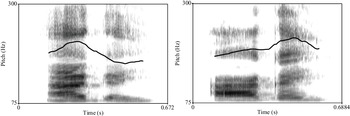
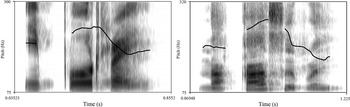
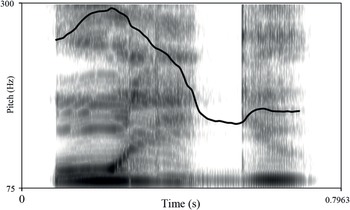
Figures 6 and 7 illustrate the typical f0 trajectory differences between the tonal pattern shown by a high tone on the first syllable – on the left – and a high tone on the second syllable – on the right – for two pairs of words that are segmentally identical.Footnote 9 Figure 8 illustrates the pitch pattern of words with more than two syllables with an expected stress pattern, whereas Figure 9 illustrates the pitch pattern of a trisyllabic word with initial stress.
F0 difference in tonal patterns of /óːʝi/ ‘needle’ and /oːʝı́/ ‘he/she follows’.

F0 difference in tonal patterns of /áːɡai/ ‘he/she says’ and /aːɡái/ ‘he/she wants’.

F0 patterns in words with stress on the second syllable /ipuːrai/ [iˈpuːrɛi] ‘dress’ and /nakasɨrai/ [naˈqasɨrɛi] ‘scorpion’.

F0 pattern in a word with stress on the first syllable /úːridɨ/ [ˈúːʎiɟɨ] ‘his maternal grandmother’.

Transcription of recorded passage: ‘The North Wind and the Sun’
Phonemic transcription

Semi-narrow phonetic transcription

Morphemic gloss
Abbreviations used in the glosses: 1, 2, 3 = first, second, third person; conj = conjunction; det = determiner; dur = durative; impf = imperfective; irr = irrealis; nom = nominalizer; nosp = non-specific pronoun; perf = perfective; pl = plural; rel = relative; rpas = remote past; sg = singular.


English translation
The Wind and the Sun were arguing about who was in command. At that moment a walker passed by. He had a blanket covering him. Then he said, ‘The first (one) of us to make the walker take off his blanket is the one in charge.’ So, the Wind blew intensely as much as he could but the more he blew the tighter the blanket clung to the walker. After that, the Wind got tired. Then the Sun shined intensely, and the walker took off his blanket. Thus, the Wind admitted that the Sun was in charge.
Acknowledgments
The research leading to this Illustration was conducted thanks to a postdoctoral research grant awarded by the Mexican National Council of Science and Technology (Spanish acronym CONACYT). I would like to thank Dr. Paolo Roseano and Dr. Wendy GarcÍa for their advice at the Laboratory of Phonetics of the University of Barcelona. I would also like to thank Prof. Dr. Zarina Estrada of the University of Sonora for her support in this project, Dr. Ryan Bennett for his comments on plosives and implosives, and Laura Arman, Jared Sharp and Alex Nastevski for their careful reading. Likewise, I thank the anonymous reviewers for their insightful comments. Finally, I would like to thank the Ódami community, especially to Araceli Carrillo, for their enthusiastic teaching, patience and time.
Supplementary material
To view supplementary material for this article (including audio files to accompany the language examples), please visit https://doi.org/10.1017/S002510032100013X