


1. INTRODUCTION
Particle accelerations have emerged as a frontier research area in the last few decades. The development of high-power laser system (Strickland & Mourou, Reference Strickland and Mourou1985) has renewed this area due to its potential application in electron and ion accelerations (Umstadter, Reference Umstadter2001, Reference Umstadter2003; Kitagawa et al., Reference Kitagawa, Sentoku, Akamatsu, Sakamoto, Kodama, Tanaka, Azumi, Norimatsu, Matsuoka, Fujita and Yoshida2004; Modena et al., Reference Modena, Najmudin, Dangor, Clayton, Marsh, Joshi, Malka, Darrow, Danson, Neely and Walsh1995; Esarey et al., Reference Esarey, Sprangle, Krall and Ting1996; Hoffmann et al., Reference Hoffmann, Blazevic, Ni, Rosemej, Roth, Tahir, Tauschwitz, Udrea, Varentsov, Weyrich and Maron2005; Gibbon, Reference Gibbon2005; Roth et al., Reference Roth, Brambrink, Audebert, Blazevic, Clarke, Cobble, Cowan, Fernandez, Fuchs, Geissel, Habs, Hegelich, Karsch, Ledingham, Neely, Ruhl, Schlegel and Schreiber2005; Glinec et al., Reference Glinec, Faure, Pukhov, Kiselev, Gordienko, Mercier and Malka2005; Giulietti et al., Reference Giulietti, Galimberti, Giulietti, Gizzi, Labate and Tomassini2005; Lifschitz et al., Reference Lifschitz, Faure, Glinec, Malka and Mora2006; Yin et al., Reference Yin, Albright, Hegelich and Fernandez2006; Hoffmann et al., Reference Hoffmann, Blazevic, Rosmej, Spiller, Tahir, Weyrich, Dafni, Kuster, Ni, Roth, Udrea and Varentsov2007). Electron can be accelerated in vacuum easily by a laser field (Evans, Reference Evans1988; Hauser et al, Reference Hauser, Scheid and Hora1994; Sprangle et al., Reference Sprangle, Esarey and Krall1996; Hartemann et al., Reference Hartemann, Van-Meter, Troha, Landahl, Luhmann, Baldis, Gupta and Kerman1998; Hora et al., Reference Hora, Hoelss, Scheid, Wang, Ho, Osman and Castillo2000; Cheng & Xu, Reference Cheng and Xu1999; Singh, Reference Singh2005; Liu et al., Reference Liu, He and Hora2006; Gupta & Ryu, Reference Gupta and Ryu2005; Gupta & Suk, Reference Gupta and Suk2006a, Reference Gupta and Suk2006b; Nishida, Reference Nishida2009; Smorenburg et al., Reference Smorenburg, Kamp, Geloni and Luiten2010). An electron, having the velocity comparable to the speed of light in vacuum, can extract energy from the laser field. Lawson-Woodward theorem shows the limitations of vacuum electron acceleration (Esarey et al., Reference Esarey, Sprangle and Krall1995).
Electron accelerated in vacuum is basically a kick-off process in which the longitudinal electric field of the electromagnetic wave scatters the electrons beyond the interaction region. This acceleration is also due to the fact that the Lorentz force is associated with the laser field interaction. The polarization of electromagnetic field is also very important in this process. In the case of a linearly polarized laser pulse, the parameters of the laser pulse interaction with an electron depend upon the direction of polarization, and resonance absorption possesses an inhomogeneous distribution, which reduces the efficiency of acceleration process (Gupta et al., Reference Gupta, Hur and Suk2007a; Niu et al., Reference Niu, He, Qiao and Zhou2008; Singh et al., Reference Singh, Gupta and Sajal2009). In the case of a circularly polarized laser pulse, resonance absorption possesses axial symmetry, which confines the electron near the axis. Other than this, the other laser parameters such as the laser spot size, position of the peak of pulse, initial electron energy gain play an important role in electron acceleration in vacuum. The momentum of electron increases with the magnitude of the electric field. For a small focal spot size, the transverse amplitude is dominant, thus, the electrons escapes in the transverse direction (Hartemann et al., Reference Hartemann, Van-Meter, Troha, Landahl, Luhmann, Baldis, Gupta and Kerman1998; Kawata et al., Reference Kawata, Kong, Miyazaki, Miyauchi, Sonobe, Sakai, Nakajima, Masuda, Ho, Miyanaga, Limpouch and Andreev2005; Xu et al., Reference Xu, Kong, Chen, Wang, Wang, Lin and Ho2007a, Reference Xu, Kong, Chen, Wang, Wang, Lin and Ho2007b; Gupta et al., Reference Gupta, Jang and Suk2009). For more accurate electron dynamics, the longitudinal component of the field should be taken into consideration (Cicchitelli et al., Reference Cicchitelli, Hora and Postle1990). In that case, the acceleration is possible almost symmetrically around the laser propagation direction (Malka et al., Reference Malka, Lefebvre and Miquel1997; Mora & Quesnel, Reference Mora and Quesnel1998). GeV class electron acceleration can be obtained using the lowest order axicon fields (with small spot size) of a high power laser beam (Salamin, Reference Salamin2006). The electrons produced due to the above-threshold ionization of high-Z atoms can also be accelerated to GeV level energies (Karmakar & Pukhov, Reference Karmakar and Pukhov2007).
Usually, electron cannot retain most of its acceleration energy due to the deceleration by the training part of the pulse. The magnetic field may play a crucial role in reducing the energy loss during the deceleration cycle (Singh et al., Reference Singh, Gupta and Sajal2009). There are two factors that affect the vacuum electron acceleration in the presence of the magnetic field. One is the electron motion and the other is the enhancement in the strength of ponderomotive force ( ) to the electrons. The applied magnetic field bends the interacting electron to the interaction region and the enhanced ponderomotive force accelerates it further. At resonance, the electron not only accelerates to a higher energy level but also retains it even after passing of the laser pulse in the form of betatron oscillations. Recently, we have proposed some vacuum electron acceleration mechanism and observed the effect of applied magnetic field (Gupta et al., 2005, 2006a, 2006b). The electron accelerations have been studied in a combined circularly polarized laser pulse fields with strong axial magnetic fields, and found that energy gain depends on the ratio of Larmor frequency and laser frequency along with laser intensity.
In fact, the electron energy gain during laser acceleration in a vacuum strongly depends on the laser intensity as the longitudinal momentum of the electron is proportional to the square of the laser intensity amplitude. Two lasers have some advantages over single laser for electron acceleration in a vacuum. If the frequencies, amplitudes, and polarizations of both lasers are considered such that only axial field survives, then the theoretical analysis can be considered linear. Two crossed lasers having the same amplitude and frequency are responsible for interference in a vacuum (Maher & Hall, Reference Maher and Hall1976; Hora, Reference Hora1988; Salamin & Keitel, Reference Salamin and Keitel2000; Gupta & Suk, Reference Gupta and Suk2007b; Singh et al., Reference Singh, Sajal and Gupta2008). Due to the constructive interference, the resultant field amplitude enhances and improves the electron energy gain compared to the cases of single lasers. Also, due to the beating effect of the electromagnetic waves, the electron can gain additional energy (Gupta et al., Reference Gupta, Kumar, Hur and Suk2007c). We revisit the previous work by including the effect of an applied magnetic field and find some additional results. Two high-intensity lasers with different wavelengths (propagating in opposite direction to each other) cause modulation of the fields. However, the resultant field accelerates the electron, but the magnetic field plays an important role to enhance the electron energy during this mechanism. We find the cyclotron resonance effect on the estimation of electron energy gain. We examine the dynamics of an electron in the presence of a magnetic field in vacuum, where two lasers have been used for acceleration. The electron energy gain has been estimated by solving the resultant coupled differential equations using a single particle code. The simulation results have been discussed and a discussion of the results is given.
2. LINEAR ANALYSIS
The laser-driven electron dynamics can be analyzed using the equation of motion and the energy equation. To understand this, let us consider the linear approximation analysis. We consider two lasers propagate in vacuum in opposite directions to each other such that their focal points intersect at origin to interact with an electron. The vector potential of both lasers can be given by  , where A j is the laser amplitude, ωj is the laser frequency, k j is the wave number, and j = 1, 2. Note that the field of the second laser can be written by replacing k 0j by −k 0j in all expressions. The scalar potential of the laser can be written as
 , where αj is the undetermined function and can be calculated by Lorentz gauge
 . The electric and magnetic field corresponding to the vector and scalar potential of the laser can be given by
 and
 , respectively. There also exists an applied transverse magnetic field, i.e.,
 , where B 0 is the amplitude of the magnitude field. The equations governing electron momentum and energy are


where  is the electron momentum,

 is the Lorentz factor,
 is the electron velocity, c is the speed of light, and −e and m are the electron's charge and rest mass, respectively.
We solve the momentum and energy equations, i.e., Eqs. (1) and (2) using a relativistic single-particle code. The electron energy γmc 2 as a function of the propagation distance is obtained for different parameters by assuming the initial electron energy γ0mc 2, where  and
 is the initial electron velocity. Throughout this calculation, time and length are normalized by 1/ω01 and c/ω01, respectively. Velocity, momentum and energy are normalized by c, mc, and mc 2, respectively. The laser intensity parameter is normalized as
 . In this calculation, we use parameters, a 0j = 1 (corresponding to laser intensity
 , a 0j = 3 (corresponding to laser intensity
 ), a 0j = 5 (corresponding to laser intensity
 ), the considered laser wavelengths are
 , and
 MeV. The used magnetic field strength parameter is
 .
We solve Eqs. (1) and (2) to find out the electron energy and the results are given as follows. Figure 1a shows the electron energy (γmc 2, in MeV) as a function of the propagation distance (zω01/c) at different magnetic field strengths (b 0 = 0.05, 0.1) for a 0j = 3 and γ0mc 2 = 5 MeV. Due to the beating of two lasers of different wavelengths (short and long wavelength), the test electron trapped and further accelerated to gain energy. The results show that the applied magnetic field is very important in this acceleration mechanism. Initially, the electron moves around the propagation axis. As the gyration frequency of electron increases, the magnetic field turns the electron in interaction region. In this way, the electron stays in the interaction region longer and gains more energy during the acceleration. If the magnetic field is absent in this mechanism, however, then the electron can be accelerated to get such an amount of energy but will lose it during deceleration. Figure 1b shows the same for large wavelength difference of the lasers. The electron energy gain increase as the difference of wavelengths of both lasers wave increased. Our results show about two-fold electron energy gain compare to the former case for  . The large wavelength difference may allow the interacting electron in the interaction region for long time, consequently, if the electron gains more energy. From these simple calculations, it may be shown that both the cyclotron resonance effect and the laser wavelength modulation lead to a significant energy transfer to an electron. Now, we extend this analysis using the actual laser fields to simulate the electron energy gain during acceleration.
Electron energy (γmc 2, in MeV) as a function of the propagation distance (zω01/c) with two lasers in the presence of magnetic fields b 0 = 0..05, 0.1 for (a) λ01~1 μm, λ02~5μm and (b) λ01~1μm, λ02~8μm. Other simulation parameters are a 0j = 3, and γ0mc 2 = 5 MeV.

3. NONLINEAR ANALYSIS
Let us consider again the electron dynamics under two laser pulses propagates in opposite direction to each there. The actual electric and magnetic field can be approximated as (Esarey et al., Reference Esarey, Sprangle and Krall1995; Cicchitelli et al., Reference Cicchitelli, Hora and Postle1990)

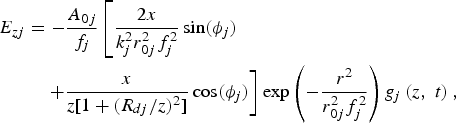
where  ,

 ,
 ,
 ,
 is the Rayleigh length, r 0j is the minimum spot size of the laser, and τ0j is the laser-pulse duration.
Following the previous procedure, using Eqs. (3) and (4), we again solve Eqs. (1) and (2) for electron dynamics and energy gain. We again use test particle calculations to study the electron dynamics in the fields of two lasers and the magnetic field. The numerical parameters are also the same as those of earlier study. The electron trajectory in the x-z plane can be seen in Figure 2a for different magnetic field strengths (b 0 = 0..05, 0.1). The corresponding electron energy gain (γmc 2, in MeV) as a function of the propagation distance (zω01/c) is shown in Figure 2b. The laser beam-waist size is equal to r 0j = 10λ0j and the laser pulse length is cτ0j = 7.5λ0j. The initial position of the laser pulse peak is chosen at origin and the optimum position of test electron is adopted as good magnetic field effects on energy gain. As we can imagine, the field intensity distribution is quite important for vacuum electron acceleration. The intense ponderomotive force driven by the long wavelength laser pushes the electrons in the forward direction, so the electron can be accelerated to an energy level. Furthermore, the second laser of short wavelength can accelerate this electron to further energy gain. Due to this trapping and acceleration process finally, the electron gain a significant energy.
(a) Electron trajectory in x - z plane and (b) corresponding electron energy (γmc 2, in MeV) as a function of the propagation distance (zω01/c) for different magnetic fields (b 0 = 0..05, 0.1). Other simulation parameters are λ01~1 μm, λ02~5 μm a 0j = 5, and γ0mc 2 = 10 MeV.

The test electron experiences a ponderomotive force due to the laser pulses in the presence of the magnetic field. The external magnetic field is employed so that it can affect the electron dynamics efficiently. Due to the combined effect of the magnetic field and the resultant field of the lasers, the electron rotates around the propagation direction of the laser pulse. The external magnetic field enhances the strength of ponderomotive force to the electron. At resonance, electron gyration frequency is comparable to the laser frequency, the maximum energy can be transferred to the test electron and the electron can gain maximum energy. From the results, we see that after passing the laser pulse, betatron oscillations set up between the electron and the resultant electric field of the laser pulses, and the electron also retains the maximum energy due to the effect of the magnetic field.
Specific role of the applied magnetic field can be observed from Figure 3. To observe the cyclotron resonance effect, the maximum electron energy gain (γmmc 2) during the acceleration by two laser pulses has been depicted with the electron cyclotron frequency (ωc/ω01) for different laser intensity amplitudes (a 0j = 1, 3, 5) as shown in Figure 3a and different initial electron energies (γ0mc 2 = 5, 7, 10 MeV) as shown in Figure 3b. The magnetic field enhances the oscillatory velocity of the electron due to cyclotron resonance that leads to enhancement of the ponderomotive force. Also, the magnetic field deflects and keeps the electron in the accelerating phase. Hence, electron gains significant energy via resonant electron acceleration under the resultant field of the lasers and the magnetic field. At cyclotron resonance, when the Larmor frequency is comparable to the field frequency, the electron energy gain maximizes due to the efficient energy transfer process. The electron energy gain also increases due to the high amplitude of laser intensity. We find that a less magnetic field is required to get the higher electron energy for a high intensity laser. At high-intensity of the laser, the quiver electron velocity exceeds the laser spot size, which allows it to escape from the laser pulse around the focus with enough electron energy. If high-intensity laser is used for electron acceleration in vacuum, then the electrons closer to the propagation axis can be accelerated in laser propagation direction. The electron energy gain in this scheme strongly depends on the initial electron energy. A pre-accelerated electron moves to the interaction region soon and then accelerates to higher energy.
Maximum electron energy (γmmc 2 5 MeV) with (ωc/ω01) for (a) different laser intensity parameters (a 0j = 1, 3, 5), where γ0mc 2 = 1 MeV is considered and (b) different initial electron energies (γ0mc 2 = 5, 7, 10 MeV), where a 0j = 5 is considered. Other simulation parameters are same as discussed previously.

4. CONCLUSIONS
Cyclotron resonance effects on electron accelerations by two lasers of different wavelength have been analyzed. The beating of two lasers produces a higher resultant field that can accelerate the test electron to a significant energy level. The wavelength difference of the lasers traps and further accelerates the electrons. The applied magnetic field in this scheme is not only important to enhance the electron energy gain but also crucial to retains it in the form of betatron oscillations. The electron motion under magnetic field is influenced by the cyclotron frequency. In the beginning, when the electron has modest velocity, the cyclotron resonance plays an important role and after getting enough velocity, the electron gains energy from the laser field via Cerenkov resonance. The results show that the electron energy gain increases when the magnetic field strength increases and the electron energy is maximizes at a certain value of magnetic field sue to the cyclotron resonance.
Recent experimental results (Malka et al., Reference Malka, Lefebvre and Miquel1997) have been reported on the MeV electron acceleration by a high-intensity laser in vacuum. A laser of peak intensity on the order of 1019W/cm 2 with wavelength of 1.056 μm and spot diameter of 10 μm has been employed to accelerate an electron in vacuum. The electrons with initial energies of 10 KeV are accelerated up to 1 MeV in this experiment. In our work, we have used two lasers of different wavelengths in place of a single laser. However, the electron energy gain is much higher in our case as the initial electron kinetic energy of the electrons is very high and compare to the reported experiment. Also, it is evident from our calculations that certain specific values of the magnetic field allow attaining maximum energy by the electron for a particular intensity of the lasers. The efficiency of energy transfer in the presence of a magnetic field enhances with the laser intensity amplitude and the initial electron energy. If high-intensity lasers are applied then one may utilize a weak magnetic field for sufficient electron energy gain in this mechanism. Similarly, higher electron energy has been expected with higher initial electron energy.
ACKNOWLEDGMENTS
This research was financially supported by the Challenge Research Project of the National Research Foundation (NRF) and the Asian Laser Center Project of Korea.



