Introduction
Human papillomavirus (HPV) is a DNA virus that infects human epithelial tissues. Currently, over 170 different subtypes of HPV have been identified. Of these, 12 are referred to as high-risk in light of their cancer-causing nature; the most common of which are HPV subtypes 16 and 18. The remaining low-risk types cause skin warts and other non-cancerous diseases; HPV subtypes 6 and 11 represent the majority of this subgroup. While most HPV infections are acquired through sexual transmission, vertical transmission, horizontal transmission and auto-inoculation may also play a role in its spread.
Most HPV-related head and neck cancers arise from the oropharynx, and their prevalence is increasing, now accounting for over 70 per cent of head and neck cancers in adults.Reference Gillison, Broutian, Pickard, Tong, Xiao and Kahle1–Reference Syrjänen5 Of these, most malignant infections are due to HPV 16, and the tonsils are the most frequently affected site.Reference Herrero, Castellsagué, Pawlita, Lissowska, Kee and Balaram6–Reference Klussmann, Weissenborn, Wieland, Dries, Kolligs and Jungehuelsing7 This highlights the importance of delineating both when tonsillar HPV infection is first acquired and the length of latency. Evaluating its prevalence and subtype makeup in the paediatric population is a crucial step in understanding whether such a relationship exists.
It has been well established that HPV subtypes 6 and 11 cause juvenile-onset recurrent respiratory papillomatosis in paediatric patients. However, beyond this, much remains unknown about HPV in the oropharynx of paediatric patients. Whether children simply do not acquire HPV infection with the same frequency as adults, or whether they become infected and subsequently either eliminate the infection or harbour it as a latent infection within their systems for years, remain causes for speculation.
The current literature suggests that the prevalence of paediatric tonsillar HPV ranges from 0 to 20 per cent;Reference Wojtera, Paradis, Husein, Nichols, Barrett and Salvadori8 however, given the vast differences between the studies’ methodologies, it is unclear whether the discrepancy is due to procedural variances or true geographical differences. Specifically, these studies used different sets of primers and probes, in combination with traditional polymerase chain reaction and a range of genotyping, gene targeting, and novel methods of typing to detect HPV, and, hence, they cannot be compared. The results demonstrated higher prevalence ranges in European countries, and lower ones in US, Asian and South American studies; of note, however, the largest study from England and Southern Scotland demonstrated a 0 per cent prevalence. Prevalence data from many countries are still lacking.
This study endeavoured to determine the prevalence of the most common types of HPV (subtypes 6, 11, 16 and 18) currently targeted by the quadrivalent HPV vaccine in a sample of 100 paediatric patients undergoing routine tonsillectomy in London, Ontario, Canada. No such study has been carried out in Canada to date.
Materials and methods
The primer and probe sets, as well as the outlined methods of DNA extraction and quantitative polymerase chain reaction for the detection of HPV, have been previously validated.Reference Nichols, Dhaliwal, Palma, Basmaji, Chapeskie and Dowthwaite9 Institutional ethics review board approval for this study was obtained from Western University in London, Ontario, Canada.
Patient recruitment
Patients aged 0–18 years undergoing tonsillectomy for recurrent tonsillitis, sleep-disordered breathing, or periodic fevers with aphthous stomatitis, pharyngitis, and adenitis (‘PFAPA’) at Children's Hospital, London Health Science Center, Ontario, Canada, were recruited for this study concurrently, by three paediatric otolaryngologists (JES, MH and JP), between March 2017 and February 2018. Informed consent was obtained from parents or guardians prior to enrolment. Patients were excluded if: they were older than 18 years, they had a known disease caused by HPV such as respiratory papillomatosis, parents did not consent to the study, or the patients did not assent.
Human papillomavirus questionnaire
The study authors developed a questionnaire to be completed by patients’ parents or guardians, and a separate questionnaire to be completed by patients themselves if older than 13 years. The questionnaire comprised demographic and risk factor items, including birthplace, history of HPV-associated conditions, and both parental and patient HPV vaccination status. Questionnaire response scales included categorical and open-ended formats. The HPV questionnaires were completed following study consent or assent.
Specimen collection and tissue analysis
All tonsillectomies were performed by one of three paediatric otolaryngologists (JES, MH or JP). Tonsillectomies were performed using monopolar cautery. After the tonsils were removed, a small (10 × 10 mm) sample was cut and transported to the laboratory. Two samples were obtained for each participant: one from the left tonsil and one from the right tonsil. Samples were stored at −80°C, until DNA extraction was carried out using 20–30 mg of fresh tissue treated as per the Qiagen® DNA/RNA extraction protocol.10
Quantitative polymerase chain reaction
Detection of HPV subtypes 6, 11, 16 and 18 was carried out using multiplex quantitative polymerase chain reaction under the conditions recommended in the Quantitech Multiplex handbook (Qiagen). A 0.2 μl sample of genomic DNA from each tonsil was used, along with negative and positive controls, in the quantitative polymerase chain reactions, which had a total reaction volume of 10 μl.
Positive controls included: the ubiquitous house-keeping gene glyceraldehyde 3-phosphate dehydrogenase, which served to confirm the presence and quality of the input patient genomic DNA; CaSki genomic DNA, which served as the positive control for HPV 16; HeLa genomic DNA, which served as the positive control for HPV 18; and plasmids carrying the HPV 6 or HPV 11 genomes, which served as controls for the relevant low-risk HPV subtypes. In addition, there was a no-template negative control.
Samples were heated for 15 minutes at 95°C to activate the amplification enzyme, and then amplified through 40 cycles at 94°C for 60 seconds and 60°C for 90 seconds. All samples were tested with glyceraldehyde 3-phosphate dehydrogenase, and the primer and probe sets for subtypes 6, 11, 16 and 18.
Results
A total of 112 patients were invited to participate in the study. Four parents refused to have their child participate. Of the remaining 108 parents who agreed to have their child participate, 6 were excluded: three surgical procedures were cancelled, and tonsil specimens of three patients had to be sent off to pathology for testing for concerns unrelated to HPV. Of the 102 included patients, the surveys of 3 were not returned. Our analysis is based on the remaining 99 responses.
Participant demographics
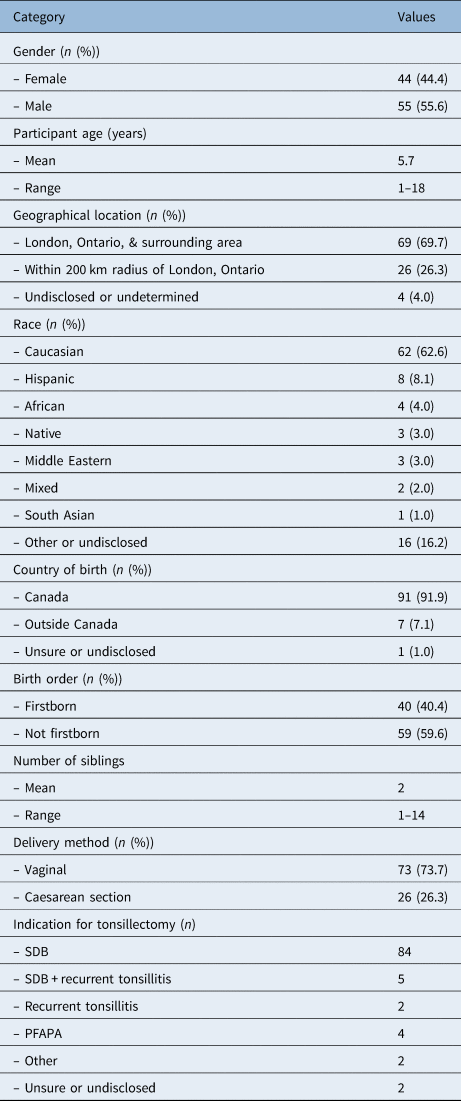
There were 44.4 per cent females and 55.6 per cent males (Table 1). The mean age of all patients was 5.7 years (range, 1–18 years).
Participant demographics

SDB = sleep-disordered breathing; PFAPA = periodic fevers with aphthous stomatitis, pharyngitis, and adenitis
In terms of indications for surgery, 84.8 per cent of patients had sleep-disordered breathing, and 5.1 per cent had sleep-disordered breathing and recurrent tonsillitis. An additional 4.0 per cent of patients received surgery because of periodic fevers with aphthous stomatitis, pharyngitis, and adenitis, 2.0 per cent for recurrent tonsillitis alone, and 1.0 per cent each for recurrent tonsillar abscess and as preparation for a pharyngeal flap for velopharyngeal dysfunction with cleft lip and palate.
Of the patients, 69.7 per cent were from London, Ontario, and its immediate surrounding communities, and 26.3 per cent were from cities within a 200 km radius around London. With respect to race, 62.6 per cent of patients identified as Caucasian, 8.1 per cent as Hispanic, 4.0 per cent as African, 3.0 per cent as Native, 3.0 per cent as Middle Eastern, 1.0 per cent as South Asian and 2.0 per cent as of mixed heritage. In terms of birthplace, 91.9 per cent of patients were born in Canada and 7.1 per cent were born abroad.
Firstborn children comprised 40.4 per cent of participants; the remainder had 1–14 older siblings (mean of 2 siblings). Vaginal deliveries accounted for 73.7 per cent of patients; the remainder were delivered by Caesarean section.
Four of eight patients aged over 13 years returned a separate risk factor questionnaire; of these, one patient reported prior sexual activity, birth control use, smoking and alcohol use.
Participant questionnaire items
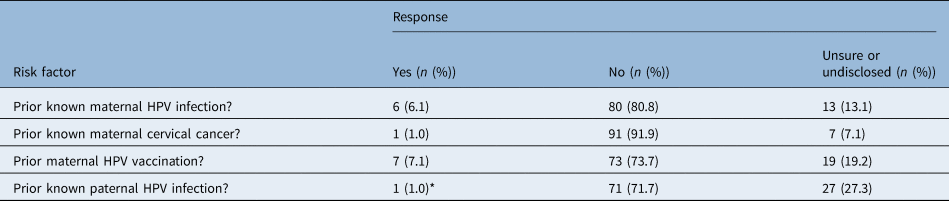
Four per cent of parents indicated that their child had received the HPV vaccine: a 4-year-old male, a 5-year-old male, an 8-year-old female and a 14-year-old male. An additional 22.2 per cent of parents indicated that they were unsure whether their child had received the HPV vaccine (Table 2). No patients had a history of HPV-associated conditions, including juvenile-onset recurrent respiratory papillomatosis, warts, oropharyngeal cancer or cervical cancer.
Participant risk factor questionnaire results

*Questionnaire results indicated that the vaccinated children included a 4-year-old male, a 5-year-old male, an 8-year-old female and a 14-year-old male. As the human papillomavirus (HPV) vaccine is currently not offered to children this young in Ontario without extenuating circumstances, it is likely that these parents were simply indicating that their child's immunisations were up-to-date, and were unclear which immunisations this entailed. Consequently, the results of this question were considered inaccurate and not amenable to further analysis.
Parental questionnaire items
The age range of mothers at the time of birth was 17–42 years (average age of 29 years). With respect to known HPV infection, 6.1 per cent of mothers and 1.0 per cent of fathers self-disclosed the presence of this infection, and an additional 1.0 per cent of mothers had a history of cervical cancer (Table 3). The subtypes of HPV infections were unknown to all affected patients. Maternal HPV vaccinations were self-reported by 7.1 per cent.
Parental risk factor questionnaire results

Mean maternal age was 29 years (range, 17–42 years); age was undisclosed in three cases (3.0 per cent). *The father who had prior human papillomavirus (HPV) infection and one of the mothers with prior HPV infection were both parents of the eight-year-old female who was reported to have been vaccinated against HPV.
Tonsil specimen status
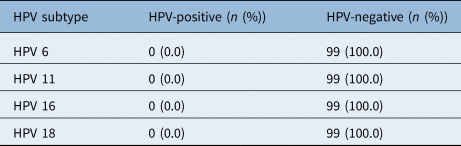
A total of 198 tonsil specimens (99 left tonsils and 99 right tonsils) were tested for HPV subtypes 6, 11, 16 and 18 (Table 4). All tonsil specimens were positive for the internal glyceraldehyde 3-phosphate dehydrogenase control confirming the presence of genomic DNA, but all were negative for the detection of HPV subtypes 6, 11, 16 and 18 genomic DNA, indicating the absence of HPV.
Tonsil specimen HPV status

HPV = human papillomavirus
Discussion
Despite evidence demonstrating the increasing prevalence of HPV in head and neck cancers in the Canadian adult population, the timeline with which this virus is acquired remains poorly defined. This study demonstrated a 0 per cent prevalence of paediatric tonsillar HPV infection subtypes 6, 11, 16 and 18, suggesting that children from Southwestern Ontario do not carry the infection outside of its known association with juvenile-onset recurrent respiratory papillomatosis. Whether some adult-onset cases of HPV-related head and neck cancers could be caused by rare latent HPV acquired in childhood remains a possibility, given this study's small sample size, but this is unlikely to be a major contributing factor. Instead, it appears that HPV is acquired predominantly in adulthood or late adolescence, a trend that remains consistent with other sexually acquired diseases. Although it has been suggested that HPV may be acquired through vertical or horizontal transmission, and remain latent in children for an unknown period of time, this does not appear to be the case in our study population. Further, this study corroborates that none of the conditions for which subjects had tonsillectomies – sleep-disordered breathing, periodic fevers with aphthous stomatitis, pharyngitis, and adenitis, and recurrent tonsillitis – are associated with the presence of HPV DNA.
The results of a recent systematic review by Wojtera et al. (2018) demonstrated a prevalence of 0–20 per cent for paediatric tonsillar HPV across multiple studies worldwide, with US data demonstrating a 0–4 per cent prevalence.Reference Wojtera, Paradis, Husein, Nichols, Barrett and Salvadori8 That the present investigation demonstrated a 0 per cent prevalence suggests one of three conclusions. First, it should be noted that although the rates of HPV-related head and neck cancers have been increasing in recent years, the rates of HPV-related cases of genital warts and juvenile-onset recurrent respiratory papillomatosis have both been decreasing. This suggests an increasing effect of herd immunity on younger, vaccinated generations of youth in Southwestern Ontario, particularly with respect to the low-risk HPV subtypes that more commonly cause these conditions.11 Alternately, it could be hypothesised that there is a geographical distribution of paediatric tonsillar HPV worldwide, which mirrors the geographical dispersal for cervical HPV subtypes.Reference Clifford, Rana, Franceschi, Smith, Gough and Pimenta12,Reference Li, Franceschi, Howell-Jones, Snijders and Clifford13 If this theory were conceded, it would suggest that Canadians do not frequently acquire HPV in childhood, and that there may be no correlation between paediatric tonsillar HPV infection and adult HPV-associated head and neck cancers. This would support the concept that either the mucosa of children is less hospitable to HPV infection or that children clear HPV more easily than adults, and, thus, adult head and neck cancers arise from viruses acquired after the perinatal period. Finally, as the methodologies of the studies included in the literature review varied, it is feasible that there were inaccuracies in some of the results. Namely, many of the included studies used traditional polymerase chain reaction to test for HPV, a technique that results in greater rates of false positives and could produce falsely inflated prevalence values.Reference Venuti and Paolini14 This would suggest that the low prevalence detected in this study may have been expected, as children have few risk factors for HPV acquisition.
Four parents (4.0 per cent) indicated that their child had previously received the HPV vaccine, with three of these children under the age of nine years. As the HPV vaccine is currently not offered to children this young in Ontario without extenuating circumstances, it is likely that these parents were simply indicating that their child's immunisations were up-to-date and were unclear which immunisations this entailed. Consequently, the results of this question were considered inaccurate and not amenable to further analysis.
• Prevalence of human papillomavirus (HPV) as a cause of oropharyngeal cancers is increasing, accounting for over 70 per cent of head and neck cancers in adults
• Although sexual transmission is the commonly accepted mechanism of HPV acquisition, vertical and horizontal transmission may also play a role
• Prevalence of HPV among children remains poorly defined, ranging from 0 to 20 per cent in various worldwide studies
• Paediatric patients from Southwestern Ontario do not appear to carry tonsillar HPV subtypes 6, 11, 16 or 18
• This study's demonstration of a low incidence of paediatric tonsillar HPV infection supports recommendations of administering HPV vaccine prior to sexual activity onset
• This earlier vaccine administration offers protection against later acquisition of viral infection
The finding that children from Southwestern Ontario do not appear to carry latent tonsillar HPV is reassuring with respect to promotion of the HPV vaccine. Despite being publicly available for both males and females in Canada, the current uptake rates of the HPV vaccine remain around 56 per cent, below those of other vaccine-preventable diseases.Reference Bird, Obidiya, Mahmood, Nwankwo and Moraros15 Although there are several theories regarding the cause of this reluctance, the predominant ones include concerns regarding vaccine safety, a preference to wait until the child is older, and not having enough information to make an informed decision.Reference Ogilvie, Anderson, Marra, McNeil, Pielak and Dawar16 This study's demonstration of a low incidence of paediatric tonsillar HPV infection supports the recommendation of administering the vaccine prior to the onset of sexual activity, as this earlier administration offers protection against later acquisition of viral infection.
This study was limited by the small sample, recruited from a single hospital site, which may have been subjected to selection bias or may not have been representative of the greater population. Additionally, only four HPV subtypes – 6, 11, 16 and 18 – were tested in this study. Although these are the four most common subtypes, it is possible that less common subtypes were missed. Further, tonsillar HPV is known to concentrate in tonsillar crypts; although efforts were made to obtain adequate crypt coverage during tissue extraction and analysis, it is possible that these crypts were inadequately represented. Finally, our study population was very young; only 8.1 per cent of patients were aged 13 years or older. Thus, the generalisability of these findings to the entire paediatric age range (0–18 years) is also limited.
Conclusion
Our study demonstrated that younger children from Southwestern Ontario do not appear to carry tonsillar HPV subtypes 6, 11, 16 or 18. These findings suggest that adult head and neck cancers may not be associated with latent paediatric tonsillar HPV infection.
Competing interests
None declared