

Introduction
Italy is a thorny case for comparativists. Its peculiarities range from a fluid party system, frequent distortions of electoral laws, and attempts to amend the constitution to the intertwining of populist, technocratic, and far-right executives. Therefore, as explored in this Special Issue, Italy's political system has been variously considered as a latecomer lagging behind advanced democracies, a forerunner of (usually, negative) tendencies, or an outlier difficult to categorize. Still, a fundamental aspect has been underexplored so far: Italy's relatively poor democratic quality, compared to mature liberal democracies, and possible explanations thereof. In a nutshell, our paper asks: how has the quality of Italian democracy evolved in recent decades? And how is this related to the features of its political parties?
The paper therefore advances and renovates, with a focus on Italy, the comparative politics literature on democratic quality. As elaborated by Morlino (Reference Morlino2011), a contemporary “good” democracy is based – beyond the minimalist electoral definition – on quality standards in its procedures, contents, and results, which can be measured along specific dimensions and sub-components. We embrace this approach and aim to expand comparative analyses on Italy's democratic quality in time, space, and detail. Regarding time, we contend that those contributions examining the quality of Italian democracy need to be updated, catching up with new trajectories, especially after the 2013 election – with the Five Star Movement's breakthrough – and the radicalization of the right-wing coalition as of the 2022 national elections. In terms of space, our analysis compares ups and downs of various aspects of Italy's democratic quality not only over time, but also situating the country among consolidated liberal democracies in Europe and worldwide. As concerns detail, we implement a vast collection of existing observational data on democratic regimes.
This is a first, systematic empirical test to unpack the often contradictory connotations of Italy as a forerunner, latecomer, or outlier. We argue that these claims need to be justified: in which specific dimension(s) of democratic quality is Italy different from/similar to other liberal democracies, in which time span, and according to which indicators? Such an analysis of Italy compared to other established democracies ultimately constitutes a working protocol to be extended to other countries of interest.
Centering our framework on Morlino's dimensions of democratic quality, the first section of the paper examines a broad collection of observational data to establish a cross-national and diachronic comparison between Italy and other liberal democracies. Thus, our goal is to re-trace the trajectory of various aspects of Italy's democratic quality and situate them in comparative perspective. Our conclusion is that Italy embodies either a positive/negative outlier, or forerunner/latecomer depending on the dimension observed. Compared to mature liberal democracies, it presents on average a less robust rule of law, better accountability (although menaced by frequent institutional reforms), higher (but declining) participation, less party system closure and more volatility, and it performs relatively poorly concerning rights, freedoms, equality, and responsiveness.
Building on such descriptive analysis, the second part then adopts an explanatory perspective and seeks to identify possible correlates of such defects of Italy's democratic quality. We argue that political parties – and some of their organizational features – can contribute to explaining some variation in the trends of democratic quality and that Italy is a paradigmatic case in this regard. As fundamental gatekeepers in regulating access to government and managing public policies, parties are essential components of liberal democracies performing pivotal functions of linkage and representation. However, when parties fail to fulfill these functions properly – for example, being too personalized or unstructured – they can contribute to deteriorate democratic quality. This happens when parties are electoral machines for strong leaders, with no incentive to reinforce the rule of law, accountability, rights, or other aspects of what makes a democracy strong.
We limit our study to two features broadly related to party organization: personalization and institutionalization. We argue that these aspects, in which Italy is an outlier, could affect the proper functioning of political parties and, in turn, democratic quality. We expect that higher levels of party personalization, as well as lower levels of party institutionalization, are associated with worse democratic quality along different dimensions, but more systematically in the procedural components, where parties can have a more direct impact. We thus examine the connection between personalization and de-institutionalization – two peculiarities of Italian parties – and democratic quality defects. Despite their exploratory nature, the findings from quantitative analyses across alternative measures demonstrate the detrimental role of high party personalization and low party institutionalization for democratic quality, paving the way for further causal examinations.
In addition to exploring how Italian democracy evolved compared to other cases, the paper offers a possible explanation for the deterioration of democratic quality through some party characteristics. Enhancing the debate on democratic quality, and finding how, when, and where Italy performs better or worse than other democracies, has remarkable implications beyond academic interest and the single case. In fact, the internal defects of a democratic regime might weaken its resilience to shocks, for example the overlapping of various crises and the formation of far-right governments. This paper offers a compass to understand the Italian experience, and its future trajectory, in a comparative fashion.
Reassessing Italy's democratic quality
In the 1990s, when many countries democratized, scholars started investigating how to study democratic regimes beyond the minimalist definition centered on competitive elections. In a seminal contribution (Diamond and Morlino, Reference Diamond and Morlino2005), the concept of democratic quality was introduced, to assess the performance of old and new democracies. Coming from marketing studies, the category of quality is based on the evaluation of a product and entails the assessment of its procedures (production), contents (characteristics), and results (customer satisfaction). From these elements, Diamond and Morlino proposed a list of dimensions along which democratic quality can vary: rule of law, accountability, participation, and competition (procedures); rights, freedoms, and equality (contents); and responsiveness (results, Morlino, Reference Morlino2011). That research project – aimed at measuring and evaluating democratic quality's objective and real characteristics, rather than normative or ideal aspirations (Geißel et al., Reference Geißel, Kneuer and Lauth2016) – resulted in an influential agenda, including data projects (Bühlmann et al., Reference Bühlmann, Merkel, Müller and Weßels2012; Lauth, Reference Lauth2016) and comparative studies (Berg-Schlosser, Reference Berg-Schlosser2004; Korosteleva and Hutcheson, Reference Korosteleva and Hutcheson2006; Roberts, Reference Roberts2009; Levine and Molina, Reference Levine and Molina2011; Huber and Schimpf, Reference Huber and Schimpf2017; Juon and Bochsler, Reference Juon and Bochsler2020; Morlino, Reference Morlino2020; Vittori, Reference Vittori2022).
Prominent contributions have already provided compelling evaluations of Italy's democratic quality, mainly based on political institutions and political culture. On institutions, already in the early 2000s, scholars underlined how the bipolarization of the party system increased vertical accountability, although coupled with a deterioration in the rule of law and horizontal accountability, due to the predominance of Silvio Berlusconi's media and governments over a fragmented parliament (Morlino, Reference Morlino2003). That was the context during Italy's so-called “never-ending” transition, after the collapse of the First Republic (1948–1994) and the profound though unstable restructuring of the political system around Forza Italia (Morlino, Reference Morlino2013). This literature often identified Italy as a European outlier, due to higher party system fragmentation, instability of coalition governments, and higher citizens' dissatisfaction with the executive (Pasquino and Valbruzzi, Reference Pasquino and Valbruzzi2010). Other analyses underlined the “corruption affairs, the (…) clientelist practices, the internal economic crisis and the decline in the country's role on the European and international stages” (Sandri et al., Reference Sandri, Telò and Tomini2013: 261) in a Special Issue depicting Italy as a European “anomaly” or “laboratory” of negative trends.
On political culture, scholars have explained the variation in responsiveness of Italian democracy based on the rise, transformation, and decline of different subcultures (Catholic, Socialist/Communist) in Italian regions (Solt, Reference Solt2004). Their decay has been connected to a weakening of parties' mediation function, harming democratic responsiveness and accountability (Almagisti, Reference Almagisti2008). Most of these (institutionalist and culturalist) analyses culminated in a collective volume (Morlino et al., Reference Morlino, Piana and Raniolo2013) which took stock of previous contributions to offer an overview of different aspects of Italy's democratic quality. In its conclusion, the authors evaluated changes in different dimensions of democratic quality affected by various actors (parliament, government, parties, and interest groups). They concluded that Italy's democratic quality was deteriorating across most dimensions, but especially in horizontal accountability and competition.
Although offering a first, systematic inspection of Italy's democratic quality, this debate presents significant inconsistencies. First, most of these analyses have been conducted with single case studies (on Italy, or small-N comparisons) and did not always clarify whether the defects of Italian democracy are a specific feature of this case, or rather shared by other democracies. Second, many data projects have been recently developed to substantiate similar debates on democratic quality. Therefore, it is nowadays possible, and perhaps necessary, to refresh this debate and look at Italy's democratic quality through a new, vast collection of observational data. Building on these leading contributions, it is time to re-assess the recent trajectories of Italy's democratic quality. To privilege knowledge accumulation – although we do not claim exclusivity in such framework (Coppedge et al., Reference Coppedge, Lindberg, Skaaning and Teorell2016; Fishman, Reference Fishman2016; Munck, Reference Munck2016; Graziano and Quaranta, Reference Graziano and Quaranta2024) – we follow the same conceptualization of democratic quality, substantiating it with empirical data in a large-N analysis of liberal democracies.Footnote 1
Empirical patterns
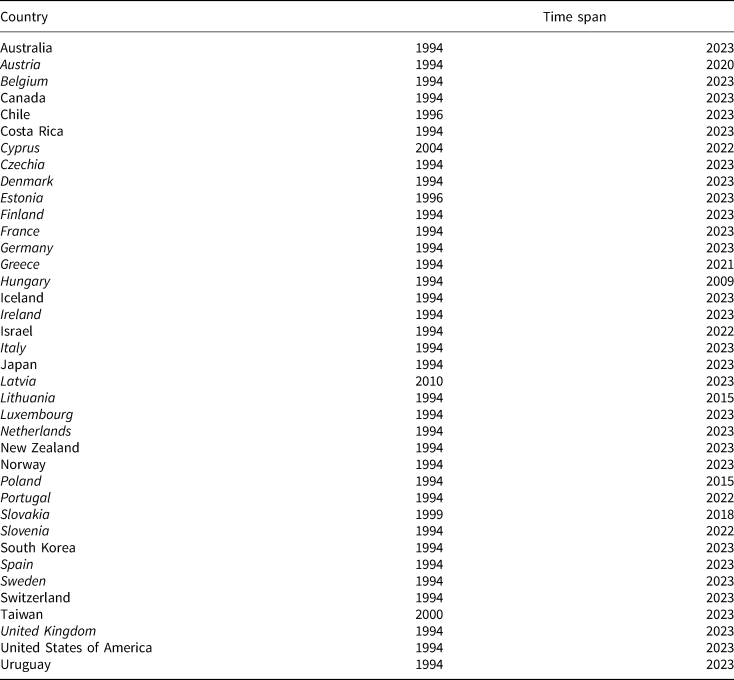
This section assesses how democratic quality dimensions have evolved in the last three decades in Italy and other liberal democracies, to highlight on which dimensions we can consider Italy as forerunner, latecomer, or outlier, compared to similar regimes. We restrict our analysis after 1994, as we are interested in the trajectory of Italian democracy after the First Republic. Our case selection includes countries classified as liberal democracies in the regimes of the world (RoW, Lührmann et al., Reference Lührmann, Tannenberg and Lindberg2018) categorization by Varieties of Democracy (V-Dem, Coppedge et al., Reference Coppedge, Gerring, Knutsen, Lindberg, Teorell, Altman, Angiolillo, Bernhard, Borella, Cornell, Fish, Fox, Gastaldi, Gjerlow, Glynn, Good God, Grahn, Hicken, Kinzelbach, Marquardt, McMann, Mechkova, Neundorf, Paxton, Pemstein, Rydén, von Römer, Seim, Sigman, Skaaning, Staton, Sundström, Tzelgov, Uberti, Wang, Wig and Ziblatt2024 version 14) for at least 10 consecutive years (a rough equivalent of two electoral cycles).Footnote 2 By selecting cases based on their political regime, we avoid limiting our investigation to specific areas, for example, Western Europe. In Appendix B, however, we replicate each analysis including liberal democracies in the European Union (EU). We cover a maximum of 38 (Table 1, V-Dem) and a minimum of 12 countries over roughly 30 years. The panel is unbalanced as backsliding countries fall out of our sample when they are no longer liberal democracies (e.g. Hungary after 2009). The last measurement year is 2023 for V-Dem data, 2017 for the Democracy Barometer (DB, Bühlmann et al., Reference Bühlmann, Merkel, Müller and Weßels2012), or earlier for other sources.
Liberal democracies included in the comparison

V-Dem/RoW liberal democracies for at least 10 years; in italics EU countries (UK until Brexit).
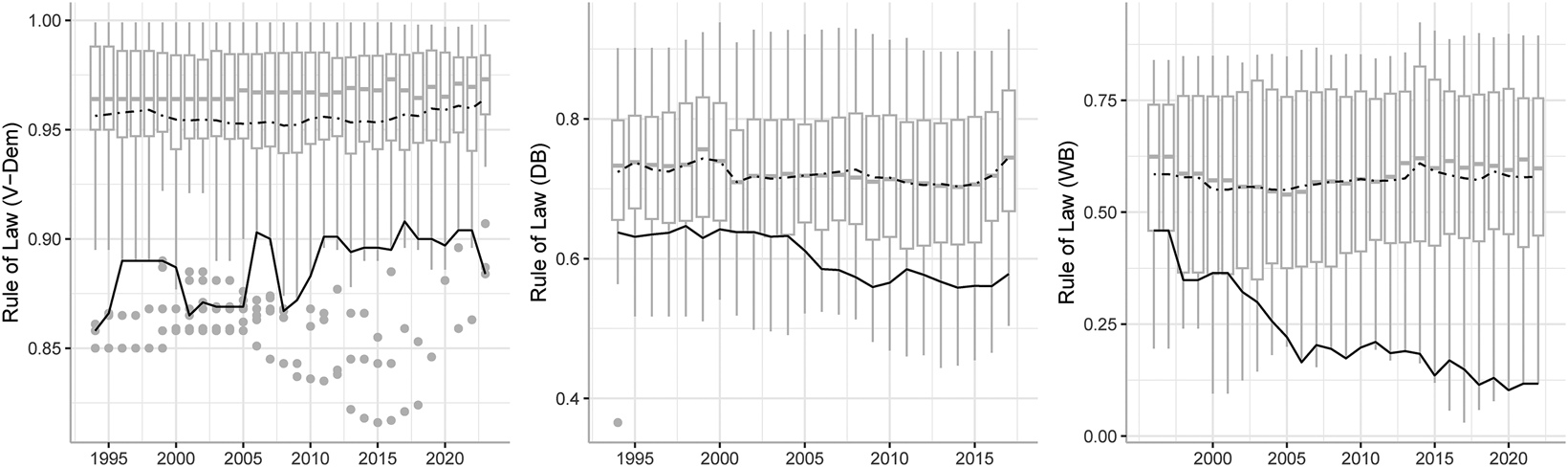
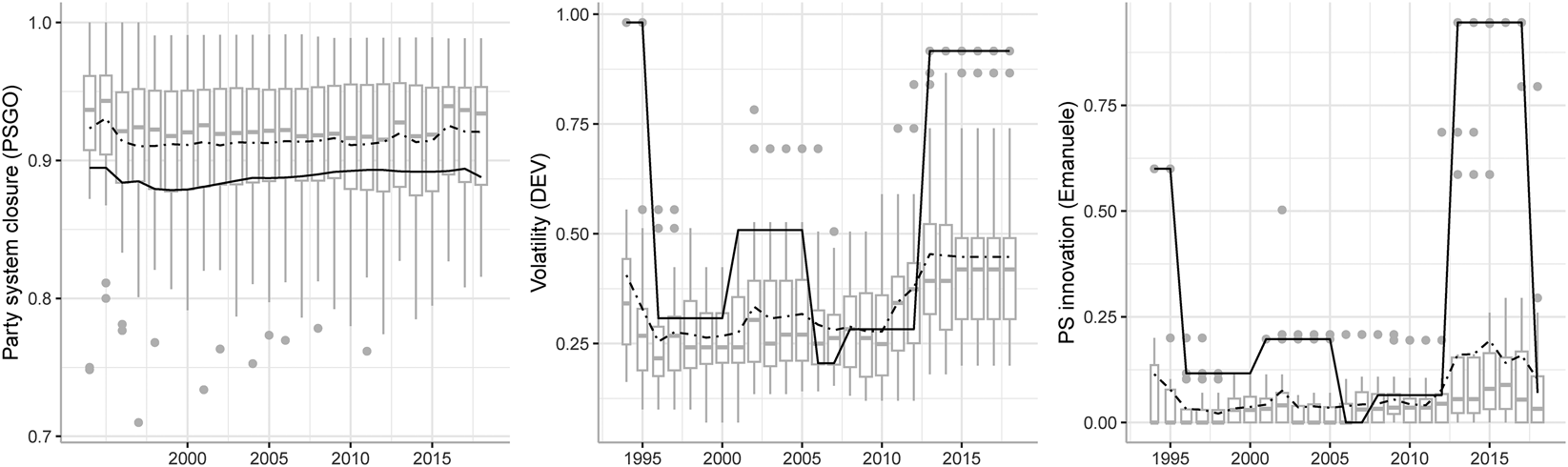
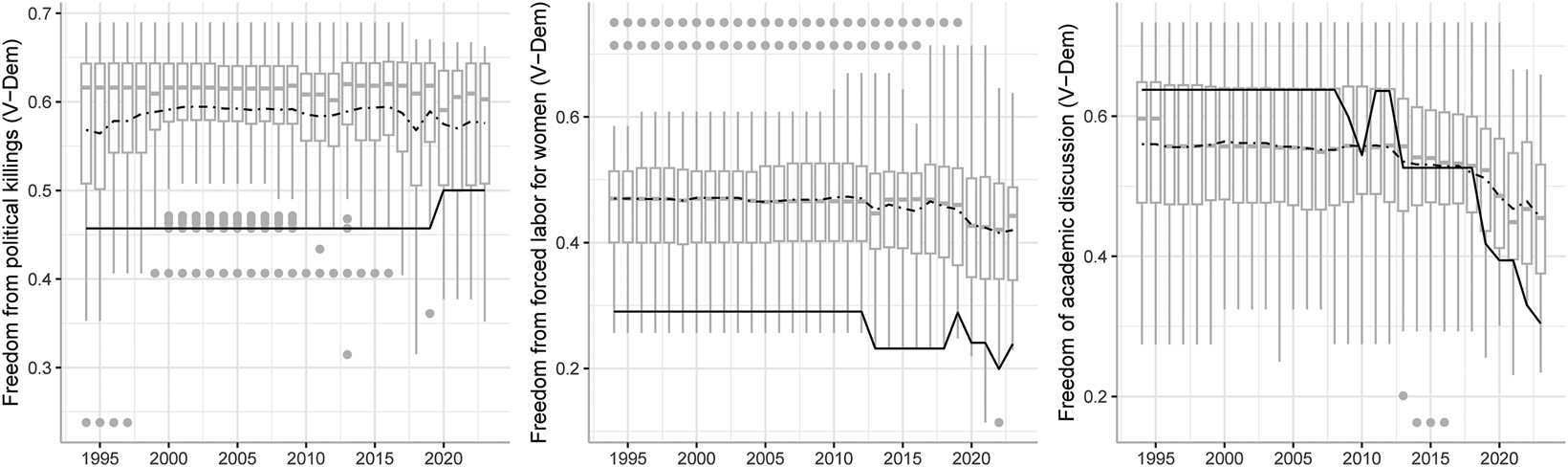
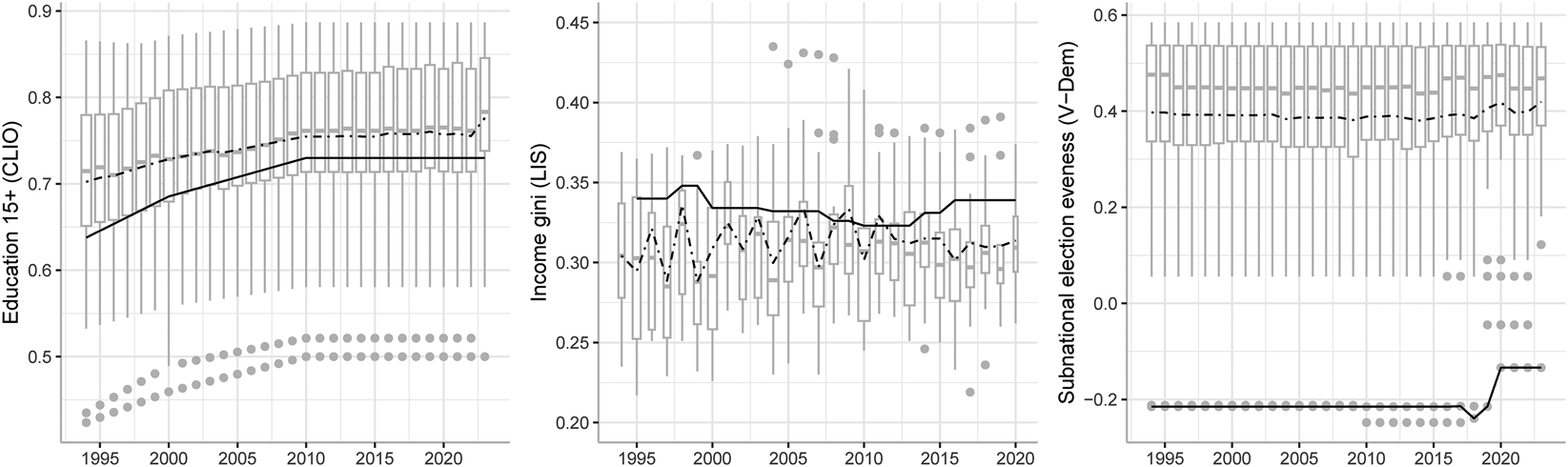
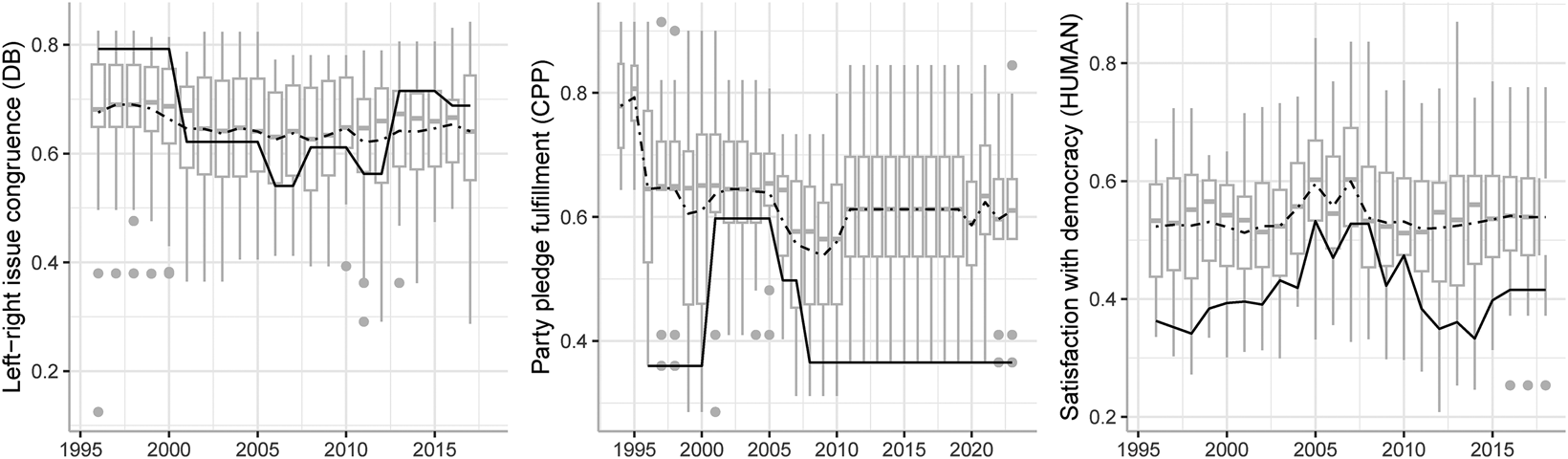
For each dimension of democratic quality, we examine multiple indicators. We use a variety of sources based on expert judgments, factual data, or mass surveys (we introduce each indicator in the text, Appendix Table A3 provides a complete overview). Most variables were matched using the Quality of Government (Teorell et al., Reference Teorell, Dahlberg, Holmberg, Rothstein, Khomenko and Svensson2023) tool, others manually. The paper uses such a large array of variables (re-scaled between 0 and 1) to limit bias: this massive collection of data should minimize errors due to experts' subjectivity on the one hand, and incompleteness of factual information on the other (Graziano and Quaranta, Reference Graziano and Quaranta2024). Therefore, it complements and extends previous empirical examinations on democratic quality (Morlino, Reference Morlino2011: Chapter 8) with a time-series cross-sectional analysis until today on a larger sample of established liberal democracies. For a complete overview, we refrain from aggregating such data into overarching dimensions (or principal components), as this could conceal important variation in individual indicators. Instead, we present graphs tracking the time evolution of such variables, highlighting the scores for Italy (black line) and the sample average (dashed line). This allows us to see whether Italy's trajectory compares with other liberal democracies or should rather be considered frontrunner or latecomer of broader tendencies. The graphs also report boxplots showing the yearly distribution of the data, to identify when Italy can be considered an outlier. This visualizes time and space variation of Italy's democracy simultaneously – unlike previous literature (Morlino, Reference Morlino2011; Morlino et al., Reference Morlino, Piana and Raniolo2013).Footnote 3
Procedural qualities
The first procedural dimension is rule of law. It relates to a well-functioning legal system, where everyone is equal before the law, which is public, clear, universal, known, and non-retroactive (Møller and Skaaning, Reference Møller and Skaaning2014). Looking at the rule of law trends in Italy and other liberal democracies (Figure 1), we see how Italy scores below the sample average in the indicators considered. According to the V-Dem rule of law index, Italy is a negative outlier before 2005. Moreover, it remains well below the first quartile of the distribution for the index by DB and that developed by the World Bank Worldwide Governance Indicators (WB, Appendix Table A3). We reach the same conclusions considering EU countries (Figure A10) and alternative measures (Figure A11): rule of law indices from the sustainable governance indicators of the Bertelsmann Stiftung transformation index (BTI, Schiller et al., Reference Schiller, Hellmann and Paulini2022), the World Justice Project, Freedom House (FH), and other more specific DB indicators – on transparency, in which Italy is close to being an outlier, and confidence in the police, which has declined since 2011. From this overview, we can affirm that – across various sources – Italy has lower rule of law scores and qualifies as negative outlier compared to liberal democracies worldwide, in Europe, and especially in recent years.
Rule of law.

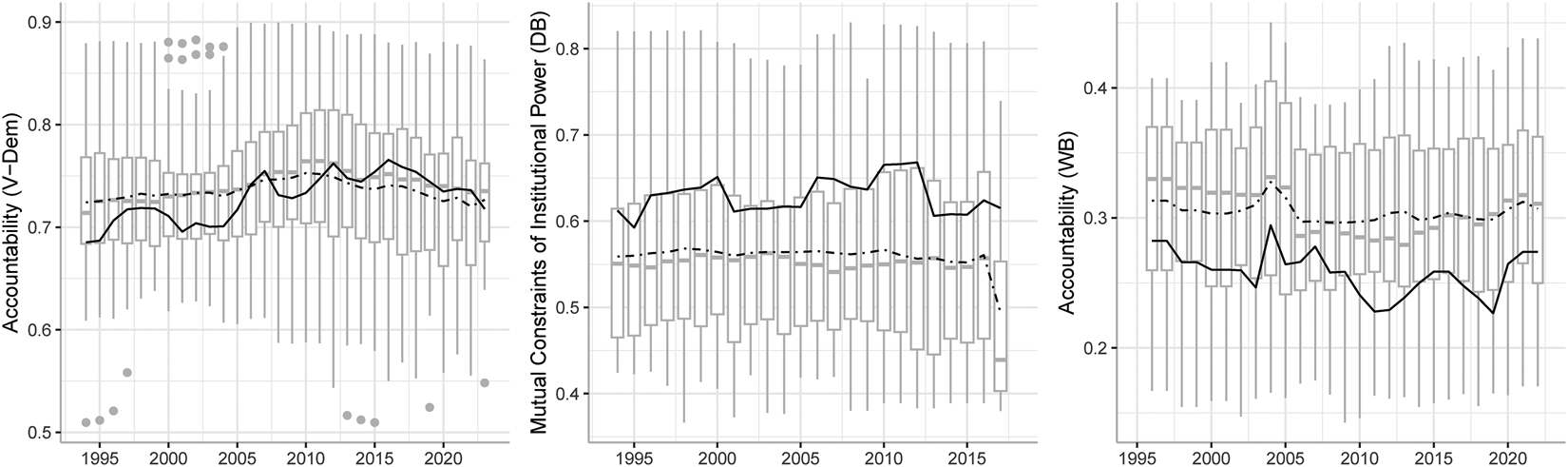
The second dimension, accountability, consists of horizontal (checks and balances, parliamentary, and judicial oversight), vertical (the relationship between rulers and ruled), and diagonal institutions (independent media) which constrain otherwise unlimited political power (Lührmann et al., Reference Lührmann, Marquardt and Mechkova2020). Figure 2 presents the V-Dem accountability index, the DB Mutual Constraints of Institutional Power index (on horizontal accountability), and the WB index on overall accountability. On horizontal accountability, the Italian system has stronger checks and balances than other countries (DB index), bordering the distribution's third quartile. This would suggest that most of its “immobilismo” (stalemate) may actually be a signal of a positive outlier trend. However, the other indices considered reveal a similar (first) or even lower (third panel) score, which put the country close to the average, qualifying as a latecomer. Such trends are confirmed within the EU (Figure A12). Figure A13 plots alternative measurements. First, we consider BTI specific indicators (executive accountability, the resources available to legislative actors, and the independence of supervisory bodies), where Italy (except for the second aspect) scores below the average and almost qualifies as negative outlier. Second, we examine the frequency of electoral system reforms (International Institute for Democracy and Electoral Assistance, IDEA). Italy exceeds the average (around 1), as it introduced and applied 3 electoral reforms since 1994. Although the variable type prevents us from meaningful calculations, we consider Italy an outlier, as its politicians often change electoral laws. Moreover, on diagonal accountability (last panel of Figure A13), while Italy used to perform better than other countries, today it approximates the average, which is generally declining and particularly in Italy. Therefore, we can conclude that Italy's evaluation (outlier or latecomer) depends on measurement choices.
Accountability.

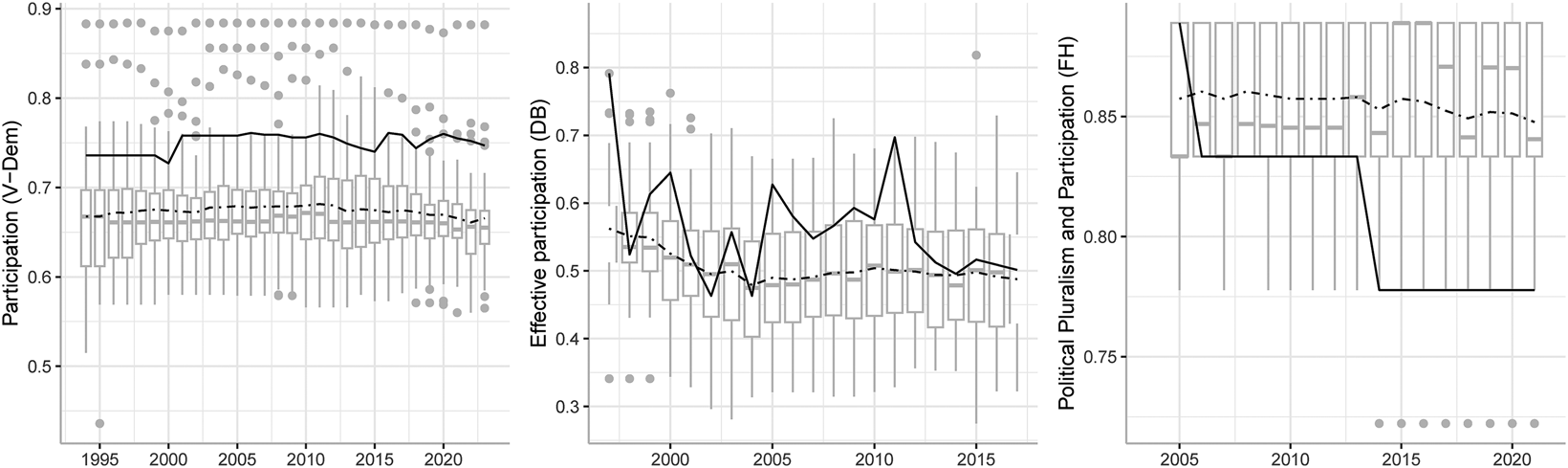
Participation, the third dimension, requires an effective engagement of citizens, without formal or de facto limits to universal franchise. This component is often considered to be reinforcing other dimensions, for example, rule of law (Vaccaro, Reference Vaccaro2023). Italy is a positive outlier on the V-Dem participation index (Figure 3). Arguably, this is due to the significant impact, especially since the 1990s, of direct democracy institutions, decentralization, and high turnout rates. Such trends are replicated in the DB effective participation and FH political pluralism and participation indicators, which nonetheless show a recent decline. Similar patterns are registered within EU countries (Figure A14) and across alternative indicators (Figure A15): on mass mobilization (V-Dem) – where Italy seems to be a latecomer, approaching the sample average – and Vanhanen's (Reference Vanhanen1997) democracy index's participation component (the percentage of the total – not only adult or enfranchised – population which voted in the last elections). A similar trajectory can be seen for turnout (for national and European Parliament elections; IDEA Voter Turnout Database): with an uninterrupted decline since 2013 and the largest inter-election decrease between 2018 and 2022. While Italy used to score in the top 25% of the sample, it is now below the average. These measures confirm our interpretation: even though Italy was once a positive outlier with high participation, its strong decline makes it today a latecomer of low participation and a forerunner of more extreme disaffection.
Participation.

We then examine competition, accounting for electoral and party systems, government alternation, and coalition formulas. Figure 4 shows first the party system closure indicator from the Party Systems and Governments Observatory (PSGO, Casal Bértoa and Enyedi, Reference Casal Bértoa and Enyedi2022), measuring party alternation in coalition and access to government. The trends are parallel, with Italy scoring close to the first quartile. This is not unexpected, considering the frequent innovations of Italy's party system. However, it is surprising that closure has not decreased since 2018 – with the Five Star Movement first gaining office – which can be explained by the fact that coalition governments included parties that had governed in the past. Then, we look at electoral volatility from the Dataset of Electoral Volatility (DEV, Emanuele, Reference Emanuele2015). Italy is a clear outlier before 1996 and since 2013, although close to the average in other periods. The trend is confirmed by the party system innovation index, measuring the presence of new and strong parties in a given election (Emanuele, Reference Emanuele2016), showing that, although closure remains low, Italian competition is characterized by waves of volatility and innovation.
Competition.

Figure A16 considers EU countries and Figure A17 alternative measurements. First, it plots the DB competition index (measuring the openness of electoral legislation), according to which Italy used to be slightly above average, to then approach the mean between 2008 and 2013, being a latecomer. A similar trend is reflected by Vanhanen's other component of the democracy index (smaller parties' seat share). We also consider electoral fragmentation (third panel, PSGO; effective number of electoral parties), legislative party fractionalization (Rae's index from Comparative Political Data Set), in which Italy has a diverging pattern: above the third quartile until 2006, with a drop between 2008 and 2013, due to the articulation of competition in coalition blocs, and a re-approximation of the average since 2013. The same conclusion is reached for volatility in European elections (DEV). Italy's competition thus seems multi-faceted: it shows moderate closure despite high periods of volatility and innovation, but also high competition (except between 2000 and 2010), and fractionalization. Therefore, Italy has comparable levels of competition to the sample, but its competition is unstructured, fragmented, and volatile, making it an outlier and forerunner.
Content- and result-based qualities
Content- and result-related dimensions measure what democracies deliver and how responsive they are to citizens. As freedoms and equality are deemed the highest objectives of democracy (Przeworski, Reference Przeworski2010), the fifth dimension assesses freedoms, including civil liberties and political rights. From Figure 5 (all V-Dem indicators – the most detailed source in this aspect, showing important variations even within liberal democracies), Italy scores low in terms of freedom from political killings, forced labor (or servitude) for women – often appearing here as negative outlier. Italy anticipates the decrease in other countries, qualifying partially as a frontrunner in this negative trend. Lastly, V-Dem's measure for freedom of academic and cultural discussion reports a sharp decline for Italy, especially since the 2010s, anticipating and surpassing a broader decline. These trends are confirmed within EU countries (Figure A18). Figure A19 corroborates this pattern: unlike economic liberties (V-Dem; in line with other countries after having higher state ownership of the economy in the past) and freedom of the press (FoP from FH, where Italy scores better until 2015), Italy performs below average for the V-Dem index of freedom from torture, the FH indicator on freedom of expression and belief, and the BTI on civil rights and political liberties. On this dimension, we therefore conclude that Italy can be considered a negative outlier, although this might be sensitive to measurement choices.
Freedoms.

The sixth dimension concerns socioeconomic equality. Figure 6 reports various indicators: educational (CLIO project, in the V-Dem dataset), income (Luxembourg Inequality Study Database), and territorial equality (in electoral integrity, V-Dem). In the first plot of Figure 6, we observe lower average years of education of the Italian population over 15, stagnating since 2010 – while other democracies (modestly) advance. Moreover, the Gini index of income inequality shows a stable and more unequal income distribution in Italy (the fourth most unequal country in the sample): not technically an outlier, but still strongly divergent. We also look at a measure of territorial unevenness in democratic quality, capturing the extent to which all areas in the country enjoy same levels of electoral integrity. Italy presents severe territorial political inequalities and is clearly an outlier. Although not directly connected to socioeconomic aspects, we deem this dimension particularly relevant, because it describes important territorial disparities in electoral integrity (thus, political inequality) presumably between North and South. Figure A20 reports those trends for EU liberal democracies, showing Italy as outlier on income inequality and territorial unevenness. Figure A21 considers other indicators: first, the V-Dem index of health inequality, which is aligned with the average, even above since 2015.Footnote 4 Second, we look at the UN Development Program Gender Inequality Index (considering reproductive health, empowerment, and labor market), another operationalization of the Gini index from the Organization for Economic Cooperation and Development Country Statistical Profiles and other BTI indicators – social inclusion and health equality index. The trends are confirmed (Italy as a negative outlier), except for gender inequality.
Equality.

Finally, responsiveness accounts for people's satisfaction with the political system and how much the system adheres to people's preferences. Figure 7 measures it with three variables. First, we see that the congruence (on the left-right scale) between the positions of the electorate and members of parliament, despite some fluctuations, remains comparable to liberal democracies – with higher congruence before 2001 and after 2013 (DB aggregated survey data). Second, the manifestos' electoral pledges fulfilled by parties in government (Thomson et al., Reference Thomson, Royed, Naurin, Artés, Costello, Ennser‐Jedenastik, Ferguson, Kostadinova, Moury, Pétry and Praprotnik2017, Comparative Pledges Project) present Italy as negative outlier (with a parenthesis between 2001 and 2008). Third, we look more generally at the discontent vis-à-vis the democratic system: aggregating various surveys on this topic (Human Understanding Measured Across National Surveys, Claassen, Reference Claassen2020), Italy remains below the average of liberal democracies, with only 40% of its population satisfied with democracy. Such trends are replicated among EU countries (Figure A22). Also, a detachment between citizens and institutions in Italy is confirmed by the alternative measure considered: lower and decreasing confidence in government (aggregated from mass surveys by the DB; Figure A23). We conclude that, despite the high party/voter congruence, Italy suffers from low systemic responsiveness.
Responsiveness.

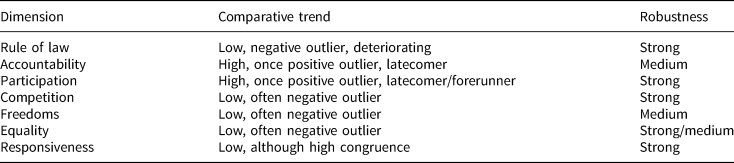
Table 2 summarizes the findings.Footnote 5 Italy represents an outlier, a forerunner or latecomer, or follows the sample, depending on specific aspects of democratic quality. Compared to established liberal democracies, it is characterized by: (i) a less robust (and deteriorating) rule of law; (ii) overall above-average accountability, albeit threatened by declining scores and the unstable electoral legislation (outlier, latecomer, or forerunner depending on measurements); (iii) high participation levels which are now dropping faster than other cases; (iv) more competition, though less structured (with high volatility and fragmentation); (v) low and decreasing scores for freedoms; (vi) severe income-based and territorial inequalities; and (vii) low responsiveness of the system, despite some congruence between voters and politicians. To sum up, Italy approximates being a negative outlier on some indicators (rule of law, freedoms, territorial equality) and positive on others (participation, volatility, electoral reforms). Although for some indicators it travels in parallel to the sample, on most dimensions on which Italy was a virtuous example (accountability, participation, or competition), it is recently approaching the mean or declining rapidly. On that, Italy may be either a latecomer to a general erosion or a forerunner, anticipating future trends.
Evolution of Italy's democratic quality

Political parties and democratic quality
The examination of fine-grained indicators of democratic quality allowed us to identify some of the defects of the Italian case. Now we ask: what might explain such trends and divergences between Italy and other liberal democracies? Are they produced by Italian idiosyncrasies or broader patterns? Italy is often regarded as peculiar because of the developments of its political parties (Pasquino and Valbruzzi, Reference Pasquino and Valbruzzi2010). Indeed, the country has seen the creation and success of quite specific party models – for example, Berlusconi's personal party or the Five Star Movement's digital democracy. Some of these peculiarities, we argue, might be connected to the evolution of democratic quality. Building on the previous section, this second part of the paper thus explores the role of some characteristics of Italian parties in explaining variation of democratic quality.Footnote 6
Why should parties matter for democratic quality? Obviously, free and fair elections are the minimal precondition for democracy, requiring the presence of political parties competing against each other. But it does not suffice that parties exist: they should also function properly. Past literature has underlined how unstable and inefficient parties would lead to higher political dissatisfaction and disengagement, opening a window of opportunities for anti-system challengers (Mainwaring, Reference Mainwaring1999). We argue that specific features connected to the power and effectiveness of political parties can affect democratic quality.
The main explanatory mechanism consists of parties' unwillingness or inability to fully perform their fundamental political tasks. If they fulfill at best their functions of linkage and representation, parties can effectively translate citizens' preferences into the political agenda, by safeguarding their interests. Otherwise, parties could become primarily concerned with reaping benefits for themselves, distributing resources to personnel and members, potentially fueling divisions among relevant sectors in the country. They could become the vehicle for the expression of authoritarian ambitions of charismatic leaders, which political parties cannot keep outside their ranks, failing to act as democratic gatekeepers (Levitsky and Ziblatt, Reference Levitsky and Ziblatt2019). An established strand of research has already assessed how party organization shapes the way in which parties function and interact with institutions and society (Harmel and Janda, Reference Harmel and Janda1994; Katz and Mair, Reference Katz and Mair1995; Dalton et al., Reference Dalton, Farrell and McAllister2011; Scarrow et al., Reference Scarrow, Webb and Poguntke2017; Webb et al., Reference Webb, Scarrow and Poguntke2022). We further argue that, because of their flawed internal organization, parties might no longer be interested in improving democratic quality beyond the electoral arena or with specific public policies. We empirically explore such connection between parties and democratic quality.
We identify two featuresFootnote 7 that could directly affect the fulfillment of parties' democratic functions and on which Italy is expected to be an outlier: personalization, which could make parties less accountable and responsive, and low institutionalization, that might have negative effects on competition and participation. We expect these features to have an especially important impact on the procedural dimension, but also a more general effect on other democratic quality dimensions, as they might be all to a certain extent related and co-vary jointly (Morlino, Reference Morlino2011).
First, we observe the degree of personalization of the party, which we understand as the prominence of individual politicians at the expense of the party and collective identities (Karvonen, Reference Karvonen2014; Marino et al., Reference Marino, Martocchia Diodati and Verzichelli2022). This may affect the extent to which parties care about and express voters' preferences. In fact, parties revolving around a single strong figure might be more prone to becoming leader-centered electoral machines and disregard (or even manipulate) the articulation of people's preferences.Footnote 8 Personalized parties might worry less about bottom-up support and representation and more about individual interests at the top, even if they may collide with democratic safeguards. We therefore expect that a higher personalization of political parties is negatively correlated with several dimensions of democratic quality, especially rule of law, accountability but also citizens' satisfaction with the system (responsiveness).
Second, we consider the extent to which parties are institutionalized, that is, have acquired “organizational stability and value” (Basedau and Stroh, Reference Basedau and Stroh2008). The concept of party institutionalization entails a relative stability in the configuration of the political landscape, that can be measured in terms of party rootedness and systemness (Casal Bértoa, Reference Casal Bértoa2017). We argue that parties with a stable electoral base and legislative presence – institutionalized parties – can better articulate citizens' preferences, provide clearly recognizable electoral offers, and have more mobilization potential. We expect party institutionalization to be positively associated with democratic quality, particularly on the dimensions of competition and responsiveness. Conversely, when parties are incoherent in their supply and ineffective in mobilizing voters, inter-party interactions become unpredictable, with negative effects on democratic quality.
Therefore, our goal is twofold: (i) understanding to what extent Italy differs from other liberal democracies in terms of party personalization and institutionalization; and (ii) testing if/how these features are systematically related to democratic quality in the sample. First, we shed light on trends of personalization and party institutionalization across liberal democracies, to assess whether Italy follows similar patterns or stands out. Indeed, Italy has been presented as exceptional in comparison to West European countries, due to its de-institutionalized party system (Emanuele and Chiaramonte, Reference Emanuele and Chiaramonte2020) and political parties (Di Mascio, Reference Di Mascio2014), as well as the extremely “relevant and diversified record of personal parties” (Calise, Reference Calise2015: 313). Here, we bring together personalization and institutionalization and broaden the scope of previous analyses across space and time. Subsequently, we proceed to examine the impact of those party characteristics on democratic quality.
Large-N comparisons: Italy as a typical case?
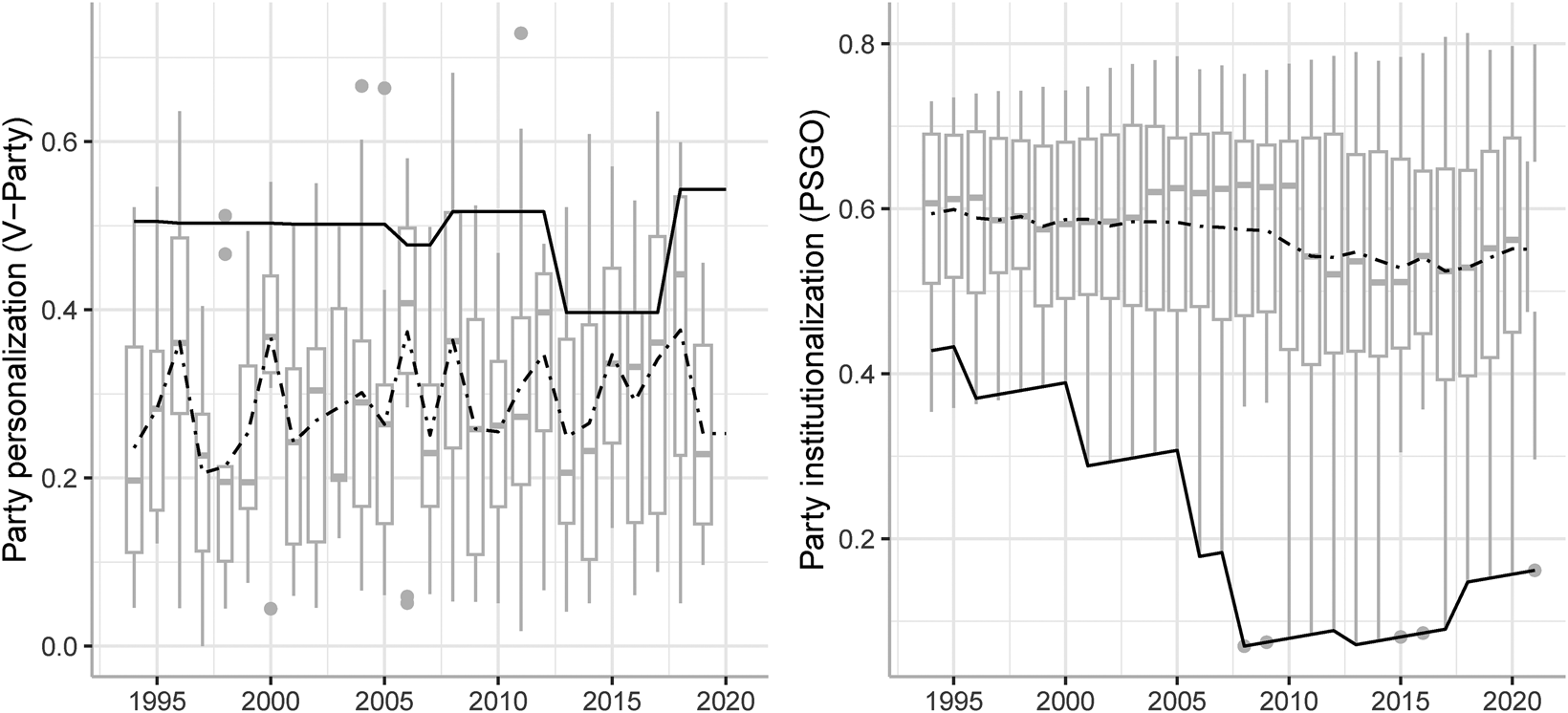
To measure party features in such a broad set of countries over 30 years, we use fine-grained indicators based on secondary data. For party personalization, we rely on the Varieties of Party Identity and Organization (V-Party, Düpont et al., Reference Düpont, Kavasoglu, Lührmann and Reuter2022) variable asking experts “to what extent is this party a vehicle for the personal will and priorities of one individual leader?”. We measure party institutionalization through PSGO's (Casal Bértoa and Enyedi, Reference Casal Bértoa and Enyedi2022) index combining parties' average age and electoral dominance, defined as the progressive enhancement of their electoral share.Footnote 9 As V-Party and PSGO indicators are at the party-election level, for each country/year we take the party mean weighted by seat share. We first shine the spotlight on Italy, to determine whether the evolution of its parties' features is in line, anticipates or contrasts with other liberal democracies. From these time-series, as we did in the previous section, we determine if Italy is a forerunner, latecomer, or outlier. We present graphs of the two above-mentioned party features to highlight trends for Italy and the sample average, whose distribution we show via boxplots.
The first graph of Figure 8 addresses party personalization, showing consistently higher and increasing values for Italy, bordering the classification as outlier. This is in line with the experience of Berlusconi's entrepreneurial party and with the leader-centrism tendencies of other populist (mostly – but not only – radical-right) parties, such as recently Fratelli d'Italia (Puleo et al., Reference Puleo, Carteny and Piccolino2024). The second graph plots party institutionalization, which is dramatically lower for Italy: the lowest score in the sample (with a consistent drop since 2008), anticipating a declining tendency. Here we can consider Italy as an outlier – especially among West European countries – and a forerunner of the broader pattern of decline.
Party characteristics.

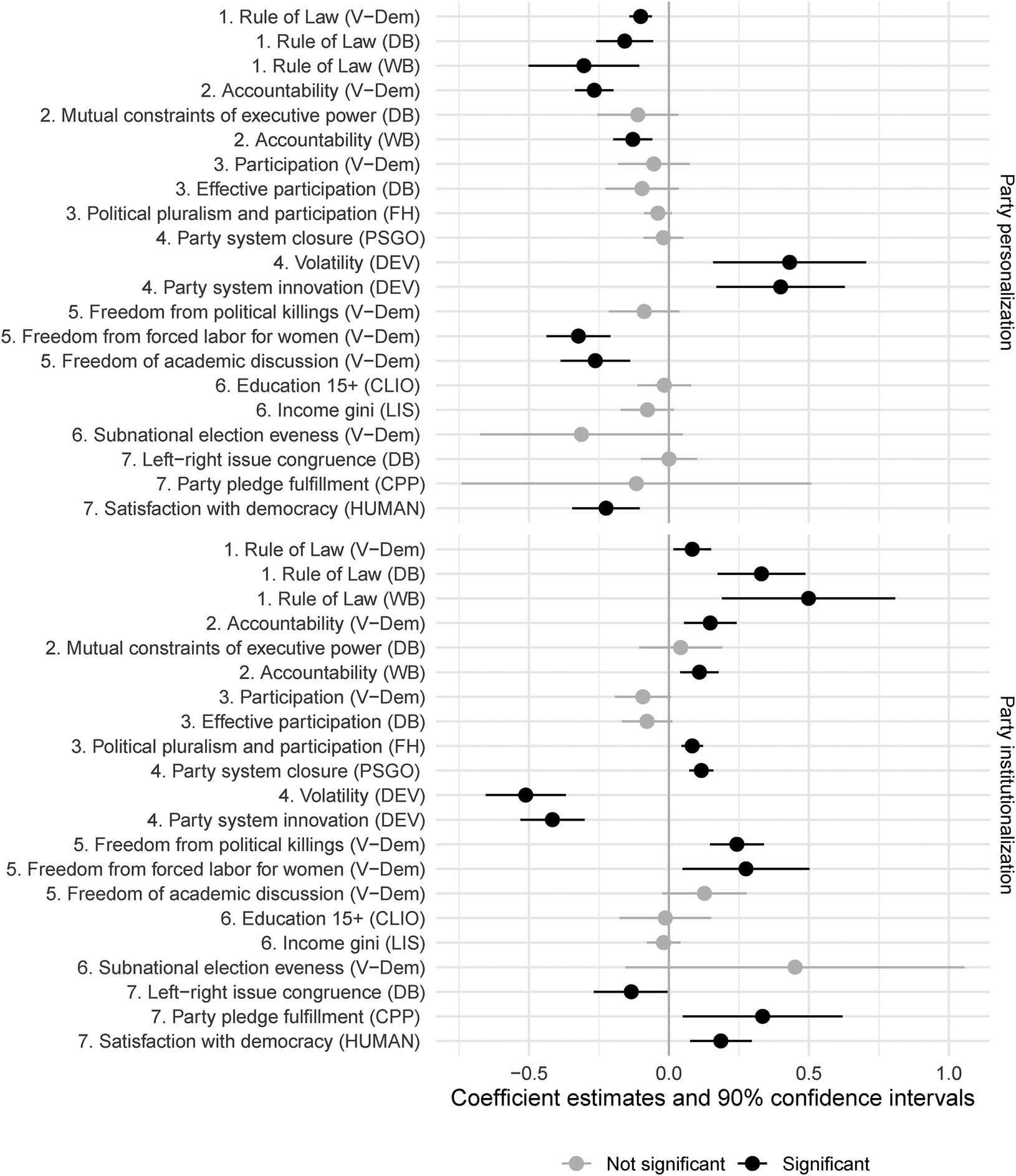
To what extent are such peculiarities of Italian parties related to various components of democratic quality? As suggestion for further research, Figure 9 summarizes the results of a battery of ordinary least-squares multivariate regressions (Appendix C, Tables A4–A10), taking one party feature (either personalization or institutionalization, as explanatory variable) and one indicator of democratic quality (outcome) at a time in separate models. We control for (logged) GDP per capita and population (V-Dem) and, to address reverse causality and error autocorrelation, have 1-year lagged independent variables and country-clustered standard errors. To account for time-related unobserved variance, we incorporate year-fixed effects – but not country-fixed effects, as most variance is between rather than within countries and our variables are relatively stable over time. With such design, we refrain from any claim of causality, but we interpret the models as consistent between-country associations,Footnote 10 that should be considered as a first step toward future causal investigations. Nonetheless, we are confident that we can identify meaningful associations to contextualize Italy's position across liberal democracies.
Impact of party features on democratic quality.

Figure 9 shows the coefficients for party personalization (top panel) and institutionalization (bottom panel) for each democratic quality indicator (labels on the left, each number indicates a dimension). From this analysis, there is evidence that individual features of political parties can explain some democratic quality components. Overall, we have consistent results on the impact of party personalization: it is associated with lower values of all rule of law indices and two out of three measures of accountability. The coefficients for the participation dimension are in the expected direction but non-significant. Moreover, party personalization is significantly related to higher party system closure and volatility, lower freedoms, and satisfaction with democracy. Although not all our coefficients reach conventional statistical significance, we can still affirm that party personalization is on average detrimental for different aspects of democratic quality, particularly but certainly not only on the procedural dimension.
The indicator on party institutionalization yields consistent findings. Higher party institutionalization is associated with higher scores on rule of law, accountability, some indicators of participation and competition, lower volatility and innovation, higher satisfaction with democracy and pledge fulfillment. Such positive effects also spread to other democratic qualities, among which higher freedoms. In short, the democratic quality dimensions that are the most affected by our explanatory variables are those related to procedural aspects of democratic quality (rule of law, accountability, participation, and competition) though some effects hold for other dimensions (rights and freedoms, equality, and responsiveness). Appendix D reports models for the previously examined alternative measures (Figure A24, Tables A11–A17) with broadly convergent results.
This large-N analysis sheds further light on the Italian case. In the first part of our investigation, we demonstrated how Italy substantially deviates from liberal democracies, being an outlier, forerunner, or latecomer, depending on specific aspects of democratic quality. Here, we complement this statement to show how Italy also has structurally higher levels of party personalization and lower party institutionalization. This is illustrated by Appendix Figures A25 and A26, reflecting the overall negative association between these two variables in Italy and in our sample of liberal democracies. As our analysis has identified a connection between some characteristics of political parties and democratic quality across established liberal democracies, we can conclude that it is plausible that most of the defects of Italian democratic quality are explained by flaws in its political parties (e.g. personalization and de-institutionalization), and that Italy represents a typical case of this association.
Appendix E further validates this claim through a multilevel approach. Figures A27–A30 plot the values of personalization and institutionalization against the V-Dem rule of law scores, highlighting between- and within-country lines of best fit. Italy qualifies as a typical case of the cross-national association between democratic quality and party features, as low levels of rule of law are associated with high party personalization and low institutionalization. Such between-country variation is not mirrored within units (i.e. different slopes), which confirms our choice to avoid country-fixed effects, as most variance is due to the varying intercept of each country-clustered group of observations. Figure A31 replicates the results of the baseline analysis through multilevel models with random slopes, random intercepts, year-fixed effects, and the same controls. Although such models are quite demanding for our data (as random intercepts absorb most of the between-country variance), the main signs and the significance of many coefficients are retained, which corroborates our interpretation.
Conclusion
This paper has reassessed Italy's democratic quality, by updating previous debates with a variety of observational data on consolidated liberal democracies in the last three decades. From our analysis, we conclude that Italy represents both a positive/negative outlier or frontrunner/latecomer across different dimensions of democratic quality, depending on which dimensions we focus on. And also that, among other elements, most of its democratic defects can be explained by the high personalization and low institutionalization of its political parties. Despite being mostly descriptive and with a final attempt toward explanation, these findings lead us to further thoughts. First, when depicting Italy as an outlier or forerunner of different political tendencies, scholars should ground their claims better, to specify in which dimensions Italy should be considered so. At too high levels of abstraction, without clear populations of reference, time spans, and conceptually sound selections of multiple variables, considering Italy as “anomalous” compared to other democracies might be simplistic, if not pretentious.
This being said, Italian democracy does prove to be resilient – for instance, by remaining a liberal-democratic regime during episodes of turbulent political crises, recurrent recessions, and economic stagnation. However, across a multitude of measurements, we showed that Italy suffers from endemically low scores in some aspects of democratic quality – for example, rule of law, freedom, equality, and responsiveness – and it lately seems to be declining in the dimensions where it was closer to (or even performing better than) other liberal democracies – such as accountability, competition, and participation.
This is important because research on democratization and autocratization shows that defective democracies (or democracy of a lower quality) are more vulnerable to crises (Morlino and Quaranta, Reference Morlino and Quaranta2016), more likely to experience processes of deconsolidation (Fishman, Reference Fishman2016) or deterioration of other democratic quality elements (e.g. media's diagonal accountability, Wunsch and Blanchard, Reference Wunsch and Blanchard2023), which are often associated with democratic backsliding when radical actors are in power (Boese et al., Reference Boese, Edgell, Hellmeier, Maerz and Lindberg2021) and propose significant constitutional reforms. How democratic qualities increase or decline in various configurations (Morlino, Reference Morlino2011: 267) remains a fertile direction of research. Nonetheless, this further implies that scholars should more carefully examine the caveats of Italian democracy, and what effects on the regime and its citizens they might have in the long run. This also applies to the analysis of other democracies, which could be studied with the protocol this paper proposes on Italy.
Moreover, scholars should keep paying attention to the impact of parties and their organization on specific facets of democratic quality. We suggest looking at disaggregated data, which can account for the internal variation of each aspect and case. Our findings have revealed how party personalization can be particularly detrimental for various dimensions of democratic quality, while party institutionalization can improve it. Since it stands out on both these explanatory factors (party features) and outcomes (democratic quality components), Italy embodies a paradigmatic case that should be studied accordingly. Lastly, although our study only represents a first inquiry in this direction, developing a prominent tradition in this regard, structured comparisons could corroborate and add causal nuances to the enunciation of these quantitative trends, thus providing suggestions for further research and policy recommendations.
Funding
This research received no specific grant from any public or private funding agency.
Data
The replication dataset is available at http://thedata.harvard.edu/dvn/dv/ipsr-risp.
Supplementary material
The supplementary material for this article can be found at https://doi.org/10.1017/ipo.2025.7.
Acknowledgments
We are grateful to the editors of RISP, as well as to the anonymous reviewers involved at different stages of the review process, for their support, detailed feedback, and fruitful observations. We would also like to thank the organizers and participants of the online and onsite workshops related to the Special Issue “Italy: Outlier or Forerunner”, for their inspiring framework and promising explorations, especially the guest editors Susan Scarrow and Giliberto Capano. Finally, we are particularly grateful to Leonardo Morlino, Leonardo Puleo, Carolina Plescia, and Luca Tomini for their individual comments on earlier versions of the manuscript, which have significantly supported the steering of our thoughts and the articulation of this inquiry since its very first steps.
Competing interests
The authors declare none.