Introduction
The factors that determine clutch size have been a topic of debate among ornithologists since Lack first hypothesized about the evolution of bird clutch size in 1947. Lack (Reference Lack1947) suggested that the clutch size of gulls and waders belonging to the Charadriiformes is limited by incubation capacity. In a cold environment, parents pay a high energetic cost for incubation, and these costs increase with clutch size (Thomson et al. Reference Thomson, Monaghan and Furness1998). When more eggs are laid, parents are forced to spend more time incubating (Sandercock Reference Sandercock1997, Larsen et al. Reference Larsen, Lislevand and Byrkjedal2003, Niizuma et al. Reference Niizuma, Takagi, Senda, Chochi and Watanuki2005) and probably cannot warm all eggs effectively (Reid et al. Reference Reid, Monaghan and Ruxton2000, Niizuma et al. Reference Niizuma, Takagi, Senda, Chochi and Watanuki2005). The incubation-limitation hypothesis has been both accepted and rejected with regard to the Charadriiformes. Specifically, it has not held true for some waders (Sandercock Reference Sandercock1997, Arnold Reference Arnold1999, Wallander & Andersson Reference Wallander and Andersson2002, Larsen et al. Reference Larsen, Lislevand and Byrkjedal2003), but experiments in gulls and skuas revealed that the hatching success rates of enlarged clutches were lower than those of normal sized clutches (see Andersson Reference Andersson1976, Niizuma et al. Reference Niizuma, Takagi, Senda, Chochi and Watanuki2005).
Typically, egg temperature is maintained at c. 30–40°C during the incubation period but the thermal tolerance of embryos differs among bird species (see Webb’s review Reference Webb1987). When embryos are left at lower than optimal temperatures, their development is delayed (Booth Reference Booth1987). If an embryo is left below 30°C for a long time, it may die or develop abnormally (Booth Reference Booth1987, Székely et al. Reference Székely, Karsai and Williams1994, Engstrand & Bryant Reference Engstrand and Bryant2002). Niizuma et al. (Reference Niizuma, Takagi, Senda, Chochi and Watanuki2005) reported that a relatively low egg temperature and longer durations of egg temperatures below 30°C in enlarged clutches resulted in low hatchability in black-tailed gulls Larus crassirostris Vieillot.
The incubation capacity, or the effective heat transmission to the egg, is probably closely related to the number of brood patches in gulls. If a bird attempts to incubate more eggs than it has brood patches, hatchability may decrease. Skuas (Stercorariidae), which have two brood patches (Phillips Reference Phillips2002), generally lay two-eggs clutches (Andersson Reference Andersson1976, Furness Reference Furness1987), and three-egg clutches have rarely been reported (Bonner Reference Bonner1964, Furness Reference Furness1987, Millar et al. Reference Millar, Lambert, Bellamy, Stapleton and Young1992, Phillips Reference Phillips2001, Reference Phillips2002). Indeed, with the exception of one case (Phillips Reference Phillips2002), hatching successes for natural or artificial supernormal clutches in skuas are relatively low (Andersson Reference Andersson1976, Furness Reference Furness1987, Phillips Reference Phillips2001). Accordingly, we would expect that south polar skuas are not able to warm three eggs with two brood patches. We thus tested the incubation-limitation hypothesis in south polar skuas (Catharacta maccormicki Saunders) by comparing mean egg and nest temperatures and the total time that egg temperature dropped below 30°C between artificially created two-egg and three-egg clutches. In addition, to investigate the incubation efficiency, we estimated the hatching success and hatchability of natural two-egg and three-egg nests.
Methods
Study area
The study was conducted on the Barton Peninsula (62°13′S, 58°47′W) King George Island, South Shetland Islands during the summers (November–February) of 2004–2009. The area of the snow (or ice) free zone that is available for nesting on the Barton Peninsula is c. 8.4 km2 (Kim et al. Reference Kim, Chung, Kim, Yoo and Ahn2005). Two skua species, south polar skuas and brown skuas (Catharacta lonnbergi Matthews) and their mixed pairs, breed at the study site, with the south polar skua being the predominant species (Kim et al. Reference Kim, Chung, Kim, Yoo and Ahn2005).
Clutch size, number of brood patches and mating patterns
To locate nests, we searched around breeding sites and observed the territorial behaviour of south polar skuas throughout five consecutive breeding seasons (2004–2009). Once the first egg was observed in the nest, we visited that nest daily with the exception of blizzard days until egg laying was complete. The maximum egg number in a nest was defined as the clutch size. To identify the sex, the number of brood patches and mating pattern of breeding pairs, 36 pairs (13, 21 and 2 pairs having one, two and three-egg clutches, respectively) and 12 incubating adults (just one adult of a pair) of south polar skuas were caught. All skuas caught were sexed on the basis of the Z and W-linked CHD genes from blood samples (Fridolfsson & Ellegren Reference Fridolfsson and Ellegren2000) and banded with one KOPRI (Korea Polar Research Institute) numbered steel leg ring. To check whether three-egg clutches were created by polygyny or by female-female pairing in south polar skuas, we attempted to identify the mating pattern of owners having three eggs on the basis of individual sexing data. This, however, was not possible for two of the four three-egg clutches because one three-egg clutch found in 2006 was predated in the early stages of incubation, and the other clutch was found after the nest was abandoned in late January 2005, which was too late to determine the mating pattern.
Egg and nest temperature
To compare the incubating egg temperature between normal (one- and two-egg) and three-egg clutches in south polar skuas, we measured the egg temperature (Tegg) using dummy eggs during 2008–2009. In a recent study performed by Niizuma et al. (Reference Niizuma, Takagi, Senda, Chochi and Watanuki2005), dummy eggs were made for measuring Tegg by filling natural eggshells with agarose gel. However, it is difficult to collect natural skua eggs for experiments because researchers must minimize their disturbance when working in the Antarctic region. Although addled eggs were sometimes collected after incubation had finished, shells of addled eggs poorly preserved, and the number of addled eggs was insufficient for the experiment. Thus, we used the eggshells of domestic geese whose size (c. 85 x 60 mm) was slightly larger than that of the south polar skua (c. 70 x 50 mm, J.-H. Kim, unpublished data). The goose eggs were adjusted to the size of a south polar skua egg using following methods: first, parts of the narrow and broad ends of the goose eggs were cut off to a width of 5 cm, then we paired the shell ends such that they had a total length of 7 cm. The dummy eggs were then filled with agarose gel (see Niizuma et al. Reference Niizuma, Takagi, Senda, Chochi and Watanuki2005), and a datalogger (ACR Systems INC., SmartButton, DG1921; 17.35 diameterx 5.89 mm height) was loaded into the centre. Dataloggers were calibrated in a thermal bath (10–50°C) measured using a mercury thermometer before loading in the dummy eggs. Dummy eggs were painted to match the natural colour of south polar skua eggs after sealing.
Five clutches of two eggs were selected for measuring egg and nest temperatures, after testing for the acceptance of the dummy egg and enlarged clutch size by incubating adults. To evaluate whether Tegg and nest temperature (Tnest) are influenced by incubating one additional egg, we measured the temperatures of two-egg and three-egg clutches in the same nests. Tnest was measured simultaneously with Tegg using a similar datalogger. To measure the Tnest we placed a datalogger at a 1 cm depth inside the nest cup. Data loggers in dummy eggs and nests recorded the Tegg and Tnest every minute for 24 hours. The skuas’ own eggs were incubated in an incubator in the King Sejong Station during the experiments and returned to their original nest once the work was finished.
To evaluate the incubation equality for each egg within a nest, we calculated the difference between the lowest and highest Tegg (ΔTegg). Embryos of many seabirds cannot maintain normal development below 30°C (Dawson Reference Dawson1984). We determined the total amount of time that Tegg dropped below 30°C over a day to compare the disturbance time of an embryo’s development between two-egg and three-egg clutches.
Hatching success and hatchability
To investigate the hatching success and hatchability of south polar skuas, we visited 60, 91 and 86 nests every day with the exception of blizzard days during 2004–2005, 2005–2006 and 2006–2007, respectively. Hatching success was estimated as the percentage of hatched eggs per nest. If we found an unhatched egg during the normal hatching time, we determined whether the egg was addled. An egg was defined as addled if it made a gurgling sound when shaken. If eggs disappeared during the laying and incubation periods, we regarded them as predated eggs because the main causes of egg loss at this site are predation by brown and south polar skuas (c. 95% of eggs lost; J.-H. Kim, unpublished data). The hatchability per nest is defined here as the percent of hatched eggs from the remaining eggs in a nest during the normal hatching time. Thus, predated eggs were excluded for estimating the hatchability.
Statistical analyses
All statistical analyses were performed using SPSS ver. 12.0. To avoid pseudoreplication (see Hulbert Reference Hulbert1984), we used Tegg, ΔTegg, and Tnest measured every 10 min (144 measurements per day) for statistical analyses. Meanwhile, we accumulated the time that Tegg dropped below 30°C during the 24 hours for 1440 measurements per egg. A Mann-Whiney U-test was done to detect differences in Tegg, ΔTegg, and Tnest between two- and three-egg clutches. The differences in Tegg within a nest were analysed using a t-test for two-egg clutches and a one-way ANOVA for three-egg. We compared the hatching success and hatchability between one-egg and two-egg clutches using a Mann-Whitney U-test. In this comparison, the hatching success and hatchability of three-egg clutches was excluded because no hatched eggs were present in the three-egg clutches.
Results and discussion
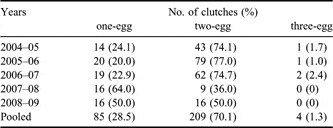
Clutch size
Although both one-egg and two-egg clutches were common, the majority of clutches contained two eggs in 2004–2005, 2005–2006, and 2006–2007 but not in 2007–2008 and 2008–2009 (Table I). We also found four naturally occurring three-egg clutches over the 2004–2007 study periods (Table I). Generally, supernormal clutches have been regarded as outcomes of polygyny (Conover et al. Reference Conover, Miller and Hunt1979, Kovacs & Ryder Reference Kovacs and Ryder1983), egg retrieval behaviour (Shugart Reference Shugart1980, Kim et al. Reference Kim, Nam, Fulton and Yoo2006), brood parasitism (Conover et al. Reference Conover, Miller and Hunt1979), or female-female pairing (Hunt & Hunt Reference Hunt and Hunt1977, Conover et al. Reference Conover, Miller and Hunt1979, Shugart Reference Shugart1980, Conover Reference Conover1983, Kovacs & Ryder Reference Kovacs and Ryder1983). However, the probability that three-egg clutches were formed by brood parasitism or egg retrieval behaviour is low because south polar skuas are very aggressive towards intruders and defend their breeding territory intensively during the breeding season. In addition, neighbouring nests are probably located too far apart to draw a neighbour’s eggs into one’s own nest (see Kim et al. Reference Kim, Chung, Kim, Yoo and Ahn2005). Bonner (Reference Bonner1964) and Phillips (Reference Phillips2002) observed that polygynous parents produce three-egg clutches in brown skuas. However, we did not observe three different adults at a nest containing three eggs. Not only all skua pairs with one-egg and two-egg clutch but also two of the four pairs with three-egg clutches were heterosexual pairs. Nevertheless, the possibility that polygynous parents created the supernormal clutches cannot be ruled out because we could not identify the mating pattern for two of the owners of three-egg nests.
Frequency distribution of clutch size of south polar skuas (2004–2009).

Incubation efficiency
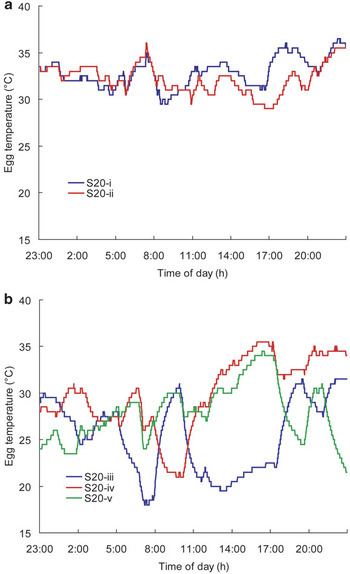
As in other Stercorariidae, the incubating south polar skuas caught had two discernible brood patches regardless of clutch size. Incubation capacity is closely related to the number of brood patches. Niizuma et al. (Reference Niizuma, Takagi, Senda, Chochi and Watanuki2005) showed as an example that the number of brood patches in black-tailed gulls limits the number of incubated eggs in an enlarged clutch. Thus, when south polar skuas attempted to incubate three eggs, they could warm just two eggs with brood patches (Fig. 1).
An example of egg temperatures (Tegg) measured during one day (1440 min) in two-egg and three-egg clutches of south polar skuas. Data of Tegg are from the nest S20. a. Two-egg clutch, b. three-egg clutch.

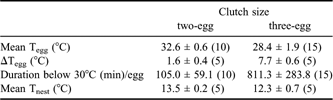
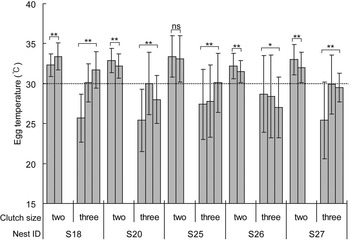
Fluctuations in Tegg of two eggs of both clutches showed synchronous patterns within same period (Fig. 1). However, Tegg of the extra egg in three-egg clutches tended to change in opposition to the other two eggs, and the composition of the pair of eggs following the synchronous Tegg fluctuation pattern shifted randomly (Fig. 1b). The mean egg temperature (Tegg) of two-egg clutches was significantly higher than that of three-egg clutches (z = 4.12, P < 0.001), and the ΔTegg values of two-egg clutches were significantly smaller than those of three-egg clutches (z = 2.61, P < 0.01; Table II). We also found significant differences in individual Tegg values within clutches in both clutch groups, except for one case in a two-egg clutch (Fig. 2). Even though we found significant differences in Tegg within the two-egg clutches, the overall mean Tegg for all eggs in these clutches did not fall below 30°C. In contrast, the mean temperatures of 12 eggs among the 15 eggs in the three-egg clutches were below 30°C. The mean accumulated time per egg that the Tegg dropped below 30°C in three-egg clutches was significantly longer than in the two-egg clutches (z = 4.16, P < 0.001; Table II). The above results indicate that parents could not efficiently incubate three eggs at a time.
Mean egg temperature (Tegg), differences between lowest and highest temperatures (ΔTegg), nest temperature (Tnest), and accumulated time per egg that Tegg dropped below 30°C during the one-day measurements. Data presented are mean ± SD and sample sizes are given in parentheses.

Comparisons of individual egg temperatures (±SD) measured over one day within the nest for two-egg and three-egg clutches. Significant levels are symbolized by: *P < 0.05, **P < 0.001.

We found that when one egg was added to a clutch with two eggs, the Tnest decreased significantly. The mean Tnest when skuas incubated two eggs was higher than that when they incubated three eggs (z = 2.61, P < 0.01; Table II). Szentirmai et al. (Reference Szentirmai, Székely and Liker2005) demonstrated that the cooling rate of an egg is a function of the clutch size and ambient temperature. In our experiment one egg could not be covered with a brood patch and probably would sit in a gap between the nest and the body of the parent. Thus, the gap probably allows the nest to be exposed to the low ambient temperature, thereby decreasing the Tegg. Our results suggest that the incubation efficiencies could be reduced by decreasing the thermal insulation of the nest in the enlarged clutches.
Hatching success and hatchability
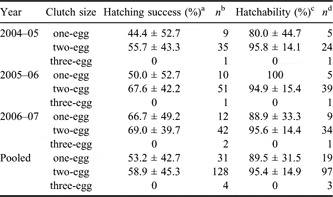
No significant differences in hatching success were found between the one-egg and two-egg clutches (Table III). The relatively high hatchability (89.5% in one-egg clutches; 95.4% in two-egg clutches) in normal-sized clutches suggested that eggs were incubated efficiently. However, we found that the hatching success and hatchability of three-egg clutches were zero (Table III). Hatchability is decreased when eggs are exposed to below-normal incubation temperatures for long periods of time (Vleck & Vleck Reference Vleck and Vleck1996, Niizuma et al. Reference Niizuma, Takagi, Senda, Chochi and Watanuki2005). Even though the embryos of some seabirds can endure and survive at low temperatures (e.g. 26°C for Adélie penguins (Pygoscelis adeliae (Hombron & Jacquinot); Weinrich & Baker Reference Weinrich and Baker1978), 10°C for fork-tailed storm-petrels (Oeanodroma furcata (Gmelin); Vleck & Kenagy Reference Vleck and Kenagy1980), 10°C for western gulls (Larus occidentalis Audubon; Bennett et al. Reference Bennett, Dawson and Putnam1981), and 5°C for Heermann’s gulls (Larus heermanni Cassin; Bennett & Dawson Reference Bennett and Dawson1979)), it remains unknown how long seabird embryos can sustain cooler temperatures, and most cannot maintain normal development below 30°C (Dawson Reference Dawson1984). In our study, the mean accumulated time per egg that the Tegg dropped below 30°C over the entire incubation period (c. 30 days; J.-H. Kim, unpublished data) was c. 406 hours for three-egg clutches (range 128–626 hours) compared to c. 53 hours for the two-egg clutches (range 7–87 hours). This suggests that relatively long exposures to below 30°C induced embryo mortality in three-egg clutches. Therefore, enlarged clutches are more at risk for cold temperature induced mortalities in the Antarctic region than are normal-sized clutches.
Hatching success and hatchability of south polar skuas.

a = average hatching success (± SD) per nest, b = no. of nests, c = average hatchability (± SD) per nest obtained from eggs not predated during the normal hatching time, d = number of nests having at least one egg not predated during normal hatching time.
Conclusions
Our results indicate that the incubation efficiency of south polar skuas is negatively affected by incubating one additional egg. This low incubation efficiency prevented the successful hatching of abnormal, three-egg clutches, resulting in zero percentage hatchability in three-egg clutches. Thus, our data supports the incubation-limitation hypothesis for south polar skuas. Incubating an enlarged clutch imposes additional physiological costs to parents (e.g. Reid et al. Reference Reid, Monaghan and Ruxton2000, Niizuma et al. Reference Niizuma, Takagi, Senda, Chochi and Watanuki2005) and may affect parental survival (Reid et al. Reference Reid, Monaghan and Ruxton2000). Given the tendency for birds to instinctively try to warm all eggs, they will probably incur more costs for incubating a larger clutch (Gabrielsen & Steen Reference Gabrielsen and Steen1979). We did not estimate changes in the body conditions of parents incubating two-egg and three-egg clutches during the incubation period to evaluate parental costs. However, such an investigation should be conducted to test the trade-off hypothesis in south polar skuas.
Acknowledgements
We thank H.-U. Peter, S.G. Chang, E.J. Lee, S. Hahn, M. Ritz, A. Fröhlich, M. Kopp, S.G. Chang and J. Kim for their assistance in the field. We are indebted to Y. Niizuma, H.-G. Choi, J.H. Kim and A. Takahashi for helpful advice and discussion. We are also grateful to 17, 18, 19, 20, 21 and 22nd overwintering teams of the King Sejong Station, KOPRI for supporting the fieldwork. This work was supported by Status and Changes of Polar Species and Coastal/Terrestrial Ecosystems (PE09040) funded by Korea Polar Research Institute (KOPRI) in the Korea Ocean Research & Development Institute (KORDI) and the Korea Research Foundation Grant funded by the Korean Government (MOEHRD, Basic Research Promotion Fund) (KRF-2008-355-C00046).