The greeting at Schubert Online (Schubert-online.at) touts the site as ‘the world’s largest collection of Schubert manuscripts, first and early editions!’ Offering high-resolution digital reproductions of over 500 autographs of Schubert’s compositions and over 600 first and early editions as well as miscellaneous letters and documents relating to the composer’s life, this project lives up to this claim. Supported by the Vienna Science and Technology Fund and in cooperation with the Wienbibliothek im Rathaus (Vienna City Library) and the Institute of Musicology at the Universität Wien, this resource was developed by the Institute for Applied Musicology and Psychology. Since 2010 the project has been housed at the Institute of Art History and Musicology/ Division of Musicology of the Österreichische Akademie der Wissenschaften. While most of the autograph manuscripts that have been digitized belong to the music collection of the Wienbibliothek, a significant number of others are held by the Österreichische Nationalbibliothek, the Staatsbibliothek zu Berlin – Preußischer Kulturbesitz and the Nasjonalbiblioteket (National Library) of Norway.
The sources at Schubert Online are clearly displayed in colour, and the images are easily manipulated on screen. Each document may be viewed in an overview of all its pages, as individual pages or in browse mode. Pages can be scaled up or down (25–200%), rotated, and measured in inches or centimetres. Although images can be printed or saved as PDFs, there is an electronic watermark (www.schubert-online.at) in the centre of each page.
The site, which is available in both German and English, is organized into four main menus: autograph scores, printed music, letters and other materials. Encompassing some 578 manuscripts dating from 1810 to 1828, the collection of autograph scores is the most important. Many of these manuscripts are owned by the music collection of the Wienbibliothek, an institution that also holds numerous other significant music sources. In addition to the Schubert collection, it owns manuscripts of works by Johann Strauss Jr, Joseph Lanner, Johann Nestroy, Hugo Wolf and Ernst Krenek, as well as the archives of Universal-Edition and the music publisher Doblinger. Sources from the Strauss family, Nestroy and Wolf collections have also been digitized and are available from the library’s web page.Footnote 1 The Schubert collection originated from a bequest of the industrialist and art patron Nicolaus Dumba (1830–1900). Aside from the autograph scores the library boasts ‘a nearly complete collection of first editions’ of the composer’s works, as well as letters in Schubert’s hand, miscellaneous other primary documents, later editions of Schubert’s music and manuscript copies of his works made by other people.Footnote 2 In 2001, in recognition of its importance, the Schubert collection was added to UNESCO’s Memory of the World Register. To many Schubert scholars, this collection is already well known; its sources have served as the basis for the Neue Schubert Ausgabe and a number of facsimile editions, as well as for numerous explorations of Schubert’s creative process. Indeed, in 1978 Ernst Hilmar (the head of the music division of the library from 1975 to 1994) published a catalogue of these manuscripts.Footnote 3
The autographs available at Schubert Online are categorized in the following manner: sketch, fragment, incomplete movements/works, draft, worked on manuscript, final stage, autograph with few corrections, partial autograph and copy in another hand with autograph entries. In a small number of cases, there are multiple types of autographs for a given work and sources from more than one institution. For instance, the score of the Kyrie to Schubert’s Mass in E-Flat Major, D. 950 comes from the Berlin Staatsbibliothek while the piano score of the Mass’s Gloria and a draft score of the ‘Cum sancto spiritu’ come from the Wienbibliothek. In addition to the autographs of Schubert’s completed works, there are also a small number of copies of works by other composers and composition exercises in imitation and canon, as well as materials for compositions that Schubert never completed, such as the piano sketches for the ‘Tenth’ Symphony in D, D. 936A.Footnote 4 Sources for well-known works discussed in the scholarly literature include: ‘incomplete drafts’ of the C minor, A major, and B-flat major Piano Sonatas D. 958–960; a ‘worked on manuscript’ for the String Quartet in G major D. 887; and a copy of part one of Winterreise with Schubert’s annotations.
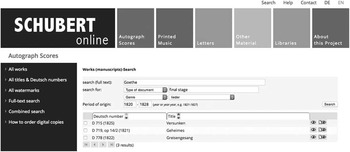
The landing page for each of the four types of documents (autographs, printed music, letters and other materials) offers a number of user-friendly ways of accessing the material. The left-hand column of Figure 1 shows the options for the autograph scores: all works; all titles and Deutsch numbers; all watermarks; full-text search; combined search; and how to order digital copies. Selecting any of the first three options results in an ordered list of the sources. Perhaps the first two of these options, organizing the compositions by genre (and then within each genre by Deutsch number) and a single list of all works by Deutsch number, will be the most widely used.Footnote 5 The ‘full-text search’ option and the ‘title’ prompt in the ‘combined search’ option enable users to search by title, but the German title (i.e. Streichquartett and not string quartet) including the diacritics, must be used. The ‘combined search’ option also facilitates searches of the full text in addition to ones by title of composition, collection and collection signature, genre, kind of issue, type of document, previous owner, instrumentation, text, ‘persons involved’ (for instance, a poet), Deutsch number, watermark and period of origin. Most of these categories are accompanied by drop-down menus, revealing the corresponding names or terms. Users may search each category by itself or combine categories, as in the search shown in Figure 1.
Combined search for lieder setting Goethe texts; final stage autograph dating 1820–1828 (accessed 23 January 2016)

The other types of sources available at Schubert Online are arranged in a similar way, and have similar search options. The first and early editions of Schubert’s works (located under the ‘Printed Music’ prompt) are owned by the Österreichische Nationalbibliothek.Footnote 6 This institution houses numerous other significant Schubert sources, and its other contributions to Schubert Online include some 70 autograph scores as well as an 1827 letter from Schubert to Johann Neumann. Schubert Online’s remaining two collections of documents are significantly smaller. There are 14 letters, 13 of which are owned by the Wienbibliothek. Written by Schubert to close friends and associates, they date from 1816 to 1827. The Wienbibliothek has also supplied four miscellaneous sources dating from 1816 and 1828. These include an invitation to Schubert’s memorial and an 1816 daybook entry.
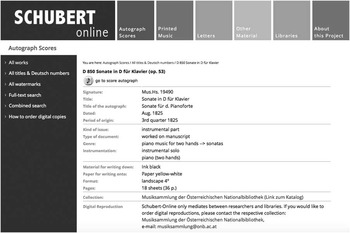
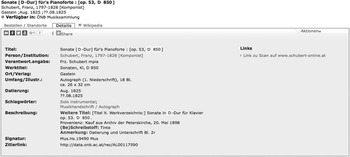
Each document is provided with a catalogue entry listing its basic characteristics, such as the paper type and size, date of origin, current owner, and, in some cases, the watermark. Figure 2a, reproducing the entry for the Sonata in D major D. 850, demonstrates the range of information supplied by each catalogue entry. Perhaps most impressively, all of the information is available in English as well as German. Compare, for instance, the Österreichische Nationalbibliothek record for the same autograph, shown in Figure 2b. Although some of the main pages of this music collection are available in English, searches and catalogue entries are only available in German. For texted works, the Schubert Online catalogue includes the name of the poet, and in the case of lieder and qsmall-scale vocal works, the full German text is printed. Likewise, the texts of letters and other documents are also transcribed. This is an excellent feature for users not familiar with nineteenth-century German script.
Schubert Online catalogue entry for Schubert’s Sonata in D major D. 850 (accessed 23 January 2016)

Österreichische Nationalbibliothek catalogue entry for Schubert’s Sonata in D major D. 850 (accessed 23 January 2016)

Although these catalogue descriptions appear to be quite thorough, they do not include the length in bar numbers of manuscripts providing only part of a movement or work. In comparison, the Digital Archives of the Bonn Beethoven-Haus provide detailed descriptions of each manuscript. Likewise, the Library of Congress clearly states that their manuscript of Schubert’s ‘Sehnsucht’ (D. 879) comprises the first 71 bars of the 89-bar song.Footnote 7 In the case of a song or a short qone-movement work the absence of bar numbers might not be inconvenient, but when studying a long multi-movement work the lack of detail in the catalogue record could become a little vexing, especially for a novice. Take, for instance, the two sources for the partially completed opera Adrast D. 137 (1819–21).Footnote 8 The larger source is a multi-movement manuscript comprising 188 pages. The catalogue record states that this manuscript is a ‘fragment’. Yet it gives no indication of which movements are included or of the state of each movement. The other manuscript comprises 36 pages. The catalogue description does not mention that it contains only nos. 8 and 9 of the composition, and even though the handwriting at the bottom of the first page of the manuscript itself describes the document as a ‘fragment’ the catalogue classifies it as a ‘worked on manuscript’.
Along somewhat similar lines, there does not seem to be a standardized type of catalogue entry for works that are grouped together in a collection or single manuscript. ‘Schwangesang’ D. 318, ‘Luisens Antwort’ D. 319 and a fragmentary sketch of the melodic line, without text, of ‘An den Mond’ D. 311 are grouped in a four-page manuscript, and the hotlinks from the catalogue entry for each song lead to a reproduction of the entire autograph.Footnote 9 In contrast, the catalogue does not indicate that the autographs of 16 of Schubert’s Goethe settings were collated into a single volume. This manuscript is owned by the Berlin Staatsbibliothek; its online digital collection enables users to view the volume in its entirety – including the front and back cover – and its catalogue describes the volume, as well as each song’s position within it.Footnote 10
A closer examination of Schubert Online’s catalogue entries raises a variety of other technical issues. There is no discussion of the manner in which the data in these records was obtained; this is particularly significant because the dating of some of these manuscripts has been somewhat of a contentious issue. In particular, Robert Winter, using paper studies, questioned some of the conclusions of Ernst Hilmar as well as those contained in the second edition of Deutsch’s catalogue.Footnote 11 Perhaps the descriptions of the manuscripts at Schubert Online rely on those of the institution that owns each source, but it seems that they resemble the work of Hilmar and/or Deutsch, as Winter’s research and conclusions are not referenced. Likewise, the site’s section on watermarks, which includes a reproduction of each watermark accompanied by a list of the compositions written on the corresponding type of paper, does not include any sort of documentation or description of the ways the watermarks were reproduced. Moreover, it seems that information regarding watermarks is only provided for the manuscripts owned by the Wienbibliothek.Footnote 12 Of course, one might suppose that a scholar who needed this type of technical information would seek out the corresponding secondary sources, which are easily accessible through databases such as RILM. Moreover, these issues of fine-tuning should not detract from the success of Schubert Online’s main mission – the preservation and dissemination of high quality reproductions of Schubert’s autographs and early editions.
Like other online digital music collections, Schubert Online is a work in progress. As this review was being completed, the first and early editions were being added and the site was given a new format.Footnote 13 Moreover, further expansions with contributions from the Schubert-Ausgabe are planned. Perhaps other additions might include the type of bibliography or discussion of Schubert research that is available for Beethoven scholars at the Beethoven-Haus website. Although this type of documentation might be beyond the purview of what is already an amazing, technically complex project, at least a listing of studies that explore the manuscripts reproduced at Schubert Online would be useful. (In addition, links to the RISM listings for the works might also be of assistance.)
Schubert Online is an excellent resource. Not only does it preserve high quality images of important manuscripts that will degrade over time, it also makes them easily accessible to scholars all over the world. These types of web projects are excellent teaching resources, allowing students who do not reside in cities with institutions holding such splendid manuscripts to experience the trials, conundrums and rewards of source study. That multiple institutions are collaborating on this project is particularly remarkable, and perhaps further partnerships might be possible. For instance, hotlinks to other sites displaying digitized images of Schubert manuscripts, such as The Morgan Library & Museum, and The Juilliard School, would be useful.Footnote 14 One looks forward to the day when Schubert Online becomes not only ‘the largest collection of Schubert music manuscripts, first and early editions’ but also the place to go for ‘one-stop shopping’ for all Schubert primary sources.