Childhood and adolescent obesity, a pressing global health issue affecting approximately 340 million individuals, arises from a multifactorial aetiology involving genetic susceptibility, environmental exposures and lifestyle choices(Reference Leandra, Ziad and Zargar1). Childhood obesity is linked to an earlier onset of cardiometabolic disorders such as type 2 diabetes, hypertension, dyslipidemia and metabolic syndrome, alongside psychological issues, including low self-esteem(Reference Franks, Hanson and Knowler2–Reference Moradi, Mozaffari and Askari4). Critically, obesity in early life establishes a trajectory for its persistence into adulthood(Reference Geserick, Vogel and Gausche5,Reference Singh, Mulder and Twisk6) , highlighting the urgency of early intervention.
Excessive caloric intake is one of well-established, modifiable risk factors of childhood obesity, suggesting dietary control is an effective intervention approach. Medium-chain fatty acids (MCFA), referred to as fatty acids with 8–12 carbon atoms [primarily comprising octanoic (C8:0), decanoic (C10:0) and dodecanoic (C12:0) acids], are known to promote energy expenditure and lipid catabolism by activating brown adipose tissue and modulating intestinal health(Reference Jia, Xu and Xu7,Reference Rial, Karelis and Bergeron8) . In adults, MCFA supplementation has been linked to enhanced satiety and reductions in body weight and fat mass among overweight individuals, although the findings remain inconsistent(Reference Maher, Deleuse and Thondre9–Reference Wu, Mao and Zhang12). Preliminary case-control studies reported lower levels of lauric acid in cord blood among obese neonates(Reference Aydogan Mathyk, Piccolo and Alvarado13), and lower levels of decanoic acid in erythrocytes among obese preschool children(Reference Liu, Liu and Shi14). However, the relationships between dietary MCFA intakes and overweight and obesity remain unclear in children and adolescents.
This study aimed to explore the associations of total MCFA and its components (C8:0, C10:0 and C12:0) intakes with overweight/obesity, obesity and central obesity among children and adolescents, which may provide valuable insights for dietary strategies for obesity prevention.
Methods
Study design and population
This cross-sectional study utilised data from the National Health and Nutrition Examination Survey (NHANES, access towards https://wwwn.cdc.gov/Nchs/Nhanes/), conducted by the National Center for Health Statistics. NHANES is a nationally representative, cross-sectional survey designed to evaluate the health and nutritional status of the non-institutionalised US civilian population through a combination of interviews and standardised physical examinations. The survey protocols were approved by the National Center for Health Statistics Research Institutional Review Board. As the data are de-identified and publicly accessible, the requirement for additional ethical approval for this analysis was waived by our institution.
Information on children and adolescents aged 6–17 years was extracted from the NHANES 2007–2023. Excluded criteria were as follows: (1) incomplete MCFA data; (2) missing total energy intake data; (3) missing height, weight or waist circumference measurements; and (4) outlier of total energy intake (1 % of low or high total energy intake for each age group).
MCFA measurement
Dietary intake data were collected by two 24-h recall interviews. The first assessment was conducted in person at a mobile screening centre, while the second was administered via telephone 3–10 d later. Dietary MCFAs were classified as C8:0, C10:0 and C12:0 in the dataset. Total daily intake of these individual C8:0, C10:0 and C12:0 was determined by averaging the values from the two dietary recalls, and their sum was aggregated to represent total MCFA intake. For analytical purposes, dietary intakes of total MCFAs, C8:0, C10:0 and C12:0 were each stratified into tertiles.
Covariates
The potential covariates included age, sex, race (White, Black, or other races), caregivers’ education level (below high, high, or above high school), poverty income ratio (PIR, <1·3 or ≥1·3), birth weight (<5·5, 5·5–9·0 or ≥9·0 pounds), smoking during pregnancy (no, yes or unknown), smoker in home (no, yes), ≥60 min of physical activity (PA) per week (<7, = 7 days, or unknown), energy intake, carbohydrate intake, protein intake, UFA intake and other SFA intake.
Outcomes
Overweight/obesity was defined as a BMI-for-age at or above the sex-specific 85th percentile according to the CDC growth charts. Obesity was defined as a BMI-for-age at or above the sex-specific 95th percentile(Reference Kuczmarski, Ogden and Guo15,16) . Central obesity was considered present if the waist circumference exceeded the age- and sex-specific 90th percentile(Reference Fernández, Redden and Pietrobelli17).
Statistical analysis
Because this was a secondary analysis of pre-existing NHANES data, no a priori sample size calculation was performed. All eligible children and adolescents aged 6–17 years with valid dietary MCFA data, anthropometric measurements and dietary survey weights were included. The weighted analyses were performed using the procedures of SDMVPSU, SDMVSTRA, WTDR2D and WTDR2DPP. The weighted sample size was 48 271 085. Measurement data were assessed by ANOVA, and described as mean [± standard error]. Enumeration data were tested via χ2 test, and presented as number and percentage [n (%)]. Missing values for categorical covariates, including caregivers’ education level, birth weight, smoking during pregnancy and PA, were retained as an ‘unknown’ category. Participants with missing primary exposure data, missing anthropometric outcome data or missing dietary survey weights were excluded because these variables were essential for defining the exposure, outcomes and survey-weighted estimates. The number of missing values for each covariate was reported in Table S1. To assess potential selection bias, the demographic, dietary and anthropometric characteristics were compared between included and excluded participants (Table S2). A conceptual directed acyclic graph was used to guide covariate selection among MCFA intake, sociodemographic factors, early-life factors, lifestyle factors, dietary composition and obesity-related outcomes (Fig. S1). Covariates were selected a priori based on the directed acyclic graph and prior literature. Age, sex, race, PIR and caregivers’ education level were considered sociodemographic confounders. Birth weight, smoking during pregnancy, household smoking and PA were included as early-life, household and lifestyle factors. Carbohydrate, protein, UFA and other SFA intake were included to account for overall dietary composition. To avoid potential multicollinearity caused by simultaneous inclusion of total energy intake and macronutrient components, total energy intake was not included in the main multivariable model when macronutrient intakes were adjusted. Multicollinearity was assessed using variance inflation factors. All variance inflation factor values were below five, indicating no problematic multicollinearity (Table S3). Pearson correlation analyses were carried out between MCFA components and other SFAs (Table S4). Weighted univariate (Table S5) and multivariable Logistic models were used to evaluate the relationship of MCFA (total, C8:0, C10:0, and C12:0) with overweight, obesity and central obesity, with OR and 95 % CI. Subgroup analyses were conducted according to age (<12 and ≥12 years) and sex. Multiplicative interactions between MCFA intake and age or sex were evaluated by adding the corresponding interaction terms to the weighted regression models. Given the complex survey design and the use of quasi-likelihood estimation, interactions were evaluated using Rao-Scott adjusted likelihood ratio tests with F-distribution correction, accounting for survey weights and design degrees of freedom. For tests of linear trend across MCFA intake tertiles, the median value of the original continuous MCFA variable within each tertile was assigned to all participants in that tertile, and the resulting variable was entered into the weighted regression model as a continuous term. The P value for its regression coefficient was reported as the P for trend. Restricted cubic spline analyses were performed to examine the nonlinear associations of continuous MCFA intakes with obesity-related outcomes. Three knots were placed at the 10th, 50th and 90th percentiles of the corresponding MCFA distribution, with the median intake used as the reference value. Overall and nonlinear associations were evaluated by ANOVA tests of the spline terms, with the nonlinear component specifically tested against the linear component. All subgroup, interaction, trend and restricted cubic spline analyses incorporated the complex NHANES survey design, including sampling weights, strata and primary sampling units. To adjust for total energy intake, the exposure variables for sensitivity analyses were expressed as energy density, calculated as the percentage of total dietary energy derived from total MCFA, C8:0, C10:0 and C12:0, respectively. All statistical analyses were performed using SAS 9.4. P < 0·05 was considered statistically significant.
Results
Characteristics of children and adolescents
The screening flow chart of children and adolescents is shown in Figure 1. Records of 17 693 children and adolescents aged 6–17 years were initially retrieved from the NHANES 2007–2023. We excluded participants with incomplete MCFA data (n 3568), missing data on total energy intake (n 1), missing anthropometric measurements (height, weight or waist circumference; n 316), missing dietary two-day sample weight (n 2064) and outliers of total energy intake (n 262). After these exclusions, 11 482 eligible children and adolescents were finally included in the study.
The screening flow chart of children and adolescents.

A comparison between the 11 482 included and 6211 excluded participants was presented in Table S2. Compared with excluded participants, included participants differed significantly in race, caregivers’ education level, PIR, total energy intake, carbohydrate intake and prevalence of central obesity (all P < 0·05), whereas no significant differences were observed in age, sex, birth weight, smoking during pregnancy, PA or BMI categories.
Table 1 presents the characteristics of children and adolescents. The statistical differences were found in age, sex, race, caregivers’ education level, PIR, birth weight, ≥60 min of PA per week, energy intake, carbohydrate intake, protein intake, UFA intake, other SFA intake, BMI and central obesity among the three groups of total MCFA (all P < 0·05).
Characteristics of children and adolescents

Table 1. Long description
The table presents characteristics of children and adolescents categorized by total medium-chain fatty acids (MCFA) levels: <1.00 g, 1.00-1.81 g, and >=1.81 g. It includes 11 columns and 18 rows, detailing variables such as age, sex, race, caregivers’ education level, poverty income ratio, birth weight, smoking during pregnancy, smoker in home, physical activity, energy intake, carbohydrate intake, protein intake, unsaturated fatty acid intake, other saturated fatty acid intake, BMI, and central obesity. Each row provides percentages and counts for each category, with statistical differences noted among the three MCFA groups. Notable trends include variations in age distribution, sex, race, and education level across the MCFA categories. The table highlights significant differences in health and lifestyle factors among the groups.
S.E: standard error; F: ANOVA..
Distribution of MCFA intake across obesity-related outcomes
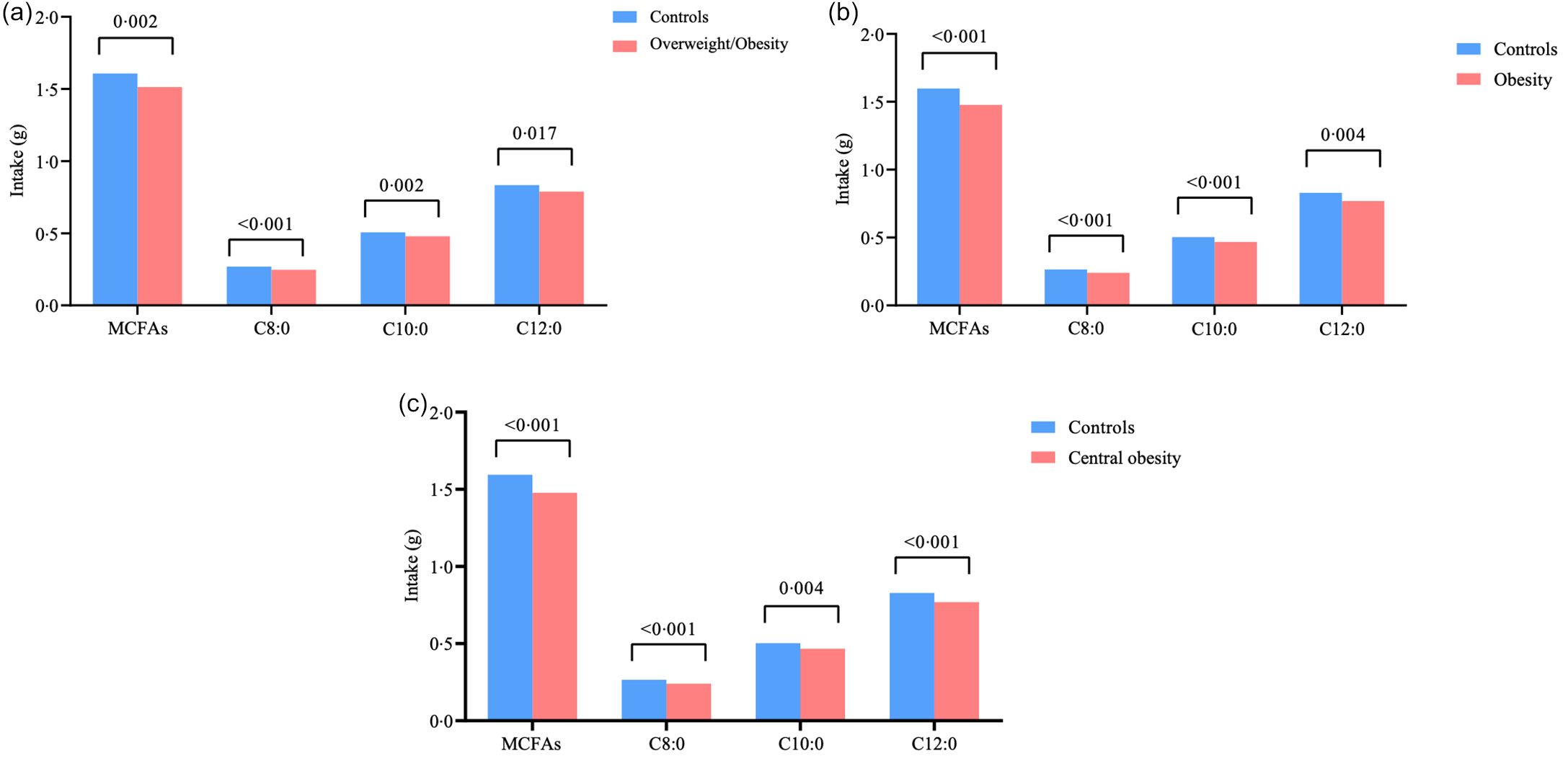
The distribution of MCFA across the groups defined by underweight/normal weight, overweight, obesity or central obesity was described in Figure 2. The levels of total MCFA, C8:0, C10:0 and C12:0 intake in the groups of overweight/obesity, obesity or central obesity were lower than those in the controls, respectively (all P < 0·05).
The distribution of MCFA across the groups defined by underweight/normal weight, overweight, obesity, or central obesity. (A) overweight/obesity v. controls (underweight/normal weight); (B) obesity v. controls (underweight/normal weight/overweight); (C) central obesity v. controls (non-central obesity).

Correlation assessment among MCFA components and other SFA
The correlation coefficients between MCFA components and other SFA were shown in Table S4. C8:0 and C10:0 were strongly correlated (r 0·891, P < 0·0001), C8:0 and C12:0 were strongly correlated (r 0·803, P < 0·0001), C10:0 and C12:0 were moderately correlated (r 0·660, P < 0·0001) and the correlations with other SFA intake ranged from r 0·451 to 0·781 (all P < 0·0001). These findings suggest that MCFA components share partially overlapping dietary sources. The individual MCFA components were analysed in separate parallel models rather than being mutually adjusted in the same model; therefore, inter-component correlations did not perform direct multicollinearity within a single component-specific model.
Associations of MCFA with overweight/obesity, obesity and central obesity in children and adolescents
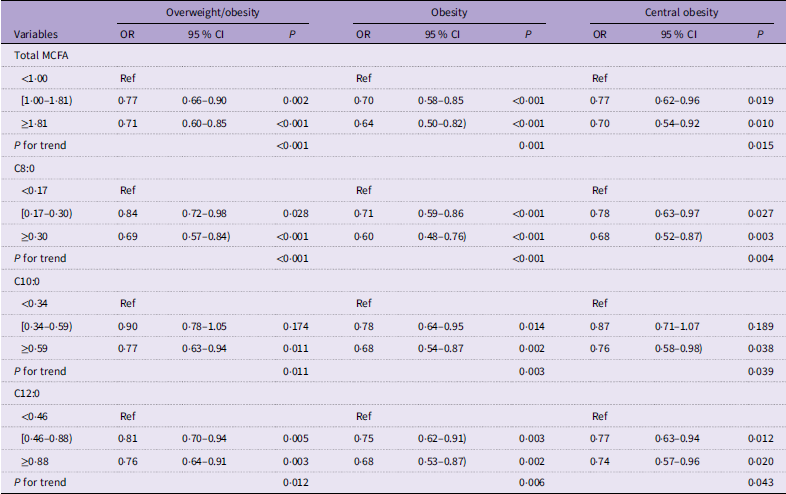
Table 2 shows the associations of total MCFA and its components (C8:0, C10:0 and C12:0) with overweight/obesity and central obesity in children and adolescents. After adjusting for age, sex, race, PIR, caregivers’ education level, smoking during pregnancy, smoker in home, birth weight, ≥60 min of PA per week, carbohydrate intake, protein intake, UFA intake and other SFA intake, higher intakes of total MCFA and its components (C8:0, C10:0 and C12:0) were related to with all obesity-related outcomes. Compared to the lowest intake tertile, participants in the highest tertile of total MCFA intake had lower odds of overweight/obesity (OR = 0·71, 95 % CI: 0·60–0·85), obesity (OR = 0·64, 95 % CI: 0·50–0·82) and central obesity (OR = 0·70, 95 % CI: 0·54–0·92). A similar relationship was observed for C8:0, with the inverse association found for obesity-related outcomes (overweight/obesity, OR = 0·69, 95 % CI: 0·57–0·84; obesity, OR = 0·60, 95 % CI: 0·47–0·75; central obesity, OR = 0·68, 95 % CI: 0·53–0·88). Significant protective associations were also consistently present for C10:0 and C12:0. A statistically significant trend across increasing MCFA intake was observed for all exposure-outcome associations in the adjusted models (all P for trend <0·05), indicating graded inverse associations across intake categories.
Associations of MCFA with obesity-related outcomes in children and adolescents

Table 2. Long description
A table comparing the associations of total MCFA and its components (C8:0, C10:0, and C12:0) with overweight/obesity and central obesity in children and adolescents. The table has 12 rows and 12 columns. Column headers include Variables, Overweight/obesity OR, Overweight/obesity 95% CI, Overweight/obesity P, Obesity OR, Obesity 95% CI, Obesity P, Central obesity OR, Central obesity 95% CI, and Central obesity P. Row labels include Total MCFA, C8:0, C10:0, and C12:0 with different intake levels. Notable trends include lower odds of overweight/obesity, obesity, and central obesity with higher intakes of total MCFA and its components. Significant protective associations are observed for C8:0, C10:0, and C12:0. A statistically significant trend across increasing MCFA intake is observed for all exposure-outcome associations.
Ref, reference; MCFA, medium-chain fatty acids.
Adjusted model: adjustment for age, sex, race, poverty income ratio, caregivers’ education level, smoking during pregnancy, smoker in home, birth weight, ≥60 min of physical activity per week, carbohydrate intake, protein intake, unsaturated fatty acidintake and other SFA intake.
Nonlinear associations of MCFA intakes with obesity-related outcomes
Restricted cubic spline analyses showed significant overall associations of total MCFA, C8:0, C10:0 and C12:0 intakes with overweight/obesity, obesity and central obesity (all P for overall <0·05; Figs. S2–S5). Significant nonlinear associations were observed for most exposure-outcome relationships (all P for nonlinearity <0·05), except for the association between C8:0 intake and central obesity, for which the overall association remained significant (P for overall <0·001), but there was no statistically significant evidence of nonlinearity (P for nonlinearity = 0·068; Fig. S3C).
Further assessments of the association by subgroups
Stratified analyses by age and sex were performed to evaluate the observed associations (Table 3). For total MCFA and C8:0 intakes (the highest tertile), inverse associations with outcomes (overweight/obesity and obesity) were observed in the subgroups of age and sex. A statistically significant interaction of total MCFA-age and C8:0-age was detected (all P for interaction <0·05). For C10:0, inverse associations with overweight/obesity were primarily observed among children aged <12 years and males. However, no significant interaction was detected for either age (P for interaction = 0·177) or sex (P for interaction = 0·143). For C12:0, inverse associations with overweight/obesity were found among children aged >12 years and males. An interaction with age was observed (P for interaction = 0·029), whereas no interaction by sex was detected (P for interaction = 0·581). For C10:0 in obesity, inverse associations were observed in all age groups (P for interaction = 0·026) and males (P for interaction = 0·398). For C12:0, inverse associations with obesity were all significant in the subgroups, but no interactions were presented. Total MCFA and C8:0 intakes were inversely related to central obesity across children aged >12 years and all sex subgroups, with an interaction by age. For C10:0, an inverse association with central obesity were only observed in children aged <12 years (marginal significance), with an interaction by age (P for interaction = 0·036). For C12:0, inverse relationships with central obesity were exhibited in children aged >12 years (P for interaction = 0·001) and females (P for interaction = 0·968).
Associations of MCFA with obesity-related outcomes in subgroups of age and sex

Table 3. Long description
A table comparing the associations of medium-chain fatty acids (MCFA) with obesity-related outcomes across different age groups and sexes. The table has 12 rows and 20 columns, including headers and row labels. Columns are grouped by age categories (<=12 years and >12 years) and further divided into male and female subgroups. Row labels include variables like Total MCFA, C8:0, C10:0, C12:0, and their respective tertiles. Each cell contains odds ratios (OR), 95 percent confidence intervals (CI), and P-values for the associations. Notable trends include inverse associations of total MCFA and C8:0 intakes with overweight/obesity and obesity across different age and sex subgroups. Significant interactions by age are observed for total MCFA and C8:0. For C10:0, inverse associations with overweight/obesity are primarily seen in children aged <=12 years and males. For C12:0, inverse associations with overweight/obesity are found in children aged <=12 years and males, with a significant interaction by age. Inverse associations with obesity are observed for C10:0 in all age groups and males, and for C12:0 in all subgroups. Total MCFA and C8:0 intakes are inversely related to central obesity across children aged <=12 years and all sex subgroups, with an interaction by age. For C10:0, an inverse association with central obesity is observed in children aged <=12 years, with an interaction by age. For C12:0, inverse relationships with central obesity are exhibited in children aged <=12 years and females.
Ref, reference; MCFA, medium-chain fatty acids.
Sensitivity analysis regarding the relationship of MCFA energy density with obesity outcomes
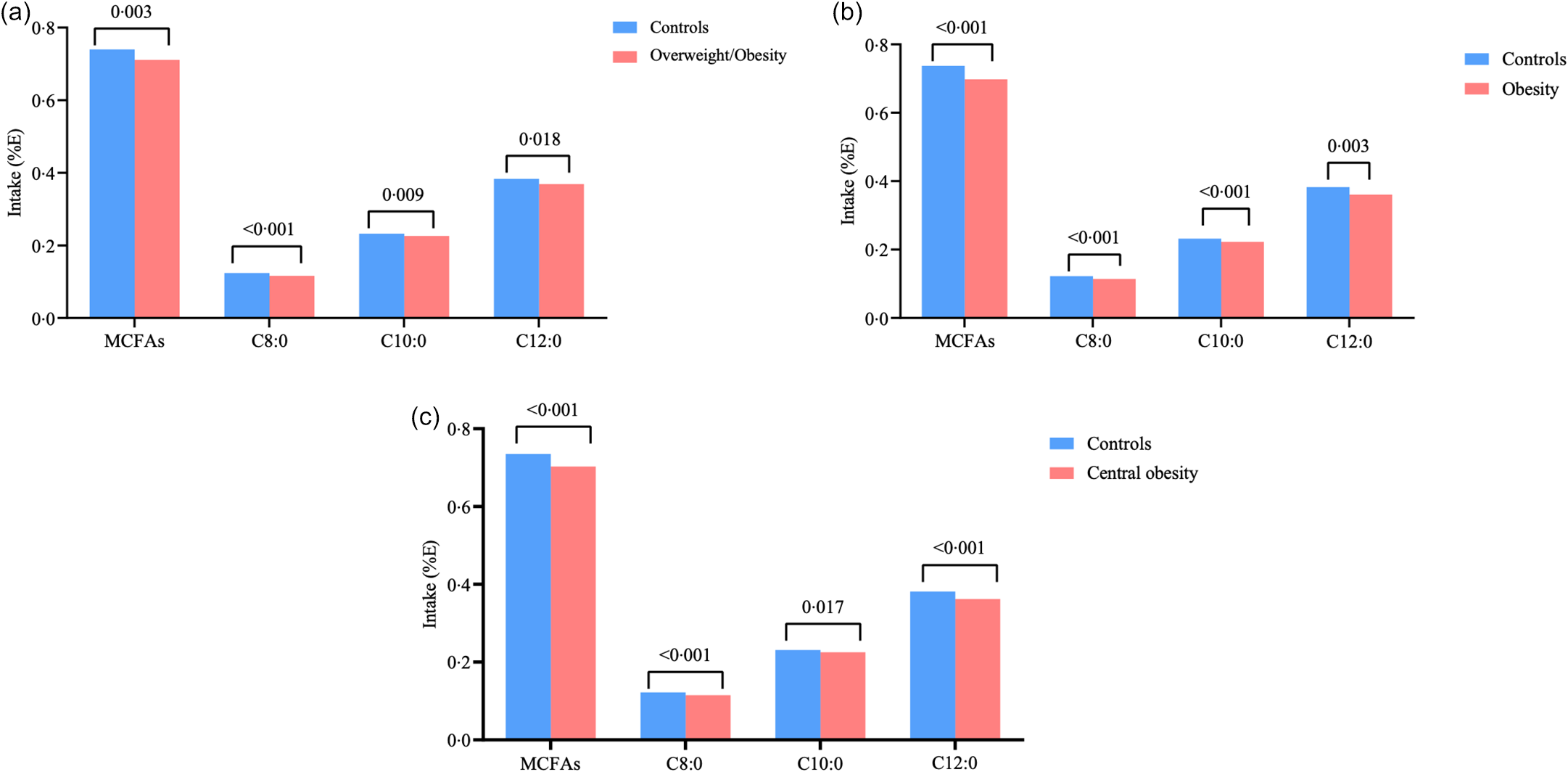
Figure 3 presents the distribution of MCFA energy density across obesity outcome groups. The energy density of total MCFA, as well as of C8:0, C10:0 and C12:0 individually, was significantly lower in groups with overweight/obesity, obesity or central obesity compared to controls (all P < 0·05). As shown in Table S6, the associations of energy density of total MCFA, C8:0 and C12:0 intakes with obesity-related outcomes were consistent. For C10:0, the relationship was not found in central obesity (marginal significance for overweight/obesity).
The distribution of MCFA energy density across the groups defined by underweight/normal weight, overweight, obesity, or central obesity. (A) overweight/obesity v. controls (underweight/normal weight); (B) obesity v. controls (underweight/normal weight/overweight); (C) central obesity v. controls (non-central obesity).

Discussion
In the present study, we explored the relationships of total MCFA and its components (C8:0, C10:0, and C12:0) intakes with obesity-related outcomes among children and adolescents. Our findings showed that higher intakes of total MCFA were associated with a lower risk of overweight/obesity, obesity and central obesity among children and adolescents. The consistent associations were found between C8:0, C10:0 and C12:0 and obesity-related outcomes. In addition, inverse associations between total MCFA intake and obesity-related outcomes were generally observed across the sex subgroup, whereas some age-related heterogeneity was detected for selected MCFA components. The associations for C10:0 were less consistent across subgroups, and although significant estimates were observed in some subgroups, these findings were not uniformly supported by interaction analyses and should therefore be interpreted cautiously.
MCFA, including C8:0, C10:0 and C12:0, are mainly derived from coconut oil, palm kernel oil and human milk, where they account for approximately 5–8 %, 6–7 % and 48–58 % of total fatty acids, respectively(Reference Francois, Connor and Wander18–Reference Gardner, Rahman and Lai21). A randomised crossover trial found that consuming extra virgin coconut oil, v. olive oil, may suppress hunger and the desire to eat in males aged 19–40 years(Reference Metin, Bilgic and Tengilimoğlu Metin22). A meta-analysis of thirteen trials demonstrated that dietary medium-chain triglycerides (MCTs) can lead to modest yet significant reductions in body weight and adiposity, without adverse effects on lipid profiles(Reference Mumme and Stonehouse11). Maher et al.(Reference Maher, Deleuse and Thondre9) reported that the consumption of MCT decreases subsequent energy intake over a 48-h period. Breakfasts containing MCT led to reduced subsequent food intake compared to those containing long-chain triglycerides in men(Reference Van Wymelbeke, Himaya and Louis-Sylvestre23). A 14 % decrease in energy intake among non-dieters with MCT consumption v. long-chain triglyceride consumption(Reference Rolls, Gnizak and Summerfelt24). One study also found that energy intake at dinner was lower following MCT consumption than after a lunch supplemented with MCT(Reference Van Wymelbeke, Louis-Sylvestre and Fantino25). MCFA are partially digested in the stomach by lingual and gastric lipases and subsequently solubilised in the aqueous phase of intestinal contents. After absorption, they bind to albumin and are directly transported to the liver through the portal circulation(Reference Decker26,Reference Thomson, Keelan and Garg27) . MCFA can enter mitochondria independently of the carnitine transport system, facilitating rapid β-oxidation(Reference Turner, Hariharan and TidAng28,Reference Wang, Liu and Han29) . At the cellular level, MCFA have been shown to interfere with the transcriptional activation of lipogenic genes by inhibiting the interaction between transactivating receptors and thyroid hormone response elements within the promoters of fatty acid synthase and Acetyl-CoA carboxylase(Reference Akpa, Point and Sawadogo30–Reference Thurmond, Baillie and Goodridge32). In an in vitro model using LO2 hepatocytes, steatosis induced by long-chain triglycerides, including oleate and palmitate, could be reversed by supplementation with octanoate or decanoate(Reference Wang, Fu and Li33). Furthermore, MCFA treatment reprogrammed hepatic lipid metabolism by suppressing anabolic lipid pathways and enhancing catabolic processes, accompanied by downregulation of key lipogenic transcription factors (LXRα and SREBP-1), lipid-synthesising enzymes (Acetyl-CoA carboxylase and fatty acid synthase) and fatty acid transport-related proteins such as CD36 and lipoprotein lipase(Reference Wang, Fu and Li33). Evidence from adult MCT supplementation trials and in vitro studies provides possible biological context for the observed inverse associations, but these findings should not be interpreted as direct mechanistic confirmation for the present paediatric dietary findings. Adult supplementation trials typically involve controlled and relatively high-dose MCT exposure, whereas the present study assessed habitual dietary MCFA intake in children and adolescents. Similarly, cellular studies often use experimental concentrations that may not reflect physiological dietary exposure. Therefore, the mechanisms described in previous studies remain speculative in paediatric dietary settings.
The present findings suggest that elevated total MCFAs, C8:0, C10:0 and C12:0 levels were linked to the lower odds of obesity-related outcomes. Similar results were found in MCFA energy density. In addition, the apparent age- and sex-specific patterns for C10:0 should be regarded as exploratory. Given the post-hoc nature of the subgroup analyses, reduced statistical power within subgroups and multiple comparisons, these findings may reflect chance variation rather than true biological heterogeneity. Future studies with prespecified subgroup hypotheses are needed to confirm whether the association between C10:0 intake and obesity-related outcomes differs by age or sex.
However, several limitations should be considered when interpreting the results. First, the cross-sectional design precludes the establishment of causal relationships between MCFA intake and obesity outcomes. Children and adolescents with established overweight or obesity may have modified their dietary habits, including the amount or sources of dietary fat, in response to their weight status, parental advice or clinical counselling. Such behaviour could lead to lower observed MCFA intake among participants with obesity and may partly explain the inverse associations observed in this study. Future prospective cohort studies are needed to confirm these associations. Second, although dietary MCFA intake was assessed using two 24-h recalls, this method may not fully capture long-term habitual intake; more precise dietary assessment approaches are warranted. The nondifferential misclassification from 24-h recalls may bias results toward the null. Third, the study population was limited to the USA, which may affect the generalizability of the findings to other populations. Fourth, the categorical covariates with missing values in the study were retained as an ‘unknown’ category. This strategy may reduce sample loss but cannot fully eliminate bias due to missingness. In addition, differences in several sociodemographic and dietary characteristics, as well as central obesity prevalence, were observed between included and excluded participants. Therefore, selection bias resulting from participant exclusions cannot be completely excluded and may affect the generalizability of the findings. Fifth, shared dietary sources and high correlations limited interpretation of component-specific estimates as independent effects. Finally, despite adjustment for multiple potential confounders, residual confounding, such as unmeasured genetic or parental obesity status, cannot be entirely ruled out.
Conclusion
We investigated the relationships of total MCFA and its components (C8:0, C10:0 and C12:0) intakes with obesity-related outcomes among children and adolescents. Higher dietary intakes of total MCFA and selected MCFA components were associated with lower odds of overweight/obesity, obesity and central obesity. Further prospective and intervention studies are needed before dietary recommendations regarding MCFA can be made for childhood obesity prevention.
Supplementary material
For supplementary material/s referred to in this article, please visit https://doi.org/10.1017/S0007114526108745
Data availability statement
The datasets used and analysed during the current study are available from the NHANES (access towards https://wwwn.cdc.gov/nchs/nhanes/Default.aspx/).
Acknowledgements
Not applicable.
Author contributions
TZ: Conceptualisation-Equal, Data curation-Equal, Formal analysis-Equal, Investigation-Equal, Methodology-Equal, Software-Equal, Visualisation-Equal, Writing - original draft-Lead; BZ: Data curation-Equal, Investigation-Equal, Methodology-Equal, Software-Equal; ZC: Data curation-Equal, Validation-Equal, Visualisation-Equal; YP: Methodology-Equal, Supervision-Equal; CG: Methodology-Equal, Supervision-Equal; YL: Conceptualisation-Equal, Funding acquisition-Equal, Project administration-Equal, Resources-Equal, Supervision-Equal, Writing - review & editing-Equal.
Funding
This research was supported by the Medical Science and Technology Research Foundation of Guangdong Province (Grant number: A2021328).
Competing interests
The authors declare that there is no conflict of interest.
Ethical standards
The NHANES database has obtained ethical approval from the Institutional Review Board of the National Center for Health Statistics of the USA CDC. Since this database is publicly available, according to relevant regulations, ethical approval has been waived by the Institutional Review Board of our hospital.