Introduction
Psychopathology is on the rise during adolescence (Rutter, Reference Rutter1995, Reference Rutter2005; Newman et al. Reference Newman, Moffitt, Caspi, Magdol and Silva1996) and evidence suggests that the adult mental health burden (Murray & Lopez, Reference Murray and Lopez1996; Ormel et al. Reference Ormel, Petukhova, Chatterji, Aguilar-Gaxiola, Alonso, Angermeyer, Bromet, Burger, Demyttenaere, de Girolamo, Haro, Hwang, Karam, Kawakami, Lepine, Medina-Mora, Posada-Villa, Sampson, Scott, Ustun, Von Korff, Williams, Zhang and Kessler2008) may be largely due to disorders with precursors or onset in childhood and adolescence (Kim-Cohen et al. Reference Kim-Cohen, Caspi, Moffitt, Harrington, Milne and Poulton2003; Copeland et al. Reference Copeland, Shanahan, Costello and Angold2009). Because developmental pathways are set in motion or become entrenched during adolescence, adolescent psychopathology may have long-term consequences (Ferdinand et al. Reference Ferdinand, Verhulst and Wiznitzer1995; Quinton et al. Reference Quinton, Gulliver and Rutter1995; Rutter & Maughan, Reference Rutter and Maughan1997; Costello et al. Reference Costello, Angold and Keeler1999; Fergusson & Horwood, Reference Fergusson and Horwood2001; Verboom et al. Reference Verboom, Sijtsema, Verhulst, Penninx and Ormel2014). Hence, it is important to understand the epidemiology of mental disorders during adolescence.
Earlier studies have yielded important information on many aspects of the epidemiology of mental disorders in children and adolescents (e.g. Costello et al. Reference Costello, Angold, Burns, Stangl, Tweed, Erkanli and Worthman1996, Reference Costello, Egger and Angold2005b ; Verhulst et al. Reference Verhulst, van der Ende, Ferdinand and Kasius1997; Angold et al. Reference Angold, Costello and Worthman1998; Fergusson & Horwood, Reference Fergusson and Horwood2001; Ford et al. Reference Ford, Goodman and Meltzer2003; Maughan et al. Reference Maughan, Collishaw, Meltzer and Goodman2008; Merikangas et al. Reference Merikangas, He, Burstein, Swanson, Avenevoli, Cui, Benjet, Georgiades and Swendsen2010; Moffitt et al. Reference Moffitt, Caspi, Taylor, Kokaua, Milne, Polanczyk and Poulton2010; Kessler et al. Reference Kessler, Avenevoli, Costello, Georgiades, Green, Gruber, He, Koretz, McLaughlin, Petukhova, Sampson, Zaslavsky and Merikangas2012a , Reference Kessler, Avenevoli, Costello, Green, Gruber, McLaughlin, Petukhova, Sampson, Zaslavsky and Merikangas b ). However, some important aspects remain unaddressed or need replication. These include severity, age of onset, persistence and continuity, and concentration of morbidity. Severity is important because it is unclear to what extent the previously reported remarkably high lifetime and 12-month prevalence rates represent mild disorders (Costello et al. Reference Costello, Angold, Burns, Stangl, Tweed, Erkanli and Worthman1996; Copeland et al. Reference Copeland, Shanahan, Costello and Angold2011; Kessler et al. Reference Kessler, Avenevoli, Costello, Green, Gruber, McLaughlin, Petukhova, Sampson, Zaslavsky and Merikangas2012b ). Age of onset and continuity are important issues as well. With a few exceptions (Kessler et al. Reference Kessler, Cox, Green, Ormel, McLaughlin, Merikangas, Petukhova, Pine, Russo, Swendsen, Wittchen and Zaslavsky2011), age-of-onset information has rarely been used to its fullest potential, that is, by modelling age of onset as outcome or time-dependent covariate in a survival framework. Such a framework is highly appropriate to estimate the association of sociodemographic variables with mental disorder, adjusted for earlier disorders, and to study homotypic and heterotypic continuity of psychopathology. Homotypic continuity, in general, refers to the continuity of similar behaviours over time. In this paper, we analyse homotypic and heterotypic continuity of psychopathology at the level of classes of disorders (e.g. mood disorders) and the two broad domains of internalizing and externalizing disorders. Thus, homotypic continuity refers to continuity within class or domain whereas heterotypic continuity refers to continuity of psychopathology between classes or domains. Finally, concentration of morbidity is important because studies in adult populations suggest that in particular multimorbidity (⩾3 lifetime disorders) is associated with high levels of disability and service use (e.g. Kessler et al. Reference Kessler, McGonagle, Zhao, Nelson, Hughes, Eshleman, Wittchen and Kendler1994; Jenkins et al. Reference Jenkins, Lewis, Bebbington, Brugha, Farrell, Gill and Meltzer1997; Andrews et al. Reference Andrews, Henderson and Hall2001; Jacobi et al. Reference Jacobi, Wittchen, Hölting, Höfler, Pfister, Müller and Lieb2004).
The purpose of this paper, therefore, is to provide comprehensive epidemiological data on adolescent mental disorders. We distinguish four classes of disorders: anxiety, mood, behaviour and substance use disorders. The first two belong to the internalizing domain, the last two to the externalizing domain. We are especially interested in the ratio of mild to severe cases, age of onset, persistence (recurrence and chronicity), homotypic and heterotypic continuity, and the concentration of morbidity, and will also present data on prevalence (lifetime, 12-month, 30-day) and baseline problem levels and sociodemographic predictors analysed in a multivariate survival framework.
Method
Sample and procedure
The TRacking Adolescents' Individual Lives Survey (TRAILS) is a prospective cohort study of Dutch adolescents using bi- or triennial measurements from age 11 years onward. Its aim is to chart and explain the development of mental health from preadolescence into adulthood. Previous publications have extensively described its design, methods, and response rates and bias (de Winter et al. Reference de Winter, Oldehinkel, Veenstra, Brunnekreef, Verhulst and Ormel2005; Huisman et al. Reference Huisman, Oldehinkel, Winter, Minderaa, Bildt, Huizink, Verhulst and Ormel2008; Nederhof et al. Reference Nederhof, Jörg, Raven, Veenstra, Verhulst, Ormel and Oldehinkel2012; Ormel et al. Reference Ormel, Oldehinkel, Sijtsema, van Oort, Raven, Veenstra, Vollebergh and Verhulst2012). Briefly, participants were selected from five municipalities in the North of the Netherlands, both urban and rural areas, including the three largest cities. Children born between 1 October 1989 and 30 September 1991 were eligible for inclusion, providing their schools were willing to participate and they met the study's inclusion criteria (de Winter et al. Reference de Winter, Oldehinkel, Veenstra, Brunnekreef, Verhulst and Ormel2005). Over 90% of the schools, enrolling a total of 2935 eligible children, agreed to participate in the study. Through extended efforts, 76% of these children and their parents consented to participate (T1, n = 2230, mean age = 11.1 years, s.d. = 0.6 years, 50.8% girls). Response rates at follow-ups ranged from 96.4% (T2, n = 2149, mean age 13.6 9 years, s.d. = 0.5 years, 51.0% girls) to 81.4% (T3, n = 1816, mean age 16.3 years, s.d. = 0.7 years, 52.3% girls). Each assessment wave was approved by the Dutch Central Committee on Research Involving Human Subjects (CCMO; www.ccmo.nl).
The data we present here were collected in the first (T1, baseline) and fourth (T4) assessment wave of TRAILS, which ran from March 2001 to July 2002 and from October 2008 to September 2010, respectively. The response rate at T4 was 84.3% of the initial T1 sample (n = 1881, mean age 19.1 years, s.d. = 0.6 years, 52.3% girls) (Nederhof et al. Reference Nederhof, Jörg, Raven, Veenstra, Verhulst, Ormel and Oldehinkel2012; Ormel et al. Reference Ormel, Oldehinkel, Sijtsema, van Oort, Raven, Veenstra, Vollebergh and Verhulst2012). Not all T4 participants agreed to have the full diagnostic interview, but 1584 adolescents provided complete diagnostic data [Composite International Diagnostic Interview (CIDI), mean age 19.3 years, range 18–20 years, 54.0% girls], representing 84.2% of the T4 sample and 71.0% of the original T1 baseline sample. Response rates were somewhat better than for most European studies (Alonso et al. Reference Alonso, Angermeyer, Bernert, Bruffaerts, Brugha, Bryson, de Girolamo, de Graaf, Demyttenaere, Gasquet, Haro, Katz, Kessler, Kovess, Lépine, Ormel, Polidori, Russo, Vilagut, Almansa, Arbabzadeh-Bouchez, Autonell, Bernal, Buist-Bouwman, Codony, Domingo-Salvany, Ferrer, Joo, Martínez-Alonso, Matschinger, Mazzi, Morgan, Morosini, Palacín, Romera, Taub and Vollebergh2004; Wittchen et al. Reference Wittchen, Nelson and Lachner1998; de Graaf et al. Reference de Graaf, Ten Have, van Gool and van Dorsselaer2012). Non-response was somewhat higher in males and in adolescents of non-Western ethnicity, with divorced parents, low socio-economic status (SES), low intelligence quotient and academic achievement, poor physical health, and with behaviour and substance use problems (Nederhof et al. Reference Nederhof, Jörg, Raven, Veenstra, Verhulst, Ormel and Oldehinkel2012). Multiple logistic regression analyses showed that these effects were partially overlapping (data available on request). Non-response showed little to no association with urbanization, parental religiousness, being a single child, or the most recently available self-reports of anxiety and mood problems.
Sample representativeness
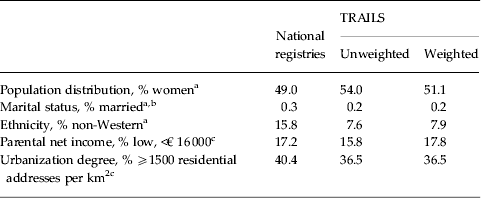
The TRAILS sample was largely (84.3%) collected from the three provincial capitals in the northern part of the Netherlands. This does not include the metropolitan area of the Randstad (Amsterdam, Rotterdam, Den Haag and Utrecht), which is more ethnically diverse. Apart from ethnicity and under-representation of people from extremely urbanized areas and – to a small extent – males, the T4 CIDI TRAILS sample is representative of the Dutch population aged 18–20 years (Table 1).
Representativeness of the TRAILS sample

TRAILS, TRacking Adolescents' Individual Lives Survey.
a Census data and TRAILS sample data from 2009.
b Census data from ages 18–19 years.
c Census data and TRAILS sample data from 2001.
Measures
Diagnostic assessment
TRAILS assessed the presence of mental disorders at T4 using the computer-assisted World Health Organization CIDI 3.0. The assessment included mood disorders (major depressive disorder, dysthymic disorder, and bipolar disorder I and II), anxiety disorders (panic disorder, agoraphobia, social phobia, specific phobia, generalized anxiety disorder, separation anxiety disorder, and obsessive–compulsive disorder), behaviour disorders (attention-deficit/hyperactivity disorder, oppositional defiant disorder, and conduct disorder) and substance use disorders (alcohol abuse/dependence, drug abuse/dependence). TRAILS assessed eating disorders (anorexia nervosa, bulimia nervosa, binge-eating behaviour) differently, so we have not included them.
The CIDI 3.0 is a structured diagnostic interview that has been used in multiple surveys worldwide to generate diagnoses based on the Diagnostic and Statistical Manual of Mental Disorders, fourth edition (DSM-IV) (Kessler & Ustun, Reference Kessler and Ustun2004). The CIDI 3.0 assesses age of onset of any disorder with a series of questions that have been shown to yield plausible age-of-onset data (Kessler et al. Reference Kessler, Berglund, Demler, Jin, Merikangas and Walters2005a ). An important feature of the 3.0 version of the age-of-onset questions is the help of mnemonic aids and the sequence of onset questions, typically starting with the worst episode ever of the index disorder (when did it occur), followed by the most recent episode (when did it occur), and finally targeting the first ever episode and its age of onset (Kessler et al. Reference Kessler, Berglund, Demler, Jin, Merikangas and Walters2005a ).
In TRAILS, trained lay interviewers performed the CIDI at T4. Some clinical calibration studies found the CIDI's assessment of the selected disorders to be generally valid in comparison with blinded clinical reappraisal interviews using the Structured Clinical Interview for DSM-IV (SCID) (Kessler et al. Reference Kessler, Abelson, Demler, Escobar, Gibbon, Guyer, Howes, Jin, Vega, Walters, Wang, Zaslavsky and Zheng2004, Reference Kessler, Avenevoli, Green, Gruber, Guyer, He, Jin, Kaufman, Sampson, Zaslavsky and Merikangas2009; Haro et al. Reference Haro, Arbabzadeh-Bouchez, Brugha, de Girolamo, Guyer, Jin, Lepine, Mazzi, Reneses, Vilagut, Sampson and Kessler2006) but in comparison with the Schedule for Clinical Assessment in Neuropsychiatry (SCAN) the CIDI performed less well (Brugha et al. Reference Brugha, Jenkins, Taub, Meltzer and Bebbington2001). CIDI-based prevalence estimates were typically no higher than SCID estimates, except for specific phobias and oppositional defiant disorder, but higher than SCAN estimates. The definitions of all disorders in the Dutch CIDI adhered to DSM-IV criteria. Diagnostic hierarchy rules were applied for every disorder, with the exception of substance use disorders. Impairment criteria embedded in the CIDI-DSM-IV diagnostic thresholds require the presence of at least some impairment or moderate symptom severity (distress) to make a diagnosis.
Prevalence rates and ratios
We established lifetime, 12-month and 30-day prevalence rates according to the DSM-IV (APA, 1995). In addition, we calculated the ratio of the 12-month prevalence to the lifetime prevalence, as well as the ratio of the 30-day prevalence to the 12-month prevalence. The ratio of 12-month prevalence to lifetime prevalence of a particular disorder tells – with certain assumptions on age of onset – something about its persistence. The 30-day to 12-month prevalence ratio tells something about the source of persistence: when smaller than the 12-month to lifetime prevalence ratio, it points at recurrence; when larger it points at chronicity.
Severe disorders
To separate mild from severe disorders, we used the Merikangas et al. (Reference Merikangas, He, Burstein, Swanson, Avenevoli, Cui, Benjet, Georgiades and Swendsen2010) definition of severe disorders. This definition sets higher thresholds for impairment and symptom severity than the CIDI-DSM-IV. To be severe, anxiety or mood disorders required both severe distress and impairment of daily activities. We did not separate agoraphobia and panic disorder into severe and less severe disorders because, following Merikangas et al. (Reference Merikangas, He, Burstein, Swanson, Avenevoli, Cui, Benjet, Georgiades and Swendsen2010), we considered the standard CIDI-DSM-IV severity rating for these disorders to be sufficiently severe. Behaviour disorders required severe impairment to be classified as severe. With regard to substance use disorders, we considered dependence severe and abuse non-severe unless it developed into dependence. The reason for this is that CIDI-DSM-IV substance use disorder in Dutch young people rarely is associated with functional impairment or distress (Bijl & Ravelli, Reference Bijl and Ravelli2000; ten Have et al. Reference ten Have, Nuyen, Beekman and de Graaf2013).
Baseline psychopathology
The parent-report Child Behavior Checklist (CBCL) and the self-report Youth Self-Report (YSR) are questionnaires of good reliability and validity (Verhulst et al. Reference Verhulst, van der Ende, Ferdinand and Kasius1997; Achenbach & Rescorla, Reference Achenbach, Rescorla and Archer2006) that cover behavioural and emotional problems in the past 6 months. Both contain about 112 problem items, which are scored on a three-point scale. Both consist of eight narrow-band scales. In order to improve the match with DSM-IV diagnoses, Achenbach et al. (Reference Achenbach, Dumenci and Rescorla2003) constructed CBLC/YSR/DSM-IV scales. As a result, six CBLC/YSR/DSM-IV scales were derived: affective problems, anxiety problems, somatic problems, attention deficit/hyperactivity problems, oppositional defiant problems and conduct problems. These were used in the present study. Scale scores were dichotomized [normal range versus (sub)clinical range].
Sociodemographic variables
We measured the following sociodemographic variables at baseline: gender; age; ethnicity (Western origin, non-Western origin); SES, a composite measure of paternal and maternal education (elementary education, lower tracks of secondary education, higher tracks of secondary education, senior vocational training, university), occupation and family income (lowest 25%, middle 50%, highest 25%) (Veenstra et al. Reference Veenstra, Lindenberg, Oldehinkel, De Winter and Ormel2006); urbanicity [0–999 addresses per km2 (low), 1000–2499 addresses per km2 (moderate/strong), 2500 or more addresses per km2 (extreme)] (Reijneveld et al. Reference Reijneveld, Veenstra, de Winter, Verhulst, Ormel and de Meer2010); number of biological parents living with the respondent (both, not both); siblings (no, yes); and parental religiosity (non-religious, passively religious, actively religious) (van der Jagt-Jelsma et al. Reference van der Jagt-Jelsma, de Vries-Schot, de Jong, Verhulst, Ormel, Veenstra, Swinkels and Buitelaar2011).
Statistical analysis
To obtain weighted prevalences (Table 2), we used a sampling weight based on three indicators from the first measurement wave: gender, SES, and total problems score on the CBCL (normal, subclinical, clinical) to adjust for selective attrition (Achenbach & Rescorla, Reference Achenbach, Rescorla and Archer2006). The sample weight of cases with missing CBCL or SES information (n = 95; 6.0%) was set to 1. With the age-of-onset data, we generated standardized cumulative prevalence curves (Fig. 1). Homotypic continuity, especially persistence of a disorder and whether it was due to recurrence or chronicity, was examined using prevalence ratios (Table 2). We used a multivariate Cox proportional hazards model (1) to analyse heterotypic continuity by (a) adding the onset of co-morbid disorders as time-dependent covariates (Table 3) and (b) by linking baseline (age 11 years) problem levels to the onset of post-baseline disorders (tables available on request), and (2) to examine sociodemographic predictors (Table 4). Thus, effects of a particular predictor were adjusted for other predictors (e.g. other disorders in Table 3; other problem dimensions in tables on request; and other sociodemographic covariates in Table 4). Our study evaluated all tests at the 0.05 significance level with two-sided tests.
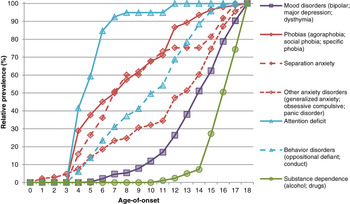
Standardized cumulative prevalence curves for Diagnostic and Statistical Manual of Mental Disorders, fourth edition (DSM-IV) disorders.

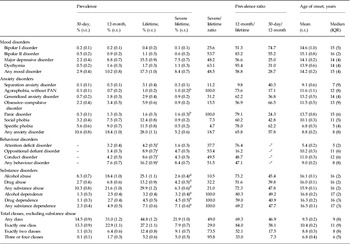
Weighted a prevalences, prevalence ratios and age of onset of DSM-IV disorders in TRAILS (n = 1584)

DSM-IV, Diagnostic and Statistical Manual of Mental Disorders, fourth edition; TRAILS, TRacking Adolescents' Individual Lives Survey; s.e., standard error; IQR, interquartile range; PAN, panic disorder; CBCL, Child Behavior Checklist; SES, socio-economic status.
a Cases weighted by gender, CBCL cut-offs (normal, borderline clinical and clinical) and parental SES. Cases with missing CBCL and/or SES were assigned the weight 1.
b All lifetime disorders meet criteria for severe lifetime disorder.
c 30-day prevalence not established.
d Severe substance abuse defined as substance dependence.
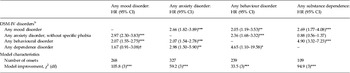
HR estimates from Cox regression analyses of co-morbidity on age of onset of DSM-IV disorders by class (n = 1558) a

HR, Hazard ratio; DSM-IV, Diagnostic and Statistical Manual of Mental Disorders, fourth edition; CI, confidence interval; df, degrees of freedom.
a DSM-IV hierarchy rules applied where applicable.
b Aggregate DSM-IV any disorders added as time-dependent covariates (reference category = no onset before age T). Any disorders include the disorders as listed in Table 2 (excluding specific phobia).
† p < 0.10, * p < 0.05, ** p < 0.01, *** p < 0.001.
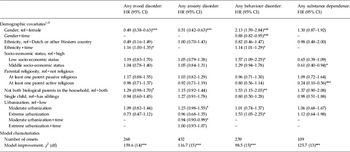
HR estimates from multiple Cox regression analyses of T1 demographic covariates on age of onset of DSM-IV disorders by class (n = 1558) a , b

HR, Hazard ratio; DSM-IV, Diagnostic and Statistical Manual of Mental Disorders, fourth edition; CI, confidence interval; ref, reference category; df, degrees of freedom.
a DSM-IV hierarchy rules applied where applicable.
b All models include aggregate DSM-IV disorders from other classes as time-dependent covariates (ref = no onset before age T).
c Demographic covariates measured at T1 (age 10–12 years).
d Demographics entered as time-independent covariates. If the proportional hazards assumption was violated interactions with time centred on age 11 years (mean age at T1) were added.
† p < 0.10, * p < 0.05, ** p < 0.01, *** p < 0.001.
Results
Prevalence
Table 2 presents prevalence rates for CIDI-DSM-IV mental disorders by time-frame (lifetime, 12-month, 30-day) and severity. All four DSM classes of disorders were important components of overall lifetime prevalence. According to the lifetime time-frame, mood disorders affected 17% of the total sample: 15% met criteria for major depression. About one in four adolescents met criteria for an anxiety disorder, with rates for individual disorders ranging from 1% for agoraphobia without panic disorder to 12% for specific and social phobia. Behaviour disorders affected 16% of the sample, with about equal rates for oppositional defiant and conduct disorder. Prevalence rates for substance dependence were substantially lower than for substance abuse. Nearly 45% of the total sample experienced at least one of the disorders in Table 2 during their lives, with 5.2% of the sample having disorders from ⩾3 different classes and 10.1% of the sample having three or more disorders lifetime irrespective of class.
Severe disorders
The lifetime prevalence of severe disorders was 22%; for half of the total lifetime prevalence, 23% were mild. In general, mood and behaviour disorders were more often severe than anxiety disorders (Table 2). Severe mood disorders represented 49% of all mood disorders, while severe anxiety disorders represented only 19% of all anxiety disorders. Severe anxiety cases included relatively many individuals with generalized anxiety, obsessive–compulsive disorder, panic disorder and agoraphobia. Cases of separation anxiety disorder, specific phobia and social phobia were typically milder. Severe behaviour disorders comprised nearly a third of all the severe cases in the sample. The proportion of subjects with at least one severe disorder rose with increasing co-morbidity across classes, from 29% for respondents with only one disorder to 96% for respondents with disorders from ⩾3 different classes.
Age of onset
Fig. 1 shows the standardized cumulative prevalence graphs. Major depressive disorder, dysthymia, and bipolar I and II are combined, and so are the phobias, and the other anxiety disorders except separation anxiety. The curves track the lifetime prevalence of each index disorder at each age. We standardized each curve as a proportion of its lifetime prevalence at age 19 years, which reduced between-disorder variations in prevalence to ease comparisons between ages of onset (unstandardized graphs available on request). The curves of disorders of the same class are the same colour (online version only). Visual approximation of these data distinguishes seven age-of-onset groups. These onset groups, which do not overlap with the four classes of disorder, are as follows:
-
(1) Attention deficit/hyperactivity disorder occurred earliest; onsets increase rapidly in early childhood, with virtually no new onset after age 6 years.
-
(2) Phobia had early onsets as well. Most phobias, especially the specific phobias, had onsets before age 8 years and virtually no new onset occurred after age 14 years.
-
(3) Separation anxiety closely followed phobia with one difference: new onsets occurred until age 17 years except during age 11–14 years when hardly any onset of separation anxiety occurred.
-
(4) Behaviour disorders began around the time of school entry and their onsets increased steadily until age 14–15 years.
-
(5) Other anxiety disorders (generalized anxiety disorder, obsessive–compulsive disorder, panic disorder) tended to develop on average 2 years later than the behaviour disorders; they were not prevalent until early adolescence, after which their incidence rose steadily.
-
(6) Mood disorders were even less prevalent until early adolescence, after which their incidence rose steadily as well. Bipolar disorder had a slightly later onset.
-
(7) Drug and alcohol dependence had the latest age of onset, with incidences beginning at age 14 years and steadily increasing after that.
Table 2 shows the mean and median age of onset for each disorder.
Homotypic continuity
As shown in Table 2, the overall 12-month prevalence was 31%, which represented 69% of lifetime prevalence, while the 30-day prevalence was 14%, 47% of the 12-month prevalence. The ratio of 12-month prevalence to lifetime prevalence showed a wide range across disorders: from 10% for separation anxiety to 93% for dysthymia. The interquartile range was 52–76%, suggesting substantial persistence. The 30-day to 12-month prevalence ratios were typically smaller than the 12-month to lifetime prevalence ratios with only a few exceptions, suggesting that, on the whole, within-class continuity (persistence) comes more from recurrence than chronicity.
Heterotypic continuity
As expected, the presence of a mental disorder substantially increased the subject's risk of developing a disorder of a different class (Table 3). Of the 12 hazard ratios tested, 11 were significant, ranging from 2 to 5. The exception was anxiety disorders, which did not increase the risk of substance dependence. We found the strongest heterotypic continuity, in both directions, between behaviour disorders and substance dependence.
Baseline problems predict onset of disorders in adolescence
The previous continuity analyses were all based on retrospectively collected CIDI data. To supplement this with prospective data, we examined the predictive value of (sub)clinical baseline emotional and behaviour problems as assessed at age 11 years with CBCL (parent-report) and the YSR (self-report) with regard to the post-baseline onset of CIDI-DSM-IV disorders (online Supplementary Tables S1 and S2). Because all attention deficit disorders, most specific phobia and separation anxiety disorders, and many oppositional disorders had an onset prior to baseline, they are not included in the post-baseline onset group. To compensate for this, we also linked baseline problems to the 12-month prevalence at age 19 years (online Supplementary Tables S3 and S4). We found substantial continuity at the level of the broad domains of internalizing and externalizing problems; at the disorder-class level, continuity was less marked. Mood and anxiety disorders were predicted by baseline affective and anxiety problems; behaviour disorders by baseline oppositional, conduct and affective problems whereas baseline anxiety problems reduced the risk of behaviour disorders. Substance dependence was predicted by conduct, affective and attention problems. Effects were typically weak with most hazard ratios in the 1.5–2.5 range but it should be noted that effects of all baseline problem scales were adjusted for each other. We obtained similar results for the 12-month prevalence at age 19 years, with the self-report YSR being a better predictor than the parent-reported CBCL. The latter showed only a few significant associations with the 12-month prevalence of disorders, with the association between (sub)clinical baseline attention problems and any behaviour disorder being the strongest (odds ratio 3.83, 95% confidence interval 2.17–6.75).
Sociodemographic predictors
Table 4 presents the adjusted hazard ratios of the selected sociodemographic characteristics assessed at baseline for each class of mental disorder. We found the most significant associations between sociodemographic variables and behaviour disorders. Associations of sociodemographic variables with mood, anxiety and substance use disorders were typically non-significant or weak. The strongest associations were found for gender, SES, and absence of one or both biological parents. Men had a substantially lower risk for anxiety and mood disorders than women, but a significantly higher risk of behaviour disorders. The smaller than unity gender × time interaction indicates that the effect of gender on risk for behaviour disorders decreased during adolescence while the larger than unity ethnicity × time interaction indicates that the effect of ethnicity increases. Maternal education accounted for most of the SES effect on behaviour disorders. Neither parental income nor professional status, the other components of SES, predicted much change in mental health risks (data available on request). Urbanization predicted only behaviour disorders which were more prevalent in highly urbanized areas.
Concentration of morbidity
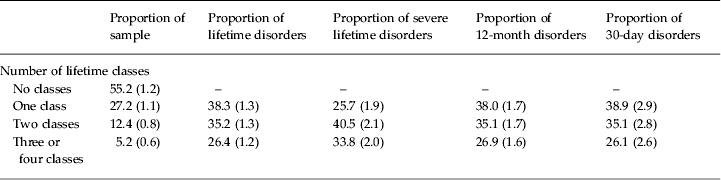
Nearly 75% of lifetime disorders were co-morbid disorders. Table 5 shows that the concentration of morbidity in adolescents with lifetime disorders from multiple classes is highly prominent. The 5.2% of the sample with a lifetime history of disorders from ⩾3 classes accounts for a third of all severe lifetime disorders and slightly more than a quarter of all 12-month and 30-day disorders. Concentration of morbidity was relatively similar among the 10.1% with ⩾3 disorders irrespective of class who accounted for 55% of all severe lifetime disorders and nearly half of all 12-month and 30-day disorders.
Clustering of lifetime, severe lifetime, 12-month and 30-day disorders among persons with lifetime co-morbidity

Data are given as percentage (standard error).
Discussion
Strengths and limitations
Our findings should be interpreted in the light of strengths and limitations. Strengths of this study include its well-documented sample of adolescents, followed from preadolescence to adulthood and the considerable sample size. One limitation is that, despite limited non-response at baseline and attrition at follow-ups, CIDI non-response was significant and not entirely random. Bias due to non-response in psychiatric epidemiological studies tends to be conservative, with actual prevalence rates often higher and actual associations stronger, especially for externalizing disorders (Eaton et al. Reference Eaton, Kessler, Wittchen and Magee1994; Kessler et al. Reference Kessler, Chiu, Demler, Merikangas and Walters2005b ; Merikangas et al. Reference Merikangas, He, Burstein, Swanson, Avenevoli, Cui, Benjet, Georgiades and Swendsen2010). Another limitation arises from the fact that CIDI-DSM-IV diagnoses were based on fully structured lay interviews carried out at age 19 years and not verified by professionals with clinical expertise. This very probably will have inflated prevalence estimates in comparison with semi-structured diagnostic interviews such as the SCAN and SCID (Brugha et al. Reference Brugha, Jenkins, Taub, Meltzer and Bebbington2001; Haro et al. Reference Haro, Arbabzadeh-Bouchez, Brugha, de Girolamo, Guyer, Jin, Lepine, Mazzi, Reneses, Vilagut, Sampson and Kessler2006). On the other hand, TRAILS' single diagnostic CIDI assessment has probably resulted in deflated lifetime estimates, as studies with multiple cumulative diagnostic assessments report substantially higher prevalence rates than studies with a single CIDI administration (Moffitt et al. Reference Moffitt, Caspi, Taylor, Kokaua, Milne, Polanczyk and Poulton2010; Copeland et al. Reference Copeland, Shanahan, Costello and Angold2011). Finally, we did not collect diagnostic information from sources other than the respondent, which might affect reliability (Ford et al. Reference Ford, Goodman and Meltzer2003). Evidence suggests, however, that this is not a major concern, as the reliability of self-reports increases during adolescence, while that of parents and teachers decreases (Edelbrock et al. Reference Edelbrock, Costello, Dulcan, Kalas and Conover1985).
Similar lifetime prevalence across Western countries
Direct and detailed comparisons with other adolescent studies are complicated by between-study differences in sampling, age range, and – very importantly – the DSM-IV categories included. Our report did not include eating disorders, somatoform disorders or post-traumatic stress disorder. Nevertheless, after accounting for differences in included diagnoses, our findings are remarkably similar in overall prevalence rates to studies in industrialized countries that have used similar methodology (a single CIDI-DSM-IV assessment). Overall lifetime and 12-month prevalence in late adolescence tends to fluctuate around 45% and 30% (e.g. McGee et al. Reference McGee, Feehan, Williams and Anderson1992, Wittchen et al. Reference Wittchen, Nelson and Lachner1998; Merikangas et al. Reference Merikangas, He, Burstein, Swanson, Avenevoli, Cui, Benjet, Georgiades and Swendsen2010), of which our findings suggest that about half are severe disorders.
Similar lifetime prevalence in youth and adults
Most disorder-specific lifetime prevalence rates in TRAILS' adolescents approximate, and some even exceed, those found in nationally representative CIDI-DSM-IV surveys of adults (Kessler et al. Reference Kessler, Berglund, Demler, Jin, Merikangas and Walters2005a ; de Graaf et al. Reference de Graaf, Ten Have, van Gool and van Dorsselaer2012). Two factors may explain this phenomenon. First, adults are more likely to forget earlier (mild) episodes or are unwilling to disclose them (Simon & Von Korff, Reference Simon and Von Korff1995; Moffitt et al. Reference Moffitt, Caspi, Taylor, Kokaua, Milne, Polanczyk and Poulton2010). If this under-reporting increases and accumulates with age, lifetime prevalence may falsely appear to remain stable with increasing sample age. Second, retrospective evidence shows that many adult mental disorders, especially chronic–recurrent disorders, have early initial onsets during childhood and adolescence (Kessler et al. Reference Kessler, McGonagle, Zhao, Nelson, Hughes, Eshleman, Wittchen and Kendler1994, Reference Kessler, Berglund, Demler, Jin, Merikangas and Walters2005a ; Bijl et al. Reference Bijl, Ravelli and van Zessen1998), which would be detected by and included in prevalence surveys of adolescents.
Continuity
Within-class homotypic continuity
Most 12-month to lifetime prevalence ratios of individual disorders exceeded 0.60. Although confounding by recent onset and under-reporting of brief mild episodes is likely, these ratios suggest that most disorders are quite persistent. Consistent with earlier studies (Merikangas et al. Reference Merikangas, He, Burstein, Swanson, Avenevoli, Cui, Benjet, Georgiades and Swendsen2010; Kessler et al. Reference Kessler, Avenevoli, Costello, Georgiades, Green, Gruber, He, Koretz, McLaughlin, Petukhova, Sampson, Zaslavsky and Merikangas2012a ), the 30-day to 12-month prevalence ratios were typically lower than 12-month to lifetime ratios, supporting the possibility that disorder persistence may be due more to episodic recurrence than to chronicity. Higher 30-day to 12-month ratios for anxiety disorders than for mood disorders suggest that anxiety disorders are more often chronic than mood disorders.
Between-class co-morbidity and heterotypic continuity
Research on the structure of co-morbidity among common mental disorders has largely focused on prevalence (Angold et al. Reference Angold, Costello and Erkanli1999), rather than on its development (Kessler et al. Reference Kessler, Cox, Green, Ormel, McLaughlin, Merikangas, Petukhova, Pine, Russo, Swendsen, Wittchen and Zaslavsky2011). Using Cox regression analysis, we found moderate heterotypic continuity in both directions between all four classes of disorders except for anxiety to substance use. This similarity of heterotypic continuity between all disorder classes is interesting because one would expect that disorder classes that tend to onset early would be stronger predictors of classes tending to onset later, but not the other way around.
Baseline problem levels as domain-specific precursors
The continuity findings were all based on retrospectively collected CIDI data. To supplement this we examined the predictive value of baseline problems for the onset of disorders in adolescence and the 12-month prevalence at age 19 years. We found domain-level homotypic continuity, i.e. baseline externalizing problems predicted later externalizing disorders and baseline internalizing problems predicted later internalizing disorders, and also heterotypic continuity as baseline internalizing problems predicted externalizing disorders (but not the other way around). Effects were weak to moderate, with a 1.5- to 3.05-fold increase in risk. Self-report of baseline problems was a better predictor of 12-month prevalence of disorders than parent-report, with the exception of parent-reported attention problems, which strongly predicted 12-month prevalence of behaviour disorders. Collectively, these findings suggest that problem levels at age 11 years are weak to moderate predictors of the development of diagnosable disorders in adolescence.
Age of onset
Although age-of-onset distributions varied between disorders, they definitely overlapped. New cases of each individual disorder, except for specific phobias and – by definition – attention deficit disorder, continued to develop throughout adolescence. Our age-of-onset findings confirm other reports (Kim-Cohen et al. Reference Kim-Cohen, Caspi, Moffitt, Harrington, Milne and Poulton2003; Costello et al. Reference Costello, Egger and Angold2005a ; Merikangas et al. Reference Merikangas, He, Burstein, Swanson, Avenevoli, Cui, Benjet, Georgiades and Swendsen2010). These age-of-onset patterns are the opposite of those for nearly all chronic physical disorders, for which risks increase with age, peaking in late-middle and old age (van den Akker et al. Reference van den Akker, Buntinx, Metsemakers, Roos and Knottnerus1998; Yach et al. Reference Yach, Hawkes, Gould and Hofman2004). Conversely, mental disorders tend to begin in youth, with substantially lower future risk for those who enter adulthood without any lifetime mental disorder (Kessler et al. Reference Kessler, Chiu, Demler, Merikangas and Walters2005b ).
Sociodemographic predictors
Our results regarding sociodemographic variables are largely consistent with previous research (McGee et al. Reference McGee, Feehan, Williams and Anderson1992; Costello et al. Reference Costello, Angold, Burns, Stangl, Tweed, Erkanli and Worthman1996, Reference Costello, Egger and Angold2005b ; Verhulst et al. Reference Verhulst, van der Ende, Ferdinand and Kasius1997; Fergusson & Horwood, Reference Fergusson and Horwood2001; Ford et al. Reference Ford, Goodman and Meltzer2003; Merikangas et al. Reference Merikangas, He, Burstein, Swanson, Avenevoli, Cui, Benjet, Georgiades and Swendsen2010; Kessler et al. Reference Kessler, Avenevoli, Costello, Georgiades, Green, Gruber, He, Koretz, McLaughlin, Petukhova, Sampson, Zaslavsky and Merikangas2012a ). Gender was a strong correlate, with girls having more anxiety and mood disorders and fewer behaviour disorders. Absence of one or both biological parents in the household and low SES, especially low maternal education, predicted behaviour disorders, but not anxiety and mood disorders. Though the significance of parental education and family composition has already been well documented, including for childhood physical health outcomes (Merikangas et al. Reference Merikangas, He, Burstein, Swanson, Avenevoli, Cui, Benjet, Georgiades and Swendsen2010), the causal dynamics are still unclear (Fergusson & Horwood, Reference Fergusson and Horwood2001; Shanahan et al. Reference Shanahan, Copeland, Costello and Angold2008).
Clinical and public health implications
We observed substantial co-morbidity. Half of all affected youth had at least one additional lifetime diagnosis, 10% of the entire sample had three or more lifetime disorders, and 5% had lifetime disorders from three or four classes. These results strongly indicate that, even at this young age, co-morbidity between classes of disorders is not uncommon. Given the differences in included diagnoses, our co-morbidity rates are roughly similar to those reported for German and US adolescents and young adults (Wittchen et al. Reference Wittchen, Nelson and Lachner1998; Kessler et al. Reference Kessler, Avenevoli, McLaughlin, Green, Lakoma, Petukhova, Pine, Sampson, Zaslavsky and Merikangas2012c ). Co-morbidity was associated with high overall severity, as 10% of the sample with ⩾3 disorders and the 5% of the sample with disorders from ⩾3 classes experienced 55% and 34% of all severe lifetime disorders, respectively.
The observed concentration of morbidity is consistent with the possibility of a general psychopathology severity dimension. During the past two decades, strong evidence has shown three underlying dimensions to psychopathology, which represent the core psychopathological liabilities (or processes) of internalizing, externalizing and thought disturbance (Vollebergh et al. Reference Vollebergh, Iedema, Bijl, de Graaf, Smit and Ormel2001; Kotov et al. Reference Kotov, Ruggero, Krueger, Watson, Yuan and Zimmerman2011; Krueger & Markon, Reference Krueger and Markon2011). Historically, the possibility of a superordinate general psychopathology severity dimension has been suggested (Wing et al. Reference Wing, Mann, Leff and Nixon1978). Empirical support for a general severity dimension for psychopathology continues to accumulate (Lahey et al. Reference Lahey, Applegate, Hakes, Zald, Hariri and Rathouz2012; Caspi et al. Reference Caspi, Houts, Belsky, Goldman-Mellor, Harrington, Israel, Meier, Ramrakha, Shalev, Poulton and Moffit2013).
The concentration of morbidity has diagnostic implications as well (e.g. Kessler et al. Reference Kessler, Avenevoli, McLaughlin, Green, Lakoma, Petukhova, Pine, Sampson, Zaslavsky and Merikangas2012c ; Uher & Rutter, Reference Uher and Rutter2012). Is the splitting up of symptom clusters into many different disorders in the DSM-IV, and the DSM-5 as well, correct and helpful? Are those with severe co-morbidity the unlucky few who have developed multiple separate disorders or are we struggling with a syndrome uncharacterized by current classifications? From a public health and aetiological perspective, splitting into specific disorders may be less effective than trans-diagnostic classification at the disorder-class level, especially if age-of-onset patterns are taken into account. From a clinical perspective, the answer depends strongly on the value to treatment of distinguishing between specific disorders.
The high prevalence of mild CIDI-DSM-IV disorders raises two related questions: does the CIDI-DSM-IV overdiagnose – and – given that mild disorders in adolescence predict serious adult disorders, do mild cases require intervention (Kessler et al. Reference Kessler, Merikangas, Berglund, Eaton, Koretz and Walters2003)? If treatment of mild disorders in childhood reduces future risk – an untested assumption as yet – then mild disorders should be treated and attempts to avoid overdiagnosis are actually unwanted and the current diagnostic cut-off between normal variation and mild disorder has utility. If, however, treatment of mild disorders does not reduce future risk, then the resources are better spent on prevention and treatment of severe disorders and co-morbidity. In this case, the current diagnostic cut-off between normal variation and mild disorder has less utility.
The fact that the burden of psychopathology is concentrated in youths with multiple lifetime disorders suggests focusing treatment and prevention on youth with lifetime multimorbidity. Unfortunately, because clinical trials in children and adolescents are relatively rare and in addition tend to exclude co-morbid cases, the evidence on prevention and treatment of multimorbidity is virtually lacking. To improve long-term outcomes, early prevention and treatment programmes perhaps best target self-control and neuroticism in addition to the mental disorders as these temperamental traits seem to play an important role in the development of co-morbidity and associated life outcomes (Oldehinkel et al. Reference Oldehinkel, Hartman, de Winter, Veenstra and Ormel2004; Lahey, Reference Lahey2009; Moffitt et al. Reference Moffitt, Arseneault, Belsky, Dickson, Hancox, Harrington, Houts, Poulton, Roberts, Ross, Sears, Thomson and Caspi2011; Ormel et al. Reference Ormel, Jeronimus, Kotov, Riese, Bos, Hankin, Rosmalen and Oldehinkel2013).
Conclusions
Our findings, supported by earlier evidence, justify four conclusions about the mental health of adolescents in Western populations. First, as shown by prospective cumulative studies (Moffitt et al. Reference Moffitt, Caspi, Taylor, Kokaua, Milne, Polanczyk and Poulton2010; Copeland et al. Reference Copeland, Shanahan, Costello and Angold2011), episodes of mild DSM-IV mental disorder are common. In that respect, mental illness is no different from physical illness, with its common episodes of influenza, colds, migraine and injuries. The second conclusion stresses that in slightly over half of the lifetime DSM-IV disorder prevalence, the disorder is mild, but the third conclusion emphasizes that a fifth of the adolescents experienced at least one severe disorder. Notably, the prevalence of severe mental disorder in adolescents is higher than even the most prevalent major somatic conditions, including asthma and diabetes (Eder et al. Reference Eder, Ege and von Mutius2006; Hossain et al. Reference Hossain, Kawar and El Nahas2007). The fourth conclusion highlights that about 10% of all youth have poor mental health and may be at risk of long-term mental illness in adulthood. Collectively, the findings point strongly to the need to investigate the long-term effects on adult mental health risk of (i) early and intensive treatment of multimorbid youth and (ii) non-intensive treatment of mild disorders.
Supplementary material
For supplementary material accompanying this paper visit http://dx.doi.org/10.1017/S0033291714001469.
Acknowledgements
This research is part of the TRacking Adolescents' Individual Lives Survey (TRAILS). Participating centres of TRAILS include various departments of the University Medical Center and University of Groningen, the Erasmus University Medical Center Rotterdam, the University of Utrecht, the Radboud Medical Center Nijmegen, and the Parnassia Bavo group, all in the Netherlands. We are grateful to all adolescents, their parents and teachers who participated in this research and to everyone who worked on this project and made it possible.
TRAILS has been financially supported by various grants to J.O., A.J.O., F.C.V. and W.A.M.V. from the Netherlands Organization for Scientific Research (NWO) (Medical Research Council programme grant no. GB-MW 940-38-011; ZonMW Brainpower grant no. 100-001-004; ZonMw Risk Behavior and Dependence grant no. 60-60600-97-118; ZonMw Culture and Health grant no. 261-98-710; Social Sciences Council medium-sized investment grants no. GB-MaGW 480-01-006 and GB-MaGW 480-07-001; Social Sciences Council project grants no. GB-MaGW 452-04-314 and GB-MaGW 452-06-004; NWO large-sized investment grant no. 175.010.2003.005; NWO Longitudinal Survey and Panel Funding 481-08-013), the Dutch Ministry of Justice (WODC), the European Science Foundation (EuroSTRESS project FP-006), Biobanking and Biomolecular Resources Research Infrastructure BBMRI-NL (CP 32) and the participating universities.
Declaration of Interest
F.C.V. is a contributing author of the Achenbach System of Empirically Based Assessment, from which he receives remuneration.