Introduction
Where a desolate sense of meaninglessness is encountered by the person at the end of life, one finds the essence of spiritual pain.
–Saunders (Reference Saunders1988).Approximately 66% of patients with advanced cancer experience pain (van den Beuken-van et al., Reference van den Beuken-van, Hochstenbach and Joosten2016), while simultaneously facing the existential threat of a life-limiting diagnosis (Delgado-Guay et al., Reference Delgado-Guay, Chisholm and Williams2016; Guerrero-Torrelles et al., Reference Guerrero-Torrelles, Monforte-Royo and Tomás-Sábado2017). Meaning-making theories (Park, Reference Park2010, Reference Park2013) and empirical evidence (Jim and Andersen, Reference Jim and Andersen2007; Simonelli et al., Reference Simonelli, Fowler and Maxwell2008; Dezutter et al., Reference Dezutter, Casalin and Wachholtz2013, Reference Dezutter, Luyckx and Wachholtz2015) suggest that pain is particularly distressing when it disrupts or challenges a patient's sense that his or her life has meaning. A sense of meaning in life is a facet of spiritual well-being that refers to the extent to which one experiences personal worth or significance and views the world as understandable (Puchalski et al., Reference Puchalski, Ferrell and Virani2009; George and Park, Reference George and Park2016). Poorly controlled pain can lead some patients to question their most basic assumptions about themselves and the world (Koffman et al., Reference Koffman, Morgan and Edmonds2008; Buck and Meghani, Reference Buck and Meghani2012) and is associated with feelings of hopelessness and a desire for hastened death (Sela et al., Reference Sela, Bruera and Conner-spady2002; O'Mahony et al., Reference O'Mahony, Goulet and Kornblith2005).
Despite the often concomitant challenges of cancer pain and existential concerns, these patient needs are treated in isolation with separate psychosocial interventions such as Pain Coping Skills Training and Meaning-Centered Psychotherapy. Pain Coping Skills Training is an evidence-based pain management approach that involves systematically teaching patients’ coping skills to alter unhelpful pain-related thoughts and behaviors (Keefe et al., Reference Keefe, Abernethy and Campbell2005a). Meta-analytic evidence from randomized clinical trials (RCTs) suggests that Pain Coping Skills Training and similar psychosocial approaches produce significant, clinically meaningful reductions in cancer pain and pain interference (Sheinfeld Gorin et al., Reference Sheinfeld Gorin, Krebs and Badr2012). To date, however, these psychosocial pain management approaches have yet to include an explicit focus on existential concerns (Siddall et al., Reference Siddall, Lovell and MacLeod2015). One of the leading approaches for addressing existential concerns in patients with advanced cancer is Meaning-Centered Psychotherapy. This approach, drawing on the work of Frankl (Reference Frankl1964), involves education on common sources of meaning in life (e.g., historical, experiential, creative, and attitudinal) and experiential exercises that help patients identify and connect with a personal sense of meaning (Breitbart and Poppito, Reference Breitbart and Poppito2014). Multiple RCTs demonstrate that Meaning-Centered Psychotherapy can increase patients’ sense of meaning in life (Rosenfeld et al., Reference Rosenfeld, Cham and Pessin2018) and overall spiritual well-being and decrease their depressive symptoms, hopelessness, and desire for hastened death (Breitbart et al., Reference Breitbart, Rosenfeld and Gibson2010, Reference Breitbart, Poppito and Rosenfeld2012, Reference Breitbart, Rosenfeld and Pessin2015, Reference Breitbart, Pessin and Rosenfeld2018). We were interested in incorporating aspects of Meaning-Centered Psychotherapy into Pain Coping Skills Training to meet both the existential concerns and pain management needs commonly encountered by patients with advanced cancer.
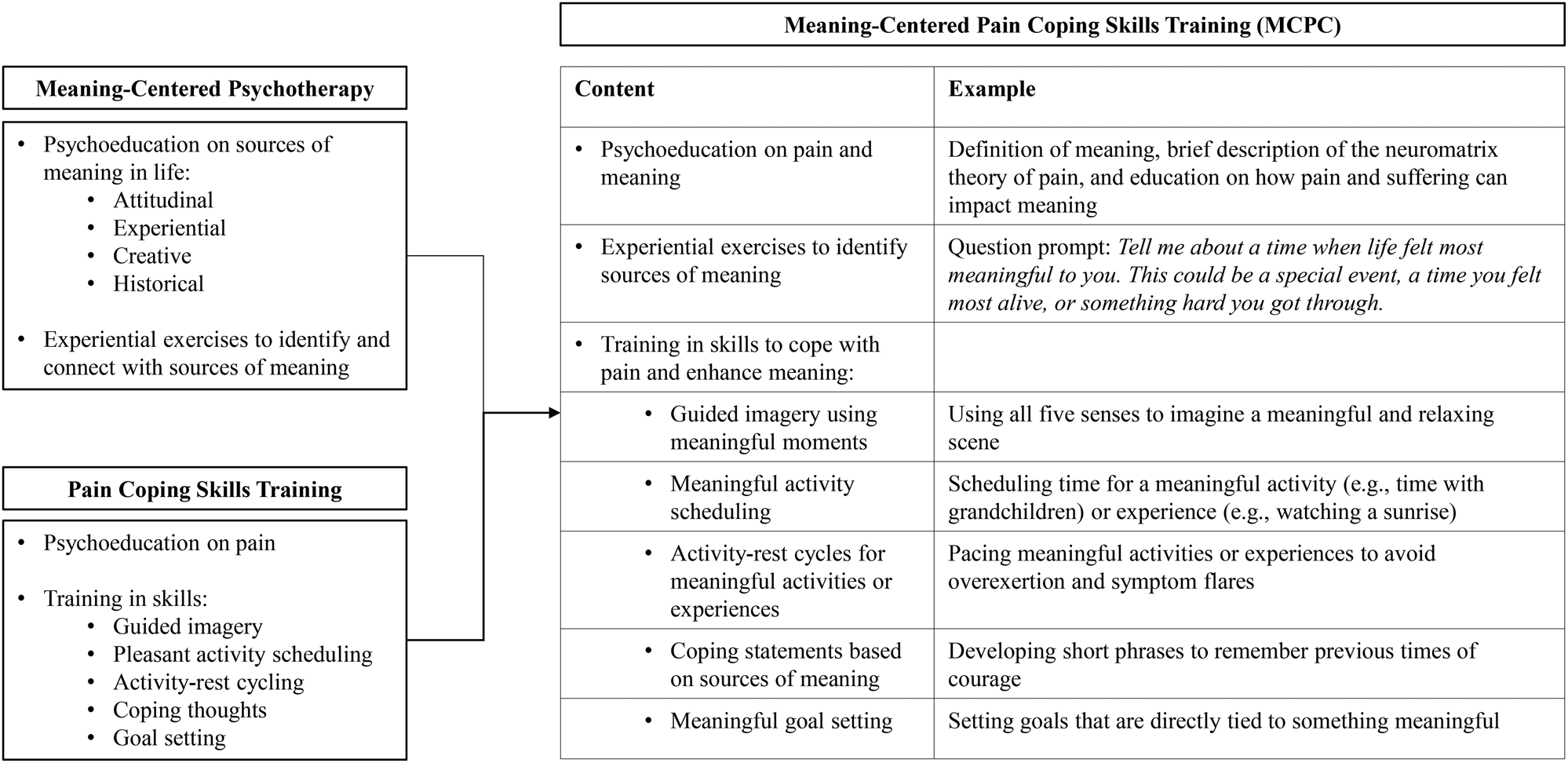
Our team recently created Meaning-Centered Pain Coping Skills Training (MCPC), a novel psychosocial intervention that concurrently targets pain management and existential concerns. MCPC was informed by social cognitive theory (Bandura, Reference Bandura1986, Reference Bandura2004), existential philosophy (Frankl, Reference Frankl1964; Yalom, Reference Yalom1980), and previous Pain Coping Skills Training and Meaning-Centered Psychotherapy treatment protocols (Breitbart and Poppito, Reference Breitbart and Poppito2014; Kelleher et al., Reference Kelleher, Winger and Dorfman2019). MCPC's primary goals are to (1) help patients identify valued sources of meaning in their lives and (2) teach patients cognitive and behavioral skills to reduce pain and enhance their engagement in meaningful activities. To address the first goal, we included experiential exercises from Meaning-Centered Psychotherapy in which the therapist asks patients specific questions to help them identify and connect with sources of meaning in their lives. To address the second goal, we adapted traditional Pain Coping Skills Training (e.g., guided imagery and activity–rest cycles) to focus on both managing pain and enhancing meaning (see Figure 1 for a more detailed description of MCPC).
Overview of MCPC skills training.

The objective of this study was to obtain patient evaluations of the initial version of the MCPC protocol. Patients provided their input on the session content, intervention structure (i.e., individual vs. dyadic sessions and intervention length), and delivery modality (i.e., in-person, telephone, or videoconference). They also described potential barriers to session attendance. The findings of this study will be used to refine MCPC's protocol prior to conducting a pilot trial to test its feasibility.
Methods
Study design
Our team conducted a qualitative study to gather patient evaluations of the initial version of the MCPC protocol. This study received an institutional review board approval (Duke University Pro00083582), was conducted following principles embodied in the Declaration of Helsinki (Code of Ethics of the World Medical Association), and adheres to the Consolidated Criteria for Reporting Qualitative Research guidelines (Tong et al., Reference Tong, Sainsbury and Craig2007).
Participants
Eligibility criteria were determined based on previous Pain Coping Skills Training (Kelleher et al., Reference Kelleher, Winger and Dorfman2019) and Meaning-Centered Psychotherapy (Breitbart et al., Reference Breitbart, Pessin and Rosenfeld2018) protocols, including (1) stage IV solid tumor cancer diagnosis, (2) at least moderate pain (worst pain in the past week ≥4 out of 10) at screening, (3) Palliative Performance Scale (Ho et al., Reference Ho, Lau and Downing2008) of 60 or higher at screening, (4) ability to speak and read in English, and (5) age ≥18 years. Exclusion criteria included (1) significant cognitive impairment, (2) untreated serious mental illness (e.g., schizophrenia) that would interfere with engagement in the study, and (3) patients with primary brain tumors.
Potentially eligible patients were identified via electronic medical record review. Following provider approval, patients were called to assess interest and screen for eligibility. They were asked to rate their worst pain in the last week on a scale from 0 (no pain) to 10 (worst pain imaginable). When a patient reported less than moderate pain (i.e., <4 out of 10), they were asked to re-rate their pain considering what it would be if they did not take pain medication. We used this approach because some patients with cancer pain may wish to learn psychosocial approaches to pain management but would not be eligible for an intervention because their pain level is too low while on medication.
Interested and eligible patients were scheduled for an in-person appointment to complete written informed consent and then participate in the interview. Participants were compensated $20. Interviews were conducted until thematic saturation was reached, the point at which additional interviews were not likely to add new information (Guest et al., Reference Guest, Bunce and Johnson2006).
Data collection
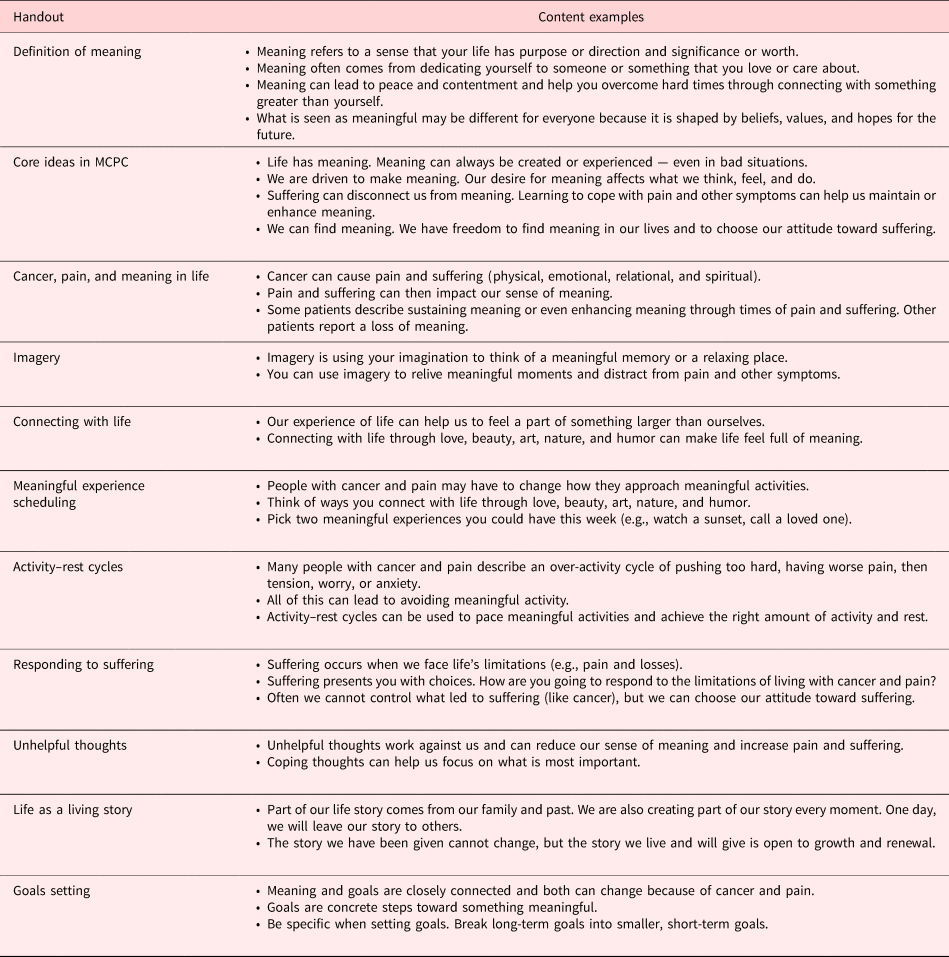
The first author (J.G.W.), a clinical psychologist experienced in working with cancer populations, conducted individual interviews with all participants between December 2017 and May 2018. Using a semi-structured format, participants were asked to evaluate MCPC's content by reviewing intervention session handouts (see Table 1 for a description of each handout). These handouts served as a way to familiarize participants with MCPC's educational content (e.g., definition of meaning) and the strategies used to train patients in pain coping skills. Strategies to be used to train patients in five different coping skills were described, including (1) guided imagery using a meaningful memory to distract from pain, (2) meaningful experience scheduling to connect with life in valued ways despite having pain, (3) activity–rest cycles to pace meaningful activities or increase activity tolerance while avoiding overexertion that increases pain, (4) coping thoughts to replace thoughts that increase pain, and (5) goal setting to develop specific steps toward something meaningful. After participants were presented with each handout, they were prompted with questions such as “When you read this, what did you think about? What changes, if any, would you make?” At the end of the interview, participants were asked about their preferences regarding the intervention's structure (i.e., individual vs. dyadic sessions and session length) and delivery modality (i.e., in-person, telephone, or videoconference) and to describe potential barriers to attending sessions.
Summary of intervention session handouts

Interviews took place in private rooms at a medical center and ranged in length from 35 to 65 min. All interviews were audiorecorded and transcribed verbatim. Following the interview, participants completed assessments of pain severity and pain interference (Brief Pain Inventory-Short Form; Cleeland and Ryan, Reference Cleeland and Ryan1994) and psychological distress (National Comprehensive Cancer Network Distress Thermometer; Holland and Bultz, Reference Holland and Bultz2007). Other demographic and medical information were collected via electronic medical record review.
Analysis
Interview transcripts were analyzed in NVivo 12.0 (QSR International) using techniques from applied thematic analysis (Guest et al., Reference Guest, MacQueen and Namey2011). A codebook was created a priori with major content areas from the interview guide, including (1) evaluation of the educational information and skills training described in the intervention handouts, (2) preferences for the intervention structure and delivery modality, and (3) barriers to session attendance. After segmenting the text into these major content areas, the first author (J.G.W.) used an inductive and iterative thematic coding process to group responses into broad categories with specific subthemes. Data-driven codes were created as they emerged from the interviews and, as new codes emerged, they were applied to previously coded text until all relevant content was captured. Two other study team members (K.E.S. and K.R.) reviewed the coding and resolved any discrepancies in interpretation.
Results
Participants
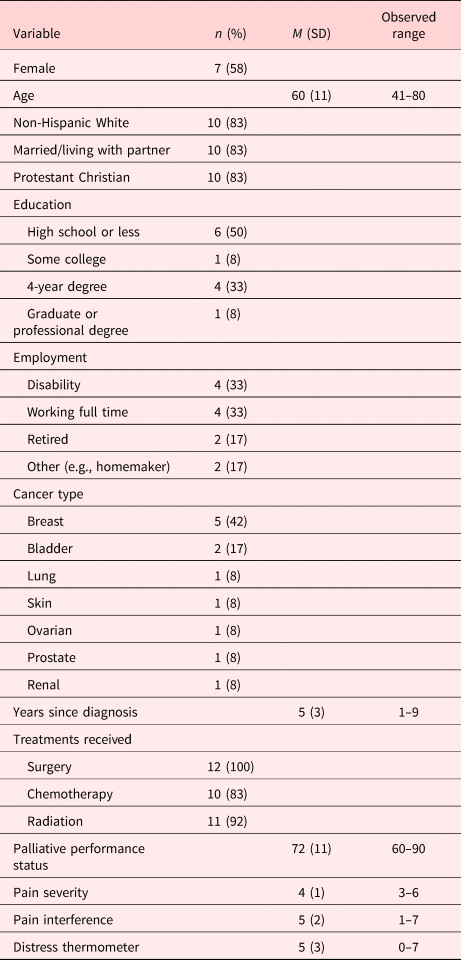
Twenty-five patients were contacted about the study and six declined screening due to lack of interest. During screening, four patients reported their worst pain in the last week as less than moderate (i.e., <4 out of 10). Two of these patients were taking pain medication and re-rated their pain as moderate or severe when considering what their worst pain would be without medication. The other two patients were ineligible because they were not taking pain medication and their worst pain was less than moderate. Four additional patients were eligible based on screening but never scheduled an interview due to illness progression (n = 1) and lack of interest (n = 3). Enrollment was stopped after 12 interviews because we had sufficient information to refine MCPC's protocol and determined that thematic saturation had been reached because no new themes were emerging from the interviews (Guest et al., Reference Guest, Bunce and Johnson2006).
Participants were 58% female, mostly Caucasian (83%) and, on average, 60 years old (SD = 11). They reported a moderate level of pain severity (mean = 4.38 out of 10, SD = 1.38), pain interference (mean = 4.54 out of 10, SD = 1.59), and psychological distress (mean = 4.58 out of 10, SD = 2.64; see Table 2 for additional participant characteristics).
Participant demographic and medical characteristics (N = 12)

Evaluation of education information and skills training descriptions in intervention handouts
When reviewing the intervention handouts, many participants poignantly described ways in which the content resonated with their experience and a few offered helpful ideas for refinement. Their response concepts were grouped into three broad categories: meaning in life, reasons for learning pain coping skills, and feedback on intervention refinement. Subthemes within these categories were then identified, which are described in the following sections using representative quotations.
Category 1: meaning in life
Three subthemes were identified that related to meaning in life: relying on meaning to cope with pain and illness, reconstructing meaning in the context limitations, and motivation for seeking meaning.
Relying on meaning to cope with pain and illness. Participants often derived a sense of meaning from frameworks that helped them cope with their pain and poor prognosis. This primarily involved relying on personally held religious or spiritual beliefs.
I keep reminding myself of my faith … what's the worst possible thing that can happen? I'm going to die. But if that happens, I'm not going to be in pain anymore and I'm going to … a place where I'm going to be in relief … I think it has a lot to do with me being able to handle my pain.
Suffering in my faith has very, very special meaning … I believe that Christian faith, and Greek mythology and Greek philosophy, I sincerely believe that happiness is like Socrates said, ‘happiness through suffering’. You can't be happy if everything is handed to you. You have to have a little pain, you have to have a little disappointment … then you realize the fullness of life and you're happy.
Reconstructing meaning in the context limitations. Some spoke of their pain and illness diminishing their sense of meaning. A few found that, over time, they were able to regain meaning by changing how they thought about their limitations. Others were still in a process of reconstructing their sense of meaning.
I made it through the first year depressed … Every thought in my head was, ‘I'm going to die’ … Well, I was sitting on the couch one day and I said … ‘I'm going to get up and live my life’. And that's what I did, just by changing my train of thought … it [advanced cancer] will change your whole life. The way you think about everything. The way you love people. I mean, I see stuff that is beautiful that you might not see.
I'm thinking, ‘What are you here for? What do you do? Do you deserve this?’ … I was always brought up to help your brother and your neighbors and your friend … When you get sick, you can't do all that. So that sure messed me up in a lot of ways.
Motivation for seeking meaning. Some participants described why they sought and valued meaning, which often related to feeling actively involved in life. For a few, meaning was a primary reason for living.
[In reference to a handout on the core ideas of MCPC] The last one, [it says] ‘we have freedom to find meaning in our lives and to choose our attitude toward suffering’. I truly believe that … That's why I sit through the [work] meeting for 2 hours. I'm out there still trying to live my life … even though I'm hurting.
If you don't have meaning in life, you don't have a lot to live for … you can look at meaning in so many different ways. Life has got meaning and you can find meaning anywhere you look, if you just study for it.
Category 2: reasons for learning pain coping skills
Participants expressed enthusiasm about learning how to use pain coping skills. Comments about why participants were interested in pain coping skills training were grouped into two subthemes: wanting options for pain coping in addition to taking medication and reducing stress helps manage pain.
Wanting options for pain coping in addition to taking medication. Participants described the importance of analgesic medication but also a desire for learning non-pharmacological approaches to pain management.
Me personally, it's hard. It has affected me a whole lot, trying to deal with the pain. Sometimes I don't want to be on medication for the pain. I'd rather try to deal with it without medication.
When you're in just really awful pain … you got to figure out something … you can't just take more drugs. That's what I always tell [my provider] … I want less drugs. That's what I want to do—figure out how to do it with less.
Reducing stress helps manage pain. Participants also thought that learning pain coping skills could help them reduce stress, which would likely reduce their pain.
[In reference to using activity-rest cycles to reduce stress when engaging in a meaningful activity] You know when you get stressed your back wells up. That's right where T8 is, where I had my surgery. It gets so tight and then it starts hurting across here, just from me stressing out it starts hurting. So I try to keep my stress level very low.
[In reference to a handout on meaningful activity scheduling] I've always been a nature freak. But now I really, really soak all of that up … when I do that, I can say that I have no pain because I'm thinking about something else … I'm so at ease.
Category 3: feedback on intervention refinement
A few participants offered helpful suggestions for refining the intervention. Their comments were grouped into two subthemes: additional content and patient-centeredness.
Additional content. A few participants wanted the sessions to focus on training in strategies that would help them cope with other common issues in advanced cancer, such as sleep disturbance and fatigue. Others described additional skills (e.g., problem-solving and assertive communication) that helped them manage their pain and may be beneficial for other patients to learn.
I don't sleep … my mind is always wandering, but pain plays a part with me not sleeping. I want to work on reducing the pain and the stress and my sleep quality.
I always look at the situation … What do I need to solve the problem? What is my plan? … Go through different things to solve the issue or find things that help you with that pain … I think that is good for people [to learn].
Patient-centeredness. A few participants emphasized the importance of presenting the material in a patient-centered manner. This included phrasing handouts in a way that increases patient autonomy and removing timeframes when talking about goals.
[In reference to a handout on the core ideas of MCPC] I think the word ‘freedom’ is really good because nobody wants to be told how it's all going to be. Nobody wants to be told that this is what you have to do to deal with this.
[In reference to a handout on goal setting] Long-term goals. It's saying a month … But I'm not too much on long-term goals right now with my life.
Intervention structure, delivery modality, and barriers to session attendance
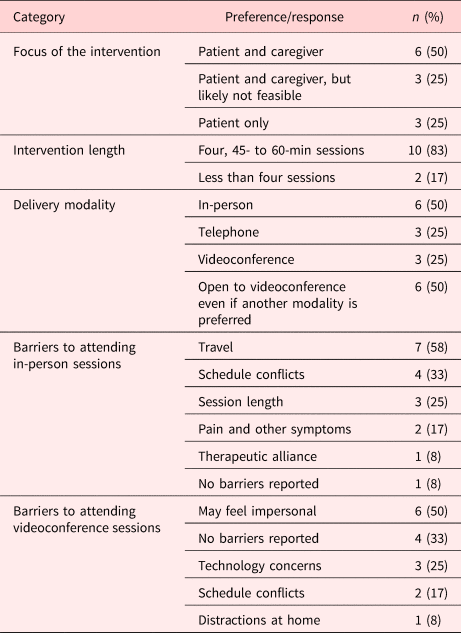
At the end of the interview, participants were asked about their preferences regarding the structure of the intervention, delivery modality, and any foreseeable barriers to attending sessions. Because all participants (N = 12) were asked the same questions, the percentages of those who endorsed each preference are summarized in the following section (see Table 3 for additional details).
Intervention preferences and potential barriers to attending sessions

Caregiver participation. Half of the participants (50%) preferred that the intervention focus jointly on the patient and the caregiver. They offered multiple reasons for this preference, such as enhancing social support and the potential for caregivers to benefit from the intervention. Some (25%) wanted their caregiver to attend sessions, but thought their caregiver would not be able (e.g., too busy) or willing (e.g., not interested in discussing cancer) to participate. Others (25%) did not have a caregiver.
Intervention length. Nearly all participants (83%) stated that four 45- to 60-min sessions were an acceptable length for the intervention. Two participants (17%) thought that the intervention should be less than four sessions.
Delivery modality. The majority of participants either preferred (25%) or, if another modality was their first preference, were open to trying (50%) videoconference-delivered sessions. Those whose first preference was in-person sessions (50%) often thought that they would feel more connected to the therapist than if they were completing sessions remotely. Some (25%) preferred telephone-delivered sessions.
Barriers to in-person sessions. All but one participant (92%) reported barriers to attending in-person sessions, with travel difficulties being the most notable concern. Some reported that the length of the intervention (25%) or pain and other symptoms (17%) might deter them from participating.
Barriers to videoconference-delivered sessions. Half of the participants (50%) thought that videoconference-delivered sessions might feel impersonal. Others mentioned concerns about technology issues (e.g., internet access) (25%) or distractions at home (8%). A few (17%) stated that their busy schedules would not allow them to participate regardless of the delivery modality. Others could not identify any barriers (33%).
Discussion
The objective of this study was to obtain patient evaluations of the initial version of MCPC's protocol. Based on findings from semi-structured interviews, MCPC's educational content and described coping skills training resonated with participants in specific ways, and a few participants offered helpful suggestions for enhancing the protocol. These findings have a direct impact on the refinement of the intervention and implications for future research and clinical practice. Important implications include addressing concepts of meaning in pain treatment, targeting co-occurring symptoms, considering the role of family caregivers, and delivering interventions remotely.
First, participants described meaning as being highly relevant to coping with advanced cancer and pain. Some relied on a strong sense of meaning as a coping resource; others felt that pain and illness had diminished their sense of meaning, which resulted in a process of trying to regain meaning. This finding is consistent with the influential sociology theory of symbolic interactionism (Blumer, Reference Blumer1986). Specifically, this theory posits that meaning taking occurs when individuals rely on categories or frameworks to make sense of the world or a situation, whereas meaning-making is an iterative social process by which meaning is constructed. Concerning meaning taking, many participants in this study viewed their pain and suffering through a religious or spiritual framework that offered hope. Previous research suggests that adaptive religious and spiritual coping is common among those with serious illness and, often, beneficial for pain management (Wachholtz et al., Reference Wachholtz, Fitch and Makowski2016; Park et al., Reference Park, Masters and Salsman2017; Balboni and Balboni, Reference Balboni and Balboni2018). Concerning meaning-making, some participants sought to reconstruct their sense of worth and significance in light of numerous limitations. Clinicians can help patients navigate this meaning-making process using experiential exercises from Meaning-Centered Psychotherapy that are designed to identify sources of meaning (Breitbart et al., Reference Breitbart, Pessin and Rosenfeld2018). Once identified, patients may benefit from learning skills (e.g., meaningful activity scheduling) to help them regularly utilize or engage with sources of meaning. Assessing whether a patient is adaptively relying on a meaning framework or in a process of meaning-making may thus provide important information for clinicians.
A few participants provided helpful suggestions for refining MCPC's skills training. One important suggestion was that the intervention focuses on multiple common symptoms, like sleep disturbance and fatigue. Previous clinical trials with patients with cancer demonstrate that training in pain coping skills can decrease sleep disturbance, fatigue, and psychological distress and improve self-efficacy for managing symptoms other than pain (Keefe et al., Reference Keefe, Ahles and Sutton2005b; Somers et al., Reference Somers, Abernethy and Edmond2015; Dorfman et al., Reference Dorfman, Kelleher and Winger2019; Kelleher et al., Reference Kelleher, Winger and Dorfman2019). Clinicians should work with patients to apply these coping skills to multiple symptoms that are likely to co-occur in the context of advanced disease (Kwekkeboom et al., Reference Kwekkeboom, Tostrud and Costanzo2018).
Concerning the structure of MCPC, many participants preferred sessions in which the patient and caregiver jointly participate; however, some also noted that joint sessions would not be feasible, and a few did not have a caregiver. It is important to consider that a dyadic approach would focus on the shared needs of the patient–caregiver dyad (Hu et al., Reference Hu, Liu and Li2019), which may not always be appropriate. Based on our clinical experience, involving caregivers can at times reduce a patient's openness to discussing existential topics. At other times, it can be very beneficial. Thus, there is a need for interventions that focus solely on patients and those that include caregivers to varying degrees (Keefe et al., Reference Keefe, Ahles and Sutton2005b; Porter et al., Reference Porter, Keefe and Baucom2017). Matching the structure of an intervention (e.g., dyadic, caregiver-assisted, individual) to specific patient needs is an important consideration for future research.
Nearly, all participants reported significant barriers to attending in-person sessions, including logistical issues such as travel and schedule conflicts. In contrast, participants reported fewer barriers to attending videoconference-delivered sessions, and these barriers tended to be modifiable (e.g., inconsistent internet access). There is increasing evidence that videoconference-delivered interventions for patients with cancer pain are highly feasible and acceptable and demonstrate comparable efficacy to in-person interventions (Somers et al., Reference Somers, Abernethy and Edmond2015; Kelleher et al., Reference Kelleher, Winger and Dorfman2019). Remote delivery modalities are likely an effective way to enhance the reach of psychosocial interventions, particularly for patients with advanced cancer who often encounter numerous obstacles (e.g., fluctuating symptoms and frequent medical appointments) to attending in-person sessions (Siddiqi et al., Reference Siddiqi, Sikorskii and Given2008; Seow et al., Reference Seow, Barbera and Sutradhar2011; Applebaum et al., Reference Applebaum, Lichtenthal and Pessin2012; Hui et al., Reference Hui, Glitza and Chisholm2013; Tang et al., Reference Tang, Liu and Lin2014).
Limitations of this study should be noted and include a small, cross-sectional sample of primarily Caucasian patients from one cancer center. Future research is needed to determine if MCPC's protocol is relevant to a more demographically diverse population. Additionally, participants completed assessments after the interview, which may have influenced their responses.
In conclusion, participants found MCPC's content to be relevant, offered suggestions for improvement, and expressed the need for remote delivery modalities. Based on these findings, we refined MCPC's protocol and are currently pilot testing this approach in a single-arm feasibility trial. MCPC is an innovative step toward Dame Cicely Saunders’ vision of holistic pain management for patients facing a life-limiting illness.
Acknowledgments
The authors thank the study participants and D. Mark Waters, ANP-BC; Jason A. Webb, MD; R. Morgan Bain, MD; and Rebekah M. Winger, BS, for their assistance with this study. Initial findings from this study were presented as a research poster at the 2019 Annual Meeting and Scientific Sessions of the Society of Behavioral Medicine.
Funding
J.G.W.'s work was funded by a postdoctoral fellowship award from the American Cancer Society (130526-PF-17-054-01-PCSM, PI).
Conflict of interest
The authors have no conflicts of interest to disclose.