Introduction
Campylobacter spp. are Gram negative, microaerophilic, curved or spiral rods from the family Campylobacteriaceae. Currently, there are 17 species and six subspecies assigned to the genus Campylobacter. The majority of species are motile, having a single polar flagellum at one or both ends of the cell. The most well-studied species of the Campylobacter genus are C. jejuni (subspecies jejuni) and C. coli, currently recognised as the leading cause of acute diarrhoea worldwide, accounting for 400 million cases of gastroenteritis in adults and children each year (EFSA, 2011). Other species such as C. lari and C. upsaliensis have also been isolated from patients with diarrhoeal disease, but are reported less frequently (Hermans et al., Reference HERMANS, VAN STEENDAM, VERBRUGGHE, VERLINDEN, MARTEL, SELIWIORSTOW, HEYNDRICKX, HAESEBROUCK, DE ZUTTER, DEFORCE and PASMANS2014). Campylobacter spp. are highly prevalent in poultry production systems, such as broilers, layers, turkeys, and ducks (Zhang et al., Reference ZHANG, SAHIN, SWAYNE, GLISSON, MCDOUGALD, NOLAN, SUAREZ and NAIR2013; Sahin et al., Reference SAHIN, KASSEM, SHEN, LIN, RAJASHEKARA and ZHAN2015). Prevalence rates, especially in slaughter age conventional broiler flocks, can reach as high as 100% on some farms worldwide. Both C. jejuni and C. coli are well adapted to the avian host and reside mainly in the intestinal tract of birds. Despite extensive colonisation in the intestine Campylobacter infections in general produce little or no overt disease in avian host (Hermans et al., Reference HERMANS, PASMANS, MESSENS, MARTEL, VAN IMMERSEEL, RASSCHAERT, HEYNDRICKX, VAN DEUN and HAESEBROUCK2012: Hermans et al., Reference HERMANS, VAN STEENDAM, VERBRUGGHE, VERLINDEN, MARTEL, SELIWIORSTOW, HEYNDRICKX, HAESEBROUCK, DE ZUTTER, DEFORCE and PASMANS2014; Sahin et al., Reference SAHIN, KASSEM, SHEN, LIN, RAJASHEKARA and ZHAN2015). However, limited data suggest that Colonisation may be associated with disease production in poultry under certain conditions. For example, a very recent study reported intestinal inflammation and diarrhoea in fast growing breeds of broiler chickens following an experimental challenge (Humphrey et al., Reference HUMPHREY, CHALONER, KEMMETT, DAVIDSON, WILLIAMS, KIPAR, HUMPHREY and WIGLEY2014). Also, vibrionic hepatitis with high morbidity and mortality associated with Campylobacter infections was reported in laying hens and ostriches (Wei et al., Reference WEI, CHA, KANG, ROH, SEO, YOON and JANG2014). However, it was questionable if Campylobacter alone was sufficient to cause this condition as other predisposing factors may be required for the induction of the disease (Jennings et al., Reference JENNINGS, SAIT, PERRETT, FOSTER, WILLIAMS, HUMPHREY and COGAN2011; Sahin et al., Reference SAHIN, KASSEM, SHEN, LIN, RAJASHEKARA and ZHAN2015). Some recent investigations suggested that Campylobacter spp. colonisation in chickens was negatively associated with intestinal function and growth performance as well as with bird welfare (Williams et al., Reference WILLIAMS, SAIT, TRANTHAM, COGAN and HUMPHREY2013; Awad et al., Reference AWAD, SMORODCHENKO, HESS, ASCHENBACH, MOLNAR, DUBLECZ, KHAYAL, POHL and HESS2015). Extensive research on Campylobacter spp. on poultry farms has been undertaken over the last two decades, the majority of which were on commercial broiler production units in developed countries. As a result, new and significant knowledge has been gained regarding the epidemiology and ecology of Campylobacter spp. in poultry. However, many gaps remain and effective intervention strategies for control are lacking. Several distinct features of Campylobacter spp. in poultry have been discovered. Firstly, it is rarely detected in young birds less than three weeks of age under commercial production conditions (Allen et al., Reference ALLEN, RIDLEY, HARRIS, NEWELL and POWEL2011), and maternal antibodies seem partially responsible for such protection (Cawthraw and Newell, Reference CAWTHRAW and NEWELL2010; Sahin et al., Reference SAHIN, KASSEM, SHEN, LIN, RAJASHEKARA and ZHAN2015). Once a broiler flock is infected, the majority of the birds within the flock become colonised within a short time period (Barrios et al., Reference BARRIOS, REIERSEN, LOWMAN, BISAILLON, MICHEL, FRIDRIKSDOTTIR, GUNNARSSON, STERN, BERKE, MCEWEN and MARTIN2006). Secondly, although the overall prevalence of Campylobacter spp. in poultry is high, there is considerable variation in the prevalence at farm and flock levels (Ridley et al., Reference RIDLEY, MORRIS, GITTINS, CAWTHRAW, HARRIS, EDGE and ALLEN2011). Thirdly, vertical transmission via eggs does not play a major role on poultry farms. Epidemiologic studies from around the world have clearly indicated that horizontal transmission from the environment is the main source of colonisation in poultry and that vertical transmission from breeder flocks to broilers is insignificant (Sahin et al., Reference SAHIN, KOBALKA and ZHANG2003; Lin, Reference LIN2009; Sahin et al., Reference SAHIN, KASSEM, SHEN, LIN, RAJASHEKARA and ZHAN2015). Potential sources of flock infection include old litter, untreated drinking water, other farm animals, domestic pets, wildlife species, flies, insects, farm equipment and transport vehicles, and farm workers. The lack of evidence for vertical transmission distinguishes Campylobacter spp. from Salmonella spp., which can be transmitted via eggs.
Despite its commensal nature in poultry, Campylobacter is among the leading bacterial zoonotic pathogens of importance to food safety and public health, with C. jejuni being responsible for the majority of human campylobacteriosis, followed by C. coli and rarely by C. lari and others. The poultry reservoir, especially broiler meat, is recognised as the most important vehicle for transmission to humans (Umaraw et al., Reference UMARAW, PRAJAPATI, VERMA, VERMA, V. PATHAK and SINGH2015; Sahin et al., Reference SAHIN, KASSEM, SHEN, LIN, RAJASHEKARA and ZHAN2015).
Campylobacteriosis is a disease transmitted to humans from animals or animal products. Most cases are associated with eating raw or undercooked poultry meat or from cross-contamination of other foods by these items. Most often, carcasses or meat are contaminated from faecal material during slaughtering. Recent studies ranked campylobacteriosis in poultry as the highest pathogen causing food borne illness with the largest burden on public health considering the number of cases, hospitalisations, deaths, economic costs and health related quality of life (Scallan et al., Reference SCALLAN, HOEKSTRA, ANGULO, TAUXE, WIDDOWSON, ROY, JONES and GRIFFIN2011; Ridley et al., Reference RIDLEY, MORRIS, GITTINS, CAWTHRAW, HARRIS, EDGE and ALLEN2011; Hermans et al., Reference HERMANS, VAN STEENDAM, VERBRUGGHE, VERLINDEN, MARTEL, SELIWIORSTOW, HEYNDRICKX, HAESEBROUCK, DE ZUTTER, DEFORCE and PASMANS2014).
Most related illnesses in humans are sporadic and characterised by watery or bloody diarrhoea, abdominal cramps, and possible fever; however, severe conditions may occur in immunocompromised patients, requiring antibiotic treatment (Sahin et al., Reference SAHIN, KOBALKA and ZHANG2003). Complications, such as Guillain-Barré syndrome, may follow infection which may result in serious health consequences (Jennings et al., Reference JENNINGS, SAIT, PERRETT, FOSTER, WILLIAMS, HUMPHREY and COGAN2011). In addition to the predominant role of chicken meat in sporadic infections, outbreaks due to Campylobacter spp. infections are also commonly associated with consumption of poultry or raw milk and contaminated water (Lin, Reference LIN2009; Sahin et al., Reference SAHIN, KASSEM, SHEN, LIN, RAJASHEKARA and ZHAN2015). Furthermore, the prime impact of poultry in the epidemiology of human campylobacteriosis is supported by a high prevalence of the bacteria in both live birds and on carcasses (Guerin et al., Reference GUERIN, SIR, SARGEANT, WADDELL, O'CONNOR, WILLS, BAILEY and BYRD2010). Considering the fact that handling or consumption of contaminated chicken meat is the main risk factor for human campylobacteriosis, major efforts from various stakeholders have been devoted to find effective and feasible means for control in the poultry production chain.
The purpose of this review is to provide an overview on the current knowledge of Campylobacter spp. in poultry with an emphasis on current challenges in the post-antibiotic era and potential immune interventions.
Colonisation of Campylobacter in poultry
A unique feature of Campylobacter spp. ecology in poultry is that the organism is rarely detected in commercial flocks of less than three weeks of age regardless of production methods and species of poultry (Allen et al., Reference ALLEN, RIDLEY, HARRIS, NEWELL and POWEL2011). Interestingly, a recent study found that Campylobacter spp. were not detected during the first three weeks of age in multiple broiler flocks raised on commercial farms with very low biosecurity measures and incomplete hygiene practices by animal caretakers in tropical climates (Allain et al., Reference ALLAIN, CHEMALY, LAISNEY, ROUXEL, QUESNE and LE2014). This universally observed lag phase in the colonisation of poultry, even in the presence of likely exposure to positive birds and other risks, implies that a biological mechanism of colonisation resistance may be present in young birds. Maternal antibodies are widely present in broiler chicks and have shown to be partly responsible for the absence of colonisation in young chickens (Cawthraw and Newell, Reference CAWTHRAW and NEWELL2010). In a broader context, colonisation of chickens by Campylobacter spp. can be affected by such factors as the age of the bird and strain of the bacterium (Chaloner et al., Reference CHALONER, WIGLEY, HUMPHREY, KEMMETT, LACHARME-LORA, HUMPHREY and WILLIAMS2014). Genotype of the broiler chicken (i.e. growth rate and breed) does not appear to have any significant influence on colonisation under field conditions (Gormley et al., Reference GORMLEY, BAILEY, WATSON, MCADAM, AVENDANO, STANLEY and KOERHUIS2014). Once a broiler flock is infected, the majority of birds become colonised within a few days, and the overall prevalence within the flock reaches the high levels (up to 100%) at slaughter age (Barrios et al., Reference BARRIOS, REIERSEN, LOWMAN, BISAILLON, MICHEL, FRIDRIKSDOTTIR, GUNNARSSON, STERN, BERKE, MCEWEN and MARTIN2006). A recent mathematical model predicted that Campylobacter spp. impacts 95% of a flock of 20,000 birds within 4.4 to 7.2 days after colonisation of the first broiler bird (Sahin et al., Reference SAHIN, KASSEM, SHEN, LIN, RAJASHEKARA and ZHAN2015). Conversely, in poultry with a longer life span (e.g. layer chickens), a decrease in the colonisation level may be observed over time as the birds age, and some birds may eventually clear the infection owing to the development of active immunity (Cawthraw and Newell, Reference CAWTHRAW and NEWELL2010).
Birds are naturally infected via the faecal oral route, after which the organism establishes itself in the intestinal tract, with the main site of colonisation being the caeca and colon and, to a lesser extent, the small intestines, liver, and other organs (Chaloner et al., Reference CHALONER, WIGLEY, HUMPHREY, KEMMETT, LACHARME-LORA, HUMPHREY and WILLIAMS2014). Although young birds may develop clinical disease (e.g. diarrhoea and weight loss), as shown in some experimental infections with Campylobacter spp. (Humphrey et al., Reference HUMPHREY, CHALONER, KEMMETT, DAVIDSON, WILLIAMS, KIPAR, HUMPHREY and WIGLEY2014), the vast majority of studies discussed the commensal nature of the organism in poultry, with no clinical signs of disease occurring (Sahin et al., Reference SAHIN, KOBALKA and ZHANG2003). Even in the sporadic events where signs of disease were observed in experimentally infected chicks, gross pathologic and microscopic lesions associated with infection were mostly minimal and mainly confined to the gastrointestinal tract (Zhang et al., Reference ZHANG, SAHIN, SWAYNE, GLISSON, MCDOUGALD, NOLAN, SUAREZ and NAIR2013).
A distinct feature of Campylobacter spp. colonisation in poultry is that the organism resides mainly in the mucus layer of the intestinal crypts, without direct adhesion or invasion of the epithelial cells, producing no signs of overt illness in most cases (Jennings et al., Reference JENNINGS, SAIT, PERRETT, FOSTER, WILLIAMS, HUMPHREY and COGAN2011). More recently, it was suggested that Campylobacter spp. establish colonisation by utilising a strategy that involves transient invasion of intestinal epithelium to avoid mucosal clearance combined with rapid replication in the intestinal mucus (Lin, Reference LIN2009; Sahin et al., Reference SAHIN, KASSEM, SHEN, LIN, RAJASHEKARA and ZHAN2015). A large number of Campylobacter cells can be recovered in the caeca and excreted in faeces for a prolonged period (i.e. at least until the slaughter age) following the establishment of organisms in the intestinal tract after both natural and experimental infections (Elvers et al., Reference ELVERS, MORRIS, NEWELL and ALLEN2011).
Under the condition of commercial production, chicken flocks can be colonised by single or multiple species and genotypes of Campylobacter, even during a single rearing cycle (Hermans et al., Reference HERMANS, PASMANS, HEYNDRICKX, VAN IMMERSEEL, VAN DEUN and HAESEBROUCK2011), and this has been reproduced in experimental infections (Chaloner et al., Reference CHALONER, WIGLEY, HUMPHREY, KEMMETT, LACHARME-LORA, HUMPHREY and WILLIAMS2014). In poultry, especially in broiler chickens, C. jejuni is the predominant species colonising the flocks, followed by C. coli and occasionally other species; however, C. coli has been reported to be the dominant species isolated from commercial turkeys and from organic and free range chickens (Hermans et al., Reference HERMANS, PASMANS, HEYNDRICKX, VAN IMMERSEEL, VAN DEUN and HAESEBROUCK2011).
Prevalence and associated risk for Campylobacter spp. on poultry farms
Prevalence of Campylobacter spp. positive poultry flocks are generally high but vary by regions, seasons, and production systems (conventional, free range, and organic, etc.), with positive flocks ranging from 2% to 100% infection rates (Bahrndorff et al., Reference BAHRNDORFF, RANGSTRUP-CHRISTENSEN, NORDENTOFT and HALD2013). Seasonal variations are observed in the prevalence of positive flocks with a peak in summer and autumn months (Barrios et al., Reference BARRIOS, REIERSEN, LOWMAN, BISAILLON, MICHEL, FRIDRIKSDOTTIR, GUNNARSSON, STERN, BERKE, MCEWEN and MARTIN2006). A high prevalence of Campylobacter in warm months may be due to an increased fly population and its mediated transmission (Bahrndorff et al., Reference BAHRNDORFF, RANGSTRUP-CHRISTENSEN, NORDENTOFT and HALD2013; Sahin et al., Reference SAHIN, KASSEM, SHEN, LIN, RAJASHEKARA and ZHAN2015), or via contamination of water sources, such as bore holes. It is reported that prevalence of Campylobacter has increased in the post-antibiotic era, especially in organic and free range flocks compared to conventional production (Allen et al., Reference ALLEN, RIDLEY, HARRIS, NEWELL and POWEL2011; Allain et al., Reference ALLAIN, CHEMALY, LAISNEY, ROUXEL, QUESNE and LE2014). Free access to the outside environments and longer life span may account for the increased prevalence rates in organic and free range productions. The organism is ubiquitous in the surrounding environment and sources of flock infection and risk factors influencing exposure are complex in nature. A large number of epidemiologic studies conducted in different countries indicated that horizontal transmission from environmental sources is the main route of flock colonisation by Campylobacter spp. (Barrios et al., Reference BARRIOS, REIERSEN, LOWMAN, BISAILLON, MICHEL, FRIDRIKSDOTTIR, GUNNARSSON, STERN, BERKE, MCEWEN and MARTIN2006; Agunos et al., Reference AGUNOS, WADDELL, LEGER and TABOADA2014; Sahin et al., Reference SAHIN, KASSEM, SHEN, LIN, RAJASHEKARA and ZHAN2015). Factors commonly associated with Campylobacter colonisation in broiler flocks include lack of overall biosecurity on farms, water quality, presence of other animals in close proximity to poultry houses (including other poultry species, livestock, pets, and wildlife), age and number of houses on a farm, slaughter age, size of flocks, the practice of partial depopulation (thinning), seasonal and climate changes, use of ventilators, fly and rodents populations, use of old litter, farm equipment, transport vehicles and farm workers. Conversely feed, fresh litter and good quality water are rarely the sources for the initial introduction of Campylobacter spp. into poultry flocks, although they can be contaminated by the organism in poultry houses where the birds are colonised and thus can facilitate the spread within production facilities (Guerin et al., Reference GUERIN, SIR, SARGEANT, WADDELL, O'CONNOR, WILLS, BAILEY and BYRD2010; Humphrey et al., Reference HUMPHREY, CHALONER, KEMMETT, DAVIDSON, WILLIAMS, KIPAR, HUMPHREY and WIGLEY2014; Ellis-Iversen et al., Reference ELLIS-IVERSEN, RIDLEY, MORRIS, SOWA, HARRIS, ATTERBURY, SPARKS and ALLEN2012; Bahrndorff et al., Reference BAHRNDORFF, RANGSTRUP-CHRISTENSEN, NORDENTOFT and HALD2013). Recently it was shown that using fly screens on ventilation openings in chicken houses significantly reduced the number of Campylobacter spp. positive flocks and removed the normal summer peak in infection prevalence (Bahrndorff et al., Reference BAHRNDORFF, RANGSTRUP-CHRISTENSEN, NORDENTOFT and HALD2013). Naturally contaminated cattle faeces and used poultry litter were a viable source of Campylobacter spp. colonisation for broiler chickens (Ridley et al., Reference RIDLEY, MORRIS, GITTINS, CAWTHRAW, HARRIS, EDGE and ALLEN2011). The persistence of Campylobacter spp. colonisation was linked to the availability of nutrients and to litter moisture content. All these observations clearly indicate horizontal transmission from the farm environment as the major source of exposure of flocks.
Notably, many studies concluded that vertical transmission from breeder flocks via eggs was not a major source in the introduction into broiler houses (Allen et al., Reference ALLEN, RIDLEY, HARRIS, NEWELL and POWEL2011), although some controversy still exists. Lack of colonisation during the first weeks of life in broilers, those hatched from eggs originated from breeder flocks infected with Campylobacter spp. under natural farms settings, argues against the importance of vertical transmission (Barrios et al., Reference BARRIOS, REIERSEN, LOWMAN, BISAILLON, MICHEL, FRIDRIKSDOTTIR, GUNNARSSON, STERN, BERKE, MCEWEN and MARTIN2006). Likewise, many studies reported that the strains infecting broiler flocks and their parent breeder flocks were of different genotypes and thus indicated the unlikelihood of vertical transmission for contamination of poultry flocks (Sahin et al., Reference SAHIN, KOBALKA and ZHANG2003; Cawthraw and Newell, Reference CAWTHRAW and NEWELL2010; Sahin et al., Reference SAHIN, KASSEM, SHEN, LIN, RAJASHEKARA and ZHAN2015)
Immunity and Campylobacter spp. infections in poultry
Despite the fact that Campylobacter spp. colonise chicken intestine as commensal organisms, it still triggers immune responses. Generally, the induced antibody response is slow and moderate in chickens. The anti-Campylobacter spp. serum IgG, IgA, and IgM levels were increased gradually two to three weeks after experimental inoculation, and mucosal IgA was elevated three to four weeks upon infection in chickens (Cawthraw and Newell, Reference CAWTHRAW and NEWELL2010). Laboratory challenge experiments indicated that specific maternal antibodies conferred partial protection against colonisation in chickens (Hermans et al., Reference HERMANS, PASMANS, MESSENS, MARTEL, VAN IMMERSEEL, RASSCHAERT, HEYNDRICKX, VAN DEUN and HAESEBROUCK2012; Cawthraw and Newell, Reference CAWTHRAW and NEWELL2010). This demonstrated a protective role of the antibodies against infection and provided a rationale for the development of immune intervention strategies for control. Clearly, chicken host immunity to Campylobacter spp. infection is different from that to other bacterial infections such as avian salmonellosis (Wigley, Reference WIGLEY2013). Recently, Hermans et al. (Reference HERMANS, PASMANS, HEYNDRICKX, VAN IMMERSEEL, VAN DEUN and HAESEBROUCK2011) comprehensively reviewed chicken intestinal mucosal immune responses to Campylobacter spp. infections and provided an insightful view on the interaction between the bacteria and the chicken host. It has been suggested (Hermans et al., Reference HERMANS, PASMANS, HEYNDRICKX, VAN IMMERSEEL, VAN DEUN and HAESEBROUCK2011) that caecal mucosal crypts, the major colonisation site of Campylobacter spp., develop an inefficient inflammatory response which fails to clear Campylobacter from the intestine. In addition, Hermans et al. (Reference HERMANS, PASMANS, HEYNDRICKX, VAN IMMERSEEL, VAN DEUN and HAESEBROUCK2011) proposed a mechanism potentially responsible for the redirection of chicken host immune response toward tolerance, consequently leading to persistent and high level of colonisation in the chicken gut. Connell et al. (Reference CONNELL, MEADE, ALLAN, LLOYD, KENNY, CORMICAN, MORRIS, BRADLEY and O'FARRELLY2012) observed that gut related immune mechanisms are critical for regulating Campylobacter spp. colonisation levels in chickens. Together, these recent findings have improved the understanding of the delicate interaction between the chicken mucosal immune system and infections. Elucidation of the underlying mechanisms for the tolerogenic mucosal immune response may eventually facilitate the development of effective intervention strategies to mitigate infection in poultry. Although Campylobacter spp. primarily colonise the intestinal tract, they can be isolated from the spleen, liver, and blood in young chickens, suggesting that they may invade intestinal epithelial cells and become systemic (Sahin et al., Reference SAHIN, KOBALKA and ZHANG2003). It has been demonstrated that C. jejuni can breach the gut epithelial barrier, and it's in vitro invasiveness was correlated with the magnitude of spleen infection in inoculated chickens (Clark et al., Reference CLARK, OAKES, REDHEAD, CROUCH, FRANCIS, TOMLEY and BLAKE2012). Notably, a recent study by Humphrey et al. (Reference HUMPHREY, CHALONER, KEMMETT, DAVIDSON, WILLIAMS, KIPAR, HUMPHREY and WIGLEY2014), using four commercial breeds of broiler chickens for experimental infection, found that breed has a significant effect on the outcome of C. jejuni infection and immune response. Specifically, all breeds mounted an innate immune response, but the length and magnitude of inflammatory responses varied in different breeds, leading to commensal colonisation in some breeds but disease in others, with damage to gut mucosa and occurrence of diarrhoea (Humphrey et al., Reference HUMPHREY, CHALONER, KEMMETT, DAVIDSON, WILLIAMS, KIPAR, HUMPHREY and WIGLEY2014). Together, these findings revealed the complex interaction between Campylobacter and the chicken host and suggested the need for re-evaluation of immune responses during infections in poultry.
Potential immune interventions
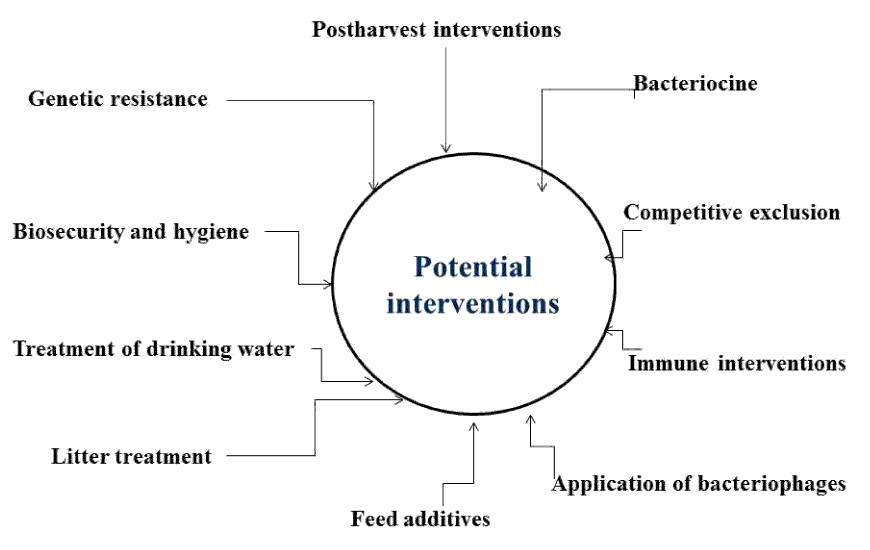
Three general strategies have been proposed to control Campylobacter spp. colonisation on poultry farms: (1) reduction of environmental exposure (biosecurity measures), (2) an increase in host resistance to reduce carriage in the gut (competitive exclusion, vaccination, and host genetics selection), and (3) the use of antimicrobial alternatives to reduce and even eliminate the bacteria from colonised chickens (bacteriophage therapy and bacteriocin treatment) (Figure 1).
Pre and postharvest interventions of Campylobacter spp. in poultry.

Campylobacter spp. are common in the farm environment and can contaminate poultry houses via many different routes, which makes the prevention of flock colonisation a difficult task. Because the majority of human campylobacterioisis infections are associated with the consumption of chicken meat, control in broilers has received the most attention. The next section summarises immune interventions that have been evaluated for the control of Campylobacter spp. in broiler production.
Immune intervention is an attractive approach to control Campylobacter spp. as it has been well established that infection with C. jejuni in poultry can induce protective immunity against re-infection, supporting the feasibility of developing vaccines (immune interventions) against colonisation in poultry. However, to date there are still no effective and consistent immune interventions, primarily due to the lack of understanding of the protective immunity, the great antigenic variability of different Campylobacter spp. strains, and the inability of current vaccination regimens to induce a strong and persistent mucosal immune response in chickens. Identification of immunogenic and protective antigens in C. jejuni is a critical step for the development of effective intervention measures. Various candidates, most of which are outer membrane proteins required for Campylobacter spp. pathobiology, have been identified and summarised in a previous review (Lin, Reference LIN2009).
Recently, Yeh et al. (Reference YEH, HIETT, LINE and SEAL2014) examined reactivity of broiler chicken sera to selected recombinant chemotactic proteins and showed that the chemotactic protein Cj0473 is a potential candidate for immune intervention against Campylobacter spp. infection in broilers. Using in vivo induced antigen technology, Hu et al. (Reference HU, HUANG and JIAO2014) identified the genes expressed during C. jejuni infection of the chicken host and suggested that these genes may be potential vaccine candidates for immunisation. Two types of immune interventions have been pursued to reduce Campylobacter spp. load in poultry: passive immunisation and active vaccination of broilers. In passive immunisation, several recent studies (Al-Adwani et al., Reference AL-ADWANI, CRESPO and SHAH2013; Paul et al., Reference PAUL, AL-ADWANI, CRESPO and SHAH2014; Hermans et al., Reference HERMANS, VAN STEENDAM, VERBRUGGHE, VERLINDEN, MARTEL, SELIWIORSTOW, HEYNDRICKX, HAESEBROUCK, DE ZUTTER, DEFORCE and PASMANS2014; Sahin et al., Reference SAHIN, KASSEM, SHEN, LIN, RAJASHEKARA and ZHAN2015) evaluated oral administration of specific chicken egg yolk derived antibodies for reduction of C. jejuni colonisation. The studies only showed ineffectiveness (Lin, Reference LIN2009) or partial success (Hermans et al., Reference HERMANS, VAN STEENDAM, VERBRUGGHE, VERLINDEN, MARTEL, SELIWIORSTOW, HEYNDRICKX, HAESEBROUCK, DE ZUTTER, DEFORCE and PASMANS2014) from this approach. Riazi et al. (Reference RIAZI, STRONG, COLEMAN, CHEN, HIRAMA, VAN FAASSEN, HENRY, LOGAN, SZYMANSKI, MACKENZIE and GHAHROUDI2013) produced a unique, pentavalent, single domain antibody directed against C. jejuni flagella and observed that oral administration of the antibodies reduced colonisation in the caeca without affecting chicken body weight gain. Most of the previous studies on immunisation have focused on active vaccination, which has been comprehensively reviewed in recent articles (Lin, Reference LIN2009; Hermans et al., Reference HERMANS, PASMANS, HEYNDRICKX, VAN IMMERSEEL, VAN DEUN and HAESEBROUCK2011; Garcia et al., Reference GARCIA, BAHRNDORFF, HALD, HOORFAR, MADSEN and VIGRE2012). Identification of immunogenic and potentially protective antigens in C. jejuni has resulted in recent development work being focused on subunit vaccines using various delivery systems such as oral live Salmonella spp. vectored vaccine (Lin, Reference LIN2009; Theoret et al., Reference THEORET, COOPER, ZEKARIAS, ROLAND, LAW, CURTISS and JOENS2012; Laniewski et al., Reference LANIEWSKI, KUCZKOWSKI, CHRZASTEK, WOZNIAK, WYSZYNSKA, WIELICZKO and JAGUSZTYN-KRYNICKA2014; Sahin et al., Reference SAHIN, KASSEM, SHEN, LIN, RAJASHEKARA and ZHAN2015), Eimeria spp. parasite vector based live vaccine, and nanoparticle encapsulated vaccine administered via the oral or intranasal route (Huang et al., Reference HUANG, YIN, PAN, ZHANG, ZHU, LIU and JIAO2010; Clark et al., Reference CLARK, OAKES, REDHEAD, CROUCH, FRANCIS, TOMLEY and BLAKE2012; Annamalai et al., Reference ANNAMALAI, PINA-MIMBELA, KUMAR, BINJAWADAGI, LIU, RENUKARADHYA and RAJASHEKARA2013). Two Campylobacter spp. antigens; flagellin and a protein called PEB1, have been put forward as subunit vaccine candidates for use either as purified recombinant proteins or by expression in carrier vaccine strains, such as live attenuated Salmonella or Shigella spp. (Umaraw et al., Reference UMARAW, PRAJAPATI, VERMA, VERMA, V. PATHAK and SINGH2015). The inactivated microorganisms offer several advantages as potential vaccines for mucosal immunisation, as they are inexpensive to produce and possess multiple antigens that can be important for protection. A killed whole cell vaccine against Campylobacter spp. could be safe, immunogenic, and protect against disease, particularly if combined with an effective mucosal adjuvant, such as E. coli heat labile toxin (LT) (Umaraw et al., Reference UMARAW, PRAJAPATI, VERMA, VERMA, V. PATHAK and SINGH2015). Some recent work, using a mixture of heat and formalin killed C. jejuni in mice, has shown that LT enhances the mucosal immune response over a wide range of vaccine doses (Lin, Reference LIN2009). Vaccination with killed C. jejuni whole cells enhanced immune responses and partly reduced colonisation in chickens (de Zoete et al., Reference DE ZOETE, VAN PUTTEN and WAGENAAR2007; Lin, Reference LIN2009).
Despite extensive efforts, chicken trials have shown limited success for different vaccination regimens. Clearly, the short life span of broiler chickens and the need to induce protective immunity in the intestinal tract have posed a significant challenge for development of vaccines for chickens (Connell et al., Reference CONNELL, MEADE, ALLAN, LLOYD, KENNY, CORMICAN, MORRIS, BRADLEY and O'FARRELLY2012; Garcia et al., Reference GARCIA, BAHRNDORFF, HALD, HOORFAR, MADSEN and VIGRE2012; Lin, Reference LIN2009). In addition two factors, the cost and simplicity of administration, should be considered for such vaccines. The in ovo approach may be explored for Campylobacter spp. vaccine development because application at embryonation day 18 has proven to be a safe, effective and convenient method for protecting chickens against viral, bacterial, and protozoal diseases in poultry (Sahin et al., Reference SAHIN, KASSEM, SHEN, LIN, RAJASHEKARA and ZHAN2015).
Conclusions
It is widely accepted that contamination of poultry by Campylobacter spp. is a significant risk factor of human campylobacteriosis. Thus, the prevention and control of C. jejuni in poultry would reduce the risk of human exposure to infection and is an important food safety issue. However, there is no effective, reliable, and practical immune intervention measure available in poultry to date. Significant advancement has been made during the past years in understanding the epidemiology and ecology of Campylobacter spp. in poultry as well as in evaluating intervention strategies. As a commensal of birds, the bacteria is well adapted in the poultry intestinal tract. This commensal interaction elicits only a moderate immune response of tolerogenic nature in the avian gut, resulting in persistent colonisation with high numbers of the organism. Due to the fact that Campylobacter is commonly present in the farm environment and can be introduced into poultry houses in many ways, it is extremely difficult to keep chicken flocks free of infection during the production stage. Immune interventions have certain potential, but may not be sufficient when applied individually, and may be more effective when multiple measures are used in combination. However, use of multiple strategies may prove to be difficult due to practical and economic reasons. Thus, additional efforts are critically needed to develop practical and effective immune interventions. To accomplish this difficult task, future research needs to be targeted in several promising areas. For example, understanding the interaction of Campylobacter spp. with the poultry immune system may provide clues for eliciting protective immunity and optimising immunisation strategies. More research is needed to address key issues regarding potential immune intervention to produce safe food products via effective control in poultry.