INTRODUCTION
Relationships between religion and the state in modern democracies vary tremendously. Countries such as Canada and the United States practice strict separation between religion and the state. In other countries, such as the United Kingdom, Norway, and Ireland, the state supports religion, either because there is an officially established church or because one religion in particular dominates the socio-cultural landscape.Footnote 1 Even while the levels of religious identification and religiosity are decreasing at least among Western countries (Norris and Inglehart Reference Norris and Inglehart2011), many “support” states bolster the dominant religious tradition. Israel is one such state. Its Basic Laws, which have a quasi-constitutional status, identify Israel as a Jewish state and a democracy. On symbolic and substantive levels, the state is strongly associated with Judaism. And yet there are significant cleavages among Israeli Jews between and among those who identify as secular and those who identify as religious. These cleavages were reflected in the 2013 elections, which produced victories for religious and secular parties alike. This suggests that the predominance of Judaism belies robust religious pluralism. In this paper we investigate this pluralism, focusing on mass level attitudes on the relationship between synagogue and state.
This topic is significant for several reasons. First, it provides an opportunity to investigate mass attitudes on church state relations in a new context. Much of the literature in this area focuses on the United States (cf. Jelen Reference Jelen1999; Jelen and Wilcox Reference Jelen and Wilcox1995; Reference Jelen and Wilcox1997). Israel makes for a very different case with respect to the religious economy and the institutionalized relationships between church and state. While the United States separates these domains, Israel is a “support” state that identifies itself as Jewish and has very high levels of government involvement in religion (Fox and Rynhold Reference Fox and Rynhold2008). Second, church state relations are an important aspect of Israeli domestic politics that receives scant attention as compared to the Arab-Israeli conflict, the status of the occupied (or administered) territories, and the status of Israel's growing Arab-Israeli minority (Peleg and Waxman Reference Peleg and Waxman2011). This disparity makes sense, given that the manner in which these issues are resolved directly affects the possibilities for long-term peace in the region. However, the centrality of Israel's identity as a Jewish state — and what exactly that means to domestic constituencies — also affects the prospects for peace and mediation in the region.
Finally, the secular religious cleavage is highly salient among Israelis. Israeli Jews have internalized a high level of civil religion, but they are divided on the degree to which traditional religious laws should structure public policy (Liebman and Don-Yehiya Reference Liebman and Don-Yehiya1983). The management of this division affects Israel's long-term identity as a Jewish democracy. Because the secular and religious camps view each other with some suspicion, this socio-cultural divide has the potential to disrupt an already contentious politics. “[S]ecular Israelis … characterize the religious community as Israel's own ‘Islamic Jihad’ while Ultraorthodox spokespeople more than repay the compliment, branding secular Israelis as ‘heretics’” (Wald and Shye Reference Wald and Shye1994). To be sure, Israeli Jews are united by a kind of religious “tribalism,” as Dov Waxman (Reference Waxman2012) notes, but again they are divided internally based what kind of state various factions want Israel to be (Sandler, Freedman, and Telhami Reference Sandler, Freedman and Telhami1999). A Halachic theocracy? Or a liberal democracy?
This article investigates Israeli attitudes on an array of highly salient issues that draw on this cleavage, such as support for civil marriage, judicial review, and the status of Jewish law. We argue that attitudes on these issues are structured by identification with one of two expressions of religion: (1) associational religion, which refers to affect (and deference) toward orthodox, institutional aspects of religion identification, as well as religious practice; and (2) religious ethos, which embraces a broad conception of religious identity that includes secular communities (Wald and Shye Reference Wald and Shye1995). This hypothesis is tested using the 2009 Israeli National Election Study (INES). Concerning support for civil marriage and support for Jewish laws and traditions, we find that religious observance and identification with religious communities and political parties are strongly associated with support for the role of religion in public life. None of these seem to influence the level of support for judicial review. Attitudes on that issue are structured by a more general support for the rule of law, as is consistent with the wider literature.
EARLY COMPROMISES
The distinction between associational and ethotic expressions of Judaism began in the late 19th century and informed the cultural conflict between religious and secular Jews as Zionism emerged. Many of the early leaders in the movement were secular Jews who pursued state building for entirely practical reasons — they believed it would provide a bulwark against European anti-Semitism and persecution. They cast Judaism in ethotic terms as a secular nationality, and they founded a series of proto-state institutions that purchased land in Palestine and promoted the migration of Diaspora Jewry to their historic homeland. Religious Jews, exemplars of associational religion, were split on the Zionist enterprise. Some believed that the state advanced the Messianic destiny of the Jewish people (Ratzabi Reference Ratzabi2008), but many in the Ultraorthodox community had reservations about the secular character of political Zionism, believing that the redemption of the Jewish people could not come through secular Jewry. “[T]hey valued the Land of Israel as a religious virtue, but continued to perceive their life in the state of Israel as a continuation of exile” (Sandler Reference Sandler1996, 137).Footnote 2 The creation of a Jewish state politicized Judaism in a way that it had not been during exile, and it forced Jews to grapple with the relationship between religion and the state in the context of their own sovereignty (Fox and Rynhold Reference Fox and Rynhold2008). The chief concern of religious Jews was this: what role would Jewish laws and traditions play in the emerging state? Jewish tradition would suggest that some distinction could be made between religion and political authority, without the two being strictly separate (Don-Yehiya Reference Don-Yehiya1984).
From the perspective of the secular Zionists, the legitimacy of their claim to be building a Jewish state would be undermined without the support of the religious. They committed, therefore, that religion would have a role in the state, and as a result religious Jews participated in proto-state institutions such as the World Zionist Organization. Once the state was founded, religious parties were routinely incorporated into the government as a way to institutionalize consociational norms (Sandler Reference Sandler1996). As partners with the political Zionists, the Orthodox community would have an opportunity to influence the character of the emerging state. Notwithstanding David Ben-Gurion's statist attitudes (Don-Yehiya Reference Don-Yehiya1984; Liebman 1998; Liebman and Don-Yehiya Reference Liebman and Don-Yehiya1983), he was able to secure support from the Ultraorthodox, or Haredim, in 1947 by issuing the Status Quo Agreement. This agreement committed the state to observance of the Sabbath, adherence to dietary laws in state kitchens, religious influence over marriage and family, and religious autonomy in education (Ben-Gurion Reference Ben-Gurion, Rabinovich and Reinharz1947). These accommodations reflect the idea that in the modern era there are a variety of ways to live an authentically Jewish life (Elazar Reference Elazar1985), and that the state can provide space for these different expressions of Judaism to exist even as they compete with one another (Don-Yehiya Reference Don-Yehiya1999a). However, neither the Status Quo Agreement nor the statutes that codified this agreement resolved the relationship between religion and the state, so much as they institutionalized an unsettled relationship between synagogue and state.
The state is committed to universalistic democratic principles, such as political equality, but it gives a pride of place to religion generally and Judaism specifically. That may have the effect of elevating the status of particular religious communities at the expense of others (Liebman Reference Liebman1988). Rather than consider religion to be a private matter, religion is brought directly into the public sphere. It provides the basis on which the state relates to its people, and as such it leads to contestation. With the growth of the Haredi community (Wald Reference Wald, Jelen and Wilcox2002) and the increased willingness of civil courts to challenge the authority of the religious community (Sandler, Freedman, and Telhami Reference Sandler, Freedman and Telhami1999), this unsettled and contested dimension of Israeli politics will likely endure.
CONTEMPORARY CLEAVAGES
There is considerable disagreement among Israeli Jews over how to resolve these issues. Informed by different conceptualizations of Judaism, the secular and religious communities embrace very different visions of the Israeli polity and of each other. At the same time, both communities recognize the importance of the other. Even secular Jews would acknowledge that social and political life in Israel should evidence that Israel is a Jewish state. And for their part, “[r]eligious spokesmen deny any intention of trying to use state power to regulate citizens' private lives” (Dowty Reference Dowty1998, 169). Secular and religious Jewry, then, are different expressions of religion. The religious, Orthodox, and Haredi communities exemplify associational religion with its emphasis on orthodoxy, while secular and self-identifying “traditional” Jews exemplify religious ethos, which is not unlike ethnicity. One does not tend to think of “secular” as an expression of religion, but in the Israeli case we note that identifying as secular does not necessarily mean rejecting Judaism or religious belief and observance, just Orthodox expressions of Judaism. Secular Jews may be observant, but not ritually observant (Wald and Shye Reference Wald and Shye1994).
An individual's support for religious versus secular parties and their level of religious observance are two manifestations of their identification with associational religion versus religious ethos. We rely on the 2009 INES to operationalize these concepts. Respondents were asked the extent to which they observe religious tradition with the following response options: “(1) I do not observe the tradition at all; (2) I observe some elements of the tradition; (3) I observe the tradition to a great extent; (4) I observe the tradition completely to its every detail.” High levels of observance are associated with orthodoxy and associationalism. Respondents were also asked which party they supported in the 2009 election. With respect to the party system, it is useful to make a distinction between Haredi parties, secular parties that support the religious status quo, and secular parties that wish to limit the public role of religion. Shas and United Torah Judaism are Haredi parties that wish to align the state more closely with Jewish law. Support for these parties is associational and suggests that one is motivated by narrowly defined Jewish interests in the face of larger antagonistic forces. Likud and Labour are the historically dominant secular parties, but they have always included religious parties in their governing coalitions. They wish to maintain accommodations for the religious community. Support for these parties draws on the ethos model of party support that joins the religious and secular significance of the state in such a way that promotes a broad civil religion (Wald and Shye Reference Wald and Shye1995). Yisrael Beitenu and Kadima are secular parties. Owing partly to the influx of immigrants with questionable Jewish bona fides (Don-Yehiya Reference Don-Yehiya1999a), these parties wish to change the status quo such that the religious lose some of their privileges.Footnote 3
The Role of Jewish Law
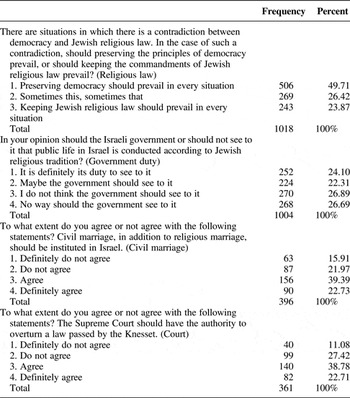
Support for Jewish laws and traditions are operationalized by INES questions that inquire about support for the role of Jewish law in public life, civil marriage, and judicial review. The role of Jewish law is unsettled. The Status Quo Agreement established deference to religious authorities in some public domains, but it was just one of several compromises. In the pre-state period, for example, religious minorities were given some autonomy and permitted to establish separate cultural and educational institutions. This segregation carried over into the new state, and the result is that even today there are separate religious and secular institutions that compete for cultural influence and state resources. Two questions from the INES inquire about attitudes on this dimension. The marginals for these questions are reported in Table 1.
The distributions of the dependent variables

Note: The data come from the 2009 Israel National Election Study.
The first question asks about the relationship between church and state at an abstract level, inquiring which should prevail in the event of a contradiction: the principles of democracy or Jewish law. In the American context, the public is divided on the abstract dimensions of church state relations (Jelen and Wilcox Reference Jelen and Wilcox1995), and the same appears to be the case in Israel. We note that 50% of Israeli Jews report that democracy should prevail. The remaining respondents are divided almost evenly between those who prefer Jewish Law to prevail, and those who are unsure. The second question asks whether the government should ensure that public life is conducted according to Jewish religious traditions. While about 46% of Israeli Jews agree that government should maybe or definitely “see to it that public life in Israel is conducted according to Jewish religious tradition,” about 54% take the opposite view. Given that personal religiosity is associated with support for a porous wall of separation between church and state (Jelen and Wilcox Reference Jelen and Wilcox1995), we hypothesize that with respect to Jewish law:
HYPOTHESIS 1:
Identification with religious parties and high levels of religious observance among Israeli Jews will be positively associated with support for Jewish laws and traditions in public life.
Marriage
The relationship between church and state also shapes the policy agenda (Jelen Reference Jelen1999), and so we assess mass attitudes on more specific issues such as marriage. Another accommodation made to the religious community is that it was given jurisdiction over personal status issues, such as family law, burials, one's status as Jewish, etc. This arrangement was codified in a number of ways, but most notably with the 1953 Marriage and Divorce Law, which gave the Orthodox Rabbinical Courts jurisdiction over marriage and divorce for Israeli Jews (Gottschalk Reference Gottschalk1954). “While there are several legal implications of the law, the most notable is that civil marriage is not permitted in Israel. Israeli Jews wanting to be married in Israel have no choice but to be married by an Orthodox rabbi. Non-Jews must look to their own religious communities to perform marriages. No one may look to the secular state” (Oldmixon and Samaniego in press). This statute aggrandized the political and social power of the Orthodox community, but it was supported by “the secular parties in the name of preserving the unity of the Jewish people” (Strum Reference Strum1989, 460).
This accommodation is becoming increasingly problematic, as Israeli Jews who do not wish to be married by an Orthodox rabbi increasingly look for other options. Indeed, nearly 20,000 Israeli Jews a year get married abroad (Zarchin Reference Zarchin2012). Orthodox control over marriages also creates problems with respect to gender equity. Pursuant to Jewish law, couples may not divorce unless the husband consents. The rabbinate can encourage an uncooperative husband to grant a divorce, but they have very little leverage and the decision ultimately belongs to the husband (Strum Reference Strum1989). As a result, women can be effectively trapped in marriages against their will (Garcia-Navarro Reference Garcia-Navarro2010). It comes as very little surprise, then, that a majority of Israeli Jews support civil marriage, as is evident from Table 1. With respect to marriage laws, we hypothesize the following:
HYPOTHESIS 2:
Identification with religious parties and high levels of religious observance among Israeli Jews will be negatively associated with support for civil marriage.
Judicial Review
Normally, a written Constitution might provide some guidance as to how to manage the relationship between religion and the state. This is the arrangement in the United States, and it receives tremendous support from elites (Jelen and Wilcox Reference Jelen and Wilcox1995). Israel, however, does not have a written constitution, in no small part because religious and secular parties objected. Secular Jews supported legislative supremacy and were concerned that a constitution would impede the actions of the government, while religious Jews were concerned that a constitution would seem to elevate the laws of the state over Jewish law (Don-Yehiya Reference Don-Yehiya1999a). As a result, Israel's Supreme Court has always been on tenuous ground in the practice of judicial review. With no constitution and a norm of legislative supremacy, the law meant what the Knesset said it meant, and there was no entrenched, privileged document by which statutes could be judged (Mahler Reference Mahler2011). In the 1969 case Bergman v. Ministry of Finance, however, the High Court of JusticeFootnote 4 struck down a portion of Financing Law, which privileged established political parties in the government financing of elections. This case is commonly considered Israel's Marbury v. Madison (1803). It was the first time the court exercised judicial review over a statute passed by the Knesset, and it marked a shift in Israeli jurisprudence (Woods Reference Woods2008; Reference Woods2009).
In the years since the Bergman decision, the role of the Supreme Court expanded, along with its stature and independence (Sharim 1990; Shetreet Reference Shetreet1984; but see also Meydani Reference Meydani2011). It slowly developed an activist, rights-based jurisprudence (Woods Reference Woods2009). This was buttressed by passage of two Basic Laws in 1992: (1) Securing Human Dignity and Freedom and (2) Freedom of Occupation. These laws provided an implicit basis for judicial review (Elazar Reference Elazar1993; Mahler Reference Mahler2011), and as such established a “constitutional revolution” (Barak Reference Barak1993). In the wake of this development, the Supreme Court has become increasingly willing to hear cases that in an earlier era it would have considered unjusticiable — including religious and personal status issues that are traditionally under the purview of rabbinical courts (Sandler, Freedman, and Telhami Reference Sandler, Freedman and Telhami1999). Hirschl (Reference Hirschl2001) argues that this “constitutional revolution” was driven by the largely secular Ashkenazi elites as a way to shore up their social and political power in the face of the growing prominence of the more religious Mizrahi community. It makes sense, then, that religious parties comprise the most vocal Court critics in this new era (Don-Yehiya Reference Don-Yehiya1984; Mahler Reference Mahler2011).
The method by which Supreme Court justices are selected exacerbates the tensions between religious parties and the Court. As we have noted, Israel has a system of Rabbinical Courts with jurisdiction over personal status issues. The judges on these courts are all male, Orthodox rabbis, and they draw their salary from the state. “There are currently 12 regional rabbinical courts and one Great Rabbinical Court, which is the appellate court for regional court decisions. The rabbinical courts system is supervised administratively by the Ministry of Justice and, like any other state organ, is bound by rulings of the Israeli Supreme Court” (Hacker Reference Hacker2012, 62). Whereas the consociational polity ensures that the Orthodox and Haredim have representation in the Knesset, no such norm exists on the Supreme Court. Justices are appointed by a committee that includes current members of the Supreme Court. As the Supreme Court has become more active, it has been able to perpetuate this norm through the appointment process to the exclusion of the religious community.
When the state was founded, the idea of a robust judicial authority was an anathema to religious and secular Jewry alike. But as the Court has become more active, as it has shown a greater willingness to intervene in religious matters, we argue that the Court generally and judicial review specifically may have become a flashpoint for the Orthodox and Haredi communities. As is evident in Table 1, a majority of Israeli Jews agrees that the Supreme Court should have the power of judicial review, but a sizable minority of about 38% objects to judicial review. Given that activism compromises the status of the Rabbinical Courts, we hypothesize the following relationship:
HYPOTHESIS 3:
Identification with religious parties and high levels of religious observance among Israeli Jews will be negatively associated with support for judicial review.
ANALYSIS
To test our hypotheses, we utilize the 2009 INES, which was designed to assess Israelis' attitudes on political, economic and religious agendas, their political orientations, and electoral behavior. In addition, it contains essential demographic information on respondents. The study includes a nationally-representative sample of 1210 Israelis, including both Jews and Arabs. We exclude Arab respondents because of the nature of our study. This dataset was chosen because it is one of the most recent sources that include survey questions relevant to our study.
As discussed previously, our dependent variables are measured by the four survey questions. These questions, found in Table 1, address (1) the relative importance of democratic rules and Jewish religious law; (2) the role of government in the extent to which public life is conducted according to Jewish religious tradition; (3) whether civil marriage should be instituted; and (4) whether the Supreme Court should be authorized to overturn a law passed by the Knesset. The responses to the questions are measured by three-point or four-point ordinal scales.
We expect that the responses to these questions are primarily affected by level of identification with associational aspects of religion, which treats “religious groups in Weberian terms as specialized institutions charged with the administration or intermediation of grace” (Wald and Shye Reference Wald and Shye1995, 496). We operationalize this concept in a way that allows us to measure association with “specialized” religious institutions in Israel. Specifically, we use respondents' party support and their degree of religious observance. In this context, religious observance captures commitment to ritually Orthodox behaviors. To complement this, we also include a measure of affect. That is, we include a measure of whether the respondents — all of whom are Israeli Jews — personally identify as religious or secular. These variables allow us to test whether social identification with the religious or secular camp affects attitudes on issues related to this intra-religious group cleavage.
Support for Orthodox and Haredi parties signals support for narrowly defined Jewish religious interests in the public sphere. Party support is measured by two indicator variables, the first of which equals one if respondents reported to support a religious party such as HaBayit Hayehudi-the New Mafdal or Shas. These parties wish to expand the role of Jewish laws and traditions. We expect support for the religious parties to be positively associated with support for the role of religion in public life. The second indicator variable measures support for secular parties, and equals one if respondents reported to support Kadima, Yisrael Beitenu, or the New Movement-Meretz. These parties wish to curtail the role of Jewish laws and traditions. Support for these parties is expected to be negatively associated with support for the role of religion in public life. Respondents receive zero if they reported to support other parties, such as Likud or Labour, which are the traditional ethos parties, or none of the parties. This constitutes the baseline category.
The degree of religious observance is measured by a four-point scale. It ranges from (1) I do not observe the tradition at all; (2) I observe some elements of the tradition; (3) I observe the tradition to a great extent; to (4) I observe the tradition completely to its every detail. Self-identification as religious is operationalized with the question, “How would you define yourself?” Respondents chose one of the categories including secular, traditional, religious, and Haredi. We create an indicator variable that equals one if respondents choose “religious” or “Haredi” and zero otherwise. Respondents identifying as religious or Haredi are expected to be more supportive of the role of religion in public life, as compared to their secular or traditional peers.
In addition, our regression models include respondents' group identification, which is captured with the following question: “Which of the following terms best defines your identity?” Respondents chose one of the terms: Israeli, Jewish, my ethnicity (Ashkenazi-Sephardi), and my religiousness/secularity. From this question, we create an indicator variable that equals one if respondents chose Israeli as the first identification and zero otherwise. “Israeli” is a civil identity. While it is often imbued with religious meaning (Liebman and Don-Yehiya Reference Liebman and Don-Yehiya1983), it is a secular identity that includes Muslims and Christians. In selecting “Israeli” as one's primary identity, one is prioritizing an inclusive civil identity ahead of an exclusive ethno-religious identity. We expect, therefore, that Israeli Jews identifying themselves first and foremost as Israeli will be less likely to support associational expressions of religion.
In the analysis of the Supreme Court question, we include responses to the question as to the relative importance of the rule of law and national security. Acceptance of the rule of law is not a widely diffuse norm in Israel (Liebman Reference Liebman1988). Even so, we expect that support for this norm will be associated with support for judicial review. The question asks, “There are situations in which there is contradiction between preserving the rule of law and protecting national security interests. In the case of such contradiction, should the national security interests prevail or should the rule of law prevail?” Response items include (1) National security interests should prevail in every situation; (2) Sometimes this, sometimes that; (3) Preserving the rule of law should prevail in every situation.
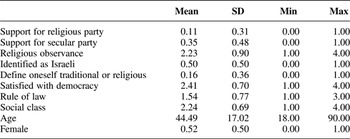
Finally, we include satisfaction with democracy and demographic characteristics as control variables. Satisfaction with democracy is measured by a four-point scale ranging from (1) very dissatisfied, (2) dissatisfied, (3) satisfied, and (4) very satisfied with the way Israeli democracy functions. Demographic control variables measure respondents' subjective social class, age, and sex. Subjective social class ranges from (1) low, (2) medium, (3) medium-high, to (4) high. Age is measured by respondents' actual age in years. Sex equals one if respondents are female and zero otherwise. Descriptive statistics of all explanatory variables are reported in Table 2.
Summary statistics of the explanatory variables

Note: The number of observations is 891. Summary statistics are computed for the sample used in the analysis of mass attitudes on religious laws in Table 3. The data come from the 2009 Israel National Election Study.
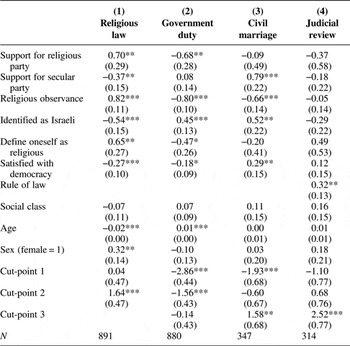
The regression estimates with standard errors in parentheses are reported in Table 3. Our dependent variables are ordinal measures; thus, we estimate a series of ordered logit models. Column 1 of Table 3 reports the results for the attitudes toward the relative importance of democratic rules and Jewish religious law. The dependent variable is measured by the three-point scale where one denotes support for the dominance of democratic rules, while three denotes support for the dominance of Jewish religious law. Two on the scale denotes “sometimes democracy, and sometimes Jewish religious law.” Most explanatory variables are estimated to have a statistically significant relationship with this dependent variable. In particular, the positive coefficients associated with support for a religious party and religious observance indicate that those who support a religious party and observe the religious traditions strictly are more likely to support the position that “keeping Jewish religious laws should prevail in every situation.” In contrast, the negative coefficient associated with support for a secular party indicates the opposite: supporters of the secular parties are more likely to say “preserving democracy should prevail in every situation,” as compared to their peers who support secular status quo parties. These findings provide support for Hypothesis 1.
Estimation results for mass attitudes on four issues

Note: Table entries are regression coefficients with standard errors in parentheses. The data come from the 2009 Israel National Election Study. *p < 0.10, **p < 0.05, ***p < 0.01 (two-tailed tests). The number of observations in models 3 and 4 is lower that for models 1 and 2 because the questions related civil marriage and judicial review were not included on each edition of the survey instrument.
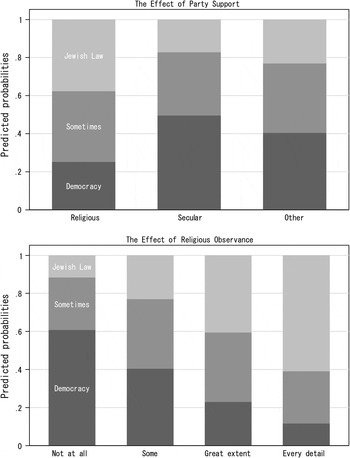
To interpret the substantive impact of party support and religious observance, we compute the predicted probabilities of choosing the three response categories in the outcome variable. First, we compute the probabilities by party support. The results are presented in Figure 1. All other variables are held constant at their medians. According to the top panel of Figure 1, the probability that religious party supporters choose the dominance of democratic rules is predicted to be 0.25, while the probability that secular party supporters support this is predicted to be 0.49. Thus, the former is about half as likely to support the dominance of democratic rules as compared to the latter. In contrast, the predicted probability that religious party supporters choose the dominance of Jewish religious laws is larger by 0.20 than the predicted probability that secular party supporters do. The pattern in the predicted probabilities for those who support other parties or none of them is similar to those who support secular parties.
Predicted probabilities of mass attitudes on religious law. Note: The predicted probabilities are computed by using the estimation results in Table 3. All other variables are set at their medians.

The bottom panel of Figure 1 shows the predicted probabilities of mass attitudes toward Jewish religious law when the scale of religious observance changes from the minimum to the maximum. The predicted probabilities of choosing the dominance of Jewish religious law increase from 0.1 to 0.6 when we compare those who do not observe the tradition at all and those who observe the every detail of the tradition.
Column 1 of Table 3 also demonstrates that respondents who identify as religious are more likely to support religious law. There are also some interesting results for the control variables. Those who identify themselves as Israeli, feel satisfied with democracy in Israel, and are older tend to choose the dominance of democratic rules, while female respondents tend to choose the dominance of Jewish religious law. Social class has no statistically significant relationship with the dependent variable.
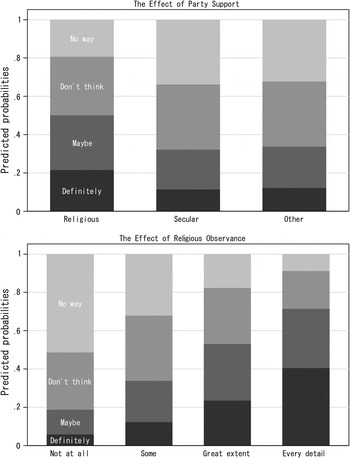
Column 2 of Table 3 reports the results for mass attitudes toward whether the government should ensure that public life is conducted according to Jewish religious tradition. The attitudes are measured by the four-point scale from “definitely,” “maybe,” “don't think so,” to “no way” that the government has such duty. The negative coefficients associated with support for a religious party, religious observance, and identification as religious in column 2 indicate that those who support a religious party, observe the religious tradition strictly, and identify as religious are more likely to support the option that the government should intervene in the public life so that it is conducted according to religious tradition. Here again, these findings support Hypothesis 1. The top panel of Figure 2 reports the predicted probabilities, showing that religious party supporters are more likely to choose “definitely” and “maybe” by 0.18 point, as compared to secular party supporters or others. The bottom panel of Figure 2 shows that the probabilities that “definitely” and “maybe” are chosen increase by 0.2 to 0.3 point as the degree of religious observance changes from the minimum to the maximum level.
Predicted probabilities of mass attitudes on government duty. Note: The predicted probabilities are computed by using the estimation results in Table 3. All other variables are set at their medians.

The coefficients for sex and social class do not emerge as significant. However, the other control variables provide interesting results. Identification as Israeli places a national, secular identity above identification as Jewish, religious, or ethnic. Those who affirm this secular identity are more likely to reject the idea that the government has a duty to promote Jewish tradition in public life. However, those who are satisfied with Israeli democracy, for all of its complications, more likely to support the promotion of Jewish traditions in public life.
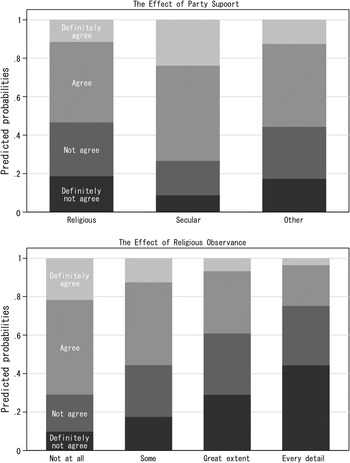
Column 3 of Table 3 reports the estimated results for the mass attitudes on civil marriage. The attitudes are measured by the four-point scale, where higher values denote higher support for institution of civil marriage in Israel. As expected, party support and religious observance are shown to have a significant relationship with the attitudes on civil marriage. As Hypothesis 2 anticipates, we find a positive relationship between support for a secular party and civil marriage. On the other hand, strict religious observance is negatively associated with support for civil marriage. The top panel of Figure 3 demonstrates that there is about 0.13 point difference in the probability of choosing “definitely agree” on the idea that civil marriage is instituted between supporters of religious and secular parties. The similar substantive effect is found when the degree of religious observance changes from the minimum to the maximum. Self-identification as religious is not significant.
Predicted probabilities of mass attitudes on civil marriage. Note: The predicted probabilities are computed by using the estimation results in Table 3. All other variables are set at their medians.

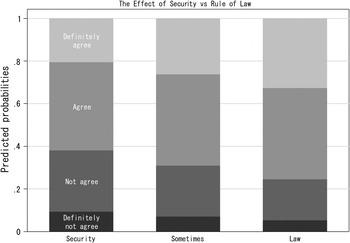
Column 4 of Table 3 reports the results for the attitudes on the role of the Supreme Court and judicial review. The attitudes are measured by the four-point scale ranging from “definitely do not agree” to “definitely agree” that the Supreme Court should have the authority to overturn a law passed by the Knesset. In contrast to the findings in Columns 1–3, neither party support nor religious observance is estimated to have a statistically significant relationship with the dependent variable. Thus, Hypothesis 3 is not supported. Instead, respondents' attitudes on the dominance of the rule of law are positively associated with the dependent variable: those who indicate that the rule of law should prevail in situations where its preservation is in conflict with national security interests tend to agree that the Supreme Court should have the power of judicial review. Figure 4 shows that the difference in the probability of supporting the authority of the Supreme Court is 0.15 between those who prioritize national security or the rule of law. This is consistent with the findings of Caldeira and Gibson (Reference Caldeira and Gibson1992) who find that, in the case of the United States, support for the rule of law translates into higher levels of support for the national high court (but see Gibson and Caldeira Reference Gibson and Caldeira2003).
Predicted probabilities of mass attitudes on judicial review. Note: The predicted probabilities are computed by using the estimation results in Table 3. All other variables are set at their medians.

The lack of a relationship between religious attitudes and views on the role of the Supreme Court is contrary to our expectations, but may be attributable to one or several of the following explanations. First, the survey question we used to examine religious-based attitudes toward the Supreme Court may not prime the secular-religious cleavage for survey respondents. Judicial review allows courts to serve as veto-players, reigning in the elected government and acting as protectors of minority interests. In this sense, they have the potential to be “minoritarian” (Gibson Reference Gibson2007) because they are empowered to render authoritative decisions that trump those enacted by officials duly elected by the people. The fundamental tension invoked by the question about judicial power, therefore, is likely to be the divide between those that view judicial review as antidemocratic and those that view it as necessary for the prevention of abuses of power by legislative majorities. If this is the salient dimension upon which respondents split, the division likely works against our hypothesis. Secular Jews have historically supported legislative supremacy and the power of judicial review undermines the power of the Knesset. Indeed, Ben-Gurion himself might have objected to judicial review as a threat to what he characterized as “mamlachtiut,” or legitimacy and authority of the state (Dowty Reference Dowty1998).
Second, our hypothesis suggested that religious Jews would perceive the Supreme Court as a clear threat to the authority of the Rabbinical Courts or to religion in general. The Rabbinical Courts are bound by the rulings of the high court but the Orthodox and Haredi communities have been systematically excluded from service on the bench. According to Sandler, Freedman, and Telhami (Reference Sandler, Freedman and Telhami1999, 140) these characteristics of the Supreme Court make it a threat to the “Jewishness'' of the state in the eyes of the Ultraorthodox. It is difficult to determine how widespread this attitude is or how pervasive we should expect it to be. Sitting as the High Court of Justice, the Supreme Court hears over a thousand petitions each year (Israel Ministry of Foreign Affairs 2012). We are unable to ascertain what portion of the court's docket is comprised of cases with religious significance. If the attention paid to religious issues by the court is low and observant Jews do not find most of the court's outputs objectionable, it may be the case that religious Jews do not perceive the Supreme Court as a central site of religious- secular conflict in Israel. If religious Jews do not perceive the Supreme Court as a threat in a general sense, then religious respondents attitudes toward the Supreme Court ought to be shaped by non-religious attitudes.
Third, attitudes toward the Court and its use of judicial review may not divide Israelis on the religious secular dimension. We expected that as the Court became more active vis-à-vis religious issues that it would alienate the religious community. It is possible, however, that both communities still question the legitimacy of a robust court, as they did in the early years of the state. Basic Law: Freedom of Occupation, for example, was amended in 1994 to allow the Knesset to pass regular laws in contradiction with the Basic Law. The “amendment was designed to overcome a Supreme Court ruling that the Knesset passed law forbidding the import of non-Kosher meat is incompatible with the Basic Law” (Don-Yehiya Reference Don-Yehiya1999b, 96), and it was supported by legislators on the left and right. By contrast, the United States Supreme Court is considered a legitimate arbiter of First Amendment issues, even though tremendous disagreement exists with respect to specific decisions (Don-Yehiya Reference Don-Yehiya1999b). No such tradition of Supreme Court legitimacy exists in Israel. This suggests that Israel's “constitutional revolution” is still in its infancy.
CONCLUSION
We are reminded of Henry Kissinger's observation that “Israel has no foreign policy; it has only a domestic policy.” The policy challenges commonly associated with Israel implicate foreign policy, but Kissinger's point is that Israeli foreign policy is shaped by competing domestic interests rather than a realistic pursuit of national interest. We agree with the centrality this observation places on domestic politics, and in this article we investigate whether and how domestic politics are shaped by competing socio-cultural groups that identify with different expressions of religion. Whereas religious ethos implies a broad conception of religious identity that accommodates secular members of the religious community, associational religion entails a more narrowly defined, orthodox conception of religious identity mediated by institutions and mandated rituals. Israel was structured based on compromises between these camps within Jewry. This has produced a domestic politics rife with persistent conflicts among Israeli Jews over the relationship between religion and the state.
We identify three salient issues — the status of Jewish laws and traditions, civil marriage, and judicial review — and consider whether attitudes on these issues are affected by identification with the main cultural camps. We include multiple indicators of the level of identification with associationalism and ethos in our models. We consistently find that religious observance and defining oneself as religious or Haredi are positively related to support for the privileged position of religion in political and social life. Support for religious parties is positively related to support for the precedence of religion in public life and the government's duty to promote this; support for secular parties is negatively related to support for religious privilege with respect to marriage. Our religious indicators do not appear to affect support for judicial review, and we think that may be because secular and religious Jews alike traditionally support legislative supremacy.
The results highlight the utility of viewing domestic political competition through the lens of socio-cultural, group-based politics. To be sure, Israel is a diverse country that cleaves on the basis of nationality, ideology, and ethnicity. Likewise, we find that the intra-religious cultural cleavages present at the founding are still operative today. Whatever threats Israel faces from abroad, there is still robust disagreement among Israeli Jews about what it means to be a Jewish state. Fortunately, Israel's consociational polity is designed to cope with and govern this kind of society. Some have suggested that the growth of the Haredim and the fusion of ultra-nationalism with a segment of the Haredi community threaten the longstanding, delicate accommodation between religious and secular Jews in Israel (Dowty Reference Dowty1998). We believe, however, that religion and the state have a peculiar and unsettled relationship, but not an unstable relationship. The state struggles with the implications of being a Jewish democracy, but it is unlikely to renounce either aspect of its identity.
Moving beyond Israel, it would be useful to consider whether mass attitudes on church state issues in other democratic contexts are structured by the associational-ethotic dimension. We suspect they are, irrespective of whether states ensure support for religion or strict separation. Previous research has emphasized the importance of religiosity, but the associational-ethotic dimension may be better suited to explain differences among religious populations. It may also account for the connection that some make between their religious and national identities. We expect that whether a state has a majoritarian or consociational polity is a key variable that mediates how each expression of religion finds representation in the political system. In consociational polities, different religious communities are more likely to have an institutionalized foothold on the policy process. In majoritarian polities, they are more likely to be excluded. A comparison of the Republic of Ireland and Northern Ireland provides a useful illustration of this.
Neither state has an established church, per se, but both provide support for religious institutions such as schools. The Republic is predominantly Catholic. This is reflected in the party system, where the two main parties (Fine Gael and Fianna Fáil) are both center-right and traditionally aligned with Catholic teaching. In Northern Ireland, Catholics and Protestants exist in rough numerical parity, and the party system is organized on the basis of ethno-religious identities. As the Republic has grappled with religiously salient issues such as civil unions for same sex couples or the legalization of divorce, the distinction among ethotic versus associational Catholics may explain how policy has developed. Catholics who have internalized a narrow, associational understanding of their religion may be uncomfortable with policies that disassociate Catholic orthodoxy from public policymaking. Because ethotic Catholics are less likely to link their Irishness with their Catholicism, they might be more willing to accommodate secular norms in the policy arena. The same is almost certainly true in Northern Ireland, but because Northern Ireland has more of a consociational polity, a wider variety of political and religious perspectives are ensured representation. As a result, policies that challenge religious orthodoxy are more likely to find advocates in the party system and be considered legislatively. In the Republic, these kinds of issues are less likely to find champions in the party system. Lacking an avenue into the legislative policymaking arena, these kinds of issues are often considered by national popular vote (McGraw Reference McGraw2008).
Whether the associational-ethotic dimension applies in other democratic contexts is an open, empirical question that merits further investigation. We hope to contribute to generalizable theories that explain mass attitudes on church state relationships, and this initial focus on Israel has provided a promising start. As in any democracy, Israel routinely considers whether and to what extent religion should be privileged in the public sphere. The majority Jewish population is divided on this question. And again, we find that the distinction between ethotic and associational expressions of religion clarifies how attitudes on these issues are structured.