Every content word in English has at least one stressed syllable. A stressed syllable is longer, louder, and higher in pitch than an unstressed one. Sensitivities to stress appear early in infancy. That is, infants aged between 0 ; 1 and 0 ; 4 can detect changes in the rhythmic patterns of alternating Strong-weak (Sw) syllables (Jusczyk & Thompson, Reference Jusczyk and Thompson1978). A trochaic bias (Sw) is demonstrated at age 0 ; 9 by English-learning infants, but this bias is not observed at age 0 ; 6. This suggests that infants orient to the predominant stress pattern of the target language between these ages (Jusczyk, Cutler & Redanz, Reference Jusczyk, Cutler and Redanz1993; Echols, Crowhurst & Childers, Reference Echols, Crowhurst and Childers1997).
Infants' developmental sensitivities to stress suggest it is a salient property that can be used in the early stages of word learning – specifically in the segmentation of word forms (e.g. Curtin, Mintz & Christiansen, Reference Curtin, Mintz and Christiansen2005; Johnson & Jusczyk, Reference Johnson and Jusczyk2001; Jusczyk, Houston & Newsome, Reference Jusczyk, Houston and Newsome1999). It has also been demonstrated that lexical stress is encoded in the word-form representations of newly segmented sequences in infants as young as 0 ; 7 (Curtin et al., Reference Curtin, Mintz and Christiansen2005). Moreover, in a word–object associative learning task, infants aged 1 ; 0 were able to learn two new words that differ primarily in the stress pattern (e.g. beDOka and BEdoka) when paired with two novel objects (Curtin, Reference Curtin2009). In this case, infants had to rely on the stress differences in order to learn the pairing. Stress has also been shown to be beneficial for detecting phonetic contrasts in familiar words. Infants aged 0 ; 11 detect minimally distinct sounds in stressed syllables (Vihman, Nakai, Depaolis & Hallé, Reference Vihman, Nakai, Depaolis and Hallé2004), but not in unstressed ones (Hallé & de Boysson-Bardies, Reference Hallé and de Boysson-Bardies1996). However, if the words are novel, infants aged 0 ; 10.15 can detect segmental changes in weak syllables (Johnson, Reference Johnson2005).
In all of these studies it was necessary for infants to attend to the stress pattern in order to use that information to either segment words, learn the mapping between novel words and objects, or to detect contrasts. Perhaps stressed and unstressed syllables are encoded differently and access to information contained in the various syllables depends on this situation. The current study tests whether infants aged 1 ; 0 store and access lexical stress in their representations of newly learned words when this information is not necessary for distinguishing between forms.
EXPERIMENT 1
We began by teaching infants a single word–object pairing after which infants are presented with the correct pairing (Same trial) and two incorrect pairings (Switch trials). In one Switch trial (Segment Switch), the familiar object is paired with a novel form that differs in segments but shares the same stress pattern as the familiar word. In the other Switch trial (Stress Switch), the familiar object is paired with a novel form that has the same segments as the familiar word but the stress pattern is altered. If infants detect the incorrect pairings, then they are: (i) recognizing the correct word–object pairing and (2) distinguishing between mismatches in the pairings. This will suggest that they are forming the linkage and storing the stress information.
Methods
Participants
Twenty-six infants aged 0 ; 1 (M=1 ; 0.16, SD=14 days) from monolingual English homes successfully participated in this study. An additional fourteen infants were tested but excluded from the analysis due to the following reasons: failure to habituate (n=6), experimenter/equipment error (n=4), and fussiness (n=4). Infants were randomly assigned to one of four groups for counterbalancing purposes. Participating infants were given an ‘Infant Speech Scientist’ T-shirt.
Stimuli
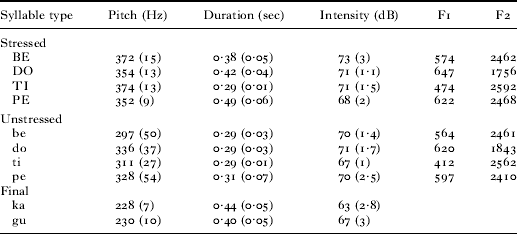
Trisyllabic word forms with differing trochaic stress patterns were recorded by a female native speaker of English. The stimuli consisted of BEdoka (/bédoka/), TIpegu (/típegu/), beDOka (/bedóka/), and tiPEgu (/tipégu/) (capital letters indicate stress). All syllables contained full vowels (i.e. no reduced vowels occurred in unstressed syllables). There were no significant differences (ps>0·1) between the vowels in the stressed and unstressed syllables as determined by their first and second formants (see Table 1). Stress was assessed by pitch, duration, and intensity differences. Stressed syllables differed significantly from their unstressed counterparts in pitch (F(1, 62)=29·46, p<0·001) and duration (F(1, 62)=89·09, p<0·001), but not in amplitude (F(1, 62)=1·78, p=0·187). As is typical for English, the final syllables (always unstressed) were longer than syllables that occurred in initial or medial position. The average acoustic measurements for the stressed and unstressed syllables are presented in Table 1.
Average acoustic measurements of auditory stimuli (standard deviation in parentheses)
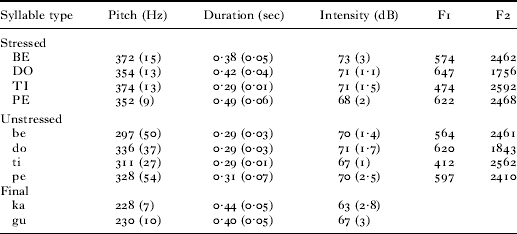
note: Vowel formants (F1 and F2) are averaged across all tokens of stressed and unstressed syllables.
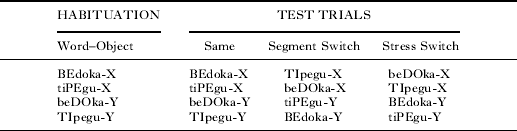
Infants were habituated either to BEdoka, tiPEgu, beDOka, or TIpegu, and the pairing with objects was counterbalanced.
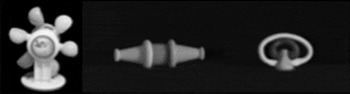
Each habituation and test trial consisted of eight exemplars repeated twice with a 1·5 s silent interval between exemplars, resulting in audio files of 20 s in duration, one for each word. Each novel word was associated with a novel object (see Figure 1).
Objects used in experiments.

Apparatus
Testing took place in a 2·74 m by 1·82 m quiet room. The infant sat on the parent's lap facing a Smartboard monitor (122 cm wide×91·5 cm high) mounted on the wall that was approximately 1·5 m away. Images were projected onto the Smartboard via a NEC LT245 projector. The audio stimuli were delivered at 65 dB, ±5 dB, over a BOSE 101 speaker, located directly below the monitor. The infants were recorded using a Sony DCRDVD92 digital video camera. The parent wore Bose True Noise-cancellation Headphones over which vocal music was played from a Teac CD-P1250 CD player. The experiment was run on a Macintosh Power PC G5. Habit X 1.0 (Cohen, Atkinson & Chaput, Reference Cohen, Atkinson and Chaput2004) was used to order stimuli presentation and collect looking time data. In an adjacent testing room, the experimenter, who was blind to the audio stimuli and to whether a trial was a habituation or test trial, monitored the infant's looking times via a closed-circuit television system. A designated key was pressed on the computer keyboard during infant looks, which the Habit X 1.0 program recorded. The video record was used for subsequent frame-by-frame reliability coding.
Procedure
We used a modified version of the ‘Switch’ task (Werker, Cohen, Lloyd, Casasola & Stager, Reference Werker, Cohen, Lloyd, Casasola and Stager1998). Infants were habituated to a single word–object pairing, and then tested on their ability to detect a switch in the pairing. Each trial began when the infant fixated on a movie of a flashing red light. Infants were first presented with a pretest stimulus, the label munepo (all syllables were equally stressed) paired with a waterwheel (Figure 1). At the end of experiment, infants were once again presented with the waterwheel paired with munepo. If infants were still engaged in the experiment, looking time should recover to near pretest level during this final trial.
After the pretest, each subsequent habituation trial had an object (Figure 1) presented on the screen with an accompanying novel label (see Table 2). Each block consisted of four trials and there was a maximum of six blocks.
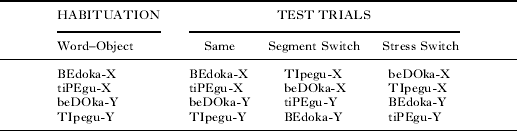
note: All test trials were presented in randomized order.
Looking time was calculated on-line, and when the average looking time across a four-trial block decreased to the pre-set criterion (65%), the habituation phase ended. Infants participated in a minimum of eight and a maximum of twenty-four habituation trials.
Following habituation, infants were presented with three test trials. On one test trial, infants heard the same word–object pairing presented during habituation (Same Trial). On a second test trial, infants saw the same object presented during habituation paired with an incorrect word (Segment Switch). Importantly, this word shared the same stress pattern but differed in the segments (see Table 2). This trial allows us to test whether infants encode the Strong-weak-weak syllable pattern (Sww) without the segmental information. For example, if infants are habituated to BEdoka and if the looking time to the Switch trial TIpegu does not differ from the Same trial then it is possible that infants only attend to the rhythmical pattern and ignore the segments. On the third test trial, infants were presented with the familiar object paired with the correct segments, but with a new stress pattern (Stress Switch). This trial was used to determine whether infants detect the incorrect stress pattern or whether they accept it as the correct label. If infants ignore stress, since it is not necessary for learning the word–object mapping, then they should not treat this test trial differently from the Same trial. The order of presentation of the test trials was randomized across participants.
Results and discussion
To determine whether infants maintained interest throughout the experiment and recovered from habituation, we compared looking times during pretest to looking times during the post-test. There was no significant difference between the pretest and post-test (p>0·05). We next compared the post-test trial to the last habituation block. A 2 (trial: post-test vs. last habituation block) by 4 (word group: BEdoka, beDOka, TIpegu, tiPEgu) ANOVA revealed significant differences between the post-test and last block of habituation looking times (F(1, 22)=462·82, p<0·001; ηp2=0·955), with the infants looking longer to the post-test (M=18·35, SD=1·95) than to the last block of habituation trials (M=8·5, SD=2·06). There were no group differences (F(3, 22)=1·53, p=0·23; ηp2=0·173). These analyses indicate that infants maintained interest and recovered from habituation. The average number of trials for habituation was 14·77 (SD=4·34) and 96% of infants habituated by the 5th block (320 tokens of the same word–object pairing block).
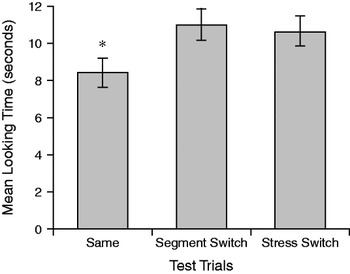
A 3 (test trials: Same vs. Segment vs. Stress) by 4 (word group: BEdoka, beDOka, TIpegu, tiPEgu) mixed ANOVA revealed significant main effects for the within-subjects factor of test trial (F(1, 22)=7·74, p=0·01, ηp2=0·26), but no difference for the between-subjects factor of group (F(3, 22)=0·916, p=0·449, ηp2=0·111), and no significant interaction. Planned comparisons of the different trials, Same (M=8·42, SD=4·05), Segment Switch (M=11·02, SD=4·11), and Stress Switch (M=10·65, SD=4·32) revealed that infants looked longer at the Segment Switch trials and the Stress Switch trials than at the Same trial. A significant effect of trial type (t(25)=−3·01, p=0·011; t(25)=−2·34, p=0·028; Same vs. Segment Switch and Same vs. Stress Switch, respectively) was obtained (see Figure 2).
Infants aged 1 ; 0's looking times for Same, Segment Switch, and Stress Trials.Footnote 1

Infants in this experiment looked longer to both of the Switch trials compared to the Same trial. This suggests that infants aged 0 ; 1 do not encode just the stress pattern since the switch in segments resulted in longer looking times. This further suggests that infants encode stressed syllables as different from their unstressed counterparts. That is, the ‘be’ in BEdoka is not the same as the ‘be’ in beDOka. Thus, infants are encoding the stress information of the word since they treat the label that differs primarily in stress as an inappropriate pairing. However, there is another possible explanation. To succeed at this task, infants only need to discriminate between the pairing they learned during habituation (e.g. BEdoka – Object X), a completely novel pairing (e.g. TIpegu – Object X), and a form with a novel stress pattern (e.g. beDOka – Object X). In other words, the same results might obtain if the object had been a checkerboard, a blinking light, or any other visual display.
If infants are only discriminating between familiar and novel items, then these results demonstrate that infants can detect the change in segments, where the item maintained the same stress pattern as the habituation item (Sww or wSw), and infants can detect a change in stress, where segmental information remained constant but the stress shifted (BEdoka>beDOka). Regardless of whether or not infants are actually treating this experiment as a word-learning task or a discrimination task, this finding suggests shifting the position of stress in a word changes the perception of that syllable. This provides partial support for the hypothesis that the representations of the newly learned words encode the stress information.
In order to ensure that infants are engaged in word learning, and that they are storing the stress information, even though it is not required for distinguishing between forms in this task, in the next experiment we taught infants aged 1 ; 0 two word–object pairings. If they detect mismatches in the pairing, this will provide support for the first interpretation of Experiment 1, namely, that infants form detailed representations of words.
Experiment 2
This experiment was designed to test whether infants in Experiment 1 were forming word–object linkages and not simply discriminating novel stimuli from a previously heard pairing. We tested two groups of infants aged 1 ; 0 on their ability to form two word–object pairings (Object Group) and their ability to detect a mismatch in the stress pattern (Stress Group).
Method
Participants
Fifty-two infants aged 1 ; 0 from monolingual English homes successfully participated in this experiment. The Object Group consisted of twenty-six infants (M=1 ; 0.12, SD=16 days) and the Stress Group consisted of twenty-six infants (M=1 ; 0.16, SD=15 days). Twenty-six additional infants were tested but excluded from the analysis due to failure to habituate (n=6), experimenter/equipment error (n=7), and fussiness (n=13). Infants were randomly assigned to one of the two groups. Participating infants received an ‘Infant Speech Scientist’ T-shirt.
Stimuli
The same stimuli were used as in Experiment 1.
Apparatus
The same apparatus as in Experiment 1 was used.
Procedure
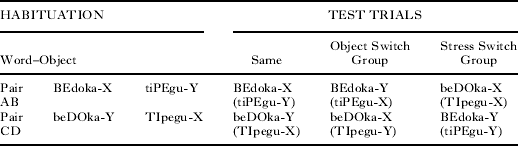
The same type of habituation paradigm used in Experiment 1 was used here, however, now infants were habituated to two novel word–object pairings. Both groups (Object and Stress) were habituated to two word–object pairs (see Table 3). Within each group, infants were presented with Pairing A (BEdoka and object X) and Pairing B (tiPEgu and object Y) or Pairing C (TIpegu and object X) and Pairing D (beDOka and object Y). Every block of four trials contained two instances of each word–object pairing presented in a random order (e.g. ABAB, ABBA, etc.).
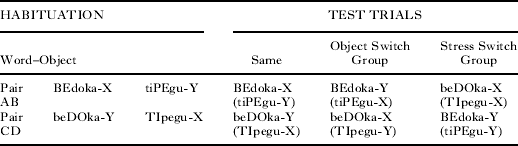
note: Items in brackets are alternative trials. The Same trials were identical for the Object and the Stress Switch groups. All test items were presented in random order.
The test phases for both groups included a Same trial (e.g. BEdoka – Object X) as in Experiment 1 (see Table 3). However, the Object group's Switch trial consisted of the incorrect pairing of a word and object (e.g. BEdoka – Object Y or tiPEgu – Object X). The Stress group's Switch trial consisted of the correct pairing, but the stress was shifted to the adjacent syllable (e.g. beDOka – Object X). All test trials were presented in randomized order.
Results and discussion
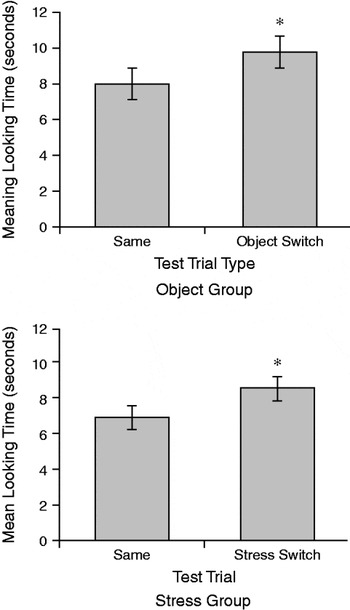
A 2 (trials: post-test versus last habituation block) by 2 (group: Object versus Stress) ANOVA revealed a significant effect of trials (F(1, 50)=290·91, p<0·001; ηp2=0·853), with the infants looking longer to the post-test (M=16·86, SD=3·51) than to the last block of habituation trials (M=7·69, SD=2·53). There was no interaction between groups and trials (F(1, 50)=2·27, p=0·138; ηp2=0·043). These findings demonstrate that infants were still engaged in the task across all group conditions. The infants in this experiment maintained interest and recovered from habituation. The average number of trials required for infants to habituate was 14·76 (SD=5·1) and 86% of infants habituated by the 5th block after hearing 160 tokens of each word–object pairing (360 tokens total).
A 2 (test trials: Same vs. Switch) by 2 (group: Object vs. Stress) mixed ANOVA revealed a significant main effect for the within-subjects factor of test trial (F(1, 50)=10·14, p=0·002, ηp2=0·169), but no effect of the between-subjects factor of group (F(1, 50)=1·25, p=0·268, ηp2=0·024), and no significant interaction. Infants looked significantly longer at the Switch trial regardless of which group they were in (Object Group: M same=8·04, SD=3·95; M switch=9·71; SD=4·7; Stress Group: M same=6·98, SD=3·42; M switch=8·64, SD=3·5). That is, infants looked longer to a mismatch between the object and the label, indicating that they formed the appropriate linkages between the novel words and their objects, and infants looked longer when the word had the incorrect stress pattern, suggesting they encoded the stress pattern (see Figure 3).
Looking times for Same and Switch trials for Object Switch and Stress Switch Groups.Footnote 2

These results suggest that infants as young as 1 ; 0 are learning the word–object pairings and that they are encoding information about which syllable contains stress. Taken together, Experiment 1 and Experiment 2 demonstrate that infants aged 1 ; 0 have detailed representations for these newly learned words.
General discussion
Infants are sensitive to word-level stress from very early on in development. They use stress information to segment words, learn about sound contrasts, and distinguish between words. Here, we asked whether stress information is also encoded in the representations of newly learned words and further whether stressed syllables are treated as different from their unstressed counterparts. Our findings provide support for the notion that infants form detailed representations of newly learned words. That is, infants store the stress information about the word and they do not treat stressed and unstressed versions of a syllable as the same.
Prior research examining the content of infants' representations for words has focused on infants' ability to detect mispronunciations of familiar words (e.g. Swingley & Aslin, Reference Swingley and Aslin2002; Fennell & Werker, Reference Fennell and Werker2003) or to learn minimal words differing in their segments (e.g. Stager & Werker, Reference Stager and Werker1997). Findings from these studies are complex in that age and task influence infants' ability to detect changes in the segments (or features). For example, when infants under 1 ; 5 are taught two minimally different novel words (e.g. bin and din) paired with two novel objects, they do not appear to detect a switch in the pairing (Pater, Stager & Werker, Reference Pater, Stager and Werker2004; Stager & Werker, Reference Stager and Werker1997; Werker, Fennell, Corcoran & Stager, Reference Werker, Fennell, Corcoran and Stager2002). However, if words are familiar or known, then infants as young as 1 ; 2 will detect minimal differences (Bailey & Plunkett, Reference Bailey and Plunkett2002; Fennell & Werker, Reference Fennell and Werker2003; Swingley & Aslin, Reference Swingley and Aslin2002). The context in which the relevant, phonetically similar contrast occurs may also be a factor in children's ability to succeed learning new associations. For example, Thiessen (Reference Thiessen2007) familiarized infants aged 1 ; 3–1 ; 4 to three word–object pairings: the novel word daw paired with a novel object, dawbow with another novel object, and tawgoo also paired with a novel object. Here, the infants heard ‘d’ in two different words and ‘t’ in one word. In one test trial, infants saw the appropriate pairing of daw with its object. In the mismatch trial, the daw object was inappropriately paired with taw. Simply by hearing the relevant contrast, in this case /d/ and /t/, in different lexical contexts helped infants to notice the mismatch in the pairing.
The majority of the evidence suggests that infants have fully specified representations of words (see Newman (Reference Newman2008) for a review), but that cognitive demands can affect access to this information (Werker, Fennell, Corcoran & Stager, Reference Werker, Fennell, Corcoran and Stager2002; Werker & Curtin, Reference Werker and Curtin2005). That is, infants will detect minimal differences if the test condition is simplified by presenting infants with both objects on the screen while hearing a label (Yoshida, Fennell, Swingley & Werker, Reference Yoshida, Fennell, Swingley and Werker2009), and if infants are provided with information about the referential status of the novel label either by presenting the label in a sentence context or with training (Fennell & Waxman, in press). The size of an infant's vocabulary can also influence success in detecting minimal differences. When an infant aged 1 ; 2 has a vocabulary comparable to that of one aged 1 ; 5, they can detect a switch in a pairing (Werker et al., Reference Werker, Fennell, Corcoran and Stager2002). These findings suggest that infants store the segmental/featural information about the words, but resource limitations due to the cognitive demands of the task may affect their ability to access this information (Werker et al., Reference Werker, Fennell, Corcoran and Stager2002).
It seems reasonable that infants would store segmental information since it helps distinguish between word forms and it helps with determining the phonemic inventory for the language. The current study examined whether infants store non-criterial information about the word form beyond what is needed to distinguish different forms. Contrasting words primarily using word-level stress (e.g. REcord (noun) vs. reCORD (verb)) is not a particularly productive process in English. Moreover, when this does occur there tends to be some quality changes in the unstressed vowel that help to further differentiate these forms. Nonetheless, word stress may still be useful for keeping stored items in the lexicon separated and maximally distinguished from one another.
The median number of words known by infants aged 1 ; 0 is six, with a range from 0–52 (Bates et al., Reference Bates, Marchman, Thal, Fenson, Dale, Reznick, Reilly and Hartung1994). This suggests that infants of this age have a fairly sparse lexicon. Lexical organization and the types of words contained within the lexicon have been shown to influence word learning. That is, low-probability words are learned at an earlier age than high-probability ones and short high-density words are learned at an earlier age than long low-density ones (Storkel, Reference Storkel2009). Moreover, infants aged 1 ; 5 learn low-probability, low-density non-words more readily than high-probability, high-density ones (Hollich, Jusczyk & Luce, Reference Hollich, Jusczyk, Luce, Skarabela, Fish and Do2002). We argue that in the early stages of word learning, infants encode a great deal of information about the word, since their goal is not to minimally distinguish between forms, but to learn words. Since their lexicons are sparse, keeping forms distinct is relatively easy. However, when young infants are faced with recognizing newly learned minimal pairs they have a difficult time (Stager & Werker, Reference Stager and Werker1997). This, coupled with the results of our current study, suggests that the more dissimilar forms are in novel word learning, the easier it is for infants to recognize differences.
It is quite possible, however, that infants in this study only store the stressed syllable (e.g. BE from BEdoka). If this is the case then when presented with beDOka at test the infant would detect that ‘DO’ is not the correct label for the object. Recent work suggests that this is not likely to be the case. Johnson (Reference Johnson2005) found that infants aged 0 ; 10.15 store information about unstressed syllables. That is, when infants were familiarized to passages containing nonsense iambic word forms (e.g. giNOME) and then tested on familiar (e.g. giNOME), near-familiar (e.g. piNOME), and unfamiliar (e.g. kiDAR) word forms, they oriented equally to the near-familiar and unfamiliar forms, suggesting that they had stored the details of the unstressed syllables. Additionally, Curtin (Reference Curtin2010) taught infants aged 1 ; 2 novel word–object pairings (e.g. Xyz) and then switched the position of the stressed syllable at test (e.g. yXz). If infants were only storing the stressed syllable, then switching the stressed syllable should not affect their looking times. However, this was not the case. Infants looked significantly longer when the stressed syllable was not in the correct position, suggesting they were storing more than just the stressed syllable.
In conclusion, our findings demonstrate that when infants as young as 1 ; 0 learn new word–object pairings, they encode all the phonological information about the word form, including lexical stress, suggesting rich representations. Stressed syllables and their unstressed counterparts are stored as separate, distinct forms even if they are segmentally equivalent. At the early stages of word learning, maximizing the distinctiveness between words – different stress patterns and different segments – perhaps helps to keep word forms separate in the lexicon, which helps to ease the task of recognizing new words. These findings further suggest that infants are not engaged in trying to find differences between words and only storing the meaningful differences. Rather, infants store all information in an exemplar-type fashion regardless of whether the information is used to distinguish between words.