Implications
There are currently few positive welfare indicators available for poultry, and the effect of environmental enrichment on the emotional state of commercially housed broilers is poorly understood. During this study, measures of fearfulness and the frequency of play-like behaviours offered insight into broiler emotional state when housed with various environmental enrichments. This paper describes a novel method of stimulating frolicking and sparring, which may be useful in investigating their potential as indicators of positive welfare. Further research is required to determine optimal levels and methods of enrichment for intensive broiler housing.
Introduction
Providing domestic fowl with environmental enrichment has been shown to improve leg condition, reduce fear reactions and increase activity levels (Reed et al., Reference Reed, Wilkins, Austin and Gregory1993; Kells et al., Reference Kells, Dawkins and Borja2001; Ventura et al., Reference Ventura, Siewerdt and Estevez2010). Conversely, a lack of environmental complexity can lead to low levels of activity and the frustration of highly motivated behaviours, such as dustbathing (Vestergaard et al., Reference Vestergaard, Skadhauge and Lawson1997; Kells et al., Reference Kells, Dawkins and Borja2001). Broiler chickens are typically raised without any environmental enrichment, however the growing demand for high welfare products has led to the development of more complex housing. These systems typically provide broilers with a combination of natural light, single-bar perches and/or straw bales. However, straw bales are primarily used by broilers as resting areas (Kells et al., Reference Kells, Dawkins and Borja2001) and traditional bar perches are poorly used (Bailie et al., Reference Bailie, Baxter and O’Connell2018). Recent research has found that broilers show a preference for platform perch designs (Bailie et al., Reference Bailie, Baxter and O’Connell2018), and that a dustbathing substrate can more successfully stimulate active foraging and dustbathing behaviours than straw bales (Baxter et al., Reference Baxter, Bailie and O’Connell2017). One aim of this experiment was to assess the effects of these preferred enrichments on broiler behaviour in a commercial house, and whether the presence of perches and/or dust baths would result in improved activity levels.
The provision of environmental enrichment can also induce optimism in animals, indicating a positive emotional or affective state (e.g. Douglas et al., Reference Douglas, Bateson, Walsh, Bédué and Edwards2012). Very little is known about the influence of environmental enrichment on broiler well-being, especially in terms of positive welfare. One way of investigating the experience of an animal is to measure behaviours associated with positive and negative states. Therefore, the other aim of this experiment was to measure the levels of fear and play-like behaviours exhibited by broilers in unenriched and enriched conditions, in order to better understand the effect of enrichment on broiler affective state. Fear is an emotional response to perceived danger and has been linked to poor performance and a higher risk of injury in poultry (Jones, Reference Jones1996). Chickens also appear to experience a negative emotional state when frightened and will avoid situations in which they may experience fear (Duncan and Filshie, Reference Duncan and Filshie1980). Provision of enrichments has been shown to reduce fear responses in chickens (Reed et al., Reference Reed, Wilkins, Austin and Gregory1993) which may represent an improvement in bird emotional state. Conversely, play has been identified as a positive welfare indicator in animals (Held and Špinka, Reference Held and Špinka2011). Play is considered to be an ‘opportunity behaviour’ that vanishes from the ethogram when conditions are poor, for example, if food becomes less available (Špinka et al., Reference Špinka, Newberry and Bekoff2001). Play has historically been defined as any ‘purposeless motor activity’ (Bekoff, Reference Bekoff1984). More recently, Burghardt (Reference Burghardt2005) suggested that play behaviour should be spontaneous, apparently self-rewarding, differing from the adult version of the behaviour, repeated in a non-stereotypical way, and occurring in the absence of severe stress. Complex play has been recorded in several avian species, particularly in corvids and parrots (Diamond and Bond, Reference Diamond and Bond2003). For domestic fowl, there has been little progress in identifying any play behaviours or investigating their potential use as welfare indicators. However, it has been tentatively suggested by several authors that sparring, frolicking and food-running contain features of play seen in other animals (Kruijt, Reference Kruijt1964; Mench, Reference Mench1988; Duncan, Reference Duncan1998; Cloutier et al., Reference Cloutier, Newberry and Honda2004).
Sparring is an immature version of adult fighting, in which birds act out components of adult aggression such as jumping, kicking and pecking, but without forceful contact or injury (Guhl, Reference Guhl1958). Sparring behaviours develop in young chicks several weeks before aggressive fighting is seen (Guhl, Reference Guhl1958; Dawson and Siegel, Reference Dawson and Siegel1967) and their frequency is not predictive of later aggression in broilers (Mench, Reference Mench1988). Consistent with resource sensitive play activities, the frequency of sparring also decreases in feed-restricted broilers while levels of aggression increase (Mench, Reference Mench1988; Girard et al., Reference Girard, Zuidhof and Bench2017). Although sparring in juveniles has been recently used as an indicator for aggression (e.g. Pettit-Riley et al., Reference Pettit-Riley, Estevez and Russek-Cohen2002), sparring was historically recorded as a distinct behaviour in fowl ethograms (Guhl, Reference Guhl1958; Dawson and Siegel, Reference Dawson and Siegel1967). Frolicking develops before sparring and is an apparently functionless behaviour in young fowl that is rarely seen after week 10 (Guhl, Reference Guhl1958; Dawson and Siegel, Reference Dawson and Siegel1967). When frolicking, chicks will perform a spontaneous burst of running, with wing-flapping and rapid direction changes (Guhl, Reference Guhl1958; Dawson and Siegel, Reference Dawson and Siegel1967). Frolicking resembles an escape reaction but without the apparent stimulus, and is a contagious behaviour, with one frolicking bird stimulating frolicking in others (Guhl, Reference Guhl1958). An increase in both frolicking and sparring was noted when there was a disturbance, for example, a loud noise or turning on the lights (Guhl, Reference Guhl1958; Dawson and Siegel, Reference Dawson and Siegel1967). Dawson (Reference Dawson1962) noted that there was an initial suppression of activity until the perceived danger (loud noise) had passed, and then an abrupt increase in frolicking and sparring. This is consistent with several species that show an increase in play following some environmental disturbance (reviewed in Špinka et al., Reference Špinka, Newberry and Bekoff2001). Food-running is a conspicuous behaviour that occurs when a chick picks up a rod or worm-like object and runs with it, making loud and repeated peeping noises (Kruijt, Reference Kruijt1964). Although food-running may appear to be related to food competition, it occurs even when chicks are raised in isolation, before any pursuing response develops (Kruijt, Reference Kruijt1964), when birds have ad libitum access to food (Rogers and Astiningsih, Reference Rogers and Astiningsih1991; Cloutier et al., Reference Cloutier, Newberry and Honda2004) and when chickens are given any rod-shaped non-nutritive material, such as pipe cleaners (Rogers and Astiningsih, Reference Rogers and Astiningsih1991; Cloutier et al., Reference Cloutier, Newberry and Honda2004).
There appears to be an increase in frolicking and sparring observed when chickens are disturbed (Guhl, Reference Guhl1958; Dawson and Siegel, Reference Dawson and Siegel1967) and when they have more space (Hughes and Wood-gush, Reference Hughes and Wood-Gush1977; Pettit-Riley et al., Reference Pettit-Riley, Estevez and Russek-Cohen2002). These results were supported anecdotally during pilot trials, where it was noticed that when an observer walked through the house, clearing the space behind them of broilers, the birds would run into this space and perform increased frolicking and sparring behaviours. It was therefore hypothesised that an experimenter walking through the birds would stimulate an increase in measurable play-like behaviours and that these activities may be influenced by the presence of enrichment.
Material and methods
Animals and housing
The study was conducted over three replicate 6-week production cycles on two commercial farms, between March and August 2016. Three matched houses on both farms were used. Approximately 22 500 Ross broiler chickens (Aviagen Ltd, Newbridge, UK) were placed as hatched in each house at the start of each cycle, giving an approximate 50 : 50 mix of males and females. The houses were standard 19×74 m metal framed sheds, with an average usable floor space of ~1361 m2. Their initial bedding material differed, with houses on Farm 1 bedded on straw pellets and houses on Farm 2 bedded on woodshavings. Additional woodshavings were distributed across the litter to maintain its condition were necessary on both farms. Natural light was provided through 24 windows with automated shutters along each side of the house. Artificial strip lighting was also provided throughout the cycle, following EU regulations (Council Directive 2007/43/EC). Temperature and humidity levels were automatically maintained to industry standards on both farms, with all houses heated using centrally controlled indirect heating systems. Both farms practiced partial depopulation of broilers at around day 30, where a portion of birds is removed for slaughter early. The remaining birds were removed for slaughter between days 32 and 42.
Treatments and experimental design
One house on each farm was allocated to each of three treatments: (1) platform perches (PP), (2) PP and dustbathing areas (PP+DB) and (3) control with no enrichment (C). Treatments were allocated to different houses in each of the three replicate production cycles on each farm, such that each treatment was applied to each house over the course of the experiment (Table 1). All enrichments were provided from day 7 of the rearing cycle. The PP treatment contained six ‘platform’ perches; three placed evenly along each long side of the house (Figure 1). The platform component of the perches was a plastic grid measuring 2.3×0.9 m, suspended in a cradle at the height of 20 cm above the litter. The PP+DB treatment contained six PP in matching locations to the PP treatment and four dustbathing areas placed along the central line of the house (Figure 1), in order to maximise the number of birds likely to use the dust bath (Baxter et al., Reference Baxter, Bailie and O’Connell2017). The dustbathing areas were contained within steel rectangles measuring 1×2.3 m, giving them a total available dustbathing area of 9.2 m2/house. The steel rectangle was 7.62 cm high and broilers were capable of climbing into the areas within the 1st week but were not able to perch on the edges. Each dustbathing area was filled with 160 l of moss-peat (two standard 80l bags; Better Growing Ltd, Dungannon, UK), to a depth of ~5 cm. Dustbathing areas were refilled by researchers twice a week throughout the study. Farmers also examined the dust baths daily and added additional peat once areas of the floor were visible and/or the peat was not considered friable enough for the birds to use.
(colour online) Broiler chickens housed in the platform perches and dust baths treatment (PP+DB). Platform perches (right) were placed along each long side of the house, in matching locations to the perches in the perches only treatment (PP). The dustbathing areas (left) were placed along the central line of the house in the PP+DB treatment.

Rotation of treatments presented to broiler chickens over three production cycles, on two farms

Birds were housed with either no enrichment (C), platform perches (PP), or platform perches and dust baths (PP+DB).
Measurements
Two researchers visited both farms twice a week during weeks 3, 4 and 5 of each cycle. All filming was performed using Camileo X-Sports (Toshiba, Surrey, UK) cameras, mounted on 1.5 m high wooden tripods. Filming of general activity and dustbathing areas took place between 0900 and 1300 h, filming of play behaviours took place between 1300 and 1500 h. All analysis of video footage was performed by the same observer.
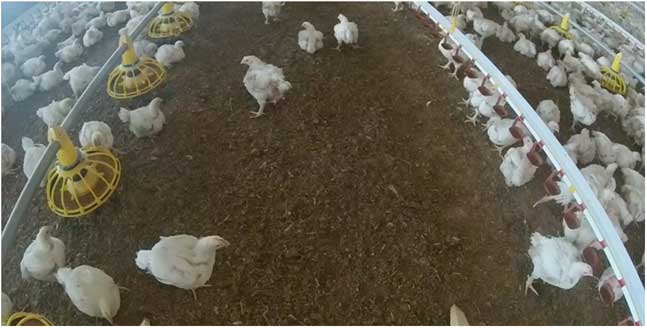
For play behaviours, footage was recorded on 1 day/week in four locations in each house. Aggressive behaviour was also recorded in these observations to monitor the frequency of aggression among broilers following a disturbance, and whether the prevalence of aggressive interactions changed over time. For the purposes of selecting random filming locations, the house was virtually split into 72 sections, using windows and feeder/drinker lines as natural markers, and categorised as either ‘central’ or ‘edge’. The sections chosen to be filmed each week were randomised using a number table, with the proviso that there were an equal number of edge and central locations. When cameras were positioned they were tilted towards the house floor in between a feeder and drinker line within the chosen section, ensuring a view of at least 2 m in front of the camera (see Figure 2 for an example of the camera view). It was impossible to observe an even number of areas around the house that were identically sized, due to the variation in distance between the feeder and drinker lines. The largest width between a feeder and drinker was 230 cm in central areas and the smallest was 130 cm in edge areas. However, these areas reflected the open space available in a commercial house and a balanced number of edge and central areas were chosen for observations. Once the observer had positioned the camera, they left the house and broilers were allowed to settle for 15 min. The observer then re-entered the house and walked directly in front of and away from the camera before turning back and returning to the camera. This displaced the birds and cleared a space a minimum of 5 m in length in front of the camera. The observer then left the house and each area was filmed for a further 15 min before cameras were placed in the next location. The three houses on each farm were filmed at roughly the same time; allowing for the walking distance between the houses there was ~5 min difference between the start of filming in each of the three houses. Footage was then analysed using all-occurrence sampling during the 5 min after the observer walk-through. The observation area consisted of the space between the feeder/drinker lines and a distance of 2 m from the tripod, which was identified on the screen as the distance between three feeder bulbs (Figure 2). With the difference in width between the feeder and drinker lines, depending on the location, this gave an observation area of 2.6 to 4.6 m2, which was considered during initial statistical testing. Any occurrences of sparring, frolicking, food-running or aggression were then scored in the 5 min following the birds being disturbed (Table 2). The time after the start of the test was noted for each behaviour and behaviours were grouped by the minute (e.g. behaviours performed in minute 1, minute 2) in order to determine whether birds were more likely to perform play behaviours immediately after being disturbed. Data for the four locations were averaged to give one score per house, per week, before analysis.
(colour online) An example camera view after broilers had been displaced by an observer walk-through. The observation area was between the neighbouring feeder and drinker lines, and a distance of 2 m from the camera, which was measured on the screen using the distance between three feeder bulbs (2 m).

Ethogram used to record broiler chicken behaviour

Adapted from Guhl (1958), Kruijt (1964), Mench (1988), van Liere (1991), Girard et al. (2017).
For dustbathing areas, two randomly chosen dust baths were filmed for half an hour each on 1 day/week. This gave a total of 1 h of footage per house per week. Videos were analysed using scan sampling. Six scans were performed per video, every 3 min after a 5-min settling period. The number of broilers in the dustbathing area and the number of broilers dustbathing was recorded (Table 2). The number of broilers dustbathing was then expressed as a percentage of the total number of broilers in the dustbathing area. The behaviour of broilers in unenriched areas was also recorded on 1 day/week. Two locations away from enrichments, one central and one edge location, were chosen randomly and filmed for half an hour in each house; giving a total of 1 h of footage per house. Broilers within a 2-m2 space in the centre of the footage, measured using an overlay on the screen, were included in observations. Scan sampling was used to record bird behaviour within this section. Three scans were performed for each video, at 10 min intervals following a 5 min settling period (at 5, 15 and 25 min). Broilers were categorised as dustbathing, foraging, sitting inactive, sitting pecking, locomotion (standing or walking), preening, resting or other (Table 2). Each behaviour was expressed as a percentage of the total birds in that scan observation, and scan samples in each location were averaged for a week. Broiler density in each scan sample was calculated to account for any variation in results caused by different numbers of birds being counted in each scan sample. For each instantaneous scan, the number of birds in the observation area was counted, and bird density was calculated as the total birds per m2 and averaged per week.
Fear responses were tested in week 5 of each cycle on one farm only, by the same observer, using an avoidance testing method (based on Graml et al., Reference Graml, Waiblinger and Niebuhr2008). In the PP treatment, one bird from four randomly chosen perches (n=4) and one bird from four random unenriched areas of the house (n=4) was assessed. In the PP+DB treatment, one bird from four randomly chosen perches (n=4), one bird from each of the four dustbathing areas (n=4) and one bird from four random unenriched areas was assessed (n=4). In the C treatment, one bird from four randomly chosen areas of the house was assessed (n=4). All unenriched areas were balanced for central and edge locations, with random number tables used to choose the locations. When selecting broilers for assessment, those on perches or in dust baths had to be more than 20 cm away from the edge of the enrichment, and birds in unenriched areas had to be at least 20 cm away from feeders and drinkers. Birds were then randomly selected by drawing an X on a Perspex sheet held in front of the area, as in Bailie and O’Connell (Reference Bailie and O’Connell2014). The observer slowly approached the chosen bird from a distance of ~5 m, with one hand held in front of the body. This initial distance, rather than 1.5 m as in Graml et al. (Reference Graml, Waiblinger and Niebuhr2008), was selected to avoid choosing a broiler that had been unable to retreat due to poor leg health (Vasdal et al., Reference Vasdal, Moe, de Jong and Granquist2018). At the point when the selected bird withdrew, a line in the litter was made at the toe of the observer’s boot, and the approximate distance between the experimenter and where the bird had moved from was recorded in centimetres using a measuring tape. ‘Withdrawal’ was defined as when the bird lifted its second foot.
Statistical analysis
All analyses were performed using IBM SPSS (Version 23). Overall there were only nine occurrences of aggression; four of these recorded in the C treatment, three in the PP+DB treatment and two in the PP treatment. No analysis was therefore performed on occurrence of aggressive behaviours. Total play behaviours included occurrences of frolicking, sparring and food-running. The residuals for total play behaviours were approximately normally distributed. There was no significant correlation between observation area size and the total play observed (r(53)=0.13, P=0.36). Cycle did not have a significant effect on the total play (P>0.05). The main and interaction effects of enrichment and age on the total play behaviours recorded were analysed using general linear mixed models with treatment and week as fixed factors and farm as a random factor. Separate analyses of frolicking and sparring behaviours were also performed using the same model. There were too few incidences of food-running to be included as a separate outcome variable (14 overall; 13 in the PP treatment and one in the PP+DB treatment). For the effect of time after the start of the test on the total play, the four locations in each house for all treatments were averaged to give the total incidences of a play performed per minute. A repeated measures ANOVA was then used to analyse the effect of time on the total play performed after birds were disturbed. This analysis was also performed within weeks to assess the effect of the week on the pattern of play after birds were disturbed. Where a Greenhouse-Geisser correction was applied, adjusted degrees of freedom are reported.
The total occupancy of dustbathing areas and percentage of birds dustbathing was analysed by week. Main effects of the week on total occupancy were analysed using a one-way ANOVA with week as a treatment factor. The percent of birds dustbathing showed non-normal distributions and heterogeneity of variance, neither were improved by transformation and a non-parametric Kruskal–Wallis test was applied to analyse the percent dustbathing by week. For behaviour in unenriched areas, the effect that treatment had on each behaviour was of interest and behaviours were modelled separately. Square root transformations applied where necessary to improve normality. Dustbathing and Other were infrequently recorded during scan sampling and were excluded from analysis. No behaviours (%) were significantly affected by the variables cycle, density and farm, P>0.05. Analysis of each behaviour was therefore performed using a GLM assessing the main and interaction effects of treatment and age.
Overall flight distance residuals were normally distributed, however equal variance could not be assumed. Due to the small sample sizes, non-parametric tests were used to compare differences between treatments and locations, with house or location as the experimental unit. Kruskal–Wallis tests were applied to test differences between fear responses from broilers in unenriched areas in the three treatments (PP, PP+DB, C; n total=36) and between the three locations in the PP+DB treatment (floor, dust bath, perch; n total=36). Comparisons between broiler fear responses on perches in the PP and PP+DB treatments (n total=24), and between the perches and the floor in the PP treatment (n total=24) were made using Mann–Whitney U tests.
Results
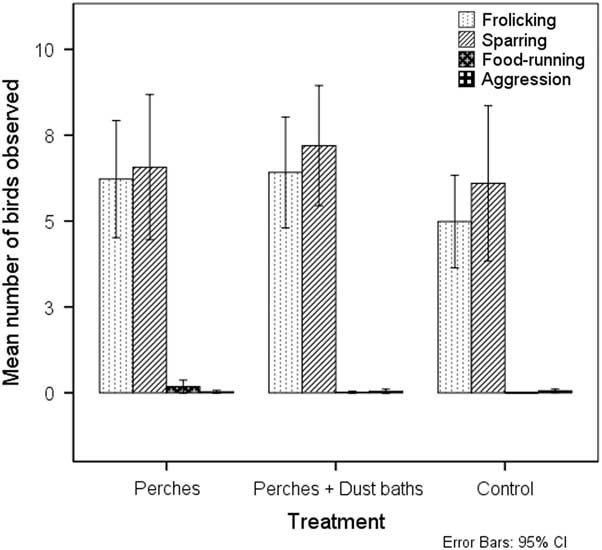
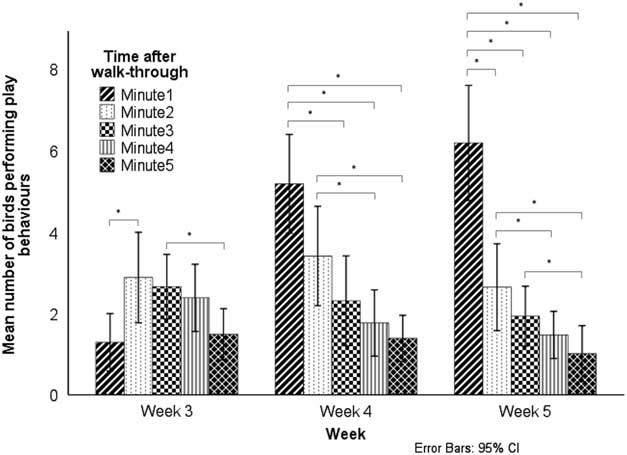
The play was observed in 93% of the videos (n=217). A total of 2701 episodes of play were observed across both farms: 1267 bouts of frolicking, 1420 broilers sparring and 14 broilers engaging in food-running. There was a significant effect of age on the total play behaviours performed (F 2,2=41.38, P=0.025), with the lowest average incidence of play behaviour (per 5 min test period) recorded in week 3 (week 3=10.61 ±5.39, week 4=13.96 ±7.31, week 5=13.15 ±6.91). Treatment did not significantly affect the average amount of play performed (P>0.05; PP = 12.97, PP+DB=13.63, C=11.13), and no type by week interaction was found (P>0.05). When analysed separately, levels of frolicking and sparring were both numerically lower in the control treatment than in both enriched treatments (Figure 3), however, there were no significant treatment effects and no significant interactions between treatment and age (P>0.05). There were also no significant age effects on the average incidence of frolicking per 5 min test period (week 3=5.20±5.83, week 4=5.96±5.43, week 5=5.72±4.51) or sparring (week 3=4.44±4.40, week 4=6.24±6.21, week 5=6.50±6.05). Play behaviours and aggression recorded are shown in Figure 3. Overall, the time after the initial walk-through had a significant effect on the total play observed (F 1.9,102.2=20.97, P<0.001), with higher average levels of play recorded immediately after birds were disturbed and then gradually declining (minute 1=4.19±3.10, minute 2=2.96±2.25, minute 3=2.28±2.78, minute 4=1.86±1.52, minute 5=1.29±1.26). Significantly more play was performed in minute 1 compared with minutes 3, 4 and 5 (P<0.05), and in minute 2 compared with minutes 4 and 5, and in minute 3 compared with minute 5. There were no significant differences between play performed in minutes 1 and 2, 2 and 3, or 3 and 4 (P>0.05). The time after broilers were disturbed also had a significant effect on level of play within weeks (week 3, F 4,68=4.54, P=0.003; week 4, F 2.39,40.68=16.71, P<0.001; week 5, F 1.74,29.60=36.19, P<0.001), however, the pattern of reducing play over time was only present from week 4 (Figure 4). In week 3, significantly less play was performed in minute 1 compared with minute 2.
Occurrences of play behaviours and aggressive interactions in broiler chickens recorded in the 5 min after they were disturbed by a walk-through

The mean number of broilers performing play behaviours (frolicking, sparring or food-running) in the 5 min after broiler chickens were disturbed by a walk-through, in weeks 3, 4 and 5 of the production cycle. * denotes significant difference between minutes (P<0.05).

Overall, an average of 58 (±17) broilers were counted using the dust baths, with an average of 73% (±26%) dustbathing. Week had no significant effect on mean dust bath occupancy (P=0.44; week 3=50.63±15.36, week 4=63.65 ±19.14, week 5=58.90 ±17.21). There was a significant effect of week on the percent of broilers dustbathing (H(2)=7.45, P=0.024); mean ranks, week 3=4.67, week 4=12.33, week 5=11.50. Pairwise comparisons showed an increase in dustbathing between weeks 3 and 4 (P=0.039), but no difference in % dustbathing between weeks 3 and 5 or 4 and 5. There were no effects of treatment on any behaviours observed in unenriched areas of the house, however age had a significant effect on the percentage of broilers foraging, in locomotion and sitting inactive (Table 3). No incidences of play were recorded during the scan samples. Post hoc tests revealed significantly more birds were foraging and in locomotion (standing or walking) in week 3 compared with week 4 and 5 (P<0.05). Conversely, significantly fewer birds were sitting inactive in week 3 compared with weeks 4 and 5 (P<0.05).
The effects of treatment and age on the percentage of broiler chickens performing different behaviours in unenriched areas of the house

CI, confidence intervals.
Post hoc tests were performed where age effects were significant and are outlined in the results section.
1 Data were transformed before analysis, means and CI have been backtransformed to their original scale.
*** P<0.001.
Treatment significantly affected the flight distance of broilers in unenriched areas of the house (H(2)=7.27, P=0.026), with pairwise comparisons showing broilers had a shorter flight distance, and could be considered less fearful, in the PP+DB compared with the C treatment (P=0.033; mean ranks: PP+DB=14.17, PP=16.25, C=25.08; average flight distances presented in Table 4). However, there were no significant effects of location, that is, whether birds were on the floor or a perch/in a dust bath, on flight distance in either the PP or PP+DB treatment (P>0.05). There was also no effect of treatment on flight distance of birds on perches in the PP compared with the PP+DB treatment (P>0.05).
Median withdrawal distance (cm) of broiler chickens from an approaching observer, in houses containing either no enrichment (control; C), perches (P) or perches and dust baths (P+DB)

CI, confidence intervals.
Withdrawal distances were measured in birds in unenriched areas of all treatments, on perches in the P and P+DB treatments, and additionally in dust baths in the P+DB treatment.
Discussion
The main aims of this paper were to explore the effect of increasing environmental complexity on broiler emotional state, measured through levels of play and avoidance behaviours, and whether these enrichments would additionally have an impact on activity levels away from enrichments. Our results suggest that disturbing and displacing the broilers was effective in stimulating certain play behaviours, however the presence of these environmental enrichments did not significantly influence the level of play observed. Levels of sitting inactive in unenriched areas of the house were also not affected by the presence of PP and dust baths, however, broilers showed reduced avoidance behaviour when housed with both types of enrichment compared with the barren control.
The novel method of disturbing broilers described in this trial appeared to be successful in stimulating sparring and frolicking, with play being performed in 93% of the videos (n=217). This is consistent with previous studies that report an increase in play following some disturbance to the animal’s environment (reviewed in Špinka et al. Reference Špinka, Newberry and Bekoff2001). Specifically for poultry, birds also appear to need a large amount of space to perform sparring behaviours (Hughes and Wood-Gush, Reference Hughes and Wood-Gush1977; Pettit-Riley et al., Reference Pettit-Riley, Estevez and Russek-Cohen2002). Higher levels of frolicking and sparring were observed immediately after the observer walk-through in the present study, with the frequency of these behaviours gradually reducing over time. No play behaviours were observed at all during scan samples of unenriched and undisturbed areas of the house. Although frolicking and sparring may be infrequent in undisturbed areas, it is also likely that scan sampling is an inadequate method of observing these short behaviours. Food-running was only observed on five occasions throughout this study, involving 14 birds in total. No specific artificial stimulus was offered in this study to elicit food-running, which has been easily stimulated by previous authors using mealworms and pipe cleaners (Rogers and Astiningsih, Reference Rogers and Astiningsih1991; Cloutier et al., Reference Cloutier, Newberry and Honda2004). The observer walk-through, therefore, appears to be a useful method of observing frolicking and sparring only, with additional stimulus needed to provoke food-running.
We found no statistically significant effect of providing enrichments on the total amount of play being performed, or on the level of each individual type of play. However, more play was observed in the enriched treatments compared with the control. There was also no effect of treatment on broiler activity levels in unenriched areas. Measures of leg health were also taken during this study and have been published elsewhere (Bailie et al., Reference Bailie, Baxter and O’Connell2018); these measures were similarly unaffected by treatment. This indicates that any differences in play behaviour were unlikely to be related to physical ability in this study. There has been very little research conducted on the frequency of play behaviours in chickens in different conditions; however these results contradict a previous finding reported by Keeling and Zimmerman (Reference Keeling and Zimmerman2009). In their trial, small groups of broilers (8 per pen) were housed in either enriched pens (woodshavings bedding, perches and scattered whole-wheat), normal pens (woodshavings bedding only) or barren control pens (no woodshavings or enrichment). Broilers were then given toys (plastic toothpicks, a ball, a cardboard box) to try to stimulate play. Contrary to their expectations, they found that birds spent less time playing in enriched conditions compared with the normal and barren treatments. This may be because their measures of play were an inaccurate measure of positive emotions, however the toys offered may also have had little biological relevance and therefore were not suitable for stimulating sparring and frolicking. It may also be that perch provision had reduced the space available for broilers to perform play. Several recent studies have found a reduction in sparring when broilers were housed with perches (Pettit-riley et al., Reference Pettit-Riley, Estevez and Russek-Cohen2002; Ventura et al., Reference Ventura, Siewerdt and Estevez2012), which the authors interpret as a positive welfare outcome. Further research investigating the motivation and frequency of these behaviours will be essential in determining how they may be employed as indicators of animal welfare.
There was a slightly different effect of age on frolicking and sparring behaviours observed in this study than previously reported. Dawson and Siegel (Reference Dawson and Siegel1967) found that laying hens develop frolicking in week 1 and show an increase in the behaviour until about 4 weeks of age when it declines and is surpassed by sparring behaviours, which peak at around 5 weeks of age and then decline (Guhl, Reference Guhl1958; Dawson and Siegel, Reference Dawson and Siegel1967). The least of both sparring and frolicking was observed in week 3 in this study, with similar levels of both behaviours in weeks 4 and 5. It is possible that a different level of sparring and frolicking is seen when birds are given an artificial opportunity to display these behaviours, rather than the normal level of these behaviours in unstimulated areas. However, this finding may also reflect the reduced effectiveness of the walk-through method when available space in the house is greater, rather than describing the overall effect of age on play behaviour. In week 3, broilers did not immediately use the space created after the walk-through for frolicking and sparring behaviours. This may be because birds had more space overall in the house. As broilers grew and space became more restricted, the effect of the walk-through became more pronounced and by week 5, there was an immediate increase in play behaviours in the space created which then declined as broilers settled. It is also possible that young broilers were more fearful, which led to a longer initial period of behavioural suppression before frolicking and sparring occurred. Fearfulness was not measured throughout the cycle in this study; however previous similar research has found that birds became less fearful as they aged (Bailie and O’Connell, Reference Bailie and O’Connell2015).
Fear is an adaptive response, however in commercial conditions eliciting strong fear reactions can cause poor performance, injury and death (Duncan and Filshie, Reference Duncan and Filshie1980; Jones, Reference Jones1996). In the present trial, broilers housed in the barren control treatment had significantly longer flight distances compared with those housed with perches and dust baths, and numerically longer flight distances to those housed with perches only. Although these avoidance tests were only performed during one week and should be interpreted with care, this suggests that broilers in the most complex environment were less fearful. This is consistent with previous studies that have reported reduced fear levels in enriched environments, probably as a result of young birds being exposed to varied and novel stimuli that do not all require a fear response (Jones, Reference Jones1996). However, no difference in fear response was found when broilers were using an enrichment (in the dust bath or on a perch) compared with those on the floor. The anti-predator hypothesis suggests that birds on elevated perches are more protected from ground predators and will be less vigilant (Newberry et al., Reference Newberry, Estevez and Keeling2001), which implies that birds on perches would be slower to show a fear response than those on the ground. It may be that the perches were too low to the ground to make a difference to behavioural responses. Broilers using the dust baths were at floor level, and so a difference in fear levels as a function of vigilance was less expected.
Consistent with previous studies, a high number of broilers were attracted to the peat dust baths, and a high percentage of them were using the peat for dustbathing (Petherick and Duncan, Reference Petherick and Duncan1989; Baxter et al., Reference Baxter, Bailie and O’Connell2017). As expected, the amount of foraging and locomotion decreased as birds aged in unenriched areas of the house (Weeks et al., Reference Weeks, Danbury, Davies, Hunt and Kestin2000; Bessei, Reference Bessei2006). However, contrary to our prediction there was no effect of treatment on these behaviours, suggesting that although enrichments were attractive, they did not influence overall activity levels. Kells et al. (Reference Kells, Dawkins and Borja2001) found that a high provision of straw bales increased activity in unenriched areas of a commercial broiler house. More recent research that used a density of bales that more closely resembled commercial practices did not find a similar increase in active behaviour (Bailie and O’Connell, Reference Bailie and O’Connell2014). It may that enrichment density had a similar impact on this trial, and that a higher number of dust baths and perches would result in a more widespread effect on house behaviour. There is generally a limit to the number of enrichments that can practically be provided on commercial farms; however more information on the optimal level of enrichments would be valuable. Peat was used in this trial due to its attractiveness as a dustbathing substrate, however it is expensive and not an environmentally sustainable option for a commercial enrichment. We have suggested ground oat hulls, which are a by-product of oat milling, as an alternative dustbathing substrate (Baxter et al., Reference Baxter, Bailie and O’Connell2017) and future work on the optimal level of enrichments should attempt to include substrates compatible with intensive systems.
Conclusions
Disturbing the broilers and creating space appeared to be an effective method of stimulating frolicking and sparring, and may be a suitable method for investigating these behaviours further. Additional research into the normal levels of these behaviours in commercial broiler housing would be valuable. The provision of dust baths and PP at the level of provision in this study did not significantly affect the amount of play-like behaviour performed or the activity levels in unenriched areas of the house. However, there was a reduction in apparent fearfulness observed when broilers were provided with both types of enrichment, compared with the barren control, which suggests the enrichments were having a positive effect on bird welfare. We suggest that the motivation for sparring should be carefully considered before classifying the behaviour as aggression, and that more research is needed to determine whether these behaviours would be a suitable measure of positive emotion in poultry.
Acknowledgements
The authors wish to thank the farmers that kindly hosted these trials. This research was jointly funded by the Department for Employment and Learning in Northern Ireland and by Moy Park Ltd.
Declaration of interest
None.
Ethics statement
All methods described in this paper were approved by the School of Biological Sciences (Queen’s University Belfast) Research Ethics Committee (reference no. QUB-BE-AREC-17-001).
Software and data repository resources
None.