Seed dispersal by frugivorous animals creates heterogeneous seed templates upon which post-dispersal processes act to determine plant recruitment. Dispersal effectiveness depends on characteristics of the primary disperser, but also on many factors affecting post-dispersal seed fate (Schupp et al. Reference SCHUPP, JORDANO and GÓMEZ2010). Further, the effects of most of these factors are highly context-dependent (Schupp Reference SCHUPP, Dennis, Schupp, Green and Westcott2007), a characteristic that is particularly evident in scenarios of anthropogenic disturbances, such as forest fragmentation. In fragmented forests many frugivores, granivores and herbivores have declined or disappeared entirely from the remaining forest patches, with cascading effects on plants (Galetti & Dirzo Reference GALETTI and DIRZO2013). However, since both plant mutualists and antagonists are often affected by disturbance, net effects are not easily predictable (Kurten Reference KURTEN2013).
Primates are recognized as important seed dispersers who often produce aggregated patterns of seed deposition (Russo & Chapman Reference RUSSO, CHAPMAN, Campbell, Fuentes, MacKinnon, Bearder and Stumpf2011). This pattern has been associated with seedling recruitment foci in primate resting areas (Anzures-Dadda et al. Reference ANZURES-DADDA, ANDRESEN, MARTÍNEZ and MANSON2011, Bravo Reference BRAVO2012). Unfortunately, primates are also recognized as suffering large negative impacts due to anthropogenic disturbances (Schwitzer et al. Reference SCHWITZER, GLATT, NEKARIS and GANZHORN2011), and an increasing number of studies have been documenting the consequences of primate decimation for plant recruitment (Anzures-Dadda et al. Reference ANZURES-DADDA, ANDRESEN, MARTÍNEZ and MANSON2011, Gutiérrez-Granados & Dirzo Reference GUTIÉRREZ-GRANADOS and DIRZO2010, Levi & Peres Reference LEVI and PERES2013).
The objective of our study was to explore some of the mechanisms that might be related to a previously found result: that seedling density of the tree Dialium guianense (Aubl.) Sandwith under sleeping sites of its main seed disperser, the mantled howler monkey (Alouatta palliata Gray), in monkey-inhabited fragments, was 33 times higher when compared with seedling density in ‘simulated’ sleeping sites in fragments without monkeys (Anzures-Dadda et al. Reference ANZURES-DADDA, ANDRESEN, MARTÍNEZ and MANSON2011). We asked the following questions: (1) Does passage through the monkey's gut favour germination? (2) Do seeds deposited in monkey dung survive better than seeds inside fruits? (3) Are the patterns of seed survival different in fragments inhabited vs. uninhabited by monkeys and/or under monkey sleeping sites vs. parent trees? (4) Does the density of D. guianense seedlings differ under monkey sleeping sites vs. under parent trees? (5) Is the density of seedlings under parent trees similar in fragments with vs. without primates? To answer these questions we conducted a laboratory experiment and two field studies in six small (3–10 ha) rain-forest fragments in Chiapas, Mexico: three with and three without the howler monkey (Alouatta palliata). Mean annual temperature and precipitation are 25.4°C and 2600 mm, respectively. Monkey-inhabited (9–15 individuals per fragment) and uninhabited (for ≥ 17 y) fragments were similar in area, perimeter, shape and vegetation characteristics (Anzures-Dadda & Manson Reference ANZURES-DADDA and MANSON2007, Anzures-Dadda et al. Reference ANZURES-DADDA, ANDRESEN, MARTÍNEZ and MANSON2011). Density of adult (≥ 20 cm diam) D. guianense trees was 62 ha−1 and 46 ha−1 in fragments inhabited and uninhabited by monkeys, respectively (Anzures-Dadda et al. Reference ANZURES-DADDA, ANDRESEN, MARTÍNEZ and MANSON2011). We did not control for connectivity, or other biotic/abiotic characteristics that may vary among fragments.
Dialium guianense is a deciduous canopy tree (up to 45 m high) widely distributed in the Neotropics. Fruits (1–2 cm) have a soft pericarp and contain one or two large seeds (9–11 mm long) surrounded by a sweet aril. Dialium guianense seeds are found in howler monkey defecations (Anzures-Dadda et al. Reference ANZURES-DADDA, ANDRESEN, MARTÍNEZ and MANSON2011), and in our study site these primates seem to be the main or only disperser of this species (Anzures-Dadda Reference ANZURES-DADDA2008). Seeds have physical dormancy and previous evidence suggests that gut-passage may be necessary for germination of this and other Dialium species (Beaune et al. Reference BEAUNE, BRETAGNOLLE, BOLLACHE, HOHMANN, SURBECK, BOURSON and FRUTH2013, Estrada & Coates-Estrada Reference ESTRADA and COATES-ESTRADA1984).
For germination trials we used 150 seeds in each of four treatments: (1) monkey-defecated seeds, (2) mechanical scarification, by making a small incision on the seed coat; (3) chemical scarification, by submerging seeds in concentrated sulphuric acid for 6 min; (4) no scarification (control). Seeds for treatments 2–4 were obtained from ripe fruit. Seeds were placed in Petri dishes (15 seeds per dish, 10 dishes per treatment) in a germination chamber; germination (radicle emergence) was recorded over 30 d. We did not test for viability of ungerminated seeds. We analysed data with generalized linear models (GLMs), with % germination as response variable and treatment as a fixed factor.
To assess post-dispersal seed fate and seedling densities, in each of the six forest fragments we selected two types of site in which high densities of seeds of D. guianense are deposited naturally: below parent trees and below monkey sleeping sites (real and simulated). Simulated sleeping sites had similar structural characteristics as real sleeping sites (canopy height > 20 m, canopy cover > 60%, and diameter at breast height of the central tree > 50 cm; Anzures-Dadda et al. Reference ANZURES-DADDA, ANDRESEN, MARTÍNEZ and MANSON2011). For each type of seed-deposition site we had two replicates per fragment (6 fragments × 2 deposition sites × 2 replicates = 24 sites). In the centre of each site we placed four groups of 24 experimental seeds (2 m between groups). Seeds of each group were exposed to two deposition conditions, mimicking natural densities (Anzures-Dadda unpubl. data): (1) 18 seeds inside mature fruits and (2) six seeds surrounded by monkey faeces (3–5 g). Seeds in the latter treatment were obtained from monkey defecations, cleaned, stored, and then covered with fresh monkey dung at the moment of experimental setup. Additionally, to identify potential post-dispersal seed predators we applied three treatments in each group: rodent exclusion (wire mesh cage), rodent and ant exclusion (cage and tape with Tanglefoot®), and control (no exclusion). Each treatment was applied to six fruits and two seeds in faeces. A total of 1152 seeds were used in this field experiment (192 seeds in each of the 6 fragments). We recorded seed fate for 16 wk. To analyse survival time we used time-to-failure analyses fitting data to a Cox proportional-hazard model. Densities (individuals m−2) of naturally occurring D. guianense seedlings were quantified for the same 24 sites. In each site we set up a 20 × 20-m plot divided into 100 subplots of 2 × 2 m. We counted all D. guianense seedlings < 50 cm tall in 20 randomly selected sub-plots and used these data to estimate the mean seedling density for each site. Data were analysed with GLMs, with seedling density as the response variable and two nested fixed factors: deposition site nested within fragment type.
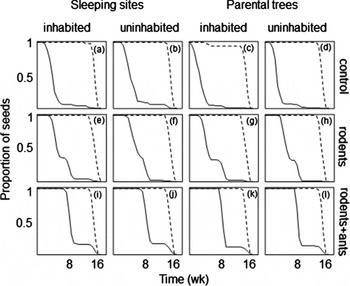
Passage through the monkey's gut favoured germination. Percentage germination was very low for control seeds (2%), but high (≥ 70%) for the other treatments (F 2,27 = 206, P < 0.001). All observed germination occurred within the first 10 d. Post hoc tests indicated that germination was lower for defecated seeds (70%) when compared with both methods of artificial scarification (86%). No germination was observed in the field. Survival time was much higher for seeds in faeces vs. seeds in fruits (χ2 = 6983, df = 1, P < 0.001), but at the end of the study, all seeds in both treatments had been killed or removed (Figure 1). Seeds in faeces suffered very little removal (< 1%), and no attack by bruchids, but fungus attack was very high (> 98%). Predator exclusion also had a significant effect on survival time (χ2 = 1594, df = 2, P < 0.001), but only for seeds in fruit. Seeds in fruits were removed by both rodents and ants. Seed survival patterns were not affected by fragment type (with vs. without monkeys) or seed deposition site (under sleeping site vs. under parent tree). Finally, D. guianense seedling density was affected by seed deposition site (F 2,22 = 14.2, P < 0.001), but only in fragments with monkeys, where density was significantly higher under sleeping sites (1 seedling m−2) than under parent trees (0.22 seedlings m−2). In fragments without monkeys, mean seedling density was equally low in both simulated sleeping sites and under parental trees (0.03 seedlings m−2). Type of fragment also had a significant effect (F 1,5 = 31.3, P < 0.001). Seedling density under parent trees was significantly higher in fragments with monkeys, compared with fragments in which the monkeys are not longer present.
Proportion of Dialium guianense seeds surviving over time in six rain-forest fragments in Chiapas, Mexico. Fragments were of two types: inhabited (a, e, f, c, g, k) and uninhabited (b, f, j, d, h, l) by howler monkeys. Seeds were placed in two deposition sites: below monkey sleeping sites (real and simulated) and under conspecific parental trees. In each deposition site seeds were also placed in two deposition conditions: inside fruits (continuous lines) and surrounded by faecal material (dashed lines). Three treatments of predator exclusion were applied: no exclusion (control), rodent exclusion (rodents) and total exclusion (rodents + ants). Each of the 12 panels represents the fate of 72 seeds inside fruits and 24 seeds surrounded by faecal material.

Our results support the generally accepted contention that the loss of frugivorous animals can affect the regeneration of plant species dispersed by them. Our results also emphasize that the regeneration process is complex and affected by multiple biotic and abiotic factors. Yet, given that none of our experimental seeds recruited seedlings in the field, that we lack long-term data on seedling performance, and that fragments might differ in relevant aspects besides howler monkey presence, we must consider our results preliminary and any conclusion ought to be drawn with caution.
Increased seedling establishment under monkey sleeping sites could be a consequence of increased seed rain and/or increased seed germination/survival in these sites. In terms of seed rain, a positive correlation has been reported to occur between seed density and seedling density for D. guianense (Anzures-Dadda et al. Reference ANZURES-DADDA, ANDRESEN, MARTÍNEZ and MANSON2011). Although in the present study we did not measure seed density under parent trees, it can be expected to be quite high. In terms of increased germination, seed deposition after passage through the gut, which can be expected to occur more often under monkey sleeping sites vs. parent trees, seems to be crucial for D. guianense, as has been shown for several Dialium species swallowed by bonobos in Africa (Beaune et al. Reference BEAUNE, BRETAGNOLLE, BOLLACHE, HOHMANN, SURBECK, BOURSON and FRUTH2013). It is important to mention that mechanical scarification (which was as effective as chemical scarification) can also occur when seeds are manipulated by granivorous animals (Elmouttie & Mather Reference ELMOUTTIE and MATHER2012). We must note that c. 35% of seeds in fruit were removed by rodents and/or ants and that a proportion of such removal may not represent predation. Future studies ought to determine the possible role of granivorous animals in the dispersal of D. guianense seeds.
How seeds are deposited also affects seed fate. Seeds deposited in monkey faeces suffered very little removal/predation by ants, rodents and bruchids. It has been reported that faeces may protect seeds against predators (Rios & Pacheco Reference RIOS and PACHECO2006). However, seeds in dung suffered high mortality due to fungal attack. We must stress the fact that no experimental seed, either surrounded by dung or by fruit pulp, germinated in the field. Fruit pulp has been shown to promote pathogen attack and also to prevent germination through inhibition (Traveset et al. Reference TRAVESET, ROBERTSON, RODRÍGUEZ-PÉREZ, Dennis, Schupp, Green and Westcott2007). Whether germination inhibition due to pulp and faeces caused attack by fungus, or whether fungus attack prevented germination, remains to be elucidated. Also, altered microclimatic conditions may negatively affect germination in small forest fragments (González-Di Pierro et al. Reference GONZÁLEZ-DI PIERRO, BENÍTEZ-MALVIDO, MÉNDEZ-TORIBIO, ZERMEÑO, ARROYO-RODRÍGUEZ, STONER and ESTRADA2011). Whether this is the case in our study system also remains to be assessed by future studies.
In summary, primary dispersal of D. guianense seeds by the howler monkey, seems to be necessary for seed germination. This positive effect on germination, together with the aggregated seed deposition patterns under the monkey's sleeping sites, is associated with high seedling densities of D. guianense in forest fragments still inhabited by this monkey. The howler monkey inhabits less than 20% of the forest remnants in fragmented landscapes of Mexico (Anzures-Dadda et al. Reference ANZURES-DADDA, ANDRESEN, MARTÍNEZ and MANSON2011), meaning that the uninhabited fragments have lost one of their main seed dispersers. This could represent a serious challenge due to cascading effects in the long term, which eventually might lead to the necessity of costly actions to restore the carrying capacity of habitat fragments for animals.
ACKNOWLEDGEMENTS
For valuable suggestions and comments we thank Horacio Paz, Alejandro Castro-Luna, Cecilia Díaz-Castelazo, Larissa Guillén, Andrea Birke, Delia Garibay-Benítez, Alejandro Martínez-Ramírez, Jorge León-Cortés, Julieta Benítez-Malvido, Juan Carlos Serio-Silva, Javier Laborde, Claudia Gallardo and Berenice Vera. For assistance with the figure we thank Atzimba López Maldonado. For field assistance we thank Rubén Morales, Marcos Gil, Alejandra Flores-Lepe and Jesús Aguirre-Flores. We thank CONACyT (graduate fellowship159285), Sigma Xi and INECOL for financial and logistical support.