Introduction
On 23 April 1947, the Amrita Bazar Patrika, a widely read English language nationalist newspaper published from Calcutta, featured the results of a gallup poll on the issue of partitioning Bengal. In reply to the Patrika's question, “Do you want a separate homeland for Bengali Hindus?” an overwhelming 98.3% Bengalis voted in favour, and 0.6% voted against the division of the province.Footnote 1 The newspaper reported that of the 99.6% Hindus and 0.4% Muslims who had replied to the poll, most had voted in favour of a division. The Patrika claimed that the results of the opinion poll were evidence of the Bengali people's verdict favouring the partitioning of the province.Footnote 2
Why did most of the poll respondents favour the partitioning of the province and what were the different calculations behind those who argued for and against the partition? More importantly, what did Partition mean to its advocates and its critics and how did these multiple meanings frame their expectations towards the future of Bengal and India? This article examines the answers to these critical questions and challenges the established narratives of Partition that see the event as a culmination of Hindu and Muslim communal politics. Rather, this article offers a counter-narrative, which highlights political contingency, where the countdown to August 1947 figures as a moment of multiple possibilities. It argues that far from being characteristic of a consensus within Bengali public opinion on the eve of Partition, the poll was only one of many opinions that framed a range of conceptions about the future of the Indian, Pakistani and Bengali nations.
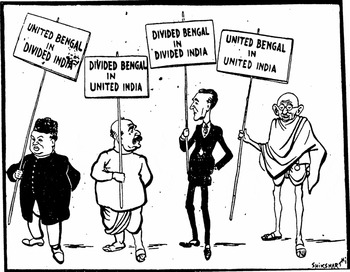
This essay focuses on the public debates surrounding the Partition issue, in the months between 20 February 1947 when the British government announced its intentions to transfer power to IndiaFootnote 3 till 20 June when the Bengal Legislative Assembly voted in favour of partitioning Bengal and in favour of the western half joining the Indian Union. The announcement's intentionality belied the uncertainty it generated in people's minds about its implementation. These four months were marked by complete political confusion as elite politics entered into a mercurial decision-making process regarding the conditions and the nature of such a withdrawal.Footnote 4 A cartoon in the Amrita Bazar Patrika published in May 1947, graphically captured the doubts and confusion in people's minds.Footnote 5 Titled, ‘Who is Right?’ it showed four key public and political figures, H. S. Suhrawardy, Shyamaprasad Mookerjee (the leader of the Hindu Mahasabha), M. A. Jinnah and M. K. Gandhi each with a placard with their supposed propositions. Thus Suhrawardy holds ‘United Bengal in Divided India’, Mookerjee ‘Divided Bengal in United India’, Jinnah ‘Divided Bengal in Divided India’ and Gandhi holds up a sign with ‘United Bengal in United India’.Footnote 6Figure 1. The cartoon clearly indicated the high-level disagreements about India and Bengal's political future. The leaders were depicted as picketing in front of an invisible higher power, which suggested a certain powerlessness. More importantly, it suggested to its readers the possibility that they could have the power to decide which of these leaders had the ‘right’ interests for Bengalis and India. In reality, such decisions were to be taken behind closed-door negotiations far away from Bengal.
‘Who Is Right?’
Source: Cartoon in the Hindustan Standard, 17 May 1947, 5.

The Congress Working Committee announced on 8 March 1947 that in the event that India was partitioned, such a partition would entail a division of Bengal and Punjab. This announcement, in the backdrop of the riots of 1946, implicitly signalled to the residents of these provinces that Partition might be imminent, if not inevitable. Uncertainties about the political future of Bengal became the central feature of public debates as Bengalis began to write in their opinion for and against the Partition to leading newspapers and send petitions to their local political and civic organizations. Newspapers, journals and pamphlets offered the discursive and representational space, which constituted a ‘common space’,Footnote 7 a public sphere where these Bengalis hoped to discuss and disseminate their ideas on the Partition and hoped to build a larger consensus. However, public opinion on the Partition operated within a partially realized public sphere, where the case for and against Partition was often formed in political and civic groups or individually, and then presented within the common space accessible to the readers of the print medium. The poll in the Amrita Bazar Patrika is a case in point. Neither the issue of Partition nor the question put forward in the poll had its origins in the public. The newspaper framed the question that affected and limited the ways in which the public could answer it. Further, the poll results accrued from individuals who arrived at a particular conclusion without any public debate. However, it was after the poll results were published that we see evidence of a full-fledged emergence of divergent public opinion, which deliberated and discussed the issue of Partition through publicly accessible print mediums.
The newspapers and journals helped to provide what Charles Taylor calls “meta-topical” spaces, where people separated by space and unknown to each other expressed shared aims, in this case the political future of Bengal.Footnote 8 Letters, opinion pieces, editorials and regular cartoons in leading newspapers and journals in Bengal such as the Amrita Bazar Patrika, the Hindustan Standard, The Statesman and the Ananda Bazar Patrika Footnote 9 constituted and contributed to such a ‘meta-topical’ space but were also indicative of a specific colonial public sphere, which was intrinsically fragmented and polyvalent.Footnote 10 These newspapers, published mainly in English,Footnote 11 were widely circulated. Moreover, they were associated with and were representative of mainly moderate ‘nationalist’ viewpoints. The authors who wrote in these newspapers were mainly urban, English-educated and situated in both eastern and western parts of Bengal. Some of them had ties to political organizations such as the Indian National Congress and the Hindu Mahasabha and some of them had been prominent political figures as assemblymen and bureaucrats in the colonial state.Footnote 12 A large number of these writers were also intellectuals, businessmen and landlords with little ties with the political machinery. Their arguments for and against Partition imbricated community interests with appeals towards the public good and national good. Even as they aimed to build a larger consensus for their respective positions, their arguments reiterated their differences and in hindsight, failed to persuade. However, as Neeladri Bhattacharya has urged, such failures characterize the modern public sphere just as much as the hegemonic politics of consensus building.Footnote 13 A critical analysis of the public debates in Bengal thus reveals a remarkable range of contestations between territorial nationalism and the imagined community that defined the Indian nation and itself primarily by its non-inclusion within the prospective Pakistan.
This essay is divided into three sections that examine Bengali public discourse in the wake of momentous political decisions made in Delhi. The first two sections showcase the differences within petitions that would, at least superficially, seem to have the same objective, that is, the partition of Bengal. While some petitions were couched within a rhetoric for a ‘Hindu’ nation, others were framed within a ‘need’ for ‘nationalist’ India. Such a ‘need’ was often framed within secondary prerequisites of economic stability, territorial jurisdiction and organic unity with the soon-to-be new nation state of India. The last section examines the demand of those who voiced their opinion against any kind of partition but were divided on whether united Bengal should join the prospective state of India, Pakistan or become a nation state itself.
Several scholars have attempted to identify the political and cultural processes that led to the Partition. In the case of Bengal, Suranjan Das's monograph on communal riots in Bengal and Joya Chatterji's work on Hindu communalism argue a case for Partition within the paradigm of a communal-national binary. Das provides a uni-linear trajectory between Muslim ‘communalism’, which in his view, resulted in the riots of 1946 and ultimately the Partition. Joya Chatterji attributes a central role to elite Bengali Hindus in spearheading the campaign that led to the fateful division of the province in 1947. She argues that the public demands for partition and a separate ‘homeland for Bengali Hindus’ on the eve of partition reflected the end result of a decisive shift ‘from nationalism to communalism’ that had marked Bengal politics and identity from the 1930s.Footnote 14 Having identified the main actors in the promotion of Hindu communalism, she then makes the problematic leap to make the case for all Bengali Hindus who in her view were not ‘passive bystanders’.Footnote 15 Both Das and Chatterji's work fall within the trap of teleology as they seek to explain the final dénouement in August 1947 as a result of communal fratricide. More importantly, such analyses erase alternative possibilities in the political and public realm that existed at this time.
That provincial politics in Bengal after the Communal Award of 1932 shifted towards mass mobilization along communal lines cannot be denied. Scholars have drawn attention to the unique political and demographic landscape of Bengal in the 1930s that ensured an easy conflation between ‘class’ and ‘community’ within mass mobilization efforts of Hindu and Muslim leaders.Footnote 16 The politics of representation also incorporated issues of peasant rights and freedom from Hindu landlord domination and the cultural flowering of Muslims who could and did re-invent the struggle of their identity within and outside the national movement.Footnote 17 However, a critical distinction needs to be made between communitarian struggles of non-elite social groups in which religion played an important organizational role and the communal mobilizations within provincial politics informed by colonial constructions of politically representative religious groups.Footnote 18 In the context of Bengali nationalism, Sugata Bose has noted that religion and religious symbols had always informed the cultural identities of both Hindu and Muslim nationalists and had played a crucial role in garnering the support of the masses and elite alike against colonial rule.Footnote 19 Further, as Partha Chatterjee rightly argues, Muslim politics in Bengal remained circumscribed as they failed to draw the support of the Hindu minority in Bengal.Footnote 20
Given these significant characteristics of Bengal politics, the arguments for the centrality of communalism that led to Partition are difficult to accept. Clearly, even within the immediate context of the Partition debates one finds public opinion far from being framed along rigidly communal lines. Partition's ‘inevitability’ is belied by the existence of multiple discourses on the issue of the division. Further, even after 20th June, when the Bengal legislative assembly sealed the deal by voting in favour of Partition, it is difficult to identify an overtly communal tone within the public demands which now concentrated in translating their demands for territory along cultural, economic and linguistic lines.
In contrast to Joya Chatterji's argument for the participation of the Bengali bhadralok in deciding the fate of their province, Partha Chatterjee has pointed out that the Bengal assemblymen, whose election had been determined on the basis of limited representation, took the final decision. Chatterjee further describes stances taken by political leaders and organizations within Bengal as contingent and strategic and that ‘positions were being taken on the assumption that Pakistan was in the offing, that there was nothing left to be done to change that eventuality and that all that remained was to strike the best bargain for each sectional interest’,Footnote 21 for Bengalis belonging to different religions and castes. In terms of Bengali public opinion, one senses similar factors influencing the stances printed in the leading newspapers and self-published pamphlets. I would like to suggest that the debates for and against Partition were neither small-scale nor do they reflect an acknowledgement of political powerlessness to influence the course of events. Although the pleas and demands on the Partition issue were addressed to an external authority, as Chatterjee suggests, the continuation of these pleas till the very end imply that these Bengalis believed themselves as crucial cogs in generating public consensus and thereby hopefully to influence high-level decisions. The authors of these letters, articles and pamphlets were Partition's bit players, who, in reality were powerless to control their political destiny, but remained confident of their ability to influence the outcome of their political futures. They were representative of a specific Bengali public, albeit a limited one.
The Need for ‘Nationalist’ India
Between February and June 1947, representations from political units such as the Municipal and Union Boards, civil groups like District Bar Associations and Zamindars’ Associations and local clubs flooded the offices of the Hindu Mahasabha and the All India Congress Committee, voicing their demands for Partition.Footnote 22 A front-page cartoon in the Hindustan Standard depicted the Viceroy being overwhelmed by nearly 10,000 telegrams demanding the Partition of Bengal.Footnote 23Figure 2. In fact, one Purna Chandra Chandra, a Calcutta resident, wrote to the editor of the leading Bengali daily, Ananda Bazar Patrika suggesting that its readers send at least10 telegrams per day to the Viceroy to inform him of their support for the Partition.Footnote 24 Most of these petitions asked for the formation of a separate province of West Bengal that would remain within the Indian Union. The demand for partitioning the province spread to the districts and mofussil towns as Calcutta-based newspapers continuously printed local resolutions. While some framed their petition within demands to safeguard ‘the lives, properties, honour and culture of the Hindus and other minorities’,Footnote 25 other resolutions argued that their demand for partition was in keeping with the nationalist core of Bengal and India.Footnote 26
‘Telegraphic Campaign for Partition’.
Source: Cartoon in the Hindustan Standard, 17 May 1947, 1.

The aim of creating a ‘homeland’ for the Bengali Hindus was by no means the only reason to advocate partitioning the province. Neither does one see the primacy of specifically ‘communal’ overtones within the articulation of those who were in support of the division. In fact, several readers of the Amrita Bazar Patrika wrote in their protest against the limitations of the poll question. D. N. Mukherjee, a member of the Bengal legislative assembly pointed out ‘the term of reference given by you does not cover all the grounds for such a partition. Many of us think that Partition is needed not so much for providing a homeland for the Hindus as for remaining united to the Indian Union’.Footnote 27 According to Mukherjee, the present debate about dividing the province was really a non-issue as such a division would ensure that India remained united and provide the opportunity to those ‘nationalist’ citizens to remain within its territorial borders. The theme of ‘unity’ was echoed by another reader of the Patrika, Sakti Ranjan Bose of Calcutta, who argued, ‘our ambition is not to create a separate homeland for Hindus but to increase the territories under the Indian Union. Why we want a separate state in the West is not because the majority is Hindu but because the majority population would like to form itself in a state which is connected to the centre’.Footnote 28 For these members of the Bengali bhadralok, Partition was explained in terms of a historical necessity, which would ensure a continued association with the national imagination.
Hemanta K Sarkar, the General Secretary of the provincial committee of the Azad Hind Fauj,Footnote 29 identified the aims and objects of the movement for a Hindu homeland as not communal. Rather, it was in accordance with the ideal of Hindu-Muslim unity in order to achieve complete independence for India. ‘We propose to fall in line with the rest of nationalist India to achieve that object by separating West Bengal as a province where the nationalist forces from all over Bengal may rally and strive instead of being throttled by a reactionary communal government in present Bengal conspiring to wipe out our very existence. Our aim is to create one more province in addition to the already numerous provinces of India the oneness of which remains as before’.Footnote 30 Interestingly, Sarkar's statement went against the anti-Partition stance of the organization.
Veteran Congress leaders such as Nalini Ranjan Sarkar and Kiran Sankar Roy, both originally hailing from the eastern part of Bengal but who had made their political career in Calcutta, publicly voiced their reasons for supporting the movement. In a series of public lectures and essays in major newspapers, Nalini Ranjan Sarkar, a veteran of the 1905 anti-Partition movement, assured those Hindus who would surely become part of Pakistan in the event of the division that, ‘In a divided Bengal those Hindus who might be left in East Bengal should have this satisfaction that West Bengal as a separate province would be there as a safe home for Hindu culture and economic interests’.Footnote 31 Using the metaphor that the Bengali Hindus were ‘living in a house on fire’, Sarkar dissociated the call for Partition as a consequence of the Cabinet Mission Plan and stressed that the demand was due to intrinsic problems within the Bengal body politic. ‘The Hindus have been forced into this position by extreme circumstances’ whose roots lay in the ‘communal administration’ of the Bengal Muslim League. He then described in detail the ‘separatist tendencies’ not only in the field of political representation but also in fields such as education and trade and industry. He emphasized that,
If the present policy of the League in Bengal had undergone a real change and in accordance with that change a constitution was evolved which made it possible for all sections of people to be imbued with the idea of a common citizenship overriding communal distinctions and thereby ruling out any communal domination, then indeed I believe the Hindus of Bengal would not think it necessary to press for a divided Bengal.Footnote 32
Thus the demand for Partition, from Sarkar's point of view had little to do with ‘saving one's religion’ but was a necessary step towards achieving the ‘nationalist’ goals of Bengal. Similarly, Kiran Sankar Roy, in a 40-page memorandum to the British Prime Minister and Secretary of State, drafted by Bengal Congress party, charged the League administration of corruption, discrimination against Hindus and the cause for the general retrogression in the province.Footnote 33 In addition it held the League singularly responsible for ‘spreading the virus of communalism’ in Bengal's politics and culture. Although Kiran Sankar was a partial advocate of the United Bengal Movement promoted by Sarat Bose, Abul Hashim and Suhrawardy, he, like other members of the Bengal Congress, ultimately argued in terms of the political necessity for Partition to ensure the survival of the Indian nation.
Those who had hitherto been against the partitioning of the province in April 1947 began to see it as a necessary evil and to similarly justify it in terms of historical necessity. Using several biological metaphors of ‘canker’ for Pakistan that needed to be removed for the general health of the Indian body politic, Partition now became the solution to the contemporary communal problems. For Niharendu Dutta Mazumdar, a Congress member of the Bengal Legislative Assembly, the issue at stake was not religion but ‘how to save Indian nationalism in Bengal against the dark forces of politico communal reaction’. He urged the people not to split over the issue of Partition, but to form ‘patriotic Councils of Action’ comprising both Hindus and Muslims to combat ‘League tyranny’.Footnote 34 In an editorial in early April, the Ananda Bazar Patrika echoed similar sentiments. It outlined three key questions that faced the Bengalis in 1947. First, in order to remain within the Indian Union, the Bengalis had to choose between the whole or a portion of the province. Second, if the whole of Bengal remained within India then they would have to decide on the issue of separate electorates. Third, given the recent history of Muslim League governance in Bengal, the editorial noted that it would be unlikely that separate electorates would be abolished. The editorial concluded that the only resolution to these three issues was the division of the province.Footnote 35
Some went on to argue that Partition would again be annulled once the Bengali Muslims realized that they could not survive alone. Krishnaprasanna Sinha, in a provocatively titled letter, ‘Kill Pakistan,’ wrote that,
If Bengal is divided it would be impossible for the Muslim League to carry on with only Eastern Bengal as a separate Muslim state. . .if only Calcutta is taken out it would be impossible for the Muslim state to function. It need hardly be emphasized that Calcutta is definitely a Hindu city, not merely by the standard of its Hindu population but also by the standard of lands and houses, which are mostly owned by the Hindus. West Bengal with Calcutta will be more self-supporting than merely East Bengal can ever hope to be. If Muslim League is confronted with the two alternatives viz. to join the All India Union in the right spirit or form East Bengal as a separate Muslim state the Muslim League would prefer the former. The Bengalee Hindus must however make it quite clear that either the whole of Bengal joins the all-India union or they separate.Footnote 36
Although the claim for Calcutta led Sinha to identify it as a ‘Hindu city’ notwithstanding the sizeable Muslim and Christian population, a similar claim was not laid out for Dacca whose population was, by Sinha's standards, predominantly Hindu. Thus the religious identity of Calcutta camouflaged the economic motives in Sinha's demand for the inclusion of the city in West Bengal.
Similarly, Kalipada Mukherjee, Secretary of the Bengal Provincial Congress Committee, at a conference in Jessore in May 1947, publicly declared that the Congress demand for Partition did not intend to abandon ‘Hindus and other national forces in East Bengal but it is believed and in no distant future it would be able by their strenuous efforts, to bring about the situation under which East Bengal should be forced to join the Indian Republic’.Footnote 37 Although this conjecture did not agree with the official policy of the Bengal Congress, like Mukherjee, others believed that this Partition would also be annulled, as had the 1905 Partition.
For some groups Partition was a ‘necessary step’ in the path of India's progress towards freedom. Bhabadev Bhattacharjee, a professor of political philosophy at Ripon College in Calcutta, used the metaphor of a joint family system to explain to his readers their current political reality. ‘If the joint family system has broken up as a result of impact of selfish ideas, how much is the danger of a country beset with warring creeds. Brothers have maintained better relations by living separately in many cases than most of those who outwardly profess brotherhood and are compelled to eulogize on united life even though in their heart of hearts they have realized the hollowness of the actual situation. To fight the movement for Pakistan in the most practical way is to cry for partitioning of Bengal. A Muslim Bengal without Hindu Bengal is a hopeless idea’.Footnote 38 Another writer, similarly argued that the
Moral partition of Bengal is already complete and notwithstanding the tender sentiments for an undivided Bengal. Constitutional partition is inevitable unless the Muslims in this province unequivocally repudiate the communal electorates and communal politics and unseat their present leadership which works against the emergence of a strong independent and progressive union of India to take her rightful place in the community of other great nations of the world.Footnote 39
For those who still remained uncertain about their views on partitioning the province and found the current demand in contradiction to the earlier movement to annul the Partition in 1905, arguments about the continuation and preservation of nationalist ideals had more appeal than religion. Major General A. C. Chatterjee thus urged the nationalists to ‘attach themselves firmly with the rest of nationalist India’. This goal could only be possible with the creation of a new province that did not subscribe to the Pakistan ideal and thus ensured that it be part of nationalist India. Chatterjee argued that the nationalist goals that had led to wide-ranging protests against the first Partition of Bengal in 1905 had not changed in 1947. In his view, the creation of a new province was being urged along similar lines and intended to ‘preserve the solidarity and integrity of the people who were nationalistic in outlook and who consider their language tradition and civilization as one, facts denied by the Muslim Leaguers’.Footnote 40
At a conference in Jalpaiguri in northern Bengal, attended by 500 delegates from that region, Pandit Lakshmi Kanta Maitra, a member of the Legislative Assembly, noted that there were three courses open to Bengali nationalists,
First was an abject surrender to the Muslim League. Hindus could not think of it. The second course was the violent method or a bloody civil war. Nationalist Hindus did not want to adopt this barbarous cruel path which was destructive of civilization. The third course was the creation of a new province, a homeland for the nationalists which would be linked with the Indian union and would remain within that union.Footnote 41
Maitra then contended that the imminent freedom of India from colonial rule was due to the sacrifice of Bengali Hindus who had now been forced to ask for a division because of ‘the irresistible logic of events and communal misrule that had sought to curtail the rights and privileges of the Hindus since its very inception’. By collapsing nationalist goals with religious identity, Maitra and others hoped to convince those who continued to doubt their political representatives’ demands for Partition.
The Dacca District Congress Committee passed a resolution on 15 May 1947 that stated,
The members of the Executive Committee have belief in the united India and the united Bengal as a unit of the Indian union. In case the division of India becomes inevitable on account of the unreasonable demand of the Muslim League as a natural corollary they claim that a separate unit with those districts of Bengal willing to join the Indian union is to be formed.Footnote 42
Along with the justifications for the cause of ‘nationalist India’, Partition in this petition echoed the widespread belief that it was the Muslim League that had generated the ‘unreasonable’ demand for separation. Thus it behoved those in opposition to Pakistan to demand inclusion within India even if it meant that very separation.
The tension between ‘Hindu’ and ‘Nationalist’ India continued to be a moot issue as the Partition debate engaged with the critical question of space and territory. How much territory was sufficient for the proposed West Bengal province? On what basis should the territorial coordinates be decided? Without anything of a guideline except the understanding that any division or ‘demand for inclusion’ would involve areas that were unlikely to be part of the proposed Pakistan, some petitioners continued to demand a region that would circumscribe a Hindu communal demography. But there were many others who couched their appeals within what they hoped would be key to the sustenance of the new Indian nation, citizenship, loyalty and economic stability.
In the event of a division, it was clear that the western districts of Bengal would join the Indian union. Consequently, the status of the eastern districts became central to the extension of a potential border. More importantly, the status and citizenship rights of Hindus who resided in this region dominated the debate on Partition. Thus several groups and petitioners, unsure whether their locality would be part of India or Pakistan, evoked their contribution and sacrifices for the Indian freedom struggle, which they argued, should guarantee their inclusion in the future Indian state. For example, the Students’ Library of Howrah framed their support for the division in the following terms,
Although it believes in the existence of a united Bengal within united India, in order to protect the civil liberty of the people, the honour of women, the culture and tradition of Bengal and to form a separate and nationalist Bengal under the Indian Union, comprising of the parts of Dinajpur and Malda districts and such other parts as are willing to come under the Indian Union and a regional ministry for the area should be set up immediately.Footnote 43
Similarly, writing to the Hindustan Standard, one Satish Chandra Roy urged that Hindus in eastern Bengal were and would remain loyal to united India and that they ‘should be given rights of citizenship in the newly created province of Bengal and the union of India as well. They shall be eligible to services, trade, education etc. in the province of Bengal and also in the union government’.Footnote 44 Roy contended that if the Hindus of East Bengal were recognized as Indian citizens, then ‘Pakistan will be compelled to give them their due share in the administration of East Bengal’ and ‘even though they reside outside the union and be entitled to the full protection of the union government’.Footnote 45 Roy's suggestions thus advocated the cause for trans-national citizenship for the minority Hindus in eastern Bengal. Like many of his compatriots Roy also assumed that the Muslim residents of this region were eager for citizenship within Pakistan.
Roy was not alone in voicing his concern about the fate of the Hindus whose homes were most likely to be part of Pakistan. A deputation from Noakhali, one of the eastern-most districts of Bengal, wrote to Shyamaprasad Mookerjee pointing out, ‘If Bengal is partitioned no doubt the Hindus of West Bengal will be saved, but what will be the position of the East Bengal Hindus under the Pakistan government? The Hindus of East Bengal paid as much for the present political improved state of affairs as for the independence of India. They sacrificed much and above all the lives of their boys and girls to fight out the Britishers (sic) from India’.Footnote 46 The petitioners thus invoked ‘nationalist sacrifice’ to the cause of freedom from colonial rule as a sure guarantee of Indian citizenship.
Narendranath Biswas of Magura, a scheduled caste, had an ingenious solution to the problems affecting his community. He urged that the community, instead of living in different districts of Bengal, move their residence to the district of Jessore, and back their demand for inclusion within India with numerical strength.Footnote 47 As one of the five districts whose future would be decided by the Boundary Commission, Jessore's position was critical in Biswas's demand for relocation. He wanted to ensure that when the time came for the decision, the district would have a numerical majority of non-Muslims to justify its inclusion within India.
In the scramble for territory, the city of Calcutta, seat of Bengali urban culture for both Muslims and Hindus, became the most sought after because of its logistical, industrial and business infrastructure. A detailed petition to Lord Listowel, from S. M. Usam, ex-Mayor of Calcutta, Mr. Abdus Sabur Khan and Mr. Mahisuddin Ahmed, the President of the Bengal Jute Grower's Association, couched their demands for Calcutta in economic terms. The petition began by indicating ‘East Bengal is the homeland of jute and Calcutta is the by-product of the marriage of Bengal jute with the Hooghly River and it is for this reason Calcutta is rightly called the city of jute and port of jute’. Jute, the petitioners reminded, was produced solely by East Bengal Muslim peasants and Scheduled classes. Such an organic connection between Calcutta and its eastern hinterlands would be severed in the case of Partition and if Calcutta was awarded to West Bengal.Footnote 48 Thus the petitioners, as representatives of not only the Muslim farmers but also the port and industrial workers in Bengal, urged the British authorities to re-think and re-work their decision to partition Bengal. On the other side of the coin, D. N Banerjee, a professor at Dacca University, noted that Calcutta, by virtue of its population that was predominantly Hindu, should be part of West Bengal.Footnote 49
The Cause for a ‘Hindu Nation’
The acceptance of the Punjab Partition by the All India Congress at the national level clearly indicated for the people in Bengal that Partition of their province was not only plausible but also imminent. The Hindu Mahasabha, which had initially advocated the idea of an ‘Akhand Hindustan’ (Unbroken India), changed its stance and focused on retaining as much territory as possible for a ‘Hindu India’. In February 1947, it appointed a Working Committee to report on ‘the feasibility and desirability of having a separate province for securing a homeland for Bengal Hindus’.Footnote 50 At a conference at Tarakeshwar, Mahasabha workers passed a resolution to begin a campaign to ‘retain East Bengal Province. . .within the Indian Union’.Footnote 51
In the following months, as the Hindu Mahasabha deployed their cadres to promote their cause the Bengal Congress also jumped onto the bandwagon for Partition, albeit for different reasons. The Congress political leadership couched the demand as one necessary to remain within ‘nationalist’ India. In over four hundred petitions addressed to the district and provincial Congress leaders, Bengalis (mainly from western parts of the province) urged for inclusion.Footnote 52 Ironically, Partition politics made strange bedfellows out of the Hindu Mahasabha and the Congress. The demand for inclusion within India among those proclaiming their nationalist credentials found common cause among those who had begun to promote the demand for a Hindu homeland. Two things immediately stand out in these petitions. First, these petitions provide a clear evidence that the political campaign for Partition was well organized and second, they concentrated mainly in the western parts of the province, which had more Hindu-majority districts and were most likely to remain in India in the event of a Partition.Footnote 53
It would be accurate to point out that some sections of the Bengali Hindu bhadralok adopted the discourse of religious nationalism in their advocacy for the Partition. The amalgam of religion with politics was the leitmotif in a number of letters sent to leading newspapers. From mid January 1947, Amrita Bazar Patrika, began to carry letters from its readers titled ‘Homeland for Bengal Hindus’. One such letter under this caption noted, ‘Bengali Hindus must face the grim reality before them. If they do so, then they will see how the good deeds done by patriotic Bengalis in an earlier day are gradually being nullified by the Muslim-dominated administration of the province. . . The Bengali Hindus must have a home where they will be able to preserve their culture and adjust its administration to their needs’.Footnote 54 Written under the pseudonym, ‘Fairplay’, the author then went on to outline the different economic and social opportunities that had been lost to the Bengali Hindus since the Communal Award.
Another writer, B. C. Sen of Calcutta, did not mince words when he warned the readers of the Patrika, ‘The Bengalee Hindus are now faced with a new danger—the danger of total extinction and being reduced to the position of Jews’.Footnote 55 Although Sen agreed that ‘Hindus and Muslims belong to the same racial stock, language and culture and their economic interests are identical’, the present political situation had placed the Muslims in a position of unchecked ‘absolute authoritarianism’. Thus the Partition ‘is a move to self-defence particularly necessitated by the fact that neither the Congress nor any other national political organization has been able to carry the Muslim masses with them’. In a booklet published in early 1947, Bhupendra C. Lahiri articulated the immediate need to have a ‘Hindu nation’ in Bengal. After pointing out that in the current state of affairs, the Hindus’ efforts to enter and influence the politics, education and the workforce had been stymied by communal reservations, Lahiri argues that the Partition of Bengal into Hindu majority and Muslim majority provinces was not only possible in terms of geographical division but was also the only way to ensure that the Hindus of eastern Bengal could be saved. In Lahiri's view, rather than undertaking a messy population exchange, ‘If the Hindus of eastern Bengal are ensured the support of the 3 crores Hindus of independent Bengal, the former would be much strengthened as a race than they are currently. . .The only way to save the Bengali Hindus is to ensure the preservation of the glory of Hindus in Western Bengal’.Footnote 56
The correlation between religion, culture and territory was not new. However, several other strands of argument were interwoven in the case for Partition. The extinction of the Bengali Hindu ‘race’ was a recurring motif evoked by some writers.Footnote 57 One Charu Chandra Sinha from Howrah, in western Bengal, argued that the Bengalis had been ‘politically, socially, and economically maimed’. While he echoed the arguments about maladministration of the League Ministry in the political and social field, he also pointed out that existing scarcity of food in Bengal specifically targeted the Bengali Hindu race. He claimed that ‘There is no vitaminous [sic] food sustaining the life of the masses with the result that they are deteriorating in health day by day proving the truth of the theory that the Bengalis are going to be an extinct race’.Footnote 58 The only way to save the situation was the creation of a separate homeland for the Hindus in Bengal.
The politics of representation in the late 1930s and the decade of the 1940s in which Bengali Muslims made substantial gains confirmed fears of political curtailment for some sections of the Bengali Hindu bhadralok. It was only a short leap to translate such fears into a rhetoric of cultural and religious strangulation. Hindu organizations began to mobilize lower caste groups such as the namasudras in Bengal within the large Hindu fold.Footnote 59 By late 1946, many Bengalis, both Hindus and Muslims, were convinced that Pakistan, whatever its constitutional structure and spatial coordinates, was inevitable. To top it all, the riots of 1946 had convinced many of ‘League maladministration’Footnote 60 and that the political future of the Bengali Hindus was in jeopardy under the current Muslim League government.
A number of writers thus echoed the theme of ‘political impotency’. D. N. Bannerjee, a professor at the Dacca University, wrote to another popular English daily, the Hindustan Standard, arguing that Partition was the ‘only solution’. He pointed out that,
The whole future of the entire Hindu community of Bengal is in serious peril today, that this community which has suffered so tremendously during the last sixty years for building up Indian nationalism and for the freedom of India is in the imminent danger in view of the impending constitutional changes of being reduced to absolute political impotence and even abject slavery; that there is a great probability of an admittedly medieval theocratic state being established in Bengal with all its consequences; and that because of their questionable slight inferiority of number the lot of the Hindus in Bengal may soon become, unless timely action is taken that of mere hewers of wood and drawers of water for a people who are by their own admission inferior to them in so many respects.Footnote 61
The theme of ‘culture in danger’ was seamlessly co-opted within a remarkable notion of Hindu cultural superiority in Bannerjee's statement. Such proclamations turned the Muslim League's claim of ‘freedom from Hindu economic and cultural domination’ on its head by arguing that the Bengali Hindus, by virtue of being minorities within Bengal, needed political freedom from being ruled by a ‘brute’ majority. Such a brand of communal ideology invoked the ghosts of ‘Muslim tyranny’ and ‘medieval theocracy’ in Bengali life, which itself was projected as essentially Hindu. On the one hand, such arguments portrayed the Bengali Hindus as victims and minorities, while on the other hand they highlighted the reputation of the Hindu Bengalis as economic, social and cultural leaders who needed the partition of the province for their continued prominence.
Against Partition
Although Bengali Muslims generally supported the demand for Pakistan, within the political leadership of the Bengal Provincial Muslim League and the Krishak Praja Party, a socialist peasant party, there was no consensus on the meaning and program of the virtual Pakistan. The historiography on Muslim politics has convincingly shown that in Bengal, the Pakistan idea had moved away from its central focus on religion as the basis of unity and had metamorphosed into a more socio-democratic ideal resulting in a myriad of ‘Pakistans’.Footnote 62 The multiple promises of Pakistan, from being a peasant utopia to a nation based on socio-democratic principles and a nation free from Hindu domination, found favour not only with the illiterate, poor and less informed Muslim peasantry in rural areas, but also within groups of highly literate and politically aware urban Muslims, principally based in Dacca and Calcutta.
Some Bengali Muslims questioned the rights of the All India Muslim League and its Bengal branch to represent Muslims of the region.Footnote 63 Several letters to the Hindustan Standard stressed the common cultural and linguistic background of the Bengali Hindus and Muslims. The current divide, according to these writers was due to colonial machinations. In May 1947, a Bengali Muslim had outlined the meaning of Pakistan thus,
By keeping silent over the details of economic and political structure of the contemplated Pakistan our leaders have allowed the Mahomedan mass to believe that it will be a land of milk and honey. But Pakistan as it is already in the offing, does not seem to be a cheering prospect to us, the Bengal Mahomedans. Firstly, Mahomedans of different provinces are infiltrating into Bengal. These immigrants thinking themselves of a noble descent cherish a most contemptuous attitude towards the Bengali Mahomedans most of whom are illiterate peasants and as it is low born converts. These immigrants have a smattering of English and are out to dominate the Bengali Mahomedans both politically and intellectually. They will form the Mahomedan middle class in Bengal by monopolizing all the government jobs. An examination of the Muslim League high command and the coterie of Muslim members of the interim government points to the future domination of Moslem India by non-Bengalis. Secondly, Pakistan means, it is clear, the greatest advantage of the Muslim capitalists and business magnates. None of them are Bengalis. Hence Bengali Mahomedans will have very little to hope from them.Footnote 64
The writer, who identified himself only as a ‘Bengali Mahomedan’, questioned the hegemonic ambitions of the Pakistan demand to represent all Muslims of the subcontinent. He further questioned the ability of the Muslims, who were culturally and linguistically different than the Bengali Muslims, to represent or respond to regional concerns. The idea of Pakistan for this particular writer thus did not hold out the promise of a socialist revolution whereby the Bengali Muslim peasantry could also be free of the ‘capitalists and business magnates’. In some ways, his concerns seem prophetic in the light of the trajectory East Bengal followed after 1947.
Opinion among the scheduled caste leadership within Bengal was also divided. Although Jogendra Nath Mandal (the leader of the Scheduled Caste Federation that was politically aligned with the Muslim League) voiced his support against the Partition of Bengal, other leaders such as Radhanath Das (a member of the Constituent Assembly, and Birat Mandal, the leader of the All India Depressed Class Association) argued that the League could not guarantee safety for the scheduled castes in eastern Bengal and the interests of the group would be best served within a divided Bengal.Footnote 65 In a press conference at Delhi, Jogendra Nath Mandal pointed out that the Partition of Bengal would not solve the current problems and would, in fact, reduce the Hindus of East Bengal to an insignificant minority. Further, he pointed out that in the event of an exchange of population, the Scheduled castes of eastern Bengal, comprising mainly the poorer sections of the Hindu community, would not have the means to make the move across the borders.Footnote 66 Mandal had some support from scheduled caste groups such as the North Bengal Rajbanshi Kshatriya Samity, which passed a resolution against the Partition on 27 April 1947 at Rangpur in northern Bengal.
However, scheduled caste leaders such as Radhanath Das, whom Jogendra Mandal had defeated in the 1940 Calcutta Corporation elections, argued that ‘If we ask our namasudra brothers in Noakhali to come to West Bengal and the government of West and North Bengal will provide them with shelter and other economic requirements, then I am prepared to swear that Jogen babu [J. N. Mandal] will not able to keep a single one of his caste brothers in Noakhali’. Further, he argued that it would be easy for the scheduled castes to move precisely because “in terms of their homes, they only have small huts, which they would not have much compunction or problem in leaving” and moving to western Bengal.Footnote 67
In response to Das, Dwarikanath Barori, who sided with J. N. Mandal, argued, ‘it's a novel discovery [on Das's part] that the scheduled castes’ attachment to their home would be less because they lived in huts’,Footnote 68 and added that in reality a majority of that community owned substantial property. Clearly, the main issue within this particular Partition debate was whether the new province in the West would be able to guarantee economic opportunities for the scheduled castes.Footnote 69
Not all Hindus in Bengal subscribed to the view that there was a need to create a new province.Footnote 70 The fault lines of the debate against the Partition of the province are captured clearly in the writings of Nares Chandra Sen Gupta. In ‘An appeal to Sons and Daughters of Bengal’, Sen Gupta urged the Bengalis not to be swept away by propaganda in favour of the partitioning the province. He pointed out that ‘Hindus of Bengal have suffered terribly of late though Muslims too could not but suffer to a larger extent’. However, Sen Gupta asserted that partitioning the province along communal lines was not a remedy at all.Footnote 71 Rather, ‘the continuance of a united Bengal freed from the canker of communal electorates and a communal ministry, continuing as a member of the Indian union’ was a better option and urged his fellow Bengalis to ‘strive and toil and fight for that rather than to seek a partition of the province which but forty years ago people considered to be an intolerable calamity?’ The persistent struggle by the Bengalis had ‘unsettled the settled fact’ earlier. For Sen Gupta, like Gandhi, an advocate of a united Bengal within the Indian Union, Partition was the very antithesis of nationalist ideals.
The ongoing proposal for a ‘homeland for Bengali Hindus’ was in Sen Gupta's view fallacious as ‘Bengal Hindus are not like Jews, wanderers in foreign lands, they have their homes in land which is their own and which generations of ancestors have made their own. . .East Bengal will, I trust, not be swerved from their allegiance to their homeland by this promise of a homeland which seeks to pluck them out of the land to which they are rooted in tradition and sentiment of centuries’.Footnote 72 Sen Gupta correctly identified the problem of demanding a homeland for Bengali Hindus that would, if successful, mean the uprooting of those who did not live within its territorial boundaries.
Even at this late date, dissenters remained against the idea of any division of the province. The Forward Bloc organized a congregation against the proposed division that was reportedly attended by more than ten thousand people.Footnote 73 Another group comprising of members of different political colours and led by Sarat Bose and Abul Hashim promoted the idea of a United Bengal, which would not be constitutionally part of India or Pakistan but have an independent identity. In a letter to Sardar Patel, Sarat Bose specified, ‘It is not a fact that Bengali Hindus unanimously demand Partition. As far as East Bengal is concerned, there is not the slightest doubt that the majority of Hindus were opposed to partition. . .the demand for Partition is more or less confined to the middle classes.. . .Future generations will, I am afraid condemn us for conceding the division of India and supporting the partition of Bengal and Punjab’.Footnote 74 This plan did not find much support within the political ranks of the Bengal Congress or the Muslim League. The Bengali public, already inundated by Mahasabha propaganda, was wary of the possibilities that Bengal as an independent entity might in the future join Pakistan.
A number of letters anthropomorphized India as a ‘motherland’ and urged the readers to be patriotic sons in preventing the vivisection of their mother.Footnote 75 While one writer questioned, ‘Is there none in Bengal to challenge this spurious censusFootnote 76 on which the Muslim League's citadel of Pakistan is being built? It was the patriotic sons of Bengal who nullified the 1905 partition; is there none to follow them to nullify the infernal Pakistan?'Footnote 77 Another urged, ‘No true Indian should entertain such absurd unreasonable and foolish ideas and all must cooperate to keep India united’.Footnote 78 Jnanjan Pal, in a critical analysis of the future of a divided Bengal, identified several problems. He specified that,
By making our demand for a partition of the province on the basis of denominational religious communities we are likely to cloud the real issue. India cannot be communally divided, nor Bengal nor any other part of it. That will smother our progress; we will be going back to a perverted type of religious medievalism, absolutely unacceptable in the modern world. . .. A homeland for Bengali Hindus is therefore ideologically separated from the Indian union.Footnote 79
As a solution to the communal issue, Pal urged a separation between religion and politics and an effort to achieve a complete secularization of political life. Such a process would be amply aided by implementing a common electorate on the basis of universal adult suffrage. The only way to solve Bengal's problems was also to keep ‘ties with the other parts of India and with the Centre or the Union firmly secured not for communal moves, but for essential political and economic advantages’. Pal was not an advocate of the United Bengal Plan. In his view, ‘Bengal's sovereignty so called that is dissociated from the Indian Union, is thus fraught with immense mischief for India as also for Bengal’. However, if the political majority did not agree to the principles of democracy and common electorate, Partition would be forced upon all Bengalis. Pal, however, hoped that the ‘Partition would be temporary in nature and would last till the communal madness had blown over’.Footnote 80
A group of Hindu residents of Barisal opposed the Partition proposal on the grounds that such a division would ‘disrupt the ancient unity and solidarity of Bengalee Hindus’.Footnote 81 Several leaders within the Bengal Congress such as Akhil Chandra Datta, Leela Roy and Kamini Kumar Datta, publicly declared that it would be ‘improper, suicidal for them to lend support to Pakistan’ and that ‘partition amounted to the acceptance of the basic principle of Pakistan namely the territorial division or re-adjustment on the basis of community or religion’.Footnote 82 In April 1947, Sarat Bose along with Kamini Kumar Datta formed the All Bengal Anti-Pakistan and Anti-Partition Committee. At a conference, the members of this committee passed a resolution noting, ‘The proposed partition on a religious basis would be in direct conflict with the principles of nationalism. That it would be a concession to the demand of Pakistan and that it would put Hindus in eastern and northern Bengal districts in a desperate position’.Footnote 83 In addition, the members decided to mobilize public opinion against Pakistan and Partition. However, such a plan found few takers at this late date.
Conclusion
One of the paradigmatic problems that have haunted the historiography of the Partition is the communal-national binary that seeks to explain religious communalism as the causal force, which at the expense of secular nationalism marked the inevitable path towards Partition. Historians of both the so-called Nationalist and the Cambridge schools become an odd couple in sharing this binary. Although the former undercuts their own emphasis on the anti-colonial nature of different communities by isolating the Muslim League as a ‘communal’ organization, the Cambridge historians fail to take cognizance of the quintessential nature of Indian nationalism that evolved specifically as an anti-colonial struggle. For both Hindus and Muslims, anti-colonial nationalism had always been informed by their religious and cultural identities, which did not necessarily mean an antagonistic communal relationship.Footnote 84 Further, as Ayesha Jalal has pointed out, the historiography has had a curious propensity to conflate communal bigotry of a few with the ‘communalism’ of many.Footnote 85
The historiography has also suffered from the need to explain the central question ‘Why did Partition happen?’ Although scholars agree that the answer is complex, there still has been a propensity to explain the Partition as inevitable, a foregone conclusion, at least after the riots of 1946. However as this article has shown, Bengali public opinion remained divided and marked with confusion when it came to the subject of the political future of the province. Neither the Congress and the Hindu Mahasabha, nor the Muslim League could claim complete support in their demands for Partition and Pakistan.
The debate on whether Bengal should be partitioned was laid to rest when the Congress and the Muslim League leaders publicly accepted and endorsed Governor Louis Mountbatten's Plan of 3 June 1947, which clearly outlined the possibility of a Partition.Footnote 86 The certainty of Partition significantly changed the tenor of public discourse. Although the ground rules for Partition had been laid down in Delhi and London, the Bengali public wrote in their views hoping to influence their leaders into deciding in favour of certain territorial coordinates.Footnote 87 Inclusion within India, both in terms of territory and citizenship, became the moot issue of the day. However, when the Bengal Legislative Assembly met on 20 June 1947, in the joint session they voted to join a new constituent assembly of Pakistan.Footnote 88 In separate sessions, representatives of the Muslim majority areas in Bengal voted to keep the province united and become part of a new (Pakistan) constituent assembly, while representatives of Hindu majority areas voted for partition and inclusion within the Indian Union.Footnote 89 On both issues, the voting was divided along communal lines, although the representatives had no way of knowing whether their respective areas would finally be in East or West Bengal.
Although the different trajectories within the public debate for and against Partition run tangential to the constitutional negotiations at the top political level, their significance lies in delineating alternative political futures. Understanding the genesis provides the starting point and the necessary corrective to evaluate India's path to post-colonial nationhood.
Acknowledgements
Research for this article was made possible by a generous fellowship from the University of Cincinnati (2002–2003) and support from the Dean's Fund at MIT (2006, 2007). I am grateful to Rahul Nair, Barbara Ramusack and Peter Perdue for their critical comments on different versions of this essay. I would like to thank Mr. Saktidas Roy, Chief Librarian, Ananda Bazar Group, Calcutta, for providing me access to the microfilm holdings at his institution.