Forty years of scholarship seeking to explain the descriptive representation of women in American politics has been built largely on the finding that women are more likely to run and win in so-called “female political subcultures” or “women-friendly districts” (e.g., Rule Reference Rule1981; Windett Reference Windett2011; Palmer and Simon Reference Palmer and Simon2012, Smith, Reingold, and Owens Reference Smith, Reingold and Owens2012; Gordon Reference Gordon2016; Pyeatt and Yanus Reference Pyeatt and Yanus2016). These areas are characterized by their sociodemographic commonalities; for example, they are more diverse, liberal, urban, and educated.
More recently, however, scholars have drawn insights from attitudinal and cross-national studies (Inglehart, Norris, and Welzel Reference Inglehart, Norris and Welzel2002) to suggest that an area's religious composition may be an equally important predictor of the representation of women in American politics (Vandenbosch Reference Vandenbosch1996; Merolla, Schroedel, and Holman Reference Merolla, Schroedel and Holman2007). Such studies argue that women candidates are less likely to emerge in areas with greater numbers of religious identifiers. These effects are quite powerful; in one study of the U.S. House of Representatives, Setzler (Reference Setzler2016) demonstrates that rates of religious adherence and denominational affiliation render insignificant the effects of other contextual variables, including a district's baseline women-friendliness.
We suggest that this finding may be a result of the size and diversity of House districts, as well as the relative salience of these elections. In other contests, we argue that both an area's aggregate religiosity and other contextual factors will affect the probability of women's descriptive representation. To test this proposition, we leverage data on nearly 15 years of state legislative elections. Our results confirm Setzler's (Reference Setzler2016) finding that greater percentages of religious adherents—especially evangelical Protestants—result in fewer candidacies and victories among both Democratic and Republican women. We also find independent evidence that women's representation is affected by district women-friendliness, specifically that women are more likely to run in women-friendly districts. Thus, both religious and other contextual factors help to explain patterns of women's representation in American state legislatures and should be considered in future analyses.
RELIGIOUS BELIEFS AND GENDER STEREOTYPES
A vast body of evidence demonstrates that individuals' worldviews are shaped by their social and cultural attachments (e.g., Hetherington and Weiler Reference Hetherington and Weiler2018). In modern America, religion is one of the most important of these identities. Although the percentage of religious “nones” has grown rapidly in recent years, the majority of Americans continue to identify with a specific faith tradition. In the 2016 presidential election, for example, more than 85% of voters identified as religious; a sizeable majority of these individuals identified as Protestant/other Christian or Catholic (Smith and Martinez Reference Smith and Martinez2016). Congregations tied to these traditions, thus, are the only social institutions that can rival political parties with respect to their available resources and frequent access to receptive constituents (Wald, Owen, and Hill Reference Wald, Owen and Hill1988).
As a result of this persistent, well-resourced access, religious organizations' intentional attitudes and actions may affect political outcomes, attitudes, and beliefs. Individuals who attend religious services frequently or identify with a faith tradition often hold distinct views from their less-devout counterparts. For example, religiosity and denominational attachments have been shown to affect individuals' political tolerance, presidential approval, and views on American foreign policy (e.g., Edgell and Tranby Reference Edgell and Tranby2007; Olson and Warber Reference Olson and Warber2008; Guth Reference Guth2012; McKenzie and Rouse Reference McKenzie and Rouse2012; Burge Reference Burge2013; Gerber, Gruber, and Hungerman Reference Gerber, Gruber and Hungerman2015; Sherkat Reference Sherkat2016).
Furthermore, Americans who are active in religious congregations are more likely than other citizens to hold gender role stereotypes averse to women in positions of political leadership (Setzler and Yanus Reference Setzler and Yanus2016). Scholars argue that this is the result of many theological bodies' advocacy of policies supporting the preservation of conventional gender roles, both in the church and in society (Kaufmann Reference Kaufmann2002; Wilcox, Chaves, and Franz Reference Wilcox, Chaves and Franz2004; Whitehead Reference Whitehead2012; Reference Whitehead2013). Many faith traditions continue to exclude women from the clergy and draw distinctions between men's and women's roles in the church. Women, for example, may be encouraged to participate in ministry activities, but be barred from holding church offices or lay leadership positions, such as deacon or elder (Esqueda Reference Esqueda2018).
The scope and extent of support for traditional gender roles, however, varies significantly by denominational group. Evangelical Protestant churches, in particular, consistently embrace doctrines critical of women's leadership in the public sphere (Wilcox, Chaves, and Franz Reference Wilcox, Chaves and Franz2004; Merolla, Schroedel, and Holman Reference Merolla, Schroedel and Holman2007; Deckman Reference Deckman and O'Connor2010; Cassese and Holman Reference Cassese and Holman2016a). Leaders rationalize these arrangements as consistent with divinely allocated gender traits, roles, and competencies (Wilcox, Chaves, and Franz Reference Wilcox, Chaves and Franz2004; Deckman Reference Deckman and O'Connor2010; Hunt Reference Hunt and O'Connor2010; Whitehead Reference Whitehead2013). Not surprisingly, congregants often echo these views; evangelicals are about seven percentage points more likely than others to mostly or completely agree that women should return to their traditional roles. Similarly, almost half of all evangelicals believe that women are not “tough” enough for politics, and approximately one out of four evangelicals say that men better protect their interests than women (Setzler and Yanus Reference Setzler and Yanus2016).
Catholic, and, in particular, mainline Protestant churches take somewhat more nuanced stances on gender equality. Although the Catholic church continues to refuse to ordain women, it has opened some positions of lay leadership (Hunt Reference Hunt and O'Connor2010). In particular, the recent appointment of three women as consultants to the Congregation for the Doctrine of the Faith, a key church advisory board, signals a creeping acknowledgment of the need to alter women's roles (O'Connell Reference O'Connell2018). Taking it a step further, most mainline Protestant congregations now ordain women, and many actively urge adherents to pursue gender equality in society (Deckman Reference Deckman and O'Connor2010).
From Stereotypes to Outcomes
The gender role, trait, and issue stereotypes transmitted from religious institutions to their congregants affect not only adherents' private worldviews, but also their public actions. Evangelical Protestant women, for example, are less likely than other women to participate at all stages of the political process (Cassese and Holman Reference Cassese and Holman2016b). The absence or presence of large religious populations in a district may also alter women's assessment of their qualifications for office (Lawless and Fox Reference Lawless and Fox2005) or willingness to run in a particular district. Greater percentages of religious adherents may also influence candidate recruitment (Sanbonmatsu Reference Sanbonmatsu2002b; Crowder-Meyer Reference Crowder-Meyer2013) or affect electoral outcomes, particularly in primary elections (Fox and Lawless Reference Fox and Lawless2010).
These effects are seen very clearly in cross-national studies of the relationship between aggregate religious composition and the nomination and election of women (Inglehart, Norris, and Welzel Reference Inglehart, Norris and Welzel2002). In the United States, too, areas with greater proportions of Christian residents are less likely to elect women to local, state, and national offices (Vandenbosch Reference Vandenbosch1996; Merolla, Schroedel, and Holman Reference Merolla, Schroedel and Holman2007). In particular, Setzler (Reference Setzler2016) demonstrates that House districts with higher proportions of religious adherents are less likely be represented by women. This effect is especially pronounced in districts with large evangelical Protestant populations. In contrast, areas with lower concentrations of evangelicals and greater percentages of religious non-adherents are more likely to elect women to represent them in Congress. These effects are so powerful that they render the effects of other contextual variables—for example, race, income, and education—statistically insignificant.
OTHER CONTEXTUAL FACTORS: THE ROLE OF WOMEN-FRIENDLINESS
While we do not dispute the powerful influence of religion on the representation of women, it seems highly unlikely that these variables completely erase the effects of other contextual indicators, including a district's political and demographic composition. Characteristics such as education, liberalism, and urbanization have a long history in gender and politics research (e.g., Rule Reference Rule1981; Windett Reference Windett2011; Gordon Reference Gordon2016). They also “provide some of the most significant and robust findings in the literature on women's descriptive representation” (Reingold and Smith Reference Reingold and Smith2012, 317).
These effects, like those observed for religion, are the result of a connection between attitude formation and aggregate political outcomes. In short, so-called “female sociopolitical subcultures” foster attitudes more sympathetic to women's rights. As a result, women who live in these communities are more likely to engage in a broad range of political activities. For example, women in more hospitable contexts may be more willing to attend meetings, participate in political organizations, or run for office (Pyeatt and Yanus Reference Pyeatt and Yanus2017). The presence of role models and a history of women's representation in government may further increase the probability of women candidates' emergence and success (Ladam, Harden, and Windett Reference Ladam, Harden and Windett2018).
The effect of district context on the representation of women, thus, can be quite powerful. Using an additive scale of district women-friendliness, which includes 12 political, sociodemographic, and economic factors, Palmer and Simon (Reference Palmer and Simon2008; Reference Palmer and Simon2012) demonstrate significant variations in women's representation; for example, women represented almost half of the most women-friendly districts, but only one of the least women-friendly districts. Likewise, Pyeatt and Yanus (Reference Pyeatt and Yanus2016) find that women in the most women-friendly state legislative districts were 20 percentage points more likely to both run and win than women in the least women-friendly districts.
The Role of Partisanship
One of the most frequent criticisms of analyses of contextual variables' effect on the representation of women is that the observed effects are solely the byproduct of party identification or district ideology. However, the consistency of the effects of both religious (Setzler Reference Setzler2016, 536) and demographic (Palmer and Simon Reference Palmer and Simon2012) indicators across party lines strongly suggests otherwise. Partisan differences in the representation of women (e.g., Thomsen Reference Thomsen2019), then, are more likely the result of polarization (Thomsen Reference Thomsen2015), recruitment (Sanbonmatsu Reference Sanbonmatsu2002a; Crowder-Meyer Reference Crowder-Meyer2013), or donor networks (Kitchens and Swers Reference Kitchens and Swers2016; Thomsen and Swers Reference Thomsen and Swers2017; Crowder-Meyer and Cooperman Reference Crowder-Meyer and Cooperman2018) than religious or contextual factors.
RELIGION, WOMEN-FRIENDLINESS, AND STATE LEGISLATIVE REPRESENTATION
As noted above, Setzler's (Reference Setzler2016) study of the effect of religion on the representation of women was conducted using data from U.S. House of Representatives elections (but see Vandenbosch Reference Vandenbosch1996).Footnote 1 The 435 members of the House represent relatively large, often quite diverse, constituencies (more than 710,000 residents, on average). The rate of incumbent re-election (over 90% in most years) is quite high, and when open seats arise, elections to fill them are often very competitive.
These factors make House seats visible, but not necessarily reflective of how context affects most American elections. State legislative districts, therefore, have significant empirical and practical advantages. Empirically, state legislators generally represent smaller, more internally similar constituencies; variation in religious beliefs and women-friendliness throughout the more than 6,000 state legislative districts far surpasses that of the 435 congressional districts. Moreover, state legislatures' varied institutional structures allow scholars to examine whether contextual effects are robust to institutional variations.
Practically speaking, women are more likely than men to begin their political careers in local or state offices (Palmer and Simon Reference Palmer and Simon2003; Sidorsky Reference Sidorsky2015; Scott Reference Scott2018). This occurs primarily because men and women enter politics for different reasons. Women are more risk averse than their male counterparts and more likely to become involved in politics to achieve communal—rather than power-related—goals (Schneider et al. Reference Schneider, Holman, Diekman and McAndrew2016). A lower salience contest for a state legislative seat may serve these ends more than a position in the national legislature. Moreover, the link between women's descriptive and substantive representation (Mansbridge Reference Mansbridge1999; Cowell-Meyers and Langbein Reference Cowell-Meyers and Langbein2009; Mendelberg, Karpowitz, and Goedert Reference Mendelberg, Karpowitz and Goedert2014) may be enhanced in state legislatures. These bodies are more active on policy issues of direct concern to women, such as education and social welfare, on which women are more likely to deliver floor speeches and introduce legislation (Gerrity, Osborn, and Mendez Reference Gerrity, Osborn and Mendez2007; Osborn and Mendez Reference Osborn and Mendez2010; Osborn Reference Osborn2012).
HYPOTHESES
We posit several specific hypotheses regarding the relationships between religion, context, and women candidates' emergence and victory in state legislative contests. First, we expect that, in smaller districts with more similar constituencies, both religion and women-friendliness will significantly affect the representation of women. Religious adherence and denominational attachments function as institutionalized identities through which individual citizens and political organizations filter their attitudes and behaviors (e.g., Wald, Owen, and Hill Reference Wald, Owen and Hill1988). A district's baseline women-friendliness functions in much the same way, fostering communities sympathetic to women's rights (e.g., Rule Reference Rule1981; Windett Reference Windett2011; Palmer and Simon Reference Palmer and Simon2012; Smith, Reingold, and Owens Reference Smith, Reingold and Owens2012, Gordon Reference Gordon2016; Pyeatt and Yanus Reference Pyeatt and Yanus2016).
Second, while we expect that greater percentages of religious adherents in a district will generally be more negative for the emergence and success of women, we expect that these effects will vary by denominational attachment. Specifically, we expect that women candidates will be least likely to emerge and win election in districts with large evangelical Protestant populations. Evangelical Protestant churches are particularly likely to espouse traditional gender roles (Wilcox, Chaves, and Franz Reference Wilcox, Chaves and Franz2004; Merolla, Schroedel, and Holman Reference Merolla, Schroedel and Holman2007; Deckman Reference Deckman and O'Connor2010; Cassese and Holman Reference Cassese and Holman2016b), and these positions alter adherents' views and political participation (Setzler and Yanus Reference Setzler and Yanus2016; Cassese and Holman Reference Cassese and Holman2016b).
Third, while we expect religion and women-friendliness to have largely independent effects, we are open to the possibility that these two factors may work together to provide complimentary or conflicting social and contextual cues. In such situations, the effect of religious variables may be enhanced in less women-friendly contexts already inhospitable to the emergence and election of women candidates. Similarly, their effect may be lessened in more women-friendly climates, where social and contextual cues are in tension with one another.
Finally, research on both religious beliefs (Setzler Reference Setzler2016) and women-friendliness (Palmer and Simon Reference Palmer and Simon2012) suggests that the effect of these factors should be relatively consistent across parties. Thus, we expect to find few significant differences in religious or contextual variables' effect on Democratic and Republican women.
To test these hypotheses, we expand upon Setzler's (Reference Setzler2016) analyses of the role of religion in explaining women candidates' emergence and victory using state legislative data. After examining the additive effects of these indicators, we consider interactive models. We conclude our analysis by looking at separate models for Democratic and Republican women. In all cases, we first consider the effect of religious adherents, and then examine the effects of three denominational groups—evangelical Protestants, Catholics, and mainline Protestants.
METHODS
In the analyses that follow, our unit of analysis is election by state legislative district for both upper and lower houses from 2001 to 2015.Footnote 2 Although we do not have any theoretical expectation that the effect of our key predictors should differ across chambers, out of an abundance of caution, we include a dummy variable to control for upper house districts.Footnote 3
Dependent Variables
The subsequent analyses employ two related dependent variables. The first variable, woman run, measures whether or not a woman ran in an election. The second, woman win, considers whether or not a woman won an election. Both variables are dichotomous with the higher value (1) reflecting whether a woman ran or won in a district.Footnote 4 Thus, all of the models presented are logistic regressions. Additionally, as there may be some variation specific to legislative districts, standard errors are clustered on the legislative district.
Religious Adherence and Denominational Attachments
The most comprehensive available data on religion comes from the Association of Statisticians of American Religious Bodies (ASARB), which conducts a decennial census on religious congregations and membership. Our first independent variable measures adherents, which are defined by the ASARB as “members, their children, and the estimated number of other participants who are not considered members” (Grammich et al. Reference Grammich, Hadaway, Houseal, Jones, Krindatch, Stanley and Taylor2012b).Footnote 5 We also consider three specific denominational groups: evangelical Protestants, Catholics, and mainline Protestants.
The ASARB data are widely accepted and viewed as reliable but they are not available at a geographic level below counties (Jones et al. Reference Jones, Doty, Grammich, Horsch, Houseal, Lynn, Marcum, Sanchagrin and Taylor2002; Grammich et al. Reference Grammich, Hadaway, Houseal, Jones, Krindatch, Stanley and Taylor2012a). However, based on Setzler's (Reference Setzler2016, see also Adler Reference Adler2002) methodology, we estimated the number of religious persons in each state legislative district both before and after the 2010 Census and the subsequent redistricting.Footnote 6
Apportioning county totals into districts based on Census data assumes that the distribution of religious persons is roughly similar across the county. In other words, if a county is 30% Catholic overall, this approach assumes that the entire county is 30% Catholic and not that one half of the county is 40% Catholic and another is 20% Catholic. That is not an unreasonable assumption in many contexts, but in some places, large numbers of Hispanic or Eastern European immigrants, for example, might lead to concentrations of one faith's adherents in a smaller geographic area. In those contexts, our estimate would be imprecise. That said, this approach provides the best currently available estimate of religious persons by state legislative district.
Political Context
To measure state legislative districts' political context, we follow the general approach of Pyeatt and Yanus (Reference Pyeatt and Yanus2016) in calculating a measure of women-friendliness.Footnote 7 Specifically, the authors consider 12 indicators that predict a legislative district's propensity to nominate and elect a woman: partisanship, ideology, district size, percent urban, percent African American, percent Hispanic, percent foreign born, median income, college educated, married women, blue collar workers, and school age population. The authors then create a 13-point additive scale of women-friendliness. For each indicator, a district scores one point on the index when its value is more “women-friendly”—more likely to nominate or elect women—than the median district.Footnote 8
In the analyses shown here, we modify this scale slightly (see Setzler Reference Setzler2016). Specifically, we construct an 11-point women-friendliness index that omits partisanship and ideology. We are concerned that including these indicators in the index mutes their effect on female candidate emergence and success. Thus, we model them separately.Footnote 9 To measure partisanship, we use Republican presidential vote percentage in the district in the most recent presidential election. To measure district ideology, we use the index compiled by (Tausanovitch and Warshaw Reference Tausanovitch and Warshaw2013). This variable roughly ranges from approximately −1 to 1 with lower values being more liberal and higher values being more conservative.Footnote 10
Interactions
To test if the effect of religion varies with district women-friendliness, many of our models include interactive effects. Specifically, we interact the percentage of religious adherents in the district as well as the percentages of Catholics, evangelical Protestants and mainline Protestants with the district's score on the 11-point women-friendliness scale.
Control Variables
In order to assure full model specification, we include controls for variations in state legislative institutions. Specifically, women may be more likely to run and win in multi-member districts (districts that elect more than one representative for a single constituency; e.g., Darcy, Welch, and Clark Reference Darcy, Welch and Clark1985; Matland and Studlar Reference Matland and Studlar1996; King Reference King2002; Paxton, Hughes, and Painter Reference Paxton, Hughes and Painter2011). This is a dichotomous variable with the higher value reflecting states with multimember districts. Second, a state's legislative professionalism (Squire Reference Squire2007)—including term length, frequency of legislative meetings, salaries, and legislative staff—may also influence a woman's likelihood of running for office and winning an election. This rank-ordered variable ranges from 1 to 50, with higher values reflecting states with less professionalized legislatures. Third, state legislative term limits may affect the representation of women; these were initially touted as a means of increasing descriptive representation, but have not had consistent effects (Carey, Niemi, and Powell Reference Carey, Niemi and Powell2009; O'Regan and Stambough Reference O'Regan and Stambough2018, although see Pettey Reference Pettey2017 for an alternative view). This is a dichotomous variable with the higher value reflecting term limited states.
We also include two additional factors to account for the state's political environment. First, we include a rank-ordered measure of women's participation. This measure, compiled by the Institute for Women's Policy Research, accounts for women's representation in government, voter registration and turnout, and training and resources available to potential women candidates (IWPR 2017). This variable ranges from 1 to 50 with higher numbers reflecting more positive environments for women. Second, we include a measure of states' political culture (Elazar Reference Elazar1984, also used in previous state legislative analysis Hogan Reference Hogan2001; Pyeatt and Yanus Reference Pyeatt and Yanus2016). We expect that districts in states with moralistic political cultures will be more positive for the representation of women while districts in states with traditionalistic political cultures will be more negative.Footnote 11 The baseline category is the individualistic political culture, which should be most neutral for women.
Finally, we include dummy variables for presidential and odd numbered election years with midterm election years serving as the baseline; fluctuations in the races at the top of the ballot may have systematic down-ballot effects. For both variables, higher values reflect the categories of interest, specifically presidential election years and odd-numbered election years.
FINDINGS
Women Running
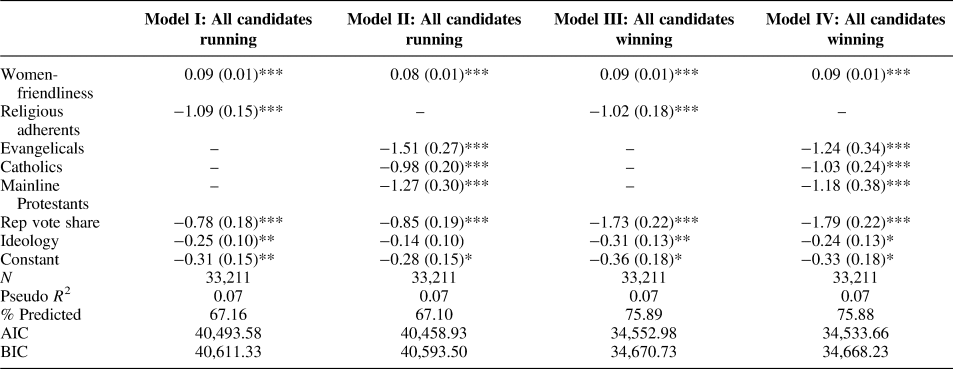
We begin our exploration with analyses that, broadly speaking, replicate Setzler's (Reference Setzler2016) study of the effect of religion in U.S. House races using state legislative data. Consistent with Setzler (Reference Setzler2016), the first column of Table 1 shows a clear, negative relationship between the percentage of religious adherents in a district and the nomination of women candidates in general election contests. Specifically, holding all other variables at their means, moving from the 10th percentile to the 90th percentile of religious adherents reduces the probability of a woman running for a state legislative seat by 8.3 percentage points (39.2 to 30.9%).Footnote 12 With more than 7,000 state legislative districts in the United States, a more than 8% reduction in the probability of women's candidacies over the range of the variable could result in as many as 600 fewer women candidates.
The effects of religious adherence and women-friendliness: women running for and winning state legislative office, 2001–2015

Note: All of the models presented above are logistic regressions with the standard errors clustered on the legislative district. Controls suppressed for presentation purposes; full models available in the Online Appendix.
*p > 0.10; **p > 0.05; ***p > 0.01, based on a two-tailed test.
Our state legislative analysis also reveals that women-friendliness also exerts a significant, positive effect on women's candidacies. Moving from the 10th percentile to the 90th percentile of women-friendliness increases the likelihood of a woman running by 16.8 percentage points (27 to 43.8%). Interestingly, the effect of women-friendliness is twice that of religion. This deviates from previous House research.
The second column of Table 1 considers the effects of denominational attachments on the nomination of women. In all cases, having more identifiers decreases the probability of a woman candidate's emergence; as hypothesized, this effect is largest among evangelical Protestants. The probability of a female candidate is reduced by 10.4 percentage points for evangelicals (39.2 to 28.8%), 8.4 percentage points for Catholics (38.7 to 30.3%) and 4.2 percentage points for mainline Protestants (36.8 to 32.7%). Moreover, as in the adherent model, women-friendliness again exerts an additional, substantively larger, effect on women's candidacies; the probability of a woman running increases by 15 percentage points (27.7 to 42.7%) over the range of the variable.
Women Winning
It is also critical to know whether women-friendliness and the percentage of religious adherents or identifiers affects the likelihood of a woman being elected.Footnote 13 The last two columns of Table 1 illustrate very similar findings to the entry models. As a district's women-friendliness increases, the likelihood of a woman's election increases, this time by 13.2 percentage points (16.9 to 30.1%). Moreover, as the percentage of religious adherents in a district increases, the likelihood of a woman being elected decreases 6 percentage points (26 to 20%). To give the reader a sense of the substantive impact of this probability change, in the average cycle, 15% of the nation's approximately 7,000 state legislative races are decided by a margin of 5 or fewer percentage points. Women run in approximately 20% of those contests, or about 200 races. Thus, a 6 percentage point change in the probability of women candidates' victory has the potential to affect the outcome of more than 200 legislative races.
Similar, albeit more nuanced, results emerge when examining denominational groups' effect on women's representation. Overall, larger populations of evangelical Protestants, Catholics, and mainline Protestants reduce the probability of a woman candidate winning. We observe the largest predicted probability changes for evangelicals (6.6 percentage points) and Catholics (6.8 percentage points) with more modest effects for mainline Protestants (3 percentage points). Once again, the effect of women-friendliness also continues to be significant and sizeable, with the likelihood of a woman being elected increasing 12.2 percentage points (17.3 to 29.5%).
Religion and Women-Friendliness
Having found substantial evidence that both religious variables and other contextual indicators affect the descriptive representation of women, we now consider whether the effects of religion vary with district-level women-friendliness or whether these indicators exert largely separate effects.Footnote 14
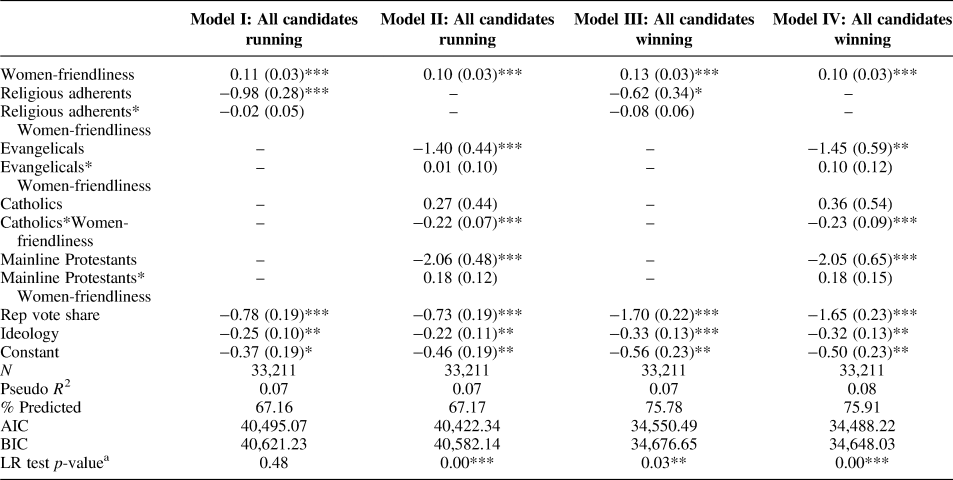
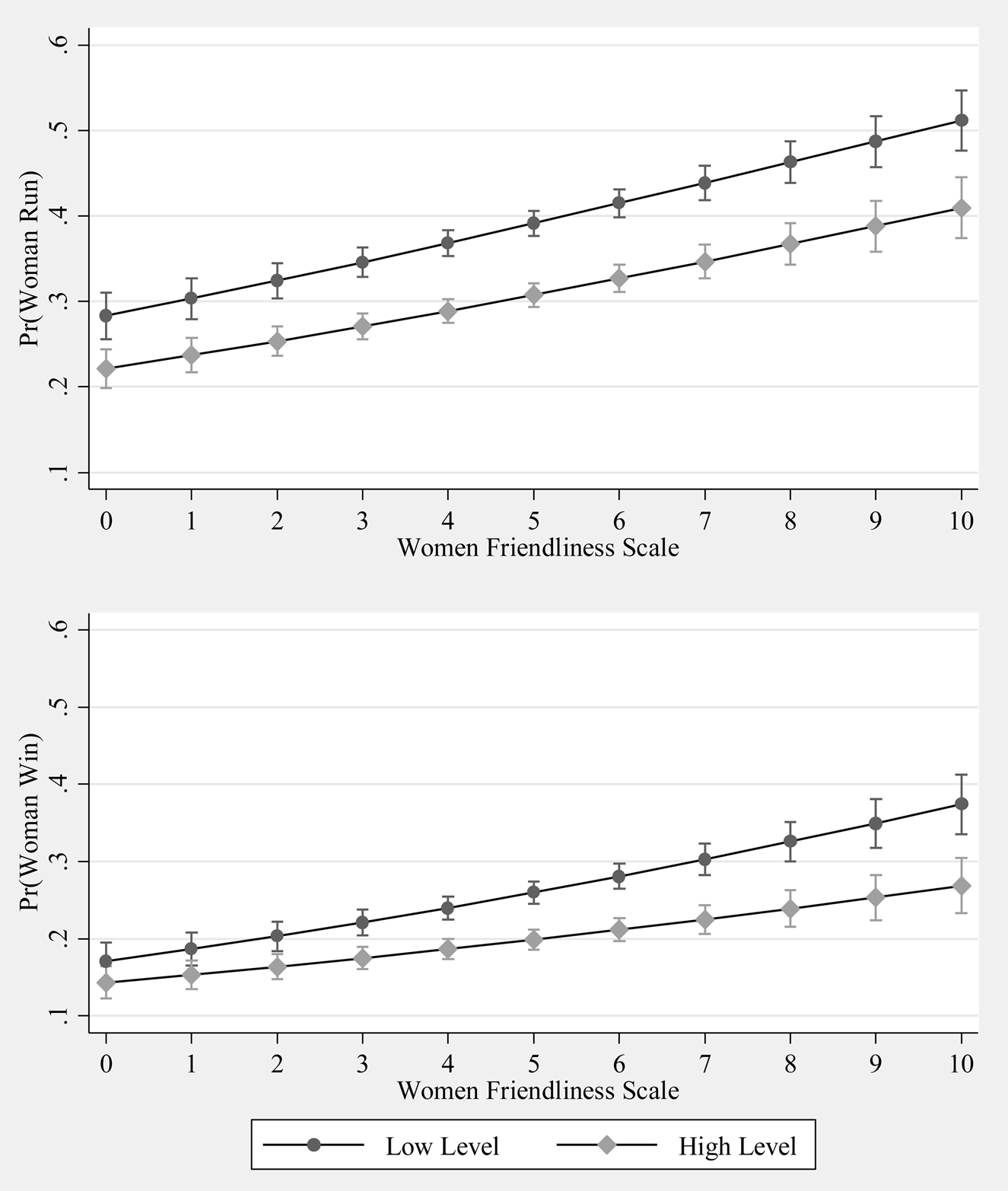
Examining the first and second columns of Table 2, for both candidate emergence and victory, we observe a negative and statistically significant effect for religious adherents. These effects are similar to those observed in Table 1, as are the positive, significant effects for women-friendliness. In short, there is no evidence of an interactive effect in either model. As shown in Figure 1, over the range of the women-friendliness scale, the difference in women candidates' emergence between districts with high and low numbers of adherents ranges from a little more than 6 percentage points to slightly more than 10 percentage points. The bottom panel shows a similar relationship for women winning, with a difference ranging from approximately 3 percentage points to 10.5 percentage points.
The effects of religious adherence and women-friendliness: women running for and winning state legislative office, 2001–2015

Note: All of the models presented above are logistic regressions with the standard errors clustered on the legislative district. Controls suppressed for presentation purposes; full models available in the Online Appendix.
a The likelihood-ratio test compares the model presented in Table 1 without the interaction to the model presented here with the interaction.
*p > 0.10; **p > 0.05; ***p > 0.01, based on a two-tailed test.
Comparison of districts with high and low levels of religious adherents by women-friendliness

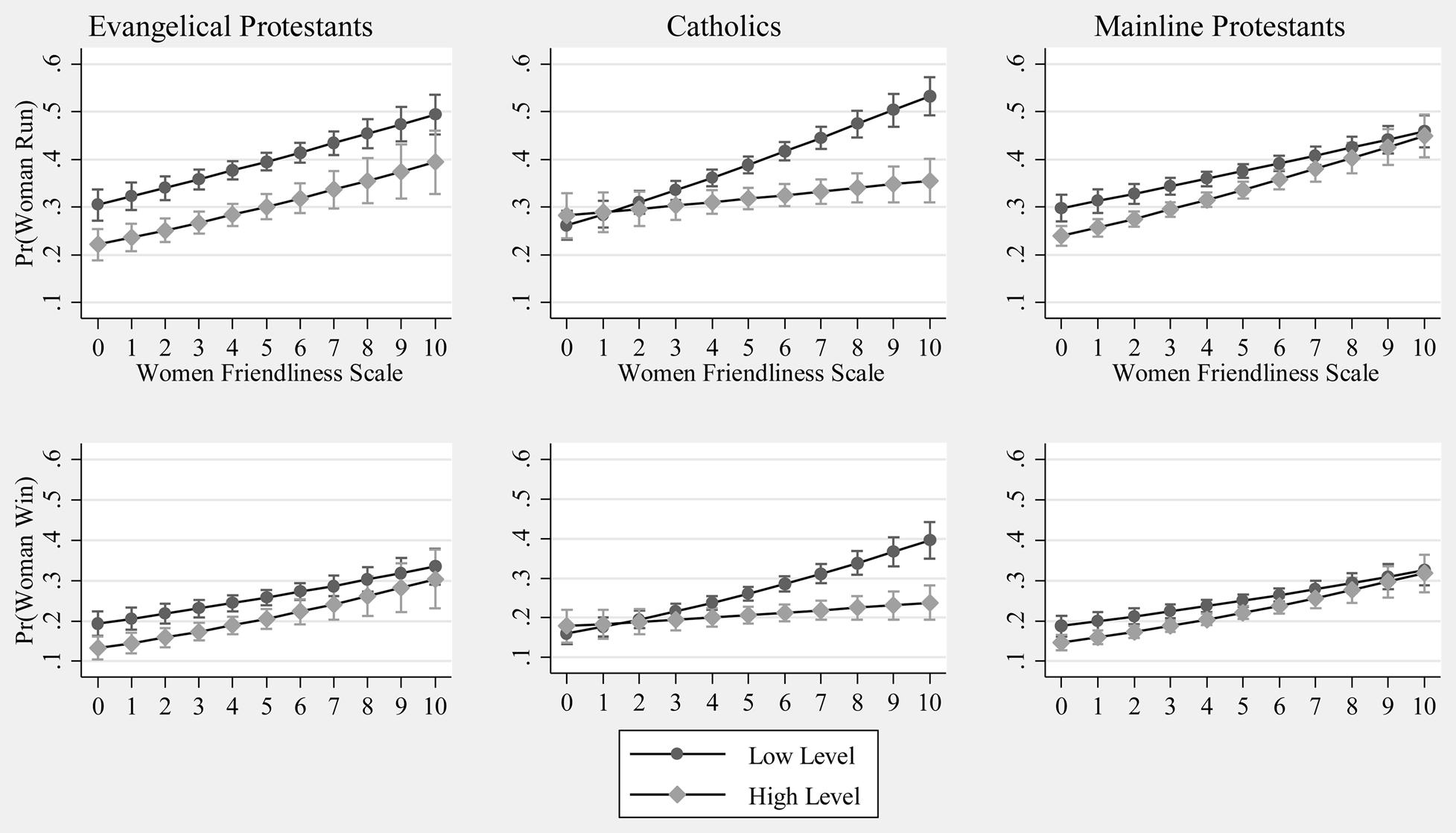
Models II and IV of Table 2 examine interactions between each of the three denominational groups and women-friendliness. The predicted probabilities are plotted in Figure 2. Of the three groups, evangelicals have the most consistently negative effect on the representation of women, regardless of the level of women-friendliness. However, there is little evidence of an interactive effect. Higher percentages of evangelicals lead to an 8 to 10 percentage point reduction in the likelihood of entry and a 3 to 6 percentage point reduction in the likelihood of victory, depending on the level of women-friendliness.
Comparison of districts with high and low levels of religious denominations by women-friendliness

We see modest evidence of an interactive effect between Catholics and district women-friendliness. Larger Catholic populations reduce the likelihood of a woman running for office or being elected by 10 percentage points or more at the highest levels of women-friendliness. But, at the lowest levels of women-friendliness, higher percentages of Catholics have no effect on the likelihood of female entry or victory.
The effect for mainline Protestants is essentially the inverse of that observed for Catholics, albeit more modest. In the most women-friendly districts, increasing the number of mainline Protestants has no effect on women candidates' entry. However, in the least women-friendly districts, more mainline Protestants reduces the likelihood of a woman running by roughly 6 percentage points and of a woman winning by roughly 4 percentage points.
Religion, Women-Friendliness, and Party
Recall that we have little reason to expect significant differences across parties.Footnote 15 Setzler (Reference Setzler2016) finds that both Democratic and Republican women were reluctant to run in highly religious, and particularly evangelical Protestant, districts. Non-interactive models of religion and women-friendliness by party echo these results for state legislatures. In these models (shown in Online Appendix Tables 2b and 2c), Democratic women were 5.8 percentage points less likely to run and 2.3 percentage points less likely to win in districts with more religious adherents. The numbers are similar for Republicans, with more adherents leading to 4.3 and 3.2 percentage point decreases in female entry and success.
These patterns generally persist in interactive models of adherents and women-friendliness by party (shown in Online Appendix Tables 5 and 6). These models show a 5 to 6 percentage point decline for Democratic women's entry in more religious districts and a 3 to 6 percentage point decline for Republican women's entry. Democratic women are 1 to 5 percentage points less likely to win; their Republican counterparts are 1 to 7 percentage points less likely to win. In short, the effect of religious adherents and district women-friendliness is relatively consistent across the two parties.
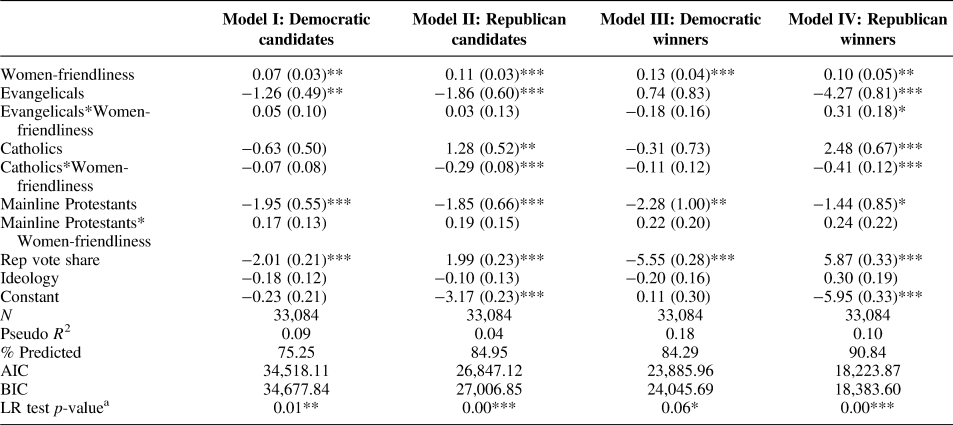
Most denominational models reveal similarly small partisan differences; we show these results in Table 3. At all levels of district women-friendliness, women of both parties are generally disadvantaged by having larger numbers of Protestants in their districts.Footnote 16 Larger numbers of evangelical Protestants reduce the likelihood of women's entry by approximately 5 percentage points for Democrats and between 5 and 7 percentage points for Republicans. The trends are similar for mainline Protestants; Democratic female candidate entry is reduced by between 1 and 4 percentage points and the effect on the probability of Republican entry ranges from no difference to a 3 percentage point reduction.
The effects of religious adherence and women-friendliness: women running for state legislative office, 2001–2015

Note: All of the models presented above are logistic regressions with the standard errors clustered on the legislative district. Controls suppressed for presentation purposes; full models available in the Online Appendix.
a The likelihood-ratio test compares the model presented with a model without the interaction (not shown).
*p > 0.10; **p > 0.05; ***p > 0.01, based on a two-tailed test.
In terms of victory, more evangelical Protestants reduces the probability of victory for Democratic women by at most 4 percentage points; these effects are comparable for Republican women—a 3 to 6 percentage point reduction. For both parties, more mainline Protestants almost always have a negative effect on women's victory. The predicted probability change is always less than 2.5 percentage points.
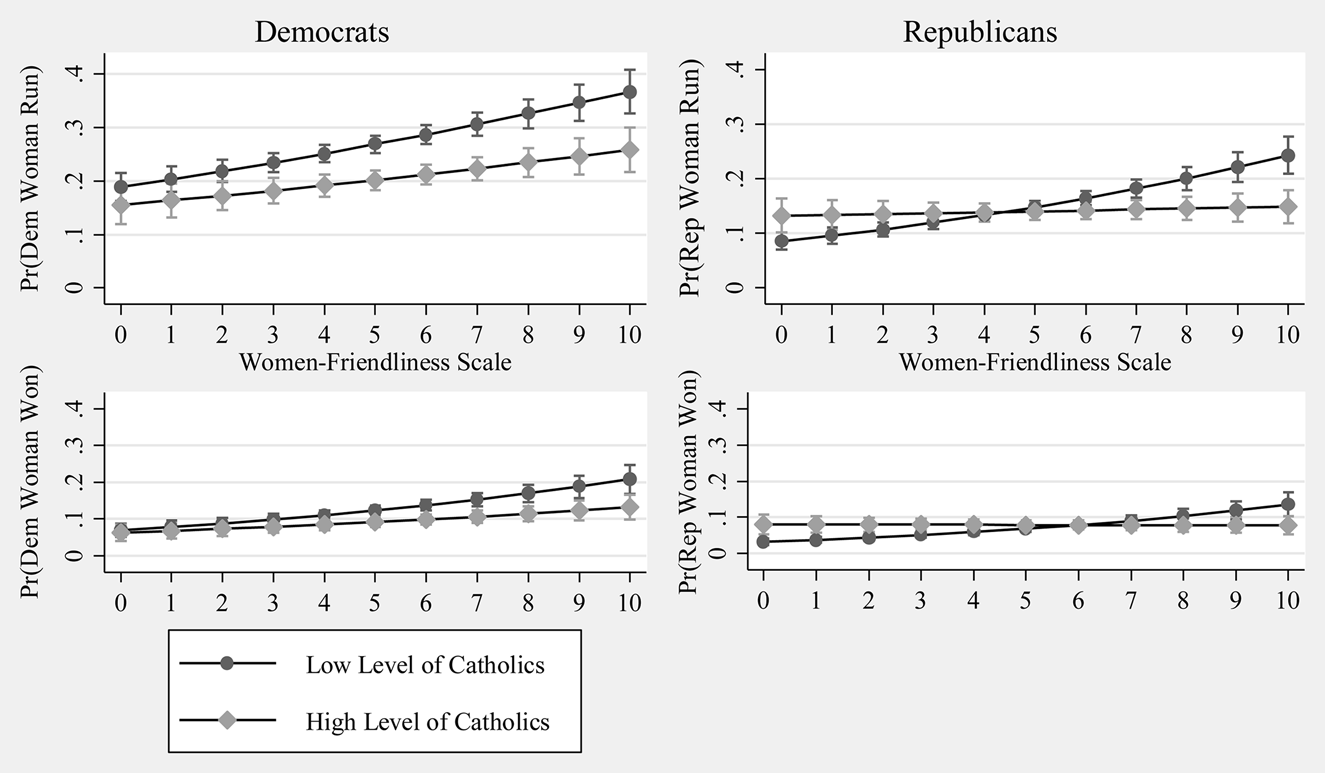
The effect of a district's Catholic population, however, varies somewhat for Democrats and Republicans. For Democratic women, the illustrations shown in the left-hand column of Figure 3 indicate that, in the most women-friendly districts, larger Catholic populations negatively affect the probability of women candidates' emergence by up to 10 percentage points. Percent Catholic has a more modest effect on emergence at lower levels of women-friendliness, reducing women's probability of entry by less than four percentage points. In considering victory, the size of a district's Catholic population reduces the likelihood of a woman winning by up to seven percentage points, but only in the most women-friendly districts. Generally speaking, then, the effect of a district's Catholics population for Democratic women is comparable to that shown in the two party models—generally negative but variable in magnitude depending on women-friendliness.
Comparison of districts with high and low levels of Catholics by women-friendliness and party

For Republican women, a larger Catholic population increases women's likelihood of running and winning by roughly 4 percentage points in the least women-friendly districts. At the highest levels of women-friendliness, however, a larger Catholic population decreases the likelihood of a Republican woman's entry by over 9 percentage points and their likelihood of victory by over 5 percentage points. These differential effects suggest that the Catholic population's effects are somewhat distinct for Republicans and Democrats and clearly differ from the effect of Protestants, both evangelical and mainline.
The differential effects of Catholic populations on the representation of women merit a more thorough investigation than we can undertake here. However, our intuition is that these findings owe to both the diversity and the rapidly changing identity of the American Catholic population, which makes them distinct from other denominational groups. While Catholics make up one-fifth of the American population, they are no longer predominantly non-Hispanic, white Northeasterners. Today's Catholics are more likely than other identifiers to be immigrants or the children of immigrants. The percentage of Americans who identify as Hispanic is growing rapidly, as are the Catholic populations in the Midwest and South (Lipka Reference Lipka2015). This creates unique contextual cross-pressures—particularly if one considers the components of the women-friendliness scale—for Catholic identifiers.
CONCLUSION AND DISCUSSION
In summary, the preceding analysis of state legislative districts illustrates the importance of both religious variables (adherents and denominational affiliation) and other contextual indicators for the emergence and success of women candidates. These results partially diverge from those found in the U.S. House of Representatives (Setzler Reference Setzler2016); in state legislatures, religious indicators are almost universally negative for the representation of women, but district women-friendliness also exerts a strong, positive effect. These effects are particularly robust in districts with high percentages of religious adherents and evangelical Protestant identifiers. Moreover, we find little evidence of interactive or partisan effects for religious adherents or Protestant identifiers; these effects are relatively stable regardless of district women-friendliness. To the extent that differences do exist, they are most visible in the analyses of Catholics.
Several theoretical concerns merit further consideration. First, while religion continues to have a consistent, negative effect on the emergence and success of women candidates, we must ask why demographic and socioeconomic factors have a more positive effect in state legislatures than in the U.S. House of Representatives. We believe this can be attributed in part to state legislative districts' insularity and smaller, less varied constituencies; in these areas, political context may influence potential candidates' assessment of their qualifications or decision to run for office more significantly. The lower levels of salience and competitiveness in these contests may also alter the dynamics of women's entry, empowering party officials, donor networks, and other recruitment structures (Sanbonmatsu Reference Sanbonmatsu2002b; Crowder-Meyer Reference Crowder-Meyer2013; Kitchens and Swers Reference Kitchens and Swers2016; Thomsen and Swers Reference Thomsen and Swers2017; Crowder-Meyer and Cooperman Reference Crowder-Meyer and Cooperman2018) shown to have systematic biases favoring male candidates. Moreover, because state legislative races are more typical of the majority of American elections, the implications of religion and other contextual indicators for the descriptive representation of women at all levels should not be overlooked.
Second, the significant variations observed by denomination are noteworthy. It is not surprising that large evangelical Protestant populations are the least favorable to women running and winning, given what we know about the gender role, trait, and issue stereotypes espoused by churches in this tradition (Setzler and Yanus Reference Setzler and Yanus2016). It is similarly unsurprising that mainline Protestant identifiers have comparatively modest effects on women candidates' emergence and victory. Our findings for Catholics, particularly in the partisan analysis, however, suggest a continued need to better understand the nuanced effects of this group's behaviors and beliefs on the representation of women. While it would premature at this stage to offer any definitive conclusions, it seems that clear that the diversity of the changing American Catholic population introduces an additional layer of complexity that merits further investigation.
Finally, the analyses presented here largely illustrate an absence of significant partisan differences. In other words, our findings show that the effects of context are fairly similar for women of both parties. This lends further credence to Setzler's (Reference Setzler2016) intuition that these similarities may be the result of prior selection effects that narrow the pool of possible candidates on the ballot in November. In other words, it is possible—and perhaps likely—that qualified women candidates are not recruited or actively discouraged from running in primary contests in these districts. Future empirical analyses of primary elections are necessary to consider this possibility. Further analysis is also needed to examine the direct and indirect effects of religious groups' attempts to recruit candidates for office. Especially at lower levels of government, these groups can play an integral role in candidate recruitment.
In addition, this study presents several additional empirical implications for future analyses of the descriptive representation of women in American politics. First, our results underscore the importance of including measures of religion in empirical models of gender and representation. Rates of adherence and denominational affiliation clearly have powerful, independent effects that have been absent from most published studies on this question. Including these indicators would help researchers to better understand the influence of religious and non-religious determinants of gender bias.
As important, our results also suggest that demographic and socioeconomic context continue to play important roles in explaining women candidates' emergence and success. Despite scholars reluctance to utilize omnibus measures of women-friendliness (but see Ondercin and Welch Reference Ondercin and Welch2009; MacDonald and O'Brien Reference MacDonald and O'Brien2010; Fulton Reference Fulton2012; Pyeatt and Yanus Reference Pyeatt and Yanus2016; Setzler Reference Setzler2016), it is clear that this indicator is a parsimonious measure of a number of theoretically important factors affecting women's representation. Thus, we encourage scholars not to throw the baby out with the bathwater, and to consider reimagining a measure of women-friendliness rather than discarding it entirely.
We also encourage future scholars to pursue additional qualitative and quantitative analyses of the effect of religious identities and political context on women's interest in running for office, recruitment as candidates by parties and outside groups, and rates of victory in primary elections. Studies such as these may shed greater light on how contextual indicators of all kinds shape women's self-assessments of their qualifications to run for office, political ambition, and willingness to enter politics at all levels.
Supplementary material
The supplementary material for this article can be found at https://doi.org/10.1017/S1755048319000476.