

Introduction
Post-exercise systolic blood pressure recovery (SBPR) is an expression of the rate of systolic blood pressure (SBP) decline after peak exercise and is identified as an indicator of how the cardiovascular and autonomic nervous systems respond to physical stressReference Fletcher, Balady, Amsterdam, Chaitman, Robert and Jerome1. An abnormal or delayed SBPR is defined as the ratio of the third-minute SBP recovery to 1 min SBP recovery greater than 1.0Reference McHam, Marwick, Pashkow and Lauer2 and associated with increased systemic vascular resistanceReference Kurl, Laukkanen, Rauramaa, Lakka, Sivenius and Salonen3, Reference Laukkanen, Kurl, Salonen, Lakka, Rauramaa and Salonen4, sympathetic overactivity and attenuated parasympathetic reactivationReference Laukkanen, Kurl, Salonen, Lakka, Rauramaa and Salonen4, Reference Taylor and Beller5. It is also reported that delayed SBPR is a marker of autonomic dysfunction and vasoactivity abnormalitiesReference Singh, Larson, Manolio, O'Donnell, Lauer and Evans6, and related to increased risk of coronary diseasesReference Amon, Richard and Crawford7, Reference Acanfora, De Caprio, Cuomo, Papa, Ferrara and Leosco8, strokeReference Laukkanen, Kurl, Salonen, Lakka, Rauramaa and Salonen4, hypertensionReference Singh, Larson, Manolio, O'Donnell, Lauer and Evans6 and acute myocardial infarctionReference Taylor and Beller5.
Previous studies have demonstrated that obesity is associated with cardiovascular risk factors such as hypertension, diabetes, hyperlipidaemia and increased sympathetic overactivityReference Kannel, Cupples, Ramaswami, Stokes, Kreger and Higgins9–Reference Landsberg, Saville and Young11. The relationship between SBPR and adiposity level is not well documented. It is also not known whether the incidence and risk of delayed SBPR are associated with changes in body weight and whether it is a modifiable risk factor. Different obesity parameters such as body mass index (BMI), waist circumference (WC), waist-to-hip ratio (WHR) and waist-to-height ratio (WHtR) are currently used to differentiate between normal weight, overweight and obese subjects. These obesity indices have been identified as very important anthropometric variables and good predictors of cardiovascular risks and diseasesReference Mykkanen, Laasko and Pyorala12–Reference Ho, Lam and Janus17. We have previously demonstrated independent associations between SBPR and BMI in men and WC in women in non-obese individualsReference Dimkpa and Ugwu18, but not in overweight and obese individuals. Furthermore, it has not been demonstrated which of the four anthropometric variables has the strongest relationship with SBPR in adults. This information is of importance considering the increased cardiovascular risk in the obese population. A relationship between increased risk of delayed SBPR with increased adiposity calls for increased measures for weight reduction in the adult population and reduction of its life-threatening consequences. Similarly, the determination of the best obesity index that may predict changes in SBPR will facilitate decisions on whether SBPR is a modifiable risk factor.
The present study, therefore, aimed to determine (a) the incidence of abnormal or delayed SBPR in relation to the level of adiposity in the study population, (b) the risk of delayed SBPR in overweight/obese adults relative to their non-overweight/obese controls and (c) the best predictor of the third-minute SBP ratio and delayed SBPR among the four obesity indices. We, therefore, hypothesized that (a) the incidence of abnormal or delayed SBPR would be higher in the overweight/obese individuals than their non-overweight/obese controls, (b) the overweight/obese individuals would be at a higher risk of experiencing delayed SBPR than the non-overweight/obese controls and (c) general obesity index (BMI) in men and central obesity indices (WC, WHR or WHtR) in women would indicate the strongest associations with the third-minute SBP ratio and delayed SBPR, respectively.
Methods
Subjects
A total of 520 adults randomly selected from the students and members of staff of Igbinedion University, Okada, and residents of Okada town in Edo State, Nigeria, accepted the invitation to participate in the study. We administered structured health and lifestyle screening questionnaires to the subjects to gather information on the subjects' medical history, physical activity status and whether they smoke or take medications that affect cardiovascular function. Subjects were also invited to undergo physical examination, resting blood pressure (BP) and heart rate measurements, and to perform a vigorous cycle ergometer exercise intensity test of 75–85% of age-predicted maximum heart rate (HRmax). These measurements and tests were conducted by experienced personnel under the supervision of an experienced physician. Subjects were excluded if they were hypertensive or had a history of unstable cardiovascular, peripheral vascular or respiratory disease, a malignancy, or orthopaedic or musculoskeletal lesions. Other exclusion criteria were smoking history, alcoholic disease, diabetes, taking medications that could affect cardiovascular function and inability to achieve an exercise intensity test of 75–85% of age-predicted HRmax.
Physical activity status of all subjects was evaluated using the international physical activity questionnaire (IPAQ) for young and middle-aged adultsReference Booth19. The IPAQ comprises a set of four questionnaires that are used to assess the physical behaviours of participants at different times and places and the time spent being physically active in the previous 7 days. The reliability and validity of IPAQ have been tested, and the results suggest that it is an acceptable measure of physical activity in young adultsReference Booth19. Based on the IPAQ scores, subjects were classified as either inactive, moderately active or highly active. These scores were recorded in metabolic equivalents min week− 1. The study population included subjects who were moderately and highly active. Of the 520 subjects selected, 332 subjects aged 18–48 years were eligible for the study. This population included 164 males and 168 females. Subjects were informed (written and oral) of the experimental procedures, and their consent was obtained before participation. The investigation conforms to the principles outlined in the Declaration of Helsinki. The Experiments and Ethics Committee of the College of Health Sciences of the University approved the study.
Anthropometric measurements
The subject's height was measured to the nearest 0.1 cm, and weight was measured to the nearest 0.1 kg in light clothing without shoes. BMI was calculated as weight (kg) divided by the square of the height (m2). Waist and hip circumferences were measured twice to the nearest 0.1 cm, and the mean was used for subsequent analysis. WC was measured halfway between the top of the iliac crest and the lower rib margin, while the hip circumference was measured at the level of the greater trochanters. WHR and WHtR were then calculated.
Exercise test
Subjects made a total of three visits for the exercise test; the first visit was 1 week before the experimental test to ascertain eligibility for the study; those who could not achieve 75–85% HRmax intensity were excluded from the study. The second and third visits were during the experimental and repeat tests. Before the exercise test, the age-predicted HRmax of each subject was determined asReference Tanaka, Monahan and Seals20 HRmax = 208 − (0.7 × age).
Each subject performed a symptom-limited, cycle ergometer exercise test of intensity targeted at 80% of their age-predicted HRmax. The exercise tests were carried out between 08.00 and 11.00 hours in a well-ventilated room, using a mechanically braked cycle ergometer (Homeware Ltd, North York, ON, Canada). Participants were instructed not to take coffee, eat a heavy meal or participate in any vigorous physical activity for 24 h prior to the test and not to consume beverages containing alcohol for 2–3 days prior to the exercise test. They were also properly instructed on how to perform the exercise test, with demonstrations. The testing protocol comprised an initial 2 min warm-up of exercise at a workload of 20 W, followed by a step-by-step increase in workload by 20 W every minute until the subject reached the targeted percentage of age-predicted HRmax. The rating of perceived exertion to exercise was obtained using Borg's scaleReference Borg21 immediately after the exercise protocol through oral questionnaires, and this correlated with the intensity of exercise achieved by subjects. The most common reasons for stopping the exercise test were leg fatigue (n = 12), exhaustion (n = 18), breathlessness (n = 4) and dizziness (n = 2), irrespective of age or gender. These subjects (12 men and 24 women) were excluded from the study since they could not complete the exercise protocol. An experienced physician supervised the entire exercise test.
Blood pressure and heart rate measurements
The measurements of BP and HR were performed by experienced research personnel and with the use of a standard mercury column sphygmomanometer and an Omron electronic monitor (HEM-712C; Omron Health Case, Inc., Vernon Hills, IL, USA), respectively. Resting BP and HR were measured after 10 and 15 min of rest in a seated position in a quiet room. These measurements were obtained 1 week before the exercise test in order to ascertain whether a subject had normal BP and HR. Those who were hypertensive (systolic/diastolic BP ≥ 140/90 mmHg) and those who indicated tachycardia (resting HR ≥ 95th percentile) were excluded from the study. Before each day's exercise test, each subject's pre-exercise BP and HR were also measured twice (after 10 and 15 min of rest) when sitting on the cycle ergometer. During the exercise, BP was measured at 2 min intervals and during the last minute of exercise, as soon as the subject reached the targeted percentage of age-predicted HRmax. The peak exercise BP was defined as the final values measured at the termination of the exercise. HR during exercise was measured every minute until the subject attained the targeted 80% HRmax intensity. The workload and the cycling speed were kept steady at the point when the subject reached the targeted HRmax, until the final exercise blood pressure measurement was completed. The final HR values measured at the termination of the exercise were recorded as the maximal HR. Further measurements of post-exercise BP were done immediately after exercise (within the first minute) and subsequently at 2 min intervals until recovery of BP to pre-exercise level (i.e. measurements were done at 1, 3, 5 and 7 min). During the post-exercise BP measurements, subjects were asked to adopt a sitting position on the bicycle without pedalling, while the research personnel was blinded to the test results at baseline and during exercise. Each of these measurements was repeated for the subjects, under the same experimental conditions, on a separate day, and the mean of the values obtained from the 2 days' tests was used as the experimental value. Furthermore, for consistency, the BP measurements for each subject during the study were handled by the same research personnel.
We evaluated SBPR using the third-minute SBP ratio relative to 1 minute SBP recovery, which is expressed as post-exercise SBP at 3 min divided by post-exercise SBP at 1 minReference McHam, Marwick, Pashkow and Lauer2. This ratio was used because of its advantage in accuracy of BP measurementReference McHam, Marwick, Pashkow and Lauer2, since both SBPs can be obtained only in the recovery state. Furthermore, the SBPs at 1 and 3 min of recovery were available to all subjects. Abnormal or delayed SBPR was defined as the third-minute SBP ratio value greater than 1.0Reference McHam, Marwick, Pashkow and Lauer2.
Subject classification
For the purpose of the present study, subjects' adiposity levels were classified into two groups by BMI (non-overweight/obese group, 18.5–24.9 kg/m2; and overweight/obese group, ≥ 25 kg/m2).
Statistical analysis
Data are presented as means ± SD. Characteristics of study participants were compared between men and women using an independent sample t-test. Multiple linear regression analysis was performed to calculate age-adjusted coefficients between each obesity index and the third-minute SBP ratio. The third-minute SBP ratio was entered as the dependent variable, while age, BMI, WC, WHR and WHtR were entered as the independent variables in the regression model. The t-statistics was used to compare the strength of relationships. Age-adjusted Pearson's partial correlation analysis was used to determine the relationship between physical activity and SBPR and BMI. The risk of delayed SBPR in the overweight/obese individuals relative to their non-overweight/obese controls was estimated using age-adjusted logistic regression analysis. The exposure variable, overweight/obesity, was coded as 1 for yes and 0 for no, and the outcome variable, delayed SBPR, was coded as 1 for yes and 0 for no, in a logistic regression model. The strength and independence of association between obesity indices and the incidence of delayed SBPR were determined using logistic regression analysis. The principle outcome, delayed SBPR, was coded as yes/no. Each of the obesity indices was entered as a continuous variable and assessed separately by means of unadjusted and age-adjusted analyses. Statistical significance was set at P < 0.05. All statistics were done using SPSS for Windows (Version 16.0; SPSS, Inc., Chicago, IL, USA).
Results
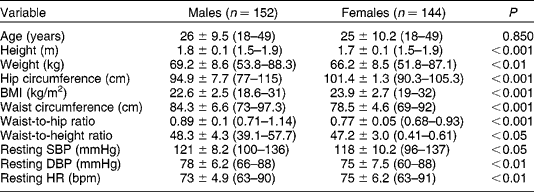
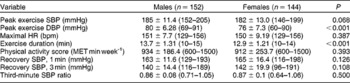
Of the 332 subjects eligible for the study, 36 subjects were excluded because they could not complete the exercise protocol due to cardiorespiratory symptoms necessitating termination of the test. Our data analysis, therefore, included data from 296 subjects (152 men and 144 women) who completed the exercise protocol. The baseline and exercise and post-exercise characteristics of subjects are presented in Tables 1 and 2. The mean age for men was 26 ± 9.5 years, while that of females was 25 ± 10.2 years. Men evidenced higher WC, WHR, WHtR, resting SBP, resting diastolic blood pressure (DBP), peak exercise DBP and exercise duration than the women (P < 0.05 or 0.001); women on the other hand evidenced higher BMI and resting HR than the men (P < 0.001; P < 0.01). Physical activity score, peak exercise SBP, maximal HR, recovery SBP in 1 min, recovery SBP in 3 min and the third-minute SBP ratio indicated no significant differences between the genders.
Baseline characteristics of subjectsi
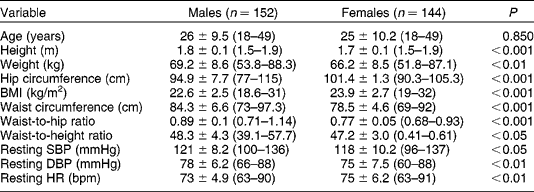
BMI, body mass index; SBP, systolic blood pressure; DBP, diastolic blood pressure; HR, heart rate; bpm, beats per minute.
i Data are represented as means ± SD (range).
Exercise and post-exercise characteristics of subjectsi

SBP, systolic blood pressure; DBP, diastolic blood pressure; HR, heart rate; bpm, beats per minute; MET, metabolic equivalents.
i Data are represented as means ± SD (range).
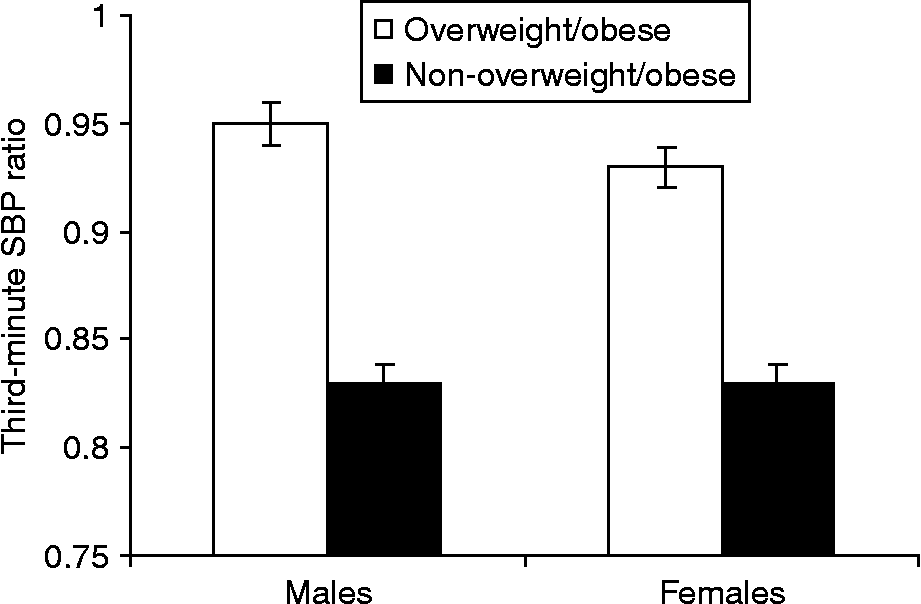
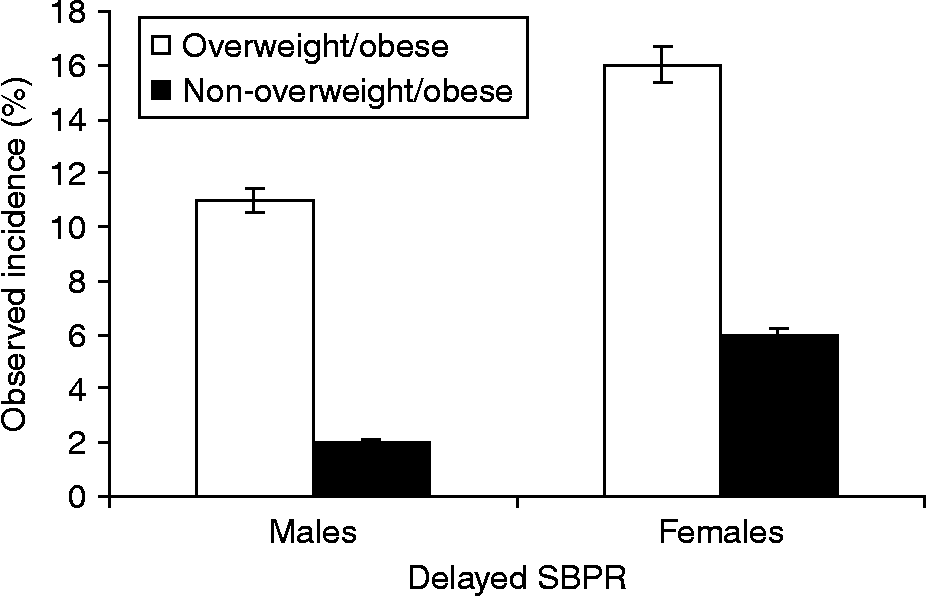
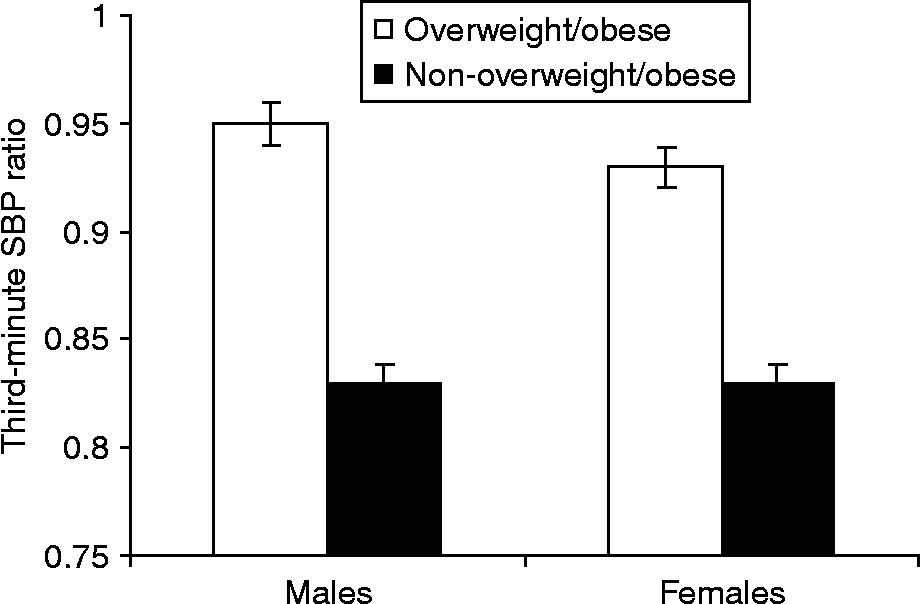
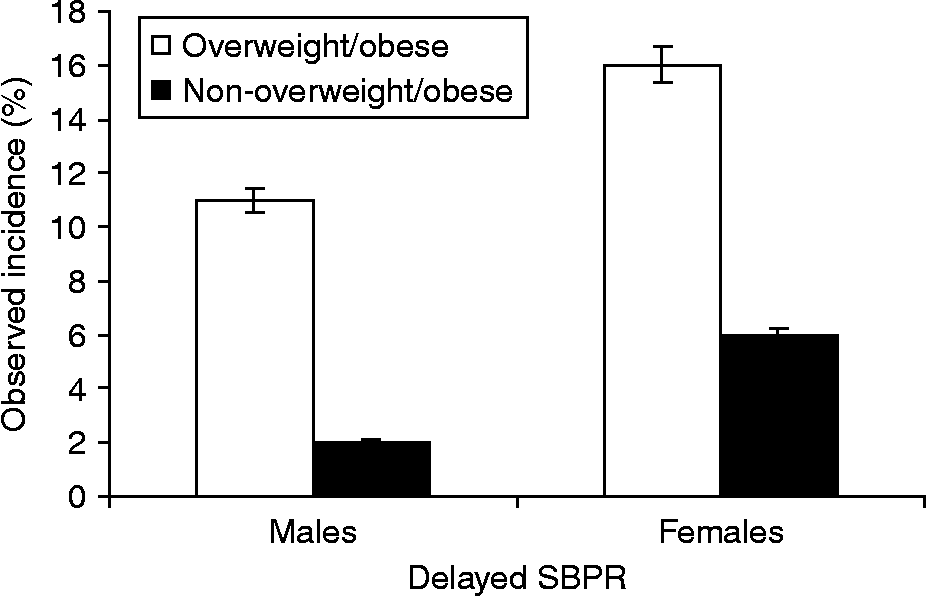
The distribution of the third-minute SBP ratio in the overweight/obese group and their non-overweight/obese controls for both men and women is shown in Fig. 1. The third-minute SBP ratio was significantly (P < 0.001) greater in the overweight/obese group (men, 0.95; women, 0.93) than that in the non-overweight/obese group (men, 0.83; women, 0.83). The observed incidence of delayed SBPR in relation to the degree of adiposity in both males and females is shown in Fig. 2. Our data indicate that the overweight/obese group (men, 11%; women, 16%) evidenced a higher incidence of delayed SBPR than that in the non-overweight/obese group (men, 2%; women, 6%). Furthermore, the age-adjusted odds ratio of the incidence of delayed SBPR from overweight and obesity is shown in Table 3. Overweight/obese men and women indicated higher risks (OR 14.3, 95% CI 3.47–59.03 and OR 5.7, 95% CI 2.23–14.78, respectively) of delayed SBPR than those in the non-overweight/obese controls.
Mean third-minute systolic blood pressure (SBP) ratio for both the overweight/obese and the non-overweight/obese men and women
Observed incidence of delayed systolic blood pressure recovery (SBPR) in relation to body weight in men and women
Age-adjusted risk of the incidence of delayed systolic blood pressure recovery (SBPR) from the overweight/obese state relative to the non-overweight/obese state

OR, Odds ratio; CI, confidence intervals.
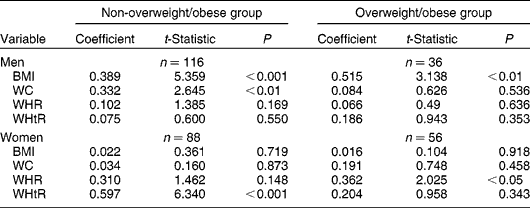
Multiple linear regression analysis was performed to assess age-adjusted influence of each obesity index on the third-minute SBP ratio (Table 4). The t-statistics showed that of the four variables, BMI had the strongest associations with the third-minute SBP ratio in both the non-overweight/obese and the overweight/obese men (t-statistics 5.36, P < 0.001 and 3.14, P < 0.01). In women, WHtR in the non-overweight/obese group (t-statistics 6.34, P < 0.001) and WHR in the overweight/obese group (t-statistics 2.02, P < 0.05) indicated the strongest associations with the third-minute SBP ratio.
Age-adjusted association between each obesity indices and the third-minute systolic blood pressure ratio
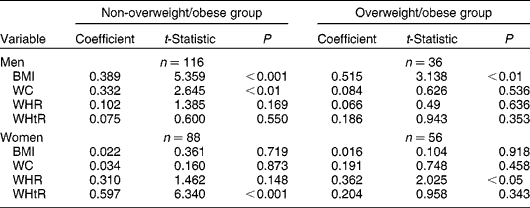
BMI, body mass index; WC, waist circumference; WHR, waist-to-hip ratio; WHtR, waist-to-height ratio.
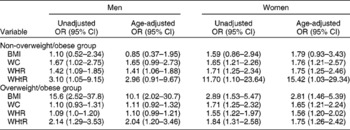
Logistic regression was used to assess the association of each obesity variable with delayed SBPR. Unadjusted logistic regression analysis indicted that BMI, WC, WHR and WHtR were associated with the risk of delayed SBPR in both men and women for all groups (Table 5). After adjusting for age, the association with increased odds of delayed SBPR persisted for all the obesity variables except for BMI in the non-overweight/obese group. Of the four variables, WHtR indicated the strongest associations with increased risk of delayed SBPR in the non-overweight/obese men and women (OR 2.96, 95% CI 0.91–9.67 and OR 15.42, 95% CI 2.03–39.34), respectively. On the other hand, BMI had the strongest relationship with delayed SBPR in the overweight/obese men and women (OR 10.07, 95% CI 2.02–30.71 and OR 2.81, 95% CI 1.46–5.39), respectively.
Unadjusted and age-adjusted odds ratio (OR) for delayed systolic blood pressure recovery associated with each obesity index

BMI, body mass index; WC, waist circumference; WHR, waist-to-hip ratio; WHtR, waist-to-height ratio.
Additionally, we performed an age-adjusted partial correlation analysis relating physical activity status of subjects with SBPR and BMI. Our data revealed that the physical activity status of subjects independently and negatively associated with SBPR (P < 0.001) and BMI (P < 0.01 or 0.001) in both the overweight/obese and non-overweight/obese groups for men and women (Table 6).
Age-adjusted partial correlation between physical activity status of subjects and systolic blood pressure recovery (SBPR) and body mass index (BMI)

i Values were represented as coefficient R (R 2; P value).
Discussion
Post-exercise SBP recovery has not been previously compared between normal and abnormal body weights. Similarly, the incidence of delayed post-exercise SBPR in relation to body weight has not been previously studied. The present study indicated that the third-minute SBP ratio was significantly higher in the overweight/obese group than that in the non-overweight/obese controls (Fig. 1). This was indicative of faster SBP recovery in the non-overweight/obese subjects than that in the overweight/obese subjects. Our data also indicate that the incidence of delayed or blunted SBPR was higher in the overweight/obese group than that in the non-overweight/obese group (Fig. 2). Furthermore, we observed that the overweight/obese men and women were 14 and 3.5 times likely to experience blunted SBPR than their non-overweight/obese controls, respectively (Table 3). These data may be of importance since CVDs are major complications of delayed SBP recovery as well as obesity.
The mechanisms responsible for the present results are not well understood. However, it is thought that changes in autonomic nervous system activities and physical activity status of subjects may explain the present findings. For example, a delay in the rate of SBP decline from dynamic exercise has been previously associated with an increase in sympathetic activity and attenuated parasympathetic reactivationReference Kurl, Laukkanen, Rauramaa, Lakka, Sivenius and Salonen3, Reference Laukkanen, Kurl, Salonen, Lakka, Rauramaa and Salonen4. Some studies have also suggested that overeating and subsequent weight gain are associated with sympathetic overactivityReference Landsberg, Saville and Young11, Reference Palatini22, whereas others have shown that sympathetic overactivity might lead to excess weightReference Sorof, Poffenbarger, Franco, Benard and Portman23, Reference Masuo, Mikami, Itoh, Ogihara and Tuck24. Furthermore, a faster rate of SBPR has been previously associated with an increase in aerobic capacity and fitnessReference Laukkanen, Kurl, Salonen, Lakka, Rauramaa and Salonen4. A reduction in body weight has also been shown to improve autonomic activitiesReference Rissanen, Franssila-Kallunki and Rissanen25, Reference Laaksonen, Laitinen, Schonberg, Rissanen and Niskanen26 and an array of established cardiovascular risk markers, including fasting glucose levels, insulin resistance, hypertension and hypercholesterolaemiaReference Pasanisi, Contaldo, de Simone and Mancini27. In the present study, we demonstrated that increased physical activity status was independently related to faster SBPR and decrease in body weight (as expressed in BMI). The present study, therefore, calls for the need to adopt preventive measures such as increased healthy physical activities to curb obesity and reduce the incidence of delayed SBPR, thus avoiding the associated life-threatening consequences.
The independent relationship between obesity indices such as BMI and WC and SBPR has been demonstrated in non-overweight/obese males and females, respectivelyReference Ho, Lam and Janus17, but not in overweight and obese individuals. In addition, it is not known which obesity index best predicts delayed SBPR in adults. In the present study, we demonstrated the strength of association between each obesity index and SBP ratio and delayed SBPR in both the non-overweight/obese and the overweight/obese individuals. BMI indicated the strongest association with the third-minute SBP ratio in both the non-overweight/obese and overweight/obese males, and agrees with the results of a previous studyReference Ho, Lam and Janus17. In females, WHtR in the non-overweight/obese subjects and WHR in the overweight/obese group had the strongest associations with the third-minute SBP ratio. These data agree with previous reports which have shown that central obesity is more strongly associated with cardiovascular risks than general obesity in womenReference Ho, Chen, Woo, Leung, Lam and Janus28, Reference Mueller, Wear, Hanis, Emerson, Barton and Hewett-Emmett29, while general obesity indicates a stronger relationship with cardiovascular risks in men than in womenReference Ho, Chen, Woo, Leung, Lam and Janus28. Our data further indicated that, among the four obesity indices, WHtR in the non-overweight/obese group and BMI in the overweight/obese individuals were the best predictors of delayed SBPR. These findings strengthen the previous reports on the importance of these obesity variables (BMI, WHR and WHtR) in predicting cardiovascular risks30–Reference Sakurai, Miura, Takamura, Ota, Ishizaki and Morikawa35 and may suggest that delayed SBPR could be a modifiable cardiovascular risk factor.
In addition, our data, which showed WHtR as one of the best predictors of SBPR, suggest that taking height into consideration might improve the screening of cardiovascular risk markers based on WC. This will be especially important in the estimation of central obesity in individuals at the extremes of height distribution. Previous reports have shown that basing central obesity estimation solely on WC, independent of the presence of visceral fat, will produce higher WC values in taller as opposed to shorter womenReference Kwok, McElduff, Ashton, Lowe, Wood and Humphries36, and may pose difficulties in global screening of cardiovascular risk markers.
In conclusion, the present study demonstrated that the overweight/obese individuals evidenced slower SBP recovery and a higher risk of delayed SBPR than the non-overweight/obese individuals. Among the four anthropometric variables, BMI, a general obesity index, was the strongest predictor of the third-minute SBP ratio in both the overweight/obese and the non-overweight/obese men. On the other hand, central obesity indices (WHR and WHtR) indicated the strongest associations with the third-minute SBP ratio in the non-overweight/obese and in the overweight/obese women, respectively. Furthermore, the present findings possibly suggest that WHtR may be the best obesity variable for the prediction of abnormal post-exercise SBP response in non-obese individuals, while BMI may be most useful in predicting abnormal SBPR in the overweight/obese individuals. Our findings, therefore, may help facilitate decisions that will show abnormal or delayed SBPR as a modifiable cardiovascular risk factor. In addition, the present study suggests that a reduction in body weight through healthy physical activities such as exercise may reduce the incidence and increased risk of delayed SBPR and its associated cardiovascular risks.